Vol.7 (2017) No. 6
ISSN: 2088-5334
Optimizing Economic Load Dispatch with Renewable Energy Sources
via Differential Evolution Immunized Ant Colony Optimization
Technique
N. A. Rahmat
#, N. F. A. Aziz
#, M. H. Mansor
#, I. Musirin
* #Electrical Power Department, College of Engineering, Universiti Tenaga Nasional, Malaysia E-mail: [email protected], [email protected], [email protected]
*
Universiti Teknologi MARA (UiTM), Shah Alam, 40450, Malaysia E-mail: [email protected]
Abstract— Recently, renewable energy (RE) has become a trend in power generation. It is slowly evolving from an alternative energy
source into the main energy source. The technology is currently working as an auxiliary to the existing generators. Demands for electricity is expanding rapidly nowadays, which require generators to run near its operation limit. This activity put grieve risk to the generators. Nonetheless, the extensive analysis should be conducted upon RE integration into the existing power system. This paper assesses its economic impact on the power system. Setting up RE technology such as photovoltaic and wind turbine are costly, yet may reduce generator’s fuel cost in the long run. Thus, economic load dispatch (ELD) is conducted to compute the operating cost of power system with the integration of RE system. In this study, the operating cost represents the fuel cost of conventional fossil-fuel generators. Furthermore, a novel optimization technique namely Differential Evolution Immunized Ant Colony Optimization is proposed as the optimization engine. Comparative studies are conducted to assess the performance of the proposed approach.
Keywords— economic load dispatch (ELD); renewable energy (RE); differentia evolution immunized ant colony optimization
(DEIANT)
I. INTRODUCTION
Nowadays, renewable energy (RE) system has become one of the mainstream topics in power system studies. The rapid urbanization increases electricity demand. However, the increasing load demand forces the generators to operate up to their critical operating point. Consequently, the generators will require more fuel, which increases operating cost and emission levels. Therefore, RE system such as PV units, wind turbine, and mini-hydro generators are being integrated into the existing power system to support conventional generators. PV integration is seen as an attractive approach to reduce fuel cost, and save the environment. In order to assess its economic impact on the power system, it is crucial to conduct Economic Load Dispatch (ELD) with RE integration.
Currently, RE is considered as intermittent energy sources as most of their resources comes from solar and wind energy. The efficiency of PV units and wind turbine are uncertain; they greatly depend on the weather condition and geographical location. For example, solar energy can only be harvested efficiently in an area that regularly receives consistent sunlight. Electricity generation can be
maximized during a sunny day. Meanwhile, wind can only be farmed in the windy area. This issue causes difficulties in conducting economic dispatch with RE integration. Numerous researches on economic load dispatch have been conducted. In a study reported in [1], RE systems are considered as micro-grid in a power system, which caters for several MW of power only. The research detailed the correlation between the operating cost and the fluctuation of RE sources. The research suggested that RE can effectively support conventional generators if the weather condition is good.
A research on ELD with solar and wind power was conducted in [2], where Firefly algorithm was implemented as the optimization engine. The research has discovered that the fuel cost can be reduced through optimal load sharing among RE and conventional electric generator.
A research conducted in [4] utilized Support Vector Machine (SVM) to predict future solar irradiance. The data gathered through SVM was used to design new PV systems, as well as observing the current systems performance. The knowledge of predicting future solar irradiance
Conventionally, ELD problems were solved by using mathematical methods such as Newton-Raphson, Gauss-Seidel, fast-decoupling, gradient search, and lambda iteration. These approaches proved to be effective in solving basic ELD problem. However, the incorporation of RE in power system causes ELD problem to become sophisticated, and the conventional approach is unable to solve the problem properly. Therefore, new and unconventional approaches are introduced to solve the complex ELD problems.
Genetic algorithm (GA) is one of the widely used algorithm to solve ELD. The algorithm serves as an attractive approach to solve complex power system problem as the algorithm can easily escape local extremum, and efficiently reaches a global solution. However, GA is unsuitable for a problem with a great number of parameters; it causes GA structure to become more complex and slows down the algorithm response time [5], [6]. Problems such as ELD with RE integration might be a challenge for the algorithm.
Particle Swarm Optimization (PSO) is another widely used algorithm. PSO has been implemented into numerous optimization studies, and receive an extensive modification to suit the studies. PSO stochastic population-based algorithm was used to evaluate hybrid RE system [7], [8]. PSO is easier to develop as compared to GA. Moreover, the simplicity of its algorithm allows PSO to have shorter computation time and easy to modify [9]. Unfortunately, similar to GA, PSO may have issues when encountering a problem with many parameters, such as ELD with RE integration [9]. Nonetheless, in [10], [11], PSO was still used to optimize the sizing of PV-wind turbine hybrid system. The studies revealed that PSO successfully optimizes the complex ELD problem albeit the major drawback. Another complex ELD problem solved by using PSO is highlighted in [12]. The researcher utilized PSO to optimize the performance of multi-area economic dispatch. In the study, the system performance was indicated by the voltage index.
Other optimization-based algorithms developed to solve ELD problem include Random-drift Particle Swarm Optimization [13], Chaotic Differential Bee Colony [14], Cuckoo Optimization Algorithm [15], Oppositional Invasive Weed Optimization [16], and Kinetic Gas-molecule Algorithm [17].
In this research, photovoltaic (PV) panel represents the intermittent energy source. The computation of economic load dispatch will include photovoltaic systems. Furthermore, Differential Evolution Immunized Ant Colony Optimization (DEIANT) algorithm is utilized to optimize ELD solution. The study is conducted on IEEE 57-Bus system with seven (7) conventional generators, and two units of PV systems. Comparative studies are conducted between DEIANT, ACO, and PSO to access the performance of the proposed technique.
II. MATERIAL AND METHOD
A. Economic Load Dispatch with Intermittent Energy Source
Economic load dispatch is conducted to compute the operating cost of power system through the strategic dispatch of electricity while fulfilling load demand. In this research, economic dispatch is conducted by including photovoltaic system into the power system.
The basic economic dispatch will only consider real power generation. This research simplifies ELD problem by ignoring emission, penalty constraint, prohibited operating zone, ramp-rates, and valve-point loading effect. Economic load dispatch involves computing the suitable generation level, and the resulting operating cost. The equations are taken from [17]. The operating cost is calculated by using the following quadratic equation:
= = + + (1)
Where Ci is the fuel cost of generating Pi amount of output power. ai, bi and ci is the fuel cost coefficient for Pi. The total generated power must be equal to the summation of load demand, PD and power loss, Ploss as in Eq. (2)
= + (2)
The power loss is calculated by using Eq. (3):
= + + (3)
Where Bij, B0i, and B00 are the elements of loss coefficient matrix.The generation level is bounded by generation limits. Equation (4) represents the inequality constraint of generation limits for each unit:
≤ ≤ (4)
Where Pimin and Pimax is the minimum and maximum generation limit of unit generator i, respectively.
In this research, sunlight represents the intermittent energy source. Eq. (5) is used to calculate operating cost of PV unit:
! " = #$ %& " + #,#$ !, $− %& "
+ ),#$(%& − !, $) (5) Where Cpvi is the cost of PV, Cp,pvi is the penalty cost, and
Cr,pvi is the reserve cost. pvij is the ith PV unit during jth hour.
PVi,av is the available amount of energy of ith PV unit. The irradiance data is obtained from [3].
The objective function of this study is to minimize the operating cost of power system with an intermittent power source with the proper dispatch of load among the generators.
The total operating cost of conventional generators and PV units is calculated by combining Eq. (1) and eq. (5), which produce eq. (6):
B. Ant Colony Optimization
Ant Colony Optimization (ACO) was introduced by Marco Dorigo as reported in [18]. The researcher introduced the algorithm as a solution to solve the travelling salesman problem (TSP). TSP is a problem of determining the strategic journey of a salesman, which could reduce travelling cost and period. As the name suggests, the algorithm copies the behaviour of a colony of ant in search of food. An ant will start its journey randomly. As it moves, it lays behind a trail of scent termed as a pheromone. Fig. 1 illustrate the behaviour of ant tour [19].
Fig. 1 Nature of ants' journey
If another ant discovers the pheromone trail, it will possibly follow the trail as well. By doing so, the ant will enhance the level of pheromone laid by the initial ant. The trail with a greater amount of pheromone will be favoured by the colony, while the trail with lower pheromone level will be forgotten. This nature of ant inspires the ACO algorithm in solving TSP.
C. Differential Evolution Immunized Ant Colony Optimization
Differential Evolution Immunized Ant Colony Optimization (DEIANT) algorithm is developed to improve the performance of conventional Ant Colony Optimization (ACO). ACO is discovered to suffer stagnation and complexity issues that cause the algorithm to produce a
sub-optimal solution. In [16], conventional ACO algorithm was modified by incorporating mutation and cloning process adopted from Differential Evolution and Artificial Immune System. The pheromone-laying process was subjected to the mutation and cloning process to increase tour-variation. As reported in [16], the modification successfully overcomes ACO stagnation issue and improve its convergence rate.
DEIANT process is depicted in Fig. 2 and briefly discussed as follows:
1) Initialization: Set the number of ants and nodes. The
cloning and mutation coefficient are also initialized. DEIANT is unique, in which a small number of search ants with a small number of nodes is enough to produce a desirable solution. For DEIANT, the fewer number of ants and node will make the algorithm faster. In this research, both ant and node are set to five.
2) Ant Tour: DEIANT holds new exploration process as
compared to the classical ACO. The first node is selected heuristically. Rather than conventional probabilistic node selection of ACO, the next node in DEANT tour is selected by using permutation strategy. Mathematically, permutation process explicitly represents the random behavior of ant touring process, as shown in Fig. 3. Different ants will produce different tour. The ant that produces the shortest path (best solution) will be subjected to the cloning process.
In this research, the summation of permutation that produces the lowest number is considered as the shortest path. Eq. (7) and eq. (8) represent permutation process. The selected tour will be subjected to the cloning process.
Fig. 1 Ant tour process
-! = - , - , -/⋯ - (7)
- = - + - + -/⋯ +- (8)
Where:
n : number of nodes to be generated
n1, n2, n3,nm
: generated node
m: : mth number of node
3) Tour Cloning: The selected tour is subjected to the
cloning process. The process will replicate the selected tour depending on the initialized cloning coefficient. The cloning process compensates the small number of search agent (ant) in finding the desired path. The number of ants is reduced, but the diversity of possible solution is increased through the cloning process.
A simple representation of cloning process is as Fig. 4; the original tour will be cloned into several identical copies, called cloned tour. The cloned tour will be mutated afterward.
Fig. 2 Cloning process
4) Tour Mutation: The cloned tour will be mutated by
using Gaussian or Normal distribution. Gaussian distribution is utilized in the mutation process, represented by Eq. (9). Mutation process will alter the element of the cloned tour.
12 = 1, + 3(0, 5(1 − 1 ) ∙77 (9)
Where:
Mutation process is conducted to increase the variation of ant tour, thus increasing the variety of solution to be selected. The variation of the tour depends on the initialized mutation coefficient. The mutated tour will be called the
offspring tour, while the cloned tour will be called the parent tour.
5) Crossover: The parent and offspring tour are
combined in a single matrix. Fig. 5 represents the crossover process. The crossover process is conducted further enhance
the variation of the tour.
Fig. 3 Crossover process
6) Tour Selection: The element of the crossover-matrix
is arranged in descending order. The best element is the best solution, which will be used in computing objective function.
7) Objective Function Calculation: The best solution
will have the lowest evaporation rate. The objective function is solved by calculating the control variable, represented by eq.(10)
max max
x
d
d
x
=
⋅
(10)Where:
d : distance of ant tour dmax : maximum distance
xmax : the maximum value of x
The value of x will be taken as the multiplier to the output of the generator for ELD computation.
8) Termination: DEIANT process is terminated if either
the best solution is obtained, or the maximum iteration has been reached.
In this study, DEIANT is used to optimize the operating cost of power system with the integration of PV systems.
III. RESULTS AND DISCUSSION
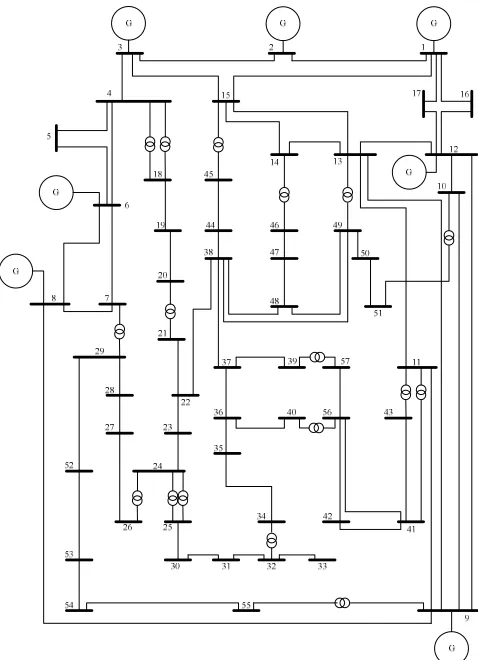
The simulations are conducted on IEEE 57-Bus system, with seven generators, fed with conventional fossil fuel. Two units of intermittent energy source are to be included as distributed generation units, which represented by photovoltaic systems. Fig. 6 illustrate IEEE 57-Bus system.
Fig. 4 IEEE 57-Bus System
Xi+m : Pheromone mutation function
Xjmin : Smallest node number
Xjmin : Largest node number
fi : Travelled distance
In order to understand the effect of RE integration to ELD, two cases of ELD are created; Two (2) cases are studied in this research; Case 1 is ELD without PV unit, and Case 2 is ELD with PV unit. Comparative studies are conducted among DEIANT, ACO, and PSO. The data of IEEE 57-Bus system and its generators limits are tabulated in Table 1 and Table 2 respectively.
TABLEI
COST COEFFICIENT OF IEEE57-BUS SYSTEM
Generators a b c
G1 400 7.0 0.0070
G2 200 10.0 0.0095
G3 220 8.5 0.0090
G4 200 11.0 0.0090
G5 240 10.5 0.0080
G6 200 12.0 0.0075
G7 180 10.0 0.0068
TABLEII
IEEE57-BUS SYSTEM GENERATOR LIMITS
Generators Minimum (MW) Maximum (MW)
G1 100 575
G2 50 100
G3 50 140
G4 50 100
G5 100 550
G6 50 100
G7 100 410
A. Case 1: ELD without PV Units
Basic ELD is conducted for the first case. The load is distributed accordingly among the available generating units. The load demand is fixed at 1273MW. Simulation results are tabulated in Table 3. Case 1 is a static study of economic dispatch. No changes or modification was introduced for this case.
TABLEIII
OPTIMIZATION OF ELD WITHOUT PVUNITS
Technique DEIANT ACO PSO
G1 (MW) 139.57 140.82 142.36
G2 (MW) 92.84 93.67 94.69
G3 (MW) 56.66 57.17 57.79
G4 (MW) 73.94 74.61 75.42
G5 (MW) 461.27 465.43 470.50
G6 (MW) 97.33 98.21 99.28
G7 (MW) 353.58 356.77 360.66
Total Cost
($/hour) 42017.46 42395.62 42857.81
Total Loss
(MW) 2.19 13.67 27.69
The results tabulated in Table 3 reflect the effectiveness of DEIANT in solving ELD. The algorithm computed lower total cost (42017.46 $/hour), as compared to ACO and PSO. This indicates that DEIANT successfully achieves its
objective function, which is minimizing the cost. The algorithm achieves its objective function by strategically dispatch load among the generators, which eventually results in lower power loss (2.19MW) as compared to ACO and PSO. In this study, the total cost represents the fuel cost of the fossil fuel generator. Without the integration of PV, the load demand is only distributed among the available conventional generators. Each generator operates within its operating limits. In this case study, the total operating cost is affected by the amount of fuel consumption of each generator; the amount of fuel and its respective cost is directly proportional to the level of generation. Overall, DEIANT solves the problem as regular ELD problem.
B. Case 2: ELD PV Units
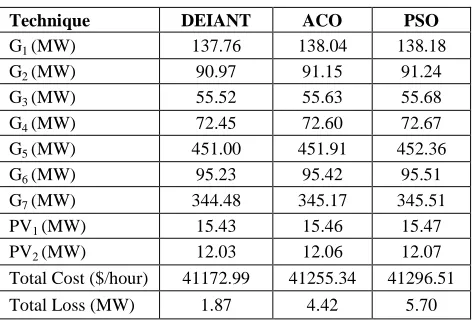
For case 2, two units of PV are now incorporated in ELD computation. The loads are distributed among PV and the conventional generators. The aim is to redistribute the load among the generators, which eventually reduce the operating cost, assuming that operating cost is directly proportional to fuel cost. Thus, for this case, the start-up cost of PV is not included in the operating cost. Furthermore, in this study, solar irradiance level is considered peak. The optimization results are tabulated in Table 4.
According to Table 4, DEIANT computed lower total cost (41172.99 $/hour), and lower power loss (1.87 MW), as compared to ACO and PSO. This indicates the effectiveness of DEIANT in solving ELD with PV integrations. The operating cost in Case 2 is significantly lower than the operating cost in Case 1. After PV units are installed into the grid, load demand is re-dispatched among the available generators and the PV units. Now, the PV units and the existing conventional generators supply the loads concurrently. The conventional generators are now running at a lower operating level as compared to Case 1; PV units supports the operation of the conventional generators. Consequently, the conventional generators will be running at the lower operating level and consumed less fuel. Reduced fuel consumption helps to reduce the operating cost of the 57-Bus system. As computed by DEIANT, the operating cost for Case 2 (41172.99 $/hour) is significantly lower than Case 1 (42017.46 $/hour). Therefore, in the long run, PV installation helps to reduce the operating cost of a power system.
TABLEIV
OPTIMIZATION OF ELD WITH PVUNITS
Technique DEIANT ACO PSO
G1 (MW) 137.76 138.04 138.18
G2 (MW) 90.97 91.15 91.24
G3 (MW) 55.52 55.63 55.68
G4 (MW) 72.45 72.60 72.67
G5 (MW) 451.00 451.91 452.36
G6 (MW) 95.23 95.42 95.51
G7 (MW) 344.48 345.17 345.51
PV1 (MW) 15.43 15.46 15.47
PV2 (MW) 12.03 12.06 12.07
Total Cost ($/hour) 41172.99 41255.34 41296.51
It is also noted in Table 4 that DEIANT computed lower power loss (1.87MV) as compared to ACO and PSO. Lowered power loss marks the efficiency of the power system in fulfilling load demand. As computed by DEIANT, the power loss for Case 2 (1.87MW) is significantly lower than Case 1 (2.19MW). Thus, results in Table 4 indicates the effectiveness of PV installations for improving the efficiency of power generation and distribution. Furthermore, lower power loss also indicates the effectiveness of DEIANT in solving ELD with PV units, as compared to ACO and PSO.
IV. CONCLUSION
In conclusion, DEIANT successfully optimizes ELD with photovoltaic integration. The algorithm computes lower operating cost, and lower power loss, as compared to ACO and PSO technique. The study also proves that DEIANT is capable of solving complex ELD problem. Moreover, PV integration significantly reduce fuel cost, as the technology will support the operation of existing conventional generators.
For future study, it is recommended to conduct a dynamic analysis of economic dispatch with intermittent energy sources. Climatic changes, dynamic load demand, and fluctuation of fuel prices need to be considered in order to improve the accuracy of the conducted study. Moreover, the optimization algorithm can be further modified to improve its performance. It is also suggested that comparative studies be conducted among hybrid or modified optimization techniques.
ACKNOWLEDGMENT
This paper is based on work supported by Universiti Tenaga Nasional (UNITEN) under ETA training program scheme. Any opinions, findings and conclusion or recommendation expressed in this paper are those of the authors and do not necessarily reflect those of the institution.
REFERENCES
[1] N. Augustine, S. Suresh, P. Moghe, and K. Sheikh, "Economic dispatch for a microgrid considering renewable energy cost functions," in Innovative Smart Grid Technologies (ISGT), 2012 IEEE PES, 2012, pp. 1-7.
[2] N. Saxena and S. Ganguli, "Solar and Wind Power Estimation and Economic Load Dispatch Using Firefly Algorithm," Procedia Computer Science, vol. 70, pp. 688-700, // 2015.
[3] A. A. ElDesouky, "Security and stochastic economic dispatch of a power system including wind and solar resources with environmental consideration," International Journal of Renewable Energy Research (IJRER), vol. 3, pp. 951-958, 2013.
[4] F. H. Anuwar and A. M. Omar, "Future Solar Irradiance Prediction Using Least Square Support Vector Machine," International Journal
on Advanced Science, Engineering and Information Technology, vol. 6, pp. 520-523, 2016.
[5] J. Causa, G. Karer, A. Núnez, D. Sáez, I. Škrjanc, and B. Zupančič,
"Hybrid fuzzy predictive control based on genetic algorithms for the temperature control of a batch reactor," Computers & chemical engineering, vol. 32, pp. 3254-3263, 2008.
[6] S. V. Ustun and M. Demirtas, "Optimal tuning of PI coefficients by using fuzzy-genetic for V/f controlled induction motor," Expert Systems with Applications, vol. 34, pp. 2714-2720, 2008.
[7] S. Hakimi, S. M. Tafreshi, and A. Kashefi, "Unit sizing of a stand-alone hybrid power system using particle swarm optimization (PSO)," in Automation and logistics, 2007 IEEE international conference on, 2007, pp. 3107-3112.
[8] T.-Y. Lee and C.-L. Chen, "Wind-photovoltaic capacity coordination for a time-of-use rate industrial user," IET Renewable Power Generation, vol. 3, pp. 152-167, 2009.
[9] S. Avril, G. Arnaud, A. Florentin, and M. Vinard, "Multi-objective optimization of batteries and hydrogen storage technologies for remote photovoltaic systems," Energy, vol. 35, pp. 5300-5308, 2010. [10] F. J. Ardakani, G. Riahy, and M. Abedi, "Design of an optimum
hybrid renewable energy system considering reliability indices," in Electrical Engineering (ICEE), 2010 18th Iranian Conference on, 2010, pp. 842-847.
[11] V. Sánchez, J. M. Ramirez, and G. Arriaga, "Optimal sizing of a hybrid renewable system," in Industrial Technology (ICIT), 2010 IEEE International Conference on, 2010, pp. 949-954.
[12] M. K. M. Zamani, I. Musirin, S. I. Suliman, M. M. Othman, and M. F. M. Kamal, "Multi-Area Economic Dispatch Performance Using Swarm Intelligence Technique Considering Voltage Stability," International Journal on Advanced Science, Engineering and Information Technology, vol. 7, pp. 1-7, 2017.
[13] J. Sun, V. Palade, X.-J. Wu, W. Fang, and Z. Wang, "Solving the power economic dispatch problem with generator constraints by random drift particle swarm optimization," IEEE Transactions on Industrial Informatics, vol. 10, pp. 222-232, 2014.
[14] P. Lu, J. Zhou, H. Zhang, R. Zhang, and C. Wang, "Chaotic differential bee colony optimization algorithm for dynamic economic dispatch problem with valve-point effects," International Journal of Electrical Power & Energy Systems, vol. 62, pp. 130-143, 2014. [15] S. Armaghani and N. Amjady, "Multi-objective Multi-area
Environmental and Economic Dispatch Using Cuckoo Optimization Algorithm," Journal of Modeling in Engineering Vol, vol. 12, 2014. [16] A. Barisal and R. Prusty, "Large-scale economic dispatch of power
systems using oppositional invasive weed optimization," Applied Soft Computing, vol. 29, pp. 122-137, 2015.
[17] M. Basu, "Kinetic gas molecule optimization for nonconvex economic dispatch problem," International Journal of Electrical Power & Energy Systems, vol. 80, pp. 325-332, 2016.
[16] N. A. Rahmat, I. Musirin, and A. F. Abidin, "Solving Multi-Pollutant Emission Dispatch Problem Using Computational Intelligence Technique," Journal of Electrical Systems, vol. 12, 2016.
[17] N. A. Rahmat, I. Musirin, A. F. Abidin, and S. A. Jumaat, "Differential Evolution Immunized Ant Colony Optimization in Solving Fuzzy Economic Dispatch with Multiple Fuel Options," in Applied Mechanics and Materials, 2015, pp. 479-483.
[18] Dorigo, M., & Di Caro, G. (1999). Ant colony optimization: a new meta-heuristic. In Evolutionary Computation, 1999. CEC 99. Proceedings of the 1999 Congress on (Vol. 2, pp. 1470-1477). IEEE. [19] N. Rahmat and I. Musirin, "Differential evolution ant colony