Analysis of Students’ Errors in Summative Evaluation: A
Corpora Based Research
*
1Bazimaziki Gabriel
,
2Mukadisi Florence,
3Nyirahabimana Asterie,
4Twahirwa Jean Bosco
1University of Rwanda, Department of Humanities and Language Education, P.O Box 55 Rwamagana, Rwanda
2Department of Languages and Entrepreneurship, Rwanda Polytechnic / College of Musanze, P.O. Box 226, Musanze,
Rwanda
3University of Rwanda, Department of Early Childhood and Primary Education, P.O Box 55 Rwamagana, Rwanda
4University of Rwanda, Department of Humanities and Language Education, P.O Box 55 Rwamagana, Rwanda
This study analyses undergraduate students’ errors in their summative evaluation with special
emphasis on a literary subject that is taught in English. The study is an analysis of students’ corpora and uses qualitative analysis. Three questions spearheaded the discussion namely (1) what are errors that students make in their final evaluation? (2) What are the effects of these errors? (3) What can be done to help students reduce these errors? The study has a threefold significance namely showing teachers in charge of language teaching the areas that should be more emphasized; reveal students how important they should cope with these challenges to better their language use and become more proficient in a second language, if they are willing and committed to correct these errors. It was found that most of learners make similar errors related with spelling, subject verb agreements, pluralization, capitalization and misuse of prepositions.
Key words: Analysis, formative assessment, summative evaluation, English language, language Errors, writing skills, Second language.
INTRODUCTION AND BACKGROUND
Generally, formative assessments involve types of evaluation known as continuous assessment tests. These include, but are not limited to quizzes, assignments, practical group-works and in-class presentations whose main aim is to identify students’ strengths and weaknesses so as to remedy where necessary. In Literary subjects, continuous assessment ordinarily augurs students’ improvement not only at subject mastery level but also the four language skills such as listening, writing, reading and speaking. However, although trained in English from primary to tertiary level, some undergraduate students in University and College of Education face writing skills difficulties in English language in particular since they learn it as a second language besides French and Swahili and the mother tongue Kinyarwanda.
Actually, when English is taught and used as a foreign language, most of its learners and users make errors from pre-primary to tertiary levels. In Rwanda, University students in higher education learn English as a subject to
enable them understand other courses taught in English in the best way. The English for Academic purpose (EAP) and English for Specific purpose (ESP) are two crosscutting subjects taught to enhance four language skills - listening, speaking, reading and writing along the
three years students spend for Bachelor’s Degree.
However, despite teachers’ efforts made to grapple with students’ writing difficulties in this second language, numerous errors occur in their written works specifically in
*Corresponding Author: Bazimaziki Gabriel, University of Rwanda, Department of Humanities and Language
Education, P.O Box 55 Rwamagana, Rwanda. E-Mail:
[email protected]; Tel: +250 788415847.
Co-Author Email: 2[email protected]; Tel:
+250-788432969; Email: 3[email protected]; Tel:
+250-788896805; Email: 4[email protected]; Tel:
+250 788847184
Research Article
their final examination. In this contention, one of the prevalent challenges that Rwandan Education system is facing today is the difficulties in English which has become a global language and medium of instruction in Rwanda since approximately two decades. This study seeks to analyse these errors with particular interest in students from literary combinations such as Kinyarwanda- English Education, Swahili-English Education and French English Education. The study uses qualitative analysis with some quantifiable data in terms of errors recording. Analysis based on students’ final evaluation copies selected randomly in one literary course taught in year two students. Currently, exploring errors made by students of English as a foreign language has attracted attention of many linguists and researchers in the area of language education throughout the globe at various education levels. Among the studies conducted, most come up with convergent results basically syntactic category errors, lexical and mechanism errors. Trained in English language from primary to tertiary level - as the education system is purely English, some undergraduate students in University of Rwanda - College of Education face writing skills difficulties in English language in particular since they learn it as a second language besides French, Swahili and the mother tongue Kinyarwanda. Although researchers and Linguistic gurus advocate that these errors are part of language learning processes and development, it would be unfair to posit that these errors are important in language use as they sound embarrassing for natives. Abdulgalil (2018) advocates that EA (Error Analysis) is important in improving teaching methods. He explains that EA supplies valuable and usable data information in the preparation of teaching materials, textbooks, and assessments, as well as practical applications for the teaching of language. In this regard, exploring university students’ errors in their summative assessments has a twin significance that is, rethinking of the methodology fitting for the classroom contextual and physical setting in favour of the learners and focus on the higher categories of identified errors while teaching and learning English as a foreign language.
Aims of the study
The aim of this study was to explore the language difficulties that second language learners face with particular interest in their written assessments. The
researchers identified and analysed various students’
errors in their summative assessments in a literary course taught in English. The study highlighted difficulties of students in language use, in writing in particular. Possible remedies were suggested for improvement in foreign language teaching and learning methodologies.
Study questions
The study was guided by three main questions such as (1) what are errors that students make in their final evaluation? (2) What are the effects of these errors? (3) What can be done to help students reduce these errors?
Theoretical Framework
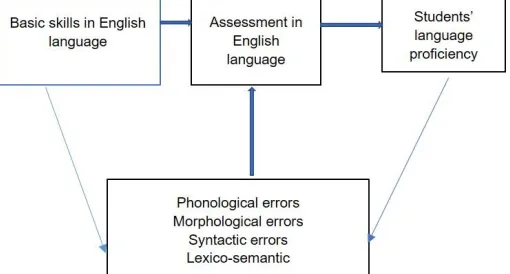
While language learning was formerly viewed as a process of mechanical habit formation where good students produce correct sentences and not through making mistakes; where errors were to be avoided through controlled opportunities for production - either written or spoken, memorizing dialogues and performing drills leading to the chances of making minimal mistakes (Richards , 2006), today these old methodologies are not given enough room and many new methodologies are used centering on the learner. Thus, researchers proposed a diagram below, as their own conception; on which this study should be grounded. The researchers take into consideration the writing skills and gauge it based on recurrent errors made by students in their final assessment.
Fig. 1. The influence of Basic skills in written assessment
From the above diagram, the role and influence of basic language skills in assessment is undeniable. One can theorize that basic English skills play a big part in someone’s writings and errors committed in assessment are closely connected with basic linguistic skills. Elsewhere, being proficient in English will greatly be influenced by the basic skills that one is equipped with in that language be they phonological, morphological, syntactic and lexico - semantic levels. Hence, all the above elements are interwoven in that way some influence others. In the case of students who learn Literature in a second language - English in this context, errors are likely to occur especially because it is a language they were not grown up with although trained in it, a language that they do not have enough basic skills so that they can write in it without making any error.
REVIEW OF RELATED LITERATURE
Error analysis in English as a Foreign Language has been a ground of interest for many researchers such as Linguists, EFL teachers and educators in many parts of the
globe with focus on learners’ speech or writing. This is
Pescante-Malimas et al. (2017) conducted a study on students’ errors and came up with the stand that despite the fact that the students had been studying grammar, syntax, and mechanics from secondary to tertiary level, they could not be said to have fully grasped or mastered the basics of correct written English. The point as made here Once L2 errors are analysed, the nature of problems and difficulties encountered by language learners will be identified. Identifying such difficulties can therefore help EFL/ESL teachers pinpoint their students' weaknesses and hence revise their teaching methods and learning
materials accordingly (Alkhresheh, 2011 qtd in
Al-Khresheh, 2016).
According to Krashen, learned competence and acquired competence develop in very different ways. In his view, language learning occurs through the formal study of rules, patterns, and conventions, a study which enables one to talk about and consciously apply the knowledge gained. Dias Da Silva et al (2018) investigated the importance of errors and mistakes as essential part in the learning of foreign language. They posit that some errors and mistakes can help learners develop the mental structures necessary for the consolidation of the target language. Actually, the learning and teaching of a foreign or second language cannot undermine errors as a relevant tool especially in situation similar to when learners’ first language is far distanced from the target language. Knowing and analyzing these errors is very important in that the teacher can ensure the difficulties learners are facing so that they can put more emphasis for improvement not by correcting them but by increasing practices that engage much more the learner to use the foreign language in any context. Mediero Durán & Robles Baena(2012) explored errors made by university students and highlighted that two areas such as noun phrase and prepositions need be more emphasized during the teaching of English as a Foreign Language.
A view emphasized by Bani (2019) put it that foreign language (EFL) teaching and learning in tertiary level is very challenging because interference of first language to the target language leads to numerous lexical errors which renders language incoherent. In the same vein, Madahvi& Malini (2017) confirm that students make errors when writing in second language because of having tendencies to translate from their L1 where they get confused as the two different languages have two different structures. The researchers suggested that students’ motivation should be nurtured towards learning English, writing in particular, because speaking a language is not enough and is supplemented by writing which will determine the person’s fluency in that language. University students whose Kinyarwanda is L1 and English their L2 fall in the same trap whereby the two language structures are totally different probably because they are two distant languages. One is a Bantou language while the second is a Germanic language. Needless to say, errors these students make are often time related to this distance between the two.
They often time make errors such as grammatical errors, including but not limited to punctuation errors, prepositional, sentence structure, semantic, word choice, spelling, verb tense marker, subject verb agreements, pluralization, , capitalization; thus falling under the categories of phonological, morphological, Semantic, Lexical, syntactic, morpho-phonetic, lexico-semantic and lexico-syntactic errors.
METHODOLOGY
The present study analyses errors made by learners in their final assessment in Literature in English. The methodology used is basically qualitative as dictated by the four research objectives aligning with the research questions which are the main frame for the study. Data were collected from students’ final examination copies. Not all students were analysed. Rather, we used purposive homogeneous sampling simply because participants in this study are mainly being trained for teaching languages.
As Liker et al. (2016) explain that the rationale behind
purposive sampling is to concentrate on people with particular characteristics who will be better able to assist with the relevant research, our choice fell on undergraduate one students with particular interest in
Introduction to Literary Genres. Out of forty six (46) students’ scripts, twenty seven (27) were selected purposefully to identify errors made by learners in their final exam. Two hundred and eight errors were identified from twenty-eight scripts. Following closely, we grouped these errors in accordance with their categories and then proceeded with analysis. Errors were identified script by scripts. For ethical purposes, students’ scripts were labelled using the symbol # followed by a number.
FINDINGS AND ANALYSIS
Errors were identified script by script among those selected. Results were summarized in a table and then discussed cogently. Thus, data were collected as follows:
#1
This is refer to…(This refers to) : syntactic (unnecessary
verb addition; subject verb disagreement) error
Rhyme schem (rhyme scheme): morphological (word
form) error)
To develope the theme (To develop the theme):
morphological (addition) error
People faight agaist (people fight against): phonological
(spelling) error
The Liver Between (The River Between): phonological
(Spelling) error?
He struggling but at the end he killed (He was struggling
but at the end he was killed): Syntactic (Active and
#2
The different between (The difference between): lexico-
syntactic (Adjective noun confusion) error
The most one old one than (The oldest/eldest one of):
syntactic (comparative and superlative confusion) error
This is take place on (This takes place on): morpho-
syntactic (subject verb disagreement; verb tense form)
error
Betray in the city (Betrayal in the City): morphological
(word form) error
#3
Through out of the story (Throughout the story):
syntactic (unnecessary/wrong addition) error
The moral reason (The moral lesson): lexico-semantic
(wrong word choice) error
Themes that founded in (Themes that are found in):
syntactic (verb form) error
She was appear as the woman (She appeared as a
woman): syntactic (Passive active voice confusion) error
She was pride of (she was proud of/ she took pride in):
lexico-syntactic (noun adjective confusion) error
Which is came (which came): syntactic (Passive /active
confusion) error
The auther (The author): phonological (Spelling) error
Calture (culture): phonological (spelling) error
defferent to (different from): syntactic (misuse of
preposition) error
Connsonnant sound (Consonant sound): morphological
(wrong doubling) error
The protagonist is refer to (the protagonist refers to):
syntactic (verb form: passive versus active) error
#4
Fell sorry (felt sorry): lexico-semantic (verbs confusion)
error
Good time will came (good time will come): morpho
-syntactic (wrong word form) error
The story wich (the story which): morphological (spelling)
error
The massage wich (the message which): morphological
(spelling) error
Undirect comparison (Indirect comparison):
morphological (spelling) error
Literary devices like smile, iron (Literary devices like
simile, irony): phonological (spelling) error
Written literature have…. (Written literature has….):
syntactic (subject verb disagreement) error
People who doesn’t know (people who don’t know):
syntactic (subject verb disagreement) error
Oral literature is oldest than written… (Oral Literature is
older than written): morpho-syntactic (wrong form of
adjective) error
It encrease knowledge (It increases knowledge):
phonological (spelling) error
Because speakers speaks (Because speakers speak):
syntactic (subject verb disagreement) error
There isn’t wiritter (There isn’t a writer): morphological
(spelling) error
Felling of the narrator (feeling of the narrator):
phonological (spelling) error
Someone who are read to understand (Someone who is
ready to understand): syntactic (Subject verb
disagreement)
Our value is bether than others (our value is better than
others): phonological (spelling) error
#5
Preserve their cultural (Preserve their culture):
lexico-syntactic (noun/adjective confusion) error
Among to them (Among them): syntactic (Addition of
unnecessary preposition) error
Some men who is going (Some men who are going):
syntactic (subject verb disagreement) error
She did not agree his husband (She did not agree with
her husband): syntactic error (preposition omission) error
First of oll(First of all): phonological (spelling) error
It can absence (It can be absent): lexico-syntactic (noun-
adjective confusion) error
Dialogue have two person (Dialogue has two persons):
syntactic (subject verb disagreement) error
#6
That is means that the play can ended (That means the
play can be ended): syntactic (wrong addition; Active
/passive) error
The process of distinguish… (The process of
distinguishing….): morpho-syntactic (verb form) error
Let me tak each character (let me talk about each
character): morpho-syntactic (spelling) error
Lawino don’t wants to destroy her culture (Lawino doesn’t
want to destroy her culture): syntactic (Subject verb
agreement) error
Some mens who behave like Ocol (Some men who
behave like Ocol): syntactic (irregular plural) error
#7
By choising the foreigner (By choosing the foreigner):
morphological (spelling) error
african traditional culture (African traditional culture):
Graphological erro
Okonkwo was a leader prominent (Okonkwo was a
prominent leader): syntactic (word misplacement) error
By reffering to any novel (By referring to any novel):
morphological (wrong doubling) error
His familisencluding (His families including….):
phonological (spelling) error
#8
He adviced his children (He advised his children):
phonological (spelling) error
To develop ourself (to develop ourselves): morpho
-syntactic (Pluralisation)
She is beautiful flower (She is a beautiful flower):
syntactic (spelling and word omission) error
She respect her father (She respects her father):
When Waiyaki meet Muthoni and Nyambura (When
Waiyaki meets Muthoni and Nyambura): syntactic
(subject verb disagreement) error
Irriterate( illiterate): morphological (spelling) error
#9
To here it (to hear it): lexico syntactic (wrong word choice)
error
….is very important than… (is more important than):
morpho-syntactic (Comparative form) error
The protagonist who against evil (the protagonist who
fights against the evil): syntactic (verb omission) error
It is long than … (it is longer than...): morpho-syntactic
(Adjective form) error
It is too small than these sentence (It is smaller than this
sentence): morpho-syntactic (comparative wrong form;
pluralization) error
Talk about to Okonwko (Talk about Okonkwo): syntactic
(misuse of preposition (wrong addition) error
It begun where…. (It began where….): morpho-syntactic
(Verb tense form) error
You stoped on…(You stopped on…): morphological
(omission) error
Is old than… (Is older than….): morpho-syntactic (word
form) error
This proverbs is (This proverb is): syntactic (determiner/
noun mismatch) error
Revolution French (French Revolution): syntactic (Words
misplacement) error
He don’t fear blood (He doesn’t fear blood): syntactic
(Subject- verb disagreement) error
How the dog has eat (How the dog has eaten): morpho
-syntactic (verb tense form) error
This fiction has the purpose of to teach us (This fiction
has the purpose to teach us/ of teaching us):
syntactic (Wrong prepositional phrase) error
The purpose of to reach on his target (the purpose to
reach his target): syntactic (Wrong prepositional phrase)
error
The protagonist is a character who have (The protagonist
is a character who has…): syntactic (Subject- Verb
agreement) error
He was going to left them (He was going to leave them):
lexico-syntactic (verb tense form) error
To fight gainst (To fight against): morphological (sound
omission) error
#10
He didn’t found him (He didn’t find him): syntactic (verb
tense form) error
Six element of drama (Six elements of drama):
morphological (Plural marker) error
It indicate (it indicates): morphological (verb tense
marker) error
The message the author want to convey (The message
the author wants to convey): morpho-syntactic (verb
tense marker omission)
It was literature refers to …( It was literature which refers
to…): syntactic(pronoun omission)error
Oral literature can found in (Oral Literature is found in):
lexico-semantic (verbs misuse) error
Oral literature are oldest form of… (Oral literature is the
oldest form of): syntactic (subject verb disagreement
Heroes who were die (Heroes who died): morpho
-syntactic (Verb tense form) error
He has a good action and wants a successifuly (He has a
good action and wants success): morphological (word form) error
For example of fiction (Example of fiction): syntactic
(wrong word addition)
Linguistic parrallerism (Linguistic parallelism):
morphological (wrong doubling) error
The speaker are sad (The speaker is sad): syntactic
(Subject verb disagreement) error
Ngugi adhere… (Ngugi adheres…): syntactic (Subject
verb disagreement) error
Gramatical rules (grammatical rules): morphological
(omission) error
Two character make (Two characters make): syntactic
(pluralization) error
#11
..To explain it bellow (…to explain it below):
morphological (wrong doubling) error
There is a big different among them (There is a big
difference among them): lexico-semantic (wrong word
choice) error
Written litterature (Written Literature): morphological
(wrong doubling) error
This one is imp- ossible (This one is im-possible):
phonological (word cutting) error
It can be expr- ssed (It can’t be ex- pressed):
morphological (word cutting) error
Can be forgoten (Can be forgotten): morphological
(spelling) error
Things Fall Appart (Things Fall Apart): morphological
(wrong doubling) error
Dramatic technics (Dramatic Techniques): morphological
(spelling) error
They came in Africa and start to rule (Came in Africa and
started to rule): morpho-syntactic (verb tense form) error
This is a character who involves through the story (This is
a character who is involved through the story):
syntactic (verb tense form) error
Immaginary work of Literature (Imaginary work of
literature): phonological (spelling) error
#12
Traged (Tragedy): morphological (word form) error
…which consist the dead (… which consists of the
dead): lexico-syntactic (prepositional omission) error
This a play which ….(This play which…): syntactic(word
order) error
It begin and end (It begins and ends): morphological
(verb form) error
A form of Literature that use spoken (a form of literature
#13
Where drama take place (Where drama takes place):
morphological (verb form) error
This poem writen by … (This poem is written by…):
morphological (wrong verb form) error
Because that events… (Because that event/ those
events…): morphological (wrong addition) error
The story take place (The story takes place):
morphological (Verb form) error
This is a story about sadness events (This is a story
about sad events): morphological error
It is differ from … (it is different from…): morphological
(wrong word form) error
With reference of this statement … (With reference to this
statement…): lexico-semantic (preposition) error
Those all events …. (All those events…): syntactic (Word
order) error
#14
There are big difference… (There is a big difference…):
morpho-syntactic (verb form) error
Have some literarly techniques… (Have some literary
techniques…): morphological (spelling) error
…easly to be changed… (easily to be changed…):
phonological (sound omission) error
Acco- rding (Accor- ding): phonological ( word cutting)
error
The one who have it he/she may adds or removes… (The
one who has it may add or remove…): syntactic (Subject
doubling; verb tense form) error
#15
This is word which is used… (This is a word which is
used): syntactic (word omission) error
Things for Apart (Things Fall Apart): phonological
(spelling) error
They proud with his/ her successful (they are proud of his
success): syntactic (verb omission) error
Antagonist who fighting (Antagonist who fights):
morpho-syntactic (wrong verb form) error
Prose writting (Prose writing): morphological (spelling
(wrong doubling) error
#16
The grammatic rule (the grammatical rule):
morphological (wrong word form) error
We may concluse (we may conclude): lexico-semantic
(wrong word choice error) error
Even theme are… (Even themes are…): syntactic
(pluralization) error
Especial on the stage (Especially on the stage):
morphological (omission) error
Activities which done by… (Activities which are dine
by…): syntactic (wrong verb form) error
Can’t be don (can’t be done): morpho-syntactic (wrong
verb form; omission) error
Dialogue are… (Dialogue is….): syntactic (Wrong verb
form (subject verb disagreement) error
Is an important in … (is important in…): syntactic (Misuse
of determiner) error
#17
Tragedy is a form of dramma (tragedy is a form of
drama): phonological (spelling) error
While I am differenting (While I am differentiating….):
morpho - syntactic (wrong verb form) error
Things fall apart by Chinua Achebe (Things Fall Apart by
Chinua Achebe): graphological error
The river Between (The River Between): graphological
error
Written literature (Written literature: morphological
(spelling; wrong doubling) error
#18
Engambment (enjambment): phonological (Spelling)
error
Are the followi- ng (are the follo- wing): phonological
(Wrong word cutting) error)
Departue (Departure): phonological (Spelling) error
In prose they obeys (In prose they obey):
morpho-syntactic (Wrong verb form (subject verb disagreement)
error
They doesn’t follow (They don’t follow): syntactic
(Subject verb disagreement /wrong verb form)
The most richer form than other forms (The richest form
of others): morpho-syntactic (Wrong adjective form)
Most of tragedy ends unhappy (Most of tragedies end
unhappily): morphological (word form) error
Ficticious (Fictitious): phonological (spelling) error
The speaker’s fell is sadness (the speaker’s feeling is
sadness): morpho –syntactic (wrong word form) error
#19
It is not a good to be live without rember (It is not good to
live without remembering): morpho-syntactic error ;
morphological( omission)error
Someone tell different person to remember (Someone
tells different people to remember): syntactic (subject
verb disagreement; pluralisation) error
The speaker has sad because…(The speaker is sad
because…): lexical (wrong word choice) error
Excelent text (excellent text): phonological (spelling) error
Soliloque(Soliloqui): phonological(spelling) error
#20
Romeo and Juliet are good friend (Romeo and Juliet are
good friends): syntactic (pluralisation) error
Juliet was come from Capulet (Juliet came from
Capulet): syntactic (wrong verb form) error
He cannot to be done any work (He cannot do any work):
syntactic (wrong verb form) error
#21
Tears was down fall (Tears were falling down): syntactic
(Wrong Verb form) error
The speakear’s voice was full of unhappy (The speaker’s
voice was full of unhappiness): phonological (Spelling);
Any kind of story that written (Any kind of story that is written): syntactic (verb form) error
Fiction is a story that are not true (Fiction is a story that
is not true): syntactic (subject verb disagreement; verb
form) error
Author create things that are not happen but should be
happen (The author creates things that do not happen
but should happen): Syntactic (verb form) error
Those are five element of drama (Those are five
elements of drama): syntactic (pluralization) error
One among of element of drama (One of the elements of
drama): syntactic (misuse of preposition) error
She/he do a good action (She/he does a good action):
syntactic (Verb form; subject verb disagreement) error
Antigonist try to (Antagonist tries to): syntactic (verb form
error (subject verb disagreement) error
#22
They cominicate with their neibouring (They
communicate with their neighbouring): Phonological
(Spelling) error
Both speaker and lissener …(Both speaker and
listener…): phonological (spelling)error
This terms is used …(This term is used…): syntactic (subject verb disagreement) error
A playwrit (A playwright): phonological (Spelling/
omission) error
Christimas Day (Christmas Day): phonological (Spelling)
error
Petter bought butter (Peter bought butter): phonological
(spelling) error
Can be a writter (Can be a writer): phonological (spelling)
error
CamalaLaye (Camara Laye): phonological (Spelling) error
Setting it show where and when (Setting shows where
and when): syntactic (subject repetition) error
An auther write a novels (An author writes a novel):
phonological (spelling) error
doga, mulili, laye’s father…(Doga, Mulili, Laye’s father..):
graphological error
Sentences or Plagraphs (Sentences or paragaraphs):
phonological (spelling) error
#23
Changable (Changeable): phonological (spelling) error
We must know how to use its (we must know how to use
them): syntactic (pluralization) error
Moral resson (moral lesson): phonological (spelling) error
Someone who write book called autor (someone who
write a book called author): syntactic (subject verb disagreement) and phonological (spelling) errors
Prose and poetry both are literary genres (prose and
poetry are both literary genres): syntactic (word order)
error
Another one example (Another example): syntactic
(irrelevant addition) error
Orol Literature (Oral Literature): phonological (spelling)
error
Even if he/she die (Even if he/she dies): syntactic (subject
verb disagreement) error
#24
To give advises (to give advices): phonological (spelling)
error
He used smile, anathora (He used simile, anaphora):
phonological (spelling error)
A character who have (A character who has): syntactic
(subject verb disagreement) error
Literarly work (Literary work): phonological (spelling
error)
Betry in the city (Betray in the city): phonological
(spelling) error
metathor (metaphor): phonological (spelling) error
#25
Clemantine (Clementine): phonological (spelling) error
Love make people ful (love makes people fool): syntactic
and phonological (Subject verb disagreement; spelling)
errors
Clemantine who are civilized (Clementine who is
civilized): phonological and syntactic (spelling subject verb agreement) errors
Join another ones (join another one): syntactic (wrong
pronoun)
He putted all his… (he put all his…): morphological
(wrong doubling)
A wife leave husband and marry other who are… (A wife
leaves a husband and marries another who is)
syntactic (subject verb disagreement) error
A woman proud of his culture (A woman proud of her
culture): lexical (wrong choice of adjective) error
#26
The poem is talk about (The poem is talking about):
syntactic (verb tense) error
A story of imaginative (as story of imagination): lexical
(adjective –noun confusion) error
There is characters Okonkwo and his son (There are
characters Okonkwo and his son): syntactic (Subject
verb agreement) error
He hate them until to died (He hated them until he died):
syntactic (Verb tense form) error
The novel the river between (The novel The River
Between): graphological (Capitalisation) error
#27
The major character is fight for (The major character is
fighting for): morphological (verb form) error
Is cring (is crying): phonological (spelling error)
It were there befor( It was there before): syntactic and
phonological (Spelling)error
Speaches which that used by the author (Speeches that
were used by the author): morpho-syntactic (spelling and
verb omission) errors.
Actors whose the plot is built up on (actors whose plot is
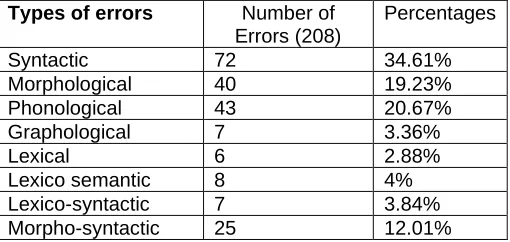
Thus, the table below holds the identified errors at syntactic, morphological, phonological, graphological, lexical and Lexico-semantic, lexico- syntactic and morpho-syntactic levels.
Table 1: Table summarizing errors made by students in their final exams
Types of errors Number of
Errors (208)
Percentages
Syntactic 72 34.61%
Morphological 40 19.23%
Phonological 43 20.67%
Graphological 7 3.36%
Lexical 6 2.88%
Lexico semantic 8 4%
Lexico-syntactic 7 3.84%
Morpho-syntactic 25 12.01%
Taken together, “writing is a continuous complex process of expressions. It is not itself a simple process with its native language and rather even more a complicated process if the language is a foreign language” (Abdulgalil, 2018). As revealed from the above identified errors, many of them are recurrent particularly verb tense markers, pluralization, subject verb agreement, morphological
errors basically omission, ungrammatical and
unnecessary addition, lexical categories and many syntactic feature errors among other things. Mostly, among the errors identified as shown in the above table, syntactic errors (34.61%) outweigh others followed by
phonological category counting (20.67%) and
morphological which counts (19.23%). The morpho-syntactic errors (12.01%), lexico-semantic (3.84%) and lexico-syntactic (3.36 %), graphological (3.36%). As can be seen, concerning syntactic errors, subject verb agreement, wrong verb form and pluralization are the recurrent errors while spelling errors are common among morphological and phonological categories. Besides, students have difficulties in word cutting at the end of a line and this is due to little basic phonological skills. Spelling is another kind of error among those identified, for example, Clemantine, anaphora, metathor, literarly work, he gives advises, is cring, cominicate with their neibouring, Petter, solliloque, etc… which is recurrent in the students writing. This is connected with little training in spelling drills which results in committing such grammatical errors.
CONCLUSION AND RECOMMENDATIONS
This study has explored errors in students’ final evaluation scripts. It has been found that most of the errors are related with syntactic and lexical areas. It is important that these areas be emphasized when teaching and learning English in Rwandan Education levels to lay good ground for error minimization. Teachers of Literature are also advised to integrate language learning in the literary subjects so that students can conversant with English thereby reducing these errors. Very likely, language students in particular
have to take care of their language and be committed to improving so as to minimize their language errors in their final evaluation by and large. They are required to read enough and do enough writing exercises even beyond classroom hours because coping with language errors should not be a matter of one individual rather of both teachers and learners.
ACKNOWLEDGEMENT
The researchers are very grateful to whoever contributed to this study in one way or another particularly the anonymous reviewers of premier publishers for their constructive criticism.
REFERENCES
Abdulgalil Abd Allah Salih (2018) Error Analysis of Composition Writing: A case of Saudis EFL University
Students. IJRDO- Journal of Educational Research.
3(11).45-54.
Al-Khresheh Mohammad Hamad (2016) A Review Study
of Error Analysis Theory. International Journal of
Humanities and Social Science Research, 2016, 2, 49-59.
Bani Abdo,Ibrahim (2019) Lexical Formation Error in the Descriptive Writing of Indonesian Tertiary EFL
Learners. International Journal of Linguistics Literature
and Translation (IJLLT). 2(1), 85-89.
Bustomi, A. (2009) An Error Analysis on students’
descriptive writing. A case study on students of Harapan Jaya Senior High a School at Cipondoh, Tangrang. (PhD Thesis). 83-183
Eduardo Dias da Silva, Romar Souza-Dias, Juscelino Francisco do Nascimento (2018) Do not give up! The importance of mistakes in the process of teaching and
learning foreign languages. Brazilian English Teaching
and Learning Journal (BETL) 9(1), 244-253.
Elizabeth Taylor Tricomi (1986) Krashen's Second-language Acquisition Theory and the teaching of edited American. English Journal of Basic Writing. 5(2) 1986. MadahviVethamaiccam& Malini G. (2017) Analysing
Errors among Form One Students’ Written English
Composition in a Private Chinese School. Asian
Journal of Education and e-Learning. 5(1) (ISSN: 2321 – 2454).16-26.
Mediero Durán Mª Esther, Robles Baena A. (2012) Exploring the errors made by EFL students at
University level: in Research Challenges for
Anglophone studies in the 21st Century. Ediciones
Universdad Salamanca. Retrieved from
https://books.google.rw/books
Pescante-Malimas, M. A &Sonrisa C. S. (2017) Linguistic Error Analysis on Students’ Thesis Proposals. IAFOR Journal of Language Learning. 3(2), 193-209.
Richards, J., C. (2006) Communicative Language
Sajid Mehmood, Ammara Farukh & Muhammad Ahmad (2017) Error Analysis of English Composition at
Intermediate Level. International Journal of Sciences
and Research. 73 (5), 56-72.
YelayBirhan (2017) Assessment of the qualities of academic writing in senior essays of English graduates:
The case of Dire Dawa University. International Journal
of English and Literature. 8 (8), 102-114.
Accepted 3 August 2019
Citation: Bazimaziki G., Mukadisi F., Nyirahabimana A.,
Twahirwa J.B (2019). Analysis of Students’ Errors in
Summative Evaluation: A Corpora Based Research. International Journal of Literature, Language and Linguistics, 5(2): 225-233.