Consumer Perceptions of Creativity, Utility and Value on the Attitude towards the
Purchase of Goods
Author’s Details:
Sara Ghaffarfamian1 and Fereshteh Lotfizadeh2
1 Master of Business Administration, Department of Business Management, Zanjan Branch,
Islamic Azad University, Zanjan, Iran
2 Assistant Professor of Marketing, Department of Business Management, Zanjan Branch,
Islamic Azad University, Zanjan, Iran (Corresponding Author)
Abstract
Creativity in new products plays an important role in the growth a profitability and managers to succeed in sales of new products, the attitude of consumers towards their products noticed. The study seeks to assess consumer perceptions of creativity, coolness and value to the product is the attitude. The study population will comprise 384 students of Zanjan Universites. In order to collect the data questionnaire were utilized and Cronbach’s alpha and split-half were employed to evaluate the reliability of the questionnaire, which revealed to be 0.86 and 0.92 respectively Its validity using face validity and content validity was approved. In this study data analysis software SPSS was used, and to test the hypothesis using path analysis is used. The findings from the study show that the first hypothesis (novelty product, through the coolness product the value of the perceived hedonistic, there were significant effects) and The second hypothesis (the hedonistic perception has a significant impact on consumer attitudes toward products) and The third hypothesis(Meaningfullness product through Utilitarian Value Perceived a significant impact on consumer attitudes toward the product).The sig less than 0.5 and all three hypotheses have been confirmed. Practical tips are provided at the end of the study.
Key words:New product innovation, consumer attitude, Novelty, Meaningfullness, Coolness, Hedonic value perceived, Utilitarian value perceived
1. Introduction
Consumer attitudes have always stems from perception. Consumer attitude plays an important role in their purchasing behavior and purchasing decisions. So if marketers and managers want to gain more market share and consequently higher profits, should take care of consumer attitude towards goods (Litwin, 2001: 822).
Consumer attitudes has an important role in the production, sale and marketing of goods. If we know why one consumers approve the product, or buys a product, the manufacturer and seller of that product, fulfill their actions more easily. Otherwise, sometimes if we do not know why the consumer does not like the product or not willing to purchase it, costly investments, efforts and activities, will be destroyed. Recognizing that an organization can survive only if it can satisfy customers' needs and demands, causes study about the consumer attitude be important and necessary.
When the perception of the value of a product is positive, positive attitude and willingness toward those goods will emerges .Consumers tend to choose products with their intended value and on the other hand minimize their undesirable traits generally goes toward buying products that generate more value. Now, creativity is a new and popular concept and is a process that helps organizations to extend their products of the market .If we add intense competition on the world market to this condition, the importance of new and innovative products as a competitive advantage in the current economy will be double. Creativity in new products not only enables organizations to gain a competitive advantage over competitors but also offers
accessories would be helpful to improve organizational performance.
characteristics of organizations leads to creativity in new products and the role of creativity as an indicator
of the performance of new products covering the flow of creative research (Im & Bhat, 167: 2015) .
Customer center view focuses on the perception of consumers of new products and their creativity. So we should focus to this fact that weather creativity which can be understood by consumers has any effect on consumer behavior and their attitude toward the product and buy and eventually be the reason of the company's success (Cairns et al., 816: 2010). This is possible if the value of creativity used in new products be in line with consumer expectations .while the production of new and innovative products, in a way that the product, while also being useful for the consumer, quite fresh, fashionable and stylish, it can create extraordinary value for consumers. The production of creative products which can provide expected novelty, utility and value, contributes to the attitude and willingness of consumers to the product and this is so reasonable to investigate the perceptions of consumers of product innovation to enable manufacturers to be more creative in product. Therefore, in this study, we examine whether consumer perceptions of creativity,
utility and value of new products influence the consumer attitudes to purchase the product?
2. Literature Review
In this new market, one of the most important things that producers can do to make a distinction between them and other companies is increasing creativity in new products. So they should show the creativity in their products to consumers, new and useful (Im & Bhat, 166: 2015). It should be noted that despite the role of consumers in new product innovation and success or failure of new product,in most research, consumer insights apply to managers were ignored. Rubra and Avrdanyny (2010) observed that efficiency and consumer value depends on product usage and knowledge of the product. Consumer point of view, clearly has a sense of creativity and its dimensions and the impact of creativity on the evaluation of new products (we Bet, 166: 2015). To ensure that product innovation is successful or not, a customer-centric view is necessary. Because this is the end consumers who ultimately decide the success of creativity. Consumers, merchant final judgment and creativity used in its new product. Only if the value of creativity and the performance of the new product is accepted by consumers, creative activities, new products will be
substantial and significant. (Zhu and Peterson, 16: 2016).
2.1 Creativity
Over the past thirty years, innovation as a competitive advantage and a crucial element in the trade is considered (Estanyola &Rocaba, 2015: 589). But what we will use in this study is the definition of innovation in new products based on the article Amabile (1983-1988). The concept of creativity in new products show that a new product is quite different from the competitors' products, so that consumers desired, meaningfulness is important (Im & Bhat, 166: 2015).
2.2 Dimension of Creativity
During the investigation carried out on product creativity, there are two main aspects that verified by the managers of new products (Im & Bhat, 167: 2015). These two aspects must be integrated together to create innovative product.
Novelty
Novelty means the difference and distinguish and being original (Cairns et al., 187: 201).It means breaking the rules, which include the production and unusual combination of astonishing. Always known as a main ingredient in a variety of definitions of creativity. Im and Workman define the novelty as a difference of competitors‟ products and Simonton (2002) define originality as one of the conditions of creative products. According to him creative ideas must be fresh, surprising, unexpected and even shocking (and Zoe and Peterson, 18: 2013).
Meaningfullness
Meaningfulness for target customers, is the degree in which these new products for target customers, be convenient and useful. (Im & Workman, 115: 2004)
From Rubra points of view, the meanigfullness deminsion of the innovation emphasis on product performance, usefulness, importance and ability to fulfill the needs of the consumer (Bet, 168: 2015).
2.3 Utilitarian Value
Utilitarian Value is overall benefits of the product or the applications and services that it offers. Utilitarian Value is a very different and more important than hedonistic values. Utilitarian value oriented include cognitive aspects such as: Economic value for money and judgment about the comfort and well-being, saving time (ovebay and Lee, 1161: 2006). Consumers seek utilitarian value in a task-oriented, rational manner.Holbrook and Hirschman (1982) said that in the purchase of goods which are important for people and needs more thinking time, having Utilitarian value is so crucial. Utilitarian value can be attributed to the success of consumers in finding the products they need (Moor and Carpenter, 69: 2009). Im et al (2015) argue that utilitarian value refers to functional benefits, operations or use of a product (Teruzzi, 25: 2015).
2.4 Hedonic value
Hedonic value is defined as an overall assessment of empirical benefits and pleasure which an organization offer. It can be defined as an entertainment and nothing more than reality .Consumer often shop for an appreciation and experience rather than simply for task completion. These people usually have fun and make a purchase outside the routine. Im et al (2015) argued that the hedonistic value refer to the empirical, emotional and beauty aspect of a product (Teruzzi, 25: 2015).
2.5 Coolness
Pountain &Robins (2002) defined coolness as an inner sense of the people, on hedonism and pleasure and happy being. Gladwell (1997), defines the coolness as a real-time feature, stylish and charming (Sriramacg and armurthy, 13: 2009). Perceived coolness strongly influences customers' responses to designs, as an attractive, pleasing product.
Based on literature review we have this hypothesis:
H1: product novelty, through the coolness has a significant impact on the perceived hedonistic value.
2.6 Consumer attitudes
Any decision that the consumer make, to some extent, involves a phenomenon that psychologists call it attitude. Thorsion one of the recent theorist who investigate about attitudes, defines it as: "The feelings that person has about a stimulus" (Samadi, 141: 2007). In a comprehensive definition, attitude, is to organize long-term processes, motivational, emotional, cognitive and perceptual processes according to some environmental aspects in which one is located. Accordingly, the attitude of a person represents a way of thinking, emotions and reactions that he (as compared to a store, product or TV show) has to its surrounding environment (Rousta & Bthaii, 296: 2006).
Based on these literature, we want to test:
H2: Hedonic Value Perceived has a significant effect on consumer attitude towards the products.
H3: Meaningfullness of product through Utilitarian value Perceived has a significant effect on consumer attitudes toward the products.
3. Method of research
In this study, books, articles, thesis, etc were used for the collection of theoretical bases and the questionnaire was used to collect data .This study was conducted in september 2016 in all universities of Zanjan .The population sample of this study was all students of Zanjan universities. Sampling method which was conducted in this study, was stratified sampling. Since the statistical community, public and Azad university students, are limited, so according to Daryle w. Morgan table, the sample size for this study, 384 samples were determined.
The questionnaire consisted of two parts:
Part I: this section of the questionnaire is provided in order to get demographic information such as age, gender, marital status, level of education.
Part II: consists of 30 questions from the standardized questionnaires, which the researchers and well-known experts designed them and various studies have repeatedly confirmed the validity and reliability of them. From questions 1 up to 27 have been extracted from Im & Baht, 2015 and Question 28 to 30 have been extracted from Jalilvand and others in 2012.
In this study, six factors including products novelty ,meaningfullness, coolness, utilitarian value, hedonic value and consumer attitudes were assessed with a questionnaire containing 30 questions which products novelty variables include six items, meaningfullness includes 6 items, Coolness includes 5 items, utilitarian value includes 5 items, hedonic value contains 5 items and consumer attitudes includes 3 items. In this questionnaire, 5-point Likert scale (from 1= fully disagree to 5= strongly agree) was used that is given completely in appendix A.
4. Pre-test and Test
This study, the test was conducted in three stages:
Pre-test I: In this step, one questionnaire containing 24 product names, among 30 respondents, were
distributed. In this questionnaire, respondents were asked to among the products, choose 3 products in which they believe are more recent and were familiar it, and also preferred that eventually two products „cars and mobile phones were selected.
Pre-test II: In the second test to assess the validity and reliability of the questionnaire distributed among 30 individuals and collected. Cronbach's alpha coefficient is 0.86 and split half 0.92 is obtained.
Validity and reliability
In this study face validity and content validity were used as tools .Before distributing of the questionnaire in order to lubrication sentences and words, several management professors, Ph.D students of Literature and English as well as expert of marketing confirmed it and then appropriate modifications and changes were implemented and questions were assessed , and the final questionnaire was developed. In order to assess the reliability or validity of the designed questionnaire Cronbach's alpha coefficient and split-half method is used. Cronbach's alpha coefficients were calculated using the software SPSS, that Cronbach's alpha obtained for 30 questionnaires was /86 which indicates that the reliability of the questionnaire is very high and Cronbach's alpha for the total of 384 questionnaires was 0.92 split-half reliability coefficient method in this study has been obtained 0.92.
5. Data analysis
To analyze the data collected using path analysis method using SPSS 22 software hypotheses were tested.
In the demagraphic section, data on the respondents were analyzed.of the 384 respondents, 48.4% were male and 51.6% female. Also, 59.1% of them were single and 40.9% of them were married. Education respondents are: Associate Degree 9.4% Bachelor of 60.2% Masters of 26.3% and PhD student 4.2%. The average age of respondents is as follows: less than 20 years 4.9%, 20 To 30 years 69.3%, 31 to 40 years, 22.4%, 3.4% higher than 40 years.
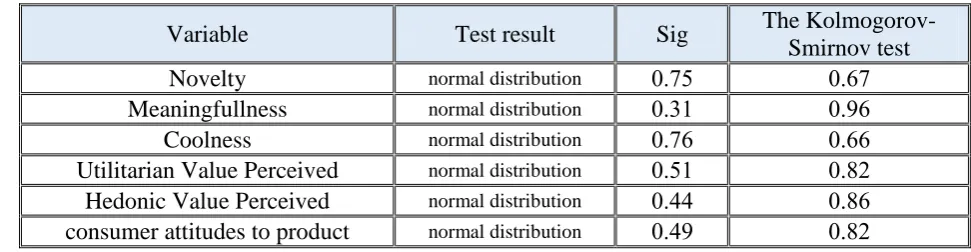
The inferential analysis using the Kolmogorov - Smirnov normality assumption samples were studied.
Assumptions of normality test results of the samples in the table below:
Table 1. The normal test variables
The Kolmogorov-Smirnov test Sig Test result Variable 7..0 7.00 normal distribution Novelty 7... 7..0 normal distribution Meaningfullness 7... 7.0. normal distribution Coolness 7..0 7.00 normal distribution
Utilitarian Value Perceived
7... 7.00
normal distribution
Hedonic Value Perceived
7..0 7.0.
normal distribution
consumer attitudes to product
Because this study was to examine the relations between the variables novelty, MeaningfullnessCoolness, Utilitarian Value, Hedonic Value consumer and consumer attitudes, therefore, to determine the path and calculate the direct and indirect effects of variables using regression techniques, must be based on diagrams, directions to be separated.
According to Table 2 multiple correlation coefficient represents the relationship between independent and dependent variables are. The coefficient of determination shows the dependence of the independent variable is the dependent variable changes.
Table 2. Multiple correlation coefficients and coefficients of determination the path analysis
Watson factor Adjusted
coefficient of determination
(R² Adj) The coefficient of
Finally, with regard to Table 3 beta coefficient obtained in this way.
Table 3. Coefficients of paths and path analysis
Direction Beta
coefficients
Novelty Coolness 7.0.
Hedonic Value Perceived Coolness
7..
Coolness Hedonic value Percived Novelty
7..0
Meaningfullness Utilitarian Value Perceived 7..
consumer attitudes to product Utilitarian Value Perceived
7..0
Hedonic Value Perceived consumer attitudes to product 7.00
The results obtained were examined in the analysis of the above, the following table is also briefly mentioned.
Table 4. The effect of independent variables on the dependent variable direct and indirect
Total direct and indirect effects of each variable direct effects Indirect effects independent variable 7.07 -7.07 Novelty 7.. -7.. Meaningfullness
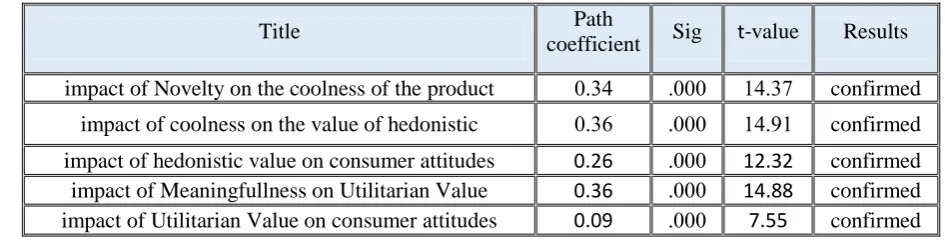
In this study, using path analysis, novelty product and Meaningfullness on the consumer's attitude to the product through the operating coolness, Utilitarian Value Perceived and perceived value hedonistic, has been studied, the results obtained from it are shown in the following tables.
Table 5. Testing hypotheses
Results t-value Sig Path coefficient Title confirmed 00..0 777 . 7..0 impact of Novelty on the coolness of the product
confirmed 00..0
777 . 7... impact of coolness on the value of hedonistic
confirmed
21.21
777 .
6.15
impact of hedonistic value on consumer attitudes
confirmed
23.77
777 .
6.25
impact of Meaningfullness on Utilitarian Value
confirmed
6.44
777 .
6.68
impact of Utilitarian Value on consumer attitudes
Finally, we can conclude, according to the t-statistics presented in Table 5 is clear that the amount for these three hypotheses is greater than 1.96.The calculated value for significant is equal to 777. . Hence it can be concluded that all three hypotheses are confirmed with a 99% confidence level.
6. Discussion:
The statistical results obtained from the questionnaire shows that the goal of the researcher in the present study, using the path analysis was to find the relationship between the Consumer perception of creativity, coolness and value, on the attitude towards the goods purchasing. In this study, the impact of innovation in new products and consumer attitudes towards the use of the new product is checked. Findings of research and analysis assumptions, indicated that the first hypothesis by statistic (14.37 and 14.91) and a significance level of 0.00, the second hypothesis statistic (12.32) and the statistical significance level of 0.00 and the third hypothesis (14.88 and 7.55) and a significance level of 0.00 are approved. Therefore, we conclude that
To put it simply, we can say:
Consumer attitudes to the product, is highlighted act in the buying or in another word purchasing process, Because people initially checked that whether they are willing to buy the product or not, That this willingness to goods originating from both the perception of the value of that product bring for the individual, and hedonistic value and utilitarian value. If the perceived value of the product, is extremely high for one, leading to the purchase of the product. Thus, it can be said that the final decision of individuals would greatly affect the perceived value of the product. The consumer in those product with new creative and quite fashionable, as well as usable and useful features, can easily understand the value of hedonistic and utilitarian value.
7. Suggestions
Suggestions based on First hypothesis:
Manufacturers of products with the right or correct research and comply with the society in which the product is offerings, identify features and characteristics of their customers, in a way that they can influence the hedonistic values of the customers. Thus, managers by creating sectors for research and development in the company and investment in these sectors to collect information, identify new technologies, training of researchers and encourage creative workforce, identify scientifically the customer needs, increase the utility of the product.
Companies, to enhance the performance and usage of creative new ideas, can use customer reviews and ideas. For this purpose, managers can create a system to get new ideas on the website of the company and use customers` ideas on the website and even give cash prizes to new and applicable ideas or active members. The inclusion of the customer in earlier versions of product development and design team, can help companies to manufacture products for a variety of tastes.
Construction of new and technologic products, with a nostalgic design, due to consumer preference for traditional products, such as the construction of Volkswagen, which is designed to look old, but the technology used in it is completely up to date or build platter design with new technology and old appearance.
Suggestions based on second hypothesis:
Mass customization is one of the suggestions that will be submitted to carry out this hypothesis. Since in the mass customization, customers are given the opportunity to modify and justify the basic elements of the product and its configuration, the customer, will have the opportunity to design the product based on aesthetic sense and this will be an exciting and enjoyable for the customer.
Consumers who are seeking hedonistic values, are often fashion-oriented people, for this reason, for showing the new products and fashion, the use of celebrities or popular individuals in advertising is suggested. One of the factors that should be considered in the choice of these people is the fitness of them t with the product, not only fit in terms of expertise, but also all the features that can induce a sense of proportion to the audience should be included. For example, an actor which is located in people's mind as handsome and good-looking person, can be used as modeling or sports equipment and sports clothing must be advertised by celebrities.
Suggestions based on third hypothesis:
The final product should be useful and usable. People should be able to use the product, and meet their needs. Therefore, it is suggested, since customers like to touch the product, see it closely and then purchase, let them be as close as possible to the product, test it to have a vision of the product they want to buy and with more confidence shopping and in the lack of physical testing, display the video of introducing
Recommended for products that require technical support, a technical expert specialist should be considered because customers require the provider who is always accessible and in appropriate time and place meet their needs and provide the products in the shortest possible time and also with the best quality.
Appendix A.
New product novelty
Compared with other competing products, this product… 1. is radically different.
2. can be considered as revolutionary. 3. is really “out of the ordinary”.
4. provides something not commonly found. 5. incorporates new ideas/concepts.
6. has unique features.
New product meaningfulness
Compared with other competing products, this product… 1. is appropriate for customers' needs.
2. fits customers' needs. 3. is useful for customers. 4. increases value to customers. 5. is relevant to customers' needs. 6. serves a purpose for customers.
New product coolness
Comparedwith other competing products, how do you feel about this product? This product is… 1. not at all trendy–very trendy.
2. not at all hip–very hip.
3. not at all appealing–very appealing. 4. not at all fascinating–very fascinating. 5. not at all attractive–very attractive.
Utilitarian value
Please evaluate your attitude toward this product for the following items: This product is… 1. ineffective–effective.
2. not helpful–helpful. 3. not functional–functional. 4. not necessary–necessary. 5. impractical–practical
Hedonic value
Please evaluate your attitude toward this product for the following items: This product is… 1. not fun–fun.
2. dull–exciting.
3. not delightful–delightful. 4. not thrilling–thrilling.
5. not at all enjoyable–enjoyable.
Consumer attitudes
Please evaluate your attitude toward this product for the following items: This product is…
1. Very bad–very good
2. Very worthless– very valuable
3. Very unpleasant –very pleasant
References
Bicen Pelin , Kamarudin Suzilawati , Johnson William H.A.(2014) "Validating new product creativity in the eastern context of Malaysia " .Journal of Business Research , 67 .pp 2877–2883.
Carpenter Jason M , Moore Marguerite (2009). "Utilitarian and hedonic shopping value in the US discount sector" . Journal of Retailing and Consumer Services 16 .PP 68–74.
Estanyola Elisenda , Rocaba David (2015)؛ "ReviewCreativity in PR consultancies: Perception and management", Public Relations Review , Vol. 41 , No.5, pp 589-597.
Giese Joan L, Malkewitz Keven , Orth Ulrich R. , Henderson Pamela W. (2014)." Advancing the aesthetic middle principle: Trade-offs in design attractiveness and strength". Journal of Business Research 67 .pp 1154–1161.
Im, S., Bhat, S., & Lee, Y. (2015). "Consumer perceptions of product creativity, coolness, value and attitude". Journal of Business Research, 68, pp 166-172.
Im, S., & Workman Jr, J. P. (2004). "Market orientation, creativity, and new product performance in high-technology firms". Journal of Marketing, 68, 114-132.
Jalilvand, Mohammad Reza, Samie, Neda, Dini, Behrooz, Yaghoubi Manzari, Parisa, (2010), Examining the structural relationships of electronic word of mouth, destination image, tourist attitude toward destination and travel intention: An integrated approach, Journal of Destination Marketting &Management,(1), 134-143.
Kunz Werner, Schmitt Bernd, Meyer c Anton (2011),”How does perceived firm innovativeness affect the consumer?”, Journal of Business Research (64) pp 816–822.
W.Litvin Stephen, J.MacLaurin Donald,” Consumer Attitude and Behavior” (2001), Journal of Annals of Tourism Research, Vol. 28, No. 3, pp 821-823.
McAdam Rodney & McClelland John (2002) "Sources of new product ideas and creativity practices in the UK textile industry", Technovation (22), pp113–121.
Overby Jeffrey W. & Lee Eun-Ju. (2006). "The effects of utilitarian and hedonic online shopping value on consumer preference and intentions". Journal of Business Research 59 .pp 1160–1166.
Rousta,ahmad.,& Bathaii,atiyeh (2006). "consumer behavior, marketing strategy ". Publication Sargl, First Edition,pp 290-350.
Samadi,mansour.(2007). " Consumer behavior ". Publication Aiiz, second Edition, pp 141.
Sriramach and ramurthy, rajendran (2009). " What‟s cool ? Examinig rand coolness and its consequences". Master's Theses.pp1-85.
Teruzzi Eva (2015), "Consumer Assessment of New Creative Products across China and the United States", Master's Theses.pp1-111.