Manning,L. and Wareing, P. 2018. Evolving risk management systems. Journal of the Institute of Food Science & Technology.
23 August 2018
Evolving risk management systems
by Manning, L. and Wareing, P.
Copyright, Publisher and Additional Information: This is the author accepted manuscript. The final published version (version of record) is available online via Wiley. This article may be used for non‐commercial purposes in accordance with Wiley Terms and Conditions for Self‐Archiving.
Please refer to any applicable terms of use of the publisher.
DOI: https://fstjournal.org/features/32-3/risk-management-systems
Evolving risk management systems 1
Louise Manning and Peter Wareing consider evolving challenges to risk management 2
systems in the food industry and identify options to help organisations manage their own 3
spectrum of risk(s) and remain resilient. 4
Introduction 5
The current reality is that food supply chains are global, complex and sometimes opaque. Food 6
supply chains are also highly reactive, as regulatory, market, technical and social requirements 7
keep evolving and sourcing links become increasingly fluid. In addition, the challenges that 8
present risk to food products and food companies also shift. Some challenges are historic, for 9
example, food safety and food crime, but others are new and contemporary. In the future, 10
evidence suggests that the speed of change will accelerate even faster, requiring businesses to 11
be more resilient and agile. This is the first in a series of planned articles and papers on the 12
theme of risk management in food supply chains. 13
Resilience is the ability of a supply chain to absorb market and regulatory shocks and remain 14
operational and functioning1. Supply chain resilience is affected either by internal factors or by 15
external factors outside the control of actors within the chain, e.g. floods, harvest failure, animal 16
disease and so on. Three elements influence resilience: 17
control factors including protocols, policies, procedures, and systems; 18
supply and demandfactors that create disturbance to the multi-directional flow 19
of materials, product, finance and information; and 20
processes, such as transport, communication and infrastructure2. 21
Therefore, risk reduction strategies that drive resilience must be embedded within the norms of 22
‘the way we do things’, and as a result drive agility and adaptive capability, and reduce, or 23
Risk management 25
The Food Law Code of Practice (England)4 defines risk as: ‘the chance or probability that a 26
person will be harmed or experience an adverse health effect if exposed to a hazard’. Risk 27
analysis involves three components: 28
risk assessment, 29
risk management and 30
risk communication5.
31
Thus, it is important to reflect on the wider context of risk management systems by being 32
informed via risk assessment processes underpinned by effective risk communication. 33
Effective risk management requires multidisciplinary insights and constructive engagement 34
between food chain actors to develop an integrated supply chain approach using appropriate 35
risk management tools to improve business resilience and in so doing reduce risk6. The recently
36
reissued ISO 31000:2018 Risk Management Guidelines7 describe risk management simply as 37
the ‘coordinated activities to direct and control an organisation with regard to risk’, and further 38
states that ‘controls are any process, policy, device, practice or other conditions and/or actions 39
which maintain and/or modify risk’. The Guide describes the eight principles of risk 40
management as: 41
1. Customised to the organisation 42
2. Integrated into all organisational activities 43
3. A structured and comprehensive approach 44
4. Inclusive - ensuring appropriate and timely involvement of necessary stakeholders 45
5. Dynamic - considering internal and external factors that influence risk 46
6. Aware of any limitations in the available information (information asymmetry) 47
8. Driving continuous improvement. 49
Risk management approaches should maximise the degree of risk reduction, whilst ensuring 50
that the measures undertaken are efficient, effective in managing the risks, not restrictive and 51
balance the cost of ensuring compliance with the derived benefits4,8,9. Hajmohammad and
52
Vachon10 identify four different risk management strategies: 53
a) risk avoidance 54
b) risk assessment 55
c) monitoring-based risk mitigation using performance criteria e.g. supplier approval 56
monitoring procedures and 57
d) collaboration-based risk mitigation based on determining mutual responsibilities for 58
risk management and collaborating on mitigating risk. 59
Developing a risk register in combination with contingency or disaster recovery strategies can 60
alleviate the impact of risk but may not be agile enough to react quickly in the event of a sudden 61
supply chain ‘shock’, or an emergent, previously unknown risk3. As a result, there are a number
62
of supply chain risks that compete for supply chain resources to either manage or eliminate 63
them. The traditional supply chain response to managing and mitigating risk includes adopting 64
insurance, information sharing or outsourcing risk to other supply chain actors11. However, 65
power dynamics in the food supply chain means that information, including evidence of risk 66
mitigation and control, is not always equally shared and this information asymmetry weakens 67
the ability to develop effective risk management systems throughout the supply chain and 68
wastes resources in duplication of verification (assurance) efforts, especially for small and 69
medium sized enterprises (SMEs). 70
Information is only of value when it meets specific stakeholder needs and can be processed and 72
used by its target users12. Further, Verbeke argues market failures arise when sellers have more 73
knowledge than buyers about likelihood of safety issues arising, food safety control capability, 74
provenance, traceability, product attributes, process attributes or nutritional content, i.e. that 75
information is asymmetrically distributed. This means that for effective risk management to 76
occur, information asymmetry must be overcome so that the required information is available 77
and representative, the characteristics of the information are clearly defined, the information 78
relates to specific food batches and is ultimately truthful. Moral hazard is the risk that in a 79
transaction, one party is not acting in good faith through the provision of partial or misleading 80
information13. 81
What are the options for reducing information asymmetry? 82
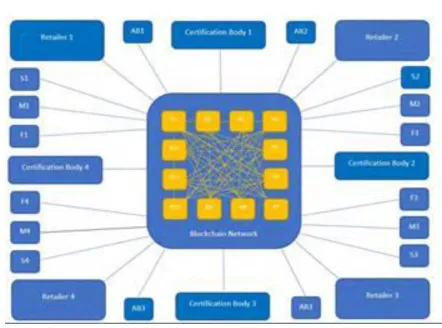
One option being put forward to reduce asymmetry is the application of distributed ledger 83
technology, such as blockchain (Figure 1). This technology could be a disruptive innovation 84
that promotes security, reliability and transparency in food supply chain interactions, and its 85
use could lead to enhanced food safety controls14. Distributed ledger technology can be 86
applied as a tool to integrate data across supply chain risk management systems, including 87
inputs from multiple supply chain actors, such as temperature sensors, GPS locators, video 88
cameras, radio-frequency identification (RFID), barcodes / QR codes, as well as product 89
analytical test data, labelling declarations and site certifications relating to foodstuffs, their 90
packaging, and location. This would permit real-time tracking to confirm product status, and 91
the time and location of specific actions15. With sufficient resource and if it was cost-92
effective, retailers, food service companies and manufacturers can verify food safety and food 93
quality data in real-time across their supplier base. 94
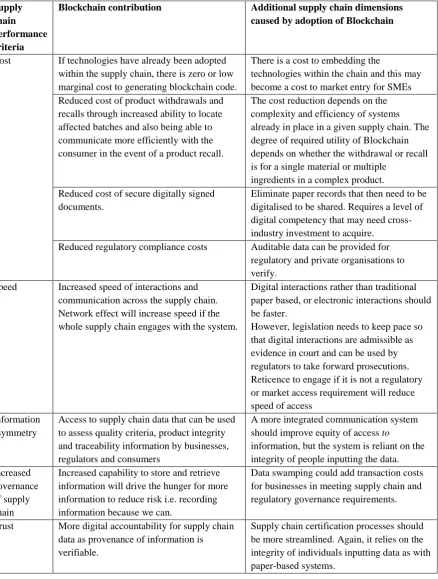
Table 1. Advantages of using Blockchain technology (Adapted from Kshetri13) 96 Supply chain performance criteria
Blockchain contribution Additional supply chain dimensions caused by adoption of Blockchain
Cost If technologies have already been adopted within the supply chain, there is zero or low marginal cost to generating blockchain code.
There is a cost to embedding the
technologies within the chain and this may become a cost to market entry for SMEs Reduced cost of product withdrawals and
recalls through increased ability to locate affected batches and also being able to communicate more efficiently with the consumer in the event of a product recall.
The cost reduction depends on the complexity and efficiency of systems already in place in a given supply chain. The degree of required utility of Blockchain depends on whether the withdrawal or recall is for a single material or multiple
ingredients in a complex product. Reduced cost of secure digitally signed
documents.
Eliminate paper records that then need to be digitalised to be shared. Requires a level of digital competency that may need cross-industry investment to acquire.
Reduced regulatory compliance costs Auditable data can be provided for regulatory and private organisations to verify.
Speed Increased speed of interactions and communication across the supply chain. Network effect will increase speed if the whole supply chain engages with the system.
Digital interactions rather than traditional paper based, or electronic interactions should be faster.
However, legislation needs to keep pace so that digital interactions are admissible as evidence in court and can be used by regulators to take forward prosecutions. Reticence to engage if it is not a regulatory or market access requirement will reduce speed of access
Information asymmetry
Access to supply chain data that can be used to assess quality criteria, product integrity and traceability information by businesses, regulators and consumers
A more integrated communication system should improve equity of access to
information, but the system is reliant on the integrity of people inputting the data. Increased
governance of supply chain
Increased capability to store and retrieve information will drive the hunger for more information to reduce risk i.e. recording information because we can.
Data swamping could add transaction costs for businesses in meeting supply chain and regulatory governance requirements.
Trust More digital accountability for supply chain data as provenance of information is verifiable.
Supply chain certification processes should be more streamlined. Again, it relies on the integrity of individuals inputting data as with paper-based systems.
97
With suitable secure permissioned access agreements, regulators could also undertake real 98
more effective incident responsiveness, reduced cost and increased speed of transactions in 100
the supply chain, the ability to overcome information asymmetry and improve trust between 101
stakeholders (Table 1). 102
Conclusions 103
Global supply chains are a complex ecosystem based on trust especially where elements of the 104
chain are currently opaque in terms of practices and risk management controls. Effective risk 105
management should drive improved supply chain resilience. Distributed ledger technology, 106
such as blockchain, has value in development of frictionless borders as a means to more 107
effectively control and reduce cost of trans-global trade. It can increase the transparency and 108
governance of supply chains through greater access to information generated by food 109
businesses, however it will require secure permissioned controls and careful design to work in 110
the complex food chain ecosystem. The enhanced ability to store information might improve 111
timeliness for process and product verification, but conversely lead to data swamping for 112
supply chain actors, regulators and those organisations undertaking third party verification. 113
Tools to identify trends and non-conformance will be needed to translate data into intelligence. 114
Through the use of decentralised information platforms, a broad range of technologies can be 115
integrated into an effective management system. As a result, information asymmetry may be 116
reduced, leading to improved supply chain trust. However, it is important that the rules and 117
standards that are set by the industry at inception are transparent and open to all, otherwise the 118
120
121
122
Figure 1. Diagram of Blockchain Network (Source: www.primority.com) 123
Keywords: risk, management, resilience, analysis, information, asymmetry
References
1Folke, C. (2006), Resilience: the emergence of a perspective for social-ecological systems
analyses. Global Environmental Change, 16(1), 253-267.
2Christopher, M. & Peck, H. (2004), Building the resilient supply chain, International
Journal of Logistics Management, 15(2), 1-13.
Dr Louise Manning is a Reader in Food Policy and Management at Harper Adams University, Newport, Shropshire TF10 8NB.
Email. [email protected]
Dr Peter Wareing is an independent food safety professional and a Director at P Wareing Food Safety Ltd.
3Manning, L., & Soon, J. M. (2016). Building strategic resilience in the food supply chain.
British Food Journal, 118(6), 1477-1493.
4FSA (2017) (Food Standards Agency). The Food Law Code of Practice (England) April
2017 Available from:
https://www.food.gov.uk/enforcement/codes-of-practice/food-law-code-of-practice (accessed 10 July 2018).
5Food Agriculture Organisation/World Health Organisation (FAO/WHO) (2006), “Food
safety risk analysis. A guide for national food safety authorities”, pp. 1-78, available at www.who.int/foodsafety/publications/micro/riskanalysis06.pdf (accessed 12 July 2018).
6Manning, L., & Soon, J. M. (2013). Mechanisms for assessing food safety risk. British Food
Journal, 115(3), 460-484.
7BS ISO 31000, (2018) Risk management – Principles and guidelines BSI London.
8García-Cela, E., Ramos, A. J., Sanchis, V., & Marin, S. (2012). Emerging risk management
metrics in food safety: FSO, PO. How do they apply to the mycotoxin hazard? Food Control, 25(2), 797-808.
9Koutsoumanis, K. P., & Aspridou, Z. (2016). Moving towards a risk-based food safety
management. Current Opinion in Food Science, 12, 36-41.
10Hajmohammad, S., & Vachon, S. (2016). Mitigation, avoidance, or acceptance? Managing
supplier sustainability risk. Journal of Supply Chain Management, 52(2), 48-65.
11Olson, D.L. & Wu, D., (2011), Risk management models for supply chain: a scenario
analysis of outsourcing to China, Supply Chain Management: An International Journal, 16(6), 401 – 408.
12Verbeke, W. (2005). Agriculture and the food industry in the information age. European
review of agricultural economics, 32(3), 347-368.
13Starbird, S. A. (2005). Moral hazard, inspection policy, and food safety. American Journal
of Agricultural Economics, 87(1), 15-27.
14Tian, F. (2017). A supply chain traceability system for food safety based on HACCP,
blockchain & Internet of things. In Service Systems and Service Management (ICSSSM), 2017 International Conference. June 2017 (pp. 1-6). IEEE.
15Kshetri, N. (2018). 1 Blockchain’s roles in meeting key supply chain management