78
ISSN 1392-2785 ENGINEERING ECONOMICS. 2007. No 2 (52) COMMERCE OF ENGINEERING DECISIONS
Brand Image Formation
Vytautas Janonis, Regina Virvilaitė
Kauno technologijos universitetas Laisvės al. 55, LT-44309, Kaunas
The article consists of five parts, where the first part formulates the problem, aim and objectives of the article. The aim of the article is to conduct a study of brand im-age and provide recommendations for brand imim-age en-hancement after theoretical analysis of the process of brand image formation. The aim is achieved with the help of the objectives formulated that seek: 1) to define and prove the conception of brand image theoretically, 2) to analyze the process of brand image formation, 3) to carry out the research on brand image, 4) to provide recom-mendations for brand image strengthening. The tools of classical marketing do not help answering the question why some brands are so unique or why the image of par-ticular brands is better in comparison with others. There-fore, the article analyzes the problem how a positive brand image should be developed.
The second part of the article reveals the conception of brand image. Various models of brand image are pre-sented and the importance of brand positioning in the process of positive brand image formation is proved in the same part as well.
The third part introduces and describes the modified model of brand image formation, enumerating three and the main phases of brand image formation that are brand identity, brand positioning and brand image.
The results of the empirical study of brand image are presented in the fourth part of the article. Conducting the empirical study of brand image the methods of qualitative and quantitative studies were employed. The aim of the empirical study was to examine Fizz brand image. The summary of the results and the recommendations for Fizz brand enhancement are presented after the empirical study of Fizz brand positioning and Fizz brand.
The last part provides the final conclusions for brand image formation.
Keywords: brand image, brand identity, brand positioning.
Introduction
The urgency. A company striving to achieve better results in the market in comparison with its competitors needs to acquire and retain particular uniqueness that cannot be imitated and would provide a competitive ad-vantage. One of such resources that can hardly be imi-tated is brand image, possessed by the company.
Brand itself does not ensure the competitive advan-tage of the company in the market. Good results are achieved just by those companies which are capable of managing their brands, rendering brand identity, deter-mining brand elements and defining brand uniqueness
and equity. The development of brand image as well as its strengthening helps to retain a position in the market for a company under the conditions of intensive competition.
The problem. Theconception of brand image com-bines the identification of brand image with intangible assets of the company that needs to be managed in order to use it efficiently. Under the conditions of globalization brand becomes one of the core tools in competitive mar-ket. It is extremely important to increase brand’s equity due to the fact that consumer’s attitude towards a particu-lar brand influences consumer’s behaviour. Seeking to get consumer’s attention and make him/her choose a good of the company from many other provided in the market, companies should single out their goods among other competitive goods by performing theoretical and empirical studies. Therefore, the article analyzes the problem of how a positive brand image should be formed. The object of the article is the process of brand im-age formation.
The aim of the article attempts at conducting a study of brand image and providing recommendations for brand image enhancement after theoretical analysis of the proc-ess of brand image formation.
The objectives of the article are:
1. To define and prove the conception of brand im-age theoretically.
2. To analyze the process of brand image formation. 3. To carry out the research on brand image.
4. To provide recommendations for strengthening brand image.
Research methodology includes systemic and com-parative literary analysis, secondary data analysis, quali-tative and quantiquali-tative studies. The qualiquali-tative studies are based on the method of a focus group while the quantita-tive studies employ the method of a questionnaire survey.
The Conception of brand image
79 and company’s ability to manage the strategy of brand positioning, adequately revealing brand’s equity to a con-sumer (Kotler, 2001).
Marketing literature provides a great number of brand
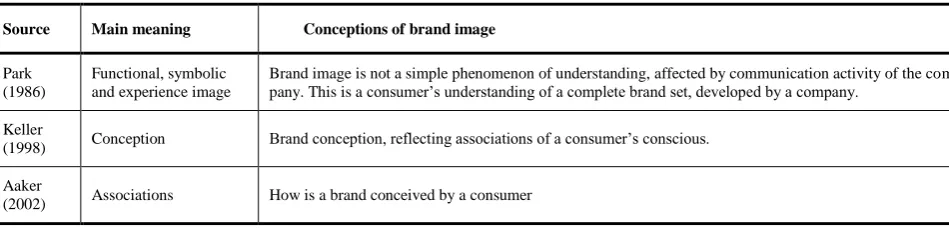
image definitions. The table below indicates brand image conceptions of various scientists that are used while analyzing the conception of brand image in the article (table 1).
Table 1 Conceptions of brand image
Source Main meaning Conceptions of brand image
Park (1986)
Functional, symbolic and experience image
Brand image is not a simple phenomenon of understanding, affected by communication activity of the com-pany. This is a consumer’s understanding of a complete brand set, developed by a comcom-pany.
Keller
(1998) Conception Brand conception, reflecting associations of a consumer’s conscious.
Aaker
(2002) Associations How is a brand conceived by a consumer
Brand image associations are classified into con-crete categories. G. Hankinson’s (2005) classification is presented in the second table, which indicates vari-ous models of brand image. The majority of the models group the associations into two categories: functional associations that indicate tangible features of good; and emotional or symbolic associations that reveal intangi-ble features, reflecting consumer’s effect on social ap-proval, self-expression or self-esteem (Keller, 1998; Hankinson and Cowking, 1993; de Chernatony, 1989). Other authors (Keller 1998; Park, 1986) indicate the third category, defined as experience. The associations
are linked with consumer feelings, experienced while con-suming a good or a service and the stimulation of inner need or variety satisfaction (Park, 1986).
Researcher Keller (1993; 1998) includes one more category of associations that is brand conception, combin-ing the entire brand evaluation by a consumer. Brand asso-ciations play a very important role in the development of brand strategy. Scholar D. A. Aaker (1997) claims that brand associations have meanings that need to be grouped. These meanings should determine brand positioning; there-fore, brands that are well positioned provide an attractive set of strong associations.
Table 2 Models of brand image
Authors Functional associations Symbolic associations Experience associations Brand conception
Hadkinson and Cowking
(1993) Functional attributes Symbolic value - -
De Chernatony and
McWilliam (1989) Functional dimensions Symbolizing dimensions - -
Park (1986)
Satisfaction of functional benefit
Satisfaction of symbolic benefit
Satisfaction of experience
benefit -
Keller
(1998) Functional benefit Symbolic benefit Experience benefit
Brand conception, indicat-ing a universal brand
evaluation
Source: G. Hankinson 2005:25
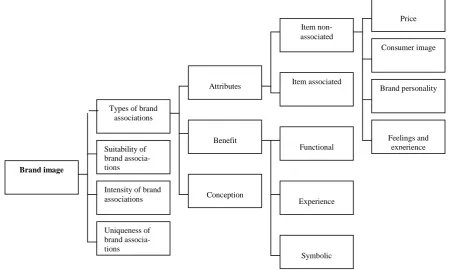
Keller’s (1998) model reveals the idea that brand cognition consists of brand recognition and brand image as indicated in Figure 1. Brand image is detailed and ex-panded due to its complexity. Brand image is the result of suitability, intensity, uniqueness and brand associations characteristic for a consumer.
Keller’s (1998) model indicates various types of brand associations, such as attributes that may be item associated and non-associated, benefit that can be func-tional, experience and symbolic and brand conception.
Advertising outcome is frequently more addressed than the process itself while seeking for a successful branding, possible to be attained in different ways (D. Aaker and E. Joachimsthaler, 1997). However, the
80 Analyzing brand image as a component part of branding it should be emphasized that conveying brand identity to a consumer, strategic development of brand image is of a significant importance. From the perspec-tives of organizations branding enlarges consumer’s
loyalty, increases sales and helps expanding and retain-ing the market place (Gregory, 2001). The management of brand image becomes one of the most essential factors for the increase of brand equity as well as company’s.
Figure 1. Model of brand image (Keller, 1998:94)
Positioning importance
Brand positioning is extremely important in the proc-ess of brand image development. A method used for brand introduction is defined as positioning activity. The decoding of brand image in the target market depends on
positioning strategies, carried out by a company and the way a message is created and rendered to consumers.
Different conceptions on brand positioning defined by various authors are presented in the table below (table 3).
Table 3
Positioning conceptions
Source Conceptions of brand positioning
Aaker and Joachimsthaler
(2000) The statement of brand identity and equity is actively expressed for the target audience.
de Chernatony (2001)
The process ensures the competition of a brand in the market and allows taking a different, significant and pre-cious position in the conspre-ciousness of the target market consumers.
Kapferer (2003)
Emphasis of distinctive features that provide distinction in comparison with competitors and become attractive for society.
The majority of marketing specialists claim that posi-tioning depends to a greater extent on efficient marketing communications such as advertising and sales promotion. Other researchers such as S. Dibb and L. Simkin (1992) state that positioning is affected by pricing, distribution and the nature of a good.
Position is usually defined by attributes/ equity that are important to a specific consumer group (for example, price could be of major importance for visitors of Kwik
Save shop, the level of services might be important for Hilton visitors and quality, environment and socialization could be important while choosing a restaurant).
G. J. Hooley (2001) identifies the following phases of the process:
identification of competitors
singling out of decision making attributes evaluation of decision making attribute
Price
Attributes
Item non-associated
Item associated
Uniqueness of brand associa-tions
Intensity of brand associations Suitability of brand associa-tions
Types of brand associations
Brand image
Benefit
Conception
Symbolic Experience Functional
Feelings and experience Brand personality
81 significance
identification of competitor position according the most important attributes
identification of consumer needs preparation of a positioning map selection of the desired position selection of positioning strategy
Forming a clear and consistent brand image, brand po-sitioning becomes the background of marketing activity. Marketing professionals spend millions of dollars every year seeking to create and retain brand image. Their efforts are not fruitless and the proof of it is a strong brand image (for example, Marlboro or Pepsi). Theorists and practi-cians (Levy, 1955, Park, 1986, Reis and Tront, 1986) note that the development of brand image, communication and maintenance make up the core for long-term success. (For example, the success of Harley Davidson positioning is authentic motorcycle experience).
It has to be noted that brand positioning in the market is not static especially in those cases when brand com-bines several item categories. The whole of similarities and differences helping to retain brand authenticity in one category may cause harm to the same brand within an-other category. In spite of the problems, connected with it, brand positioning remains a significant factor, condi-tioning the success of brand.
Brand image development process
Defining the development of brad image, it should be marked that a strong brand should have a rich and clear identity, adequately passed to the target market. Image should reveal brand concept together with real experience, corresponding to brand understanding. A recent consumer searches and wants to experience something unique and peculiar, what is associated with a brand. A mismatch of brand image with a consumer’s expectations gives a chance to competitors. Brand iden-tity includes the desired meaning of a brand that would be decoded in the target market. Seeking to perform efficiently, brand identity should differ from that of competitors and be developed in a way, comprehensible to consumers.
Scientist Park (1986) states that brand success in the market depends on the choice of brand identity, the usage of identity developing image, and the guarantee that the image adequately transfers brand identity, chosen by a company, differentiating it from competitors and re-sponding to a desired consumer’s equity. While Kapferer (2003) claims that brand image is the most efficient way of communication with consumers and reveals the sig-nificance of brand identity.
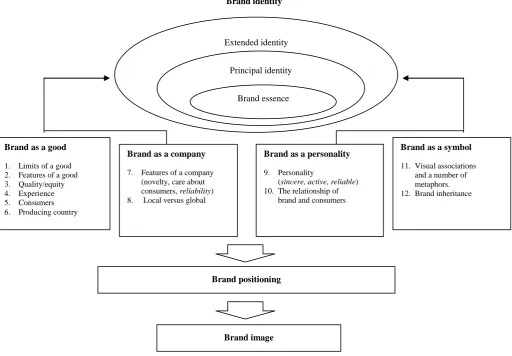
D. Aaker and Joachimsthaler E. (2001) mark the process of brand image development (figure 2).
Figure 2. Modified process of brand image development (D. Aaker and E. Joachimsthaler, 2003:54)
Brand identity
Extended identity
Principal identity
Brand essence
Brand as a good
1. Limits of a good 2. Features of a good 3. Quality/equity 4. Experience 5. Consumers 6. Producing country
Brand as a company
7. Features of a company (novelty, care about consumers, reliability) 8. Local versus global
Brand as a personality
9. Personality
(sincere, active, reliable) 10. The relationship of
brand and consumers
Brand as a symbol
11. Visual associations and a number of metaphors. 12. Brand inheritance
Brand positioning
82 The second picture shows brand identity and the con-ceptions, connected with it. Twelve categories of brand identity elements are enumerated for four purposes: brand – good – good limits, features, quality/equity, experience, consumers, country producer; organizing – company fea-tures, local orientations versus global; personality – brand personality, brand and consumer relationship; sym-bols – a set of visual associations and inherited brand metaphors.
It should be noted that the structure of brand identity consists of principal identity, extended identity and brand essence. Typically, brand identity should possess from six to twelve parameters and only in this case it can re-flect that what should be achieved with a help of a brand. J. Kapferer (2003) singles out the prism of brand identity that determines six elements of brand identity such as physical appearance, personality, culture, relationship, consumer’s self-image and consumer reflection.
According to D. Aaker and Joachimsthaler E (2003), all parameters of principal brand identity should reflect a construction strategy, usefulness and at least one associa-tion that should differentiate the brand and get the atten-tion of consumers. Principal brand identity will not change even though the brand might be transferred to another markets or good categories. If consumers accept the brand according to its principal identity this means that the brand achieved its aim. The principal brand iden-tity reveals to consumers and company employees that what is the most important.
Extended brand identity combines all identity ele-ments that are not included into the primary identity and are subdivided into groups based on their importance. Principal brand, identity contains from two to four pa-rameters that describe brand image narrowly. However, sometimes it is more purposeful to set a more narrow approach that determines brand essence, which can be defined as an idea, entailing a brand’s soul. Researcher J Kapferer (2003) states that brand essence originated from a wish to generalize brand identity and positioning. Brand essence includes the principal value that is offered (for example, Volvo is the safest car).
Summing up theoretical studies of Aaker and Joachimsthaler (2003), Kapferer (2003), Keller (1998), de Chernatony (2001) and other authors it becomes obvi-ous that the rendering of brand identity to consumers plays a significant role in the process of developing posi-tive brand image. the correspondence between brand identities, revealed while building brand image, and the coding of meaning by consumers should exist.
Empirical study of
Fizz
brand identity
Research methodology. The study of brand image employs a general marketing approach. The research process, conducting the investigation of Fizz brand image is based on the marketing research suggested by L. G. Shiffman and L. L. Kanuk (1987). The researchers L. G. Shiffman and L.L. Kanuk suggest starting marketing re-search by setting out the rere-search aims and hypothesis that are formulated afterwards (Hypothesis is an uncon-firmed statement or some possible solution that can be confirmed or denied applying empirical data.). In the
sec-ond stage of brand investigation, secsec-ondary data is gath-ered and analyzed. If data is not sufficient for achieving study objectives, the primary research is devised and will constitute the third stage of the study. Scholars L. G. Shiffman and L.L. Kanuk suggest using qualitative and quantitative studies. First of all the method of qualitative studies is chosen and the interview plan and its place is constructed and scheduled. Gathering of qualitative data and its analysis is completed later on. Qualitative re-search terminates with a report preparation and the results of the research are used for quantitative studies. There-fore, the method of quantitative studies is chosen and tools for quantitative data collection are planned. After the research, the results received are analyzed, presenting final conclusions
The aim of the research is to examine the image of Fizz brand.
The hypotheses formulated are presented below: 1. Fizz brand selection is related to functional
fea-tures of the brand.
2. Fizz brand selection is related to symbolic features of the band.
3. Fizz brand selection is related to experience fea-tures of the brand.
4. Fizz brand consumers chiefly identify themselves with a cheerful, stylish, vigorous and young girl. 5. Principle features of Fizz brand personality are
cheerfulness, vitality and softness.
6. Consumers while drinking cider Fizz image them-selves as a cheerful, youthful, modern and active person.
Design, course and results of qualitative
studies
Research method. For the purpose of conducting this type of study the method of focus group was se-lected. A focus group indicates a method of qualitative data collection when information is gathered during a planned discussion group (V. Dikčius, 2005).
Research place, time and sampling frame. The qualitative research took place in April 15, 2006. The focus group included eight respondents who are the resi-dents of Kaunas city. The responresi-dents selected were stu-dent-girls, aged 21-25, who like drinking cider Fizz. The discussion of a focus group took place in the bar under the name Kokočia and lasted about 45 minutes.
83 Fizz brand associations. Fizz brand is frequently as-sociated with tastiness, apples and pears. In addition to this, the respondents identified the associations of bub-bles, sweetness, ice rocks, straws and quality. Fizz brand is not so much associated with hot summers.
Physical appearance of Fizz brand. Analyzing the opinion of the respondents about the physical appearance of Fizz brand it became clear that the opinions of the ma-jority coincides while stating idea that the logo of Fizz brand catches a consumer’s eye. Most of the participants singled out the sound of Fizz brand name as well as the association of the fizz of the cider. All the participants of the survey unambiguously agreed on the attractiveness of Fizz fruit emblems. One of the members stated that “<…> the perfect fruit emblems make one swallow saliva in the mouth”.
Consumer reflection of Fizz brand. Seeking to ana-lyze a consumer’s reflection as an element of Fizz brand identity the respondents were asked to define the con-sumer of Fizz cider. Most of the participants determined the consumer as a young, 18-25 years old, free, cheerful, vigorous, and willing to relax person. Therefore, it is pos-sible to make an assumption that one of the factors for selecting Fizz cider is a wish to be similar to the con-sumer of Fizz cider.
Besides, it has to be noted that carrying out the inves-tigation of brand consumer reflection, non-target market consumers (of older age), who choose Fizz brand had be questioned in order to find out the reason of their choice. Here it is possible to make an assumption that elder peo-ple consume Fizz cider seeking to be younger, more cheerful and active. However, due to the lack of time and funds, the research with non-target market consumers was not conducted.
Fizz brand relationship with consumers. Analysing the relationship of Fizz brand with consumers it is possi-ble to mark to ways of communication:
• direct communication with brand that is Fizz cider,
• marketing communications.
The majority of the respondents identified direct communication with Fizz cider when defining their con-sumption environment. It is possible to enumerate places of direct communication with the cider, repeated by the respondents. They are an entertaining party, a bar, a cof-fee-bar and nature. In addition, the majority of the par-ticipants identified Fizz cider tins with aluminium foil as the care of Fizz brand consumers.
Examining the second way of communication with consumers it should be noted that the majority of the par-ticipants indicated the advertising of TV and various ac-tions organized. Most of the participants stated that it were good to be aware of the assortment of Fizz cider and it’s production. Besides, the respondents would like to have more information about the caloric content, ingredi-ents and the price. Analyzing sales promotion (various lotteries and actions) as another element of marketing communications the opinions of the respondents were different. Some of them claimed that they would like to see more events, lotteries and games organized (here the
majority of participants identified games with a possibil-ity of winning quickly, in real time and having the prize taken in a market place) while another stated that such events were not so much important for them as they did not participate.
Fizz brand culture. The analysis of Fizz brand culture was related to the culture of the company. Summarizing the opinion of the respondents it is possible to assert that there were two types of opinions prevailing. For some of the members the inner culture, environmental protection, charity and support of Fizz brand producer (Stock com-pany Ragutis) was significant while for others not. It is possible to mark that a part of the respondents greatly emphasized the activity of environment protection. One of the respondents indicated that for her “<…> it was important to be aware of the fact that I choose the product of such a company that takes care of environment protec-tion because <…> the company shows in such a way that it is concerned not only with the profit while polluting the nature”. Another part of the respondents claimed that while purchasing Fizz cider they never thought of envi-ronmental protection, or charity and support activities of the company.
Fizz brand personality. Researching on Fizz person-ality as an element of brand identity the focus group members were asked to characterize Fizz brand as a per-son. The majority of the participants enumerated such features of Fizz brand personality as free, cheerful, youth-ful and vigorous.
Consumer’s self-image of Fizz brand. Aiming to in-vestigate consumer’s self-image the members were re-quested to indicate their personal characteristic features, identifying themselves as Fizz cider consumers. The ma-jority of the respondents stated that drinking Fizz cider they imaged themselves as a cheerful, free, active and independent person. The answers completely coincided with the answers on Fizz brand personality.
Design, course and results of quantitative
studies
Research method. For the purpose of conducting quantitative study of Fizz brand positioning and image survey methods were selected. Survey is a method for gathering marketing data while questioning respondents face-to-face, via the telephone, post or in a mixed way (Urbonavičius S., Pranulis A., Pajuodis A., Virvilaitė R, 2000). This method allows finding out the opinion and attitude of consumers.
Sampling frame and size. Pranulis (1998) defines sampling frame as a part of a unit selected for research that can represent the society and provide the data needed.
Stratified sample includes Lithuanian residents with the age range form 18 to 25. The respondents were ran-domly selected. In such a way 70 students dwelling in Kaunas city were interviewed.
84 Table 4
INDEX NAME QUANTITATIVE EXPRESSION
Size of general unit, N 300 000
Sampling size, n 399
Probability of reliability, P 0.95
Selection bias, ∆ 0.05
Due to the fact that the study was carried out just by one person and the amount of time and funds needed to interview 399 respondents it was decided to interview 70 respondents.
Survey place and time. A mixed type survey method was employed for the study. Some of the respondents interviewed were master students from the faculty of
Economics and Management in Kaunas University of Technology. The respondents were given the naires during their lectures. Another part of the question-naires was emailed. The survey took place in April 2006. Study results. Functional benefit of Fizz brand. The third figure presents the selection of cider Fizz, in-fluenced by functional benefit. It is obvious that the strongest qualities of Fizz brand are perfect taste, a rea-sonable price and good flavour. It was agreed with these qualities by 77 %, 71% and 65% of the respondents. Thus, it is possible to note that physical appearance of the brand gets lower attention, though a bigger part of the respondents (53%) claimed that their choice was influ-enced by the appearance of a bottle or a tin, while another part of the respondents (41%) had no opinion regarding the attractiveness of Fizz brand logo and its colours. Still the same percentage of the respondents indicated that their choice was affected by attractive logos and colours of Fizz brand.
Figure 3. Evaluation of functional qualities of Fizz brand
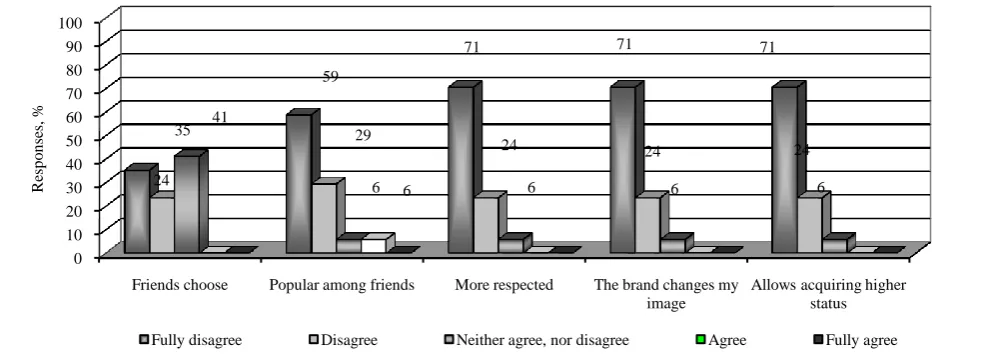
Symbolic benefit of Fizz brand. Figure 4 exhibits the selection of Fizz brand, influenced by symbolic bene-fit. The figure shows that the choice of Fizz brand is not conditioned by symbolic benefit. The majority of the
re-spondents unambiguously stated that the choice of Fizz brand did not influence the popularity of the respondents, respect of their friends, higher social status or image of the respondents.
Figure 4. Evaluation of symbolic qualities of Fizz brand
0 10 20 30 40 50 60 70 80 90 100
Perfect taste Perfect flavour Hight quality Good price Nice tin, bottle Attractive
emblem, colours
6 6
12
6 6
18
6 18
24
41
29 29
41 53
47
29
59
35
41
24 24
12 6
18
12
R
esp
o
n
se
s,
%
Fully disagree Disagree Neither agree, nor disagree Agree Fully agree
0 10 20 30 40 50 60 70 80 90 100
Friends choose Popular among friends More respected The brand changes my
image
Allows acquiring higher status 35
59
71 71 71
24
29
24 24 24
41
6 6 6 6 6
R
esp
o
n
se
s,
%
85 Experience benefit of Fizz brand. Figure 5 reveals the choice of Fizz brand conditioned by experience benefit. Ex-amining the results it is possible to note that the majority of the respondents do not associate the choice of Fizz brand with experience benefit. It is possible to single out two qualities of Fizz brand that are associated with consumer experience. They are possibility to relax and the provision of cheerfulness. Correspondingly 41 % and 35% of the
respon-dents agreed with such qualities. Besides, the majority of the respondents had no opinion about this type of Fizz brand features, conditioned by experience benefit.
Fizz brand consumer’s self-image. Figure 6 indi-cates consumer’s self-image of Fizz brand. The figure shows that the respondents, consuming the cider chiefly identify themselves as a cheerful, modern, active, youth-ful, emotional, and informal citizen consumer.
Figure 5. Evaluation of experience qualities of Fizz brand
Figure 6. Evaluation of Fizz brand consumer’s self-image
Figure 7. Evaluation of Fizz brand personality
0 10 20 30 40 50 60
Easier to relax Easier to
socialize
Easier to forget worries
Life becomes better
Provides more peace
More self-confidence
Become happier 12
24 24 24
29
29
18
12
24
47
41 41
53
18
35 35
29
24
24
12
29 41
18
12
6 6
29
6
R
esp
on
de
nt
ų
at
s.,
%
Fully disagree Disagree Neither agree, nor disagree Agree Fully agree
0 10 20 30 40 50 60 70
Cheerful Innovatuive Natural Self-confident Sexual Vigorous Soft Light Youthful Tasteful Social
Fully disagree Disagree Neither agree, nor disagree Agree Fully agree
Cheerful - - - - - - - Sad
Modern - - - - - - - Old fashioned
Male
- - - - - - - Female
Active - - - - - - - Passive Youthful - - - - - - - Mature Emotional - - - - - - - Rational
Saving - - - - - - - Spending
Popular - - - - - - - Unpopular
Relaxed - - - - - - - Tense
Impulsive - - - - - - - Careful Citizen - - - - - - - Countryman Conservative - - - - - - - Liberal
Formal - - - - - - - Informal
Soft - - - - - - - Rough
86 Fizz brand personality. Figure 7 presents the per-sonality of Fizz brand. The figure provides the idea that the majority of the respondents agrees or completely agrees with the statement that Fizz brand is youthful (88%), light (59%), cheerful (59%), vigorous (59%), tasteful (53%) and soft (53%). In addition, a bigger part of the participants disagrees with sexuality as a personal-ity feature of Fizz brand. The opinions of the respondents differentiated mentioning such features as naturalness, innovations, sociability and self-confidence and some of the respondents claimed that they agreed the brand to have the mentioned features of Fizz brand personality, while others disagreed, and the percentage of the answers was practically similar. Summarizing it can be mentioned that there is no common opinion about personality fea-tures of Fizz brand.
Fizz brand consumer reflection. It is obvious that Fizz consumer would like to be a cheerful, young, stylish,
energetic and sport-like woman who is a show star, sur-rounded by friends.
Fizz brand relationship. Figure 8 presents the evaluation of Fizz brand relationship with consumers, emphasizing marketing communications. The figure clearly indicates that consumers evaluate advertising most of all and 59% of the respondents stated that ad-vertising was important or very important. The evalua-tion of various loyalty programs is lowest as 65% of the respondents claimed that loyalty programs were unim-portant or not imunim-portant. Examining price discounts and the importance of the actions organized a part of the respondents regarded it to be important and very impor-tant while another indicated it as unimporimpor-tant and not important. However Fizz price discounts are still imptant for 53% of the respondents, but various actions or-ganized are not important for the same percent of the respondents.
Figure 8. Evaluation of Fizz brand relationship with consumers.
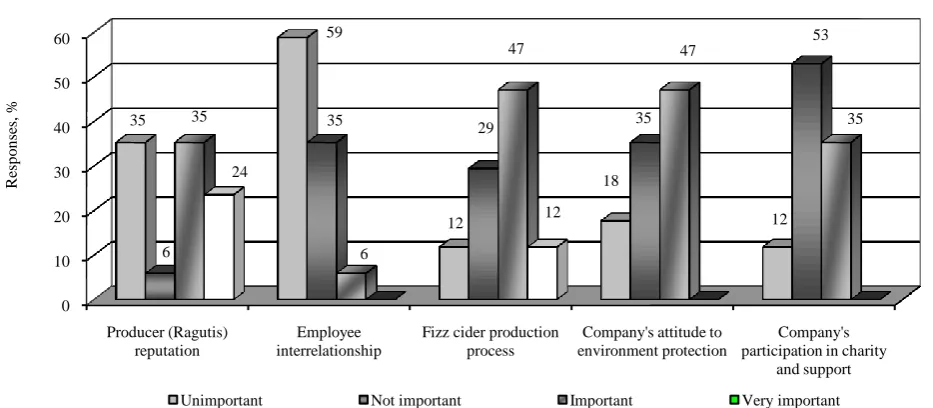
Figure 9. Evaluation of Fizz brand culture
0 5 10 15 20 25 30 35 40 45 50
Advertising Lotteries and actions
organized
Price discounts Loyalty programs
18
24
18 18
24
29 29
47 47
29 29 29
12
18
24
6
R
esp
o
n
se
s,
%
Unimportant Not important Important Very important
0 10 20 30 40 50 60
Producer (Ragutis) reputation
Employee interrelationship
Fizz cider production process
Company's attitude to environment protection
Company's participation in charity
and support 35
59
12
18
12
6
35 29 35
53
35
6
47 47
35
24
12
R
esp
o
n
se
s,
%
87 Fizz brand culture. Figure 9 provides the evaluation of Fizz brand culture. Fizz brand culture is associated with company’s culture. The figure clearly shows that consumers evaluate the reputation of the company and the process of cider Fizz production very much (59% of the respondents marked it as important or very impor-tant). Besides, company’s activity for environment pro-tection seems to be important for choosing cider for al-most a half of the respondents(47%). The participation of the company in various support and charity events and employee interrelationship appeared to be the least im-portant. 65% and 94% of the respondents marked it as unimportant or not important.
After the completion of empirical research of Fizz brand positioning and Fizz brand image it is possible to provide the following summarizing of the results:
The majority of the respondents claimed the choice of Fizz brand to be conditioned by perfect taste, a reasonable price and a good flavour. Therefore, the first hypothesis is confirmed, stat-ing that the choice of Fizz brand is based on func-tional benefit of the brand.
The respondents unambiguously claimed that the selection of Fizz brand is not associated with higher status, higher respect from friend and other symbolic features of Fizz brand benefit. Therefore, the second hypothesis is not confirmed and it is possible to make an assumption that the choice of Fizz brand is not conditioned by symbolic benefit of the brand.
The majority of the respondents did not associate the choice of Fizz brand with experience benefit; however, evaluating separate features of Fizz brand experience benefit such as becoming more cheerful or relaxed it can be noted that the major-ity of the respondents agreed and had no opinion. Thus, it is possible to state the partial confirmation of the third hypothesis.
The consumer of Fizz cider would like to imagine herself as a cheerful, young, stylish, vigorous, sport-like woman and a show star, surrounded by friends. This allows confirming the fourth hy-pothesis.
Fizz brand personality features that were singled out most of the time were youthfulness, lightness, cheerfulness, vigorousness, tastefulness and soft-ness. This confirms the fifth hypothesis.
The respondents consuming Fizz cider associated themselves with a cheerful, modern, vigorous, youthful, emotional and informal citizen con-sumer. This confirms the sixth hypothesis.
Recommendations for strengthening Fizz brand image: Taking into consideration the fact that the choice
of Fizz cider is based on functional benefit and paying attention to the quality and the taste, the producer should seek for the highest quality, use natural ingredients and implement the standards of global quality management in the company. The company should implement the system of
en-vironment protection, due to the fact that consum-ers are more and more interested in the company’s culture while choosing Fizz cider.
Seeking for successful communication with con-sumers the following marketing communications means could be used: advertising on TV, Internet, and the press and in the market place; promotion while organizing actions, momentary games, where prizes are taken immediately, price dis-counts and various actions with bars, clubs and restaurants.
Within the positioning statement it should be em-phasized that Fizz is devoted to cheerful, rampa-geous and independent youth, and is characterized by light, fresh and soft taste, is of high quality and a reasonable price.
Taking into consideration that all consumers, drinking Fizz, identify themselves with a young, cheerful, stylish, vigorous girl, surrounded by friends, who should be depicted in advertisements. Consumers should be informed about the produc-tion process, calories and assortment of Fizz cider. Bearing in mind the fact that consumers conceive
Fizz brand not only as light, tasteful and youthful but cheerful, vigorous and soft, the producer should organize parties in bars, clubs and restaurants, emphasizing Fizz cider as the drink of the party.
Conclusions
After the completion of theoretical studies of brand image formation, the following conclusions can be made:
After the analysis of the conception and models of brand image, provided by various authors, it was noted that the majority of authors identified func-tional and symbolic dimensions of brand image. Besides, brand image was associated with experi-ence while consuming a particular brand.
Summarizing the opinion of various authors, it is possible to conclude that the choice of brand posi-tioning strategy is connected with brand identity. Positioning is exploited as the aspect of specific identity in a certain time, market and against accu-rately defined competitors.
Analyzing the identified processes of brand image building it was noted that decisions, connected with positive brand image were suitable only then when consumers understood brand identity cor-rectly.
After the completion of empirical studies of Fizz-brand identity and image relationship the following con-clusions can be made:
The choice of Fizz brand is conditioned by func-tional brand benefit. The majority of the respon-dents claimed that the selection of Fizz brand was influenced by perfect taste and flavour.
88 stated that they did not identify the choice of Fizz brand with a higher status, bigger respect from friends or other symbolic features of Fizz brand benefit.
The choice of Fizz brand is partially associated with experience benefit, due to the fact that a big part of the respondents indicated such features of experience benefit as becoming more cheerful or relaxed.
Enumerating consumer’s reflection it has to be stated that the consumer of Fizz cider would like to see herself as a cheerful, young, stylish, vigor-ous, sport-like woman – show star, surrounded by friends.
The following features of Fizz brand personality were indicated in the majority of cases. They were youthfulness, lightness, cheerfulness, vigorous-ness, tastefulness and softness.
Fizz brand has a meaningful name, positive associations, attractive logotype and colourful emblems.
The respondents, while consuming Fizz cider, identify themselves with a cheerful, modern, active, youthful, emotional and informal citizen consumer.
Consumers evaluate the reputation of the company the production process of Fizz cider most of all. It can be stated that a big part of the respondents is interested in environment protection activity of the company.
Advertising and price discounts are evaluated most of all in the relationship of Fizz brand and con-sumers. Loyalty programs and price discounts are not important.
References
1. Aaker, D. Building strong brands. New York: The Free Press,
1996.
2. Aaker, D. Brand Leadership/ D.Aaker, E. Joachimsthaler. New
York: The Free Press, 2000 (translated into Russian in 2003).
3. Urbanskienė R. Prekės, jos ženklo ir vartotojų santykių reikšmė
įmonės veiklai marketingo kultūros požiūriu/ R. Urbanskienė,D. Aleliūnaitė // Inžinerinė ekonomika – Engineering Economics./ Kaunas: Technologija, 2000, p. 40-45.
4. Amber, T. Do brands benefit consumers? // International Journal of
Advertising, 1997, No. 16, p.167-198.
5. Bhat, S. Symbolic and functional positioning of brands / S. Bhat, S.
Reddy //Journal of Consumer Marketing, 1998, No 1, p. 32-43.
6. Bhat, S. Symbolic and functional positioning of brands / S. Bhat, S.Reddy //Journal of Consumer Marketing, 1998, No 1, p. 2-43.
7. Crimmins, J.C. Better measurement and management of brand
value //Journal of Advertising Research, 1992, No 4, p.11-19.
8. de Chernatony, L. From Brand Vision to Brand Evaluation,
Lon-don. 2001.
9. de Chernatony, L. Corporate branding and corporate brand
perfor-mance / L. de Chernatony, F. Harris. //European Journal of Market-ing, 2001, No.3/4, p. 441-456.
10. de Chernatony, L. Brand management through narrowing the gap
between brand identity and brand reputation // Journal of Market-ing Management, 1999, No 15, p. 157-79.
11. de Chernatony, L. Defining a `brand': beyond the literature with experts' interpretations / L. de Chernatony, F. Dall'Olmo Riley // Journal of Marketing Management, 1998, No 14, p. 417-43.
12. de Chernatony, L. Customer and brand manager perspectives on
brand relationships: a conceptual framework / L. de Chernatony, C. Jevons, M. Gabbott // Journal of Product & Brand Management, 2005, No.5, p. 300–309.
13. Grace, D. Brand associations: looking through the eye of the be-holder / D. Grace, A. O’Cass // An International Journal, 2002, No 2, p.96-111.
14. Grundey D.,Prekės ženklo formavimas ir prekės identifikavimas:
strategijų parinkimas ir vertinimas // Ekonomika: mokslo darbai, 2002, p. 30 –52.
15. Hankinson, G. Destination brand images: a business tourism
pers-pective //Journal of Services Marketing, 2005, No 1, ·p 24–32.
16. Hassan, S. Linking global market segmentation decisions / S. Hassan,
S. Craft // Journal of Consumer Marketing, 2005, No 2,· p. 81–89
17. Holley, G. Market -Focused resources, competitive positioning and
firm performance / G. Holley, G. Greenley, J. Fahy and J. Cadogan //Journal of Marketing Management,2001, No 5/6, p 503-520.
18. Hsieh, M. Universal appeals with local specifications / M. Hsieh, A. Lindridge // Journal of Product & Brand Management, 2005, ·No 1, p.14–28.
19. Kapferer, J.N. Strategic Brand Management. Kogan Page, New
York, NY and London: Kogan Page, 1997.
20. Kapferer, J.N. The New Strategic Brand Management. London:
Kogan Page, 2003
21. Keller K. L. Strategic Brand Management: Building, Measuring
and Managing Brand Equity. Prentice Hall, New Jersey: Prentice Hall, 2003.
22. Keller, K. Measuring brand power: validating a model for
optimiz-ing brand equity / K. Keller, W. B. Na; R. Marshall //Journal of Product & Brand Management, No 8, 1999, p. 170-184.
23. Low, G. The measurement and dimensionality of brand
associa-tions / G.Low, Ch. Lamb // Journal of Product & Brand manage-ment, 2000, p. 350-368.
24. Park, C. Strategic brand concept management / C. Park, B.
Jawors-ki, D. MacInnis // Journal of Marketing, 1986 p. 135.
25. Ries, A. Positioning: The Battle for Your Mind / A.Ries, J. Trout. New York: McGraw-Hill, 1986.
26. Rossiter, J. Advertising Communications and Promotion
Manage-ment / J. Rossiter, L. Percy. New York: McGraw Hill, 1997
27. Sheinin, D.A. Positioning brand extensions: implications for beliefs
and attitudes // Journal of Product & Brand Management, 1998, No 2, p. 137-149.
Vytautas Janonis, Regina Virvilaitė
Prekės ženklo įvaizdžio formavimas
Santrauka
Įmonė, norinti rinkoje pasiekti geresnių rezultatų nei konkuren-tai, turi įgyti ir išlaikyti unikalumą, kurio negalima imituoti ir kuris suteiktų konkurencinį pranašumą. Vienas iš tokių sunkiai imituojamų išteklių yra įmonės turimas prekės ženklas.
Prekės ženklas pats savaime neužtikrina įmonės konkurencinio pranašumo rinkoje. Gerų rezultatų pasiekia tik įmonės, sugebančios valdyti prekės ženklą, perteikiant jo identitetą, apibrėžiant jo elemen-tus, unikalumą bei vertę. Prekės ženklo įvaizdžio kūrimas ir stiprini-mas padeda įmonei išlaikyti pozicijas rinkoje intensyvios konkurenci-jos sąlygomis.
89 pagrindinių priemonių konkurencinėje kovoje. Kadangi vartotojų požiūris į prekės ženklą turi didelę įtaką vartotojo elgsenai, būtina didinti prekės ženklo vertę. Siekiant, kad vartotojas pasirinktų būtent šios įmonės prekę iš daugelio siūlomų rinkoje, įmonei būtina išskirti prekę iš konkurentų, atlikus prekės ženklo įvaizdžio teorinius ir empi-rinius tyrimus.
Problema. Kaip formuoti teigiamą prekės ženklo įvaizdį.
Straipsnio objektas – prekės ženklo įvaizdžio formavimo procesas.
Straipsnio tikslas – teoriškai išnagrinėjus prekės ženklo įvaiz-džio formavimo procesą, atlikti prekės ženklo įvaizįvaiz-džio tyrimą ir pateikti įvaizdžio stiprinimo rekomendacijas
Straipsnio uždaviniai:
Apibrėžti ir teoriškai pagrįsti prekės ženklo įvaizdžio
sam-pratą..
Išanalizuoti prekės ženklo prekės ženklo įvaizdžio
formavi-mo procesą.
Atlikti prekės ženklo įvaizdžio tyrimą
Pateikti prekės ženklo įvaizdžio stiprinimo rekomendacijas
Tyrimo metodika. Sisteminė bei lyginamoji mokslinės literatū-ros analizė, antrinių duomenų analizė, kokybinis bei kiekybinis tyri-mai. Kokybiniame tyrime naudojamas fokusuotos grupės metodas, kiekybiniame tyrime naudojamas anketinės apklausos metodas.
Prekės ženklo įvaizdžio samprata
Marketingo literatūroje daug dėmesio skiriama prekės ženklo įvaizdžiui. Prekės ženklo įvaizdis nagrinėjamas dviem požiūriais –
įmonės ir vartotojo požiūriai: įmonės požiūris, orientuotas į marke-tingo veiklos pagerinimą, susijusį su pozicionavimo strategijomis bei teigiamo prekės ženklo įvaizdžio išlaikymu. Vartotojo požiūris- tai vartotojų pagrįstas požiūris, kuris orientuojasi į prekės ženklo įvai z-džio interpretacijas ir prekės ženklo vertę. Prekės ženklo reikšmė rinkoje priklauso nuo įmonės sugebėjimo įvertinti, kaip vartotojai interpretuoja prekės ženklo įvaizdį, ir nuo įmonės gebėjimo valdyti prekės ženklo pozicionavimo strategiją adekvačiai perteikiant varto-tojui vertę. Marketingo literatūroje esama daugelio prekės ženklo įvaizdžio apibrėžimų. Keller (1998), Aaker (2002) nuomone, prekės ženklo įvaizdis yra susijęs su asociacijomis, kurios atsispindi vartoto-jo sąmonėje.
Daugelyje modelių asociacijos grupuojamos į dvi kategorijas:
funkcines asociacijas – apčiuopiami prekių ar paslaugų požymiai;
emocinės ar simbolinės asociacijos – neapčiuopiami požymiai, at-spindintys vartotojo poveikį socialiniam pritarimui, saviraiškai ar savigarbai (Keller, 1998; Hankinson ir Cowking, 1993; de Chernato-ny, 1989). Kiti autoriai (Keller 1998; Park,1986) pateikia ir trečiąją kategoriją – patyrimą. Šios asociacijos siejamos su tuo, ką vartotojai jaučia vartodami prekę ar paslaugą, bei su vidinio poreikio stimuliaci-ja ar įvairovės patenkinimu (Park, 1986).
Keller (1993; 1998) prideda dar vieną asociacijų kategoriją – prekės ženklo samprata, kuri apima visą vartotojų prekės ženklo įvertinimą. Prekės ženklo asociacijos yra svarbios vystant prekės ženklo strategiją. Aaker (1997) teigia, kad prekės ženklo asociacijos turi reikšmes ir jos turi būti grupuojamos. Šios reikšmės turi apibrėžti prekės ženklo pozicionavimą. Taigi gerai pozicionuojami prekių ženklai pateikia patrauklų stiprių asociacijų rinkinį.
Prekės ženklo įvaizdžio kūrimo procesas
Apibrėžiant prekės ženklo įvaizdžio kūrimą, reiktų pažymėti, kad stiprus prekės ženklas turi turėti turtingą ir aiškų identitetą, kuris būtų adekvačiai perteikiamas tikslinei rinkai. Įvaizdis turi perteikti prekės ženklo koncepciją su realia patirtimi, atitinkančia prekės ženk-lo supratimą. Dabartinis vartotojas ieško ir nori patirti ką nors unika-laus ir ypatingo, susijusio su prekės ženklu. Prekės ženklo įvaizdžio neatitiktis vartotojo lūkesčiams suteikia progą veikti konkurentams.
Prekės ženklo identitetas apima norimą prekės ženklo reikšmę, kuri būtų atkoduojama tikslinėje rinkoje. Norint veikti efektyviai, prekės ženklo identitetas turi skirtis nuo konkurentų ir turi būti ku-riamas taip, kad būtų suprantamas vartotojams.
Park (1986) teigia, kad prekės ženklo sėkmė rinkoje ilgam laiko-tarpiui priklauso nuo prekės ženklo identiteto pasirinkimo, identiteto naudojimo įvaizdžiui kurti užtikrinimo, kad prekės ženklo įvaizdis
adekvačiai perteikia įmonės pasirinktą prekės ženklo identitetą, išski-riant iš konkurentų ir reaguojant į norimą vartotojų vertę.
Pažymėtina, kad prekės ženklo identiteto struktūra susideda iš pagrindinio identiteto, išplėsto identiteto ir prekės ženklo esmės. Tipiniu atveju prekės ženklo identitetas turi turėti nuo 6 iki 12 para-metrų. Tik tuo atveju jis adekvačiai atspindi tai, kuo prekės ženklu norima pasiekti. Kapferer (2003) iškiria prekės ženklo identiteto prizmę, kuri apibūdina šešis prekės ženklo identiteto elementus: pre-kės ženklo fizinę išvaizdą, asmeniškumą, kultūrą, santykius bei varto-tojo savivaizdį ir vartovarto-tojo atspindį.
Apibendrinant teorines Aaker ir Joachimsthaler (2003), Kapfe-rer (2003), Keller (1998), de Chernatony (2001) ir kitų autorių studi-jas, galima teigti, kad nėra abejonės, jog formuojant teigiamą prekės ženklo įvaizdį esminę reikšmę turi prekės ženklo identiteto perteiki-mas vartotojui.
Prekės ženklo įvaizdžio empirinis tyrimas
Tyrimo metodologija. Prekės ženklo įvaizdžio tyrimuose
taiko-mos bendrosios marketingo tyrimų metodologinės nuostatos.
Atlik-dami Fizz prekės ženklo įvaizdžio tyrimą, remsimės Shiffman ir
Ka-nuk (1987) siūlomu marketingo tyrimo proceso nuoseklumu.
Shif-fman ir Kanuk marketingo tyrimą siūlo pradėti tikslų ir hipotezių
nustatymu. Tai atlikus, formuluojamos hipotezės. Antrajame prekės ženklo įvaizdžio tyrimo proceso etape renkami antriniai duomenys bei atliekama jų analizė. Jeigu tyrimo tikslams pasiekti šių duomenų nepakanka, projektuojamas pirminis tyrimas. Tai trečiasis marketingo tyrimo etapas. Shiffman ir Kanuk siūlo kokybinius ir kiekybinius tyrimus. Pirmiausia pasirenkamas kokybinio tyrimo metodas, sud a-romas pokalbio planas ir numatoma jo aplinka. Toliau renkami kok y-biniai tyrimo duomenys bei atliekama analizė. Kokybinis tyrimas baigiamas ataskaitos parengimu. Atlikto kokybinio tyrimo rezultatai naudojami projektuojant kiekybinį tyrimą. Parenkamas kiekybinio tyrimo metodas, sudaromas tyrimo planas ir numatomos duomenų rinkimo priemonės. Atlikus tyrimą, analizuojami gauti rezultatai ir pateikiamos išvados.
Tyrimo tikslas – ištirti Fizz prekės ženklo įvaizdį. Hipotezės:
1. Fizz prekės ženklo pasirinkimas siejamas su prekės ženklo
funkcinėmis savybėmis.
2. Fizz prekės ženklo pasirinkimas siejamas su prekės ženklo
simbolinėmis savybėmis.
3. Fizz prekės ženklo pasirinkimas siejamas su prekės ženklo
patyriminėmis savybėmis.
4. Fizz prekės ženklo vartotojas save įsivaizduoja kaip linksmą
stilingą, energingą jauną merginą.
5. Pagrindiniai Fizz prekės ženklo asmeniškumo bruožai yra
linksmumas, energingumas švelnumas.
6. Vartotojai, gerdami sidrą Fizz, save įsivaizduoja kaip links-mą, jaunatvišką, šiuolaikišką, aktyvų žmogų.
Kokybinių tyrimų projektavimas, eiga ir rezultatai
Tyrimo metodas. Šiam tyrimui atlikti buvo pasirinktas fokusuotos grupės metodas.
Tyrimo vieta, laikas ir imties atranka. Kokybinis tyrimas vyko 2006 metų balandžio mėnesyje. Fokusotoje grupėje dalyvavo 8 kaune
gyvenančios respondentės studentės, geriančios sidrą Fizz, jų amžius nuo
21 iki 25 metų. Diskusija vyko bare Kokočia. Fokusuotos grupės
diskusi-jos vyko apie 45 min.
Kiekybinių tyrimų projektavimas, eiga ir rezultatai
Tyrimo metodas. Kiekybiniams Fizz prekės ženklo
poziciona-vimo bei Fizz prekės ženklo įvaizdžio tyrimams pasirinkta apklausa.
Imties atranka ir dydis. Tyrimo generalinė visuma – tai Lietu-vos gyventojai, kurių amžius nuo 18 iki 25 metų. Respondentai at-rinkti atsitiktinės netikimybinės apklausos būdu. Apklausti 70 kaune gyvenančių studentų.
Apklausos vieta ir laikas. Apklausiama buvo mišriuoju būdu. Viena dalis respondentų pasirinkta iš Kauno technologijos universit e-to, Ekonomikos ir vadybos fakulteto magistrantų. Kita dalis anketų
išsiųsta elektroniniu paštu. Atlikus Fizz prekės ženklo pozicionavimo
90
tokius rezultatų apibendrinimus:
Didžiosios dalies respondentų nuomone, Fizz prekės ženklo
pasirinkimą lemia puikus skonis, prieinama kaina, puikus
aromatas. Pirmoji hipotezė pasitvirtino. Fizz prekės ženklo
pasirinkimas remiasi funkcine šio prekės ženklo nauda.
Respondentai beveik vienareikšmiškai tvirtino, kad Fizz
pre-kės ženklo pasirinkimas nesietinas nei su aukštesniu statusu, nei su didesne draugų pagarba, nei su kitomis simbolinės
Fizz prekės ženklo naudos savybėmis. Antroji hipotezė
nepa-sitvirtino. Fizz prekės ženklo pasirinkimas nėra siejamas su šio prekės ženklo simboline nauda.
Didžioji dalis respondentų nesieja Fizz prekės ženklo
pasi-rinkimo su patyrimine nauda, tačiau įvertinant tokias atskiras
Fizz prekės ženklo patyriminės naudos savybes, kaip tapimą
linksmesniu ar atsipalaidavimą, galima pastebėti, kad nemaža dalis respondentų pritarė ir neturėjo nuomonės. Trečioji hipo-tezė dalinai pasitvirtino.
Labiausiai Fizz sidro vartotojas save norėtų matyti kaip
linksmą, jauną, stilingą, energingą, sportišką, moterį- šou žvaigždę, esančią draugų būryje. Tai leidžia patvirtinti ket-virtąją hipotezę.
Labiausiai išskiriami Fizz prekės ženklo asmeniškumo
bruo-žai: jaunatviškumas, lengvumas, linksmumas, energingumas, skoningumas, švelnumas. Tai leidžia patvirtinti penktąją hi-potezę.
Respondentai, vartodami Fizz sidrą, dažniausiai save sieja su
linksmu, šiuolaikišku, aktyviu, jaunatvišku, emocionaliu, ne-formaliu, miestiečiu vartotoju. Tai leidžia patvirtinti šeštąją hipotezę.
Fizz prekės ženklo įvaizdžio stiprinimo rekomendacijos:
Atsižvelgiant į tai, kad Fizz sidro pasirinkimas remiasi
funk-cine nauda išskiriant kokybę bei skonį, siekti aukščiausios kokybės naudojant natūralias medžiagas, įgyvendinant visuo-tinės kokybės vadybos standartus įmonėje.
Įmonė turėtų siekti įdiegti aplinkosauginę sistemą, kadangi
varto-tojai rinkdamiesi Fizz sidrą vis labiau domisi įmonės kultūra.
Siekiant sėkmingo komunikavimo su vartotojais, naudoti šias
marketingo komunikacijos priemones: reklamą – televizijoje,
internete, spaudoje bei pardavimo vietose; pardavimų
skati-nimą– rengiant akcijas, momentinius žaidimus, kuriuose
pri-zus galima atsiimti iškart, kainų nuolaidų akcijas kartu su ba-rais, klubais bei restoranais.
Pozicionavimo teiginyje pabrėžti tai, kad sidras Fizz skirtas
linksmam, šėliojančiam, nepriklausomam jaunimui, išsiskiria lengvu, gaiviu ir švelniu skoniu, yra aukštos kokybės ir yra prieinamos kainos.
Atsižvelgiant į tai, su kuo vartotojai save tapatina, sidro Fizz,
reklamoje turėtų būti vaizduojama linksma, jauna, stilinga, energinga mergina draugų būryje.
Vartotojai turėtų būti informuojami apie sidro Fizz gamybos
procesą, sudėtį, kaloringumą bei asortimentą.
Atsižvelgiant į tai, kad vartotojai suvokia Fizz prekės ženklą
ne tik kaip lengvą, skoningą, jaunatvišką, bet ir linksmą, energingą ir švelnų, organizuoti vakarėlius baruose,
klubuo-se, restoranuoklubuo-se, akcentuojant vakaro gėrimą – sidrą Fizz.
Raktažodžiai: prekės ženklo įvaizdis, prekės ženklo identitetas, prekės ženklo pozicionavimas.
The article has been reviewed.