*Corresponding author email: [email protected] DOI : 10.21608/ejss.2017.1271.1113
©2017 National Information and Documentaion Center (NIDOC)
37
Introduction Maize is one of the most important cereal crops in Egypt that ranks as the third crop after wheat and rice. It is used as a human food and animal feed. It is characterized by a high potential of biomass and grain yield, furthermore it uptakes great amounts of nutritive elements from the soil. The role of magnesium as one of the essential nutrients for plant growth; is being a component of the chlorophyll molecule; it serves as a cofactor in most enzymes that activate phosphorylation processes as a bridge between pyrophosphate structures of ATP or ADP, DNA, RNA and the enzyme molecule; and it is essential for amino acids and fat synthesis (Mengel and Kirkby, 2001). Nevertheless, such element received little attention terms of fertilization. Kacar and Katkat (2007) noticed that chemical fertilizers produced through developing technology do not include Mg, although growing recently developed varieties of plants, having high nutritional elements uptakes besides their ability to remove higher amounts of nutrients from soil.
Impact of Magnesium Fertilization on Yield and Nutrients Uptake
by Maize Grown on two Different Soils
R. A. El-Dissoky*, Faten A. Al-Kamar and R. M. Derar
Soils, Water and Environment Res. Inst., Agric. Res. Center, Giza, Egypt
M
AGNESIUM deficiency occurs as a result to its low content in soil, competition with other cations especially calcium and potassium and its removal by crops. This study was conducted to investigate the effect of applying magnesium at various rates and methods: as a soil application , i.e. 0, 25, 50, 75 and 100 kg magnesium sulphate fed-1, and as foliar spray of 0.25 and 0.5% Mg twice on maize yieldcomponents, nutrient status and uptake and the relationships between Mg and both K and Ca for maize grown on two different soils during two summer growing seasons of 2015 and 2016. The first experiment was carried out in clay loam soil at Talkha District, Dakahlia Governorate (31° 16’ 72.71” N, 31° 46’ 25.80” E), and the second
in sandy soil at Ismailia Agricultural Research Station (30.6° 35’ 30” N, 32.2° 14’ 50” E), Egypt. Results showed that the application of Mg-rates significantly increased grain and stalk yields, 100-grain weight, grain content of oil, protein, P, K, Ca, Mg, Mn and Zn, and the uptake of N, P, K, Ca, Mg, Fe, Mn and Zn by stalk yield, with the superiority for Mg-rates 50 Kg fed-1 and 0.5% Mgfoliar spray in clay loam soil, and
for the rate 75 Kg fed-1 in sandy soil. Relationships between Mg and K or Ca at ear
leaf demonstrated that K:Mg and Ca:Mg ratios increased with the foliar spray of Mg and soil addition of Mg-rates up to 50 kg fed-1 in both soils.
Keywords: Magnesium fertilization, Maize yield, Soil texture and Nutrient relationships and Uptake.
Symptoms of Mg deficiencies on plants could be related to other nutrient status in soil. Gunes et al. (2002) stated that not only Mg deficiency occurs from lower amount of Mg in soil, but also due to competition with other cations such as H+, K+, NH
4+, Ca++ and Mn++. Schulte (2004) demonstrated that deficiency of Mg appears in sandy soils at the application of high rates of K+
and NH4+ fertilizers, since high concentrations
of these cations in the soil solution interfere (antagonistic effect) with Mg uptake by plants, and usually does not occur when the soil contains more exchangeable Mg than exchangeable K. He added that the optimum soil test levels for available Mg are 51-250 ppm for sandy soils and of 101-500 ppm for all other soils.
Jacobsen (1993) stated that K:Mg and Ca:Mg ratios are important for balanced Mg nutrition. When the supply of potassium is insufficient, the rate of Mg uptake by plants also decreases, but on the other hand, the too excessive doses of potassium fertilizers negatively influence nutrient balance in the plant. Kovacevic et al. (2004) showed that high correlations were found between ear-leaf Mg (negative correlations) and ear-leaf K as well as ear-leaf Ca (positive correlations). They found that the share of Mg in the sum of K+Ca+Mg among the tested corn hybrids ranged from 9.3 to 21.3%, also K:Mg ratio in the ear leaf ranged from 1.78 to even 6.56, whereas Ca:Mg ratio has less variable property than K:Mg ratio since the values ranged from 1.94 to 3.44. Fertilization programs in Egypt for almost crops neglected application of Mg as a macronutrient. However, many studies showed the importance of magnesium fertilization for increasing crops productivity. Under the Egyptian conditions, Darwish et al. (1997) found that the application of MgSO4 as soil or foliar application resulted in significant increases in 100-seed weight, seed and oil yields of sun flower as well as seed contents of protein and oil. On clayey soil, Ashoub et al. (2003) found that applying magnesium sulphate fertilization of 7.5 or 15 Kg fed-1 as soil application, or twice foliar spray applications of 0.5 or 1.0% caused significant increases in the dry matter per plant at the age of 49 days, the head diameter, the weight of 100 seeds, the seed yield per plant, seed, straw and biological yields fed-1 with the exception of 7.5
kg fed-1. Badran et al. (2004) studied the growth
of wheat grown on calcareous soil, and reported that the highest grain, straw and protein yields,
plant height, 1000-grain weight and grain minerals content (N, P, K and Mg) were gained by the application of 75 kg N fed-1 under foliar
spraying of 400 L fed-1 magnesium sulphate 6%
solution.
Barlog and Frackowiak-Pawlak (2008) found that potassium fertilization increased the average maize grain yield by 2.3%, but the marked grain yield increase was reached owing to the application of both K and Mg at the rates 150 and 16.3 kg ha-1, respectively in the field
studies in loamy sand to loamy soils. Szulc (2009) showed that the highest N, K and Mg contents in dry plant matter (37.0, 42.18 and 2.65 g kg-1, respectively) were found by maize
fertilized with 15 kg Mg ha-1 applied in rows,
in comparison with 0 kg and 15 kg Mg ha-1
broadcasting. Rasul et al. (2011) found that the application of 80 kg Mg ha-1 as MgSO
4.7H2O
and 140 kg P ha-1 recorded the highest value
of grain yield (5605.2 kg ha-1) of wheat grown in silty clay loam soil. In a field study in clay loam soil under semi-arid condition, Ertiftik and Zengin (2016) stated that synergic relations were found between Mg and P and Fe in maize leaves at the soil applied of Mg (0, 20, 40 and 60 kg MgO ha-1 as magnesium sulfate).
This study aims to investigate the response of maize yield grown in two different soil textures (clay loam and sandy soils) under the Egyptian conditions to magnesium fertilization and its effect on nutrients status in plant and grain and also the relationships between Mg and other nutrients.
Materials and Methods Two field experiments were conducted in two different texture soils to investigate the re -sponse of maize to Mg fertilization during the two successful summer growing seasons of 2015 and 2016. The first experiment was performed in clay loam soil at Batra Village, Talkha District, Dakahlia Governorate (Latitude 31° 16’ 72.71”
N, Longitude 31° 46’ 25.80” E), and the sec-ond experiment was csec-onducted in sandy soil at Ismailia Agricultural Research Station, Agricul-tural Research Center (Latitude 30.6° 35’ 30” N,
Longitude 32.2° 14’ 50” E), Ismailia Governor-ate, Egypt.
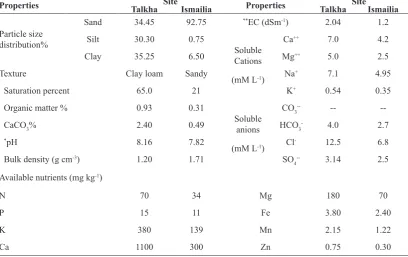
TABLE 1. Some physical and chemical properties of the study soils
Properties Talkha SiteIsmailia Properties Talkha SiteIsmailia
Particle size distribution%
Sand 34.45 92.75 **EC (dSm-1) 2.04 1.2
Silt 30.30 0.75
Soluble Cations (mM L-1)
Ca++ 7.0 4.2
Clay 35.25 6.50 Mg++ 5.0 2.5
Texture Clay loam Sandy Na+ 7.1 4.95
Saturation percent 65.0 21 K+ 0.54 0.35
Organic matter % 0.93 0.31
Soluble anions (mM L-1)
CO3-- --
--CaCO3% 2.40 0.49 HCO3- 4.0 2.7
*pH 8.16 7.82 Cl- 12.5 6.8
Bulk density (g cm-3) 1.20 1.71 SO
4-- 3.14 2.5
Available nutrients (mg kg-1)
N 70 34 Mg 180 70
P 15 11 Fe 3.80 2.40
K 380 139 Mn 2.15 1.22
Ca 1100 300 Zn 0.75 0.30
*pH in soil : water suspension1:2.5, ** EC in soil paste extract.
analyzed according to Jackson (1967) and Hesse (1971) as shown in Table 1.
Phosphorus fertilizer was added at the rate of 200 Kg fed-1 assuper phosphate (15% P
2O5)
with soil preparation before sowing for both experiments. Nitrogen fertilizer was added at a rate of 120 kg N fed-1 as ammonium nitrate (33.5%
N) at two equal doses with the second and third irrigation for maize grown in clay loam soil, as well as it was applied at a rate of 140 Kg N fed-1
as ammonium sulphate (20.5% N) at four equal doses, all two week after emergence for maize grown in sandy soil. The potassium fertilizer was applied at a rate of 24 kg K2O fed-1 as potassium
sulphate (48% K2O) with 1st irrigation after
sowing for maize grown in clay loam soil, and with sowing in sandy soil. Also, all recommended field practices for maize crop were carried out for the experiments. The field irrigation system was surface irrigated in lines every 15 days in clay loam soil, and it was drip irrigated every two days in sandy soil.
Application of magnesium treatments
Soil applications of Mg treatments (T2, T3, T4 and T5) were applied as magnesium sulphate (10% Mg) with the second irrigation for experimental at clay loam soil and after sowing by four weeks for experiment in sandy soil. Concerning foliar spraying of Mg treatments (T6 Experiments design and treatments
The experiments were performed in a Complete Randomized Blocks Design with three replicates. The experimental plot area was 10.5 m2 (5 lines x 0.60m width x 3.5m length). Each experiment consisted of seven treatments of magnesium sulphate fertilizer (10% Mg) as a soil application and foliar spraying on plants as follows:
• T1: control (without Mg application). • T2: 25 kg MgSO4 fed-1 as a soil application. • T3: 50 kg MgSO4 fed-1 as a soil application. • T4: 75 kg MgSO4 fed-1 as a soil application. • T5: 100 kg MgSO4 fed-1 as a soil application. • T6: 0.25% Mg foliar spraying (twice). • T7: 0.5% Mg foliar spraying (twice).
Sowing and fertilization
Maize seeds (c.v. single hybrid 30-K-08) were sown at the 1st season on 25th April and
15th May 2015 and harvested on 25th August and
15th September 2015 for Talkha (clay loam soil)
and Ismailia (sandy soil) sites, respectively; and were sown at the 2nd season on 27th April and
11th May 2016 and harvested on 28th August and
14th September 2016 in Talkha and Ismailia sites,
and T7), Mg was sprayed at the concentration of
0.25 and 0.5% Mg as magnesium sulphate (10% Mg) twice after 35 and 50 days from sowing (at the rate of 400 L fed-1).
Harvest and chemical analysis
At harvesting stage, plants at each plot were collected and yield parameters were recorded; Plant height (cm), plant dry weight (g), ear length (cm), ear weight (g plant-1), 100-grain
weight (g), grain weight per ear (g), grain yield (kg fed-1) and stalk yield (kg fed-1). Samples of
grain and ear leaf were taken randomly from each plot for chemical analysis to determine nitrogen, phosphorus, potassium, calcium, magnesium, iron, manganese and zinc concentrations and uptakes. Nitrogen was determined using Kjeldahl method, phosphorus was determined spectro-photometrically and potassium was determined using flame photometer. Calcium, magnesium, iron, zinc and manganese were determined using atomic adsorption plasma - ULTIMA 2- ICP- OES (Inductively Coupled Plasma Optical Emission Spectrometry) at the Unite of Soil and Water Analysis at Soils, Water and Environment Research Institute, ARC, Egypt. The oil content was determined using Soxhlet method according to A.O.A.C. (1990). Protein content was calculated as follows: (protein% = N % in grain × 5.70).
The statistical analysis was done according to Gomez and Gomez (1984) and means of treatments were compared against least significant differences test (LSD) at 5% and Duncan’s multiple comparisons Test.
Results and Discussion Soil characteristics
It is clear from the results in Table 1 that soils at Talkha and Ismailia sites were characterized by a slightly alkaline pH ( 8.16-7.82) and non saline (2.04- 1.2 dSm-1). Soil of Talkha site (clay loam
soil) was moderate in the available P, K and Mg, high in the available N and Ca and low in the available Fe, Mn and Zn; whereas soil in Ismailia site (sandy) was moderate in the available N, P, K and Ca and low in the available Mg, Fe, Mn and Zn. Concerning the relationships between Mg and Ca and K in terms of soil fertility, Jokinen (1981) illustrated that the most suitable balances between exchangeable Ca, K and Mg are supposed to be Ca:K= 12, Ca:Mg= 6 and Mg:K= 2. Whereas, the results of soil analysis before sowing (Table 1) showed that the pervious ratios were; 2.89, 6.11 and 0.47 in Talkha clay loam soil, and 2.16,
4.28 and 0.50 in Ismailia sandy soil, respectively. Therefore, from the previous ratios there were imbalances between these cations in two soils according to Jokinen (1981), whereas Ca was high in clay loam soil. In this respect Ertiftik and Zengin (2016) found that even if Mg was present in the soil in adequate amounts, the plants could not uptake sufficient amounts, and hidden or visible deficiency symptoms could occur. Maize yield and its components
In Talkha site
Data in Table 2 show that the application of Mg-rates significantly increased grain and stalk yields, plant weight, ear weight plant-1 and grain
weight ear-1, but had insignificant effect on ear
length. The superior in grain yield was recorded with the application of Mg-rate T7, but without significant differences with yield recorded with Mg-rates; T3, T4 and T6 . Grain yield increased by
8.11, 12.77, 10.44, 9.51, 11.84 and 13.99 % with the application of Mg-rates; T2, T3, T4, T5 and T7
as compared with the control (T1), respectively. Stalk yield significantly increased with Mg-rates application compared with the control (T1) up to
T3, since the differences among Mg-rates were insignificant. Stalk yield increased by 22.04, 26.33, 23.43, 22.04, 23.65 and 26.18 % with the application of Mg-rates, respectively as compared with the control. As well, the differences among the values recorded with the application of Mg-rates T2, T3 and T7 for plant dry weight, ear weight
and grain weight ear-1 were insignificant. So,
these results demonstrate positive response of maize grown in clay loam soil to Mg fertilization; whereas foliar spray of 0.5 % Mg (T7) had the
superior effect on plant dry weight, ear length, grain weight ear-1, grain and stalk yields.
It is clear from the previous results, the response to application of Mg-rates, which may be attributed to the initial status of soil before sowing (Table 1); whereas soil was moderate in its fertility of Mg and K, and high in available Ca, that may affect the supply of Mg to plant; since there is a competition among Mg, K and Ca. Also, the level of available Mg was insufficient (Fageria 2001, Römheld & Kirkby, 2007 and Gransee & Fuhrs, 2013).
In Ismailia site
fed-1). Grain and stalk yields increased by 11.66
and 11.72 % with the addition of Mg-rate T4
as compared with the control (T1); while they
increased by 6.04 and 8.14 % with foliar spray of 0.5 % Mg (T7), respectively. Also, the application of Mg rates had a significant effect on plant weight, ear weight plant-1, ear length and grain
weight ear-1. Furthermore, results showed that soil
application of Mg-rates was more effective on maize yield and its components as compared with foliar spray of Mg.
From the previous results, it is clear that there were positive response from maize yield grown on clay loam and sandy soils to the application of rates; which were the highest with Mg-rate T7 for maize grown on clay loam soil, and with T4 for maize grown on sandy soil. These responses may be attributed to the initial level of available Mg in soil before sowing as shown in Table 1 that was moderate in clay loam soil and low in sandy soil, as well as, to imbalances between Mg and Ca and K as shown in soil characteristics which reflects on the soil supply ability of Mg and consequently on maize yield (Römheld & Kirkby, 2007, Gransee & Fuhrs, 2013 and Ertiftik & Zengin, 2016).
Grain quality and its contents In Talkha site
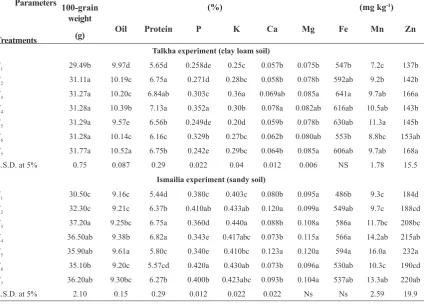
Data in Table 3 illustrate that 100-grain weight, oil and protein% (as grain quality) significantly increased with the application of Mg-rates. The highest value of 100-grain weight and oil% was recorded with the application of Mg-rate T7.
However, the differences among the obtained results of 100-grain weight recorded with other Mg-rates were insignificant. Concerning grain content of P, K, Ca, Mg, Fe, Mn and Zn, it is clear from the results that grin content of P, K, Ca, Mg, Mn and Zn significantly increased with the application of Mg-rates up to T3 (50 kg MgSO4), but had insignificant effect on Fe content. These increases in grain content of protein, oil, P, K, Ca, Mg, Fe, Mn and Zn mean increase the quality and the nutritional value of grain. Singh & Singh (1986), Rasul et al. (2011) and Ertiftik & Zengin (2016) reported similar results.
In Ismailia site
Application of Mg-rates as soil or foliar spraying had significant effect on 100-grain weight, protein% and oil % in maize grain. The values of 100-grain weight and protein content significantly increased up to T3. Also, the application of Mg-rates significantly increased
grain content of P, K, Ca, Mn and Zn, but had insignificant effect on grain content of Mg and Fe. The highest grain content of Ca, Mg, Fe, Mn and Zn were recorded with the application of Mg-rate T5 (100 kg MgSO4 fed-1), but this content was insignificant with that recorded with Mg-rate T4 (75 kg MgSO4 fed-1).
It is obvious from the mentioned results for grain content of maize grown in clay loam and sandy soils, that the application of Mg-rates had a positive effect on 100-grain weight, oil and protein percentages and its content of phosphorus, calcium, iron and zinc; and these results are in accordance with that obtained by Ertiftik and Zengin (2016). In this respect, Mengel & Kirkby (2001), Grzebisz (2004) and Barlog & Frackowiak-Pawlak (2008) stated that K and Mg exerted a positive influence on the weight of 1000 kernels, since both elements participate in the transport of carbohydrates to the sink organs. As well, these results are correlated with the importance of Mg for the plant; it serves as a cofactor in most enzymes that activate phosphorylation processes as a bridge between pyrophosphate structures of ATP or ADP, DNA, RNA and the enzyme molecule, it is essential for amino acids and fat synthesis (Mengel and Kirkby, 2001). As well, maize is considered as an exhaustive crop, and Mg both had been found to enhance the carbohydrate content like K.
Ear leaf content of nutrient In Talkha site
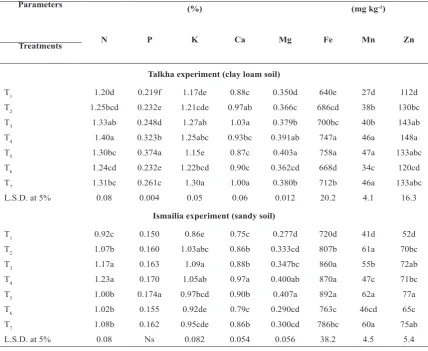
The chemical analysis of ear leaf as shown in Table 4 demonstrate that its content of N, P, K, Ca, Mg, Fe, Mn and Zn concentrations significantly increased with the application of Mg-rates. Nitrogen, K, Ca and Zn concentrations in ear leaf significantly increased with the application of Mg-rates up to T3 , however leaf content of Mg, Fe
and Mn increased up to T4 , since P content
increased with Mg-rates application up to T5
, Moreover, foliar spraying of 0.5% Mg (T7)
increased ear leaf content of K, Ca, Mn and Zn without significant differences with those recorded with Mg-rates T3 and T4. Increasing
the Mg rate of application up to T3 had a
positive effect on the ear leaf content of K and Ca, but its concentrations decreased with the application of Mg-rates; T4, T5 and T6;
TABLE 2. Effect of magnesium application rates and methods on maize yield and its components grown in clayey loam and sandy soils
Parameters
Treatments
Plant height (cm)
Plant weight
(g)
Ear length
(cm)
Ear weight
(g)
Grain weight ear-1
Grain yield (kg fed-1)
Stalk yield (kg fed-1)
Talkha experiment (clay loam soil)
T1: Control 310c 251b 19.5a 241c 214d 3429d 4519b
T2: 25 kg MgSO4 fed-1 333a 303a 19.7a 252bc 232c 3707c 5515a
T3: 50 kg MgSO4 fed-1 327ab 314a 20.3a 274a 242ab 3867ab 5709a
T4: 75 kg MgSO4 fed-1 315bc 307a 19.8a 262ab 237abc 3787abc 5578a
T5: 100 kg MgSO4 fed-1 325ab 303a 20.5a 260ab 235bc 3755bc 5515a
T6: 0.25% Mg foliar 315bc 307a 20.8a 270a 240abc 3835abc 5588a
T7: 0.5% Mg foliar 317bc 314a 21.0a 274a 244a 3909a 5702a
L.S.D. at 5% 13.4 17.1 NS 16.1 7.8 124.3 421.7
Ismailia experiment (sandy soil)
T1: Control 217a 189b 17.5c 182d 155 2615e 4250g
T2: 25 kg MgSO4 fed-1 217a 201a 18.9b 192c 162 2697d 4530d
T3: 50 kg MgSO4 fed-1 218a 209a 20.7a 196abc 169 2876ab 4695b
T4: 75 kg MgSO4 fed-1 218a 211a 20.8a 199ab 169 2920a 4748a
T5: 100 kg MgSO4 fed-1 218a 208a 20.1a 202a 167 2845b 4465e
T6: 0.25% Mg foliar 216a 201a 19.8ab 194bc 165 2673d 4405f
T7: 0.5% Mg foliar 218a 204a 19.9ab 196abc 167 2773c 4596c
L.S.D. at 5% Ns 12.2 1.2 5.8 3.9 46.1 36.0
TABLE 3. Effect of magnesium application rates and methods on grain contents of maize grown in clayey loam and sandy soils Parameters
Treatments
100-grain weight
(g)
(%) (mg kg-1)
Oil Protein P K Ca Mg Fe Mn Zn
Talkha experiment (clay loam soil)
T1 29.49b 9.97d 5.65d 0.258de 0.25c 0.057b 0.075b 547b 7.2c 137b
T2 31.11a 10.19c 6.75a 0.271d 0.28bc 0.058b 0.078b 592ab 9.2b 142b
T3 31.27a 10.20c 6.84ab 0.303c 0.36a 0.069ab 0.085a 641a 9.7ab 166a
T4 31.28a 10.39b 7.13a 0.352a 0.30b 0.078a 0.082ab 616ab 10.5ab 143b
T5 31.29a 9.57e 6.56b 0.249de 0.20d 0.059b 0.078b 630ab 11.3a 145b
T6 31.28a 10.14c 6.16c 0.329b 0.27bc 0.062b 0.080ab 553b 8.8bc 153ab
T7 31.77a 10.52a 6.75b 0.242e 0.29bc 0.064b 0.085a 606ab 9.7ab 168a
L.S.D. at 5% 0.75 0.087 0.29 0.022 0.04 0.012 0.006 NS 1.78 15.5
Ismailia experiment (sandy soil)
T1 30.50c 9.16c 5.44d 0.380c 0.403c 0.080b 0.095a 486b 9.3c 184d
T2 32.30c 9.21c 6.37b 0.410ab 0.433ab 0.120a 0.099a 549ab 9.7c 188cd
T3 37.20a 9.25bc 6.75a 0.360d 0.440a 0.088b 0.108a 586a 11.7bc 208bc
T4 36.50ab 9.38b 6.82a 0.343e 0.417abc 0.073b 0.115a 566a 14.2ab 215ab
T5 35.90ab 9.61a 5.80c 0.340e 0.410bc 0.123a 0.120a 594a 16.0a 232a
T6 35.10b 9.20c 5.57cd 0.420a 0.430ab 0.073b 0.096a 530ab 10.3c 190cd
T7 36.20ab 9.30bc 6.27b 0.400b 0.423abc 0.093b 0.104a 537ab 13.3ab 220ab
TABLE 4. Effect of magnesium application rates and methods on ear leaf contents of maize grown in clayey loam and sandy soils
Parameters (%) (mg kg-1)
N P K Ca Mg Fe Mn Zn
Treatments
Talkha experiment (clay loam soil)
T1 1.20d 0.219f 1.17de 0.88c 0.350d 640e 27d 112d
T2 1.25bcd 0.232e 1.21cde 0.97ab 0.366c 686cd 38b 130bc
T3 1.33ab 0.248d 1.27ab 1.03a 0.379b 700bc 40b 143ab
T4 1.40a 0.323b 1.25abc 0.93bc 0.391ab 747a 46a 148a
T5 1.30bc 0.374a 1.15e 0.87c 0.403a 758a 47a 133abc
T6 1.24cd 0.232e 1.22bcd 0.90c 0.362cd 668d 34c 120cd
T7 1.31bc 0.261c 1.30a 1.00a 0.380b 712b 46a 133abc
L.S.D. at 5% 0.08 0.004 0.05 0.06 0.012 20.2 4.1 16.3
Ismailia experiment (sandy soil)
T1 0.92c 0.150 0.86e 0.75c 0.277d 720d 41d 52d
T2 1.07b 0.160 1.03abc 0.86b 0.333cd 807b 61a 70bc
T3 1.17a 0.163 1.09a 0.88b 0.347bc 860a 55b 72ab
T4 1.23a 0.170 1.05ab 0.97a 0.400ab 870a 47c 71bc
T5 1.00b 0.174a 0.97bcd 0.90b 0.407a 892a 62a 77a
T6 1.02b 0.155 0.92de 0.79c 0.290cd 763c 46cd 65c
T7 1.08b 0.162 0.95cde 0.86b 0.300cd 786bc 60a 75ab
L.S.D. at 5% 0.08 Ns 0.082 0.054 0.056 38.2 4.5 5.4
there were imbalances between these nutrient in soil before sowing (as shown in Table 1). These results are consistent with Römheld & Kirkby (2007) and Gransee & Fuhrs (2013). In Ismailia site
Results in Table 4 show that the application of Mg-rates had a significant effect on ear leaf content of N, K, Ca, Mg, Fe, Mn and Zn, but had an insignificant effect on ear leaf content of P. Ear leaf content of N, K, Fe and Zn significantly increased with application of Mg-rates up to T3,
and up to T4 for ear leaf content of Ca and Mg.
It is obvious from the mentioned results that the application of Mg-rates had a positive effect on maize grown in sandy soil, related with results of analysis of soil before sowing (Table 1), that was low in available Mg. These results are consistent with that obtained by Kovacevic et al. (2004), Szulc (2009) and Ertiftik & Zengin (2016). In this respect, Izsaki (2006) and Szulc (2009) reported that P in corn leaves increased with the increases in Mg doses.
Relationships among ear leaf content of Mg, K and Ca
The results in Table 5 show the relationships between ear leaf content of Mg, K and Ca as for K:Mg and Ca:Mg ratios and the percentage of Mg for sum K+Ca+Mg concentrations.
In Talkha site
It is clear from the results that the value of K:Mg ratio was not changed with application of Mg-rates T2 and T3, then it decreased with
increasing the rate of soil application of Mg up to T5 (100 kg MgSO4). However, the ratio of
K:Mg was increased with foliar spraying of Mg (as T6 and T7). The ratio of K:Mg arranged
from 2.85 (the lowest ratio that recoded at T5) to
3.41 (the highest ratio that recoded at T7). The
Mg-rates; T4 and T5 and T6 compared with control
(T1). However, the differences among T2, T3 and
T7 for Ca:Mg ratio were insignificant, which
correlated with its concentrations in ear leaf. Regarding % of Mg for sum (K+Ca+Mg), it is obvious that percentage was significantly increased with application of Mg-rates up to T5
(100 kg MgSO4 fed-1), since the highest percent
was 16.62 % that recorded with addition of Mg-rate T5. It is clear from previous results that
application of Mg-rates; T2, T3 and T7 (25 and
50 kg MgSO4 fed-1 and foliar spray of 0.5% Mg) were sufficient to maintain the balance between Mg, K and Ca, as well as these results agree with that obtained by Kovacevic et al. (2004).
In Ismailia site
The results in Table 5 show that K:Mg ratio was affected with the application of Mg-rates; whereas it increased with the rate of T3 and foliar spray of Mg at 0.25 and 0.5% Mg. K:Mg ratio ranged from 2.39 (the lowest ratio that recoded at T5) to 3 .22 (the highest ratio that recoded at T7). Also the ratio of Ca:Mg increased with foliar spray of Mg at 0.25 and 0.5% Mg (T6 and T7), but it decreased with soil application of Mg-rates; T2, T3, T4 and T5 as compared with control (T1). This ratio correlated negatively with the increases in ear leaf content of Mg. Concerning percentage of Mg for sum (K+Ca+Mg), it is obvious that increased with application of Mg-rates up to T5, which recorded the highest percentage (17.94 %).
Kovacevic et al. (2004) demonstrated that the share of Mg in the sum K+Ca+Mg for corn hybrids ranged from 9.3 to 21.3%; K:Mg ratio ranged from 1.78 to even 6.56, whereas Ca:Mg ratio ranged from 1.94 to 3.44. Hence, the obtained results (a shown in Table 5) are in agreement with that result. So it is clear from mentioned results that foliar spray of 0.5% Mg was sufficient to maize growing in clay loam soil; as well as soil application of 75 kg magnesium sulfate per fed-1 was sufficient to maize growing in sandy soil; which maintain on the balance between K, Mg and Ca in ear leaf.
The uptake of nutrient by grain yield In Talkha site
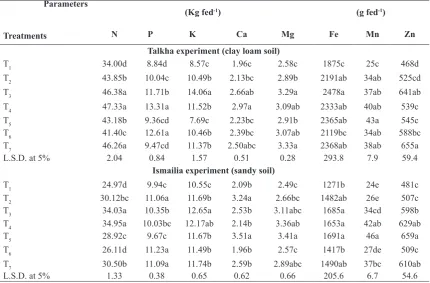
The data in Table 6 show that the application of Mg-rates significantly increased the uptake of N, P, K, Ca, Mg, Fe, Mn and Zn by grain. The uptake of N, P and Ca by grain yield significantly increased up to T4
and then decreased. As well, the uptake of K by grain significantly increased up to Mg-rate T3 then decreased. However the differences
among the uptakes of N, Ca, Mg, Fe, and Zn by grain that recorded under Mg-rates T3 and T7 were insignificant. So these results illustrate the importance of Mg supply at the rate of T3 (50 kg
MgSO4) as soil application or at the rate of T7 (0.5
% Mg) as a foliar spray on maize grown in clay loam soil.
In Ismailia site
The application of Mg-rates as magnesium sulphate had a significant effect on the uptake of N, P, K, Ca, Mg, Fe, Mn and Zn by grain, since the uptake of N, K, Mg, and Fe significantly increased with soil application of Mg-rates up to the rate of 50 kg MgSO4 (T3). Generally, it is clear from mentioned results that application o Mg-rates improved the uptakes of mostly nutrients by grain, and this demonstrates the importance of Mg supply for maize crop grown in sandy soil, and this accordance with results that obtained by Izsaki (2006), Szulc (2009) and Ertiftik & Zengin (2016).
The uptake of nutrient by stalk yield
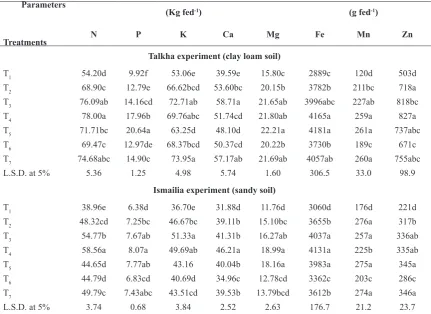
The data shown in Table 7 illustrate the effect of the application Mg-rates on the uptake of N, P, K, Ca, Mg, Fe, Mn and Zn by stalk yield of maize grown in clay loam and sandy soils.
In Talkha site
The results demonstrated that the uptake of N, P, K, Ca, Mg, Fe, Mn and Zn by maize stalk yield significantly increased with the application of Mg-rates, with superiority for Mg-rates; T3 and T7 in the mostly for nutrient uptake without significance differences among them. The highest uptake by stalk yield of N and Zn (78.0 Kg fed-1 and 827 g fed-1, respectively)
were recorded with soil application of 75 kg MgSO4 fed-1 (T4), moreover the highest
uptake of P, Mg, Fe and Mn were recorded with soil application of 100 kg MgSO4 fed-1
TABLE 5. Effect of magnesium application rates and methods on the ratios of investigated cations in ear leaf for maize grown in two different soils.
Parameters
Treatments
Ratios % Mg
in (K+Ca+Mg)
K:Mg Ca:Mg
Talkha experiment (clay loam soil)
T1: control 3.36ab 2.50ab 14.58bc
T2: 25 kg MgSO4 fed-1 3.31ab 2.66a 14.36c
T3: 50 kg MgSO4 fed-1 3.36ab 2.72a 14.14c
T4: 75 kg MgSO4 fed-1 3.20b 2.37bc 15.22b
T5: 100 kg MgSO4 fed-1 2.85c 2.17c 16.62a
T6: 0.25 % Mg foliar 3.38ab 2.49ab 14.55bc
T7: 0.5 % Mg foliar 3.41a 2.64a 14.20c
L.S.D. at 5% 0.18 0.21 0.68
Ismailia experiment (sandy soil)
T1: control 3.12 2.72 14.67
T2: 25 kg MgSO4 fed-1 3.10 2.59 14.98
T3: 50 kg MgSO4 fed-1 3.16 2.54 14.94
T4: 75 kg MgSO4 fed-1 2.65 2.46 16.52
T5: 100 kg MgSO4 fed-1 2.39 2.22 17.94
T6: 0.25% Mg foliar 3.19 2.74 14.45
T7: 0.5% Mg foliar 3.22 2.91 14.20
L.S.D. at 5% Ns Ns Ns
TABLE 6. Effect of magnesium application rates and methods on the uptake of some macro- and micronutrients by grain of maize grown in two different soils.
Parameters
Treatments
(Kg fed-1) (g fed-1)
N P K Ca Mg Fe Mn Zn
Talkha experiment (clay loam soil)
T1 34.00d 8.84d 8.57c 1.96c 2.58c 1875c 25c 468d
T2 43.85b 10.04c 10.49b 2.13bc 2.89b 2191ab 34ab 525cd
T3 46.38a 11.71b 14.06a 2.66ab 3.29a 2478a 37ab 641ab
T4 47.33a 13.31a 11.52b 2.97a 3.09ab 2333ab 40ab 539c
T5 43.18b 9.36cd 7.69c 2.23bc 2.91b 2365ab 43a 545c
T6 41.40c 12.61a 10.46b 2.39bc 3.07ab 2119bc 34ab 588bc
T7 46.26a 9.47cd 11.37b 2.50abc 3.33a 2368ab 38ab 655a
L.S.D. at 5% 2.04 0.84 1.57 0.51 0.28 293.8 7.9 59.4
Ismailia experiment (sandy soil)
T1 24.97d 9.94c 10.55c 2.09b 2.49c 1271b 24e 481c
T2 30.12bc 11.06a 11.69b 3.24a 2.66bc 1482ab 26e 507c
T3 34.03a 10.35b 12.65a 2.53b 3.11abc 1685a 34cd 598b
T4 34.95a 10.03bc 12.17ab 2.14b 3.36ab 1653a 42ab 629ab
T5 28.92c 9.67c 11.67b 3.51a 3.41a 1691a 46a 659a
T6 26.11d 11.23a 11.49b 1.96b 2.57c 1417b 27de 509c
T7 30.50b 11.09a 11.74b 2.59b 2.89abc 1490ab 37bc 610ab
TABLE 7. Effect of magnesium application rates and methods on the uptake of N, P, K, Ca, Mg, Fe, Mn and Zn by stalk of maize grown in two different soils.
Parameters
Treatments
(Kg fed-1) (g fed-1)
N P K Ca Mg Fe Mn Zn
Talkha experiment (clay loam soil)
T1 54.20d 9.92f 53.06e 39.59e 15.80c 2889c 120d 503d
T2 68.90c 12.79e 66.62bcd 53.60bc 20.15b 3782b 211bc 718a
T3 76.09ab 14.16cd 72.71ab 58.71a 21.65ab 3996abc 227ab 818bc
T4 78.00a 17.96b 69.76abc 51.74cd 21.80ab 4165a 259a 827a
T5 71.71bc 20.64a 63.25d 48.10d 22.21a 4181a 261a 737abc
T6 69.47c 12.97de 68.37bcd 50.37cd 20.22b 3730b 189c 671c
T7 74.68abc 14.90c 73.95a 57.17ab 21.69ab 4057ab 260a 755abc
L.S.D. at 5% 5.36 1.25 4.98 5.74 1.60 306.5 33.0 98.9
Ismailia experiment (sandy soil)
T1 38.96e 6.38d 36.70e 31.88d 11.76d 3060d 176d 221d
T2 48.32cd 7.25bc 46.67bc 39.11b 15.10bc 3655b 276a 317b
T3 54.77b 7.67ab 51.33a 41.31b 16.27ab 4037a 257a 336ab
T4 58.56a 8.07a 49.69ab 46.21a 18.99a 4131a 225b 335ab
T5 44.65d 7.77ab 43.16 40.04b 18.16a 3983a 275a 345a
T6 44.79d 6.83cd 40.69d 34.96c 12.78cd 3362c 203c 286c
T7 49.79c 7.43abc 43.51cd 39.53b 13.79bcd 3612b 274a 346a
L.S.D. at 5% 3.74 0.68 3.84 2.52 2.63 176.7 21.2 23.7
In Ismailia site
The results showed that the application of Mg-rates from (T2 toT7) significantly increased
the uptake of N, P, K, Ca, Mg, Fe, Mn and Zn by stalk yield of maize grown in sandy soil compared with control (T1). The highest stalk
yield uptake of N, P, Ca, Mg and Fe (58.56, 8.07, 46.21, 18.99 and 4.131 kg fed-1, respectively)
were recorded with the application of Mg-rate T4 (75 kg MgSO4 fed-1). As well as the
highest stalk yield uptake of K (51.33 kg fed-1)
was recorded with the application of Mg-rate T3 (50 kg MgSO4 fed-1) then its uptake
decreased. So, these results demonstrate the importance of soil supply by Mg as magnesium sulfate for increasing growth, yield and nutrient uptakes of maize grown in sandy soil and keep balance between nutrient, whereas soil was low in its fertility especially available Mg (Table 1). In this respect, Szulc (2009) showed that the highest N, K and Mg contents in dry plant matter (37.0, 42.18 and 2.65 g kg-1 DM,
respectively) were found by maize fertilized with 15 kg Mg ha-1 (nearly 62.5 kg MgSO
4
fed-1). As well, Ertiftik and Zengin (2016)
illustrated that the application of Mg enhanced the nutritional status of maize through synergic relations between Mg and P, S, Fe and Zn.
Finally, it can be concluded from the previous results that the response of maize crop grown on clay loam and sandy soils to magnesium fertilization was significant, since the responses were the best in clay loam soil at soil application of 50 kg magnesium sulfate fed-1 and also at the
foliar spray of 0.5% Mg twice, and they were the highest in sandy soil with the soil application of 75 kg magnesium sulfate fed-1.
Conclusion Under conditions of Dakahlia Governorate (clay loam soils) and Ismalia Governorate (sandy soils), supplying maize with magnesium sulfate as foliar spraying with 0.5 % Mg twice after 35 and 50 days from sowing for the clayey loam soil and the treatment of 75 Kg magnesium sulfate fed-1 as soil application for the sandy soil can be
References
A.O.A.C. (1990) Official Methods of Analysis of the Association of Official Analytical Chemists.
15th (ed), Published by Association of Official
Analytical Chemists Arlington, Virginia, USA. Ashoub, M. A., Abdel-aziz, I. M. A., Shahin, M. M.
and M. N. Gohar (2003) Impact of irrigation and magnesium fertilization on yield, yield components
and chemical contents of sunflower. Arab Univ. J. Agric. Sci., Ain Shams Univ., Cairo, 11(1),191-204. Badran, M. M., Easa, M. O., Abd El-Warth, M. and Raslan,M. I. (2004) Effect of N and Mg application on wheat plant grown on calcareous soil. Minufiya
J. Agric. Res.,29 (6), 1493-1502.
Barlog, P. and Frackowiak-Pawlak, K. (2008) Effect of mineral fertilization on yield of maize cultivars differing in maturity scale. Acta Sci. Pol., Agricultura Poznan, 7(4), 5-17.
Darwish, D. S., Negm, A. Y. and Zahran, F. A. (1997) Effect of magnesium application on production and
yield of sunflower. Mansoura Univ. J. Agric. Sci.,
22(10), 3375-3381.
Ertiftik, H. and Zengin, M. (2016) Changes in nutrient concentrations of maize (Zea mays var. intendata) leaves under potassium and magnesium application in Central Anatolia. Tarim Bilimleri Dergisi J. Agric. Sci.,22, 606-616.
Fageria, V.D. (2001) Nutrient interactions in crop plants. J. Plant Nutr. 24, 1269-1290.
Gomez, K.A. and Gomez, A.A. (1984) Statistical Procedures for Agricultural Research. 2nd ed., John
Wiley and Sons Inc., New York, pp: 95-109. Gransee A. and Fuhrs, H. (2013) Magnesium mobility
in soils as a challenge for soil and plant analysis, magnesium fertilization and root uptake under adverse growth conditions. Plant and Soil, 368, 5-12. Grzebisz, W. (2004) Potassium in Plant Production. Inter. Potash Institute, Basel, Switzerland, AR Poznan.
Guneş, A., Alparslan, M. and İnal, A. (2002) Plant Nutrition and Fertilization. Ankara Univ., Pub. of Agric. Fac., Ankara (in Turkish), II. Print. Publication No. 1526, Textbook: 479.
Hesse, P.R. (1971) A Text Book of Soil Chemical Analysis. John Murry Publishers, Ltd, 50 Albemarle Street, London.
Izsaki, Z. (2006) Relationship between potassium supplies of the soil and the nutrient concentration of maize (Zea mays L.) leaves. Cereal Res. Commun.
34(1-2), 501-504.
Jackson, M.L. (1967) Soil Chemical Analysis. Printic Hall of India, New Delhi, pp: 144-197.
Jacobsen S.T. (1993) Interaction between Plant Nutrients. Antagonism between potassium, magnesium and calcium. Acta Agric. Scand., Sect. B. Soil and Plant Sci., 43, 1-5.
Jokinen R. (1981) The magnesium status of Finnish mineral soils and the requirement of the magnesium supply. Magnesium-Bulletin,3(1a),1-5.
Kacar, B. and Katkat, A.V. (2007) Fertilizers and Fertilization Technique. Nobel Pub. No: 1119, Sci. and Biol. Pub. Series: (in Turkish), 34(2): 560. Kovacevic V., Brkic, I. Banaj; D., Antunovic, M. Simic,
D. and Petosic, D. (2004) Magnesium status in corn (Zea mays L.) hybrids and its relations to potassium and calcium. Cereal Res. Commun. 32(1), 41-51. Marschner, H. (1995) Mineral Nutrition of Higher
Plants. Academic, Elsevier.
Mengel, K. and Kirkby,E.A. (2001) Principles of Plant Nutrition. Int. Potash Institute, Bern, Switzerland. Pathak A. N. and Kalra, Y. P. (1971) Antagonism
between potassium, calcium and magnesium in several varieties of hybrid-corn. Zeit. Pflanzen.
Boden. 130, 118-124.
Rasul, G.A., Esmail, A.O. and Mekha, R. J. (2011) The role of magnesium in increasing of phosphorus
fertilizer efficiency and wheat yield. Mesopotamia J. Agric. 39 (2), 33-39.
Römheld, V. and Kirkby, E. A. (2007) Magnesium functions in crop nutrition and yield. Proc. Conf. in Cambridge (7th Dec. 2007), 151-171.
Schulte E. E. (2004) Soil and Applied Magnesium.
Wisconsin County Extension-Univ. of Wisconsin-Extension, RP.-08-2004.
Singh B. and Singh, B. L. (1986) Interactions of potassium, magnesium and farmyard manure on maize production. Proc. Indian Natn. Sci. Acad. B52 No. 2 pp 291-295.
Szulc, P. (2009) Effect of nitrogen fertilization and methods of magnesium application on chlorophyll content, accumulation of mineral components, and morphology of two maize hybrid types in the initial growth period. Part 1: content of chlorophyll and mineral components. Acta Scientiarum Polonorum-Agricultura Poznan, 8(2), 43-50. part 2: uptake of mineral components. Acta Scientiarum Polonorum-Agricultura Poznan, 8 (2),51-62.
ةيماشلا ةرذلل ةيئاذغلا رصانعلا صاصتماو لوصحملا ىلع مويسنغاملاب ديمستلا ريثأت
نيتفلتخم نيتبرت يف هعرزنملا
رارد معنملا دبع داشر و رامكلا زيزعلا دبع نتاف ، يقوسدلا ضوع ناضمر
رصم – ةزيجلا – ةيعارزلا ثوحبلا زكرم - ةئيبلاو هايملاو يضارلأا ثوحب دهعم