Volume 2007, Article ID 10231,15pages doi:10.1155/2007/10231
Research Article
Step Size Bound of the Sequential Partial Update LMS
Algorithm with Periodic Input Signals
Pedro Ramos,1Roberto Torrubia,2Ana L ´opez,1Ana Salinas,1and Enrique Masgrau2
1Communication Technologies Group, Arag´on Institute for Engineering Research (I3A), EUPT, University of Zaragoza,
Ciudad Escolar s/n, 44003 Teruel, Spain
2Communication Technologies Group, Arag´on Institute for Engineering Research (I3A), CPS Ada Byron, University of Zaragoza,
Maria de Luna 1, 50018 Zaragoza, Spain
Received 9 June 2006; Revised 2 October 2006; Accepted 5 October 2006
Recommended by Kutluyil Dogancay
This paper derives an upper bound for the step size of the sequential partial update (PU) LMS adaptive algorithm when the input signal is a periodic reference consisting of several harmonics. The maximum step size is expressed in terms of the gain in step size of the PU algorithm, defined as the ratio between the upper bounds that ensure convergence in the following two cases: firstly, when only a subset of the weights of the filter is updated during every iteration; and secondly, when the whole filter is updated at every cycle. Thus, this gain in step-size determines the factor by which the step size parameter can be increased in order to compensate the inherently slower convergence rate of the sequential PU adaptive algorithm. The theoretical analysis of the strategy developed in this paper excludes the use of certain frequencies corresponding to notches that appear in the gain in step size. This strategy has been successfully applied in the active control of periodic disturbances consisting of several harmonics, so as to reduce the computational complexity of the control system without either slowing down the convergence rate or increasing the residual error. Simulated and experimental results confirm the expected behavior.
Copyright © 2007 Pedro Ramos et al. This is an open access article distributed under the Creative Commons Attribution License, which permits unrestricted use, distribution, and reproduction in any medium, provided the original work is properly cited.
1. INTRODUCTION
1.1. Context of application: active noise control systems
Acoustic noise reduction can be achieved by two different methods. Passive techniques are based on the absorption and reflection properties of materials, showing excellent noise at-tenuation for frequencies above 1 kHz. Nevertheless, passive sound absorbers do not work well at low frequencies be-cause the acoustic wavelength becomes large compared to the thickness of a typical noise barrier. On the other hand, active noise control (ANC) techniques are based on the prin-ciple of destructive wave interference, whereby an antinoise is generated with the same amplitude as the undesired distur-bance but with an appropriate phase shift in order to cancel the primary noise at a given location, generating a zone of silence around an acoustical sensor.
The basic idea behind active control was patented by Lueg [1]. However, it was with the relatively recent advent of powerful and inexpensive digital signal processors (DSPs)
that ANC techniques became practical because of their ca-pacity to perform the computational tasks involved in real time.
Source
of noise Undesired noise
Error microphone Secondary
source Reference
microphone
Antinoise ANC
output
Reference ANC Error
y(n)
x(n) e(n)
(a)
x(n)
Reference P(z) Primary path
d(n) Undesired noise
y¼(
n) Antinoise
S(z) Secondary path
y(n)
W(z) Adaptive filter
S(z) Estimate
Adaptive algorithm
x¼ (n)
Filtered reference
e(n) Error
+
(b)
Figure 1: Single-channel active noise control system using the filtered-x adaptive algorithm. (a) Physical arrangement of the elec-troacoustic elements. (b) Equivalent block diagram.
is obtained by filtering the reference signal through the esti-mate of the secondary path.
1.2. Partial update LMS algorithm
The LMS algorithm and its filtered-x version have been widely used in control applications because of their sim-ple imsim-plementation and good performance. However, the adaptive FIR filter may eventually require a large number of coefficients to meet the requirements imposed by the ad-dressed problem. For instance, in the ANC system described inFigure 1(b), the task associated with the adaptive filter— in order to minimize the error signal—is to accurately model the primary path and inversely model the secondary path. Previous research in the field has shown that if the active canceller has to deal with an acoustic disturbance consist-ing of closely spaced frequency harmonics, a long adaptive filter is necessary [5]. Thus, an improvement in performance is achieved at the expense of increasing the computational load of the control strategy. Because of limitations in com-putational efficiency and memory capacity of low-cost DSP boards, a large number of coefficients may even impair the practical implementation of the LMS or more complex adap-tive algorithms.
As an alternative to the reduction of the number of coef-ficients, one may choose to update only a portion of the filter
Table 1: Computational complexity of the filtered-x LMS algo-rithm.
Task Multiplies no. Adds no.
Computing output of
L L
adaptive filter
Filtering of reference signal Ls Ls 1
Coefficients’ update L+ 1 L
Total 2L+ 1 +Ls 2L+Ls 1
Table 2: Computational complexity of the filtered-x sequential LMS algorithm.
Task Multiplies no. Adds no.
Computing output of
L L
adaptive filter
Filtering of reference Ls
N
Ls 1
N
signal
Partial update of
1 + L
N
L N
coefficients
Total
1 + 1
N
L+ 1 +Ls
N
1 + 1
N
L+Ls 1
N
coefficient vector at each sample time. Partial update (PU) adaptive algorithms have been proposed to reduce the large computational complexity associated with long adaptive fil-ters. As far as the drawbacks of PU algorithms are concerned, it should be noted that their convergence speed is reduced approximately in proportion to the filter length divided by the number of coefficients updated per iteration, that is, the decimation factorN. Therefore, the tradeoffbetween con-vergence performance and complexity is clearly established: the larger the saving in computational costs, the slower the convergence rate.
Two well-known adaptive algorithms carry out the par-tial updating process of the filter vector employing decimated versions of the error or the regressor signals [6]. These algo-rithms are, respectively, the periodic LMS and the sequential LMS. This work focuses the attention on the later.
The sequential LMS algorithm with decimation factorN updates a subset of sizeL/N, out of a total ofL, coefficients per iteration according to (1),
wl(n+ 1)
= ⎧ ⎪ ⎨ ⎪ ⎩
wl(n) +μx(n l+ 1)e(n) if (n l+ 1) modN=0,
wl(n) otherwise
(1)
for 1 l L, wherewl(n) represents thelth weight of the filter,μis the step size of the adaptive algorithm,x(n) is the regressor signal, ande(n) is the error signal.
Tables1 and2show, respectively, the computational com-plexity of the LMS and the sequential LMS algorithms in terms of the average number of operations required per cy-cle, when used in the context of a filtered-x implementation of a single-channel ANC system. The length of the adaptive filter isL, the length of the offline estimate of the secondary path isLs, and the decimation factor isN.
The criterion for the selection of coefficients to be up-dated can be modified and, as a result of that, different PU adaptive algorithms have been proposed [7–10]. The varia-tions of the cited PU LMS algorithms speed up their conver-gence rate at the expense of increasing the number of oper-ations per cycle. These extra operoper-ations include the “intelli-gence” required to optimize the election of the coefficients to be updated at every instant.
In this paper, we try to go a step further, showing that in applications based on the sequential LMS algorithm, where the regressor signal is periodic, the inclusion of a new parameter—called gain in step size—in the traditional trade-off proves that one can achieve a significant reduction in the computational costs without degrading the performance of the algorithm. The proposed strategy—filtered-x sequen-tial least mean-square algorithm with gain in step size (Gμ
-FxSLMS)—has been successfully applied in our laboratory in the context of active control of periodic noise [5].
1.3. Assumptions in the convergence analysis
Before focusing on the sequential PU LMS strategy and the derivation of the gain in step size, it is necessary to remark on two assumptions about the upcoming analysis: the inde-pendence theory and the slow convergence condition.
The traditional approach to convergence analyses of LMS—and FxLMS—algorithms is based on stochastic in-puts instead of deterministic signals such as a combination of multiple sinusoids. Those stochastic analyses assume inde-pendence between the reference—or regressor—signal and the coefficients of the filter vector. In spite of the fact that this independence assumption is not satisfied or, at least, ques-tionable when the reference signal is deterministic, some re-searchers have previously used the independence assumption with a deterministic reference. For instance, Kuo et al. [11] assumed the independence theory, the slow convergence con-dition, and the exact offline estimate of the secondary path to state that the maximum step size of the FxLMS algorithm is inversely bounded by the maximum eigenvalue of the au-tocorrelation matrix of the filtered reference, when the ref-erence was considered to be the sum of multiple sinusoids. Bjarnason [12] used as well the independence theory to carry out a FxLMS analysis extended to a sinusoidal input. Accord-ing to Bjarnason, this approach is justified by the fact that ex-perience with the LMS algorithm shows that results obtained by the application of the independence theory retain suffi -cient information about the structure of the adaptive process to serve as reliable design guidelines, even for highly depen-dent data samples.
As far as the second assumption is concerned, in the con-text of the traditional convergence analysis of the FxLMS
adaptive algorithm [13, Chapter 3], it is necessary to as-sume slow convergence—i.e., that the control filter is chang-ing slowly—and to count on an exact estimate of the sec-ondary path in order to commute the order of the adaptive filter and the secondary path [2]. In so doing, the output of the adaptive filter carries through directly to the error signal, and the traditional LMS algorithm analysis can be applied by using as regressor signal the result of the filtering of the ref-erence signal through the secondary path transfer function. It could be argued that this condition compromises the de-termination of an upper bound on the step size of the adap-tive algorithm, but actually, slow convergence is guaranteed because the convergence factor is affected by a much more restrictive condition with a periodic reference than with a white noise reference. It has been proved that with a sinu-soidal reference, the upper bound of the step size is inversely proportional to the product of the length of the filter and the delay in the secondary path; whereas with a white reference signal, the bound depends inversely on the sum of these pa-rameters, instead of their product [12,14]. Simulations with a white noise reference signal suggest that a realistic upper bound in the step size is given by [15, Chapter 3]
μmax= 2 Px¼(L+Δ)
, (2)
wherePx¼is the power of the filtered reference,Lis the length of the adaptive filter, andΔis the delay introduced by the secondary path.
Bjarnason [12] analyzed FxLMS convergence with a si-nusoidal reference, but employed the habitual assumptions made with stochastic signals, that is, the independence the-ory. The stability condition derived by Bjarnason yields
μmax= 2 Px¼L
sin
π 2(2Δ+ 1)
. (3)
In case of large delayΔ, (3) simplifies to
μmax= π Px¼L(2Δ+ 1)
, Δ π
4. (4)
Vicente and Masgrau [14] obtained an upper bound for the FxLMS step size that ensures convergence when the ref-erence signal is deterministic (extended to any combination of multiple sinusoids). In the derivation of that result, there is no need of any of the usual approximations, such as in-dependence between reference and weights or slow conver-gence. The maximum step size for a sinusoidal reference is given by
μmax= 2 Px¼L(2Δ+ 1)
. (5)
Updated during the 1st iteration withx¼(
n), during the (N+ 1)th iteration withx¼(
n+N),. . .
Updated during the 1st iteration withx¼(
n N), during the (N+ 1)th iteration withx¼(
n),. . .
Updated during the 1st iteration with
x¼(
n L+N), during the (N+ 1)th iteration withx¼(
n L+ 2N),. . .
Updated during the 2nd iteration withx¼
(n), during the (N+ 2)th iteration withx¼(
n+N),. . .
Updated during the 2nd iteration withx¼
(n N), during the (N+ 2)th iteration withx¼(
n),. . .
Updated during the 2nd iteration with
x¼
(n L+N), during the (N+ 2)th iteration withx¼(
n L+ 2N),. . .
Updated during theNth iteration with
x¼(
n), during the 2Nth iteration with
x¼(
n+N),. . .
Updated during theNth iteration with
x¼(
n N), during the 2Nth iteration with
x¼(
n),. . .
Updated during theNth iteration with
x¼(
n L+N), during the 2Nth iteration withx¼(
n L+ 2N),. . .
w1 w2 wN wN+1 wN+2 w2N wL N wL
N+1 wL
N+2 wL 1 wL
Figure2: Summary of the sequential PU algorithm, showing the coefficients to be updated at each iteration and related samples of the regressor signal used in each update,x¼
(n) being the value of the regressor signal at the current instant.
limit. In other words, we look for a useful guide on deter-mining the maximum step size but, as we will see in this pa-per, derived bounds and theoretically predicted behavior are found to correspond not only to simulation but also to ex-perimental results carried out in the laboratory in practical implementations of ANC systems based on DSP boards.
To sum up, independence theory and slow convergence are assumed in order to derive a bound for a filtered-x se-quential PU LMS algorithm with deterministic periodic in-puts. Despite the fact that such assumptions might be ini-tially questionable, previous research and achieved results confirm the possibility of application of these strategies in the attenuation of periodic disturbances in the context of ANC, achieving the same performance as that of the full update FxLMS in terms of convergence rate and misadjustment, but with lower computational complexity.
As far as the applicability of the proposed idea is con-cerned, the contribution of this paper to the design of the step size parameter is applicable not only to the filtered-x sequential LMS algorithm but also to basic sequential LMS strategies. In other words, the derivation and analysis of the gain in step size could have been done without consideration of a secondary path. The reason for the study of the specific case that includes the filtered-x stage is the unquestionable existence of an extended problem: the need of attenuation of periodic disturbances by means of ANC systems imple-menting filtered-x algorithms on low-cost DSP-based boards where the reduction of the number of operations required per cycle is a factor of great importance.
2. EIGENVALUE ANALYSIS OF PERIODIC NOISE:
THE GAIN IN STEP SIZE
2.1. Overview
Many convergence analyses of the LMS algorithm try to de-rive exact bounds on the step size to guarantee mean and mean-square convergence based on the independence as-sumption [16, Chapter 6]. Analyses based on such
assump-tion have been extended to sequential PU algorithms [6] to yield the following result: the bounds on the step size for the sequential LMS algorithm are the same as those for the LMS algorithm and, as a result of that, a larger step size cannot be used in order to compensate its inherently slower conver-gence rate. However, this result is only valid for independent identically distributed (i.i.d.) zero-mean Gaussian input sig-nals.
To obtain a valid analysis in the case of periodic signals as input of the adaptive filter, we will focus on the updating pro-cess of the coefficients when theL-length filter is adapted by the sequential LMS algorithm with decimation factorN. This algorithm updates justL/Ncoefficients per iteration accord-ing to (1). For ease in analyzing the PU strategy, it is assumed throughout the paper thatL/Nis an integer.
Figure 1(b)shows the block diagram of a filtered-x ANC system, where the secondary path S(z) is placed following the digital filter W(z) controlled by an adaptive algorithm. As has been previously stated, under the assumption of slow convergence and considering an accurate offline estimate of the secondary path, the order ofW(z) andS(z) can be com-muted and the resulting equivalent diagram simplified. Thus, standard LMS algorithm techniques can be applied to the filtered-x version of the sequential LMS algorithm in order to determine the convergence of the mean weights and the maximum value of the step size [13, Chapter 3]. The simpli-fied analysis is based on the consideration of the filtered ref-erence as the regressor signal of the adaptive filter. This signal is denoted asx¼
(n) inFigure 1(b).
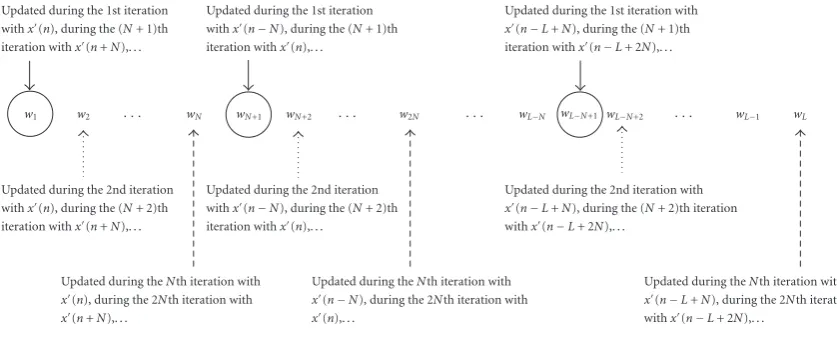
Figure 2summarizes the sequential PU algorithm given by (1), indicating the coefficients to be updated at each iter-ation and the related samples of the regressor signal. In the scheme ofFigure 2, the following update is considered to be carried out during the first iteration. The current value of the regressor signal isx¼
the filtered reference signal. However, according toFigure 2, the sequential LMS algorithm uses only everyNth element of the regressor signal. Thus, it is not worth computing a new sample of the filtered reference at every algorithm iteration. It is enough to obtain the value of a new sample at just one out ofNiterations.
TheL-length filter can be considered as formed byN sub-filters ofL/Ncoefficients each. These subfilters are obtained by uniformly sampling byNthe weights of the original vec-tor. Coefficients of the first subfilter are encircled inFigure 2. Hence, the whole updating process can be understood as the N-cyclical updating schedule ofN subfilters of lengthL/N. Coefficients occupying the same relative position in every subfilter are updated with the same sample of the regressor signal. This regressor signal is only renewed at one in every Niterations. That is, afterNiterations, the less recent value is shifted out of the valid range and a new value is acquired and subsequently used to update the first coefficient of each subfilter.
To sum up, duringNconsecutive instants,Nsubfilters of lengthL/Nare updated with the same regressor signal. This regressor signal is aN-decimated version of the filtered ref-erence signal. Therefore, the overall convergence can be ana-lyzed on the basis of the joint convergence ofNsubfilters:
(i) each of lengthL/N,
(ii) updated by anN-decimated regressor signal.
2.2. Spectral norm of autocorrelation matrices: the triangle inequality
The autocorrelation matrixRof a periodic signal consisting of several harmonics is Hermitian and Toeplitz.
The spectral norm of a matrixAis defined as the square root of the largest eigenvalue of the matrix product AHA, whereAH is the Hermitian transpose ofA, that is, [17, Ap-pendix E]
As=
λmax
AHA1/2. (6)
The spectral norm of a matrix satisfies, among other norm conditions, the triangle inequality given by
A+BsAs+Bs. (7)
The application of the definition of the spectral norm to the Hermitian correlation matrixRleads us to conclude that
Rs=
λmax
RHR1/2=λ max(RR)
1/2
=λmax(R). (8)
Therefore, sinceAandB are correlation matrices, we have the following result:
λmax(A+B)=A+BsAs+Bs=λmax(A)+λmax(B). (9)
2.3. Gain in step size for periodic input signals
At this point, a convergence analysis is carried out in order to derive a bound on the step size of the filtered-x sequential PU
LMS algorithm when the regressor vector is a periodic signal consisting of multiple sinusoids.
It is known that the LMS adaptive algorithm converges in mean to the solution if the step size satisfies [16, Chapter 6]
0< μ < 2 λmax
, (10)
whereλmaxis the largest eigenvalue of the input autocorrela-tion matrix
R=Ex¼ (n)x¼T
(n), (11)
x¼
(n) being the regressor signal of the adaptive algorithm. As has been previously stated, under the assumptions considered inSection 1.3, in the case of an ANC system based on the FxLMS, traditional LMS algorithm analysis can be used considering that the regressor vector corresponds to the reference signal filtered by an estimate of the secondary path. The proposed analysis is based on the ratio between the largest eigenvalue of the autocorrelation matrix of the regres-sor signal for two different situations. Firstly, when the adap-tive algorithm is the full update LMS and, secondly, when the updating strategy is based on the sequential LMS algorithm with a decimation factorN > 1. The sequential LMS with N=1 corresponds to the LMS algorithm.
Let the regressor vectorx¼
(n) be formed by a periodic sig-nal consisting ofKharmonics of the fundamental frequency
f0,
x¼ (n)=
K
k=1 Ckcos
2πk f0n+φk
. (12)
The autocorrelation matrix of the whole signal can be ex-pressed as the sum ofKsimpler matrices with each being the autocorrelation matrix of a single tone [11]
R= K
k=1
Ck2Rk, (13)
where
Rk
=1
2
⎧ ⎪ ⎪ ⎪ ⎪ ⎪ ⎪ ⎨ ⎪ ⎪ ⎪ ⎪ ⎪ ⎪ ⎩
1 cos2πk f0
cos
2πk(L 1)f0
cos2πk f0
1 cos
2πk(L 2)f0
. ..
.. . cos2πk(L 1)f0
1
⎫ ⎪ ⎪ ⎪ ⎪ ⎪ ⎪ ⎬ ⎪ ⎪ ⎪ ⎪ ⎪ ⎪ ⎭
.
(14)
If the simple LMS algorithm is employed, the largest eigenvalue of each simple matrixRkis given by [11]
λNk,max=1
k f0
=max
1 4
L
sinL2πk f0
sin2πk f0
. (15)
its components. Therefore, the largest eigenvalue ofRcan be expressed as
λN=1 tot,max
K
k=1 C2
kλNk,max=1
k f0
= K
k=1 C2kmax
1 4
L
sinL2πk f0
sin2πk f0
.
(16)
At the end ofSection 2.1, two key differences were de-rived in the case of the sequential LMS algorithm: the conver-gence condition of the whole filter might be translated to the parallel convergence ofNsubfilters of lengthL/Nadapted by anN-decimated regressor signal. Considering both changes, the largest eigenvalue of each simple matrix Rk can be
ex-pressed as
λN>k,max1
k f0
=max
1 4
L N
sin(L/N)2πkN f0
sin2πkN f0
(17)
and considering the triangle inequality (9), we have
λN>1 tot,max
K
k=1 C2
kλN>k,max1
k f0
= K
k=1 C2
kmax
1 4
L N
sin(L/N)2πkN f0
sin2πkN f0
.
(18)
Defining the gain in step sizeGμas the ratio between the
bounds on the step sizes in both cases, we obtain the factor by which the step size parameter can be multiplied when the adaptive algorithm uses PU,
Gμ
K,f0,L,N
= μN>max1 μN=1 max
=2/max
λN>1 tot,max
2/maxλNtot,max=1
= K
k=1Ck2λNk,max=1
k f0
K
k=1Ck2λN>k,max1
k f0
= K
k=1Ck2max
(1/4)Lsin
L2πk f0
sin2πk f0
K
k=1Ck2max
(1/4)L/Nsin(L/N)2πkN f0
sin2πkN f0
.
(19)
In order to more easily visualize the dependence of the gain in step size on the length of the filterLand on the deci-mation factorN, let a single tone of normalized frequencyf0 be the regressor signal
x¼
(n)=cos2π f0n+φ
. (20)
Now, the gain in step size, that is, the ratio between the bounds on the step size whenN >1 andN=1, is given by
Gμ
1,f0,L,N
= μN>max1 μN=1 max
= max
(1/4)Lsin
L2π f0
sin2π f0
max(1/4)L/Nsin
(L/N)2πN f0
sin2πN f0
.
(21)
Figures 3 and 4 show the gain in step size expressed by (21) for different decimation factors (N) and different lengths of the adaptive filter (L).
Basically, the analytical expressions and figures show that the step size can be multiplied byN as long as certain fre-quencies, at which a notch in the gain in step size appears, are avoided. The location of these critical frequencies, as well as the number and width of the notches, will be analyzed as a function of the sampling frequencyFs, the length of the
adaptive filterL, and the decimation factorN. According to (19) and (21), with increasing decimation factorN, the step size can be multiplied byNand, as a result of that affordable compensation, the PU sequential algorithm convergence is as fast as the full update FxLMS algorithm as long as the unde-sired disturbance is free of components located at the notches of the gain in step size.
Figure 3 shows that the total number of equidistant notches appearing in the gain in step size is (N 1). In fact, the notches appear at the frequencies given by
fk notch=k Fs
2N, k=1,. . .,N 1. (22)
It is important to avoid the undesired sinusoidal noise be-ing at the mentioned notches because the gain in step size is smaller there, with the subsequent reduction in convergence rate. As far as the width of the notches is concerned,Figure 4 (where the decimation factorN=2) shows that the smaller the length of the filter, the wider the main notch of the gain in step size. In fact, ifL/N is an integer, the width between first zeros of the main notch can be expressed as
width=Fs
L. (23)
Simulations and practical experiments confirm that at these problematic frequencies, the gain in step size cannot be ap-plied at its maximum valueN.
If it were not possible to avoid the presence of some har-monic at a frequency where there were a notch in the gain, the proposed strategy could be combined with the filtered-error least mean-square (FeLMS) algorithm [13, Chapter 3]. The FeLMS algorithm is based on a shaping filterC(z) placed in the error path and in the filtered reference path. The trans-fer functionC(z) is the inverse of the desired shape of the residual noise. Therefore,C(z) must be designed as a comb filter with notches at the problematic frequencies. As a re-sult of that, the harmonics at those frequencies would not be canceled. Nevertheless, if a noise component were to fall in a notch, using a smaller step size could be preferable to using the FeLMS, considering that typically it is more important to cancel all noise disturbance frequencies rather than obtain-ing the fastest possible convergence rate.
3. NOISE ON THE WEIGHT VECTOR SOLUTION
AND EXCESS MEAN-SQUARE ERROR
0.4 0.3 0.2 0.1 0
Normalized frequency 0
0.5 1 1.5 2
Gain
in
st
ep
siz
e
(a)L=256,N=1
0.4 0.3 0.2 0.1 0
Normalized frequency 0
0.5 1 1.5 2 2.5 3
Gain
in
st
ep
siz
e
(b)L=256,N=2
0.4 0.3 0.2 0.1 0
Normalized frequency 0
1 2 3 4 5
Gain
in
st
ep
siz
e
(c)L=256,N=4
0.4 0.3 0.2 0.1 0
Normalized frequency 0
2 4 6 8
Gain
in
st
ep
siz
e
(d)L=256,N=8
Figure3: Gain in step size for a single tone and different decimation factorsN=1, 2, 4, 8.
0.5 0.4
0.3 0.2
0.1 0
Normalized frequency 1
1.2 1.4 1.6 1.8 2 2.2
Gain
in
st
ep
siz
e
Gain in step size for different lengths of the adaptive filter,N=2
L=128
L=32
L=8
Figure 4: Gain in step size for a single tone and different filter lengthsL=8, 32, 128 with decimation factorN=2.
systems controlled by the filtered-x sequential LMS algo-rithm without an additional increase in mean-square error caused by the noise on the weight vector solution. We begin with an analysis of the trace of the autocorrelation matrix of anN-decimated signalxN(n), which is included to
pro-vide mathematical support for subsequent parts. The second part of the section revises the analysis performed by Widrow and Stearns of the effect of the gradient noise on the LMS algorithm [16, Chapter 6]. The section ends with the exten-sion to theGμ-FxSLMS algorithm of the previously outlined
analysis.
3.1. Properties of the trace of an N-decimated autocorrelation matrix
Let theL1 vectorx(n) represent the elements of a signal. To show the composition of the vectorx(n), we write
x(n)=x(n),x(n 1),. . .,x(n L+ 1)T. (24)
signal
R=Ex(n)xT(n)
= ⎡ ⎢ ⎢ ⎢ ⎢ ⎢ ⎢ ⎢ ⎢ ⎢ ⎣
rxx(0) rxx(1) rxx(2) rxx(L 1) rxx(1) rxx(0) rxx(1) rxx(L 2) rxx(2) rxx(1) rxx(0) rxx(L 3)
..
. ... ... . .. ... rxx(L 1) rxx(L 2) rxx(L 3) rxx(0)
⎤ ⎥ ⎥ ⎥ ⎥ ⎥ ⎥ ⎥ ⎥ ⎥ ⎦ . (25)
TheN-decimated signalxN(n) is obtained from vector x(n) by multiplyingx(n) by the auxiliary matrixI(kN),
xN(n)=I(kN)x(n), k=1 +nmodN, (26)
whereI(kN)is obtained from the identity matrixIof dimen-sionLLby zeroing out some elements inI. The first nonnull element on its main diagonal appears at thekth position and the superscript (N) is intended to denote the fact that two consecutive nonzero elements on the main diagonal are sep-arated byNpositions. The auxiliary matrixI(kN)is explicitly expressed as
I(kN)= ⎛ ⎜ ⎜ ⎜ ⎜ ⎜ ⎜ ⎜ ⎜ ⎜ ⎜ ⎜ ⎜ ⎜ ⎜ ⎜ ⎜ ⎜ ⎜ ⎜ ⎜ ⎜ ⎜ ⎜ ⎜ ⎜ ⎜ ⎜ ⎝ 0
. .. k 1
0
1 0
0
N . ..
0
- - - - 1
0 0 . .. 0 ⎞ ⎟ ⎟ ⎟ ⎟ ⎟ ⎟ ⎟ ⎟ ⎟ ⎟ ⎟ ⎟ ⎟ ⎟ ⎟ ⎟ ⎟ ⎟ ⎟ ⎟ ⎟ ⎟ ⎟ ⎟ ⎟ ⎟ ⎟ ⎠ . (27)
As a result of (26), the autocorrelation matrixRN of the
new signalxN(n) only presents nonnull elements on its main
diagonal and on any other diagonal parallel to the main di-agonal that is separated from it bykNpositions,kbeing any integer. Thus,
RN =E
xN(n)xTN(n) = 1 N ⎡ ⎢ ⎢ ⎢ ⎢ ⎢ ⎢ ⎢ ⎢ ⎢ ⎢ ⎢ ⎢ ⎢ ⎢ ⎢ ⎢ ⎢ ⎢ ⎢ ⎢ ⎢ ⎣
rxx(0) 0 0 r
xx(N) r
xx(2N) . .. 0 rxx(0) 0 . .. 0 rxx(N)
. . . . . . . .
. 0 rxx(0) 0 . .. 0
. . . 0 . .. 0 rxx(0) 0 . .. rxx(N)
rxx(N) 0 . .. 0 rxx(0) 0 . .. 0
. .
. rxx(N) 0 . .. 0 rxx(0)
. . .
rxx(2N) . .. . .. 0 . .. 0 0
. ..
rxx(N) 0 rxx(0)
⎤ ⎥ ⎥ ⎥ ⎥ ⎥ ⎥ ⎥ ⎥ ⎥ ⎥ ⎥ ⎥ ⎥ ⎥ ⎥ ⎥ ⎥ ⎥ ⎥ ⎥ ⎥ ⎦ . (28)
The matrixRN can be expressed in terms ofRas
RN = 1
N
N
i=1
I(iN)RI(iN). (29)
We define the diagonal matrix Λ with main diagonal comprised of theLeigenvalues ofR. IfQis a matrix whose columns are the eigenvectors ofR, we have
Λ=Q 1 RQ= ⎛ ⎜ ⎜ ⎜ ⎜ ⎜ ⎜ ⎜ ⎜ ⎜ ⎜ ⎝
λ1 0 0
0 . .. ... 0 ... ..
. . .. λi . .. ...
..
. 0 . .. ... 0 0 0 λL
⎞ ⎟ ⎟ ⎟ ⎟ ⎟ ⎟ ⎟ ⎟ ⎟ ⎟ ⎠ . (30)
The trace ofRis defined as the sum of its diagonal elements. The trace can also be obtained from the sum of its eigenval-ues, that is,
trace(R)= L
i=1
rxx(0)=trace(Λ)= L
i=1
λi. (31)
The relation between the traces ofRandRNis given by
traceRN
= L
i=1 rxx(0)
N =
trace(R)
N . (32)
3.2. Effects of the gradient noise on the LMS algorithm
Let the vectorw(n) represent the weights of the adaptive fil-ter, which are updated according to the LMS algorithm as follows:
w(n+ 1)=w(n) μ
2'(n)=w(n) +μe(n)x(n), (33)
whereμis the step size,'(n) is the gradient estimate at the nth iteration,e(n) is the error at the previous iteration, and x(n) is the vector of input samples, also called the regressor signal.
We definev(n) as the deviation of the weight vector from its optimum value
v(n)=w(n) wopt (34)
andv¼
(n) as the rotation ofv(n) by means of the eigenvector matrixQ,
v¼
(n)=Q 1
v(n)=Q 1
w(n) wopt
. (35)
In order to give a measure of the difference between actual and optimal performance of an adaptive algorithm, two parameters can be taken into account: excess mean-square error and misadjustment. The excess mean-mean-square er-rorξexcessis the average mean-square error less the minimum mean-square error, that is,
ξexcess=E
The misadjustmentMis defined as the excess mean-square error divided by the minimum mean-square error
M=ξexcess ξmin =
Eξ(n) ξmin ξmin .
(37)
Random weight variations around the optimum value of the filter cause an increase in mean-square error. The average of these increases is the excess mean-square error. Widrow and Stearns [16, Chapters 5 and 6] analyzed the steady-state effects of gradient noise on the weight vector solution of the LMS algorithm by means of the definition of a vector of noise n(n) in the gradient estimate at the nth iteration. It is as-sumed that the LMS process has converged to a steady-state weight vector solution near its optimum and that the true gradient(n) is close to zero. Thus, we write
n(n)='(n) (n)='(n)= 2e(n)x(n). (38)
The weight vector covariance in the principal axis coordinate system, that is, in primed coordinates, is related to the co-variance of the noise as follows [16, Chapter 6]:
covv¼
(n)=μ
8
Λ μ
2Λ 2
1 covn¼
(n)
=μ
8
Λ μ
2Λ 2
1
covQ 1 n(n)
=μ
8
Λ μ
2Λ 2
1 Q 1
En(n)nT(n)Q. (39)
In practical situations, (μ/2)Λtends to be negligible with re-spect toI, so that (39) simplifies to
covv¼
(n)≈μ 8Λ
1 Q 1
En(n)nT(n)Q. (40)
From (38), it can be shown that the covariance of the gra-dient estimation noise of the LMS algorithm at the minimum point is related to the autocorrelation input matrix according to (41)
covn(n)=En(n)nT(n)=4Ee2(n)R. (41)
In (41), the error and the input vector are considered statisti-cally independent because at the minimum point of the error surface both signals are orthogonal.
To sum up, (40) and (41) indicate that the measurement of how close the LMS algorithm is to optimality in the mean-square error sense depends on the product of the step size and the autocorrelation matrix of the regressor signalx(n).
3.3. Effects of gradient noise on the filtered-x sequential LMS algorithm
At this point, the goal is to carry out an analysis of the effect of gradient noise on the weight vector solution for the case of theGμ-FxSLMS algorithm in a similar manner as in the
previous section.
The weights of the adaptive filter when theGμ-FxSLMS
algorithm is used are updated according to the recursion
w(n+ 1)=w(n) +Gμμe(n)I(1+Nn)modNx
¼
(n), (42)
whereI(1+N)nmodN is obtained from the identity matrix as ex-pressed in (27). The gradient estimation noise of the filtered-x sequential LMS algorithm at the minimum point, where the true gradient is zero, is given by
n(n)='(n)= 2e(n)I (N) 1+nmodNx
¼
(n). (43)
Considering PU, only L/N terms out of theL-length noise vector are nonzero at each iteration, giving a smaller noise contribution in comparison with the LMS algorithm, which updates the whole filter.
The weight vector covariance in the principal axis coor-dinate system, that is, in primed coorcoor-dinates, is related to the covariance of the noise as follows:
covv¼
(n)= Gμμ 8
Λ Gμμ
2 Λ 2
1 covn¼
(n)
= Gμμ
8
Λ Gμμ
2 Λ 2
1
covQ 1 n(n)
= Gμμ
8
Λ Gμμ
2 Λ 2
1 Q 1
En(n)nT(n)Q. (44)
Assuming that (Gμμ/2)Λis considerably less thanI, then (44)
simplifies to
covv¼
(n)≈Gμμ 8 Λ
1 Q 1
En(n)nT(n)Q. (45)
The covariance of the gradient estimation error noise when the sequential PU is used can be expressed as
covn(n)=En(n)nT(n)
=4E(e2(n)I(N) 1+nmodNx
¼ (n)x¼T
(n)I(1+N)nmodN)
=4E(e2(n)EI(N) 1+nmodNx
¼ (n)x¼T
(n)I(1+N)nmodN)
=4Ee2(n)1 N
N
i=1
I(iN)RI(iN)
=4Ee2(n)R
N.
(46)
In (46), statistical independence of the error and the input vector has been assumed at the minimum point of the error surface, where both signals are orthogonal.
According to (32), the comparison of (40) and (45)— carried out in terms of the trace of the autocorrelation matrices—confirms that the contribution of the gradient es-timation noise isNtimes weaker for the sequential LMS al-gorithm than for the LMS. This reduction compensates the eventual increase in the covariance of the weight vector in the principal axis coordinate system expressed in (45) when the maximum gain in step sizeGμ =Nis applied in the context
4000 3000
2000 1000
0
Frequency (Hz) 4
3 2 1 0 1
P
(
f
)
(a)
4000 3000
2000 1000
0
Frequency (Hz) 50
40 30 20 10 0 10
S
(
f
)
(b)
4000 3000
2000 1000
0
Frequency (Hz) 50
40 30 20 10 0 10
Se
(
f
)
(c)
400 300
200 100
0
Frequency (Hz) 40
20 0 20
Po
w
er
sp
ec
tr
al
d
en
si
ty
(d
B
)
(d)
Figure5: Transfer function magnitude of (a) primary pathP(z), (b) secondary pathS(z), and (c) offline estimate of the secondary path used in the simulated model, (d) power spectral density of periodic disturbance consisting of two tones of 62.5 Hz and 187.5 Hz in additive white Gaussian noise.
4. EXPERIMENTAL RESULTS
In order to assess the effectiveness of theGμ-FxSLMS
algo-rithm, the proposed strategy was not only tested by simula-tion but was also evaluated in a practical DSP-based imple-mentation. In both cases, the results confirmed the expected behavior: the performance of the system in terms of conver-gence rate and residual error is as good as the performance achieved by the FxLMS algorithm, even while the number of operations per iteration is significantly reduced due to PU.
4.1. Computer simulations
This section describes the results achieved by theGμ-FxSLMS
algorithm by means of a computer model developed in MAT-LAB on the theoretical basis of the previous sections. The model chosen for the computer simulation of the first ex-ample corresponds to the 111 (1 reference microphone, 1 secondary source, and 1 error microphone) arrangement described in Figure 1(a). Transfer functions of the primary pathP(z) and secondary pathS(z) are shown in Figures5(a) and5(b), respectively. The filter modeling the primary path is a 64th-order FIR filter. The secondary path is modeled— by a 4th-order elliptic IIR filter—as a high pass filter whose
cut-off frequency is imposed by the poor response of the loudspeakers at low frequencies. The offline estimate of the secondary path was carried out by an adaptive FIR filter of 200 coefficients updated by the LMS algorithm, as a classi-cal problem of system identification.Figure 5(c) shows the transfer function of the estimated secondary path. The sam-pling frequency (8000 samples/s) as well as other parameters were chosen in order to obtain an approximate model of the real implementation. Finally, Figure 5(d) shows the power spectral density ofx(n), the reference signal for the undesired disturbance which has to be canceled
x(n)=cos(2π62.5n) + cos(2π187.5n) +η(n), (47)
whereη(n) is an additive white Gaussian noise of zero mean whose power is
Eη2(n)=σ2
η=0.0001 ( 40 dB). (48)
After convergence has been achieved, the power of the resid-ual error corresponds to the power of the random compo-nent of the undesired disturbance.
400 200
0
Frequency (Hz) 0
0.5 1 1.5 2
Gain
in
st
ep
siz
e
(a)N=1
400 200
0
Frequency (Hz) 0
0.5 1 1.5 2 2.5 3
Gain
in
st
ep
siz
e
(b)N=2
400 200
0
Frequency (Hz) 0
2 4 6 8
Gain
in
st
ep
siz
e
(c)N=8
400 200
0
Frequency (Hz) 0
5 10 15 20 25 30
Gain
in
st
ep
siz
e
(d)N=32
400 200
0
Frequency (Hz) 0
10 20 30 40 50 60
Gain
in
st
ep
siz
e
(e)N=64
400 200
0
Frequency (Hz) 0
20 40 60 80
Gain
in
st
ep
siz
e
(f)N=80
Figure6: Gain in step size over the frequency band of interest—from 0 to 400 Hz—for different values of the decimation factorN(N = 1, 2, 8, 32, 64, 80).
and the adaptive process starts. The valueμ=0.0001 is near the maximum stable step size when a decimation factorN=
1 is chosen.
The performance of theGμ-FxSLMS algorithm was tested
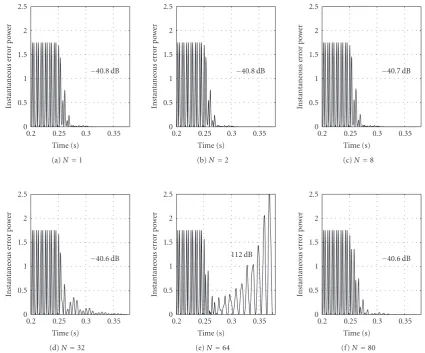
for different values of the decimation factor N. Figure 6 shows the gain in step size over the frequency band of in-terest for different values of the parameter N. The gain in step size at the frequencies 62.5 Hz and 187.5 Hz are marked with two circles over the curves. The exact location of the notches is given by (22). On the basis of the position of the notches in the gain in step size and the spectral distribution of the undesired noise, the decimation factorN =64 is ex-pected to be critical because, according toFigure 6, the full-strength gainGμ = N = 64 cannot be applied at the
fre-quencies 62.5 Hz and 187.5 Hz; both frequencies correspond exactly to the sinusoidal components of the periodic distur-bance. Apart from the caseN=64 the gain in step size is free of notches at both of these frequencies.
Convergence curves for different values of the decima-tion factorNare shown inFigure 7. The numbers that ap-pear over the figures correspond to the mean-square error computed over the last 5000 iterations. The residual error is
0.35 0.3 0.25 0.2
Time (s) 0
0.5 1 1.5 2 2.5
In
st
an
ta
n
eo
u
s
er
ro
r
p
o
we
r
40.8 dB
(a)N=1
0.35 0.3 0.25 0.2
Time (s) 0
0.5 1 1.5 2 2.5
In
st
an
ta
n
eo
u
s
er
ro
r
p
o
we
r
40.8 dB
(b)N=2
0.35 0.3 0.25 0.2
Time (s) 0
0.5 1 1.5 2 2.5
In
st
an
ta
n
eo
u
s
er
ro
r
p
o
we
r
40.7 dB
(c)N=8
0.35 0.3 0.25 0.2
Time (s) 0
0.5 1 1.5 2 2.5
In
st
an
ta
n
eo
u
s
er
ro
r
p
o
we
r
40.6 dB
(d)N=32
0.35 0.3 0.25 0.2
Time (s) 0
0.5 1 1.5 2 2.5
In
st
an
ta
n
eo
u
s
er
ro
r
p
o
we
r
112 dB
(e)N=64
0.35 0.3 0.25 0.2
Time (s) 0
0.5 1 1.5 2 2.5
In
st
an
ta
n
eo
u
s
er
ro
r
p
o
we
r
40.6 dB
(f)N=80
Figure7: Evolution of the instantaneous error power in an ANC system using theGμ-FxSLMS algorithm for different values of the decima-tion factorN(N=1, 2, 8, 32, 64, 80). In all cases, the gain in step size was set to the maximum valueGμ=N.
decimation factorN of this example was set to 4. Figure 8 compares the predicted gain in step size with the achieved results. As expected, the experimental gain in step size is 4, apart from the notches that appear at 400, 800, and 1200 Hz.
4.2. Practical implementation
TheGμ-FxSLMS algorithm was implemented in a 122 ac-tive noise control system aimed at attenuating engine noise at the front seats of a Nissan Vanette.Figure 9shows the phys-ical arrangement of electroacoustic elements. The adaptive algorithm was developed on a hardware platform based on the DSP TMS320C6701 from Texas Instruments [18].
The length of the adaptive filter (L) for theGμ-FxSLMS
algorithm was set to 256 or 512 coefficients (depending on the spectral characteristics of the undesired noise and the de-gree of attenuation desired), the length of the estimate of the secondary path (Ls) was set to 200 coefficients, and the
dec-imation factor and the gain in step size wereN = Gμ = 8.
The sampling frequency wasFs=8000 samples/s. From the
parameters selected, one can derive, according to (22), that the first notch in the gain in step size is located at 500 Hz.
The system effectively cancels the main harmonics of the en-gine noise. Considering that the loudspeakers have a low cut-offfrequency of 60 Hz, the controller cannot attenuate the components below this frequency. Besides, the ANC system finds more difficulty in the attenuation of closely spaced fre-quency harmonics (seeFigure 10(a)). This problem can be avoided by increasing the number of coefficients of the adap-tive filter; for instance, fromL=256 to 512 coefficients (see Figure 10(b)).
In order to carry out a performance comparison of the Gμ-FxSLMS algorithm with increasing value in the
decima-tion term N—and subsequently in gain in step size Gμ—
1600 1400 1200 1000 800 600 400 200 0
Frequency (Hz) 0
0.5 1 1.5 2 2.5 3 3.5 4 4.5 5
Gain
in
st
ep
siz
e
Simulated versus theoretical gain in step size,N=4,L=32
Simulation Theoretical
Figure8: Theoretically predicted gain in step size versus simulated results achieved in a modeled ANC system using theGμ-FxSLMS algorithm.
Secondary source
Error microphone Engine
noise microphoneReference
Error microphone Secondary
source
Figure9: Arrangement of the electroacoustic elements inside the van.
iterations shown. In this case, the length of the adaptive filter was set to 256 coefficients, the length of the estimate of the secondary path (Ls) was set to 200 coefficients, and the
deci-mation factor and the gain in step size were set toN=Gμ=
1, 2, 4, and 8. The sampling frequency wasFs =8000
sam-ples/s and the first notch in the gain in step size appeared at 500 Hz, well above the spectral location of the undesired dis-turbance. From the experimental results shown inFigure 11, the application of the full-strength gain in step size when the decimation factor is 2, 4, or 8 reduces the computational costs without degrading in any sense the performance of the system with respect to the full update algorithm.
Taking into account that the 2-channel ANC system im-plementing theGμ-FxSLMS algorithm inside the van ignored
400 350 300 250 200 150 100 50 0
Frequency (Hz) 50
40 30 20 10 0 10
P
o
w
er
spect
ru
m
m
ag
nitude
(dB)
ANC off ANC on
(a)L=256,N=8
400 350 300 250 200 150 100 50 0
Frequency (Hz) 50
40 30 20 10 0 10
P
o
w
er
spect
ru
m
m
ag
nitude
(dB)
ANC off ANC on
(b)L=512,N=8
Figure10: Power spectral density of the undesired noise (dotted) and of the residual error (solid) for the real cancelation of engine noise at the driver location. The decimation factor isN=8 and the length of the adaptive filter is (a)L=256 and (b)L=512.
cross terms, the expressions given by Tables1and2show that approximately 32%, 48%, and 56% of the high-level multi-plications can be saved when the decimation factorNis set to 2, 4, and 8, respectively.
2.5 2
1.5 1
0.5 0
Time (s) 0
0.04
Er
ro
r
p
o
w
er
40.16 dB
(a)N=1
2.5 2
1.5 1
0.5 0
Time (s) 0
0.04
Er
ro
r
p
o
w
er
40.18 dB
(b)N=2
2.5 2
1.5 1
0.5 0
Time (s) 0
0.04
Er
ro
r
p
o
w
er
41.7 dB
(c)N=4
2.5 2
1.5 1
0.5 0
Time (s) 0
0.04
Er
ro
r
p
o
w
er
40.27 dB
(d)N=8
Figure11: Error convergence of the real implementation of theGμ -FxSLMS algorithm with increasing value of the decimation factor
N. The system deals with a previously recorded signal consisting of harmonics at 100, 150, 200, and 250 Hz.
real implementation, such as parallel operations, addressing modes, registers available, or number of arithmetic units. In our case, the control strategy and the assembler code was de-veloped trying to take full advantage of these aspects [5].
5. CONCLUSIONS
This work presents a contribution to the selection of the step size used in the sequential partial update LMS and FxLMS adaptive algorithms. The deterministic periodic input signal case is studied and it is verified that under certain conditions the stability range of the step size is increased compared to the full update LMS and FxLMS.
The algorithm proposed here—filtered-x sequential LMS with gain in step size (Gμ-FxSLMS)—is based on sequential
PU of the coefficients of a filter and on a controlled increase in the step size of the adaptive algorithm. It can be used in ac-tive noise control systems focused on the attenuation of pe-riodic disturbances to reduce the computational costs of the control system. It is theoretically and experimentally proved
that the reduction of the computational complexity is not achieved at the expense of slowing down the convergence rate or of increasing the residual error.
The only condition that must be accomplished to take full advantage of the algorithm is that some frequencies should be avoided. These problematic frequencies corre-spond to notches that appear at the gain in step size. Their width and exact location depend on the system parameters.
Simulations and experimental results confirm the bene-fits of this strategy when it is applied in an active noise con-trol system to attenuate periodic noise.
ACKNOWLEDGMENT
This work was partially supported by CICYT of Spanish Gov-ernment under Grant TIN2005-08660-C04-01.
REFERENCES
[1] P. Lueg, “Process of silencing sound oscillations,” U.S. Patent no. 2.043.416, 1936.
[2] D. R. Morgan, “Analysis of multiple correlation cancellation loops with a filter in the auxiliary path,”IEEE Transactions on
Acoustics, Speech, and Signal Processing, vol. 28, no. 4, pp. 454–
467, 1980.
[3] B. Widrow, D. Shur, and S. Shaffer, “On adaptive inverse con-trol,” inProceedings of the15th Asilomar Conference on Circuits,
Systems, and Computers, pp. 185–195, Pacific Grove, Calif,
USA, November 1981.
[4] J. C. Burgess, “Active adaptive sound control in a duct: a com-puter simulation,”Journal of the Acoustical Society of America, vol. 70, no. 3, pp. 715–726, 1981.
[5] P. Ramos, R. Torrubia, A. L ´opez, A. Salinas, and E. Masgrau, “Computationally efficient implementation of an active noise control system based on partial updates,” inProceedings of the International Symposium on Active Control of Sound and
Vibra-tion (ACTIVE ’04), Williamsburg, Va, USA, September 2004,
paper 003.
[6] S. C. Douglas, “Adaptive filters employing partial updates,”
IEEE Transactions on Circuits and Systems II: Analog and
Digi-tal Signal Processing, vol. 44, no. 3, pp. 209–216, 1997.
[7] T. Aboulnasr and K. Mayyas, “Selective coefficient update of gradient-based adaptive algorithms,” inProceedings of IEEE In-ternational Conference on Acoustics, Speech and Signal
Process-ing (ICASSP ’97), vol. 3, pp. 1929–1932, Munich, Germany,
April 1997.
[8] K. Doˇganc¸ay and O. Tanrikulu, “Adaptive filtering algorithms with selective partial updates,”IEEE Transactions on Circuits
and Systems II: Analog and Digital Signal Processing, vol. 48,
no. 8, pp. 762–769, 2001.
[9] J. Sanubari, “Fast convergence LMS adaptive filters employ-ing fuzzy partial updates,” inProceedings of IEEE Conference on Convergent Technologies for Asia-Pacific Region (TENCON ’03), vol. 4, pp. 1334–1337, Bangalore, India, October 2003. [10] P. A. Naylor, J. Cui, and M. Brookes, “Adaptive algorithms for
sparse echo cancellation,”Signal Processing, vol. 86, no. 6, pp. 1182–1192, 2006.
[11] S. M. Kuo, M. Tahernezhadi, and W. Hao, “Convergence anal-ysis of narrow-band active noise control system,”IEEE Trans-actions on Circuits and Systems II: Analog and Digital Signal
[12] E. Bjarnason, “Analysis of the filtered-X LMS algorithm,”IEEE
Transactions on Speech and Audio Processing, vol. 3, no. 6, pp.
504–514, 1995.
[13] S. M. Kuo and D. R. Morgan,Active Noise Control Systems:
Al-gorithms and DSP Implementations, John Wiley & Sons, New
York, NY, USA, 1996.
[14] L. Vicente and E. Masgrau, “Novel FxLMS convergence condi-tion with deterministic reference,”IEEE Transactions on Signal
Processing, vol. 54, no. 10, pp. 3768–3774, 2006.
[15] S. J. Elliott, Signal Processing for Active Control, Academic Press, London, UK, 2001.
[16] B. Widrow and S. D. Stearns,Adaptive Signal Processing, Pren-tice Hall, Englewood Cliffs, NJ, USA, 1985.
[17] S. Haykin,Adaptive Filter Theory, Prentice Hall, Upper Saddle River, NJ, USA, 2002.