R E S E A R C H
Open Access
Generation of CRISPR-cas9 construct for
knockout of genes encoding
chromatin-associated proteins
Mumtaz Aarif Wani
1and Aijaz Ahmad Ganaie
2*Abstract
Background:Eukaryotic genomes have a multiscale three-dimensional organization varying from nucleosomes, loops, topologically associating domains, and chromosome territories. Chromatin, DNA wrapped around histone proteins, helps in packaging long DNA within tiny nuclear spaces. We used CRISPR-cas9, which is a system of single-protein and single-guide RNAs for genome engineering and also is simple and target specific.
Method:Two major protein families involved in maintaining and regulating structure and dynamics of chromatin are trithorax group (TrxG) and polycomb group (PcG) proteins. This study was undertaken to generate knockout cell lines of some TrxG and PcG proteins using the CRISPR-based approach in order to study their role in higher order chromatin organization.
Results:From TrxG, ISWI and Acf were selected, and from PcG, Pc and Psc were selected. Three Cas9-puro-vector constructs for ISWI gene, one cas9-Cas9-puro-vector construct for Pc, gene and two pAc-sgRNA-cas9-puro-vector constructs for each of the Acf and Psc gene were generated. These constructs were confirmed by PCR and sequencing.
Conclusion:In the future, these constructs will be used to study the role of their respective target genes in chromatin organization.
Keywords:Trithorax group proteins, Polycomb group proteins, CRISPR-cas9
Introduction
Chromatin is a complex structure consisting of DNA, proteins, and RNA. Chromatin is packaged into small nuclear space in the cell, but at the same time chromatin is accessible to various transcription factors. This dynamic nature of chromatin is maintained by various proteins and protein complexes. The structural proteins, called histones, help in the DNA assembly. The core histones, namely H2A, H2B, H3, and H4, form the nucleosome, which is the basic unit of chromatin organization. The nucleosome consists of an octamer of core histones made of a pair of each core histone and a DNA fragment of 146 bp wrapped around the octamer
core. This forms the “beads on a string” structure of
chromatin, then nucleosomal chromatin to a compact structure called 30-nm fiber chromatin (heterochroma-tin). The 30-nm fiber is packaged to a higher level into the metaphase chromosome. Chromatin-associated pro-teins are of two counteracting groups, trithorax group (TrxG) and polycomb group (PcG) that maintain the cellular memory. TrxG is of critical importance in the senescence, DNA damage, epigenetic regulation of the
cell cycle, and stem cell biology (Ingham 1998).
some histone modifiers and chromatin remodelers, as well as proteins that are not categorized within the first two classes. Thus, most of the Trx proteins perform their functions as a part of their large multiprotein complexes that are histone modifiers or nucleosome remodelers, to regulate gene expression. PcG implement transcription silencing in higher eukaryotes by forming chromatin-modifying complexes. Two main families of complexes, called polycomb repressive complex (PRC) 1 and PRC2, are targeted to repress DNA regions. We used CRISPR-cas9 technology to generate pAc-sgRNAcas9-puro-vector knockout constructs for some proteins of these two groups (TrxG and PcG) to study their function. Clustered regularly interspaced short palindromic repeats [CRISPR] are DNA sequences found in prokaryotic ge-nomes (Grissa et al. 2007). Each repeat is followed by a “spacer DNA,”which is adopted from a previous infection by a phage or plasmid (Marraffini and Sontheimer2010). Simply, CRISPR-Cas9 is an immune system in prokaryotes and provides a form of acquired immunity against phages and plasmids. CRISPR-associated genes [Cas genes] are a set of genes that are closely associated with CRISPR. Bac-teria which are able to survive a viral infection fragmentize the viral DNA and then integrate few of these fragments into their CRISPR loci and also pass on this genetic infor-mation generation to generation. Whenever in the future the same bacteria or its progeny is infected by the same viral strain or another viral strain which shares the same genetic information which the bacteria has integrated into its CRISPR locus are able to survive the infection with the help of CRISPR activation, the RNAs transcribed from
CRISPR loci called CRISPR RNA [crRNA] (Pennisi2013)
or guide RNA. RNA makes a stable complex with Cas protein and navigates and binds the specific target in viral DNA and makes a double-strand break, hence degrading the viral DNA and, in this way, escaping viral invasion.
Streptococcus pyogeneshas a CRISPR system and a single-cas gene called single-cas9 that is required for the function of this CRISPR system in the bacterium. Cas9 is a fascinating enzyme. Cas9 has the ability to interact with DNA and generate a double-strand break [DSB] at sequences that match the guide RNA sequences. The guide RNA base pairs with protospacer in viral DNA to allow cas9 enzyme to cause a specific double-strand break. The guide RNA also base pairs with another RNA sequence called tracrRNA to form a structure that recruits the cas9 enzyme. Therefore, two RNAs, guide RNA and tracrRNA, and cas9 enzyme are required to form a complex that recognizes the viral DNA and degrades it. In 2012, Jinek et.al linked together guide RNA and tracrRNA molecules to form a single-guide RNA [sgRNA], to generate a system of single-protein and single-guide RNA for genome engin-eering. This new genome engineering technology is simply called CRISPR-cas9 technology. This technique is used to generate knockout cell lines which in turn provide the in-formation regarding the function of the same gene (Jinek et al.2012).
CRISPR/Cas9 systems have been successfully used for precise genome editing in mouse embryonic stem cells (ESCs) and targeted biallelic mutagenesis in F0 zebrafish (Jao et al. 2013; Wang et al. 2013; Yang et al. 2013). Recently, CRISPR-Cas9 systems have been used to effi-ciently edit the genome of adult mice in vivo in the liver and muscle (Long et al. 2014; Xue et al.2014; Yin et al.
2014). The RNA-guided Cas9 endonuclease induces
sequence-specific DNA double-strand breaks (DSBs) that are repaired mostly by the classical and alternative nonhomologous end-joining pathways (c-NHEJ or AEJ) or by homology-directed repair (HDR) (Boboila et al. 2012). This study was carried out to generate the knock-out cell lines of chromatin-associated proteins, viz, poly-comb and trithorax. The constructs for some of these genes were successfully generated which will be used in the future to generate the knockout cell lines of the same. This study will provide insight into the mechan-ism how these proteins are responsible for the chroma-tin structure and function.
This study was carried out to design and synthesize guide sequences for TrxG (ISWI and Acf) and PcG (Pc and Psc) proteins and to generate CRISPR-cas9 constructs to knock-out TrxG (ISWI and Acf) and PcG (Pc and Psc) genes.
Fig. 1Picture showing position of guide sequences for the selected sequence of a gene
Methodology
Designing guide oligos
Select 23-250NT sequence of your desired gene and paste it in a web tool calledcrispr.mit.edu. Download the guide sequences and choose the guides on the basis of score of guides (Figs.1 and 2). If target sequence does not begin with G, add G to its 5′end to allow transcription from the U6 promoter. For the forward oligonucleotide, add TTC
to the 5′ end of the target sequence. For the reverse
oligonucleotide, reverse complement the target sequence (including an additional G nucleotide), and add AAC to the 5′end. Synthesize the oligonucleotides. Oligos were synthesized as shown in Table1.
Annealing of oligos
The forward and reverse oligos were annealed using PCR machine as follows: Mix 10μl of 2x annealing buffer (20
mM Tris, 2 mM EDTA, 100 mM NaCl, pH 8.0) with 5μl
each of 100 uM forward and reverse oligos.
Annealing program
The oligos are annealed as shown in Table 2. Incubate
for 30 min at 37 °C. Dilute 10x in ddH2O.
Phosphorylation of annealed oligos
After annealing, the oligos were phosphorylated using annealed oligos (1μl, 10μM), Roche T4 DNA ligase
buf-fer (1 μl, 1x, contains ATP), T4 polynucleotide kinase
(1μl, 1 U), ddH2O (7μl) to make the final volume 10μl
and incubate at 37 °C for 10 min.
Digestion of pAc-sgRNA-cas9-puro-vector
Meanwhile, 2μg pAc-sgRNA-Cas9 vector (300 ng, 12μl)
was digested for 1 h at 37 °C using NEB buffer 4 (1x, 5 μl), BspQ1 (NEB, 2 μl), and ddH2O (31 μl) to make
the final volume 50μl. Run the digested vector on agar-ose gel and purify the digested vector using a kit by the manufacturer’s protocol.
Ligation of digested vector pAc-sgRNA-Cas9-puro and phosphorylated oligos
The ligation was performed using pAc-sgRNA-Cas9-puro-vector (2 μl), 10x diluted oligos (2 μl), Roche T4
DNA ligase buffer (1 μl), T4 DNA ligase (1 μl), and
ddH2O (4μl) to make the final volume 10 μl and
incu-bate at 18 °C for 2 h.
Transformation
Transform 2μl of ligated vector (with desired oligos) to a 50μl aliquot of chemically competent DH5-αcells by:
Incubate 20 min on ice with plasmid.
Heat shock for 30 s at 42 °C.
Cool for 2 min on ice.
Use LB-ampicillin/carbenicillin plates (100μg/ml).
Incubate at 37 °C overnight.
Table 1Guide sequences of genes under study
S. no. Name of the target gene No. of guides Name of guides Guide sequence 5′to 3’
01. ISWI 03 ISWI19, ISWI20, ISWI21, ISWI22
and ISWI23
TTCGACGGCAGCTGTATCTGTT, TTCGGGTCTACCCTTAGGCTTCGT, TTCGATATCTCCGTCTGCTTTAGC, TTCGCTTTTCACCGGATGAACTGG, TTCGTAAGAGTCCCACGAAGCCTA
02. Acf 02 Acf10 and Acf11 TTCGCCTTCGGGCACCCGTCCTTC, TTCG
GGTGTTGACCGCCGACTGTT
03. Pc 02 Pc1, Pc2 TTCGGCCGCGTACACTAGATCGAC, TTCG
TCCAGTCGATCTAGTGTACG
04. Psc 02 Psc8 and Psc9 TTCGGGCTGTATTGCTTTCGATTC, TTCG
GACAACGGCAACGAATAAGG
Table 2Annealing program
98 °C 1 min
98–88 °C 5 s, decrease 0.1 °C/cycle × 99 cycles
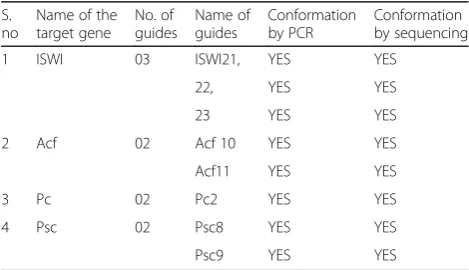
Table 3CRISPR-CAS9 constructs to knockout TrxG and PcG genes+
S. no
Name of the target gene No. of guides Name of guides Conformation by PCR Conformation by sequencing
The next day, three colonies for each clone were randomly selected and inoculated in 5 ml LB broth containing ampicillin 1μg/ml. The tubes were kept in a shaking incubator at 37 °C overnight.
Isolation of plasmids was done using Qiagenmini prep kit.
The integrity of the plasmids was checked on agarose gel.
Confirmation of positive constructs by PCR and sequencing
Confirmation of positive constructs was done by PCR using buffer (1x, 5 μl), dNTPs (1.5 mM, 5 μl), Forward
primer (U6F, 0.25 μM, 1.25 μl), Reverse primer
(0.25μM, 1.2μl), Template (50 ng, 1μl), Taq. Pol. (0.05,
0.1 μl), and MQ (36.4 μl) to make the final volume
50 μl. The PCR program followed was hot start (95 °C,
5 min), denaturation (95 °C, 30 s), annealing (56 °C, 30 s), extension (72 °C, 25 s), and last extension (72 °C, 7 min).
The positive pAc-sgRNA-Cas9-puro-vector constructs were sent to Scigenom (Kochi, India) for sequencing. The sequencing was checked by alignment using Emboss needle web tool.
Results and discussion
Eight CRISPR-CAS9 constructs to knockout TrxG and PcG genes were successfully generated as shown in Table3.
Generation of pAc-sgRNA-Cas9-puro-vector TrxG (ISWI and Acf) constructs
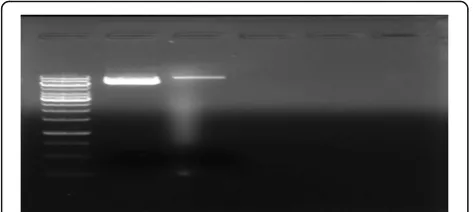
In order to generate CRISPR-based knockout cell lines of ISWI, the pAc vector was digested with BspQ1, as shown in Fig.3. The digested vector and the annealed, lated oligos were ligated. We first ligated five phosphory-lated guides of ISWI, i.e., ISWI19, ISWI20, ISWI21, ISWI22, and ISWI23, with the digested vector. Next, trans-formation of the same was performed in DH5-alpha com-petent cells. After transformation, DH5-alpha cells were grown on LB-ampicillin agar plates. We got a good number of colonies only for ISWI19, 21, 22, and 23. Three colonies from each plate were randomly selected and inoculated in 5 ml LB-ampicillin broth. The tubes were kept at 37 °C in a shaking incubator overnight. The next day, recombinant plasmids were isolated using miniprep kit. On running the isolated recombinant plasmids on 1% agarose gel, only ISWI21, 22, and 23 showed positive clones as shown in
Fig. 4. The pAc-sgRNA-cas9-puro-vector was ran as the
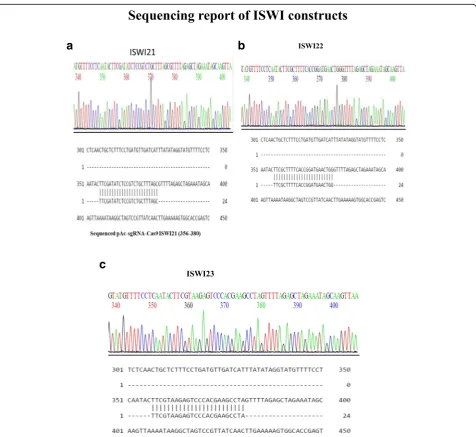
control. The confirmation of positive clones was further confirmed by PCR and sequencing sequentially. For the PCR confirmation, the U6F and the complementary oligo of guide sequences were used as primers and the PCR products were run on 1% agarose gel, as shown in Fig.5. For the confirmation by sequencing U6F primer was used, the sequencing results are shown in Fig.6a–c.
For the generation of knockouts of TrxG gene Acf, two different guide sequences were selected for Acf. These two guide sequences were annealed with their complementary guide sequences and phosphorylated.
Meanwhile, the pAc-sgRNA-Cas9-puro-vector was
Fig. 31% agarose gel of undigested and digested pAc vector
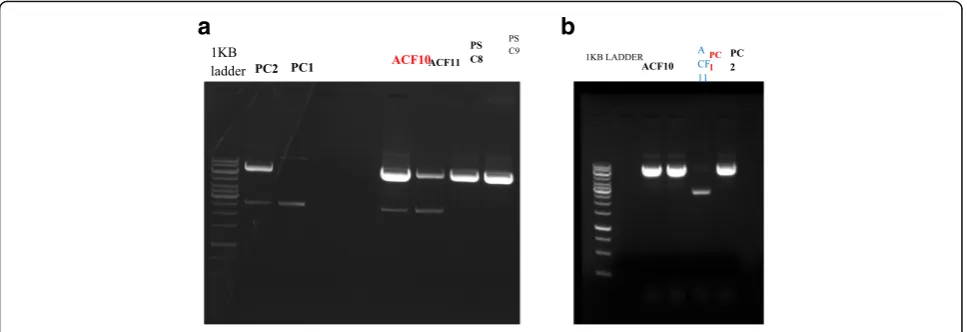
designed with BspQ1 restriction enzyme as mentioned in the materials and methods, purified and ligated with the guide oligos. Transformation of the ligated plasmids was performed in DH5-alpha competent cells and plated on LB-ampcillin agar plates. The next day, single colonies, two from each, were inoculated in LB broth and were grown overnight at 37 °C in a shaking incubator. Recombinant plasmids as shown in
Fig. 7a, were isolated and the integrity of plasmids
was checked on 1% agarose gel. As evident from
Fig. 7a, the impurities were found in the plasmids
and the same experiment was repeated as shown in
Fig. 7b. The Acf10 and Acf11 constructs were
con-firmed for the presence of insert by PCR and sequen-cing. The PCR was performed using U6F primer and the complementary sequence of each oligo. The PCR
Fig. 51% agarose gel showing PCR confirmation of positive pAc-sgRNA-Cas9-puro-vector knockout
a
c
products were run on 1% agarose gel keeping pAc-sgRNA-cas9-puro-vector as the negative control as
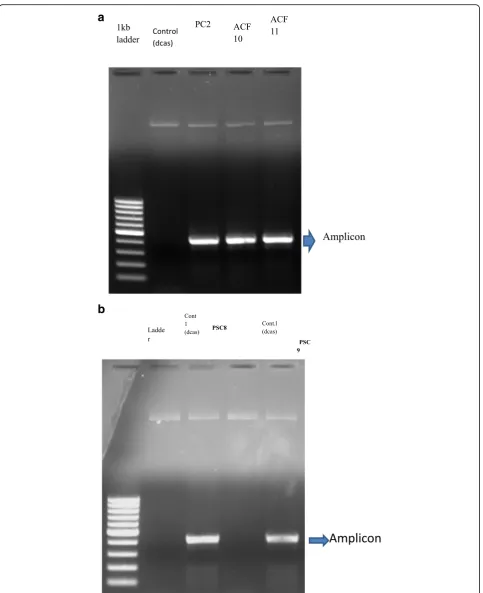
shown in Fig. 8a. The size of the PCR fragment was
found almost 491 bp as expected in each case. Further confirmation of the recombinants was performed by
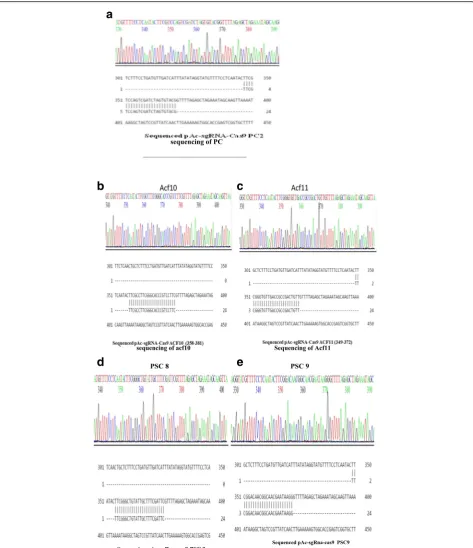
sequencing using U6F primer as shown in Fig. 9b, c.
Generation of CRISPR-Cas9 constructs for polycomb group [PcG] proteins [Pc and Psc]
For the generation of knockouts of PcG genes, Pc and Psc, and one and two different guide sequences, respect-ively, were selected for each gene. These guide se-quences were annealed with their complementary guide sequences and phosphorylated as mentioned in the ma-terials and methods. Meanwhile, the pAc-sgRNA-Cas9-puro-vector was digested with BspQ1, purified and ligated with the guide oligos. Transformation of the ligated plasmids was performed in DH5-alpha compe-tent cells and plated on LB-ampcillin agar plates. The next day, single colonies, two from each, were inoculated in LB broth and were grown overnight at 37 °C in a shaking incubator. Recombinant plasmids as shown in Fig. 7a were isolated, and the integrity of plasmids was checked on 1% agarose. As evident from Fig.7a, the im-purities were found in the plasmids except Psc8 and Psc9.The same experiment was repeated for the gener-ation of Pc1 and Pc2 constructs. The recombinant plas-mids of these genes were run on 1% agarose gel, as
shown in Fig. 7b. The impurity was still found in the
case of Pc1. The Pc2, Psc8, and Psc9 constructs were confirmed for the presence of insert sequentially by PCR and sequencing. The PCR was performed using U6F primer and the complementary sequence of each oligo. The PCR products were ran on 1% agarose gel keeping pAc-sgRNA-cas9-puro-vector as the negative control as
shown in Fig. 8a, b. The size of the PCR fragment was
found almost 491 bp as expected in each case. Further
confirmation of the recombinants was performed by sequencing using U6F primer as shown in Fig.9a, d, e.
Discussion
The CRISPR/Cas9 system is proven to be a powerful yet simple tool to manipulate the genome for the generation of genetically modified animals. In this study, we report the successful generation of eight CRISPR-cas9 con-structs to knockout TrxG and PcG. We synthesized five guide sequences ISWI19, ISWI20, ISWI21, ISWI22, and ISWI23 for TrxG protein, ISWI. Among the five guides sequences, only three ISWI21, ISWI22, and ISWI23 suc-cessfully integrated into pAc-sgRNA-cas9-puro-vector to form three CRISPR-cas9 constructs for ISWI gene.
Chromatin-associated proteins are of two counteract-ing groups, trithorax group (TrxG) and polycomb group (PcG), that maintain the cellular memory. TrxG is of critical importance in the senescence, DNA damage, epigenetic regulation of the cell cycle, and stem cell biol-ogy. Trithorax chromatin regulators are evolutionarily conserved proteins and can be divided into three classes on the basis of their molecular function. One class is methylate histone tails, and it contains SET domain. The second class, ATP-dependent chromatin remodeling factors, includes proteins that can read the histone methylation marks that are laid down by the SET domain proteins. The third class can directly bind to specific DNA sequences and includes TrxG proteins comprised of some histone modifiers and chromatin remodelers, as well as proteins that are not categorized within the first two classes. Thus, most of the Trx proteins perform their functions as a part of their large multiprotein complexes that are histone modifiers or nu-cleosome remodelers, to regulate gene expression. PcG implement transcription silencing in higher eukaryotes by forming chromatin-modifying complexes. Two main families of complexes, called polycomb repressive com-plex (PRC) 1 and PRC2, are targeted to repress DNA
a
b
a
regions. We used CRISPR-cas9 technology to generate pAc-sgRNAcas9-puro-vector knockout constructs for some of the proteins of these two groups (TrxG and PcG) to study their function. In 2012, Martin Jinek et al.
linked together guide RNA and tracrRNA molecules to form a single-guide RNA [sgRNA] to generate a system of single-protein and single-guide RNA for genome engineering. This new genome engineering technology is
a
b
c
d
e
simply called CRISPR-cas9 technology. This technique is used to generate knockout cell lines which in turn provide the information regarding the function of the same gene.
The first response of CRISPR-Cas system is to capture viral DNA and select spacers from it to insert them into
CRISPR locus (Tyson and Banfield2008). Cas1 and Cas2
are found in all three CRISPR-Cas immune systems that indicate they are involved in spacer adaptation. This hy-pothesis was confirmed by mutation studies (Aliyari and Ding2009; Dugar et al.2013; Hatoum-Aslan et al.2011). There are multiple Cas1 proteins with diverse amino acid sequences, but similar crystal structures. All purified Cas1 proteins are metal-dependent nucleases/integrases and show sequence independent binding to DNA (Wiedenheft et al. 2012).After analysis of repeat-spacer array, it was found that the spacers which were selected from phage genomes were not randomly selected, but only those regions called protospacers are selected for adapta-tion in the CRISPR locus. These protospacers lie up-stream adjacent to short[3-5 bp] DNA sequences called protospacer-adjacent motifs[PAMs]. Analysis of CRISPR-Cas systems showed that PAMs are important for type I and type II systems only (Horvath et al. 2008;
Deveau et al. 2008). Different CRISPR-Cas systems
show conservation of the PAM sequences they
recognize. New spacers are preferentially added adja-cent to leader sequence in a directional manner (Shah et al. 2009). A single long primary transcript is tran-scribed from the promoter in the leader sequence. CRISPR RNAs [crRNAs] are formed from this single transcript by cleavage inside the repeat sequence. The mechanism of production of crRNAs is different in the three CRISPR systems.
Conclusion
We synthesized five guide sequences ISWI19, ISWI20, ISWI21, ISWI22, and ISWI23 for TrxG protein, ISWI. Among the five guides sequences only three ISWI21, ISWI22, and ISWI23 successfully integrated into pAc-sgRNA-cas9-puro-vector to form three CRISPR-cas9 constructs for ISWI gene. Two guide sequences, Acf10 and Acf11, were synthesized for another TrxG protein; Acf and both the guide sequences successfully integrated into the pAc-sgRNA-cas9-puro-vector to form two CRISPR-cas9 constructs for Acf gene. For PcG proteins,
generated eight CRISPR-cas9 constructs, five for TrxG proteins, and three for PcG proteins (Table1).
Abbreviations
CRISPR:Clustered regulatory interspersed short palindromic repeats; DSB: Double-strand break; ISWI: Imitation switch; PcG: Polycomb group; PRC: Polycomb-repressive complex; RNA: Ribonucleic acid; TrxG: Trithorax group
Acknowledgements
NA.
Funding
NA.
Availability of data and materials
The necessary data was collected during study. However, on request or proposal, additional information will be provided by corresponding author.
Authors’contributions
Experimental work was carried out by MAW, while as with data compilation, editing was done by AAG. Both authors read and approved the final manuscript.
Ethics approval and consent to participate
NA.
Consent for publication
NA.
Competing interests
The authors declare that they have no competing interests.
Publisher’s Note
Springer Nature remains neutral with regard to jurisdictional claims in published maps and institutional affiliations.
Author details 1
Department of Biotechnology, Kashmir University, Srinagar, Jammu & Kashmir 190001, India.2Environmental Biotechnology Lab, Deptt. of P.G Studies and Research in Biological sciences, R. D. University, Jabalpur 482001, India.
Received: 25 April 2019 Accepted: 4 June 2019
References
Aliyari R, Ding SW (2009) RNA-based viral immunity initiated by the Dicer family of host immune receptors. Immunol Rev 227(1):176–188
Boboila C, Alt FW, Schwer B (2012) Classical and alternative endjoining pathways for repair of lymphocyte-specific and general DNA doublestrand breaks. Adv Immunol 116:1–49
Deveau H, Barrangou R, Garneau JE, Labonté J, Fremaux C, Boyaval P, Romero DA, Horvath P, Moineau S (2008) Phage response to CRISPR-encoded resistance in Streptococcus thermophilus. J Bacteriol 190(4):1390–1400 Dugar G, Herbig A, Förstner KU, Heidrich N, Reinhardt R, Nieselt K, Sharma
Ingham PW (1998) Trithorax and the regulation of homeotic gene expression in Drosophila: a historical perspective. Int J Dev Biol 42:423–429
Jao LE, Wente SR, Chen W (2013) Efficient multiplex biallelic zebrafish genome editing using a CRISPR nuclease system. Proc Natl Acad Sci U S A 110:13904–13909 Jinek M, Chylinski K, Fonfara I, Hauer M, Doudna JA, Charpentier E (2012) A
programmable dual-RNA-guided DNA endonuclease in adaptive bacterial immunity. Science 337(6096):816–821
Long C, McAnally JR, Shelton JM, Mireault AA, Bassel-Duby R, Olson EN (2014) Prevention of muscular dystrophy in mice by CRISPR/ Cas9-mediated editing of germline DNA. Science 345:1184–1188
Marraffini LA, Sontheimer EJ (2010) CRISPR interference: RNA-directed adaptive immunity in bacteria and archaea. Nat Rev Genet 11(3):181–190 Pennisi E (2013) The CRISPR craze. News focus. Science 341(6148):833–836 Shah SA, Hansen NR, Garrett RA (2009) Distribution of CRISPR spacer matches in
viruses and plasmids of crenarchaealacido thermophiles and implications for their inhibitory mechanism. Biochem Soc Trans 37:23–28
Tyson GW, Banfield JF (2008) Rapidly evolving CRISPRs implicated in acquired resistance of microorganisms to viruses. Environ Microbiol 10(1):200–207 Wang H, Yang H, Shivalila CS, Dawlaty MM, Cheng AW, Zhang F, Jaenisch R
(2013) One-step generation of mice carrying mutations in multiple genes by CRISPR/Cas-mediated genome engineering. Cell 153:910–918
Wiedenheft B, Sternberg SH, Doudna JA (2012) RNA-guided genetic silencing systems in bacteria and archaea. Nature 482(7385):331–338
Xue W, Chen S, Yin H, Tammela T, Papagiannakopoulos T, Joshi NS, Cai W, Yang G, Bronson R, Crowley DG et al (2014) CRISPR mediated direct mutation of cancer genes in the mouse liver. Nature 514:380–384
Yang H, Wang H, Shivalila CS, Cheng AW, Shi L, Jaenisch R (2013) One-step generation of mice carrying reporter and conditional alleles by CRISPR/Cas-mediated genome engineering. Cell 154:1370–1379