The Thirty-Third AAAI Conference on Artificial Intelligence (AAAI-19)
BIRD: Engineering an Efficient CNF-XOR SAT
Solver and Its Applications to Approximate Model Counting
∗Mate Soos, Kuldeep S. Meel
School of Computing National University of Singapore
Abstract
Given a Boolean formulaφ, the problem of model counting, also referred to as #SAT is to compute the number of solutions of φ. Model counting is a fundamental problem in artifi-cial intelligence with a wide range of applications including probabilistic reasoning, decision making under uncertainty, quantified information flow, and the like. Motivated by the success of SAT solvers, there has been surge of interest in the design of hashing-based techniques for approximate model counting for the past decade. We profiled the state of the art ap-proximate model counterApproxMC2and observed that over 99.99% of time is consumed by the underlying SAT solver, CryptoMiniSat. This observation motivated us to ask:Can we design an efficient underlying CNF-XOR SAT solver that can take advantage of the structure of hashing-based algo-rithms and would this lead to an efficient approximate model counter?
The primary contribution of this paper is an affirmative answer to the above question. We present a novel architecture, called BIRD, to handle CNF-XOR formulas arising from hashing-based techniques. The resulting hashing-hashing-based approximate model counter, calledApproxMC3, employs theBIRD frame-work in its underlying SAT solver,CryptoMiniSat. To the best of our knowledge, we conducted the most comprehen-sive study of evaluation performance of counting algorithms involving 1896 benchmarks with computational effort total-ing 86400 computational hours. Our experimental evaluation demonstrates significant runtime performance improvement forApproxMC3overApproxMC2. In particular, we solve 648 benchmarks more thanApproxMC2, the state of the art approximate model counter and for all the formulas where bothApproxMC2andApproxMC3did not timeout and took more than 1 seconds, the mean speedup is 284.40 – more than two orders of magnitude.
1
Introduction
Propositional model counting is a fundamental problem in ar-tificial intelligence with a wide range of applications ranging from probabilistic reasoning (Roth 1996), network reliabil-ity (Due˜nas-Osorio et al. 2017), decision making under un-certainty (Gomes, Sabharwal, and Selman 2009), quantified
∗
The open-source implementation along with accompanied tech-nical report is available at https://github.com/meelgroup/approxmc Copyright c2019, Association for the Advancement of Artificial Intelligence (www.aaai.org). All rights reserved.
information leakage (Biondi et al. 2018) and the like (Roth 1996; Gomes, Sabharwal, and Selman 2009) Given a Boolean formulaφ, the problem of propositional model counting, also referred to as #SAT, is to compute the number of solutions ofφ. In his seminal paper, Valiant showed that #SAT is
#P-complete, where#Pis the set of counting problems associated withNPdecision problems (Valiant 1979).
Theoretical investigations of#Phave led to the discov-ery of deep connections in complexity theory, and there is strong evidence for its hardness (Arora and Barak 2009; Toda 1989). In particular, Toda showed that every problem in the polynomial hierarchy could be solved by just one call to a#Poracle; more formally,P H⊆P#P(Toda 1989).
Given computational intractability of #SAT, attention has focused on approximation of #SAT. In a breakthrough, Stock-meyer provided a hashing-based randomized approximation scheme for counting that makes polynomially many invo-cations of NPoracle (Stockmeyer 1983). The procedure, however, was computationally prohibitive in practice at that time and no practical tools existed based on Stockmeyer’s pro-posed algorithmic framework until the early 2000s (Gomes, Sabharwal, and Selman 2009). Motivated by the success of SATsolvers, there has been surge of interest in the design of hashing-based techniques for approximate model counting for the past decade (Gomes, Sabharwal, and Selman 2006; Chakraborty, Meel, and Vardi 2013b; Ermon et al. 2013; Chakraborty, Meel, and Vardi 2016; Meel et al. 2016; Meel 2017; Achlioptas, Hammoudeh, and Theodoropoulos 2018).
of1−δ, the hashing-based algorithms invoke the estima-tion routineO(log1δ)times and reports the median of all such estimates. Hence, the number ofBSATinvocations is
O(lognlog(1δ)). Over the past decade, the surge of inter-est in hashing-based techniques has led to several important significant advances: such as reduction ofBSATcalls from
O(n)toO(logn)(Chakraborty, Meel, and Vardi 2016), us-age of sparser XORs (Zhao et al. 2016; Ivrii et al. 2015; Achlioptas and Theodoropoulos 2017), projection of count-ing over a smaller variable set (Aziz et al. 2015; Ivrii et al. 2015) and the like. While the state of art hashing-based counters such asApproxMC2can handle formulas involving hundreds of thousands of variables, there is still a large gap between theory and practice.
We profiled the state of the art approximate model counter, ApproxMC2and observed that over 99.99% of time is
con-sumed by BSAT. Since BSAT is invoked with a CNF
formula conjuncted with random XOR constraints, prior work on hashing-based techniques have advocated usage ofCryptoMiniSat, an efficient SAT solver designed to
han-dle CNF-XOR formulas. Inspired by the success ofSMT
solvers, Soos et al (Soos, Nohl, and Castelluccia 2009) pro-posed an elegant architecture forCryptoMiniSatthat keeps CNF and XOR clauses separately. The distributed storage allowsCryptoMiniSatto apply Gauss-Jordan elimination on XOR clauses.
The distributed storage, however, comes at the cost of dis-abling execution of inprocessing steps, e.g., bounded variable elimination (E´en and Biere 2005), on variables that are part of the XOR clauses. A careful reader might observe that the usage of distributed storage does not necessarily imply unsoundness of inprocessing steps but a sound implementa-tion of inprocessing steps would require extensive study into effect of every inprocessing step on XOR clauses. Given the complexity of inprocessing implementations in the current state of the artSATsolvers, the odds of success of an efficient implementation following extensive study into the effect of in-processing steps on XORs are very high. SinceApproxMC2 relies on the usage of random XORs, the disabling of pre- and inprocessing steps essentially restricts most of the pre- and inprocessing steps during the execution ofBSAT. The lack of usage of pre- and inprocessing steps significantly hurts the performance ofBSATsince these techniques have been shown to be crucial to the performance of state of the artSAT solvers. Furthermore, division of storage of CNF and XOR clauses induces significant overhead in synchronization of the state of the solve in CNF and XOR.
The asymmetry in the design and usage ofCryptoMiniSat motivates us to ask:Can we design an efficient approximate model counter where the underlyingSATsolver can take advantage of the structure of hashing-based algorithms?The primary contribution of this paper is an affirmative answer to the above question. We present a novel architecture, called BIRD, to handle CNF-XOR formulas arising from hashing-based techniques. The resulting hashing-hashing-based approximate model counter, calledApproxMC3, employs theBIRD frame-work in its underlying SAT solver,CryptoMiniSat. To the best of our knowledge, we conducted the most comprehensive study of evaluation performance of counting algorithms
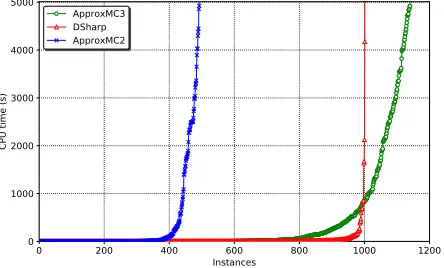
in-volving 1896 benchmarks with computational effort totaling 86400 computational hours. With a timeout of 5000 seconds, the state of the art exact model counter,DSharpand the state of the art approximate model counter,ApproxMC2were able to solve only 1001 and 492 benchmarks whileApproxMC3 could solve 1140 benchmarks. Significantly, this marks the first time that an approximate model counter is able to not only beat exact counter for challenging problems but also outperform the exact counter for the entire set of benchmarks. In particular,ApproxMC3solves 648 benchmarks more than ApproxMC2, the state of the art approximate model counter. Furthermore, for all the formulas where bothApproxMC2 andApproxMC3did not timeout and took more than 1 sec-onds, the mean speedup is 284.40 – more than 2 orders of magnitude.
The rest of the paper is organized as follows: We discuss notations and preliminaries in Section 2 and then focus on core technical features ofApproxMC3in Section 3. We then present an extensive experimental evaluation in Section 4 and finally conclude in Section 5.
2
Notations and Preliminaries
Let F be a Boolean formula in conjunctive normal form (CNF), and letVars(F)be the set of variables appearing in F. The set Vars(F) is also called thesupportofF. An assignmentσof truth values to the variables inVars(F)is called asatisfying assignmentorwitnessofFif it makesF evaluate to true. We denote the set of all witnesses ofFby RF. Given a set of variablesS ⊆Vars(F), we useRF↓Sto
denote the projection ofRFonS.
We writePr[X :P]to denote the probability of outcome X when sampling from a probability spaceP. For brevity, we omitP when it is clear from the context. The expected value ofXis denotedE[X]and its variance is denotedV[X].
Thepropositional model counting problemis to compute
|RF↓S|for a given CNF formulaF and sampling setS ⊆
Vars(F). Aprobably approximately correct(orPAC) counter is a probabilistic algorithmApproxCount(·,·,·,·)that takes as inputs a formulaF, a sampling setS, a toleranceε >0, and a confidence1−δ∈(0,1], and returns a countcsuch
thatPrh|RF↓S|/(1 +ε)≤c≤(1 +ε)|RF↓S|
i
≥1−δ. For positive integers n and m, a special family of 2 -universal hash functions mapping{0,1}nto{0,1}m, called
Hxor(n, m), plays a crucial role in our work. Lety[i]denote
theith component of a vectory. The familyHxor(n, m)
can then be defined as{h|h(y)[i] = ai,0⊕(Lnk=1ai,k·
y[k]), ai,k ∈ {0,1},1 ≤ i ≤ m,0 ≤ k ≤ n}, where⊕
denotes “XOR” and · denotes “and”. By choosing values of ai,krandomly and independently, we can effectively choose
a random hash function fromHxor(n, m).
toCryptoMiniSat. Significantly, and unlike the algorithm in (Goldreich 1999), each call of CryptoMiniSat reasons about a formula with onlynvariables.
It is well-known that long XOR-based constraints make SATsolving significantly harder in practice (Gomes et al. 2007). Researchers have therefore investigated theoretical and practical aspects of using short XORs (Gomes et al. 2007; Chakraborty, Meel, and Vardi 2014; Zhao et al. 2016). The techniques for identifying small independent supports have been developed (Ivrii et al. 2015), and word-level hash functions have been used to count in the theory of bit-vectors (Chakraborty et al. 2016). A common aspect of all of these approaches was that a linear search was used to find the right parameters of the hash functions, where each search step involves multipleSATsolver calls.ApproxMC2 targeted this weak link and shown search for parameters can be searched in logarithmic time by relying on depen-dence of hash functions. To the best of our knowledge, ApproxMC2 is currently the state of the art approximate model counter.ApproxMC3builds on top ofApproxMC2by modifying the underlyingSATsolver used byApproxMC2. The underlying SAT solver is invoked through subroutine BSAT, which is implemented using CryptoMiniSat. For-mally,BSATtakes as inputs a formulaF, a thresholdthresh, and a sampling setS, and returns a subsetY ofRF↓S, such
that|Y| = min(thresh,|RF↓S|). Note that every
invoca-tion ofBSATis performed withF conjuncted with set of XOR constraints. We henceforth denote such formulas as CNF-XOR formulas. As mentioned earlier, our profiling of ApproxMC2revealed that over 99% of the total time is taken byBSATcalls insideLogSATSearch. In the next section, we discuss a novel architecture ofCryptoMiniSatthat allows us to performBSATefficiently.
For lack of space, we refer the reader to (Chakraborty, Meel, and Vardi 2016) for description ofLogSATSearchthat invokesBSAT.
3
BIRD
: A New Framework for Handling
CNF-XOR Formulas
In this section, we discuss the primary contribution of this paper: a novel architecture forBSATto efficiently handle CNF-XOR formulas. Before delving into the technical details of the architecture, we first review the architecture ofBSAT employed inApproxMC2.
3.1
Architecture of
BSAT
in
ApproxMC2
Given extensive reliance on XORs for partitioning of the solu-tion space,BSATrequires underlyingSATsolver to have na-tive support for XORs (Chakraborty, Meel, and Vardi 2013a). Therefore,ApproxMC2employsCryptoMiniSatwith native support for XORs. Inspired by the success ofSMTsolvers, Soos et al (Soos, Nohl, and Castelluccia 2009) proposed an elegant architecture forCryptoMiniSatthat keeps CNF and XOR clauses separately. The distributed storage allows CryptoMiniSatto apply Gauss-Jordan elimination on XOR clauses.
The distributed storage, however, comes at the cost of dis-abling execution of inprocessing steps, e.g., bounded variable
Algorithm 1ComputeBloom
1: abst←0
2: forvar in clausedo
3: abst←abst|(1<<(var%32))
4: returnabst
elimination (E´en and Biere 2005), on variables that are part of the XOR clauses. A careful reader might observe that the usage of distributed storage does not necessarily imply unsoundness of inprocessing steps but a sound implemen-tation of inprocessing steps would require extensive study into effect of every inprocessing step on XOR clauses. Given the complexity of inprocessing implementations in the cur-rent state of the artSATsolvers, the odds of success of an efficient implementation following extensive study into the effect of inprocessing steps on XORs are very high. Since
ApproxMC2employs random XORs over the sampling setS
and we are interested in solutions projected over the sampling setS, the disabling of pre- and inprocessing steps essentially restricts most of the pre- and inprocessing steps during the ex-ecution ofBSAT. The lack of usage of pre- and inprocessing steps significantly hurts the performance ofBSATsince these techniques have been shown to be crucial to the performance of state of the artSATsolvers. Furthermore, division of stor-age of CNF and XOR clauses induces significant overhead in synchronization of the state of the solve in CNF and XOR. We target this weak link in this paper, and drastically improve the runtime ofApproxMC3by redesigning the architecture ofBSAT.
3.2
BIRD
: Blast, In-processing, Recover, and
Destroy
To allow seamless integration of pre- and inprocessing tech-niques, it is important that the solver has access to XOR clauses in CNF form while ensuring native support for XORs to perform Gauss-Jordan elimination. We achieve this by our architecture,BIRD: Blast-Recover-Blast, described as follows:
BIRD: Blast, In-process, Recover, and Destroy
Step 1 BlastXOR clauses into normal CNF clauses
Step 2 Inprocess (and pre-process) over CNF clauses
Step 3 Recoversimplified XOR clauses
Step 4 Perform CDCL on CNF clauses with on-the-fly Gauss-Jordan Elimination on XOR clauses un-til inprocessing is scheduled
Step 5 DestroyXOR clauses and gotoStep 2
allow-ing the usage of Gauss-Jordan elimination on such recovered XORs.
In comparison toBSATinApproxMC2, the primary chal-lenge forBIRDis to ensure thatStep 1andStep 3can be executed efficiently. Note thatLogSATSearchinvokesBSAT over the original formulaFconjuncted with XORs until the number of solutions is less thanthreshwhen the number of solutions ofF is typically of the order of 260. Therefore,
XOR constraints play a significant part in determining the solution space of the formula thatBSATtakes as input. Con-sequently, we focus on efficient blasting of XORs into CNF inStep 1and efficient and full recovery of XORs inStep 3
as described below:
3.3
Blasting of XORs to CNF
We employ the standard technique of blasting XORs into CNF. Observe that a XOR overkvariables can be equiva-lently represented as CNF overkvariables andO(2k)clauses. Since we deal with long XORs, typically of size|S|/2, we first cut a long XORs into smaller XORs by introducing aux-iliary variables. The size of small XORs is known ascutting number. We experimented with different cutting numbers and found that cutting number = 4is optimal for our use case.
3.4
XOR recovery
We now discuss the most technically challenging task of ourBIRDarchitecture: recovery of XOR constraints from CNF clauses (i.e. Step 3). Formally, given a formulaF in CNF, we would like to extractH, which is expressed as conjunction of XOR constraints such thatF →H. To put our contribution in context, we briefly review the prior work. Heule proposed the current state of the art algorithm, referred to asHeuleRecoveryfor XOR recovery in his PhD thesis, which is based on the observation that an XOR of sizekis equivalently represented by2k−1CNF clauses. For example:
(x1∨x2∨ ¬x3)
(x1∨ ¬x2∨x3)
(¬x1∨x2∨x3)
(¬x1∨ ¬x2∨ ¬x3)
⇔x1⊕x2⊕x3= 0 (1)
Observe that if we only concentrate on the sign of a variable and represent a positive variable as0and the negative variable as1, we see that the above set of clauses overx1, x2, x3can
be represented by strings{001,010,100,111}, whose deci-mal representation reads as{1,3,5,7}. Similarly if we had CNF clauses encoding the XOR constraint,x1⊕x2⊕x3= 1,
we would have decimal representation of the set of clauses as{0,2,4,8}. Based on this observation, HeuleRecovery proceeds by sorting clauses by the sets of variables occurring in a clause and stores the decimal representation of all the combinations and accordingly recovers XORs. Executing HeuleRecoveryis efficient in practice; recovery of XOR con-straints takes only a few seconds for formulas with hundreds of thousands of clauses.
While HeuleRecovery is efficient in practice, it is not robust to modification of clauses due toStep 2 and Step 4 ofBIRD. Consequently, HeuleRecovery fails to extract
Algorithm 2Barbet(clauses,M)
1: xorclauses← ∅
2: forbase cl∈clausesdo
3: ifbase cl.size> Mthen continue 4: ifbase cl.used == 1then continue 5: FIND ONE XOR(base cl)
returnxorclauses
Algorithm 3Find XOR using base clause
1: functionFindOneXOR(base cl)
2: quickcheck←array of zeroes
3: found comb←array of zeroes
4: comb←0
5: base rhs←1 .right-hand-side of the XOR
6: fori←0. . .base clsize-1do
7: base rhs←base rhs⊕base cl[i].sign
8: comb←comb|(base cl[i].sign<<i)
9: quickcheck[base cl[i].var]←1
10: base abst←CALC ABST(base cl)
11: found comb[comb]←1
12: forv∈Vars(base cl)do
13: forabst, cl∈occurrence[v]do
14: ifCheckClause(abst, cl,base cl,base abst)
then return
many of the XORs during the search procedure. The pri-mary drawback of HeuleRecovery is its reliance on pres-ence of all the equivalent CNF clauses. Let us assume XOR clausex1⊕x2⊕x3 = 0was blasted to the four clauses
shown in Eq 1 in Step 1. Now let us assume that dur-ing Step 2and Step 4, the SAT solver learns the clause x1∨x2, which subsumes (i.e., replaces), the first clause
in Eq 1: (x1∨x2∨ ¬x3)Furthermore, another frequently
used, self-subsuming resolution, would resolve (x1∨x2)
with(x1∨ ¬x2∨x3)to obtain(x1∨x3), which subsumes
(x1∨ ¬x2∨x3). Therefore, the four clauses in Eq 1 are
reduced to the following set of clauses, denoted byG.G:= (x1∨x2)∧(x1∨x3)∧(¬x1∨x2∨x3)∧(¬x1∨ ¬x2∨ ¬x3)
Note thatG→(x1⊕x2⊕x3= 0). Therefore, we would
like to recover(x1⊕x2⊕x3 = 0). The above illustrated
sequence of steps happen often and repeatedly during pre-and inprocessing of CNF formulas. Hence, a XOR recovery algorithm must be able to find any such mangled XOR from a reasonably sized CNF with hundreds of thousands of clauses.
Barbet
We now describe our recovery algorithmBarbetpresented in Algorithm 2.Barbettakes in a set of clauses and a parameter M and returns recovered XOR clauses of size≤M. First, Barbetinitializes an empty setxorclauses, to store the recov-ered XOR clauses. Then it makes a linear pass through all the clauses. If a clause is of size> Mor has already been used in construction of a XOR, we skip the clause. Otherwise, we invoke the subroutineFindOneXOR, which searches for recovery of an XOR clause from the set of clauses containing base clclause.
FindOneXORtakes in a clause,base cl, and attempts to re-cover the XOR defined exactly over the variables inbase cl. Note that there is exactly one XOR defined exactly over vari-ables inbase cl. For example, ifbase clis(x1∨x2∨x3),
then the only XOR defined overx1, x2, x3in whichbase cl
can participate isx1⊕x2⊕x3 = 1. Observe that we can
compute the rhs of the XOR by computing the parity of the variables in the XOR. The key idea behind the search for XORs over variables inbase cl, say of sizeM, to perform a linear pass (in an efficient manner as detailed below) and check whether there exists a subset of clauses that would imply the required2M−1combination of CNF clauses over
M variables.
Note that a clause may imply multiple CNF clauses over Mvariables. For example, letbase cl:= (x1∨x2∨x3), then
a clausecl:= (x1)would imply 4 clauses over{x1, x2, x3},
i.e.{(x1∨x2∨ ¬x3),(x1∨x2∨x3),(x1∨ ¬x2∨x3),(x1∨
¬x2∨ ¬x3)}. To this end, we maintain an array of possible
combinations, denoted byfoundcomb, of size2Mand update
the entry (indexed bycomb, which is binary representation of the clause for a fixed ordering of variables) corresponding a clause cl0 to 1 if cl → cl0. Similar to other aspects of SATsolving, efficient data structures are vital to perform the above mentioned checks and updates efficiently. We now discuss few crucial optimizations below in the description of
FindOneXOR:
FindOneXORassumes access to the map data structure, occurrence, such that for a variablex,occurrence[x]is a list of all the clauses that containv. Every entry of the list consists of pointer to the clause and the bitfieldabst, which is a 32-bit bloom filter of the variables inside the clause. The algorithm to computeabstis presented in Algorithm 1.
FindOneXORmaintains a map of all the variables in
base clin the data structure,quickcheck.FindOneXOR pop-ulatesbase rhs,comb,quickcheck in lines 6–9. Then we compute the bloom filter corresponding tobase clin line 10. Next, we make a linear pass over all the clauses that contain a variable inbase cland check for each clauseclifcl im-plies one of the combinations required for XOR correspond-ing tobase cl. The check is performed in the subroutine CheckClause.
CheckClausefirst checks if the variables in cl are subset of the variables inbase clbecause for cl to imply one of the combinations required for XOR defined over variables inbase abst, variables inclshould be subset of variables inbase cl. We use a bloom filter to perform this check by determining whetherabst|base abst == base abstholds. Note that bloom filters may have false positives but not false negatives. To check for false positive, we iterate through the clause to see whether every variable inclis also present in base cl. Note that performing this check requires dereferenc-ing the pointer to the clause, therefore the bloom filter check is crucial. In our experiments the usage of the bloom filter led to up to 100 fold speedup on large instances forCheckClause calls. We now perform two more checks to see ifclis useful: first the rhs for XOR corresponding toclshould match with base rhsif the sizes of bothclandbase clare same. Finally, we updatefoundcombin the subroutineAddClause. The sub-routineXORFoundchecks if all the combinations required
Algorithm 4Check if clause belongs to an XOR
1: functionCheckClause(abst, cl,base cl,base abst)
2: ifabst|base abst!=base abstthen
3: returnFalse .Bloom filter check fails
4: rhs←1
5: forlit∈cldo
6: ifquickcheck[lit.var] == 0then
7: returnFalse .Bloom filter false positive
8: rhs←rhs⊕lit.sign
9: ifcl.used == 1then 10: returnFalse
11: ifcl.size ==base cl.size and rhs != base rhsthen 12: returnFalse
13: ifcl.size ==base cl.sizethencl.used←1
14: AddClause(cl)
15: ifXORFound(base rhs)then
16: xorclauses.append(base cl)
17: returnTrue
18: returnFalse
Algorithm 5Add a clause to an XOR
1: procedureAddClause(cl)
2: basei, i, x←0
3: missing←clear
4: fork = 0; k<cl.size; k++, i++, basei++do 5: whilecl[i].var !=base cl[basei].vardo
6: missing.append(basei);
7: basei←basei + 1
8: asserti == basei
9: x←x|(cl[k].signbasei)
10: .Mark every combination for the missing variables
11: forj = 0; j<1(missing.size); j++do 12: tx←x
13: fori2 = 0; i2<missing.size; i2++do
14: ifbit set(j, i2)then
15: tx←tx + (1missing[i2])
16: found comb[tx]←1
17: end procedure
for XOR corresponding tobase clhave been found and if true, addsbase clto the listxorclauses. Recall thatbase cl uniquely represents the XOR defined over all the variables in base cl.
The algorithmAddClausefirst finds all the missing vari-ables from the clausecland computes all the combinations by taking account missing variables and updates the vec-torfoundcomb. For example, ifbase clis(x1∨ ¬x2∨x3)
and clis (x1 ∨ ¬x3), AddClausefinds thatx2 is missing
and then adds the combinations corresponding to clauses
(x1∨x2∨ ¬x3)and(x1∨ ¬x2∨ ¬x3). For efficiency, we
perform a clever usage of bitfields as illustrated in the Algo-rithm 5.
The algorithm XORFound, presented in Algorithm 6,
check-Algorithm 6Check if XOR has been built
1: functionXORFound(base rhs)
2: fori∈0. . .found comb.size-1do
3: .Only check combinations with the correct
right-hand-side
4: if(hamming weight(i)%2) == base rhsthen
5: continue
6: iffound comb[i] == 0then
7: returnFalse .XOR not complete
8: returnTrue .Every combination found
ing the hamming weight of the bitfield. Ifbase rhsis 0, then the hamming weight1should be 0 otherwise it should be 1. If any of the required combination is missing,XORFound returns False, otherwise it returns True.
3.5
XOR Reconstruction
The XOR constraints recovered byBarbetare of length at mostM, which is set to 5 in our experiments. Recall, we set thecutting numberto 4 during blasting of XORs to CNF. Therefore,Barbetis able to recover the smaller XORs ob-tained during the blasting phase. Since the original XOR constraints added byApproxMC3are of length|S|/2, we now discuss the reconstruction of original XOR constraints so as to optimize the performance of Gauss-Jordan elimina-tion. Similar toBarbet, we create a mapping from variables to the list of the XOR clauses that a variable is present. For each variablex, whose XOR-occurrence list is exactly of size 2 and where the XORs overlap exactly over this variable, we XOR together the two XOR clauses corresponding to the variablexto eliminatexand update the occurrence lists accordingly. These steps are performed until fixedpoint. We illustrate the technique with an example:
x1⊕x2⊕x8= 0
x8⊕x3⊕x4⊕x9= 0
x9⊕x5⊕x6= 1
→x1⊕x2. . .⊕x6= 1
3.6
Correctness
Note that our reconstruction process may not be able to re-construct all possible XOR operations. This, however, does not affect soundness and completeness of the SAT solving as CNF representation of all the constraints is still retained at CNF level. Therefore, one can viewStep 3andStep 4
ofBIRDasbest effortprocesses where we focus on helping CDCL as best as possible to deal with XOR clauses without having to be absolutely certain not to loose any informa-tion. This freedom is a property of the blasting-recovery method used by the system and greatly contributes to signifi-cant speedup achieved by our system as outline in the next section.
3.7
ApproxMC3
We augment ApproxMC2 with BIRDframework and call
the resulting hashing-based counter asApproxMC3. Given
1
Note that hamming weights are extremely fast to compute on modern CPUs thanks to dedicated assembly instructions
the soundness ofBIRD, bothApproxMC2andApproxMC3
provide exactly same theoretical guarantees.
Benchmark Vars Clauses ApproxMC2 ApproxMC3
time time
or-50-10-9-UC-30 100 260 1814.78 2.66 blasted squaring28 1060 3839 1845.47 2.48 55.sk 3 46 3128 12145 TO 1.35 s838 7 4 616 1490 TO 3.91
min-3s 431 1373 TO 3.86
blasted case210 872 2937 TO 5.93 blasted squaring16 1627 5835 TO 11.12 or-60-5-2-UC-30 120 315 TO 11.09 s5378a 3 2 3679 8372 TO 68.2 modexp8-4-1 79409 288110 TO 255.05 reverse.sk 11 258 75641 380869 TO 23.4 hash-6 282521 1133816 TO 246.04 modexp8-5-8 101553 402654 TO 1166.54 herman31.pm 20steps
6-int 1fract stable over 309496 159495 TO 1422.23
ConcreteRoleAffectation-Service.sk 119 273 395951 1520924 TO 2081.38 hash-11-8 518009 2078959 TO 4908.15 karatsuba.sk 7 41 19594 82417 TO 4865.53 01B-3 23393 103379 TO 4275.08
Table 1: Runtime performance comparison ofApproxMC3
vis-a-visApproxMC2. TO indicates timeout after 5000 sec-onds.
0 200 400 600 800 1000 1200
Instances 0
1000 2000 3000 4000 5000
CPU
tim
e (
s)
ApproxMC3 DSharp ApproxMC2
Figure 1: Cactus plot showing behavior of ApproxMC2,
DSharp, andApproxMC3
4
Experimental Evaluation
0 10 20 30 40 50 Benchmarks
102 103 104 105 106 107 108 109 1010
#S
olu
tio
ns
ScalMC DSharp*1.8 DSharp/1.8
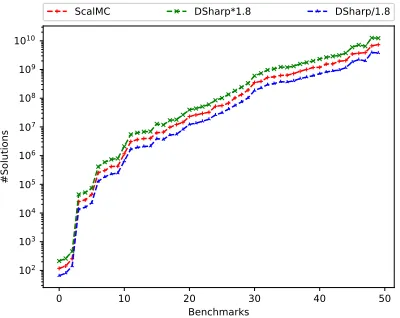
Figure 2: Plot showing counts obtained byApproxMC2 vis-a-vis true counts fromDSharp
The objective of our experimental evaluation was to answer the following questions:
1. How does runtime performance ofApproxMC3compare
with that ofApproxMC2and other state of the art counting techniques?
2. How far are the counts computed byApproxMC3from the exact counts.
The core difference betweenApproxMC2andApproxMC3 is optimization ofBSAT, therefore a fair comparison would
be to compare ApproxMC3 vis-a-vis ApproxMC2. Such
a comparison would provide a clear picture of progress achieved byApproxMC3but would still not provide a thor-ough analysis of the state of the art hashing-based techniques in comparison to other techniques. To this end, we also perform a comparison with the state of the art exact count techniqueDSharpwhich can handle projection over a sam-pling set.2
The experiments were conducted on high performance computer cluster, each node consisting of 2xE5-2690v3 CPUs with 2x12 real cores and 96GB of RAM. For all our experiments, we usedε = 0.8andδ = 0.1, unless stated otherwise. We used timeout of 5000 seconds for each ex-periment, which consisted of running a tool on particular benchmark. To further optimize the running time for both
ApproxMC2andApproxMC3, we used improved estimates
of the iteration counttfollowing an analysis similar to that in (Chakraborty, Meel, and Vardi 2016).
4.1
Results
Figure 1 shows the cactus plot for ApproxMC2 and
ApproxMC3. We present the number of benchmarks on
2
A curious reader might wonder whetherDSharpachieves pro-jection over sampling set at the cost of runtime performance. Instead, our analysis showDSharpis able to solve 100 more benchmarks thatsharpSAT, which is unable to perform projection over sampling set
x−axis and the time taken on y−axis. A point (x, y) im-plies that xbenchmarks took less than or equal to y sec-onds to solve. With a timeout of 5000 secsec-onds,DSharpand
ApproxMC2were able to solve only 1001 and 492
bench-marks whileApproxMC3could solve 1140 benchmarks. Dur-ing the recent surge of interest in the development of hashDur-ing- hashing-based techniques, the community have consistently observed that exact counters are able to solve more instances than hashing-based schemes but the strength of hashing-based schemes lied in their ability to solve instances that were be-yond the reach of exact counters. In this context, we believe ApproxMC3has achieved an important milestone in being able to solve more instances than the state of the art exact counters. Note thatApproxMC3retains the same theoretical guarantees ofApproxMC2. In particular, the performance improvement is solely due to improvement of the underlying SAT solver.
To present a clear picture of performance gain achieved
byApproxMC3overApproxMC2, we present runtime
com-parison ofApproxMC3vis-a-visApproxMC2in Table 1 on a subset of our benchmarks. Column 1 of this tables gives the benchmark name, while columns 2 and 3 list the num-ber of variables and clauses, respectively. Columns 4 and 5 list the runtime (in seconds) ofApproxMC3andApproxMC2 respectively. Table 1 clearly demonstrates thatApproxMC3 outperformsApproxMC2by up to 3 orders of magnitude. We show that not onlyApproxMC3is able to compute estimates
within few seconds for formulas where ApproxMC2 but
ApproxMC3is also significantly faster for formulas where
bothApproxMC3andApproxMC2do not timeout. In
par-ticular, for all the formulas where both ApproxMC2 and ApproxMC3did not timeout and took more than 1 seconds, the mean speedup is 284.40 – more than 2 orders of magni-tude. Recall,ApproxMC3solved 648 instances more than
ApproxMC2.
Approximation Quality To measure the quality of approx-imation, we compared the approximate counts returned by
ApproxMC3with the counts computed by an exact model
counter, viz.DSharp. Figure 2 shows the model counts com-puted byApproxMC3, and the bounds obtained by scaling the exact counts with the tolerance factor(ε= 0.8)for a small subset of benchmarks. They-axis represents model counts on log-scale while thex-axis represents benchmarks ordered in ascending order of model counts. We observe that forallthe benchmarks,ApproxMC3computed counts within the toler-ance. Furthermore, for each instance, the observed tolerance (εobs) was calculated as max( |
RF↓S|
AprxCount−1,
AprxCount
|RF↓S| −1),
whereAprxCountis the estimate computed byApproxMC3. We observe that the arithmetic mean ofεobsacross all
bench-marks is0.038(resp.0.37forApproxMC2) – far better than the theoretical guarantee of0.8.
5
Conclusion
Hashing-based techniques have emerged as a promising ap-proach that seeks to combine theoretical guarantees with scal-ability. Our profiling of the state of the art approximate model counter,ApproxMC2, revealed that over 99.99% of time is consumed by the underlying SAT solver,CryptoMiniSat, a specialized solver designed to handle CNF-XOR formulas. In this paper, we designed a new framework to handle the CNF-XOR formulas arising from hashing-based techniques and the new tool, calledApproxMC3, is able to achieve two to three orders of magnitude speedup over the existing state of the art approximate counters. With a timeout of 5000 sec-onds,ApproxMC2could only solve 492 benchmarks while ApproxMC3could solve 1140 benchmarks – a difference of
648 benchmarks. Note thatApproxMC3 retains the same
theoretical guarantees ofApproxMC2.
Acknowledgements We are grateful to the anonymous Re-viewer #3 for the excellent suggestions to rewrite the In-troduction. We are thankful to the organizers of the 2014 SAT-SMT Summer School, the venue of our first in-person meeting. This work was supported in part by NUS ODPRT Grant 000-685-133 and AI Singapore Grant R-252-000-A16-490. The computational work for this article was performed on resources of the National Supercomputing Cen-tre, Singapore https://www.nscc.sg.
References
Achlioptas, D., and Theodoropoulos, P. 2017. Probabilistic model counting with short xors. InIn Proc. of SAT.
Achlioptas, D.; Hammoudeh, Z.; and Theodoropoulos, P. 2018. Fast sampling of perfectly uniform satisfying assign-ments. InProc. of SAT.
Arora, S., and Barak, B. 2009.Computational Complexity: A Modern Approach. Cambridge Univ. Press.
Aziz, R. A.; Chu, G.; Muise, C.; and Stuckey, P. 2015. Sat: Projected model counting. InProc. of SAT, 121–137. Biondi, F.; Enescu, M.; Heuser, A.; Legay, A.; Meel, K. S.; and Quilbeuf, J. 2018. Scalable approximation of quantitative information flow in programs. InProc. of VMCAI.
Chakraborty, S.; Meel, K. S.; Mistry, R.; and Vardi, M. Y. 2016. Approximate probabilistic inference via word-level counting. InProc. of AAAI.
Chakraborty, S.; Meel, K. S.; and Vardi, M. Y. 2013a. A Scalable and Nearly Uniform Generator of SAT Witnesses. InProc. of CAV, 608–623.
Chakraborty, S.; Meel, K. S.; and Vardi, M. Y. 2013b. A scalable approximate model counter. InProc. of CP, 200– 216.
Chakraborty, S.; Meel, K. S.; and Vardi, M. Y. 2014. Balanc-ing scalability and uniformity in SAT witness generator. In Proc. of DAC, 1–6.
Chakraborty, S.; Meel, K. S.; and Vardi, M. Y. 2016. Algorith-mic improvements in approximate counting for probabilistic inference: From linear to logarithmic SAT calls. InProc. of IJCAI.
Due˜nas-Osorio, L.; Meel, K. S.; Paredes, R.; and Vardi, M. Y. 2017. Sat-based connectivity reliability estimation for power transmission grids. Technical report, Rice University. E´en, N., and Biere, A. 2005. Effective preprocessing in sat through variable and clause elimination. In Bacchus, F., and Walsh, T., eds.,Proc. of SAT, 61–75.
Ermon, S.; Gomes, C. P.; Sabharwal, A.; and Selman, B. 2013. Taming the curse of dimensionality: Discrete inte-gration by hashing and optimization. In Proc. of ICML, 334–342.
Goldreich, O. 1999. The Counting Class #P. Lecture notes of course on ”Introduction to Complexity Theory”, Weizmann Institute of Science.
Gomes, C. P.; Hoffmann, J.; Sabharwal, A.; and Selman, B. 2007. Short XORs for Model Counting; From Theory to Practice. InSAT, 100–106.
Gomes, C. P.; Sabharwal, A.; and Selman, B. 2006. Model counting: A new strategy for obtaining good bounds. InProc. of AAAI, volume 21, 54–61.
Gomes, C. P.; Sabharwal, A.; and Selman, B. 2009. Model counting. InHandbook of Satisfiability, Frontiers in Artificial Intelligence and Applications. IOS Press. 633–654. Ivrii, A.; Malik, S.; Meel, K. S.; and Vardi, M. Y. 2015. On computing minimal independent support and its applications to sampling and counting. Constraints1–18.
Lagniez, J.-M., and Marquis, P. 2017. An improved decision-dnnf compiler. InProc. of IJCAI, 667–673.
Meel, K. S.; Vardi, M. Y.; Chakraborty, S.; Fremont, D. J.; Seshia, S. A.; Fried, D.; Ivrii, A.; and Malik, S. 2016. Con-strained sampling and counting: Universal hashing meets sat solving. InProc. of Beyond NP Workshop.
Meel, K. S. 2014.Sampling Techniques for Boolean Satisfia-bility. Rice University. M.S. Thesis.
Meel, K. S. 2017. Constrained Counting and Sampling:
Bridging the Gap between Theory and Practice. Ph.D. Dis-sertation, Rice University.
Roth, D. 1996. On the hardness of approximate reasoning. Artificial Intelligence82(1):273–302.
Soos, M.; Nohl, K.; and Castelluccia, C. 2009. Extending SAT solvers to cryptographic problems. InProc. of SAT, 244–257.
Stockmeyer, L. 1983. The complexity of approximate count-ing. InProc. of STOC, 118–126.
Toda, S. 1989. On the computational power of PP and (+)P. InProc. of FOCS, 514–519. IEEE.
Valiant, L. G. 1979. The complexity of enumeration and reliability problems.SIAM Journal on Computing8(3):410– 421.