classroom technology use. AACE Journal, 16(1), 21-46.
A Framework for Addressing Challenges to Classroom
Technology Use
JENNIFER GROFF
Massachusetts Institute of Technology Cambridge, MA USA
[email protected] CHRYSTALLA MOUZA
University of Delaware Newark, DE USA [email protected]
Creating effective learning environments with technology remains a challenge for teachers. Despite the tremendous push for educators to integrate technology into their class-rooms, many have yet to do so and struggle to find consis-tent success with technology-based instruction. The chal-lenges to effective technology integration have been well-documented in the literature. In this article we present a comprehensive review of the literature on the challenges associated with effective technology integration in the classroom and the ways in which they interact with one another. Based on this review we have developed a frame-work, the Individualized Inventory for Integrating Instruc-tional Innovations (i5), to help teachers predict the likelihood of success of technology-based projects in the classroom and identify potential barriers that can hinder their technology integration efforts. Identifying potential barriers upfront can empower teachers to seek solutions early in the process, thereby increasing the likelihood of experiencing success with technology integration.
Classrooms and educators alike have seen technologies (e.g., radio, televi-sion, etc.) come and go, innovations tried and tossed out. Some technologi-cal innovations had strong support to be used in the classroom, others have not. Some have stayed, some have not. However, no other instructional tool has been at the center of an educational revolution like the computer, nor has any other innovation been as invested in, supported, criticized, and researched as the computer (Tyack & Cuban, 2000). It is clear that computer technology will not be tossed out so quickly. What is more likely is that the pressure to increase computer use in the classroom from researchers, reformers, policy-makers, and private-sector developers will steadily intensify (Cuban, 2002; Loveless, 1996).
Despite increased investments in technology, the statistics of classroom computer use are disheartening to say the least. Recent studies indicate that on average, teachers use computers several times a week for preparation but only once or twice a year for instructional purposes (Russell, Bebell, O’Dwyer, & O’Connor, 2003). These statistics raise quite a conundrum; why is there such a large disparity between classroom professional and instructional use of computers? Why is it that so many teachers use comput-ers to increase their own efficiency and productivity, yet do not strive to find effective applications for their use as instructional tools? What isit that keeps teachers from making this quantum leap?
FACTORS INFLUENCING CLASSROOM TECHNOLOGY USE: A REVIEW OF THE LITERATURE
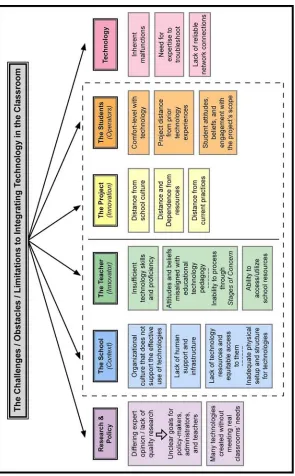
Why aren’t computers an essential tool in every classroom? What factors influence teachers’ success in technology integration?
Figure 1.
Legislative Factors
Why should we use resources to support technology integration?What evidence do we have that technology can enhance teaching and learning?
Policy. Over the last two decades policy-makers have articulated different rationales for the integration of technology into the school curriculum. These rationales often emphasize three key themes: (a) using technology to address challenges in teaching and learning, (b) using technology to foster changes in the content and quality of teaching and learning, and (c) using technology to prepare students for an increasingly technological world (McMillan-Culp, Honey, & Mandinach, 2005). Concrete recommendations on how to achieve these goals, however, are rarely included in policy reports, thereby making it difficult to draw any practical implications. The focus on technology in schools has also ebbed and flowed in the past several years as a result of high-stakes testing. Since technology itself is not directly assessed and attached to consequences through state testing, the political focus has waned from this area1. However, much of national dialogue on the critical need for students to develop 21st century skills has only escalated since the introduction of No Child Left Behind. The chal-lenge lies in that the classroom practices to meet each of these goals do not line up, and many educators do not feel they have the ability to develop rigorous, integrated, technology-based projects while still working towards the goals of annual state testing.
concrete answers on the efficacy of specific types of technology uses in the classroom in the form that policy-makers require.
In summary, the legislative factors that often prove to be barriers to technology integration in the classroom include the lack of research on the efficacy of technology-based instruction and legislative policy that shifts frequently or is innately designed to facilitate the introduction of technolo-gy in the classroom.
District/School Level Factors
How does district administration and community influence teachers’ efforts to implement technology? How does school leadership influence teachers’ efforts to implement technology? How can teachers be supported in their efforts to implement technology-based projects?
often compromised. Successful technology integration is not defined by the amount, but by the nature of its use (Earle, 2002). Unfortunately, adminis-trators are often more concerned with the frequency rather than the quality of technology use in the classroom (McKenzie, 2003).
Community and parental support can be major factors as well. It is no secret to teachers that parents can be sources of support for the classroom provid-ing assistance in managprovid-ing the operations of instructional activities. When initiating a technology-based project, this is a resource that should not go untapped. By having parents and volunteers assisting in the facilitation of the project, teachers can be alleviated of time-consuming managerial tasks to focus their energies on guiding student learning (Butzin, 1992).
School environment. School administration:Any teacher can testify to the importance of school administration. As directors, administrators influence school structure and culture, constituting the venue for any instructional initiative. Therefore, administrative support (or lack thereof) can make or break teachers’ endeavors to integrate technology into the classroom. Collier (2001) described a typical scenario where nine teachers in Shirley, Massa-chusetts were eager to align the school’s standards with technology, but had “no common planning time, no release time, no stipends, and only limited funds to reimburse course work” (p. 67). With minimal support, even the most talented teachers will have little success in technology integration (Becker & Ravitz, 1999; Zhao et al., 2002). The school where these nine teachers reside has an insufficient school culture to support classroom activities. It is the responsibility of the school administration, faculty, and staff to develop their own understanding of technology and learning—and create a working environment that condones these efforts (Collier, 2001). School administrators should not only advocate the use of technology but also provide support mechanisms such as professional development, time for planning and collaboration, and necessary resources (Earle, 2002; Groves, Jarnigan, & Eller, 1998). Necessary resources include: (a) adequate access to hardware and software; (b) technical and pedagogical support; (c) professional development plans that allocate time and resources for follow-up; and (d) social support from colleagues, including mentoring and time to explore new technologies (Morris, 2002; Zhao et al., 2002).
what Zhao and Frank (2003) term the abiotic technology infrastructure. Unfortunately, access to resources cannot guarantee effective instructional use of technology. For technology-based projects to be effectively imple-mented, there often needs to be a shift, or redefining, of curricular goals and the establishment of a support network for teachers. Administrators cannot achieve this shift alone. They must establish and lead a network of teachers, technology support personnel, and members from the community, to share in this vision and develop the proper school culture (LeBaron, 2001; Perry & Areglado, 2001). This is what Zhao and Frank (2003) termed the biotic technology infrastructure.
With only about 25% of the technology budget remaining where is the fiscal support for professional development and instructional innovation leeway? In summary, the factors associated with the district and school that often prove to be barriers to technology integration in the classroom include community members and administrators who may push for instructional practices that do not fall inline with research-proven methods and the school environment which may be lacking adequate access to technological and human resources.
The Teacher
What skills or qualities are required for teachers interested in integrating technology into their classroom? In what ways do teachers need to change their practice in order to effectively use technology?
Be it the “sage on the stage” or the “guide on the side” the teacher is undoubtedly a critical factor determining the level of success for any technology-based project. Similar to other initiatives, the teacher is the decision maker/director who has the greatest influence on classroom events. Callister and Dunne (1992) cautioned us that, “If the teacher does not know what to make of the tool, or fears it, or misconstrues its uses, it will be used badly or not at all” (p. 325).
Teacher perspective. Attitudes and beliefs: Teacher attitudes and beliefs are powerful forces which significantly influence actions in the classroom. Teacher beliefs influence professional practice, and therefore, become pivotal factors in the implementation of new technologies (Haney & Lumpe, 1995). To implement technology successfully in their classroom, teachers must develop a positive attitude towards computers and feel comfortable using them as instructional tools (Rakes & Casey, 2002). Often, however, teachers’ “attitudinal pendulum” does not swing as far to the positive side of the spectrum as most educational technologists might like and many still remain skeptical of the value of technology.
Teachers often feel apprehensive about technology because use of comput-ers requires them to challenge their current role in the classroom (Earle, 2002; McKenzie, 2004; Zhao & Frank, 2003). When attempting a technolo-gy-based project, teachers may find themselves taking on roles they never before had to fulfill such as the role of instructional designer, trainer, collaborator, team coordinator, advisor, and monitoring/assessment special-ist (McGhee & Kozma, 2003). They may also find themselves in the role of “student,” as many of the classroom pupils find themselves teaching the teacher how to use aspects of technology—an uncomfortable role for many teachers (Bowman, 2004). Although many of these roles may not be foreign to the teacher, the definition of these roles in regard to technology imple-mentation may be.
Concerns and adoption stages: Effective use of technology often requires extensive changes in classroom routines which can also produce significant levels of anxiety and concern (Bitner & Bitner, 2002). Rakes and Casey (2002) derived a model that described the Stages of Teachers’ Concerns with respect to technology. According to this model, there is an evolution in teachers’ concerns as the stages progress—concerns evolve from being negative (regarding the teachers’ abilities with the innovation) into concerns that are more positive (addressing ways to enhance the innovation). Accord-ing to Rakes and Casey, teachers’ concerns progress towards more productive stages as experience and skill development with the innovation increases2. Other researchers have also tried to map teacher progression with technolo-gy implementation in the classroom. The Stages of Instructional Evolution (Sandholtz, Ringstaff, & Dwyer, 1997) and the Level of Technology Implementation (LoTI; Moersch, 1999) are two of the most prominent continuums in the literature. Both continuums acknowledge that learning to teach with technology is an evolutionary process that moves sequentially through various stages or levels of use.
Knowledge of support resources. Implementation of technology-based projects requires access to a wide range of resources, often beyond the teachers’ immediate control. Knowing where to look and how to tap different types of support and resources is an important teacher quality (Zhao et al., 2002). These resources can take many forms—from human to digital: a teacher down the hall who knows the technology well, an online colleague in a forum who has expertise in particular technologies or pedagogical strategies, trouble-shooting websites that provide technical support, a weblog that focuses on the integration of technology within a particular subject area, and so on. Teachers’ abilities to identify the human and digital resources, within and outside their school, that can provide the help they need, can have a dramatic impact on the success of a technology project.
The Project/Innovation
What kinds of technology-based projects are more likely to succeed in schools? How can teachers decide on technology-based projects suitable for their particular context and classroom?
The qualities or characteristics of technology-based projects can significant-ly influence the possibilities for success (Zhao et al., 2002). Simpsignificant-ly put, some technology-based projects are more difficult to implement than others. In particular, Zhao et al. identified two dimensions related to the project itself that could impede its success: distance and dependence.
Distance. Distance refers to the deviance of technology-based projects from existing instructional contexts. Each school has a culture, comprised of its value set, pedagogical beliefs, and instructional practices. Technology-based projects that are removed from the school culture are less likely to be successful. A technology-based project might also be too distant from teacher current practices and prior experiences, not only requiring new classroom pedagogy but also new roles, instructional techniques, and so forth. If the project requires the teacher to also cover new content or objectives, this increases the distance from current practice and, therefore, decreases the likelihood of success. Finally, distance from school resources is also a factor. If a project requires the acquisition and implementation of technologies that do not currently exist in the school or dominates the use of existing resources it increases the distance from success (Zhao et al., 2002).
Dependence. Dependence on others outside the classroom or resources can also decrease the likelihood of project success (Zhao et al., 2002). Technol-ogy-based projects with a low level of dependence on others are more likely to be successful. Similarly, projects that minimally rely on technologies outside of the educator’s control can fair better (Zhao et al.). The struggles with gaining adequate access to technological resources are not foreign to teachers. Hanks (2002) and Morris (2002) found that availability and access to technologies was one of the largest determinants of if and how teachers selected to use technology in their classroom.
The Students
What prior student experiences, skills, and attitudes are necessary when implementing instructional projects that make use of technology? How do students respond to the classroom environment when technology is intro-duced?
As with any project or lesson, students affect the manner in which instruc-tion is initiated, designed, and delivered. It is logical, therefore, to assume that the students who will be working with the technology-based project will impact the likelihood of success. Educators who fail to anticipate the potential challenges and resistance to technology-integrated projects from their students may be alarmingly discouraged by their reaction and conse-quently develop negative perceptions toward these types of instructional projects (Åkerlind & Trevitt, 1999). As a result, student characteristics must be taken into consideration when attempting to identify potential barriers. The background, attitudes, beliefs, and skills that students bring to a proposed project can significantly influence its direction and success.
Experience and background. Since many technology-based projects require active student involvement, students must be comfortable with this new paradigm. Technology-based projects often require students to undertake a larger workload that can also be different in nature—completing open-ended tasks, collaborating with others, directing their own learning, and assuming new leadership roles to name a few (Atkinson, 1994). These activities might be challenging for those students accustomed to more traditional environ-ments where the teacher directs the learning process. Therefore, student experience with constructivist learning can facilitate the success of a project.
Technology proficiency. Just like teachers, students need to know how to use the technologies embedded in a project in order to achieve success. If the majority of students in a class are not proficient with the tools they will be using, appropriate training should be provided prior to the beginning of the project or get embedded in the project itself. Some technologies and software programs require an intense amount of training and for these tools this can become a project in itself.
2003). All of those tasks are minimally familiar to the majority of the student population. When presented with something unfamiliar, feelings of anxiety and concern of performance can quickly develop. Student concerns and attitudes toward an innovation can be broken down into enjoyment of computer use, motivation toward computer use, level of importance students assign to learning computer skills, and anxiety toward computer use (Liu & Johnson, 1998). These attitudinal factors can affect students in the class-room and can leave the project floundering. Åkerlind and Trevitt (1999) noted that “if we as teachers do not acknowledge the demands this can make on students, and work with them (where necessary) in enabling the transition process, we are undermining the likely educational success of the technolog-ical innovations we are introducing” (p. 98).
In summary, learners—who are the primary operators of the innovation— present their own barriers to achieving success with any technology-based project. Similar to teacher barriers, student barriers include limited prior experiences with technology-based projects, technology skills, and attitudes and beliefs toward computers.
Technology
What is it about technology that makes it inherently and uniquely difficult to integrate? How do these characteristics interact with classroom dynamics?
PREDICTING SUCCESS IN CLASSROOM TECHNOLOGY USE
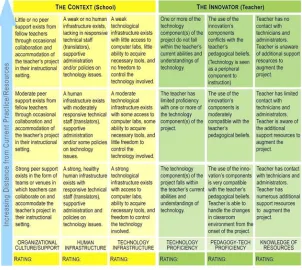
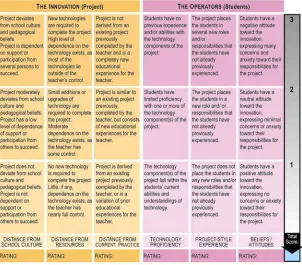
The review of the literature that has just been presented examined the factors that influence the effective integration of technology into classroom instruction. Although our review included factors that extend well beyond the school boundaries (e.g., policy and research), we focused primarily on four factors that can be directly addressed by teachers. These factors are associated with the Context, the Innovator, the Innovation, and the Opera-tors. In this section, we organize our findings into a framework, entitled the
i5 (Figure 2, and Figures 2a and 2b, for a detailed view). The i5 can help individual teachers, as well as those working with teachers (e.g., technology coordinators, administrators, etc.) to navigate the complex process of technology integration and increase the likelihood of experiencing success with the implementation of technology innovations in their local context. By using the i5, individual teachers can identify potential barriers to the implementation of technology-based projects in their classrooms. Identify-ing potential barriers upfront can empower teachers to seek solutions early in the process, thereby increasing the possibilities of experiencing success with technology integration.
Figure 2.
The
i
Figure 2a.
Figure 2b.
The i5 in Context: A Possible Example
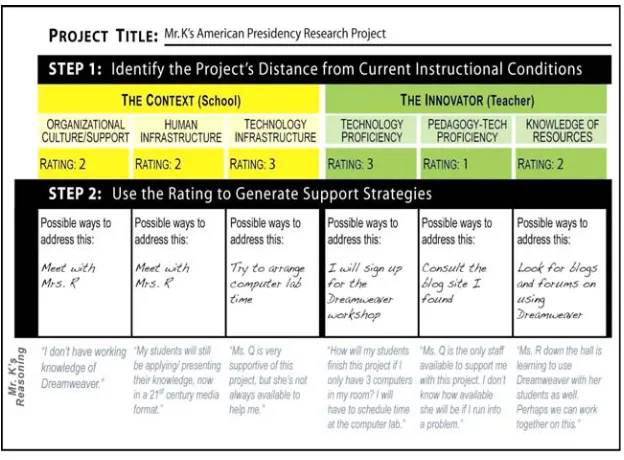
Mr. K, a seventh grade teacher, has decided to take his tried-and-true “American Presidency Research Unit” and adapt it to fit some of the new technologies in his school. Ms. Q, the district’s technology coordinator, recently installed the web-editing software Dreamweaver on all classroom computers. Mr. K decided to change his project from just asking students to convey their research by way of a booklet or research paper, to one where students must communicate their findings through a more dynamic medium such as a website. Mr. K’s goal is for his students to gain valuable technolo-gy skills, as well as understand other implications related to 21st century modes of communication (e.g., communicating information to a larger audience, communicating ideas using multiple media, etc.). Mr. K has noticed the increased technology skills of his students and believed that they would really do well with this new task. However, Mr. K realized that developing a website would be a time consuming task and, therefore, decided to initiate some group work. He thought that group work would not only expedite the completion of the project but would also help students develop valuable collaboration skills. Although Mr. K was eager to make these alterations, he was not very sure as to how to proceed with the project—he had only three computers in his classroom and he did not have working knowledge of the school’s web-building application, Dreamweaver. Fortunately, Ms. Q is very supportive and helpful whenever she can make herself available. Mr. K is very grateful of Ms. Q’s support since technology has typically not been viewed as an important tool at his school. Ms. Q’s support certainly helps Mr. K feel more confident about his chances of success, but he still has not figured out the logistics of completing the project. Ms. Q encourages Mr. K to take a few minutes and complete the i5 to determine his likely success with this project as well as identify potential hurdles (see Figures 3a and 3b for Mr. K’s scoring rationale).
computers in the classroom will be difficult. It takes some work but he arranges a schedule where the students have access to the school’s computer lab three times during the week.
At this point, Mr. K is feeling good that he has addressed two major issues to having success with this project. To further increase the likelihood of success, Mr. K attempts to address some of the areas in which he received a score of “2”. He realizes that some may be out of his immediate range for the moment—such as the lack of peer support and human infrastructure at his school—but nonetheless helpful to be cognizant of before beginning the project. As an effort to compensate for these challenges, he makes time to meet with Mrs. R who has been using Dreamweaver in her classroom for a variety of projects. He also uncovers a weblog of other educators using Dreamweaver as an instructional tool. He feels that these resources will help him learn how to manage a technology-based project like the one proposed, something he has not encountered before. The last “2s” that Mr. K feels are important to address are those related to his students. Aware that many of his students have not used Dreamweaver before, he arranges a class period to be devoted to learning its basics, graciously taught by Ms. Q. He also wants to capitalize on his students who are familiar with Dreamweaver to help coach others who are not. He knows, however, that this is a role new to his students. Mr. K conducts some research on peer-mentoring and uncovers some strategies to help his students undertake this new role.
Figure 3a. Example use of the i5 (part 1)
CONCLUSION
Using technology in the classroom is a complex, challenging task. This is evident by the lack of progress in technology integration in K-12 schools in this country, considering the length of time that has passed since the first computers made their appearance in the instructional setting. The obstacles to successfully completing a technology-based project in the classroom are vast and diverse in nature. They include:
z lack of concrete research and consensus among experts on the objec-tives and outcomes of technology integration into the school curricu-lum;
z assorted hardware and software available for school selection with unclear support on which meet a school’s needs;
z lack of teacher input on the development of innovations for instruction-al use;
z pressure and insufficient support (in the form of resources, time, professional development, and human and technological infrastructure) from the administration, community, and policy-makers to use the technology;
z inadequate school culture necessary to cultivate technology-based project success;
z teacher beliefs, attitudes, and concerns about classroom technology use—inexperience with technology, the shift of pedagogical practices, management issues, and the possibility of new roles and teaching style;
z challenges associated with technology-based projects (including its alignment with school culture/goals, compatibility with existing resources, and alignment with prior teacher experiences);
z student attitudes, concerns, and experience with technology in general and as an instructional tool, as well as background in the new roles associated with student-centered projects; and
By synthesizing the challenges to effective technology integration as identified in the research literature, we have developed a framework, called the i5, that can help teachers successfully implement technology-based projects in their classrooms. Although the i5 was founded largely on the knowledge created from empirical research, it has not yet been formally tested in an instructional setting. Our next step will be to test the i5 in real classroom settings. We are interested in investigating the i5’s ability to accurately predict project success, as well as illuminate and head-off potential obstacles to a technology-based project.
The goal for all teachers should be to create highly effective classroom environments that can meet 21st century skills and demands. Technology can be a powerful resource to achieve this goal and tools like the i5 can help all teachers successfully integrate technology in their classrooms.
References
Adams, S., & Burns, M. (1990). Connecting student learning and technolo-gy. Southwest Educational Development Lab, Austin, TX. Washing-ton, DC: Office of Educational Research and Improvement.
Åkerlind, G., & Trevitt, C. (1999). Enhancing self-directed learning through educational technology: When students resist the change. In-novations in Education and Training International, 36(2), 96-105. Atkinson, S. (1994). Key factors which affect pupils’ performance in
tech-nology project work. In J. S. Smith (Ed.), IDATER 94 (pp. 30-37). Loughborough, UK: Design and Technology, Loughborough University. Becker, H., & Ravitz, J. (1999). The influence of computer and internet use
on teachers’ pedagogical practices and perceptions. Journal of Re-search on Computing in Education, 31(4), 356-384.
Bitner, N., & Bitner, J. (2002). Integrating technology into the classroom: Eight keys to success. Journal of Technology and Teacher Education, 10(1), 95-100.
Bowman, D. (2004). Thinking through the technology puzzle. From Now On: The Educational Technology Journal, 14(1). Retrieved October 23, 2006, from http://www.fno.org/oct04/integrating.html
Butzin, S. (1992). Integrating technology into the classroom: Lessons from the project CHILD experience. Phi Delta Kappan, 74(4), 330-333. Callister, T., & Dunne, F. (1992). The computer as doorstep: Technology
as disempowerment. Phi Delta Kappan, 74(4), 324-326.
Chaptal, A. (2002). Is the investment really worth it? Educational Media International, 39(1), 87-99.
Collier, C. (2001). Staff development for technology integration in the classroom. In J. Lebaron, & C. Collier (Eds.), Technology in its place: Successful technology infusion in school (pp. 61-72). San Francisco: Jossey-Bass.
Collins, A. (1996). Whither technology and schools? Collected thoughts on the last and next quarter centuries. In C. Fisher, D. Dwyer, & K. Yo-cam (Eds.), Education and technology: Reflections on computing in classrooms (pp. 51-66). San Francisco: Apple Press.
Cuban, L. (2002). Oversold and underused: Computers in the classroom. Cambridge, MA: Harvard University Press.
Dede, C. (1997). Rethinking how to invest in technology. Educational Leadership, 55(3), 12-16.
Durost, R. (1994, September). Integrating computer technology: Planning, training, and support. NASSP Bulletin, 78, 49-54.
Earle, R. (2002). The integration of instructional technology into public ed-ucation: Promises and challenges. ET Magazine, 42(1), 5-13. Retrieved December 6, 2006, from http://www.bookstoread.com/etp/earle.pdf Fishman, B., Marx, R., Blumenfeld, P., Krajcik, J., & Soloway, E. (2004).
Creating an inventory for research on systemic technology innova-tions. The Journal of the Learning Sciences, 13(1), 43-76.
Groves, M., Jarnigan, M., & Eller, K. (1997, October/November). But how do we use it?: Discovering hidden barriers and unanticipated successes in integrating computers in a preschool curriculum. Proceedings of the Families, Technology and Education Conference (pp. 57-62), Chicago, IL. (ERIC Document Reproduction Service No. ED424998)
Hall, B., Wallace Jr., R., & Dosset, W. (1973). A development conceptual-ization of the adoption process with educational institutions. Austin, TX: Research and Development Center for Teacher Education, The University of Texas.
Hanks, R. (2002, June). Environmental and personal factors effecting K-12 teacher utilization of technology. Proceedings of the23rd National Ed-ucational Computing Conference (pp. 1-15), San Antonio, TX. (ERIC Document Reproduction Service No. ED475934)
Hannafin, R., & Savenye, W. (1993). Technology in the classroom: The teacher’s new role and resistance to it. Educational Technology, 33(6), 26-31.
Haney, J., & Lumpe, A. (1995). A teacher professional development inven-tory guided by reform policies, teachers’ needs, and research. Journal of Science Teacher Education, 6(4), 187-196.
Harris, J., & Grandgenett, N. (1999). Telecomputing tools: K-12 teacher beliefs and demographics. Journal of Research on Computing in Edu-cation, 31(4), 327-340.
presented at the Secretary’s Conference on Education Technology: Evaluating the Effectiveness of Technology, Washington, DC.
LeBaron, J. (2001). Curriculum planning for technology-rich instruction. In Lebaron, J., & Collier, C. (Eds.), Technology in its place: Successful technology infusion in schools. Jossey-Bass Reader (pp. 17-29). San Francisco, CA: Jossey-Bass.
Levine, T., & Donista-Schmidt, S. (1998). Computer use, confidence, atti-tudes, and knowledge: A causal analysis. Computers in Human Behav-ior, 14(1), 125-146.
Loveless, T. (1996). Why aren’t computers used more in schools? Educa-tional Policy, 10(4), 448-467.
Liu, L., & Johnson, D. (1998). A computer achievement model: Computer use, confidence, attitudes, and knowledge: A causal analysis. Comput-ers in Human Behavior, 14(1), 125-146.
Mandinach, E., & Cline, H.F. (2000). It won’t happen soon: Practical, cur-ricular, and methodological problems in implementing technology-based constructivist approaches in classrooms. In S. Lajoie (Ed.), Computers as cognitive tools: No more walls (pp. 377-395). Mahwah, NJ: Lawrence Erlbaum.
McGhee, R., & Kozma, R. (2003, April). New teacher and student roles in the technology-supported classroom. Paper presented at the annual meeting of the American Educational Research Association, Seattle, WA.
McKenzie, J. (2003). The technology presumption: Could integrating tech-nology sometimes be wrong-minded? From Now On: The Educational Technology Journal, 12(9). Retrieved November, 12, 2006, from http:// www.fno.org/may03/wrongminded.html
McKenzie, J. (2004). Stuffing technology into the curriculum. From Now On: The Educational Technology Journal, 13(8). Retrieved November 12, 2006, from http://www.fno.org/jun04/stuffit.html
McMillan Culp, K., Honey, M., & Mandinach, E. (2005). A retrospective on twenty years of education technology policy. Journal of Education-al Computing Research, 32(3), 279-307.
Moersch, C. (1999). Levels of technology implementation: An inventory for measuring classroom technology use. Learning and Leading with Technology, 26(8), 59-63.
Morris, M. (2002, August). How new teachers use technology in the class-room. Paper presented at the Annual Summer Conference of the Asso-ciation of Teacher Educators, Williamsburg, VA.
Ogle, T., & Byers, A. (2000, February). Evaluating teachers’ perceptions of technology use in the K-8 classroom. Paper presented at the 23rd An-nual Conference of the Eastern Educational Research Association, Clearwater Beach, FL.
Rakes, G., & Casey, H. (2002). An analysis of teacher concerns toward in-structional technology. International Journal of Educational Technolo-gy, 3(1). Retrieved December 5, 2006, from http://www.ed.uiuc.edu/ ijet/v3n1/rakes/index.html
Russell, M., Bebell, D., O’Dwyer, L., & O’Connor, K. (2003). Examining teacher technology use: Implications for pre-service and in-service teacher preparation. Journal of Teacher Education, 54(4), 297-310. Sandholtz, J., Ringstaff, C., & Dwyer, D. (1997). Teaching with
technolo-gy: Creating student-centered classrooms. New York: Teachers Col-lege Press.
Tyack, D., & Cuban, L. (2000). Teaching by machine. The Jossey-Bass Reader on Technology and Learning (pp. 247-254). San Francisco, CA: Jossey-Bass.
Wiggins, G., & McTighe, J. (1998). Understanding by design. Alexandria, VA: Association for Supervision and Curriculum Development. Zhao, Y., & Frank, K. (2003). Factors affecting technology uses in schools:
An ecological perspective. American Educational Research Journal, 40(4), 807-840.
Zhao, Y., Pugh, K., Sheldon, S., & Byers, J. (2002). Conditions for class-room technology innovations. Teachers College Record, 104(3), 482-515.
Zimmerman, I. (2001). Building public support: The politics of technology transformation. In J. Lebaron & C. Collier (Eds.), Technology in its place: Successful technology infusion in schools, Jossey-Bass Reader (pp. 99-111). San Francisco, CA: Jossey-Bass.
Notes
1. To be sure, The No Child Left Behind legislation requires schools to ensure that every student is technologically literate by the time he/she finishes the eighth grade. The emphasis, however, is on technology skills rather than an understanding of how to use the technology in the learning process.