R E S E A R C H
Open Access
Monotone variational inequalities,
generalized equilibrium problems and fixed
point methods
Shenghua Wang
* *Correspondence:School of Mathematics and Physics, North China Electric Power University, Baoding, 071003, China
Abstract
In this paper, we study monotone variational inequalities and generalized equilibrium problems. Weak convergence theorems are established based on a fixed point method in the framework of Hilbert spaces.
Keywords: fixed point; generalized equilibrium problem; monotone operator; nonexpansive mapping
1 Introduction and preliminaries
It is well known that many nonlinear problems can be reduced to the search for solutions of monotone variational inequalities. Fixed point methods are often used for finding and approximating such solutions. In this paper, we always assume thatH is a real Hilbert space with the inner product·,·and the norm · . LetCbe a nonempty closed and convex subset ofH. LetS:C→Cbe a mapping. In this paper, we useF(S) to stand for the set of fixed points. Recall thatSis said to be nonexpansive iffSx–Sy ≤ x–y,∀x,y∈C.
Sis said to beκ-strictly pseudocontractive iff there exists a constantκ∈[, ) such that
Sx–Sy≤ x–y+κx–y–Sx+Sy, ∀x,y∈C.
The class of strict pseudocontractions was introduced by Browder and Petryshyn []. It is clear that the class ofκ-strict pseudocontractions includes the class of nonexpansive mappings as a special case.
LetA:C→Hbe a mapping. Recall thatAis said to be monotone iffAx–Ay,x–y ≥,
∀x,y∈C.Ais said to beα-inverse strongly monotone iff there exists a constantα> such that
Ax–Ay,x–y ≥αAx–Ay, ∀x,y∈C.
It is clear thatα-inverse strongly monotone is monotone and Lipschitz continuous. Recall that the classical variational inequality, denoted byVI(C,A), is to findx∈Csuch that
Ax,y–x ≥, ∀y∈C. (.)
One can see that variational inequality (.) is equivalent to a fixed point problem. The elementx∈Cis a solution of variational inequality (.) iffx∈Csatisfies the fixed point equationx=ProjC(x–λAx), whereλ> is a constant. This alternative equivalent for-mulation plays a significant role in the studies of variational inequalities and related opti-mization problems. IfAisα-inverse-strongly monotone andλ∈(, α], then the mapping
ProjC(I–λA) is nonexpansive; see [] and the references therein.
A set-valued mappingT :H→H is said to be monotone if, for allx,y∈H, f ∈Tx andg∈Tyimplyx–y,f –g> . A monotone mappingT:H→H is maximal if the graphG(T) ofTis not properly contained in the graph of any other monotone mapping. It is known that a monotone mappingT is maximal if and only if, for any (x,f)∈H×H,
x–y,f –g ≥ for all (y,g)∈G(T) impliesf ∈Tx. The class of monotone operators is one of the most important classes of operators. Within the past several decades, many authors have been devoted to the studies on the existence and convergence of different schemes for zero points for maximal monotone operators; see [–] and the references therein.
LetRdenote the set of real numbers, and letFbe a bifunction ofC×CintoR. Recall that the following generalized equilibrium problem is to find anxsuch that
F(x,y) +Ax,y–x ≥, ∀y∈C. (.)
In this paper, the solution set of the equilibrium problem is denoted byGEP(F,A),i.e.,
GEP(F,A) =x∈C:F(x,y) +Ax,y–x ≥,∀y∈C.
To study equilibrium problem (.), we may assume thatFsatisfies the following condi-tions:
(A) F(x,x) = for allx∈C;
(A) Fis monotone,i.e.,F(x,y) +F(y,x)≤for allx,y∈C; (A) for eachx,y,z∈C,
lim t↓F
tz+ ( –t)x,y≤F(x,y);
(A) for eachx∈C,y→F(x,y)is convex and lower semi-continuous.
IfF≡, the generalized equilibrium problem is reduced to variational inequality (.). If A≡, the generalized equilibrium problem is reduced to the following equilibrium problem: find anxsuch that
F(x,y)≥, ∀y∈C. (.)
In this paper, the solution set of the equilibrium problem is denoted byEP(F),i.e.,
EP(F) =x∈C:F(x,y)≥,∀y∈C.
variational inequality problems, inclusion problems, saddle point problems, complemen-tarity problem, minimization problem, and Nash equilibrium problem. Equilibrium prob-lem has emerged as an effective and powerful tool for studying a wide class of probprob-lems which arise in economics, finance, image reconstruction, ecology, transportation, net-work, elasticity, and optimization. Recently, many authors studied the numerical solution of equilibriums (.) and (.) based on iterative methods. Convergence theorems are es-tablished in a different framework of spaces; see [–] and the references therein.
In this paper, an iterative algorithm is investigated for monotone variational inequalities and generalized equilibrium problems. Weak convergence of the algorithm is obtained in the framework of Hilbert spaces.
Recall that a space is said to satisfy Opial’s condition [] if, for any sequence{xn} ⊂H withxnx, wheredenotes the weak convergence, the inequality
lim inf
n→∞ xn–x<lim infn→∞ xn–y
holds for everyy∈Hwithy=x. Indeed, the above inequality is equivalent to the following:
lim sup
n→∞ xn–x<lim supn→∞ xn–y.
Recall that a function is lower semi-continuous at some pointxiflim infx→xf(x)≥f(x). It is known that the norm is lower semi-continuous. In order to prove our main results, we also need the following lemmas.
Lemma .[, ] Let C be a nonempty closed convex subset of H,and let F:C×C→R be a bifunction satisfying(A)-(A).Then,for any r> and x∈H,there exists z∈C such that
F(z,y) +
ry–z,z–x ≥, ∀y∈C.
Further,define
Trx=
z∈C:F(z,y) +
ry–z,z–x ≥,∀y∈C
for all r> and x∈H.Then the following hold:
(a) Tris single-valued;
(b) Tris firmly nonexpansive,i.e.,for anyx,y∈H,
Trx–Try≤ Trx–Try,x–y;
(c) F(Tr) =EP(F);
(d) EP(F)is closed and convex.
Lemma .[] Let A be a monotone mapping of C into H and NCv be the normal cone to
C at v∈C,i.e.,
NCv=
w∈H:v–u,w ≥,∀u∈C
Tv=
⎧ ⎨ ⎩
Av+NCv, v∈C,
∅, v∈/C.
Then T is maximal monotone and∈Tv if and only ifAv,u–v ≥for all u∈C.
Lemma .[] Let{an},{bn},and{cn}be three nonnegative sequences satisfying the
fol-lowing condition:
an+≤( +bn)an+cn, ∀n≥n,
where n is some nonnegative integer, ∞n=bn<∞ and
∞
n=cn<∞. Then the limit limn→∞anexists.
Lemma .[] Let{an}∞n=be real numbers in[, ]such that ∞
n=an= .Then we have
the following:
∞
i= aixi
≤
∞
i=
aixi,
for any given bounded sequence{xn}∞n=in H.
2 Main results
Theorem . Let C be a nonempty closed and convex subset of H,and let A:C→H be an L-Lipschitz continuous and monotone mapping.Let Fm be a bifunction from C×
C toRwhich satisfies(A)-(A),and let Bm:C→C be aκm-inverse strongly monotone
mapping for each m≥.Assume thatF:=∞m=GEP(Fm,Bm)∩VI(C,A)is not empty.Let
{αn},{δn,m}be real number sequences in[, ].Let{λn}and{rn,m}be positive real number
sequences.Let{xn}be a sequence generated in the following manner:
⎧ ⎪ ⎪ ⎪ ⎪ ⎪ ⎨ ⎪ ⎪ ⎪ ⎪ ⎪ ⎩
x∈C,
zn,m∈C such that Fm(zn,m,z) +Bmxn,z–zn,m+rn,m z–zn,m,zn,m–xn ≥,
yn=ProjC(
∞
m=δn,mzn,m–λnA
∞
m=δn,mzn,m),
xn+=αnxn+ ( –αn)ProjC(
∞
m=δn,mzn,m–λnAyn), n≥.
Assume that{αn},{δn,m},{λn},and{rn,m}satisfy the following restrictions:
(a) ≤αn≤a< ;
(b) ∞m=δn,m= ,and <δ≤δn,m≤;
(c) lim infn→∞rn,m> ,andλ≤λn≤λ,whereλ,λ∈(, /L).
Then the sequence{xn}weakly converges to some pointx¯∈F.
Proof We first show that the sequence{xn}is bounded. Setun=ProjC(vn–λnAyn), where
vn=
∞
m=δn,mzn,m. Lettingp∈F, we see that
un–p≤ vn–p–vn–un+ λnAyn,p–un
=vn–p–vn–un+ λn
+Ayn,yn–un
≤ vn–p–vn–yn–yn–un+ vn–λnAyn–yn,un–yn.
SinceAisL-Lipschitz continuous andyn=ProjC(vn–λnAvn), we find that
vn–λnAyn–yn,un–yn
=vn–λnAvn–yn,un–yn+λnAvn–λnAyn,un–yn
≤λnLvn–ynun–yn.
It follows that
un–p≤ vn–p–vn–yn–yn–un+ λnLvn–ynun–yn
≤ vn–p+
λnL– vn–yn. (.)
On the other hand, we obtain from the restriction (c) that
vn–p≤ ∞
m=
δn,mzn,m–p
≤
∞
m=
δn,mTrn,m(I–rn,mBm)xn–p
≤ xn–p. (.)
Substituting (.) into (.), we obtain thatun–p≤ xn–p+ (λnL– )vn–yn. This in turn implies from the restriction (c) that
xn+–p≤αnxn–p+ ( –αn)un–p
≤αnxn–p+ ( –αn)
xn–p+
λnL– vn–yn
≤ xn–p+ ( –αn)
λnL– vn–yn
≤ xn–p. (.)
It follows from Lemma . that limn→∞xn–p exists. This in turn shows that{xn}is bounded. From (.), we also have that
( –αn)
–λnLvn–yn≤ xn–p–xn+–p.
This implies from the restrictions (a) and (c) that
lim
n→∞vn–yn= . (.)
Sinceyn–un ≤λLvn–yn, we find from (.)limn→∞yn–un= . Hence, we have
lim
Notice that
zn,m–p=Trn,m(I–rn,mBm)xn–Trn,m(I–rn,mBm)p
≤(I–rn,mBm)xn– (I–rn,mBm)p,zn,m–p
=
(I–rn,mBm)xn– (I–rn,mBm)p
+zn,m–p
–(I–rn,mBm)xn– (I–rn,mBm)p– (zn,m–p)
≤
xn–p+zn,m–p–(xn–zn,m) –rn,m(Bmxn–Bmp)
=
xn–p+zn,m–p–xn–zn,m
+ rn,mxn–zn,m,Bmxn–Bmp–rn,mBmxn–Bmp
.
This implies that
zn,m–p≤ xn–p–xn–zn,m+ rn,mxn–zn,mBmxn–Bmp.
It follows from Lemma . that
vn–p≤ ∞
m=
δn,mzn,m–p
≤
∞
m= δn,m
xn–p–zn,m–xn+ rn,mxn–zn,mBmxn–Bmp
=xn–p– ∞
m=
δn,mzn,m–xn+ ∞
m=
rn,mxn–zn,mBmxn–Bmp.
By use of (.), we find that
xn+–p≤αnxn–p+ ( –αn)un–p
≤αnxn–p+ ( –αn)vn–p
≤ xn–p– ( –αn) ∞
m=
δn,mzn,m–xn
+ ( –αn) ∞
m=
rn,mxn–zn,mBmxn–Bmp.
This implies that
( –αn) ∞
m=
δn,mzn,m–xn≤ xn–p–xn+–p
+ ( –αn) ∞
m=
SinceTrn,mis firmly nonexpansive, we find from the convexity of·thatlimn→∞Bmxn–
Bmp= . It follows that
lim
n→∞zn,m–xn= .
Since{xn}is bounded, we may assume that a subsequence{xni}of{xn}converges weakly toξ. It follows that{zni,m}converges weakly toξ for eachm≥. Next, we show thatξ ∈
GEP(Fm,Bm). Sincezn,m=Trn,m(I–rn,mBm)xn, we have
Fm(zn,m,z) +Bmxn,z–zn,m+
rn,m
z–zn,m,zn,m–xn ≥, ∀z∈C.
From assumption (A), we see that
Bmxn,z–zn,m+
rn,m
z–zn,m,zn,m–xn ≥Fm(z,zn,m), ∀z∈C.
Replacingnbyni, we arrive at
Bmxnj,z–znj,m+
z–zni,m,
zni,m–xni
rni,m
≥Fm(z,zni,m), ∀z∈C.
Fortmwith <tm≤ andρm∈C, letρm=tmρ+ ( –tm)ξ. Sinceρ∈Candξ∈C, we have
ρm∈C. It follows that
ρm–zni,m,Bmρm ≥ ρm–zni,m,Bmρm–Bmxni,ρm–zni,m
–
ρm–zni,m,
zni,m–xni
rni,m
+Fm(ρm,zni,m)
=ρm–zni,m,Bmρm–Bmzni,m+ρm–zni,m,Bmzni,m–Bmxni
–
ρm–zni,m,
zni,m–xni
rni,m
+Fm(ρm,zni,m). (.)
It follows from (A) and (.) that
ρm–ξ,Bmρm ≥Fm(ρm,ξ) asi→ ∞.
From (A) and (A), we see
=Fm(ρm,ρm)≤tmFm(ρm,ρ) + ( –tm)Fm(ρm,ξ)
≤tmFm(ρm,ρ) + ( –tm)ρm–ξ,Bmρm
=tmFm(ρm,ρ) + ( –tm)tmρ–ξ,Bmρm,
which yields that
Lettingt→ in the above inequality, we arrive at
Fm(ξ,ρ) +ρ–ξ,Bmξ ≥.
This completes the proof thatξ∈∞m=GEP(Fm,Bm). Next, we show thatξ∈VI(C,A). In fact, letTbe the maximal monotone mapping defined by
Tx=
⎧ ⎨ ⎩
Ax+NCx, x∈C,
∅, x∈/C.
For any given (x,y)∈G(T), we havey–Ax∈NCx. So, we havex–m,y–Ax ≥ for all
m∈C. On the other hand, we haveun=ProjC(vn–λnAyn). We obtain thatvn–λnAyn–
un,un–x ≥ and hencex–un,unλ–nvn +Ayn ≥. In view of the monotonicity ofA, we see that
x–uni,y ≥ x–uni,Ax
≥ x–uni,Ax–
x–uni,
uni–vni
λni
+Ayni
=x–uni,Ax–Auni+x–uni,Auni–Ayni–
x–uni,
uni–vni
λni
≥ x–uni,Auni–Ayni–
x–uni,
uni–vni
λni
. (.)
On the other hand, we see thatvn–xn ≤
∞
m=δn,mzn,m–xn. It follows that
lim
n→∞vn–xn= . (.)
Notice that
un–xn ≤ un–vn+vn–xn.
Combining (.) with (.), one finds
lim
n→∞un–xn= .
This in turn implies thatuni ξ. It follows thatx–ξ,y ≥. Notice thatT is maximal monotone and hence ∈Tξ. This shows from Lemma . thatξ ∈VI(C,A). This com-pletes the proof thatξ∈F.
Finally, we show that the whole sequence{xn}weakly converges toξ. Let{xnj}be another subsequence of{xn}converging weakly toξ, whereξ=ξ. In the same way, we can show thatξ∈F. Since the spaceHenjoys Opial’s condition [], we, therefore, obtain that
d=lim inf
i→∞ xni–ξ<lim infi→∞
xni–ξ
=lim inf j→∞ xj–ξ
<lim inf
j→∞ xj–ξ=d.
IfBm≡, we have the following result on equilibrium problem (.).
Corollary . Let C be a nonempty closed and convex subset of H,and let A:C→H be an L-Lipschitz continuous and monotone mapping.Let Fm be a bifunction from C×C to
Rwhich satisfies(A)-(A)for each m≥.Assume thatF:=∞m=EP(Fm)∩VI(C,A)is
not empty.Let{αn},{δn,m}be real number sequences in[, ].Let{λn}and{rn,m}be positive
real number sequences.Let{xn}be a sequence generated in the following manner:
⎧ ⎪ ⎪ ⎪ ⎪ ⎪ ⎨ ⎪ ⎪ ⎪ ⎪ ⎪ ⎩
x∈C,
zn,m∈C such that Fm(zn,m,z) +rn,m z–zn,m,zn,m–xn ≥,
yn=ProjC(
∞
m=δn,mzn,m–λnA
∞
m=δn,mzn,m),
xn+=αnxn+ ( –αn)ProjC(
∞
m=δn,mzn,m–λnAyn), n≥.
Assume that{αn},{δn,m},{λn},and{rn,m}satisfy the following restrictions:
(a) <a≤αn≤b< ;
(b) ∞m=δn,m= ,and <c≤δn,m≤;
(c) lim infn→∞rn,m> ,andd≤λn≤e,whered,e∈(, /L).
Then the sequence{xn}weakly converges to some pointx¯∈F.
Corollary . Let C be a nonempty closed and convex subset of H,and let A:H→H be an L-Lipschitz continuous and monotone mapping.Assume that A–()is not empty.Let {αn}be a real number sequence in[, ],and let{λn}be a positive real number sequence.
Let{xn}be a sequence generated in the following manner:
x∈C, xn+=αnxn+ ( –αn)
xn–λnA(xn–λnAxn)
, n≥.
Assume that{αn}and{λn}satisfy the following restrictions:
(a) <a≤αn≤b< ;
(b) c≤λn≤d,wherec,d∈(, /L).
Then the sequence{xn}weakly converges to some pointx¯∈A–().
Proof PutFm(x,y)≡ for allx,y∈C, andrn,m≡. Notice thatA–() =VI(H,A), and
PH=I, we easily find from Corollary . the desired conclusion.
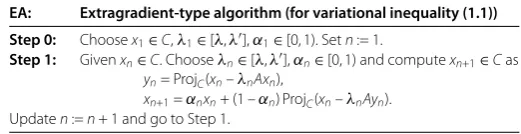
LettingFm= ,Bm= , andrn,m= in , we have the extragradient-type algorithm (see Table ).
Corollary . Let C be a nonempty closed and convex subset of H,and let A:C→H be an L-Lipschitz continuous and monotone mapping.Assume that VI(C,A)is not empty.
Table 1 The framework of the EA
EA: Extragradient-type algorithm (for variational inequality (1.1))
Step 0: Choosex1∈C,λ1∈[λ,λ],α1∈[0, 1). Setn:= 1.
Step 1: Givenxn∈C. Chooseλn∈[λ,λ],αn∈[0, 1) and computexn+1∈Cas
yn= ProjC(xn–λnAxn),
xn+1=αnxn+ (1 –αn) ProjC(xn–λnAyn).
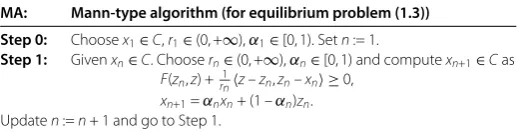
Table 2 The framework of the MA
MA: Mann-type algorithm (for equilibrium problem (1.3))
Step 0: Choosex1∈C,r1∈(0, +∞),α1∈[0, 1). Setn:= 1.
Step 1: Givenxn∈C. Choosern∈(0, +∞),αn∈[0, 1) and computexn+1∈Cas
F(zn,z) +rn1z–zn,zn–xn ≥0,
xn+1=αnxn+ (1 –αn)zn.
Updaten:=n+ 1 and go to Step 1.
Let{αn}be a real number sequence in[, ].Let{λn}and{rn,m}be positive real number
sequences.Let{xn}be a sequence generated in the following manner:
⎧ ⎪ ⎪ ⎨ ⎪ ⎪ ⎩
x∈C,
yn=ProjC(xn–λnAxn),
xn+=αnxn+ ( –αn)ProjC(xn–λnAyn), n≥.
Assume that{αn}and{λn}satisfy the following restrictions:
(a) ≤αn≤a< ;
(b) λ≤λn≤λ,whereλ,λ∈(, /L).
Then the sequence{xn}weakly converges to some pointx¯∈VI(C,A).
LettingFm=F,Bm=BandA= in , we have the Mann-type algorithm (see Table ).
Corollary . Let C be a nonempty closed and convex subset of H.Let F be a bifunction from C×C toRwhich satisfies(A)-(A)such that EP(F)is not empty.Let{αn}be a real
number sequence in[, ].Let{rn}be a positive real number sequence.Let{xn}be a sequence
generated in the following manner:
⎧ ⎪ ⎪ ⎨ ⎪ ⎪ ⎩
x∈C,
zn∈C such that F(zn,z) +rnz–zn,zn–xn ≥,
xn+=αnxn+ ( –αn)zn, n≥.
Assume that{αn}and{rn}satisfy the following restrictions:
(a) <a≤αn≤a< ;
(b) lim infn→∞rn> .
Then the sequence{xn}weakly converges to some pointx¯∈EP(F).
3 Conclusion
Competing interests
The author declares that he has no competing interests.
Acknowledgements
The author thanks the Fundamental Research Funds for the Central Universities (2014ZD44). The author is very grateful to the editor and anonymous reviewers for their suggestions which improved the contents of the article.
Received: 3 September 2014 Accepted: 11 November 2014 Published:01 Dec 2014
References
1. Browder, FE, Petryshyn, WV: Construction of fixed points of nonlinear mappings in Hilbert space. J. Math. Anal. Appl.
20, 197-228 (1967)
2. Iiduka, H, Takahashi, W: Strong convergence theorems for nonexpansive mappings and inverse-strongly monotone mappings. Nonlinear Anal.61, 341-350 (2005)
3. Qin, X, Cho, SY, Wang, L: Iterative algorithms with errors for zero points of m-accretive operators. Fixed Point Theory Appl.2013, Article ID 148 (2013)
4. Rockafellar, RT: On the maximality of sums of nonlinear monotone operators. Trans. Am. Math. Soc.149, 75-88 (1970) 5. Wang, ZM, Lou, W: A new iterative algorithm of common solutions to quasi-variational inclusion and fixed point
problems. J. Math. Comput. Sci.3, 57-72 (2013)
6. Yang, S: Zero theorems of accretive operators in reflexive Banach spaces. J. Nonlinear Funct. Anal.2013, Article ID 2 (2013)
7. Cho, SY, Kang, SM: Approximation of common solutions of variational inequalities via strict pseudocontractions. Acta Math. Sci.32, 1607-1618 (2012)
8. Rockafellar, RT: Monotone operators and the proximal point algorithm. SIAM J. Control Optim.14, 877-898 (1976) 9. Hao, Y: Zero Theorems of accretive operators. Bull. Malays. Math. Soc.34, 103-112 (2011)
10. Cho, SY, Li, W, Kang, SM: Convergence analysis of an iterative algorithm for monotone operators. J. Inequal. Appl.
2013, Article ID 199 (2013)
11. Kim, JK, Buong, N: Regularization inertial proximal point algorithm for monotone hemicontinuous mapping and inverse strongly monotone mappings in Hilbert spaces. J. Inequal. Appl.2010, Article ID 451916 (2010) 12. Wu, C, Sun, L: A monotone projection algorithm for fixed points of nonlinear operators. Fixed Point Theory Appl.
2013, Article ID 318 (2013)
13. Yuan, Q: Splitting methods for treating strictly pseudocontractive and monotone operators in Hilbert spaces. Adv. Fixed Point Theory4, 263-279 (2014)
14. Qin, X, Cho, SY, Wang, L: Convergence of splitting algorithms for the sum of two accretive operators with applications. Fixed Point Theory Appl.2014, Article ID 166 (2014)
15. Qin, X, Su, Y: Approximation of a zero point of accretive operator in Banach spaces. J. Math. Anal. Appl.329, 415-424 (2007)
16. Blum, E, Oettli, W: From optimization and variational inequalities to equilibrium problems. Math. Stud.63, 123-145 (1994)
17. Combettes, PL, Hirstoaga, SA: Equilibrium programming in Hilbert spaces. J. Nonlinear Convex Anal.6, 117-136 (2005) 18. Hao, Y: Weak convergence theorems of a hybrid algorithm in Hilbert spaces. J. Inequal. Appl.2014, Article ID 378
(2014)
19. Kim, JK: Strong convergence theorems by hybrid projection methods for equilibrium problems and fixed point problems of the asymptotically quasi-φ-nonexpansive mappings. Fixed Point Theory Appl.2011, Article ID 10 (2011) 20. Chen, JH: Iterations for equilibrium and fixed point problems. J. Nonlinear Funct. Anal.2013, Article ID 4 (2013) 21. Zhang, L, Tong, H: An iterative method for nonexpansive semigroups, variational inclusions and generalized
equilibrium problems. Adv. Fixed Point Theory4, 325-343 (2014)
22. Cho, SY, Qin, X: On the strong convergence of an iterative process for asymptotically strict pseudocontractions and equilibrium problems. Appl. Math. Comput.235, 430-438 (2014)
23. Zhang, M: Iterative algorithms for common elements in fixed point sets and zero point sets with applications. Fixed Point Theory Appl.2012, Article ID 21 (2012)
24. Wang, ZM, Zhang, X: Shrinking projection methods for systems of mixed variational inequalities of Browder type, systems of mixed equilibrium problems and fixed point problems. J. Nonlinear Funct. Anal.2014, Article ID 15 (2014) 25. Opial, Z: Weak convergence of the sequence of successive approximations for nonexpansive mappings. Bull. Am.
Math. Soc.73, 595-597 (1967)
26. Weng, XL: Fixed point iteration for local strictly pseudocontractive mappings. Proc. Am. Math. Soc.113, 727-731 (1991)
27. Yang, L, Zhao, F, Kim, JK: Hybrid projection method for generalized mixed equilibrium problem and fixed point problem of infinite family of asymptotically quasi-φ-nonexpansive mappings in Banach spaces. Appl. Math. Comput.
218, 6072-6082 (2012)
10.1186/1687-1812-2014-236