Multiple Tasks are Better than One:
Multi-task Learning and Feature Selection for Head Pose
Estimation, Action Recognition and Event Detection
Yan Yan
Advisor: Prof. Nicu Sebe
Department of Information Engineering and Computer Science
University of Trento
A thesis submitted for the degree of
Doctor of Philosophy
Acknowledgements
This thesis would not have been possible done without many important
people during my Ph.D study. My supervisor, Prof. Nicu Sebe, is not
only a good professor but also a good friend. He is always there to help me in my work and life. He has created a perfect M-Hug group. I have
really enjoyed working with him. Prof. Elisa Ricci is my mentor who
led me into the realm of machine learning and computer vision analysis.
Through our collaboration, I have learnt a lot of theoretical knowledge and
research skills. Dr. Ramanathan Subramanian, who had supervised me for
the first two years of Ph.D study, led me to get acquainted to research. I
have learnt a lot from him. Dr. Oswald Lanz, his self-motivation,
hard-working spirit and rigorous research attitude has set a good example for
me. I am also very pleased to have had the opportunity to work with Prof. Yi Yang. He was always trying to figure out every detail of the research
problem and gave me quite insightful advice. Prof. Alexander G.
Haupt-mann was my supervisor when I visited Carnegie Mellon University. I am
impressed by the way he thinks about every research problem and how he
leads and unifies the whole team with his personal charm working toward
the goal. M-Huggers are my source of happiness. They have made my life
in Trento enjoyable. Lastly, I would like to thank my wife Gaowen Liu and
my parents for their continuous support for my academic pursuit. I truly
appreciate all the people mentioned above and wish everyone happiness
Publications
This thesis consists of the following publications:
• Chapter 2:
-Y. Yan, E. Ricci, R. Subramanian, O. Lanz, N. Sebe: “No Matter Where You
Are: Flexible Graph-guided Multi-task Learning for Multi-view Head Pose
Clas-sification under Target Motion”. IEEE International Conference on Computer
Vision, pages 1177-1184, 2013.
• Chapter 3:
-Y. Yan, E. Ricci, R. Subramanian, G. Liu, N. Sebe: “Multi-task Linear
Dis-criminant Analysis for Multi-view Action Recognition”. Pending major revision
inIEEE Transactions on Image Processing, 2013.
Idea previously appeared in:
-Y. Yan, G. Liu, E. Ricci, N. Sebe: “Multi-task Linear Discriminant Analysis
for Multi-view Action Recognition”. IEEE International Conference on Image Processing, pages 2842-2846, 2013.
• Chapter 4:
-Y. Yan, H. Shen, G. Liu, Z. Ma, C. Gao, N. Sebe: “GLocal Tells You More:
Coupling GLocal Structural for Feature Selection with Sparsity for Image and Video Classification”. In Computer Vision and Image Understanding, 2014 (In
press).
-Y. Yan, Z. Xu, G. Liu, Z. Ma, N. Sebe: “GLocal Structural Feature Selection
with Sparsity for Multimedia Data Understanding”. InACM International
Con-ference on Multimedia, pages 537-540, 2013
• Chapter 5:
-Y. Yan, H. Shen, Y. Yang, D. Meng, A. G. Hauptmann, N. Sebe: “Looking up
Your Own Merriam-Webster: Semantic Dictionary Learning for Complex Event
Detection”. Under review inInternational Journal of Computer Vision, 2014.
The following are the papers published during the course of the Ph.D but not
in-cluded in this thesis:
• Y. Yan, E. Ricci, G. Liu, R. Subramanian, N. Sebe: “Clustered Multi-task Linear Discriminant Analysis for View Invariant Color-Depth Action Recognition”. In
International Conference on Pattern Recognition, 2014.
• Y. Yan, R. Subramanian, E. Ricci, O. Lanz, N. Sebe: “Evaluating Multi-task Learning for Multi-view Head-pose Classification in Interactive Environments”.
InInternational Conference on Pattern Recognition, 2014.
• Y. Yan, R. Subramanian, O. Lanz, N. Sebe: “Active Transfer Learning for Multi-View Head-Pose Classification”. In IEEE International Conference on Pattern Recognition, pages 1168-1171, 2012.
• H. Shen, Y. Yan, S. Xu, N. Ballas, W. Chen: “Evaluation of Semi-Supervised Learning Method on Action Recognition”. In Multimedia Tools and
Applica-tions, 2014 (In press).
• R. Subramanian, Y. Yan, J. Staiano, O. Lanz, N. Sebe: “On the relationship between head pose, social attention and personality prediction for unstructured
and dynamic group interactions”.ACM International Conference on Multimodal
Interaction, pages 3-10, 2013.
• G. Liu, Y. Yan, C. Gao, W. Tong, A. Hauptmann, N. Sebe: “The Mystery of Faces: Investigating Face Contribution for Multimedia Event Detection”. In
• G. Costante, V. Galieni, Y. Yan, M. Fravolini, E. Ricci, P. Valigi: “Explot-ing Transfer Learn“Explot-ing for Personalized View Invariant Gesture Recognition”
InIEEE International Conference on Acoustics, Speech and Signal Processing,
2014.
• S. Cai, C. Wang, Y. Yan, Y. Liu: “Analysis of the pencil of conics with dou-ble complex contact and its application to camera calibration”. In Journal of Shanghai Jiaotong University (Science), 2013(2).
• “CMU Informedia @TRECVID 2013: Surveillance Event Detection (SED)”. In TRECVID Video Retrieval Evaluation Workshop, NIST, Gaithersburg, MD,
2013.
• “Informedia E-Lamp @ TRECVID 2013 Multimedia Event Detection and Re-counting (MED and MER)”. In TRECVID Video Retrieval Evaluation
Work-shop, NIST, Gaithersburg, MD, 2013.
The following papers have been submitted and are under review process at the
moment of writing this Ph.D thesis:
• “L1-Norm Low-Rank Matrix Factorization by Variational Bayes”. submitted to IEEE Transactions on Neural Networks and Learning Systems, 2014.
• “It’s All About Habits: Exploiting Multi-Task Clustering for Activity of Daily Living Analysis”. submitted toInternational Conference on Image Processing,
2014.
• “Minimizing Dataset Bias: Discriminative Multi-task Sparse Coding through Shared Subspace Learning for Image Classification”. submitted toInternational
Conference on Image Processing, 2014.
• “Event Oriented Dictionary Learning for Complex Event Detection”. submitted toEuropean Conference on Computer Vision, 2014.
• “Human Interaction In A Nutshell: A Novel Strategy for Analyzing Human In-teraction in Unconstrained Videos”. submitted toACM International Conference
on Multimedia, 2014.
• “Monet Draws Pictures This Way: A Multi-task Dictionary Learning Approach to Discover Art Styles”. submitted toACM International Conference on
Contents
Contents vi
1 Introduction 1
2 Flexible Graph-guided Multi-task Learning for Multi-view Head Pose
Clas-sification under Target Motion 5
2.1 Introduction . . . 6
2.2 Related Work . . . 8
2.3 Multi-view Head Pose Classification . . . 11
2.3.1 System Overview . . . 11
2.3.2 Preprocessing . . . 12
2.3.3 Space Partitioning and Graph Modeling . . . 12
2.4 Flexible Graph-guided MTL . . . 14
2.5 Experimental Results . . . 17
2.6 Conclusions . . . 22
3 Multi-task Linear Discriminant Analysis for View Invariant Action Recog-nition 23 3.1 Introduction . . . 24
3.2 Related Work . . . 27
3.2.1 Multi-view Action Recognition . . . 27
3.2.2 Linear Discriminant Analysis . . . 28
3.2.3 Multi-task Learning . . . 29
3.3 Multi-task LDA for Multi-view Action Recognition . . . 30
CONTENTS
3.3.2 Self-Similarity Matrix Descriptors . . . 31
3.3.3 Linear Discriminant Analysis . . . 32
3.3.4 Linear Regression and LDA . . . 33
3.3.5 Multi-task Linear Discriminant Analysis . . . 34
3.3.6 Multi-task Sparse Graph Guided LDA . . . 35
3.3.7 Multi-task Flexible Graph Guided LDA . . . 37
3.4 Experimental Results . . . 39
3.4.1 Datasets . . . 42
3.4.2 Feature Representation . . . 42
3.4.3 Experimental Setup . . . 43
3.4.4 Quantitative Evaluation . . . 44
3.5 Conclusions . . . 49
4 Coupling GLocal Structural for Feature Selection with Sparsity for Image and Video Classification 50 4.1 Introduction . . . 51
4.2 GLocal Structural Feature Selection with Sparsity . . . 55
4.2.1 Problem Formulation . . . 55
4.2.2 Optimization . . . 58
4.3 Experiments . . . 59
4.3.1 Datasets and Low Level Feature Extraction . . . 60
4.3.2 Comparison Methods . . . 62
4.3.3 Experimental Setup . . . 64
4.3.4 Comparision with other methods . . . 64
4.3.5 Classifiers Effect Analysis . . . 66
4.3.6 Sparsity Analysis . . . 68
4.3.7 Global and Local Effect . . . 70
4.3.8 Influence of the Unlabeled Data . . . 70
4.3.9 Local Sets Analysis . . . 71
4.3.10 Convergence Analysis and Computational Cost . . . 71
CONTENTS
5 Semantic Dictionary Learning for Complex Event Detection 73
5.1 Introduction . . . 74
5.2 Related Work . . . 77
5.2.1 Event Detection . . . 77
5.2.2 Dictionary Learning . . . 79
5.2.3 Multi-task Learning . . . 80
5.3 Semantic Concept Selection . . . 82
5.3.1 Linguistic: Text-based Semantic Relatedness . . . 82
5.3.2 Visual High-level Representation: Elastic-Net Feature Selection 84 5.4 Semantic Dictionary Learning . . . 85
5.4.1 Multi-task Dictionary Learning . . . 86
5.4.2 Supervised Multi-task Dictionary Learning . . . 87
5.4.3 Optimization for Eqn.5.2 . . . 87
5.4.4 Supervised Multi-task`p-norm Dictionary Learning . . . 89
5.5 Experiments . . . 91
5.5.1 Datasets . . . 92
5.5.2 Evaluation Metrics . . . 93
5.5.3 Experiment Setup . . . 94
5.5.4 Comparison Method . . . 94
5.5.5 Results . . . 95
5.6 Conclusion . . . 100
6 Conclusions 102
Chapter 1
Introduction
Computer vision is a field that includes methods for acquiring, processing,
analyz-ing, and understanding images and videos and, in general, high-dimensional data from the real world in order to produce numerical or symbolic information. The
classi-cal problem in computer vision is that of determining whether or not the image or
video data contains some specific object, feature, or activity. This task can normally
be solved robustly and without effort by a human, but is still not satisfactorily solved
in computer vision for the general case - arbitrary objects in arbitrary situations. The
existing methods for dealing with this problem can at best solve it only for specific
objects, such as simple geometric objects (e.g., polyhedra), human faces, printed or
hand-written characters, or vehicles, and in specific situations, typically described in
terms of well-defined illumination, background, and pose of the object relative to the camera.
Machine Learning (ML) and Computer Vision (CV) have been put together during
the development of computer vision in the past decade. Nowadays, machine learning
is considered as a powerful tool to solve many computer vision problems.
Multi-task learning, as one important branch of machine learning, has developed very fast
during the past decade. Multi-task learningEvgeniou & Pontil[2004] methods aim to
simultaneously learn classification or regression models for a set of related tasks. This
typically leads to better models as compared to a learner that does not account for task
relationships. The goal of multi-task learning is to improve the performance of learning algorithms by learning classifiers for multiple tasks jointly. This works particularly
In this thesis, we investigate some challenging problems existing in the computer
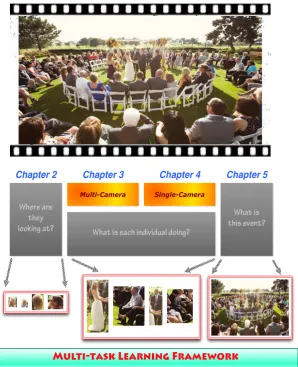
vision area under the multi-task learning framework. Fig.1.1shows the framework of
this thesis. At the first glance of Fig.1.1, probably some questions naturally presented
themselves in your mind.i.e., How do we know where a person is looking at from
far-field low-resolution cameras? How do we know what each person is doing? And how
do we know what this event is? Is it a ‘Wedding ceremony’ or ‘Flash mob gathering’? In the following parts of this thesis, we will answer these questions in detail from
the computer vision point of view considering both single and multiple camera setups
and from the machine learning point of view, especially under the multi-task learning
framework.
Where are they
looking at? What is each individual doing?
What is this event?
Chapter 2 Chapter 3 Chapter 4 Chapter 5
Multi-task Learning Framework
Multi-Camera Single-Camera
The remainder of this thesis is organized as follows:
• In Chapter 2, we answer the question of ‘Where are they looking at?’. Specif-ically, we propose a novel Multi-task Learning framework (FEGA-MTL) for
classifying the head pose of a person who moves freely in an environment
mon-itored by multiple, large field-of-view surveillance cameras.
• In Chapter 3, we answer the question of ‘What is each individual doing?’ for multi-camera setup. Specifically, we propose Multi-task Linear Discriminant
Analysis, a novel multi-task learning framework for multi-view action
recogni-tion that allows for the sharing of discriminative Self-Similarity Matrices
fea-tures among different views.
• In Chapter 4, we answer the question of ‘What is each individual doing?’ for a single-camera setup. Specifically, we propose a novel feature selection method
using a sparse model. Different from the state of the art, our method is built
uponl2,p-norm and simultaneously considers both the global and local (GLocal) structures of data distribution.
• In Chapter 5, we answer the question of ‘What is this event?’. Specifically, we firstly investigate the possibility of automatically selecting semantic meaningful
concepts for the event detection task based on both the events-kit text
descrip-tions and the concepts high-level feature descripdescrip-tions. Then we learn a
semantic-oriented dictionary representation for each event based on the selected semantic
concepts.
To summarize, the contributions of this thesis are as follows:
• We develop several novel multi-task learning algorithms,i.e., two-graph guided multi-task learning, multi-task linear discriminant analysis, multi-task dictionary
learning, which outperform the other state-of-the-art multi-task learning
algo-rithms in the specific computer vision and multimedia problems.
• We provide a novel view from mid-level (headpose and action recognition) com-puter vision task to high-level (multimedia event detection) multimedia
• We analyse the human action recognition both from single and multiple camera setups under the multi-task learning framework.
Chapter 2
Flexible Graph-guided Multi-task
Learning for Multi-view Head Pose
Classification under Target Motion
In this chapter, we propose a novel Multi-Task Learning framework (FEGA-MTL) for
classifying the head pose of a person who moves freely in an environment monitored
by multiple, large field-of-view surveillance cameras. As the target (person) moves,
distortions in facial appearance owing to camera perspective and scale severely impede
performance of traditional head pose classification methods. FEGA-MTL operates on a dense uniform spatial grid and learns appearance relationships across partitions as
well as partition-specific appearance variations for a given head pose to build
region-specific classifiers. Guided by two graphs whicha-priorimodel appearance similarity
among (i) grid partitions based on camera geometry and (ii) head pose classes, the
learner efficiently clusters appearance-wise related grid partitions to derive the optimal
partitioning. For pose classification, upon determining the target’s position using a
per-son tracker, the appropriate region-specific classifier is invoked. Experiments confirm
2.1
Introduction
Head pose estimation and tracking is critical for surveillance and human-behavior un-derstanding, and has been extensively studied for over a decade Murphy-Chutorian
& Trivedi [2009]. However, most existing approaches compute the head pose from
high resolution images, where facial features are clearly visible. Estimating the head
pose from large field-of-view surveillance cameras, where faces are typically captured
at 50×50or lower pixel resolution, has received importance only recently Chen &
Odobez[2012];Orozcoet al.[2009];Tosato et al.[2010]. Computing the head pose
under these conditions is difficult, as faces appear blurred and models employing
de-tailed facial information are ineffective.
Fewer still are head pose estimation methods that utilize information from multi-ple surveillance cameras. Employing a single camera view is insufficient for studying
people’s behavior in large environments and multi-view images have been exploited to
achieve robust pose estimation Mu˜noz-Salinaset al.[2012];Rajagopal et al.[2012];
Voit & Stiefelhagen[2009];Yanet al.[2012];Zabuliset al.[2009]. However, methods
such asMu˜noz-Salinaset al.[2012];Voit & Stiefelhagen[2009] estimate pose as a
per-son rotates in place, but is not freely moving around in the environment. The broader
goal of this work is to analyze behaviorLepriet al.[2012] from head pose cues in
un-structured interactive settings (e.g. parties), where targets (persons) can move around
freely. Therefore, in this paper we consider the problem ofmulti-view head pose clas-sification under target motion.
Fig.2.1(left) illustrates the challenges involved in the considered scenario. The
fa-cial appearance of a target with identical 3D head pose but at different positions varies
considerably due to perspective and scale. As the target moves, the face can appear
larger/smaller and face parts can become occluded/visible due to the target’s relative
position with respect to the camera. We investigated the effect of appearance change on
pose classification using the DPOSE datasetRajagopalet al.[2012], which comprises
synchronously recorded images of moving persons from four camera views,
associ-ated target positions and head pose annotations. Upon dividing the DPOSE space into
four quadrants Q1-Q4, we trained an SVM classifier with HOGDalal & Triggs[2005] features extracted from the 4-view images corresponding to a particular quadrant. The
Figure 2.1: (left) Facial appearance change under target motion: for the same 3D head pose, automatically extracted face crops corresponding to camera C1-C4 are shown for target positions P1-P3. (right) Space division: S1, S2 denote classification accuracies when the training images come from the white quadrant (figure is best viewed in color).
head pose to one of eight classes, each denoting a quantized 45o (360o/8) head-pan. Fig.2.1(right) presents the results. Much lower accuracies were obtained when
train-ing and test images came from different quadrants, confirmtrain-ing the adverse impact of
position-induced appearance changes on head pose classification.
To address this issue, we proposeFEGA-MTL, a FlExible GrAph-guided
Multi-Task Learning framework for multi-view head pose classification under target motion.
Given a set of related tasks, MTL attempts to learn relationships among the tasks as
well as task-specific differences. Upon dividing a physical space into a discrete
num-ber of planar regions (as in Fig.2.1), we seek to learn the pose-appearance relationship
in each region. Analogous with the MTL problem, one can expect some similarity in
facial appearance for a given head pose across the regions, and region-specific
differ-ences owing to perspective and scale.
FEGA-MTL seeks to simultaneously learn the relationship between facial appear-ance and head pose across all partitions of a dense uniform 2D spatial grid. Since
the facial appearance is likely to be more similar for neighboring regions (as against
spatially disjoint partitions), employing a single model to denote the inter-region
ap-pearance relationship can lead to negative transfer, arising when knowledge sharing
has a negative impact on the performance of the learned model. Therefore, we devise
a method where appearance-wise related grid clusters (which denote related tasks) are
flexibly discovered, and the within-cluster appearance similarity is modeled via the
Two graphs, which respectively define appearance similarity among (i) grid
par-titions for a particular head pose given camera geometry, and (ii) head pose classes,
guide the learning process to output the optimal spatial partitioning comprising a
num-ber of grid clusters and an associated MTL classifier. During the classification stage,
upon determining the position corresponding to a test instance using a person tracker,
the corresponding region-specific classifier is invoked. Our approach isflexibleowing to three main reasons: (1) It can work with arbitrary camera setups; (2) The learning
algorithm can adaptively deal with multiple feature descriptors having differing
dis-criminative power, and (3) Given the camera geometry and face appearance features,
the optimal grid-cluster configuration is automatically discovered using our approach.
Experiments confirm that FEGA-MTL outperforms competing head pose classification
and MTL approaches.
To summarize, the paper’s contributions are: (i) It represents one of the first works
to explore multi-view head pose classification under target motion; (ii) To our
knowl-edge, an MTL framework for head pose classification has not been proposed before; (iii) A novel graph-guided approach for simultaneously learning a set of classifiers
and their relationships is proposed, and an efficient solver is devised; (iv) We
seam-lessly connect camera geometry (traditional computer vision) with machine learning
for head pose classification through a novel graph modeling strategy; (v) FEGA-MTL
is a general framework, potentially applicable to many computer vision and pattern
recognition problems.
2.2
Related Work
Head Pose Classification from Low Resolution Faces. Head-pose classification
from surveillance images has been investigated in a number of worksBenfold & Reid
[2011];Chen & Odobez[2012];Orozcoet al.[2009];Tosatoet al.[2010]. InOrozco
et al. [2009], a Kullback-Leibler distance-based facial appearance descriptor is
pro-posed for low resolution images. The array-of-covariances (ARCO) descriptor is
in-troduced in Tosato et al. [2010], and is found to be effective for representing faces
as it is robust to scale and illumination changes. InBenfold & Reid [2011]; Chen &
Odobez [2012], head pose estimation with weak or no supervision is achieved
body pose. However, all these works address single view head pose classification.
Few works estimate head pose fusing information from multiple views
Mu˜noz-Salinas et al. [2012]; Rajagopal et al. [2012]; Voit & Stiefelhagen [2009]; Zabulis
et al. [2009]. A particle filter is combined with a neural network for pan/tilt
classifi-cation inVoit & Stiefelhagen [2009]. A HOG-based confidence measure is also used
to determine the relevant views. InMu˜noz-Salinaset al. [2012], SVMs are employed to calculate a probability distribution for head pose in each view. The results are fused
to produce a more precise estimate. Nevertheless, both these works attempt to
deter-mine head orientation as a person rotates in place and position-induced appearance
variations are not considered.
A weighted distance approach for classifying pose under target motion is proposed
in Rajagopalet al.[2012]. Upon dividing the space into four quadrants, max-margin
distance learning is employed to learn a classifier per region– such a rigid space
parti-tioning scheme will not optimally encode the pose-appearance relationship under
mo-tion, with arbitrary camera geometry. InZabuliset al.[2009], head pose under motion is determined by mapping the target’s face texture onto a spherical head model, and
subsequently locating the face in the unfolded spherical head image. However, many
camera views are required to produce an accurate texture map– 9 cameras are used
inZabulis et al.[2009]. In contrast, our approach is predominantly image-based,
ap-plicable even with few camera views.
Multi-task Learning. MTL methods aim to simultaneously learn classification or
re-gression models for a set of related tasks. This typically leads to better models as
compared to a learner that does not account for task relationships. Traditional MTL
methods consider a single shared model, assuming that all the tasks are related
Ar-gyriou et al. [2007]; Evgeniou & Pontil [2004]; Yanet al. [2013a]. However, when
some of the tasks are unrelated, this may lead to negative transfer. Recently, more
sophisticated approaches have been proposed to counter this problem. These methods
assume somea-prioriknowledge (e.g. in the form of a graph) defining task
dependen-ciesChenet al.[2011] or learn the task relationships simultaneously with task-specific
parametersGonget al.[2012];Jalaliet al.[2010];Kanget al.[2011];Zhong & Kwok.
[2012]; Zhou et al. [2011a]. Among these, the work most similar to ours is Chen
et al. [2011]. Similar to Chenet al. [2011], our algorithm adopts a graph to specify
as FEGA-MTL automatically discovers task relationships and refines the initial graph
structure. For multi-view head pose estimation under motion, the graph structure is
very useful as it reflects inter-region facial appearance similarity as derived from the
camera geometry.
2.3
Multi-view Head Pose Classification
2.3.1
System Overview
Fig.2.2presents an overview of our multi-view head pose classification system which
consists of three phases: (1) preprocessing and extraction of multi-view face
appear-ance descriptors, (2) learning of head pose-appearappear-ance relationships under motion with FEGA-MTL and (3) classification. As we deal with freely moving targets, in the
pre-processing stage, a color-based particle filter tracker incorporating multi-view
geome-try information is employed to reliably localize the target’s face and extract multi-view
face crops. Also, the tracker allows for determining the target position corresponding
to a test instance, so that the appropriate region-based pose classifier can be invoked.
Features extracted from the multi-view face appearance images are fed to the
FEGA-MTL module for learning region-specific classification parameters.
The learning process is guided by two graphs that respectively model
appearance-based task dependencies among grid partitions and head pose classes– (a) theregion
graph quantifies the multi-view facial appearance distortion based on camera
geom-etry, as the target moves from one grid partition to another, and (b) the pose graph
posits that neighboring head pose classes tend to have more similar facial appearance.
FEGA-MTL outputs the pose classification parameters for each grid partition, and the
configuration of grid clusters so that the facial appearance for a given head pose is very
similar in those partitions constituting a cluster– these grid clusters denote the learnt
task relationships given the features and task dependencies. We will now describe each
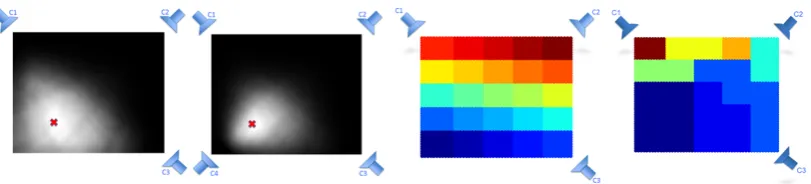
Figure 2.3: (from left to right) Appearance similarity map computed around a point with 3 camera views and 4 camera views, initial grid partitions and learned grid clusters for the 3-camera setup (figure best viewed in color).
2.3.2
Preprocessing
Tracking and Head Localization. A multi-view, color-based particle filter Lanz
[2006] is used to compute the 3D body centroid of moving targets. A 30×30×20 cm-sized dense 3D grid (with 1cm resolution) of hypothetic head locations is then placed
around the estimated 3D head-position provided by the particle filter1. Assuming a
spherical model of the head, a contour likelihood is computed for each grid point by projecting a 3D sphere onto each view using camera calibration information. The grid
point with the highest likelihood sum is determined as the head location. The tracking
and head localization procedures are illustrated in Fig.2.2. The head is then cropped
and resized to 20×20 pixels in each view.
Feature Extraction. Head crops from the different views are concatenated to generate
the multi-view face crops as shown in Fig.2.2, and similar to previous worksBenfold
& Reid [2011]; Chen & Odobez [2012], we employ HOG descriptors to effectively
describe the face appearance for head pose classification. The multi-view face
appear-ance image is divided into non-overlapping 4×4patches, and a 9-bin histogram is used as the HOG descriptor for each image patch.
2.3.3
Space Partitioning and Graph Modeling
Region Graph Modeling. To apply FEGA-MTL, we initially divide the 2D ground
space into a uniform grid withRpartitions, as shown in Fig.2.3. We want to learn the
pose-appearance relationship in each partition. The algorithm learns from a training
1The grid size accounts for the tracker’s variance and horizontal and vertical offsets of the head
setTt ={(xti, yit) : i= 1,2, . . . , Nt}for each regiont = 1,2, . . . , R, wherexti ∈ IRD denoteD-dimensional feature vectors andyit∈ {1,2, . . . , C}are the head pose labels (C= 8 classes in our setting). One of the graphs guiding the learning process specifies
the similarity in appearance for a given head pose across regions based on camera
geometry. If grid partitions form the graph nodes, we determine the edge setE1 and
the associated edge weightsγmnquantifying the appearance distortion betweenTmand Tn due to positional change from regionm to region n– these edge weights indicate whether knowledge sharing between regionsmandnis beneficial or not.
As mentioned earlier, we model the target’s head as a sphere. LetZk denote the
sphere placed at the target’s 3D head positionpk, and whose multi-view camera
pro-jection yields training imageIk inTm. Using camera calibration parameters, one can
compute the correspondence between surface points in Zkand pixels in Ik. Then, we
moveZkto positionplcorresponding to imageIl inTn, and determine how many
sur-face points inZkare still visible inIl. The appearance distortion overU camera views
due to displacement v frompk topl is defined asδ(Zk, pk → pl) = PUu=1kvk+ξn0, wheren0 is the number of surface points inZk that are occluded after translation and
ξis a constant that penalizes such occlusion.
The appearance similarity between regionsmandn is then computed based on a Gaussian model by considering distortion between all image-pairs associated to Tm, Tnas:
γmn=e − Ω
NmNnσ2
whereΩ = P ∀Ik∈Tm,Il∈Tn
[δ(Zk, pk →pl) +δ(Zl, pl →pk)],Nm andNnare number of images inTmandTn. σ = 1andE1 is the set of edges for whichγmn≥0.1.
Fig.2.3depicts the appearance similarity maps for two different camera
configura-tions when the head-sphere atpkis moved around in space (the projection ofpkon the
ground is denoted by the red ‘X’). Whenpkis close to the camera-less room corner in
the 3-camera setup, a number of regions aroundpkshare a high appearance similarity,
implying that pose-appearance relationship can be learnt jointly in these regions.
How-ever, the similarity measure decreases sharply as the target moves frompktowards any
of the three cameras, and tends to zero for the upper diagonal half of the room. Also, when a camera is introduced in the fourth room corner, appearance similarity holds
Pose Graph Modeling. A second graph guiding the learning process models the fact
that facial appearances should be more similar for neighboring pose classes as
com-pared to non-neighboring classes. For example, as shown in Fig.2.2, the facial
appear-ance of exemplars from class 1 should be most similar to exemplars from class 2 and
8. Exploiting this information, a pose graphE2is defined with associated edge weights βij = 1 ifiandj correspond to neighboring pose classesci,cj, andβij = 0 otherwise.
2.4
Flexible Graph-guided MTL
Given a training setTt, for each task (region)t, we define the matrixXt = [xt1, ...,x
t Nt]
0,
Xt ∈ IRNt×D. If N = R P
t=1
Nt denotes the total number of training samples, we
also define X = [X01, . . . ,X0R]0, X ∈ IRN×D obtained concatenating the matrices
Xtfor all theRtasks. In this paper, the notation(·)0 indicates the transpose operator. For each training sample, we construct a binary label indicator vector yt
i ∈ IRRC as
yt
i = [0,0, ...,0 | {z }
T ask1
,0,1, ...,0
| {z } T ask2
, ...,0,0, ...,0
| {z } T ask R
], i.e. the position of the non-zero element
in-dicates the task and class membership of the corresponding training sample. A label
matrixY∈IRN×RC is then obtained concatenating theyti’s for all training samples. For each regiontand pose classc, we propose to learn the region-specific weight vectors for pose classification wt,c = st,c+θt,c, wt,c,st,c,θt,c ∈ IRD. The st,c com-ponents model the appearance relationships among regions, while θt,c’s account for region-specific appearance variations. Defining the matrices S,Θ ∈ IRD×RC, S = [s1,1, ...,s1,C
| {z }
T ask 1
, ...,sR,1, ...,sR,C
| {z }
T ask R
], Θ = [θ1,1, ...,θ1,C
| {z }
T ask1
, ...,θR,1, ...,θR,C
| {z }
T ask R
], we propose to
solve the following optimization problem:
min S,Θ
(Y
0
Y)−12(Y−X(S+Θ))
2
F +λsΩs(S) +λθΩθ(Θ) (2.1)
wherek · kF denotes the matrix Frobenius norm. The normalization factor(Y0Y) −1/2
kΘk2
F penalizes large deviation ofst,cfromwt,c, whileΩs(·)is defined as follows: Ωs(S) =kSk2F +λ1
X
(i,j)∈E1
γijksti,c−stj,ck1
+λ2
X
(i,j)∈E2
βijkst,ci−st,cjk1
where γij’s and βij’s are the appearance similarity-based weights of region graph
edges E1 and pose graph edges E2 respectively as described in Sec2.3.3. The term
kSk2
F regulates model complexity, while the`1 norm regularizer imposes the weights
st,cof appearance-wise related regions and neighboring classes to be close together. In
particular, region clusters are formed as λ1 → ∞. Importantly, this effect is feature-specific– cluster structure varies from feature to feature, and the clustering obtained for
the more and less discriminant features can be very different. This is primarily why our
method isflexible, and the model as well as the proposed optimization strategy benefit from this important effect.
To solve (2.1), we adopt the Fast Iterative Shrinkage-Thresholding Algorithm (FISTA)
Beck & Teboulle[2009]. FISTA solves optimization problems of the formminµf(µ)+
r(µ), where f(µ)is convex and smooth, r(µ)is convex but non-smooth. Due to its simplicity and scalability, FISTA is a popular tool for solving many convex smooth/non-smooth problems. In each FISTA iteration, a proximal step is computed Beck &
Teboulle[2009]:
min
µ kµ−µˆk
2 F +
2
Lk
r(µ) (2.2)
whereµˆ = ˜µk− 1
Lk∇f( ˜µk), µ˜k is the current estimate andLk is a step-size
deter-mined by line search. To apply FISTA to our optimization problem, we define:
f(S,Θ) =
(Y
0
Y)−1/2(Y−X(S+Θ))
2
F
r(S,Θ) =λθkΘk2F +λskSk2F +λsλ1
X
(i,j)∈E1
γijksti,c−stj,ck1
+λsλ2
X
(i,j)∈E2
βijkst,ci−st,cjk1
Algorithm 1FEGA-MTL
INPUT:Tt,∀t= 1, . . . , R,λs,λθ,λ1,λ2,E
InitializeS0,Θ0,α0 = 1.
OUTER LOOP:
αn= 12(1 +
q
1 + 4α2 n−1)
{UpdateΘ}
ˆ
Θ=Θn−2X0(XΘn−Y) Θn+1
2 =
1 1+ˆλθ
ˆ Θ
Θn+1= (1 + αn−αn1−1)Θn+1
2 −
αn−1−1
αn Θn
{UpdateS}
ˆ
S=Sn−2X0(XSn−Y)
UpdateSn+1
2 with ADMM as follows:
For eachd= 1 :D
Initializeqd,0,ad,0,sd,0
SetM=ρE0E+ (2 + 2ˆλs)I
Compute Cholesky factorization of matrixM.
INNER LOOP:
{Updates}SolveMsd,k+1 =bk
{Updateq}qd,k+1 =STλˆ1/ρ(Esd,k+1+ 1ρad,k)
{Updatea}ad,k+1=ad,k+ρ(Esd,k+1−qd,k+1)
Until Convergence
Sn+1= (1 + αn−α1n−1)Sn+1 2
−αn−1−1
αn Sn Until Convergence
Output:W=S+Θ
proximal step amounts to solving the following:
min S,Θ
S− ˆ S 2 F + Θ− ˆ Θ 2
F + ˆλ1
X
(i,j)∈E1
γijksti,c−stj,ck1
+ˆλ2
X
(i,j)∈E2
βijkst,ci−st,cjk1+ˆλskSk
2
F + ˆλθkΘk2F (2.3)
where λˆs = 2λs/Lk, λˆθ = 2λθ/Lk λˆ1 = 2λ1λs/Lk and λˆ2 = 2λ2λs/Lk, Θˆ =
Θ−2X0(XΘ−Y)andSˆ =S−2X0(XS−Y). We solve (3.16) by consideringS,
Θseparately, using the procedure described in Algorithm1. To optimize with respect to S, we devise a novel approach using alternating direction method of multipliers
(ADMM) Boyd et al. [2011]. In Algorithm 1, STλ(x) = sign(x) max(|x| −λ,0) is a soft-thresholding operator and the matrix E=
" ˆ
λ1E1 ˆ λ2 ˆ λ1 E2 #
the edge-vertex incident matricesE1e=(i,j),h=
γij, i=h
−γij, j=h
0, otherwise
,E1 ∈IR|E1|×RC, and
E2e=(i,j),h =
βij, i=h
−βij, j =h
0, otherwise
,E2 ∈IR|E2|×RC.
Regarding the computational complexity of Algorithm 1, the main steps in the outer loop are: the update of Θwhich takes O(DR)time, the gradient computation takingO(NtDR)time and the update of S. The last step is the most computationally expensive as it requires a Cholesky matrix factorization (O(R3)) for each dimension d = 1, . . . , D. However, the Cholesky factorization is performed only in the outer loop. In the inner loop, each iteration involves solving one linear system (O(R2)) and a soft-thresholding operation (O(|E1|+|E2|)).
After the learning phase, the computed weights matrixW = S+Θis used for classification. While testing, upon determining the regiontassociated to a test sample
xtest using the person tracker, the correspondingwt,c’s are used to compute the head
pose label asarg max
c=1,...,C
w0t,cxtest.
2.5
Experimental Results
In this section, we compare head pose classification results achieved with
FEGA-MTL against (i) state-of-the-art head pose estimation methods and (ii) other FEGA-MTL
ap-proaches. We perform our experiments on the DPOSE datasetRajagopalet al.[2012].
To our knowledge, there are no other databases for benchmarking multi-view head
pose classification performance under target motion. The CLEARStiefelhagenet al.
[2007] and UcoHeadMu˜noz-Salinaset al. [2012] databases are recorded with targets rotating in-place, while the dataset proposed inZabulis et al.[2009] does not include
ground-truth head pose measurements for moving targets. DPOSE comprises over
50000 4-view synchronized images recorded for 16 moving targets, with associated
positional and head pose measurements (target positions are computed using the
per-son trackerLanz[2006]).
As mentioned earlier, the larger goal of this work is to detect interactions in
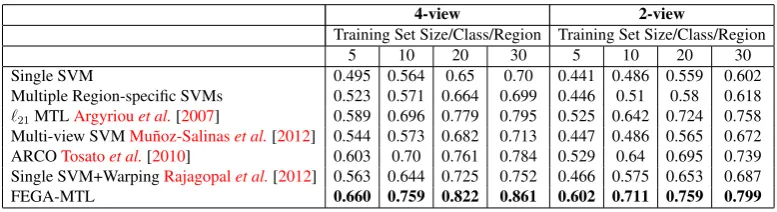
Table 2.1: DPOSE dataset: Head pose classification accuracy. Comparison with state-of-the-art head pose estimation methods.
4-view 2-view
Training Set Size/Class/Region Training Set Size/Class/Region
5 10 20 30 5 10 20 30
Single SVM 0.495 0.564 0.65 0.70 0.441 0.486 0.559 0.602
Multiple Region-specific SVMs 0.523 0.571 0.664 0.699 0.446 0.51 0.58 0.618 `21MTLArgyriouet al.[2007] 0.589 0.696 0.779 0.795 0.525 0.642 0.724 0.758
Multi-view SVMMu˜noz-Salinaset al.[2012] 0.544 0.573 0.682 0.713 0.447 0.486 0.565 0.672 ARCOTosatoet al.[2010] 0.603 0.70 0.761 0.784 0.529 0.64 0.695 0.739 Single SVM+WarpingRajagopalet al.[2012] 0.563 0.644 0.725 0.752 0.466 0.575 0.653 0.687
FEGA-MTL 0.660 0.759 0.822 0.861 0.602 0.711 0.759 0.799
Table 2.2: DPOSE dataset: Head pose classification accuracy. Comparison with MTL ap-proaches.
5training samples/class/region 10training samples/class/region
2-view 3-view 4-view 2-view 3-view 4-view
Single SVM 0.441 0.494 0.523 0.486 0.549 0.564
`21MTLArgyriouet al.[2007] 0.525 0.567 0.589 0.642 0.675 0.696
Flexible Task Clusters MTLZhong & Kwok.[2012] 0.555 0.598 0.621 0.65 0.681 0.715
Dirty model MTLJalaliet al.[2010] 0.546 0.585 0.603 0.655 0.686 0.696
Clustered MTLZhouet al.[2011a] 0.540 0.590 0.619 0.639 0.682 0.711
Robust MTLGonget al.[2012] 0.550 0.580 0.581 0.655 0.689 0.705
FEGA-MTL (region graph only,λ2= 0) 0.581 0.623 0.643 0.677 0.718 0.733
FEGA-MTL (region graph + pose graph) 0.602 0.643 0.660 0.711 0.748 0.759
into one of 8 classes (each denoting a 45◦ pan range). Since faces are captured at low-resolution by distant, large field-of-view cameras, this task is quite challenging and the
state-of-the-art can achieve only about79% accuracy on the 4-view face images (Ta-ble 3.1). We divide DPOSE into mutually exclusive training/validation/test sets. For all methods, regularization parameters are tuned using the validation set, considering
values in the interval[2−3,2−2, . . . ,23]. We consider an initial, uniformly spaced grid withR= 25regions as shown in Fig.2.3. Our results denote mean classification accu-racies obtained from five independent trials, where a randomly chosen training set is
employed in each trial.
Table3.1presents results comparing FEGA-MTL with competing head pose clas-sification methods. We gradually increase the training set size from 5 to 30
output of multiple SVMs Mu˜noz-Salinaset al.[2012] and the state-of-the-art ARCO
classifier Tosato et al. [2010] which is shown to be powerful at low resolution (we
feed in the 4-view image features to ARCO in order to extend it to the multi-view
setup). As shown in the table, both these methods perform poorly with respect to the
proposed approach, as they are not designed to account for facial distortions due to
scale/perspective changes.
A better strategy in such cases is to compensate for position-induced appearance
distortions in some way Rajagopalet al. [2012]; Zabulis et al. [2009]. The
texture-mapping approach presented inZabuliset al.[2009] is shown to be accurate, but many
cameras are required for effective texture mapping. Instead, we attempted the warping
method proposed in Rajagopal et al. [2012], which despite its simplicity is shown
to effectively work with few low-resolution views. We implemented a radial basis
SVM to determine head pose from the warped 4-view images. Warping is greatly
beneficial in the considered scenario as the Single SVM+Warping method significantly
outperforms Single SVM.
It is pertinent to point out two differences between our approach and Rajagopal
et al. [2012]– Rajagopal et al. [2012] proposes a pre-defined division of space (the
room is divided into 4 quadrants) which is not necessarily optimal for describing the
pose-appearance relationship under arbitrary camera geometry. Secondly, task
rela-tionships are not considered inRajagopal et al.[2012], and an independent classifier
is used for each quadrant. In contrast, FEGA-MTL discovers the optimal
configura-tion of grid clusters that best describes the pose-appearance relaconfigura-tionship given camera
geometry. Considering task relationships enables FEGA-MTL to achieve higher
clas-sification accuracy than a single global classifier (Single SVM), Single SVM+Warping
and separate region-specific classifiers that do not consider inter-region appearance relationships (Multiple Region-specific SVMs).
Table3.1 also presents accuracies obtained with`21MTL Argyriouet al. [2007], which assumes all tasks share a common component. As discussed before, negative
transfer adversely affects performance of`21MTL, while FEGA-MTL achieves higher
accuracy upon flexibly discovering related tasks. We also repeated the experiments
employing only two of the four camera views for head pose classification, and while
obtained accuracies are expectedly lower in this case, the accuracy trends are still
Table3.3 compares classification performance of various MTL methods. The ad-vantage of employing MTL for head pose classification under target motion is obvious
since all MTL approaches greatly outperform single SVM. Moreover, having a
flexi-ble learning algorithm which is aflexi-ble to infer appearance relationships among regions
provides some advantages in terms of classification accuracy. This is confirmed by the
fact that in all situations (varying training set sizes and number of camera views) FTC
MTL Zhong & Kwok. [2012], Clustered MTL Zhouet al. [2011a] and FEGA-MTL
achieve superior performance. FEGA-MTL, which independently considers features
and employs graphs to explicitly model region and head pose-based appearance
rela-tionships, achieves the best performance. The usefulness of modeling both region and
pose-based task dependencies through FEGA-MTL is evident on observing the results
in Table 3.3. Using the region graph alone is beneficial as such, while employing the region and pose graphs in conjunction produces the best classification performance.
Figure 2.4: Comparison of graph-guided MTL methods: classification accuracies for (left) 4-views and (right) a single view.
Fig.2.3shows the initial spatial grid and the optimal spatial partitioning learned for
a three-camera system with 5 training images/class/region. Clustered regions
corre-spond to identical columns of the task similarity matrix S, i.e. two regionsti and tj
merge ifsti,c =stj,c∀c. Constrained by the appearance similarity graph weights,
spa-tially adjacent regions tend to cluster together. While regions closer to the camera-less
room corner tend to form large clusters, smaller clusters are observed as one moves
closer to the cameras owing to larger facial appearance distortions caused by
graph weights, facial appearance features also influence the clustering of related
re-gions, and therefore, the computed optimal partitioning.
To further demonstrate the advantages of FEGA-MTL, we compare it with the
other graph-guided MTL methods Chen et al. [2011]; Zhou et al. [2011b]. Fig.2.4
shows that higher accuracy is obtained with our approach for different training set
sizes. A main difference between FEGA-MTL and these methodsChenet al.[2011];
Zhou et al. [2011b] is that they do not decomposewt,c asst,c +θt,c, and due to the non-consideration of task-specific components θt,c, they have less flexibility.
More-over, inZhouet al.[2011b] (due to the use of`2 norm) andChenet al.[2011] (due to
smoothing) task-clustering is encouraged but not enforced, i.e. thewt,c’s
correspond-ing to a cluster are similar but not identical.
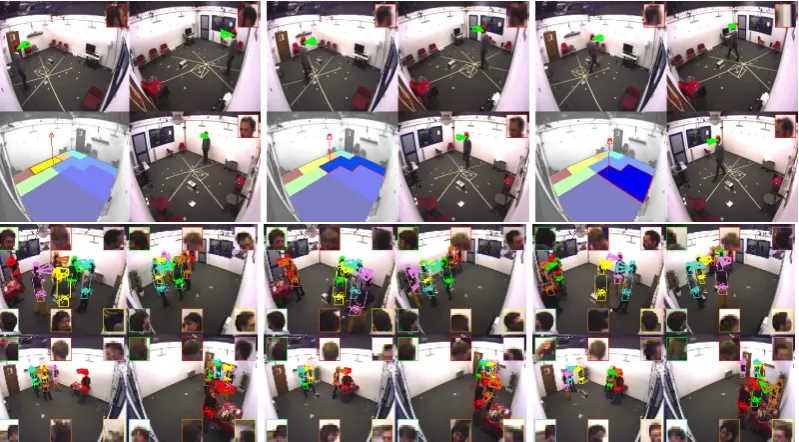
Figure 2.5: (Top) Head pose classification results for a target moving freely within a 3-camera setup are shown two-by-two. The learned clusters, as seen from a fourth view, are shown on the bottom-left inset. Cluster corresponding to the target position (denoted using a stick model) is highlighted. (Bottom) Pose classification results for a party video involving multiple mobile targets (best viewed under zoom.)
Also, it is worth noting that FEGA-MTL can also be used in a single-view
set-ting. However, the use of multiple views is greatly advantageous. Fig.2.4 presents the accuracies obtained with 4-view features against single-view features (mean of the
classification accuracy is obtained with the four-view features. The performance gain
achieved using FEGA-MTL over an SVM modeling pose-appearance relationship over
the entire space is evident, for both single and four-view cases.
Finally, Fig.2.5 shows some qualitative results obtained with FEGA-MTL for
sin-gle and multiple targets tracked real-time using Lanz [2006]. With multiple targets,
identical colors are used to denote the pose direction frustum and face crop rectan-gle for each target. This scenario is quite challenging, as six targets are interacting
naturally and freely moving around in the room.
2.6
Conclusions
We propose a novel graph-guided FEGA-MTL framework for classifying head pose
of moving targets from multiple camera views. Starting from a dense 2D spatial grid,
two graphs which respectively model appearance similarity among grid partitions and
head pose classes guide the learner to output region-specific pose classifiers and the optimal space partitioning. Experiments demonstrate the superiority of FEGA-MTL
Chapter 3
Multi-task Linear Discriminant
Analysis for View Invariant Action
Recognition
Robust action recognition under viewpoint changes has received considerable attention
recently. To this end, Self-Similarity Matrices (SSMs) have been found to be effective
view-invariant action descriptors. To enhance the performance of SSM-based methods,
we propose Multi-task LDA, a novel multi-task learning framework for multi-view
action recognition that allows for the sharing of discriminative SSM features among different views (i.e. tasks). Inspired by the mathematical connection between
variate linear regression and Linear Discriminant Analysis (LDA), we model
multi-task multi-class LDA as a single optimization problem by choosing an appropriate
class indicator matrix. In particular, we propose two variants of graph-guided
multi-task LDA: (1) where the graph weights specifying view dependencies are fixeda priori
and (2) where graph weights are flexibly learnt from the training data. We evaluate the
proposed methods extensively on multi-view RGB and RGBD video datasets, and
ex-perimental results confirm that the proposed approaches compare favorably with the
3.1
Introduction
Human action recognition and understanding from image and video content has at-tracted considerable attention in computer vision due to its critical role in surveillance,
behavior analysis, human-computer interaction, robotics and content-based retrieval.
Several solutions have been proposed for action recognition over the years–
read-ers may refer to Poppe [2010]; Weinland et al. [2011] for extensive surveys. From
the representation point of view, the approaches can be mainly classified into
meth-ods computing the time evolution of human silhouettesWeinlandet al.[2010], action
cylinders Mahmoodet al. [2001], space-time shapesYilmaz & Shah [2005],
covari-ance features Guo et al. [2013] and local 3D patch descriptors Laptev et al. [2008].
From the feature extractionpoint of view, the various approaches can be categorized into motion-based Efros et al. [2003], appearance-based Grundmann et al. [2008],
space-time volume-basedYilmaz & Shah[2005], space-time interest point-basedLin
et al.[2010], and Self Similarity Matrices-basedJunejoet al.[2011].
SSM_HOG Feature
SSM_HOF Feature
Sit Down
CAM 1 CAM 2 CAM 3 CAM 4 CAM 5
NIXMAS Dataset IXMAS Dataset
Check Watch
CAM 1 CAM 2 CAM 3 CAM 4 CAM 5
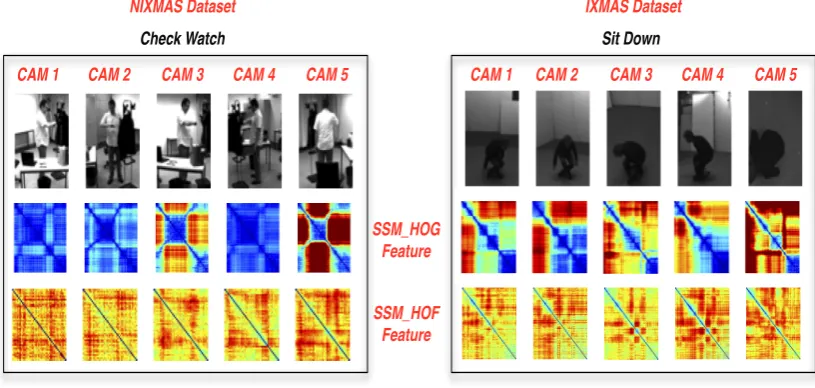
Figure 3.1: Exemplar SSMs computed from Histogram of Oriented Gradients and Histograms of Optical Flows features for the NIXMAS Weinland et al. [2010] and IXMASWeinlandet al.[2007] datasets. Note the large discrepancy between the HOG-based SSM corresponding to CAM 5 and others for both datasets.
Recently, multi-view action recognition methods have gained in popularity. Since
multi-view frameworks can achieve more robust action recognition than monocular
methods. However, as actions are typically recognized based on the actor’s motion
tra-jectories with respect to the camera viewpoint, viewpoint changes significantly impact
action understanding. Therefore, extracting view-invariant information is an
impor-tant step in multi-view settings but relatively few works have addressed the effect of
viewpoint changes on action recognition. Some recent approaches have achieved view-invariant recognition of actions by transferring features across viewsFarhadi & Tabrizi
[2008];Li & Zickler[2012];Liuet al. [2011] or using view-invariant featuresJunejo
et al.[2011];Liet al.[2012];Raoet al.[2002].
A possible methodology for achieving view-invariant action recognition is to
com-pute features which are stable across different viewpoints. Temporal self-similarity
matrices (SSMs) Junejoet al.[2011], computed from different low-level features such
as Histogram of Oriented Gradients (HOG) and Histograms of Optical Flows (HOF),
are shown to be robust descriptors for view-invariant action recognition. However, a
careful analysis of SSMs reveals that they are also sensitive to large viewpoint-related appearance changes. This effect can be observed in Fig.3.1, where SSMs correspond-ing to five views for action sequences from the IXMAS Weinland et al. [2007] and
NIXMASWeinland et al.[2010] datasets are shown. Although the SSMs associated
to all five views share some similarities, it is easy to note that the HoG-based SSM
corresponding to the last view (CAM5) is significantly different from the remaining
views (CAM1-CAM4) for both datasets.
To arrive at a signature action representation in the presence of large view-related
appearance changes, one approach is to find those camera views in which the
mo-tion patterns for that acmo-tion are highly correlated. Multi-task learning (MTL)
Ar-gyriou et al. [2007]; Evgeniou & Pontil [2004], which simultaneously learns
classi-fication/regression models for a set of related tasks, represents an attractive solution
to this end. By learning latent relationships between tasks, MTL typically enables the
synthesis of models superior to a learner that models each task independently.
In this chapter, we presentMulti-task LDA, a novel multi-task learning framework
to enhance the discriminative power of SSMs for multi-view action recognition, and
demonstrate how sharing of features across views (tasks) leads to improved
recogni-tion performance. Inspired by the equivalence relarecogni-tionship between multivariate linear
multi-class LDA as a single optimization problem by choosing an appropriate multi-class indicator
matrix, and develop an efficient algorithm to solve it. Also, by defining a graph
reflect-ing prior knowledge on the similarity among different views, the degree of relatedness
of the corresponding view features can be controlled using the proposed approach. We
describe two variants of graph-guided multi-task LDA and evaluate their performance
(1) Multi-task sparse graph-guided LDA, where the graph weights specifying view de-pendencies are defineda priori, and (2) Multi-task flexibile graph-guided LDA where
the graph weights are flexibly learnt from (or iteratively refined based on) training
features.
Our experiments demonstrate how our methods can be successfully employed for
view invariant action recognition,i.e. considering the case where images
correspond-ing to the test view are not available in the traincorrespond-ing data. The obtained results also
confirm that sharing features among views is indeed beneficial for multi-view action
recognition– our methods outperform competing SSM-based approaches that do not
consider task relationships by 10% on the IXMAS dataset. Overall, the proposed ap-proaches achieve efficient recognition of actions on both RGB (video) and RGBD
(depth image) data, and compare favorably with the state-of-the-art.
To summarize, the main contributions of this paper are:
• It represents one of the first works to explore a multi-task learning framework for multi-view action recognition. While other recent methods such as Mahasseni
& Todorovic[2013] also use MTL, a unique aspect of our framework is that, by
effectively combining SSMs descriptors and MTL, it allows for action
classifi-cation on missing views, for which no examples are available in the training data.
• The proposed approach is shown to be highly effective and achieves improved action recognition performance with respect to other classification methods based
on SSM descriptors. While competing works have typically evaluated their
algo-rithms on multi-view video data, we also demonstrate how our framework is
ap-plicable to multi-view depth images as in the ACT42Chenget al.[2012] dataset.
graph-guided learning algorithms can be generically applied to other computer
vision tasks as well.
The remainder of this chapter is organized as follows. Section 2 reviews related
work. Section 3 introduces the proposed multi-task linear discriminant analysis and
describes the application of our model to multi-view action recognition. Experiments
are described in Section 4, while Section 5 concludes this chapter.
3.2
Related Work
In this section, we review related work on multi-view action recognition, linear
dis-criminant analysis and multi-task learning.
3.2.1
Multi-view Action Recognition
Multi-view action recognition has received much attention recently, since a multi-view
setup can overcome the problem of self-occlusions and enable more robust action
recognition as compared to monocular methods. Both 3D and 2D-based approaches
have been proposed for multi-view action recognition as detailed below.
Knowing the 3D scene geometry enables the adaptation of action features from
one view to another through the use of geometric transformations. For example,
Wein-land et al.Weinland et al.[2007] use 3D occupancy grids synthesized from multiple viewpoints are used to model actions using an exemplar-based HMM. Yen et al.Yan
et al.[2008] employ a 4D action feature model for recognizing actions from arbitrary
views. This model encodes shape and motion of actors observed from multiple views,
and requires the reconstruction of 3D visual hulls of actors at each time instant. Both
approaches lead to computationally intensive algorithms as finding the best match
be-tween a 3D model and a 2D observation requires searching over a large model
parame-ter space. Weinlandet al.Weinlandet al.[2010] developed a hierarchical classification
method based on 3D Histogram of Oriented Gradients (HOG) to represent a test
se-quence. Robustness to occlusions and viewpoint changes are achieved by combining
training data from all viewpoints to train hierarchical classifiers.
A successful approach to tackle the problem of viewpoint-related appearance
features. Raoet al.Raoet al.[2002] present a view-invariant representation of human
actions by capturing changes in the speed and direction of action trajectories using
spatio-temporal trajectory curvature. Parameswaranet al.Parameswaran & Chellapp
[2005] propose to model actions in terms of view-invariant canonical body poses and
trajectories in 2D invariance space, which enables representation and recognition of
human actions from a generic view-point. Junejoet al.Junejoet al.[2011] introduced temporal SSMs descriptors as features robust to changes of point of view.
Farhadi and Tabrizi Farhadi & Tabrizi [2008] explicitly address correlations
be-tween actions observed from different views. They use a split-based representation to
describe clusters of codewords in each view. The transfer of these splits between views
is learned from multi-view action sequences. In Farhadiet al. [2009], Farhadi et al.
model view as a latent parameter, and learn features that can discriminate between both
views and actions. Liuet al. Liuet al. [2011] use a bipartite graph to model the
rela-tionship between two codebooks generated byk-means clustering of videos acquired
for each view. Then, a bipartite partition is used to co-cluster the two view-dependent codebooks into shared visual-word clusters and finally, a codebook composed of these
shared clusters is used to encode videos from both views. However, this approach only
exploits codebook-to-codebook correspondence at video-level, which cannot
guaran-tee that a pair of videos corresponding to the two views have similar feature
represen-tations based on the shared codebook. In addition, it uses a fusion method to combine
the prediction outputs of different transferred models, which in turn, requires the
clus-tering of test videos in the target view.
3.2.2
Linear Discriminant Analysis
Linear discriminant analysis (LDA) is widely used in statistics, pattern recognition
and machine learning to find a linear combination of features which characterizes or
separates two or more classes of objects or events. This makes LDA a very practical
tool for classification and dimensionality reduction. The optimal projection or
trans-formation in classical LDA is obtained by minimizing the within-class distance, and
maximizing the between-class distance simultaneously, thus achieving maximum class
discrimination.
as face recognition Belhumeour et al. [1997] or head pose estimation Huang et al.
[2012b]. Multi-task extensions of LDA have been proposed in Han et al. [2010]
andZhang & Yeung[2011]. However inHanet al.[2010], the proposed framework is
not flexible as no learning on the relationship between tasks is conducted. InZhang &
Yeung[2011] the problem of designing a multi-task LDA algorithm when the different
tasks correspond to heterogeneous feature spaces is addressed. However, we do not consider this scenario as it is not appropriate for our application.
3.2.3
Multi-task Learning
Many real-world applications involve related classification/regression tasks.
Multi-task learning methods aim to simultaneously learn models for a set of related Multi-tasks. By
learning tasks in parallel while using a shared representation, improved performance
are typically achieved.
Traditional MTL methods consider a single shared model, assuming that all the
tasks are related Argyriou et al. [2007]; Evgeniou & Pontil [2004]. However, when some of the tasks are unrelated, this may lead to negative transfer and the performance
can be even worse than single-task learning. Recently, more sophisticated approaches
have been proposed to counter this problem. These methods assume some a-priori
knowledge (e.g. in the form of a graph) defining task dependenciesChenet al.[2011]
or learning task relationships simultaneously with task-specific parametersGonget al.
[2012]. For example, Jalali et al.[2010] assume that the data follows a dirty model.
Zhouet al.[2011a] prove that the clustered MTL approach is equivalent to alternating
structure optimization that assumes the tasks sharing a low-dimensional structure. The
approach proposed in Zhong & Kwok. [2012] assumes that tasks are clustered, and that clustering structure can be inferred automatically during learning.
Multi-task learning has received considerable attention from the vision community,
and has been successfully applied to many problems such as image classificationLuo
et al.[2013], image annotationTsaiet al.[2011], visual trackingZhanget al.[2012]
and head pose classification under motion Yanet al.[2013b]. Recently, an MTL
ap-proach to monocular action recognition has been proposed inZhouet al.[2013], where
the authors exploit relatedness of action categories to learn latent tasks (motion
This paper is an extension of previous work presented inYanet al.[2013a], where
Multi-task LDA guided by a graph with fixed edge weights is proposed. To our
knowl-edge, multi-view action recognition using multi-task learning has not been considered
by other works with the exception ofMahasseni & Todorovic[2013], which is
contem-poraneous to ours. Our approach and theirs, while focusing both on MTL for
multi-view action recognition, are different in the following respects: (1) whileMahasseni &
Todorovic[2013] seeks to learn latent action groups, so that within-group feature
shar-ing is allowed but between-group feature sharshar-ing is prohibited, we explore learnshar-ing
of latent and discriminative SSM features across views; (2) A part-based action
rep-resentation is used in Mahasseni & Todorovic[2013], while we use the bag-of-words
model for encoding SSM features; (3) A large-margin framework is used for LMTL
formulation in Mahasseni & Todorovic [2013], while we propose LDA-based MTL,
and (4) While inMahasseni & Todorovic [2013] the main focus is multi-view action
recognition, we also consider the problem of action recognition with missing view,i.e.
on a novel camera view for which no examples are available in the training set. Fur-thermore, we show action classification results on the ACT42 multi-view depth image dataset, in addition to traditional action video datasets. A description of the proposed
Multi-task LDA framework is presented in the following section.
3.3
Multi-task LDA for Multi-view Action Recognition
In this section, we first present an overview of the proposed framework. Then,
Self-Similarity Matrix (SSM) descriptors are introduced followed by the analysis of the
equivalence between LDA and linear regression. Finally, our multi-task LDA algo-rithm and its application to the problem of view-independent action recognition are
described.
3.3.1
Overview
The proposed approach for view independent action recognition is illustrated in Fig.3.2. First, different types of low-level features are extracted from videos on a per-frame
ba-sis. The type of low-level features extracted depends on the considered sensors: we
CAM1 CAM2 CAM3 CAM4 CAM5 SSM
Mul$-‐Task LDA Learning Framework
Sh ari ng F ea tu re s a cro ss D iffe re nt Vie w po in ts
IXMAS NIXMAS Bag-of-words
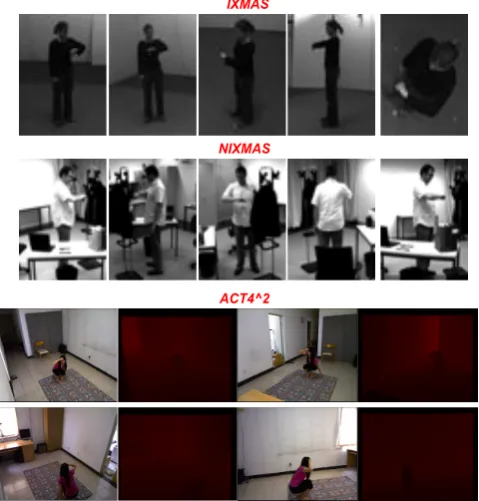
Figure 3.2: Overview of Multi-task LDA-based multi-view action recognition.
and their combination to describe RGB data, while Motion History Images (MHIs)
and their variations are adopted to encode information from depth images. Once the
SSM descriptors for these low-level features are computed, the standard bag-of-words
model is employed for encoding features into histograms. Finally, the proposed
multi-task LDA is adopted to induce feature-sharing among the different camera views. Our
approach is described in detail in the following subsection.
3.3.2
Self-Similarity Matrix Descriptors
Junejo et. al. Junejo et al. [2011] introduced SSM descriptors as features robust to
viewpoint changes. Given a sequence of imagesI={I1, I2, ..., IT}, a SSM is a square symmetric matrix:
SSM(I) =
0 e12 e13 · · · e1T
e21 0 e23 · · · e2T
e31 e32 0 · · · e3T
..
. ... ... . .. ...
eT1 eT2 eT3 · · · 0
(3.1)
extracted at frames Ii andIj respectively. Obviously, as the diagonal corresponds to
comparing a frame to itself, it contains all zeros. As low level features in this paper,
we use HOG and HOF descriptors on RGB frames, while MHIs are adopted in the
case of depth images. The chosen features are described in detail in the experimental
section. Once SSMs have been computed (separate SSMs are obtained for each type
of low level features), the strategy described inJunejoet al.[2011] is adopted for cal-culating local descriptors. For each point on the diagonal of a single SSM, three local
descriptors are computed corresponding to three different diameters in the log-polar
domain (28, 42 and 56 frames respectively in diameter). The bag-of-words model is
then employed to obtain the final histogram representation of a video clip. A codebook
size of 500 words is used in our experiments.
An example of SSMs computed on a sequence extracted from the IXMAS dataset
is shown in Fig. 3.1. Obviously, SSMs obtained with different low-level features are different, since each feature captures specific properties of an action. Moreover, SSMs
are rather stable over different people performing the same action under multiple view-points. However, as observed in the Introduction, SSMs are robust to view changes
only up to a certain extent. Therefore, in order to individuate common features from
different views, multi-task LDA learning is proposed.
3.3.3
Linear Discriminant Analysis
Linear Discriminant Analysis is a popular technique for dimensionality reduction and
classification. We consider a dataset ofN samples,T ={(xi, `i)}Ni=1, wherexi ∈ IRd and `i ∈ {1,2, ..., k} denote respectively the feature vector and the associated class label for the i-th sample, d is the data dimensionality, and k the number of classes. Let(·)0 denote the transpose operator. In discriminant analysisFukunaga[1990], three scatter matrices are defined as follows:
Sw =
1
N k X
j=1
X
{x∈T, x:`=j}
(x−cj)(x−cj)0 (3.2)
Sb =
1
N k X
j=1
St=
1
N N X
i=1
(xi−c)(xi−c)0 (3.4) whereNjandcjdenote the number