Foreign Language Effects on Judgment and Decision Making
A dissertation presented
by
Janet Geipel
to
The Department of Psychology and Cognitive Sciences
in partial fulfillment of the requirements for the degree of
Doctor of Philosophy in the subject of Cognitive Sciences
University of Trento, Trentino, Italy
ii Dissertation Advisors:
iii
Foreign Language Effects on Judgment and Decision Making
Abstract
iv
Contents
Acknowledgments ... v
Introduction ... 1
The foreign language effect on moral judgment: The role of emotions and norms ... 25
How foreign language shapes moral judgment ... 59
Testing three explanations for the foreign language effect on moral judgment ... 98
The effect of foreign language in judgments of risk and benefit: The role of affect ... 128
v
Acknowledgments
1
Chapter 1
Introduction
The use of a foreign language has become a commonplace activity for millions of people in our globalized society. People, for example, share their lives with
romantic partners who do not speak their native language, and work in international companies that implement common language policies. As a result, people frequently engage in verbal and written communications, such as discussions, reports, or emails, in a foreign language. This essay explores whether processing printed information in a foreign language, as opposed to a native language, influences judgment and decision-making in the domains of moral reasoning and risk perception. By foreign language, as I will use the term, I denote a language that is learned and used “outside the environment where the majority of the speakers use it as a native language” (Pavlenko, 2012, p. 407).
The fashion photographer Helmut Newton, born and raised in Berlin,
Germany, once had the opportunity to meet the former German chancellor for dinner. But Helmut Newton confused the dates and showed up a day later. In his handwritten apology letter he stated, “I am too upset to write in German. I can only think in English at this moment and I don’t expect to ever be forgiven.” Helmut Newton’s comment illustrates that the use of a foreign language may trigger psychological distance. This could be because the use of a foreign language attenuates emotion (for reviews see, Pavlenko, 2012; Caldwell-Harris, 2014, 2015). Helmut Newton
2
Paradowski, & Bilewicz, 2013). By thinking in a foreign language, Helmut Newton’s norm violation became more bearable. But why should emotion attenuation and/ or a suppression of sociocultural norms influence judgment and decision-making?
Theories of judgment and decision-making advocate dual-process models (e.g., Evans, 1989, 2007; Kahneman & Frederick, 2002; Stanovich,1999, 2004, 2009; Sloman, 1996). According to these models judgments and decisions are the result of two types of psychological processes: one which is intuitive, parallel, automatic, and unconscious and another which is controlled, serial, slow, and conscious. Importantly, intuition has been shown to impact judgment and decision-making through gut-feelings and norms (Kahneman, 2011). To the extent, therefore, that foreign language attenuates emotions and norms it might impact judgments and choices. In the present essay I provide empirical support for this hypothesis. I will show that the use of a foreign language influences moral judgment by reducing access to relevant sociocultural and moral norms. I will also show that it influences risk and benefit perception through affect.
In the remainder of Chapter 1, I will review research on bilingualism
3
Research on foreign language processing
More than 100 years ago, Freud noticed that the use of foreign language might trigger emotional distance. He discussed the case of a multilingual patient, Anna O., who lost her mother tongue for eighteen months and spoke only in her foreign languages (Freud, 1893). Later in the 1990s, applied psycholinguistics investigated the relationship between bilingualism and emotion by conducting one of the largest online surveys to date (Dewaele, 2008; Pavlenko, 2005). Based on 1579 respondents, these researchers found that emotional sentences, such as “I love you”, were
perceived as more emotional when printed in the native language rather than in a foreign language. Similar results were found for taboo and swear words. In the context of consumer research, Puntoni and colleagues (Puntoni, de Langhe, & van Osselaer, 2009) studied the emotional intensity of marketing slogans, such as “Parents who use drugs have kids who use drugs.” Participants perceived the slogans as more emotional when these were printed in their native language.
4
In a different study, Caldwell-Harris and Aycicegi-Dinn (2009) presented participants with false-statements either in the participants’ native language (Turkish) or a foreign language (English). Participants who received these statements in their native language showed greater skin-conductance responses for false-statements with moral content as compared to statements with neutral content. However, this content related emotional difference was not found in the foreign language condition (see Caldwell-Harris, 2015). Foreign language blunted the physiological reactivity to both moral and non-moral statements.
Although there is a wealth of studies demonstrating an emotional advantage of the native language, several have failed to find such a difference. One such study is Conrad and colleagues’ research (Conrad, Recio, & Jacobs, 2011) with native German and native Spanish speakers. While the participants performed a visual lexical
decision task either in the native or a foreign language, the researchers measured the participants’ event related potential (ERP) waves. They found that the ERP waves were similar in both language conditions. This suggests that emotional words are processed similarly in both the native and the foreign language.
In line with this finding, Opitz and Degner (2012) showed amplified ERP waves for emotional words when these were presented in either the native language (German or French) or a foreign language (French or German). However, while the ERP waves did not differ in amplitude, they differed in onset; their onset was delayed when the emotional words were presented in the foreign language. This suggests that emotional words are less automatically processed in the foreign than in the native language.
5
factors such as age of acquisition, proficiency, and context of use of the foreign language (e.g., Caldwell-Harris, 2015; Caldwell-Harris, Staroselsky, Smashnaya, & Vasilyeva, 2012; Dewaele, 2010; Puntoni et al., 2009). In other words, using and experiencing a foreign language in everyday life through social interactions can reduce the emotional differences between the native and a foreign language. For this reason, in the present experiments we interviewed participants who have learned the foreign language in a classroom context. We excluded ones who have learned it through immersion in a culture.
A further source for the inconsistent findings is that the use of a foreign language might have opposite influence on positive and negative emotion words (Caldwell-Harris, 2015; Pavlenko, 2012). Specifically, it might attenuate the negativity of negative words, but increase (or leave unaffected) the positivity of positive words. Support for this claim comes from neuroscience research. Wu and Thierry (2012) found that positive or neutral words in the foreign language automatically trigger their native language translations. However, this was not the case for negative words. These authors claimed that negative words trigger inhibitory mechanisms that block access to their native language equivalents. As Wu and Thierry eloquently put it, foreign language protects our hearts.
6
contrast, negative words might have fewer opportunities for emotional grounding because a foreign language is typically learned at a later point in life. Critically, a foreign language is experienced through adult interactions that have been shown to exhibit a positivity bias (see the Polyanna Principle by Matlin & Stang, 1978; see also Dodds et al., 2015).
Yet another explanation of these incompatible findings comes from research on the use of swear words in a foreign language. Gawinkowska et al. (2013) asked native Polish speakers to translate passages of texts either from their native language into their foreign language or vice versa. These authors found that translating foreign language swearwords into the native language resulted into weaker swearword translations, whereas translating native language swear words into the foreign language resulted in stronger translations than in the original version. Importantly, this effect was confined to politically incorrect, insulting words directed against social groups. It was not observed for other swearwords. The authors concluded that foreign language does not facilitate the use of swearwords because it attenuates their emotionality, but rather because it inhibits the activation of relevant social norms. In a foreign language people are less inhibited from using ‘taboo’ swearwords.
7
anxiety-provoking topics (Freud, 1893). Finally, it could also explain why Helmut Newton preferred to write his apology letter in English.
In sum, empirical evidence suggests that the use of a foreign language might attenuate emotions and in particular negative emotions. Research also shows that foreign language might attenuate moral and sociocultural norms. In the next two sections, I discuss theories of judgment and decision-making and explain how emotions and norms can influence these activities. In the section directly below I focus on moral judgment while in the following section on risk and benefit perception. Parts of these theories and supporting empirical evidence are covered in the papers presented in Chapters 2 to 5. My purpose here is to offer the reader with a more extensive overview.
Intuition and reasoning in moral judgment
How do people judge the ethicality of their own and others’ behaviours? This question has divided psychologists for a long time. Historically, there were two prevalent views. One assumed that moral judgment is the result of controlled, conscious processing (e.g., Piaget, 1965; Kohlberg, 1969) while another that it is the result of intuitive, unconscious processing (e.g., Freud, 1955). In the last decades, research suggests that moral judgment is the result of both intuitive and controlled processing, but intuition sometimes dominates.
8
actions (consensual and safe incest between siblings) as morally wrong. When the participants are asked to justify their moral evaluations, most are unable to provide justifications (e.g., Haidt, Koller, & Dias, 1993; Haidt, & Bjorklund, 2008), a condition known as moral dumbfounding (Haidt, Bjorklund, Murphy, 2000). This is interpreted as evidence that moral judgments are driven by intuition rather than by reason. If they were driven by reason then participants should be able to justify them.
In contrast to Haidt’s social intuitionist model, dual process models of moral reasoning (e.g., Cushman, 2013; Greene, Morelli et al., 2008; Greene, Sommerville et al., 2001) suggest that moral judgment is the result of intuitive and controlled
processing. Intuitive processing supports deontological type judgments, whereas controlled processing supports consequentialist type judgments. Deontological type judgments are defined as “judgments that focus on the rights and duties of others and are difficult to justify in consequentialist terms, such as killing one life in order to save a greater number of lives” (see Greene, 2014, p.7). Consequentialist type
judgments are defined as “engaging in cost-benefit reasoning and are more difficult to justify in deontological terms” (see Greene, 2014, p. 8). A typical consequentialist type judgment in the vein of Greene’s dual process model would be killing one person in order to save five others.
9
bridge and into the path of the runaway trolley. This would kill the person but save the five workers. Participants are asked whether it would be okay for them to push the person. In the trolley problem most people accept the proposed action—hitting a switch—thus making a consequentialist type judgment. In the footbridge problem most people refuse the proposed action—pushing a person—thus making a deontological type judgment. Why do people respond differently?
In an attempt to explain the underlying mechanisms of people’s choices in these dilemmas, Greene and colleagues conducted a study using functional
measurement resonance imaging (fMRI; Greene et al., 2001). Participants responded to a series of moral dilemmas, of the same type as the footbridge and the trolley problems, while the authors measured the participants’ neuronal activity. The results showed that footbridge type dilemmas increase neuronal activity in areas that are typically associated with social and emotional processing. In contrast, trolley type dilemmas increase neuronal activity in areas that are typically associated with working memory. These findings support the idea that deontological type judgments are most likely driven by intuitive processing, whereas consequentialist type judgment by controlled processing (but see McGuire, Langdon, Coltheart, & Mackenzie, 2009). This idea was further supported in a series of studies examining patients with brain lesions in emotional centres of the brain (e.g., Ciaramelli & di Pellegrino, 2011; Ciaramelli, Muccioli, Làdavas, & di Pellegrino, 2007; Moretto, Làdavas, Mattioli, & di Pellegrino, 2010; Thomas, Croft, & Tranel, 2011; Koenigs et al., 2007). These patients, in comparison to controls, demonstrated increased consequentialist type choices in response to footbridge type dilemmas.
10
contested the idea that consequentialist judgments are necessarily the products of controlled processing. For example, Duke and Bègue (2015) demonstrated that alcohol intoxication is positively associated with consequentialist type judgments. This is surprising because alcohol intoxication is known to increase emotional reactivity (Euser & Franken, 2012; Giancola, Josephs, Parrott, & Duke, 2010; Ray, Mun, Buckman, Udo, & Bates, 2012; Sayette et al., 2012) and to deplete cognitive resources (Giancola, 2000), and therefore the ability to reason. The dual process model of moral judgment would thus predict that alcohol intoxication should promote deontological responses—the opposite of what these authors found! Duke and Bègue (2015) proposed that impaired social cognition (e.g. reduced empathy) might provide an alternative route to consequentialist type judgment.
This claim is in line with research conducted by Patil and Silani (2014) on the relationship between reduced empathic traits and moral judgment. Patil and Silani (2014) found a positive relation between alexithymia, a trait associated with reduced empathic concern, and consequentialist judgments in footbridge type dilemmas. In a similar vein, Kahane and colleagues (e.g., Kahane, Everett, Earp, Farias, & Savulescu, 2015) found that sub-clinical psychopathy was associated with increased
11
Combining the bilingual research that I described and moral judgment research, my co-authors and I predicted that processing moral scenarios in a foreign language as compared to the native language would influence moral judgment. Specifically, we expected that the use of a foreign language might impair intuitive processing by reducing the activation of social and moral norms. We also expected that the use of a foreign language would deplete cognitive resources, because
processing information in a foreign language is more difficult and less automatic than processing one’s native language (see Volk, Köhler, & Pudelnko, 2014). Specifically, in line with Duke and Bègue’s (2015) findings with alcohol-intoxicated participants, we expected that the use of foreign language would increase consequentialist type judgments in the footbridge dilemma. We also expected that it would promote leniency towards harmless and harmful violations of moral rules.
In Chapter 2, we investigated whether the use of a foreign language, as compared to the native language, would influence the moral evaluation of the trolley and footbridge dilemmas. In Chapter 3, we examined whether the use of a foreign language influences moral judgments about moral transgressions that are harmless but offensive (e.g., eating one’s dead dog). In Chapter 4, we examined the effect of foreign language once again on offensive but harmless actions but here also on morally good actions. To get a glimpse of the underpinning processes, we also asked participants to justify their moral evaluations, and checked whether the justifications were of the deontological or the consequentialist type.
Intuition and reasoning in risk judgment
How risky are nuclear power plants? To answer this question, many of us use our immediate intuitive reaction. Nuclear power plants often trigger negative
12
and so we judge them as risky. This is called risk as feelings. Other people may weigh the pros and cons of nuclear power plants and think about it in a more analytic way. This is called risk as analysis. The distinction between risk as feelings and risk as analysis, in essence, describes a dual process model of risk and benefit perception (see, e.g., Slovic, Finucane, Peters, & MacGregor, 2004). Risk as feelings is underpinned by intuitive processing and specifically emotions, whereas risk as analysis is underpinned by controlled processing.
Robert Zajonc (e.g., Zajonc, 1980) was among the first to recognize the importance of affect in judgment and decision-making. He noted that almost all perceptions involve feelings. For example, he noted that: “We do not just see “a house”: We see a handsome home, an ugly house, or a pretentious house.” These feelings in turn guide our judgments and decisions. Zajonc (e.g., Zajonc, 1980) demonstrated that repeated exposure to an object generates positive attitudes towards that object, which is known as “the mere exposure effect.” For example, he presented participants with Chinese ideographs and varied the frequency of exposure. At a later point of the experiment, participants’ attitudes towards these Chinese ideographs were measured. The more frequently an ideograph was presented, the more positive the attitudes towards it. This effect was found to be reliable across several types of stimuli such as audio or visual (see Bornstein, 1989).
13
images have come to be associated with good or bad feelings through lifelong learning, which in turn can predict outcomes of future situations (Damasio, 1994). This is called the somatic marker hypothesis. Damasio argued that somatic markers determine the decision-making process. Crucially, if the somatic markers are absent, such as in the case of the brain lesion patients that Damasio studied, the decision-making process is impaired. Damasio’s work had a huge impact in the scientific community as it dispelled the long held view that emotions hinder reasoning.
Paul Slovic and colleagues (e.g., Slovic, MacGregor, Malmfors, & Purchase, 1999; Slovic, Finucane, Peters, & MacGregor, 2002, 2004) extended Damasio’s somatic marker hypothesis and developed the affect heuristic. They argued that judgments and decisions are guided predominantly by mental representations that are associated with positive or negative affect. When making a judgment or decision, people consult the “affective pool” of a stimulus. In other words, they use the affective pool, or affective valence, as a proxy for making a judgment or decision. This is especially true in the case of complex decisions. Note that this is similar to the assumptions made by the Social Intuition Model (Haidt, 2001), which proposes that people use their immediate “gut feeling” to make a moral judgment.
14
hazard is judged as high in risk and low in benefit. If it is positive then it signals safety, so the hazard is judged as low in risk and high in benefit. Such judgments are likely to be biased because in the real world the risk and benefit of hazards are typically associated (if at all) positively.
The affect heuristic was further supported in a study by Alhakami and Slovic (1994; see also Finucane, Alhakami, Slovic, & Johnson, 2000) who found that the affective evaluation of hazards, such as pesticides, was the major predictor of the risk and benefit correlation. These studies suggest that individuals base their risk and benefit judgments not only on analytic thinking, but also on their feelings on how they feel about the hazard. Finucane and colleagues call this “the dance of affect and reasoning” (Finucane, Peters, & Slovic, 2003), which in essence is a dual process proposal of risk and benefit judgment.
Combining this research with evidence from bilingual studies, in Chapter 5 my colleagues and I investigated whether presenting hazards in a foreign language versus the native language influences risk and benefit perception. Recall that bilingual studies suggest that a foreign language is less emotional than the native language, and that the emotional gap is particularly pronounced for negative emotions (e.g., Wu & Thierry, 2012; Sheikh & Titone, 2015). This suggests that the affective pool of a stimulus would be more positive in a foreign than in the native language. Based on the affect heuristic, we predicted that presenting hazards in a foreign language, as
16 References
Alhakami, A., & Slovic, P. (1994). A psychological study of the inverse relationship between perceived risk and perceived benefit. Risk Analysis, 14, 1085-1096. doi:10.1111/j.1539-6924.1994.tb00080.x
Bornstein, R. F. (1989). Exposure and affect: Overview and meta-analysis of research, 1968- 1987. Psychological Bulletin, 106, 265–289. doi:
10.1037/0033-2909.106.2.265
Bond, M., & Lai, T. (1986). Embarrassment and code-switching into a second language. Journal of Social Psychology, 126, 179–86.
Caldwell-Harris, C. L. (2015). Emotionality differences between a native and foreign language: Implications for everyday life. Current Directions In Psychological Science, 24, 214–219. doi:10.1177/0963721414566268
Caldwell-Harris, C. L. (2014). Emotionality differences between a native and foreign language: Theoretical implications. Frontiers in Psychology. 5. doi:
10.3389/fpsyg.2014.01055
Caldwell-Harris, C., & Aycicegi-Dinn, A. (2009). Emotion and lying in a non-native language. International Journal of Psychophysiology, 71, 193–204. doi: 10.1016/j.ijpsycho.2008.09.006
Caldwell-Harris, C.L., Staroselsky, M., Smashnaya, S., & Vasilyeva, N. (2012). Emotional resonances of bilinguals’ two languages vary with age of arrival: The Russian–English bilingual experience in the US. In P. Wilson (Ed.), Perspectives on emotion (Lodz Studies in Language 20), Frankfurt am Main, Germany: Peter Lang.
17 doi:10.1177/1754073911402381
Ciaramelli, E., Muccioli, M., Làdavas, E., & di Pellegrino, G. (2007). Selective deficit in personal moral judgment following damage to ventromedial prefrontal cortex. Social Cognitive and Affective Neuroscience, 2, 84–92.
doi:10.1093/scan/nsm001
Conrad, M., Recio, G., & Jacobs, A. (2011). The time course of emotion effects in first and second language processing: A cross-cultural ERP study with German–Spanish bilinguals. Frontiers in Psychology: Language Sciences, 2, article 351, 1–16.
Cushman, F. (2013). Action, outcome, and value: A dual-system framework for morality. Personality And Social Psychology Review, 17, 273–292. doi: 10.1177/1088868313495594
Damasio, A. R. (1994). Descartes’ error: Emotion, reason, and the human brain. New York: Avon.
Damasio, H., Grabowski, T., Frank, R., Galaburda, A.M., & Damasio, A.R. (2005).
The Return of Phineas Gage: Clues about the Brain from the Skull of a Famous Patient. In J. T. Cacioppo, G. G. Berntson, J. T. Cacioppo, G. G.
Berntson (Eds.), Social neuroscience: Key readings (pp. 21-28). New York, NY, US: Psychology Press.
Dewaele, J.-M. (2010). 'Christ fucking shit merde!' Language preferences for
swearing among maximally proficient multilinguals. Sociolinguistic Studies, 4, 595–614. doi:10.1558/sols.v4i3.595
Dewaele, J.-M. (2008). The emotional weight of I love you in multilinguals’ languages. Journal of Pragmatics, 40, 1753–1780. doi:
18
Duke, A.A., & Bègue, L. (2015). The drunk utilitarian: Blood alcohol concentration predicts utilitarian responses in moral dilemmas. Cognition, 134, 121–127. doi:10.1016/j.cognition.2014.09.006
Dodds, P.S., Clark, E.M., Desu, S., Frank, M.R., Reagan, A.J., Williams, J.R., & ... Danforth, C. M. (2015). Human language reveals a universal positivity bias. PNAS Proceedings of The National Academy of Sciences of The United States of America, 112, 2389–2394. doi:10.1073/pnas.1411678112
Euser, A.S., & Franken, I.H. (2012). Alcohol affects the emotional modulation of cognitive control: An event-related brain potential study.
Psychopharmacology, 222(3), 459–476.
Evans, J. T. (2007). Hypothetical thinking: Dual processes in reasoning and judgement. New York, NY, US: Psychology Press.
Evans, J. T. (1989). Bias in human reasoning: Causes and consequences. Hillsdale, NJ, England: Lawrence Erlbaum Associates, Inc.
Finucane, M.L., Alhakami, A., Slovic, P., & Johnson, S.M. (2000). The affect heuristic in judgments of risks and benefits. Journal of Behavioral Decision Making, 13(1), 1–17.
doi:10.1002/(SICI)1099-0771(200001/03)13:1<1::AID-BDM333>3.0.CO;2-S
Finucane, M.L., Peters, E., & Slovic, P. (2003). Judgment and decision making: The dance of affect and reason. In S. L. Schneider, J. Shanteau, S.L. Schneider, J. Shanteau (Eds.), Emerging perspectives on judgment and decision research (pp. 327-364). New York, NY, US: Cambridge University Press.
19
Freud, S. (1955). The interpretation of dreams. Oxford, England: Basic Books. Freud, S. (1893). The psychical mechanisms of hysterical phenomena. London, UK:
Hogarth Press.
Gawinkowska, M., Paradowski, M.B., & Bilewic, M. (2013). Second language as an exemptor from sociocultural norms. Emotion–related language choice revisited. PLoS ONE, 8, e81225. doi:10.1371/journal.pone.0081225 Geipel, J., Hadjichristidis, C., & Surian, L. (2015). The foreign language effect on
moral judgment: The role of emotions and norms. Plos ONE, 10, e0131529. Geipel, J., Hadjichristidis, C., & Surian, L. (2015). How foreign language shapes
moral judgment. Journal of Experimental Social Psychology, 59, 8–17. doi:10.1016/j.jesp.2015.02.001
Geipel, J., Hadjichristidis, C., & Surian, L. (2015). Testing three explanations for the foreign language effect on moral judgment. Manuscript under review.
Giancola, P.R. (2000). Executive functioning: A conceptual framework for alcohol-related aggression. Experimental and Clinical Psychopharmacology, 8, 576– 597. doi: 10.1037/1064-1297.8.4.576
Giancola, P.R., Josephs, R.A., Parrott, D.J., & Duke, A.A. (2010). Alcohol myopia revisited clarifying aggression and other acts of disinhibition through a distorted lens. Perspectives on Psychological Science, 5, 265–278. doi: Greene, J.D. (2014). Beyond point-and-shoot morality: Why cognitive (neuro)science
matters for ethics. Ethics, 124, 695–726. doi: 10.1086/675875
20
Greene, J.D., Sommerville, R.B., Nystrom, L.E., Darley, J.M., Cohen, J.D. (2001). An fMRI investigation of emotional engagement in moral judgment. Science, 293, 2105–2108. doi:10.1126/science.1062872
Hadjichristidis, C., Geipel, J., & Savadori, L. (2015). The effect of foreign language in judgments of risk and benefit: The role of affect. Journal of Experimental Psychology: Applied, 21, 117–129. doi:10.1037/xap0000044
Harris, C., Aycicegi, A., & Gleason, J. (2003). Taboo words and reprimands elicit greater autonomic reactivity in a first language than in a second language. Applied Psycholinguistics, 24, 561–571. doi: 10.1017/S0142716403000286 Haidt, J. (2001). The emotional dog and its rational tail: a social intuitionist approach
to moral judgment. Psychological Revision, 108, 814–834. doi: 10.1037/0033-295X.108.4.814
Haidt, J., & Bjorklund, F. (2008). Social intuitionists answer six questions about moral psychology. In W. Sinnott-Armstrong, W. Sinnott-Armstrong (Eds.), Moral psychology, Vol 2: The cognitive science of morality: Intuition and diversity (pp. 181-217). Cambridge, MA, US: MIT Press.
Haidt, J., Bjorklund, F., & Murphy, S. (2000). Moral dumbfounding: When intuition finds no reason. Unpublished manuscript, University of Virginia.
Haidt, J., Koller, S. H., & Dias, M. G. (1993). Affect, culture, and morality, or is it wrong to eat your dog?. Journal of Personality and Social Psychology, 65, 613–628. doi:10.1037/0022-3514.65.4.613
Harris, C.L., Ayçiçeĝi, A., & Gleason, J. (2003). Taboo words and reprimands elicit
21
Kahane, G., Everett, J. C., Earp, B. D., Farias, M., & Savulescu, J. (2015).
‘Utilitarian’ judgments in sacrificial moral dilemmas do not reflect impartial concern for the greater good. Cognition, 134, 193–209. doi:
10.1016/j.cognition.2014.10.005
Kahneman, D. (2011). Thinking, fast and slow. New York, NY, US: Farrar, Straus and Giroux.
Kahneman, D., & Frederick, S. (2002). Representativeness revisited: Attribute
substitution in intuitive judgment. In T. Gilovich, D. Griffin, D. Kahneman, T. Gilovich, D. Griffin, D. Kahneman (Eds.), Heuristics and biases: The
psychology of intuitive judgment (pp. 49-81). New York, NY, US: Cambridge University Press.
Koenigs, M., Young, L., Adolphs, R., Tranel, D., Cushman, F., Hauser, M., & Damasio, A. (2007). Damage to the prefrontal cortex increases utilitarian moral judgements. Nature, 446, 908–911. doi: 10.1038/nature06785
Kohlberg, L. (1969). Stage and sequence: the cognitive-developmental approach to socialization. In Handbook of Socialization Theory and Research (Goslin, D.A., ed.), pp. 347–480, Rand McNally
Matlin, M.W., & Stang, D.J. (1978). The polyanna principle: Selectivity in language, memory, and thought. Cambridge, MA: Schenkman.
McGuire, J., Langdon, R., Coltheart, M., & Mackenzie, C. (2009). A reanalysis of the personal/impersonal distinction in moral psychology research. Journal of Experimental Social Psychology, 45, 577–580. doi:
10.1016/j.jesp.2009.01.002
22
Journal of Cognitive Neuroscience, 22, 1888–1899. doi: 10.1162/jocn.2009.21367
Opitz, B., & Degner, J. (2012). Emotionality in a second language: It is a matter of time. Neuropsychologia, 50, 1961–1967. doi:
10.1016/j.neuropsychologia.2012.04.021
Patil, I., & Silani, G. (2014). Alexithymia increases moral acceptability of accidental harms. Journal of Cognitive Psychology, 26, 597–614. doi:
10.1080/20445911.2014.929137
Patil, I. (2015). Trait psychopathy and utilitarian moral judgement: The mediating role of action aversion. Journal of Cognitive Psychology, 27, 349–366. doi:
10.1080/20445911.2015.1004334
Pavlenko, A. (2012). Affective processing in bilingual speakers: Disembodied cognition? International Journal of Psychology, 47, 405–428.
doi:10.1080/00207594.2012.743665
Pavlenko, A. (2005). Emotions and multilingualism. Cambridge, UK: Cambridge University Press.
Puntoni, S., de Langhe, B., & van Osselaer, S. J. (2009). Bilingualism and the
Emotional Intensity of Advertising Language. Journal Of Consumer Research, 35(6), 1012-1025. doi: 10.1086/595022
Piaget, J. (1965). The Moral Judgement of the Child, Free Press.
Ray, S., Mun, E.Y., Buckman, J.F., Udo, T., & Bates, M.E. (2012). Memory for emotional picture cues during acute alcohol intoxication. Journal of Studies on Alcohol and Drugs, 73, 718–725.
23
multimodal investigation of the effects of alcohol on emotion and social bonding. Psychological Science, 23, 869–878. doi:
10.1177/0956797611435134
Sheikh, N.A., & Titone, D. (2015). The embodiment of emotional words in a second language: An eye-movement study. Cognition and Emotion. Advance online publication. doi: 10.1080/02699931.2015.1018144
Sloman, S. A. (1996). The empirical case for two systems of reasoning. Psychological Bulletin, 119, 3–22. doi: 10.1037/0033-2909.119.1.3
Slovic, P., Finucane, M., Peters, E., & MacGregor, D.G. (2002). The affect heuristic. In T. Gilovich, D. Griffin, D. Kahneman (Eds.), Heuristics and biases: The psychology of intuitive judgment (pp. 397-420). New York, NY, US: Cambridge University Press.
Slovic, P., Finucane, M.L., Peters, E., & MacGregor, D.G. (2004). Risk as analysis and risk as feelings: Some thoughts about affect, reason, risk, and rationality. Risk Analysis, 24, 1–12. doi:10.1111/j.0272-4332.2004.00433.x
Slovic, P., MacGregor, D.G., Malmfors, T., & Purchase, I.F.H. (1999). Influence of affective processes on toxicologists' judgments of risk (Report No. 99-2). Eugene, OR: Decision Research.
Stanovich, K. E. (2009). Distinguishing the reflective, algorithmic, and autonomous minds: Is it time for a tri-process theory?. In J. T. Evans, K. Frankish, J. T. Evans, K. Frankish (Eds.), In two minds: Dual processes and beyond (pp. 55-88). New York, NY, US: Oxford University Press.
24
Stanovich, K. E. (1999). Who is Rational? Studies of Individual Differences in Reasoning. Mahwah, NJ: Elrbaum.
Thomas, B. C., Croft, K. E., & Tranel, D. (2011). Harming kin to save strangers: Further evidence for abnormally utilitarian moral judgments after
ventromedial prefrontal damage. Journal of Cognitive Neuroscience, 23, 2186–2196. doi: 10.1162/jocn.2010.21591
Volk, S., Köhler, T., & Pudelko, M. (2014). Brain drain: The cognitive neuroscience of foreign language processing in multinational corporations. Journal of International Business Studies, 45, 862–885. doi: 10.1057/jibs.2014.262014-09 457862 885
Wu, Y., & Thierry, G. (2012). How reading in a second language protects your heart. The Journal of Neuroscience, 32, 6485-6489. doi:10.1523/JNEUROSCI.6119-11.2012
25
Chapter 2
The foreign language effect on moral judgment: The role of
emotions and norms
This chapter is based on the following original article:
26 Abstract
We investigated whether and why the use of a foreign language influences moral judgment. We studied the trolley and footbridge dilemmas, which propose an action that involves killing one individual to save five. In line with prior work, the use of a foreign language increased the endorsement of such consequentialist actions for the footbridge dilemma, but not for the trolley dilemma. But contrary to recent theorizing, this effect was not driven by an attenuation of emotions. An attenuation of emotions was found in both dilemmas, and it did not mediate the foreign language effect on moral judgment. An examination of additional scenarios revealed that foreign language influenced moral judgment when the proposed action involved a social or moral norm violation. We propose that foreign language influences moral judgment by reducing access to normative knowledge.
27
The foreign language effect on moral judgment: The role of emotions and norms
The capacity to deliver moral judgments is a core aspect of social competence in humans. Philosophical and psychological investigations of moral cognition have often focused on complex dilemmas that create a tension between a deontological mode of responding, which stresses adherence to moral rules (e.g., “do not kill or harm innocent people”), and a consequentialist mode, which aims at maximizing the anticipated outcome (e.g., “do the greatest good for the greater number of individuals”). Research has shown that some moral scenarios tend to promote consequentialist judgments, while other scenarios, typically those that involve personal force and the instrumental use of a person [1, 2], tend to promote deontological judgments. For example, in the well-known trolley problems [3, 4], most people judge that it is acceptable to save five persons by hitting a switch that would produce one collateral victim (standard trolley problem), but deem it unacceptable to save five persons by pushing a person off a bridge (footbridge problem) [5, 6]. Why do people accept to save the lives of five by hitting a switch but not by pushing a person?1
Two main kinds of explanations have been proposed. One emphasizes the causal structure of actions and their contexts and posits the effect of tacit knowledge of abstract moral principles [8–10]. The other perspective emphasizes the selective activation of
28
Consistent with this view, priming the emotional system has been shown to privilege deontological responses, whereas priming the analytic system has been shown to
preferentially support consequentialist choices [13,14]. Furthermore, cognitive load has been shown to selectively interfere with consequentialist responses, suggesting that such answers are products of controlled cognitive processes [15]. Additional evidence for this dual-process model of morality comes from neuropsychological studies, which show that brain-damaged patients with emotional deficits are more likely to give consequentialist responses to highly emotional dilemmas than controls [16, 17, 18].
Dual-process models of moral judgment may also guide research on language effects. In a recent study, Costa and colleagues reported that foreign language promotes
consequentialist responses [19, 20]. These authors presented participants with the standard trolley and footbridge dilemmas either in a participants’ native language or in a foreign language. They recruited participants from several cultures and examined an impressive number of native—foreign language combinations. Foreign language systematically increased the rate of consequentialist responses for the footbridge dilemma but had no
influence on the responses to the standard trolley dilemma. Following dual-process models of morality, these authors argued that foreign language influences moral choice by triggering cognitive and emotional distance, that is, by prompting cold, “head” thinking. Its effects are felt in the footbridge dilemma as this presumably triggers the “hot”, emotional system, but not in the trolley dilemma, which is presumably underpinned by the “cool”, controlled system. The authors supported their claim that foreign language attenuates emotions by referring to experimental evidence from bilingual studies [21, 22].
29
environment where it is commonly used by native language speakers [23]. Our aim is twofold. First, we attempted to consolidate the findings of previous studies [19], which reported an increase of consequentialist responses in the footbridge dilemma, but not in the trolley dilemma. To this end, we presented these two dilemmas to native Italian speakers who learned either German or English as a foreign language (Study 1), and to native Chinese speakers who learned English as a foreign language (Study 2). Second, we aimed to
investigate the claim that the foreign language effect on moral judgment is driven by reduced emotionality. For this purpose, alongside moral judgments we also gathered emotion ratings (Study 2). As a further test, we examined moral evaluations of additional high-emotion and low-emotion dilemmas (Study 3). If the effect is driven by reduced emotionality, then it should be more pronounced in the high-emotion dilemmas.
Study 1
In Study 1, we tested the foreign language effect on moral judgment using the footbridge and trolley dilemmas. We recruited students enrolled at foreign language courses at the University of Trento, because we wanted to ensure a good understanding of the materials. One group received the dilemmas in their native language, Italian, whereas two other groups in a foreign language, either English or German. We tested two foreign languages to assess the generality of the foreign language effect.
Methods
The study protocol was approved by the Ethics Committee of the University of Trento according to the principles expressed in the Declaration of Helsinki. We obtained
participants’ informed verbal consent by using a verbal consent protocol. The Ethics Committee of the University of Trento waived the requirement of written consent forms.
30
German or English at the University of Trento.2 Thirty nine participants were randomly assigned to the native language condition (NL; Italian), 37 to the foreign language English condition (FLEnglish), and 29 to the foreign language German condition (FLGerman). All participants had an intermediate level certificate (B = independent user) in the respective foreign language as specified by the Common European Framework of Reference for Languages: Learning, Teaching, Assessment (CEFR; [25]). On average, participants in the FLEnglish condition had English education since the age of 10.72, CI [8.62, 13.31], and those in the FLGerman condition had German education since the age of 13.36, CI [11.74, 14.96]. Participants in the foreign language conditions were asked to self-assess their foreign
language proficiency in terms of conversational fluency, reading, writing, and understanding on a 5-point scale (1 = almost none, 2 = poor, 3 = fair, 4 = good, 5 = very good; scale adapted from [26]). Across the four measures, the participants rated their foreign language skills as fair (FLEnglish: M = 3.33, CI [3.17, 3.50], FLGerman: M = 3.79, CI [3.64, 3.95]).
Materials and Procedure. We presented participants with the trolley and the footbridge dilemmas, together with a non-moral filler dilemma (all items were adapted from [2]; see Appendix A for the full text). Each moral dilemma stated an action (i.e., hitting a switch, pushing a person off a bridge) that would harm an individual but as a consequence save five persons. Participants had to judge the appropriateness of the proposed action by selecting Yes (consequentialist response) or No (deontological response). The filler item concerned a choice between travelling by bus or train given certain time constraints, and was designed to induce a high rate of endorsements. We expected no language effect for this item. Its purpose was to assess whether participants in the foreign language condition understood the materials–misunderstandings should drive the endorsement rate towards 50%.
31
German. In all our studies, the original materials were in English, and were translated to other languages by bilinguals. Two independent judges controlled the translated versions for consistency with the English version. The language versions were also closely matched for word count.
Results
Preliminary analyses revealed no effect of presentation order. Hence, we dropped this factor from subsequent analyses. The main findings are illustrated in Figure 1. As anticipated, the use of a foreign language increased the rate of consequentialist responses in the
footbridge dilemma but not in the trolley dilemma. While 12.8% of participants stated that it was appropriate to push the man off the footbridge when the dilemma was presented in the native language, this rate increased to 35.7% when it was presented in German, χ2 (1, N = 67)
= 4.92, p = .027, φ = .27, to 43.2% when the dilemma was presented in English, χ2 (1, N =
76) = 8.79, p = .003, φ = .34, and to 40% if we collapse over foreign language condition, χ2
(1, N = 104) = 8.61, p = .003, φ = .29. In the trolley dilemma, 53.8% of participants chose to
hit the switch when the dilemma was presented in the native language. Similar rates were observed when the language was German (60.7%), χ2 (1, N = 67) = 0.31, p = .576, φ = .07,
and English (72%), χ2 (1, N = 76) = 2.99, p = .084, φ = .20, or the two pooled together
(67.7%), χ2 (1, N = 104) = 1.99, p = .158, φ = .14.
In accord with previous research, within each language condition a higher proportion of participants endorsed the action of the trolley dilemma than of the footbridge dilemma (ps < .005, by binomial tests). Importantly, we observed no language differences for the non-moral filler item: FLEnglish: 92.0% vs. NL: 87.2%, χ2 (1, N = 76) = .45, p = .50; FLGerman:
93.1% vs. NL: 87.2%, χ2 (1, N = 68) = 0.63, p = .43, φ = 0.10; FLTotal: 92.4% vs. NL: 87.2%,
χ2 (1, N = 105) = 0.78, p = .38, φ = 0.09. This suggests that the participants understood the
32
Figure 1. Percentage of participants who endorsed the consequentialist action in Study 1, by dilemma type and language condition. The native language was Italian. The foreign language was either German (a) or English (b). *p < .05, **p < .01.
Correlations between proficiency and moral judgment. We created a proficiency score by aggregating a participant’s self-ratings in reading and understanding (each scale ranged from 1 = almost none, to 5 = very good). We only considered these scales because they are the most pertinent for the current task. The highest possible score is 10, which we also assigned to the participants in the native language condition. In the footbridge dilemma, we found that the lower the language proficiency, the higher the rate of action endorsements: r(102) = –.22, p = .023. No correlation between proficiency and action endorsements were observed in the trolley dilemma, r(102) = –.09, p = .369, or the non-moral dilemma, r(102) = –.07, p = .505.
Discussion
33
Importantly, the use of a foreign language had no influence on the evaluation of a non-moral dilemma, which suggests that the effect is “real” and not due to misunderstanding.
Study 2
In Study 2, we aimed to generalize the foreign language effect to a sample of native Chinese speakers who learned English as a foreign language. Although China accounts for roughly one fifth of the world’s population, relatively few studies have examined how Chinese respond to moral dilemmas. Some cross cultural studies found cultural differences [27], whereas others did not [28]. Relevant to the present study, previous research has shown that the reduction of emotional force in a second language is also observed in late Chinese– English bilinguals [29].
Methods
Participants. We were granted access to courses in Tsinghua University, Wuhan University, and the Shanghai University of Sport, and tested 161 students (72 female, 88 male,1 unknown, Mage = 23.41 years, age range: 18–40).3 Ninety-nine participants were randomly assigned to the foreign language condition (English), and 62 to the native language condition (Chinese). All participants reported to have a Band–4 College English Test
certification (CET-4), which is the standard English as a foreign language test administered in China. In addition, participants had to self-assess their language proficiency in English in terms of conversational fluency, reading, writing, and understanding on a 5-point scale (1 = almost none, 2 = poor, 3 = fair, 4 = good, 5 = very good). Averaging across the four measures
34
understanding as 3 or less (their exclusion does not influence the main pattern of results). The data we report are from the remaining 152 participants.
Materials and procedure. For the moral judgment task, we used similar materials and procedure as in Study 1. Participants were presented with the footbridge and trolley dilemmas, separated by a non-moral filler item. The presentation order of the moral dilemmas was counterbalanced. Following each dilemma, participants evaluated the moral
permissibility of the proposed action on a binary scale (Yes/No), but here also on a more sensitive 7-point scale (1 = forbidden, 4 = permissible, 7 = obligatory; [5]). After the moral judgment questions, participants were asked to rate the extent to which each dilemma made them feel distressed (Thinking about the scenario I just read, I felt… upset, worried, and sad). For each emotion, participants had to respond using a 7-point scale (1 = not at all, 4 =
somewhat, 7 = very much; adapted from [30]).
Results
Preliminary analyses revealed no effect of presentation order. Therefore, we dropped this factor from subsequent analyses.
Moral judgment (Yes/No). The main findings are illustrated in Figure 2. There was a significant foreign language effect for the footbridge dilemma (FL: 22.2% vs. NL: 9.7%), χ2
(1, N = 152) = 4.07, p = .044, φ = .16, but not for the trolley dilemma (FL: 56.7% vs. NL:
56.5%), χ2 (1, N = 152) < 1, p = .979, φ < .01. In line with Study 1 and previous research,
within each language condition, a higher proportion of participants endorsed the action of the trolley versus the footbridge dilemma (ps < .001, by binomial tests). No language effect was present for the non-moral item (FL: 94.4% vs. NL: 93.5%), χ2 (1, N = 152) < 1, p = .818, φ =
35
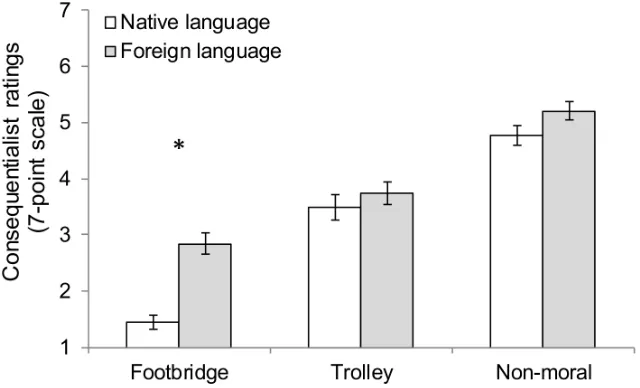
Figure 2. Percentage of participants who endorsed the consequentialist action in Study 2, by moral dilemma and language condition (native language = Chinese, foreign language = English). *p < .05.
Moral judgment (7-point scale). The main findings are illustrated in Figure 3. We submitted the permissibility ratings to a 2 (Language: foreign vs. native) × 3 (Dilemma type: footbridge vs. trolley vs. non-moral) mixed-factor analysis of variance (ANOVA) with repeated measures on dilemma type. This ANOVA revealed a main effect of language condition, F(1, 149) = 16.80, p < .001, ηp2 = .10. As anticipated, mean consequentialist ratings were higher in the foreign language condition (MFL = 3.93, CI [3.71, 4.14]) than in the native language condition (MNL = 3.23, CI [2.97, 3.49]). Importantly, this main effect was qualified by a significant language × dilemma interaction, F(1.92, 286.45) = 5.93, p = .003,
36
In line with previous research, mean consequentialist ratings were lower in the footbridge dilemma (M = 2.14, CI [1.89, 2.39]) than in the trolley dilemma (M = 3.61, CI [3.31, 3.91]). (For the non-moral dilemma: M = 4.99, CI [4.75, 5.23]).
Figure 3. Mean consequentialist ratings in Study 2 (1 = the action is forbidden, 4 = the action is permissible, 7 = the action is obligatory) by moral dilemma and language condition (native language = Chinese, foreign language = English). Error bars indicate the standard error of the mean. *p < .05.
37
.099. For the non-moral dilemma, there was also no correlation between proficiency and action endorsements, r(150) = .09, p = .288, or permissibility ratings, r(149) = –.11, p = .170.
Distress ratings. The three distress scales (upset, worried, and sad) were highly correlated (Cronbach’s α was .80 for the trolley dilemma, and .81 for the footbridge
dilemma). Therefore, we collapsed them into a single distress index by calculating the mean over the three scales. With respect to the native language, the foreign language attenuated distress ratings for both moral dilemmas. A 2 (Language: foreign vs. native) × 2 (Dilemma type: trolley vs. footbridge) mixed-factor ANOVA, revealed a significant main effect of language, F(1, 150) = 5.04, p = .026, ηp2 = .03, which was not qualified by an interaction, F(1, 150) = 0.04, p = .846, ηp2 < .01. Overall, distress ratings were lower in the foreign language condition (MFL = 4.88, 95% CI [4.60, 5.16]) than in the native language condition (MNL= 5.38, CI [5.04, 5.72]). Distress ratings were higher in the trolley dilemma (M = 5.30, CI [5.06, 5.54]) than in the footbridge dilemma (M = 4.96, CI [4.70, 5.23]), as revealed by a significant main effect of dilemma type, F(1, 150) = 8.19, p = .005, ηp2 = .05.5
Mediation analysis. We also conducted a mediation analysis to examine whether emotion mediates the effect of language on moral judgment in the footbridge dilemma. (We did not conduct a similar analysis for the trolley dilemma, as no language effect was detected for this item.) We used the SOBEL macro for SPSS [34] and the non-parametric
38
Study 2 successfully extended the foreign language effect on moral judgment to late Chinese–English bilinguals. It also investigated whether this effect is underpinned by an attenuation of emotions, as it was proposed, but not tested, in previous studies. The use of a foreign language attenuated emotions in both moral dilemmas, and the emotion attenuation did not mediate the association between language and moral judgment.
Study 3
Following Greene’s original proposal [2], one could conjecture that the foreign language effect on moral judgment is found in personal dilemmas, such as the footbridge scenario, but not in impersonal dilemmas, such as the trolley scenario. The two types of dilemmas vary on a number of dimensions, any one of which could be critical for observing the effect. For example, personal dilemmas involve harm caused using personal force, and the instrumental use of a person [1]. The main aim of Study 3 was to investigate whether the foreign language effect is linked to the personal-impersonal distinction. To this end, we examined an additional personal dilemma (high-emotion), the so-called 'crying baby scenario', and an additional impersonal dilemma (low-emotion), the 'lost wallet scenario' (for an
assessment of these dilemmas in terms of emotionality, see [16]). The evidence that the crying baby dilemma is highly emotional, even more than the footbridge or the trolley dilemmas, is widely supported [31]. A further aim was to replicate the findings of Studies 1 and 2 as well as of previous studies showing a foreign language effect in the footbridge dilemma and no effect in the trolley dilemma. To test the robustness of the foreign language effect, we examined yet a different sample of bilinguals: native German speakers who learned English as a foreign language.
Method
39
participated at the beginning of a lecture at the Free University of Berlin, while 34 in an online version of the study. The online-study participants were recruited from the University Osnabrück and Humboldt University Berlin via email lists. The link to the online survey was active for one week. Within the class and online parts of the study, participants were
randomly assigned either to the foreign language condition (n = 38; English) or to the native language condition (n = 34; German). The level of qualification in English of the participants assigned to the foreign language condition ranged from beginner (A = basic user) to
advanced (C = proficient user), with the majority holding an intermediate level qualification (B = independent user) (based on the CEFR; [25]). On average, the participants assigned to the foreign language condition began English education at age 9.02, CI [8.45, 9.60]. These participants were also asked to rate their proficiency in English in terms of conversational fluency, reading, writing, and understanding, on a 5-point scale (1 = almost none, 2 = poor, 3 = fair, 4 = good, 5 = very good). Averaging across the four measures
(Cronbach’s α = .89), they rated their skills as good (M = 4.05,CI [3.80, 4.26]).
Materials and procedure. Participants were presented with the trolley, footbridge, and non-moral dilemma of Studies 1 and 2 along with an extra dilemma of each type (all dilemmas were adapted from [2]; for the full text see Appendix). The new dilemmas included a personal dilemma (crying baby), an impersonal dilemma (lost wallet), and a non-moral scenario. In the crying baby dilemma one must decide whether to smother one’s own child in order to save oneself and several others from being found and killed by enemy soldiers. In the lost wallet dilemma a person in need must decide whether to return a wallet full of cash that seems to belong to a wealthy individual. In the new non-moral dilemma one must decide whether to make two trips home by car rather than a single trip to carry some plants in order to avoid ruining the car’s upholstery. About half of the participants in each language
40
them in the inverse order. Following each dilemma, participants had to rate the permissibility of the described action on a 7-point scale (1 = forbidden, 4 = permissible, 7 = obligatory; [5]).
Results
Preliminary analyses revealed no effect of method of administration (in classroom vs. online), or presentation order. Hence, we dropped these factors from subsequent analyses. In contrast to Studies 1 and 2, preliminary analyses revealed a significant gender effect.In line with prior work [13], male participants rated the consequentialist actions as more permissible (M = 3.00, CI [2.60, 3.40]) than female participants (M = 2.44, CI [2.23, 2.65]), F(1, 68) = 6.24, p = .015, ηp2 = .08. Given that gender differences were not a focus of the present study, in the analyses below we included gender as a covariate.
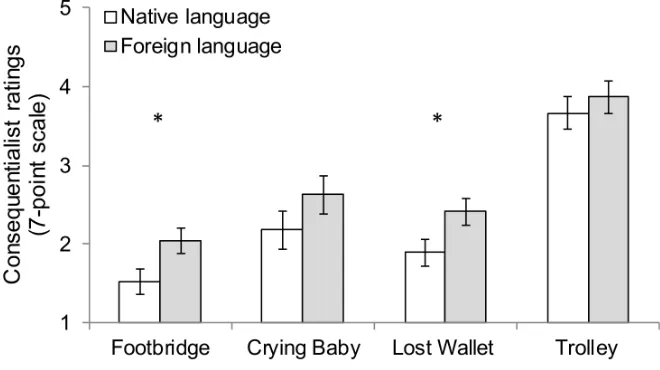
Moral judgments. The main findings for the moral items are illustrated in Figure 4. Notice that the pattern of the means for the four dilemmas is consistent with that reported in prior research [2]. We conducted a2 (Language: foreign vs. native) × 4 (Moral dilemmas: 1– 4) mixed-factor analysis of covariance (ANCOVA), with gender as a covariate. There was a main effect of language, F(1, 68) = 6.29, p = .015, ηp2 = .09. Mean consequentialist ratings were higher in the foreign language condition (MFL = 2.74, CI [2.51, 2.97])7 than in the native language condition (MNL = 2.32, CI [2.08, 2.57]). This effect was not qualified by a language × dilemma interaction, F(2.63, 178.89) = 0.29, p = .811, ηp2 < .01.8 There was no main effect of dilemma, F(2.63, 178.89) = 2.58, p = .063, ηp2 = .04.
41
In order to examine whether the foreign language effect is present in the footbridge dilemma and absent in the trolley dilemma, we conducted planned comparisons using multivariate analysis of covariance (MANCOVAs) with gender as a covariate. Confirming the pattern found in the previous studies, we detected a significant foreign language effect in the footbridge dilemma (MFL = 2.04, CI [1.73, 2.36], MNL = 1.53, CI [1.20, 1.87]), F(1, 68) = 4.79, p = .032, ηp2 = .07, but not in the trolley dilemma (MFL = 3.87, CI [3.45, 4.29], MNL = 3.67, CI [3.21, 4.12]), F(1, 68) = 0.42, p = .517, ηp2 = .01. We also performed similar
analyses for the new dilemmas. A significant foreign language effect was observed in the lost wallet dilemma (MFL = 2.42, CI [2.08, 2.76], MNL = 1.90, CI [1.54, 2.27]), F(1, 68) = 4.29, p = .042, ηp2 = .06, but not in the crying-baby dilemma (MFL = 2.63, CI [2.15, 3.11], MNL = 2.18, CI [1.67, 2.70]), F(1, 68) = 1.60, p = .211, ηp2 = .02.
42
Correlations between proficiency and moral judgment. Preliminary analyses showed that the participants in the foreign language condition reported high self-ratings of proficiency in reading and understanding (M = 8.61, CI [8.12, 9.08]). As a result, there was little variation in proficiency and thus weak associations between proficiency and moral judgment. The only dilemma for which we observed a significant (negative) correlation was the lost wallet: the lower the language proficiency, the higher the consequentialist ratings, r(70) = –.30, p = .011.
Discussion
In Study 3 we examined whether the foreign language effect is linked to the personal-impersonal distinction. The results do not support this hypothesis. We observed a foreign language effect, but this effect was not qualified by an interaction with dilemma type. Replicating the findings of Studies 1 and 2, detailed analyses showed that foreign language influenced moral judgments in the footbridge (personal) but not in the trolley (impersonal) dilemmas. Critically, the effect was also present in an impersonal dilemma (lost wallet). A surprising finding was that the foreign language effect was absent in the crying baby
dilemma. This could be because, in contrast to the other dilemmas, in this dilemma the victim of the action would die regardless. In economic jargon, performing the action is the dominant option, because its payoff is better than the payoff of omitting the action. Participants in both language conditions might have thought about the dominance relation, which would explain both the high permissibility ratings (which are consistent with previous research; see Greene et al., 2001) and the absence of the foreign language effect.9
Meta-analyses
43
summarizing the three studies. For completion, we also performed a similar meta-analysis for the footbridge dilemma.
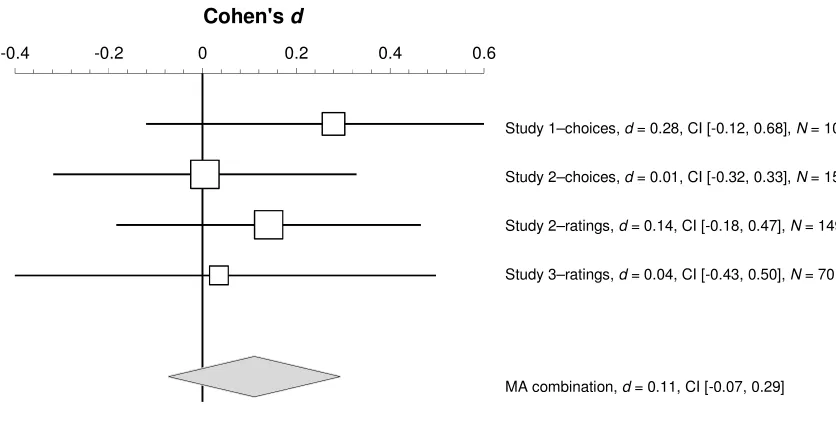
Trolley dilemma. Figure 5 illustrates the results of a random effects meta-analysis summarizing the three studies regarding the moral choices and judgments in the trolley dilemma (we used Exploratory Software for Confidence Intervals, see Cummings, 2012). The main result of each study (foreign language effect) is represented as a square marking the effect size (Cohen’s d), and its 95% CI. The diamond represents the overall effect size of the meta-analysis, and its 95% CI. The overall effect size was 0.11, 95% CI [-0.07, 0.29], which is interpreted as no effect (Cohen, 1988). In conclusion, there was no foreign language effect for the trolley dilemma across the three studies.
Figure 5. Forest plot indicating the effect sizes (squares) and 95% CIs (lines) of the three studies for the foreign language effect on the trolley dilemma. The diamond illustrates the overall effect size and its 95% CI given by a random effects meta-analysis (MA) that combines the three studies.
-0.4 -0.2 0 0.2 0.4 0.6
Cohen'sd
Study 1–choices, d = 0.28, CI [-0.12, 0.68], N = 102
Study 2–choices, d = 0.01, CI [-0.32, 0.33], N = 150
Study 2–ratings, d = 0.14, CI [-0.18, 0.47], N = 149
Study 3–ratings, d = 0.04, CI [-0.43, 0.50], N = 70
44
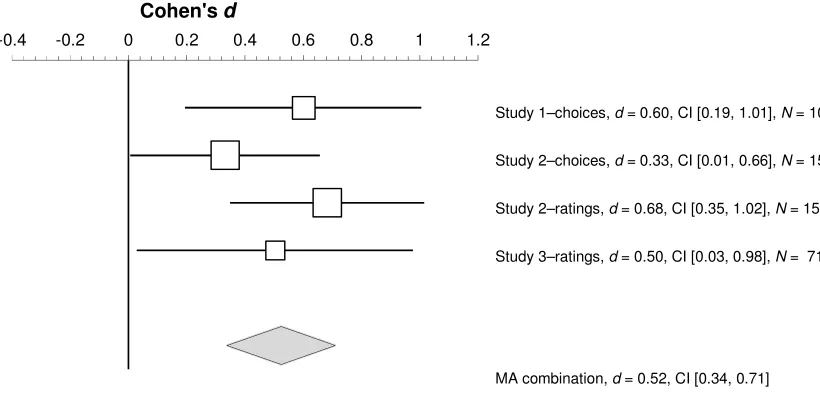
Footbridge dilemma. Figure 6 illustrates the results of a random effects meta-analysis summarizing the three studies regarding the moral choices and judgments for the footbridge dilemma between the foreign language and the native language conditions. The overall effect size was 0.52, 95% CI [0.34, 0.71], which is interpreted as intermediate effect (Cohen, 1988). In conclusion, there was an intermediate foreign language effect for the footbridge dilemma across the three studies.
Figure 6. Forest plot indicating the effect sizes (squares) and 95% CIs (lines) of the three studies for the foreign language effect on the footbridge dilemma. The diamond illustrates the overall effect size and its 95% CI given by a random effects meta-analysis (MA) that
combines the three studies.
General Discussion
The present studies provide strong evidence that the use of a foreign language influences the moral evaluation of complex moral dilemmas. In line with previous work [19, 20], foreign language increased the rate of consequentialist responses in the footbridge dilemma but not in the trolley dilemma (Studies 1–3, meta-analyses). However, in contrast to
-0.4 -0.2 0 0.2 0.4 0.6 0.8 1 1.2
Cohen's d
Study 1–choices, d = 0.60, CI [0.19, 1.01], N = 104
Study 2–choices, d = 0.33, CI [0.01, 0.66], N = 152
Study 2–ratings, d = 0.68, CI [0.35, 1.02], N = 151
Study 3–ratings, d = 0.50, CI [0.03, 0.98], N = 71
45
previous theorizing, the results do not support the claim that this effect is driven by reduced emotionality. Foreign language attenuated emotions in response to both the footbridge and trolley dilemmas, and this emotion attenuation did not mediate the effect of foreign language on moral judgment (Study 2). Furthermore, the foreign language effect was not constrained to personal dilemmas; it was also present in an impersonal dilemma (lost wallet; Study 3). Interestingly, the foreign language effect was absent in the crying baby dilemma, which we suggested might be due to that this dilemma had a distinctive feature that was absent in all other moral dilemmas: the negative outcome of the action (the baby’s death) would occur anyway, even if the action were not performed.9
If the emotional attenuation is not a viable explanation for the foreign language effect on moral judgment then what drives this effect? Why was the effect absent from the trolley dilemma but present in the footbridge and lost wallet dilemmas? Perhaps the critical
difference is that the trolley dilemma does not involve a “taboo” or prohibited action. Social and moral rules prohibit us from pushing people or keeping lost wallets. However, we have no general rules prohibiting flipping switches (see Cushman’s dual-system framework of morality [35]). We propose that foreign language may influence moral judgment by reducing the mental accessibility of social and moral rules. For this explanation to work, one has to assume that in the case of flipping the switch the categorization of the action at a more abstract level (killing the collateral innocent victim) is less automatic than the categorization of the other actions, such as keeping the wallet as a prototypical form of stealing.
46
foreign language translations, participants used “stronger” words to translate politically incorrect swearwords which were directed against social groups, compared to other types of swearwords. The authors of this study argued that in a foreign language the social and cultural norms are less salient, which makes it easier for people to use inappropriate swearwords (for similar views see [29, 38]).
One way through which foreign language might reduce the activation of social and moral norms, is by limiting access to relevant autobiographical memories. Research suggests that memories are language specific, and therefore are more accessible when the language used at retrieval matches the one present at encoding [39–41], that is, the native language. Research suggests that several moral and social rules are learned through social
communication [42], and that a great chunk of such rules concern prohibitions of specific actions [43]. An analysis of a large corpus of data demonstrated that 99% of child-directed speech about rules of conduct, referred to the prohibition of particular actions, such as “Don’t throw paper on the floor!”, but there were also many cases of parents just saying “No!” [43]. A foreign language might evoke memories related to such prohibitions to a lesser extent than the native language. Consistent with this claim, Harris and colleagues [44, 21] showed that the use of a foreign language reduced electrodermal activity in response to childhood reprimands (“Don’t do that!”).
47
scales after the moral judgment was made. It could be that the higher emotion ratings in the trolley dilemma, as compared to the footbridge dilemma, are related to post-decisional processes. But note that previous studies have also measured emotions before the moral judgment was made and they failed to find support for the claim that the footbridge dilemma evokes more negative emotion than the trolley dilemma [31; see also 32]. A fourth limitation is that the increase in consequentialist responses found in the foreign language condition might be because participants assigned to that condition might have assumed that the situations involved foreign people in a foreign country. Research suggests that feelings of social connection to the characters involved in a dilemma influences moral evaluations [49, 50, 52]. But notice that the effect was present also in a study where participants were explicitly instructed to assume that the characters were co-nationals and that the situation took place in their country [36].
48 References
1. Greene, J.D., Cushman, F.A., Stewart, L.E., Lowenberg, K., Nystrom, L.E., & Cohen, J.D. (2009). Pushing moral buttons: The interaction between personal force and intention in moral judgment. Cognition, 111, 364–371. doi:10.1016/j.cognition.2009.02.001 2. Greene, J.D., Sommerville, R.B., Nystrom, L.E., Darley, J.M., Cohen, J.D. (2001). An
fMRI investigation of emotional engagement in moral judgment. Science, 293, 2105– 8. doi: 10.1126/science.1062872
3. Foot, P. (1978). Virtues and vices and other essays in moral philosophy. Berkeley: University of California Press.
4. Thomson, J. (1985). The trolley problem. Yale Law Journal, 94, 1395–1415.
5. Cushman, F., Young, L., & Hauser, M. (2006). The role of of conscious reasoning and intuition in moral judgment: Testing three principles of harm. Psychological Science, 17, 1082–1089. doi: 10.1111/j.1467-9280.2006.01834.x
6. Pellizzoni, S., Siegal, M., & Surian, L. (2010). The contact principle and utilitarian moral judgments in young children. Developmental Science, 13, 265–270. doi:
10.1111/j.14677687.2009.00851.x
7. Greene, J.D. (2014). Beyond point-and-shoot morality: Why cognitive (neuro) science matters for ethics. Ethics, 124, 695–726. doi: 10.1086/675875
8. Dwyer, S. (2009). Moral dumbfounding and the linguistic analogy: Implications for the study of moral judgment. Mind & Language, 24, 274–296. doi: 10.1111/j.1468-0017.2009.01363.x
9. Huebner, B., Dwyer, S., & Hauser, M. (2009). The role of emotion in moral psychology. Trends in Cognitive Science, 13, 1–6. doi: 10.1016/j.tics.2008.09.006