Research article
How many roads lead to Rome? Equifinality set-size and commitment to
goals and means
ARIE W. KRUGLANSKI
1*, ANTONIO PIERRO
2AND ANNA SHEVELAND
11
Department of Psychology, University of Maryland, USA;2Department of Socialization and Development, University of Rome, ‘‘LA SAPIENZA,’’ Rome, Italy
Abstract
Four studies examined the relation between the number of equifinal means to a goal, actors’ commitment to that goal, and their commitment to the means. In Study 1, participants freely generated varying number of means to two of their work goals. In Study 2, they generated social means to their goals (people they viewed as helpful to goal attainment). In Studies 3 and 4, the number of means to participants’ goals was experimentally manipulated. All four studies found that means commitment is negatively related, whereas goal commitment is positively related, to means number. Consistent support was also obtained for the notion that the relation between means number and goal commitment is mediated by the expectancy of goal attainment, and by goal importance. Conceptual and practical implications of the findings were considered that link together the notions of substitut-ability and dependency within a goal systemic framework. Copyright #2010 John Wiley & Sons, Ltd.
An essential aspect of goal pursuit is the selection of means for advancing one’s objectives. Occasionally, several means may seem equal to the task. These define the configuration of equifinality, wherein alternative activities constitute different routes to the same end (Heider, 1958; Kruglanski, Shah, Fishbach, Friedman, Chun, & Sleeth-Keppler, 2002). In other circumstances, only a single means may permit goal progress, exhibiting the property of unifinality (Zhang, Fishbach, & Kruglanski, 2007). The totality of available means to a given goal defines the equifinality set, and the problem we presently address is how its size affects individuals’ motivational states, emotional reactions to failure, and goal driven behavior.
Substitutability and Goal Commitment
A major psychological mechanism of relevance here is substitutability. This term denotes the opportunity of switching to alternative means if goal progress via a prior means was thwarted. The substitutability construct was alluded to by major psychological theorists. These included Freud (1920) who discussed the issue ofsymptom substitutionin neurosis, Lewin (1935) who addressed the role of imagination as a substitute for veridical action, Tolman (1932) who considered striving with varied (i.e., substitutable) effortsas the hallmark of purposive behavior and Festinger (1957) who discussed multiple mutually substitutable means of dissonance reduction. More recently, Wicklund and Gollwitzer (1981) dwelled on the role of substitution in identity maintenance through alternative routes to ‘‘self-completion,’’ Steele and Liu (1983) demonstrated that
self-affirmation can substitute for attitude change in dissonance arousing situations, Petty and Cacioppo (1986) identified the central and peripheral routes as mutually substitutable means of persuasion, and Tesser (2000) theorized about the workings of substitutable means in self-esteem maintenance.
Though the substitution mechanism has been referred to in passing by major psychological theorists, it rarely constituted the central focus of their work. Consequently, hardly any systematic research was aimed directly at the substitution process or explored what factors may determine its psychological effects. Typically, authors have implied that given a sufficient goal magnitude some substitute activities would be invariably engendered (see e.g., Festinger, 1957; Freud, 1920; Steele & Liu, 1983; Tesser, 2000) but the extent of such generation and the number of resulting options have not been addressed thus far. Yet, it seems plausible that the number of equifinal means to a goal may vary across persons and situations. For instance, an expert in a domain (e.g., a car mechanic or a physician) may readily engender multiple means for dealing with a given problem, whereas a novice may struggle to come up with a single means. Also, recent socio-cognitive research on motivation (see e.g., Fishbach & Ferguson, 2007; Kruglanski & Kopetz, 2009 for a review) suggests that different means to a goal may be primed by features of individuals’ environments (Shah & Kruglanski, 2003). If so, different psychological situations may vary in the number of equifinal means being activated hence in corresponding substitution opportunities and it is of interest to consider what psychological impact on self-regulation may result from such variability. Gaining insight into these matters defines the central purpose of the present research.
Published online 11 November 2010 in Wiley Online Library (wileyonlinelibrary.com)DOI: 10.1002/ejsp.780
Goal Commitment
One type of impact could be on individuals’ commitment to the goal, or the perception of the goal as of high importance. Two possible mechanisms could mediate such an effect: an expectancy mechanism and an availability mechanism. The expectancy mechanism suggests that the presence of numerous (vs. only few) means to a goal reassures the goal will be reached (if not one way then another), increasing one’s subjective likelihood of goal attainment. We further assume that reasonable expectancyof attainment, or perceivedgoal attainability, typi-cally constitutes a precondition for goalcommitment(Kruglanski, 1996). If so, one may hypothesize that increasing the size of the equifinality set would increase individuals’ expectancy of goal attainment, thereby augmenting goal commitment.
The availabilitymechanism identifies an alternative path whereby a means set size may affect goal commitment. It suggests that the presence of several alternative means affords the availability heuristic (Tversky & Kahneman, 1974) whereby the presence of multiple (vs. fewer) means suggests that the goal they serve is important, that is, of high value. In short, it is possible that the size of the means set affects goal commitment via two paths related to (1) enhanced subjective expectancy of goal attainment (the expectancy mechanism) and (2) augmented goalvalue(the availability mechanism).
Dependency and Means Commitment
The size of the equifinality set may carry a very different consequence formeans commitment. Specifically, the presence of multiple substitutable means may lessen one’sdependency on any given means (Rusbult, 1980; Thibaut & Kelley, 1959). In terms of interdependence theory (van Lange, 2007), the individual’s comparison level for alternatives, or CLAlt, is
greater in situations where other means options exist as compared to the case where the current means appears as the sole avenue for goal pursuit. As a consequence, one’s commitment to a given means may falter if other means to the same goal were also present. Such waning of means commitment may attenuate the magnitude of individuals’ affective reactions to failures of goal pursuit via this means in so far as failures may appear reversible via alternative means, hence less final and upsetting. Thus, the notions of substitutabilityanddependencyseem inherently related, both being determined by the (variable) size of the equifinality set, or the number of alternate means available for goal pursuit.
In summary then, the general thesis of the present work is that the size of the means set to a given goal will exert opposite effects on goal and means commitment. Specifically, it will bear a positive relation to goal commitment and a negative one to means commitment.
The Present Research
To investigate these issues we carried out four studies. In two of these, we asked participants to self-generate their work related goals and means, allowing them the freedom to vary the number of listed means as desired. This approach taps naturally occurring relations between specific goals and
means, hence conferring an ecological advantage on our research; yet it also renders the studies correlational and introduces uncertainty concerning the causal interpretations of the results. To overcome this difficulty, our remaining two studies were experiments, in which we systematically manipulated the number of means generated to participants’ goals, affording a clearer causal interpretability of the findings. In all four studies, participants were employees of various organizations in Rome, Italy, and the goals they generated pertained to their work context. The description of our specific research follows.
STUDY 1
Our first study requested participants to list their work-related goals, and to identify an unspecified number of means with which they intended to pursue those goals. We then inquired into participants’ commitment to the goals and means listed as function of the number of means generated for each goal. As discussed above, we predicted that the number of means generated for a goal would have the opposite impact on participants’ commitment to the goal and to the means. Specifically, we expected that the greater the number of means generated to a given goal, the stronger the commitment to that goal, mediated by both the perceived expectancy of goal attainment assumed to vary positively with the number of means and the goal’s perceived importance.We also expected that the greater the number of means generated to a given goal, the weaker the commitment to any of those means because of the lessened dependency on it in the presence of alternative means.
Method
Participants
One hundred employees of an insurance agency in Rome, Italy volunteered to participate in the study. The sample consisted of 42 men and 58 women, with a mean age of 33.2 years (SD¼7.91). Gender and age had no significant effects on any of our dependent variables, hence they will be omitted from subsequent discussions.
Procedure
Participants were asked to generate two work-related goals that they would be trying to realize during the upcoming 3 months. Examples of the kinds of goals participants listed were: signing up of new clients, optimally managing and organizing one’s work, and enhancing one’s work quality.
Measures
Commitment to the meanswas operationalized by the negative emotional impact upon participants of the failure of goal pursuit via the use of that means (for a similar logic see Berger, 1988; Gollwitzer & Kirchhof, 1998). This was assessed by asking participants to indicate, for each means, to what extent they would feel irritated and/or upset if they could not attain the goal via the listed means (responses were recorded on a 7-point scale, with 1¼not at all annoying/irritating and 7¼very annoying/irritating). We computed an index of means commitment (i.e., negative emotional impact) by averaging the responses for each of the goals (r¼.62; p<.001). Only responses to thefirstmeans listed were considered.
Commitment to each goal was assessed by measuring the effort participants intended to invest in goal pursuit. More specifically, for each goal, we asked participants to indicate the intensity with which they intended to dedicate themselves to pursuit of the goal in the upcoming 3 months (with responses registered on a 7-point scale, with 1¼no intensity and 7¼
extreme intensity). Responses for each goal (r¼.55;p<.001) were averaged, resulting in a single index of goal commitment. Goal importance was assessed by asking participants to indicate, for each goal, the importance of the goal (on a 7-point scale, with 1¼not at all important and 7¼very important). Again, responses for each goal (r¼.39; p<.001) were averaged, resulting in a single index of goal importance.
Perceived likelihood of goal attainment was assessed by asking participants to indicate, for each goal, the perceived probability of achieving the goal in the next 3 months (with responses recorded on a 7-point scale, with 1¼not at all likely and 7¼extremely likely). The responses for each goal (r¼.44;p<.001) averaged into a single measure of perceived likelihood of goal attainment.
Results
Descriptive statistics and all bivariate correlations for all our variables are presented in Table 1.
As can be seen, the number of means listed is significantly and negatively correlated to: (1) commitment to the particular means (i.e., negative emotional impact of failure with respect to a given means), r¼ .36, p<.001; and significantly and positively correlated with (2) perceived likelihood of goal attainment, r¼.27, p<.01, (3) goal importance, r¼.27, p<.01, and (4) commitment to the goals,r¼.22,p<.05. Also note that perceived likelihood of goal attainment, goal importance, and goal commitment are positively correlated with each other: Perceived likelihood of goal attainment and
goal importance, r¼.47, p<.001; perceived likelihood of goal attainment and goal commitment,r¼.52,p<.001; goal importance and goal commitment,r¼.68,p<.001.
Goal Commitment and Equifinality-Set Size: The Mediating Role of Perceived Likelihood of Goal Attainment and Goal Importance
To further analyze the relations between our study’s variables, we performed a multiple mediation analysis testing a model with the mediating role of both perceived likelihood of goal attainment and goal importance in the relationship between number of means listed and goal commitment. To examine the proposed mediation model, we employed Preacher and Hayes’ (2008) procedure to extrapolate estimates of direct and indirect effects. Preacher and Hayes’ strategy employs the use of bootstrapping, a non-parametric re-sampling procedure, to estimate the size of indirect effects using adjusted percentile (asymmetrical) confidence intervals (CIs). This procedure is particularly advantageous when applied to the case of multiple mediation, as it is important not only to determine whether an indirect effect exists, but which mediators contribute mean-ingfully to that effect. Bootstrapping allows estimation of individual indirect effects and contrasts amongst indirect effects without potential problems due to collinearity that may pose a problem in path analysis (Preacher & Hayes, 2008). The present analysis was performed using SPSS 17.0 with Preacher and Hayes’ INDIRECT.SPS macro (available at www.quantp-sy.org). Ninety-five per cent CIs were employed and 1000 bootstrapping re-samples were run. CIs were adjusted for bias (bias corrected and accelerated, BCa) and contrasts between the indirect effects of the two mediators were tested.
The results obtained shows that the totaleffect of number of means listed on goal commitment was significant, coeff. .25, p<.05. Consistent with our hypothesis regarding the mediating role of both perceived likelihood of attainment and goal importance, thedirecteffect of number of means listed on goal commitment became (respective to the relation between the two variables revealed in the first correlational analysis reported in Table 1)non-significant, coeff..01,p¼.96, when the two mediators were controlled for. The direct effects of number of means listed on both mediators were significant (on goal importance, .32,p<.01, and on perceived likelihood of attainment, .31, p<.01, respectively). Also, the direct effects of the two mediators on goal commitment were both significant (path coefficients of goal importance on goal commitment, .54, p<.001, and of perceived likelihood of attainment on goal commitment, .27,p<.01, thus confirming our previous analysis reported in Table 1. Finally, the total indirecteffect of number of means listed on goal commitment
Table 1. Descriptive statistics and correlations between variables (Study 1)
M(SD) 1 2 3 4 5
1. Means set-size 2.33 (.78) —
2. Means commitment 4.12 (1.15) .36 —
3. Goal importance 5.36 (.94) .27 .01 —
4. Likelihood of goal attainment 4.50 (.87) .27 .14 .47 —
5. Goal commitment 5.25 (.91) .22 .05 .68 .52 —
was significant (.26, p<.01, with BCa 95%CI of .1169 to .4634 not containing zero). More importantly, the twoindirect effects of number of means listed on goal commitment through the two mediators were significant: The effect of number of means listed on goal commitment was mediated by both perceived likelihood of attainment (indirect effect¼.08, p<.05, with BCa 95%CI of .0176 to .1797 not containing zero), and goal importance (indirect effect¼.18,p<.01, with BCa 95%CI of .0470 to .3626 not containing zero). The pair-wise contrast among these indirect effects was non-significant (.09,p¼.19, with BCa 95%CI of.0662 to .3088 containing zero), indicating that the magnitude of these effects is comparable. Overall, the multiple mediator model was significant, F(3,96)¼33.51, p<.0001, with R2¼.51, and Adj. R2¼.50. This result is consistent with the hypothesis that both perceived likelihood of goal attainment and goal importance mediates the relation between equifinality set-size and goal commitment.
STUDY 2
Study 2 constituted a conceptual replication of Study 1. It specifically investigated distinctly social means for goal attainment, namely other people in the organization whom participants viewed as likely to be helpful to the attainment of their work-related goals. Should our predictions hold here as well, we would have evidence for tradeoffs between goal commitment and interpersonal commitment to one’s col-leagues at work (the social means of attainment mentioned above), attesting to the breadth of our analysis. The dependent variables of Study 1 were retained here as well.
Method
Participants
Eighty-five employees (58 men, 27 women) of an Internet technology firm in Rome, Italy volunteered to participate in the study. Their mean age was 34.62 (SD¼8.81). Gender and age had no significant effect on any of our dependent variables and thus will not be discussed further.
Procedure
As in Study 1, in the first phase of the study participants were asked to generate two work-related goals that they would be attempting to realize during the next 3 months. Examples of the kinds of goals participants listed were: initiation of new
projects, making the required deadlines, and computerizing the entire task environment.
Next, participants were asked to generate up to fivesocial means for each goal that they had listed. Specifically, they were asked to list the persons (colleagues, superiors, coworkers, etc.) that they believed could be counted on for help in reaching the goal during the upcoming 3 months. On average, participants listed 3.38 (SD¼1.68) social means per goal.
Participants then answered questions assessing their commitment to each of the social means, the perceived likelihood of goal attainment, goal importance, and their commitment to each of the goals.
Measures
Commitment to the means (i.e., negative emotional impact of failure with respect to a given means) (itemr¼.58;p<.001), likelihood of goal attainment (item r¼.29; p<.01), goal importance (itemr¼.68;p<.01), and goal commitment (item r¼.71;p<.001) were assessed using the same measures as in our first study.
Results
Descriptive statistics and all bivariate correlations for our variables are presented in Table 2.
As can be seen, the number of social means listed is significantly and negatively correlated with (1) commitment to the particular social means (i.e., negative emotional impact of failure with respect to a given social means),r¼ .27,p<.01; and significantly and positively related to (2) perceived likelihood of goal attainment,r¼.42,p<.001, (3) goal impor-tance,r¼.24,p<.05, and (4) commitment to the goal,r¼.38, p<.001, Note that perceived likelihood of goal attainment, goal importance, and goal commitment were significantly and positively correlated with each other: Perceived likelihood of goal attainment and goal importance,r¼.29,p<.01; perceived likelihood of goal attainment and goal commitment,r¼.43, p<.001; goal importance and goal commitment, r¼.70, p<.001.
Goal Commitment and Equifinality-set Size: The Mediating Role of Perceived Likelihood of Goal Attainment and Goal Importance
Our hypothesis regarding the mediating role of both perceived likelihood of goal attainment and goal importance in the relation between goal commitment and means set-size was tested via the multiple mediation model of Study 1 employing
Table 2. Descriptive statistics and correlations between variables (Study 2)
M(SD) 1 2 3 4 5
1. Social means set-size 3.38 (1.68) —
2. Social means commitment 3.71 (1.94) .27 —
3. Goal importance 6.01 (1.27) .24 .26 —
4. Likelihood of goal attainment 4.89 (1.32) .42 .25 .29 —
5. Goal commitment 5.76 (1.30) .38 .13 .70 .43 —
the Preacher and Hayes’s (2008) bootstrapping procedure described earlier.
The results obtained show that thetotaleffect of the number of social means listed on goal commitment was significant, coeff. .30,p<.001, whereas thedirecteffect of the number of social means listed on goal commitment was non-significant, coeff. .12,p¼.06. Thedirecteffects of the number of social means listed on the two hypothesized mediators were significant (on goal importance, .18,p<.05, and on perceived likelihood of attainment, .33,p<.001, respectively). Also, thedirecteffects of the two mediators on goal commitment were both significant (path coefficients of goal importance on goal commitment, .61, p<.001, and of perceived likelihood of attainment on goal commitment, .19,p<.05). Finally, thetotal indirecteffect of the number of social means listed on goal commitment was significant (.17,p<.05, with BCa 95%CI of .0516 to .3650 not containing zero). More importantly, the twoindirecteffects of the number of social means listed on goal commitment through the two mediators were significant: The effect of the number of social means listed on goal commitment was mediated by both perceived likelihood of attainment (indirect effect¼.06, p<.05, with BCa 95%CI of .0096 to .1475 not containing zero), and goal importance (indirect effect¼.11, p<.05, with BCa 95%CI of .0114 to .2587 not containing zero). The pair-wise contrast among these indirect effects were non-significant (.05, p¼.39, with BCa 95%CI of.0622 to .1969 containing zero), indicating that the magnitude of these effects is comparable. Overall, the multiple mediator model was significant,F(3,81)¼
34.77,p<.0001, withR2¼.56, and Adj.R2¼.55. This result is consistent with the hypothesis that both perceived likelihood of goal attainment and goal importance mediates the relation between equifinality set-size and goal commitment, thus confirming the results of Study 1.
DISCUSSION OF STUDIES 1 AND 2
Both Studies 1 and 2 yield data consistent with our analysis. Across both studies, the number of means generated to a goal was positively related to our participants’ commitment to their goal, and negatively related to their commitment to each means. These effects replicated across different means contents (non-social in Study 1 and social in Study 2).
Though these results are encouraging, their correlational nature, owing to the fact that participants generated as many means as they wished (within limits) to each goal, raises questions concerning the causal direction of our effects. Whereas we have postulated that it is the number of means that affects goal commitment, there is the possibility that the relation flows in the opposite direction. Specifically, it is possible that participants generated a greater number of means to their more committed goals in order to enhance their likelihood of goal attainment.1Thus, to more clearly establish the causal role of means number in affecting in contrasting ways the commitment to goals and means we carried out two
additional studies, described below, in which this variable was experimentally manipulated.
STUDY 3
Using a within-subjects study design, our third experiment tested the hypothesis that a larger means-set for a given goal results in increased commitment to that goal and decreased commitment to each of the means.
Method
Participants
One hundred and eighteen state employees in Rome, Italy volunteered to participate in the study. The sample consisted of 75 men and 43 women, with a mean age of 44.54 years (SD¼9.95). Gender and age had no significant effects on our dependent variable and thus will not be considered further.
Procedure
Participants were asked to complete a questionnaire. On its first page, the means set-size (single vs. multiple means) was manipulated. To that end, participants were asked to generate two work-related goals. Specifically, they were asked to list two goals they would be ‘‘trying to do/realize in the work context during the next 3 months.’’ Examples of the kinds of goals participants listed were: acquisition of new knowledge/ competence, timely task completion and personal develop-ment, and learning sophisticated use of computers.
Participants were then asked to list a single means to one of the goals and several (at least three) means to the other goal. The order in which this was done was counterbalanced. That is, half the participants were asked to generate the single means to the goal they listed first, and several means to the goal they listed second. The remaining half of the participants were asked to generate several means to the goal they listed first, and the single means to the goal they listed second.
After participants generated both goals and means as required, they responded to questions that assessed (a) their commitment to each means and (b) their commitment to each goal. A manipulation check followed.
Measures
As in our previous two studies,commitment to the meanswas assessed by measuring the negative emotional impact of failure with respect to a given means. Two separate indices of commitment to the means were considered, one for each goal. For the multiple-means goal, only responses to thefirstmeans listed were used in our analysis. Also following our prior procedures, commitment to each goal was assessed by measuring intended effort investment in goal pursuit.2 Two
1
Note that this possibility is different from the availability mechanism dis-cussed earlier whereby the presence of (vs. few) multiple alternative means
affords the heuristic (andsubsequent) inference that the goal must have been
important to produce such multiplicity.
2Unfortunately, in this study we have not included a separate index of goal
separate indices of commitment to the goals were considered, one for each goal.
As a manipulation check, for each means they listed participants were asked to indicate how many alternative means were available for reaching the same goal (on a 7-point scale, with 1¼no alternative means and 7¼many alternative means). Again, for the multiple-means goal, we looked only at responses to the first means listed.
Results
Manipulation Check
The results of a within-subjects repeated measures ANOVA revealed, as expected, that the number of alternative means listed for achieving a goal to be significantly greater (F(1,117)¼15.99, p<0.001, h2¼.12) for the three-means goal (M¼3.22, SD¼1.75) than the single-means goal (M¼2.52,SD¼1.51).
Goal and Means Commitment
Results of two separate within-subjects repeated measures ANOVAs (see Figure 1) revealed that for goals associated with three (vs. the single) means, participants reported significantly (1) greater goal commitment (M¼5.75, SD¼1.04, and M¼5.55,SD¼1.23, respectively; F(1,117)¼3.94,p<0.05;
h2¼.03), and (2) lesser commitment to the particular means (M¼4.75,SD¼1.74, andM¼5.41,SD¼1.62, respectively; F(1,117)¼17.82,p<0.001;h2¼.13).
Discussion
The results of our third study conceptually replicate those of its two predecessors. Once again, it is found that the size of the equifinality set is proportional to participants’ commitment to the goal served by those means, and is inversely proportional to participants’ commitment to each of the means. Specifically, the goal to which participants were asked to generate but a
single means was rated as less intensely pursued than the goal to which participants were asked to generate several means. In contrast, the generation of multiple (versus a single) means to a goal resulted in lesser commitment to each means, reflected in lesser perceived negative impact of failure to reach the goal via the particular means.
Though the foregoing results are encouraging and consistent with findings of our prior studies, it is important to ascertain how robust they are, and whether they would obtain also in a between-participants’ design wherein, unlike in the present within-participants study, participants lack a salient comparison between goals associated with a single versus multiple means. The purpose of our fourth and final study was to address this issue. Additionally, our fourth study explored the hypothesized mediating role of both perceived likelihood of goal attainment and goal importance in the relation between means number and goal commitment. Recall that this mediational hypothesis received support in our Studies 1 and 2 but it was of interest to explore whether it would also obtain in an experimental setting wherein the number of means to a goal is systematically manipulated.
STUDY 4
Method
Participants
Ninety-six employees of an investment company in Rome, Italy, volunteered to participate in the study. The sample consisted of 73 men and 23 women, with a mean age of 32.98 years (SD¼8.33). Gender and age had no significant effects on our dependent variable and will be omitted from further consideration.
Procedure
As in Study 3, all participants completed a questionnaire that manipulated equifinality-set size by asking them to generate
two work-related goals. After participants generated these goals, half the participants were asked to generate a single means of attainment to each of these goals (the single-means condition), whereas the remaining half was asked to generate three or more means of attainment to each of the two goals (the multiple-means condition). Examples of the kinds of goals participants listed were: keeping team activities within budget, acquisition of new and more important clients, and pro-fessional growth.
Following this means-set size manipulation, participants responded to questions that assessed (a) their commitment to each means, (b) their commitment to each goal, (c) goal importance, and (d) the perceived likelihood of attainment regarding each of the goals. A manipulation check followed.
Measures
The measures used to assess commitment to the means (i.e., negative emotional impact of pursuit failure via a given means) (item r¼.30; p<.01), goal commitment (item r¼.76; p<.001), perceived likelihood of goal attainment (item r¼.41; p<.001), goal importance (item r¼.54; p<.001), and awareness of alternative means (as a manipulation check) (itemr¼.55;p<.001), were identical to those of the previous studies. As in our prior three studies, we combined single measures averaging responses for each of the goals.
Results
Manipulation Check
Results of a between-participants ANOVA revealed that the number of alternative means listed for achieving a goal was significantly greater for the three-means condition (M¼4.02, SD¼1.80) versus the single-means condition (M¼3.34; SD¼1.56),F(1,94)¼3.87,p<.05,h2¼.04.
Goal Commitment, Means Commitment, Goal Importance, and Perceived Likelihood of Goal Attainment as a Function of Mean-set Size
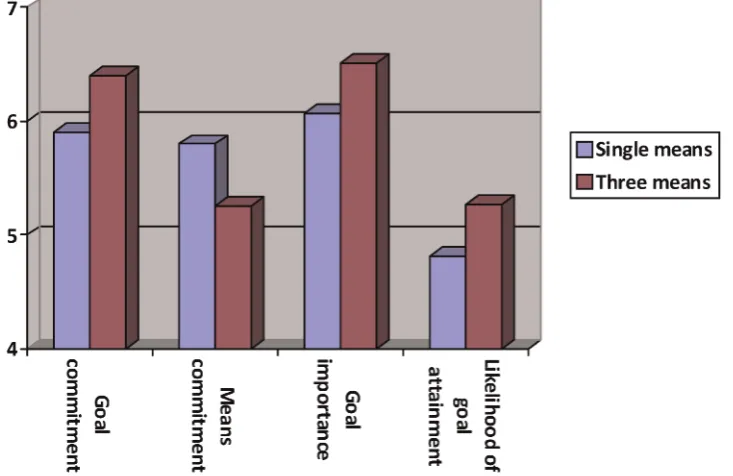
Results of four separate between-subject ANOVAs (see Figure 2) revealed that participants in the multiple (vs. the single) means condition exhibited: (1) greater perceived likelihood of goal attainment (M¼5.27, SD¼.94 and M¼4.81, SD¼1.01, respectively; F(1,94)¼5.28, p<.05,
h2¼.05); (2) greater goal importance (M¼6.51, SD¼.56 and M¼6.07, SD¼1.02, respectively; F(1,94)¼6.78, p<.01), h2¼.07); (2) greater goal commitment (M¼6.38, SD¼.70 and M¼5.97, SD¼1.04, respectively; F(1,94)¼
5.03, p<.05, h2¼.05); and (4) lesser commitment to the particular means (i.e., lesser negative emotional impact of failure with respect to a particular means) (M¼5.26, SD¼1.27 and M¼5.79, SD¼1.03, respectively; F(1,94)¼
5.04,p<.05, h2¼.05).
Also note that perceived likelihood of goal attainment, goal importance, and goal commitment are all positively correlated with each other: Perceived likelihood of goal attainment and goal importance, r¼.47, p<.001; perceived likelihood of goal attainment and goal commitment,r¼.55,p<.001; goal importance and goal commitment,r¼.63,p<.001, consistent with the results of our previous two studies.
Goal Commitment and Mean-set Size: The Mediating Role of Perceived Likelihood of Goal Attainment and Goal Impor-tance
Our hypothesis regarding the mediating role of both perceived likelihood of goal attainment and goal importance in the relation between goal commitment and means set-size (recoded as a dummy variable, with single-means con-dition¼0 and multiple-means condition¼1) was tested via the multiple mediation model of the Study 1 employing the
Preacher and Hayes’s (2008) procedure to extrapolate estimates of direct and indirect effects.
The results indicate that the totaleffect of means set-size on goal commitment was significant, coeff. .41, p<.05, whereas the direct effect of means set-size on goal commitment was non-significant, coeff. .05, p¼.71. The directeffects of means set-size on the both two mediators were significant (on goal importance, .44,p<.05, and on perceived likelihood of attainment, .46,p<.05, respectively). Also, the direct effects of the two mediators on goal commitment were both significant (path coefficients of goal importance on goal commitment, .51, p<.001, and of perceived likelihood of attainment on goal commitment, .29,p<.001. Finally, the total indirect effect of means set-size on goal commitment was significant (.35,p<.01, with BCa 95%CI of .1285 to .6570 not containing zero). More importantly, the two indirecteffects of means set-size on goal commitment through the two mediators were significant: The effect of means set-size on goal commitment was mediated by both perceived likelihood of attainment (indirect effect¼.13, p<.05, with BCa 95%CI of .0328 to .3112 not containing zero), and goal importance (indirect effect¼.22,p<.05, with BCa 95%CI of .0665 to .5004 not containing zero). The pair-wise contrast among these indirect effects was non-significant (.09,p¼.37, with BCa 95%CI of .1024 to .3128 containing zero), indicating that the magnitude of these effects is comparable. Overall, the multiple mediator model was significant,F(3,92)¼
28.39,p<.0001, withR2¼.48, and Adj.R2¼.46. This result conceptually replicates the findings of Studies 1 and 2 and is consistent with the hypothesis that both perceived likelihood of goal attainment and goal importance mediate the relation between equifinality set-size and goal commitment.
Discussion
Results of Study 4 replicate and conceptually extend those of Study 3. Once again, manipulated number of means to a goal was seen to affect in opposite ways commitment to the goal and to the means. Whereas goal commitment was higher, means commit-ment was lower in the multiple (vs. the single) means condition. Notably, this effect was obtained in a between-participants’ design wherein participants did not confront a salient comparison between goals with multiple versus single means (afforded in the within-participants’ design of Study 3). Last, but not least important, Study 4 replicated, this time in an experimental setting, the finding obtained in Studies 1 and 2 concerning the mediating role of both perceived likelihood of goal attainment and goal importance in the relation between size of the equifinality set and goal commitment.
GENERAL DISCUSSION
In pursuing their various objectives, people select the means for effecting goal progress. In some instances they might confront a sizable selection of equifinal means to choose from, whereas in other instances the selection might be quite limited. The question addressed in this research considered how the size of such an equifinality set affects individuals’ psychology of goal pursuit,
specifically their commitment to the goal they are striving to attain and to their specific means of attainment. We assumed that the size of the equifinality set would have contrasting effects on commitment to goal and to means. Because of their substitut-ability, we assumed that a sizable equifinality set would have a positive effect on goal commitment by (1) increasing perceived goal attainability, or the subjective likelihood of accomplishing one’s purpose, as well as (2) affording the availability heuristic (Tversky & Kahneman, 1974) whereby the greater number of means is treated as evidence of goal importance. At the same time, a sizable equifinality set should have a negative effect on means commitment: Because of the availability of alternative means, one may perceive any given means as less essential to goal pursuit, and be less affected by failure experiences associated with any given means.
Our studies provide consistent support for this analysis. In Studies 1 and 2, participants freely generated different numbers of means to their work-related goals, and we found that means number decreased means commitment while increasing goal commitment. Both studies also contained consistent evidence that the relation between means number and goal commitment was mediated by perceived likelihood of goal attainment and goal importance.
The strongest evidence for our analysis comes from Studies 3 and 4, which manipulated the equifinality set size experimentally. Accordingly, Study 3, using a within-participants design, found that goals to which the within-participants were induced to generate multiple means were consequently judged to warrant the investment of greater effort then goals to which the participants were instructed to generate but a single means, while the generation of multiple (versus single) means reduced perceived means commitment as assessed via expected magnitude of emotional reactions to means failures. Finally, Study 4 replicated this data pattern using a between-participants design, affording a generalization of our findings beyond the case where individuals’ attention is focused specifically on a comparison between single and multiple means goals (as in the within subjects design of Study 3). Additionally, Study 4 replicated the findings of Studies 1 and 2 concerning the mediational role of perceived likelihood of goal attainment and goal importance in bridging the relation between equifinality set size and goal commitment. All in all then, the present series of studies provides robust support for our hypotheses, and corroborates them consistently and across a wide variety of theoretically irrelevant specifics having to do with the participants and organizations studied, the types of goals and means mentioned, and method of operationalizing means generation (via free generation in Studies 1 and 2, and experimentally controlled generation in Studies 3 and 4).
to a current relationship. They proposed that circumstances under which an individual will exit from a relationship will ‘‘depend mainly on the quality of the best of the member’s available alternatives’’ (p. 22). That is, an individual would be less dependenton a relationship in the presence of multiple alternative (or substitutable) relationships. In a similar vein, empirical tests of Rusbult’s (1980) commitment model support the hypothesis that the quality of alternative available relationships constitute determinants of relationship commit-ment (Rusbult, 1983; Rusbult, Johnson, & Morrow, 1986). In present terms, any relationship could be considered a mode of gratifying one’s social and emotional needs (such as love, sex, caring): Alternative relationships simply constitute alternative means to those ends. Having such alternative relationships available reduces one’s dependency on a given relationship as means to one’s goal satisfaction.
The present findings additionally suggest that beside impact-ing commitment to a means, in this instance commitment to a given relationship, a large number of equifinal means would impact individuals’ commitment to the corresponding goal, in this instance the social and emotional goals served by a relation-ship. In the realm of relationships, a large number of options could intensify individuals’ ‘‘fixation’’ on, or commitment to, those goals. Potentially, this analysis could afford insight into various goal-commitment phenomena in the relational domain, for instance, love as a goal in itself (the ‘‘falling in love with love’’ syndrome), sex addiction, etc. From that perspective, having multiple romantic partners available might increase one’s commitment toromance as a goal, and having multiple sexual partners available might increase one’s fixation on sex as a goal. It is of interest to consider personality, cultural, and situa-tional determinants of equifinality set size. For instance, indivi-duals’regulatory mode(Higgins, Kruglanksi, & Pierro, 2003; Kruglanski et al., 2000) might be relevant in this connection: High (vs. low) ‘‘locomotors’’ might latch on to the first available means that affords goal pursuit (and, therefore, movement) and fail to generate alternative modes of advancing toward one’s objectives. In contrast, high (vs. low) ‘‘assessors’’ might be particularly keen on generating multiple means to a goal.
Another, potentially relevant variable in this connection might be the need for cognitive closure, with individuals who are low (vs. high) on this need generating a wider array of alternative means (Kruglanski, 2004; Kruglanski, Pierro, Mannetti, & De Grada, 2006). Furthermore, individuals who are promotion focused (Higgins et al., 2003) might generate a greater number of means to choose from, whereas individuals who are prevention focusedmight be inclined to come up with a narrower number of alternative means, in order to minimize the possibility of failure. These possibilities might be profitably explored in further research on the role of equifinality set size in self-regulation.
REFERENCES
Berger, C. R. (1988). Planning, affect, and social action generation. In L.
Donohue, H. E. Snyder, & T. E. Higgins (Eds.), Communication, social
cognition, and affect(pp. 93–116). Hillsdale, NJ: Erlbaum.
Festinger, L. (1957).A theory of cognitive dissonance. Oxford, England: Row,
Peterson.
Fishbach, A., & Ferguson, M. J. (2007). The goal construct in social
psychol-ogy. In A. W. Kruglanski, & E. T. Higgins (Eds.),Social psychology:
Handbook of basic principles(pp. 490–515). New York: Guilford Press.
Freud, S. (1920). A general introduction to psychoanalysis. New York:
Washington Square Press.
Gollwitzer, P. M., & Kirchhof, O. (1998). The willful pursuit of identity. In J.
Heckhausen, & C. S. Dweck (Eds.),Motivation and self-regulation across
the life-span(pp. 389–423). Cambridge, England: Cambridge University Press.
Heider, F. (1958).The psychology of interpersonal relations. New Jersey: John
Wiley & Sons, Inc.
Higgins, E. T., Kruglanski, A. W., & Pierro, A. (2003). Regulatory mode: Locomotion and assessment as distinct orientations. In M. P. Zanna (Ed.), Advances in experimental social psychology(pp. 293–344). San Diego, CA: Academic Press.
Kruglanski, A. W. (1996). Goals as knowledge structures. In P. M. Gollwitzer,
& J. A. Bargh (Eds.),The psychology of action(pp. 599–618). New York:
Guilford Press.
Kruglanski, A. W. (2004).The psychology of closed-mindedness. New York:
Psychology Press.
Kruglanski, A. W., & Kopetz, C. (2009). What is so special (and nonspecial) about goals?: A view from the cognitive perspective. In G. B. Moscowitz, &
H. Grant (Eds.),The psychology of goals(pp. 27–55). New York: Guilford
Press.
Kruglanski, A. W., Pierro, A., Mannetti, L., & De Grada, E. (2006). Groups as epistemic providers: Need for closure and the unfolding of group centrism. Psychological Review,113, 84–100.
Kruglanski, A. W., Shah, Y. J., Fishbach, A., Friedman, R., Chun, W. Y., & Sleeth-Keppler, D. (2002). A theory of goal-systems. In M. P. Zanna (Ed.), Advances in experimental social psychology(pp. 331–376). San Diego, CA: Academic Press.
Kruglanski, A. W., Thompson, E. P., Higgins, E. T., Atash, M. N., Pierro, A., Shah, J. Y., et al. (2000). To ‘do the right thing’ or to ‘just do it’: Locomotion
and assessment as distinct self-regulatory imperatives.Journal of
Person-ality and Social Psychology,79, 793–815.
Lewin, K. (1935).A dynamic theory of personality. New York, NY:
McGraw-Hill.
Petty, R. E., & Cacioppo, J. T. (1986).Communication and persuasion: Central
and peripheral routes to attitude change. New York: Springer Verlag. Preacher, K. J., & Hayes, A. F. (2008). Asymptotic and resampling strategies
for assessing and comparing indirect effects in multiple mediator models. Behavior Research Methods,40, 879–891.
Rusbult, C. E. (1980). Commitment and satisfaction in romantic associations:
A test of the investment model.Journal of Experimental Social Psychology,
16, 172–186.
Rusbult, C. E. (1983). A longitudinal test of the investment model: The development (and deterioration) of satisfaction and commitment in
hetero-sexual involvements.Journal of Personality and Social Psychology, 45,
101–117.
Rusbult, C. E., Johnson, D. J., & Morrow, G. D. (1986). Predicting satisfaction and commitment in adult romantic involvements: An assessment of the
generalizability of the investment model.Social Psychology Quarterly,49,
81–89.
Shah, J. Y., & Kruglanski, A. W. (2003). When opportunity knocks: Bottom-up
priming of goals by means and its effects on self-regulation.Journal of
Personality and Social Psychology,84, 1109–1122.
Steele, C. M., & Liu, T. J. (1983). Dissonance processes as self-affirmation. Journal of Personality and Social Psychology,45, 5–19.
Tesser, A. (2000). On the confluence of self-esteem maintenance mechanism. Personality and Social Psychology Review,4, 290–299.
Thibaut, J. W., & Kelley, H. H. (1959). The social psychology of groups.
Oxford, England: Wiley.
Tolman, E. C. (1932).Purposive behavior in animals and men. New York:
Century Co.
Tversky, A., & Kahneman, D. (1974). Judgment under uncertainty: Heuristics
and biases.Science,185, 1124–1130.
van Lange, P. A. (2007). The goal construct in social psychology. In A. W.
Kruglanski, & E. T. Higgins (Eds.),Social psychology: Handbook of basic
principles(pp. 490–515). New York: Guilford Press.
Wicklund, R. A., & Gollwitzer, P. M. (1981). Symbolic self-completion,
attempted influence, and self-deprecation.Basic and Applied Social
Psy-chology,2, 89–114.