R E S E A R C H A R T I C L E
Open Access
EvoGrader: an online formative assessment tool
for automatically evaluating written evolutionary
explanations
Kayhan Moharreri
1, Minsu Ha
2and Ross H Nehm
3*Abstract
EvoGrader is a free, online, on-demand formative assessment service designed for use in undergraduate biology classrooms. EvoGrader’s web portal is powered by Amazon’s Elastic Cloud and run with LightSIDE Lab’s open-source machine-learning tools. The EvoGrader web portal allows biology instructors to upload a response file (.csv) containing unlimited numbers of evolutionary explanations written in response to 86 different ACORNS (Assessing COntextual Reasoning about Natural Selection) instrument items. The system automatically analyzes the responses and provides detailed information about the scientific and naive concepts contained within each student’s response, as well as overall student (and sample) reasoning model types. Graphs and visual models provided by EvoGrader summarize class-level responses; downloadable files of raw scores (in .csv format) are also provided for more detailed analyses. Although the computational machinery that EvoGrader employs is complex, using the system is easy. Users only need to know how to use spreadsheets to organize student responses, upload files to the web, and use a web browser. A series of experiments using new samples of 2,200 written evolutionary explanations demonstrate that EvoGrader scores are comparable to those of trained human raters, although EvoGrader scoring takes 99% less time and is free. EvoGrader will be of interest to biology instructors teaching large classes who seek to emphasize scientific practices such as generating scientific explanations, and to teach crosscutting ideas such as evolution and natural selection. The software architecture of EvoGrader is described as it may serve as a template for developing machine-learning portals for other core concepts within biology and across other disciplines.
Keywords:Online assessment; Computers; Technology; Supervised Machine Learning; Training set; Scoring Model; Classifier; Evolution; Natural Selection; Undergraduates
Background
The landscape of science assessment is being transformed throughout the educational hierarchy in the United States (National Research Council 2012). The movement towards the assessment of complex tasks—such as explaining one’s reasoning, constructing an argument, testing hypotheses, or defending an explanation—is becoming the new norm. The 2012Advanced Placement(AP) biology exam, for example, doubled the number of open-ended questions and dramat-ically reduced the number of multiple-choice questions (Duncan 2013). The new Framework for K-12 Science
Education(National Research Council 2012) recommended assessing students’ scientific competencies by examining their mastery of so-called scientific practices such as explanation, argumentation, and communication of core ideas, none of which can be meaningfully measured using multiple-choice tests (Nehm, Ha and Mayfield 2012b). The U.S. Secretary of Education notes that every year more and more assessments in K-12 education will move to an online environment, opening up additional opportunities for novel forms of knowledge and skill measurement (Duncan 2013).
In introductory biology—one of the most highly enrolled science classes in the U.S.—formative and summative multiple-choice assessments (e.g., clicker questions, mid-term exams) remain the norm, greatly limiting the range of skills and competencies that can be assessed (Ha et al. 2011; Nehm and Haertig 2012). Open-ended formative and * Correspondence:[email protected]
3Center for Science and Mathematics Education, and Department of Ecology and Evolution, Stony Brook University, 092 Life Sciences Building, 11794 Stony Brook, NY, USA
Full list of author information is available at the end of the article
© 2014 Moharreri et al.; licensee Springer. This is an Open Access article distributed under the terms of the Creative Commons Attribution License (http://creativecommons.org/licenses/by/2.0), which permits unrestricted use, distribution, and reproduction in any medium, provided the original work is properly cited.
summative assessment tools remain scarce in introductory biology because of the time and cost associated with scor-ing written responses, raisscor-ing questions about how biology educators teaching large classes will be able to foster the development of the diverse array of skills and practices emphasized in recently developed education reform docu-ments for undergraduate biology education (e.g.,Vision and Change: American Association for the Advancement of Science 2011).
In response to these challenges, we introduce EvoGrader, one of the first non-commercial machine-learning assess-ment tools designed for use in introductory biology. We discuss how the assessment system works, provide evidence to support inferences about how scores align with student understanding, and illustrate how it may be used to assess learning of a core concept—natural selection—in the context of the scientific practice of explanation (National Research Council 2012). We also review the architecture of the underlying automated assessment system and discuss how it could be modified to assess student understanding of other core ideas and other scientific practices.
An online formative assessment tool
The Web portal
EvoGrader is a free, online, on-demand assessment service. It automatically grades written (typed) evolutionary expla-nations produced in response to ACORNS assessment items (Assessment of COntextual Reasoning about Natural Selection, Nehmet al.2012a) and“ACORNS-like” assess-ment items (e.g. questions found in Bishop and Anderson 1990; and many other evolution education studies). All of these instruments contain similar item formats: open-ended questions that ask students to explain how patterns of evolutionary change occurred (from the standpoint of a biologist). Such assessment tasks have been shown to be very useful for understanding student thinking processes (Opfer et al. 2012) and measuring evolutionary understand-ing (Nehm and Schonfeld 2008, 2010). ACORNS (and ACORNS-like) items are also useful for high school and undergraduate educators because they allow students to practice building scientific explanations, communicating their ideas through writing, and documenting their under-standing of the core idea of natural selection (Demastes et al. 1995). Despite their usefulness, these types of assess-ment tasks take large amounts of time to score. EvoGrader was developed to solve this problem.
EvoGrader is a web portal (see www.evograder.org) that contains an on-demand query box requesting the upload of students’written evolutionary explanations (in .csv format). After upload and“one-click”analysis, EvoGrader generates reports illustrating the presence or absence of accurate scientific ideas (key concepts), non-normative concepts (naïve ideas), and holistic reasoning models (pure scientific, “mixed”, and pure non-normative) in each student’s
response and in the sample of responses as a whole. The system rapidly performs the difficult work of grading written items that for the past 30 years have been used in science education research and practice (for a review, see Nehm and Ha 2011). Responses to 86 different items can be scored using the EvoGrader web portal, which relies on machine-learning methods.
Supervised machine learning: the core of EvoGrader
EvoGrader uses machine learning methods to extract key concept scores, naïve idea scores, and holistic reasoning model scores from text responses. An integral part of supervised machine learning in this case is a large corpus of explanations previously scored by domain experts. This corpus (i.e. training set) helps the software“learn”what to look for in the written explanations, and lies at the heart of EvoGrader portal. In order to understand how EvoGrader works, it is necessary to understand some basics about machine learning. The analysis of restaurant ratings will be used as an example to illustrate how machine learning can be applied in order to classify text
Perhaps a restaurant owner is interested in customers’ opinions about the meals that are served, and collects a large number of written reviews online. In order to deter-mine how many customers liked and did not like the meals, the restaurant owner must categorize the reviews into groups: e.g., positive reviews and negative reviews. In order to score the reviews a rubric with classification rules would need to be developed. For example, if a review included positive terms such as ‘good’, ‘nice’, or ‘delicious’, then it could be classified into the ‘positive review’category. On the other hand, if the review included negative terms such as ‘bad’, ‘unpalatable’, or ‘disgusting’, the review could be classified into the‘negative review’category. Combinations of terms–such as ‘not’+ key words (e.g., not good, not bad)–could also classified into categories (e.g.,‘not good’ classified as a“negative review”). With these simple classifi-cation rules, the restaurant owner categorizes 300 of the 600 reviews.
second method, the owner only has to provide the scored reviews, and not specify all of the rules and terms used to characterize each review.
Now let us assume that the new employee is replaced by a computer (i.e., machine) that is capable of either using the predefined classification rules, or coming up with new rules based on the pre-classified data. This frames the res-taurant review scoring as a machine-based text classifica-tion problem. The first method outlined above (i.e., specifying classification rules and terms characteristic of positive and negative restaurant reviews) is known as rule based text analysisand has been utilized in prior studies in science education (see [Nehm and Haertig 2012], and [Haudek et al. 2012]). The second method outlined above (i.e., using existing sets of classified data to infer the scoring rules) is how EvoGrader works, and is known assupervised machine learning (see [Nehm et al. 2012b], [Ha et al. 2011]). The primary goal ofsupervised machine learningis to discover classification rules given a corpus of classified data and then to apply those rules to score new unlabeled data. Machine learning methods are often used to minimize human effort and interactions while enhancing automation. Returning to the restaurant example, if the owner decides to take the second approach (i.e., having the new employee use the classified data to infer classification rules and diag-nostic text terms) the new employee will need to identify ‘positive reviews’ and ‘negative reviews’ and discover key terms diagnostic of each category. In supervised machine learning, the identification of these diagnostic classification terms is known asfeature extraction. Extracting discrimin-ating and independent features is key to any machine learn-ing process. Next, the employee has to come up with a procedure for building the classification rules based upon the key terms in each review and with respect to each review’s category. This procedure is known as model construction. The new employee could score a subset of the owner’s reviews and compare his classification with the owner’s classification to estimate how well his rules worked. In machine learning, this step is known asmodel validation. Once the new employee’s classification rules produce identi-cal review ratings as the owner’s ratings, he is qualified to classify new sets of reviews. Classification of new reviews is known asprediction. In our restaurant example, we can con-sider the owner to be thehuman raterfor the 300 reviews (i.e., the training dataset) and the employee as the“machine” that performsfeature extraction, model construction,model validation, andclassificationof new reviews.
Similar to the employee’s job of inferring the classification rules that the restaurant owner used to score the reviews as “positive” or “negative,” EvoGrader attempts to develop classification rules that predict the presence or absence of particular evolutionary ideas or concepts in a given written explanation. Unlike the restaurant review, where only one classification target is present (positive or negative review),
many different classification targets (ideas or concepts) could be present in students’responses to questions about natural selection. Consequently, different scoring models (i.e., classifiers) are needed for each target. Thus, for each concept in students’ responses, feature extraction, model construction, andmodel validationmust be performed.
EvoGrader architecture: back-end training and front-end scoring
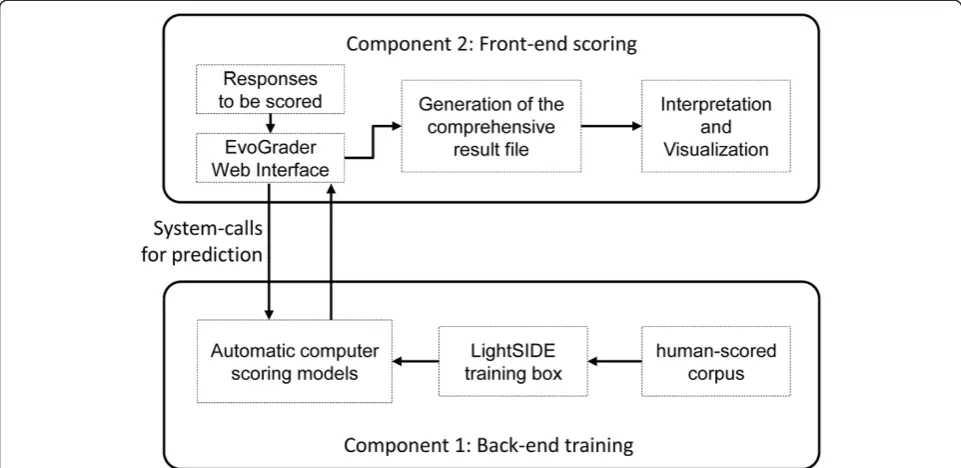
Because EvoGrader utilizes supervised machine learning, which in turn relies on discovering classification rules in a corpus of human-classified data, very large pre-scored data sets (text corpora) are required for both system training (i.e., learning from existing data) and system testing (i.e., examining the strength of classification algorithms). EvoGrader is divided into two major components: (1) a back-endtraining component, and (2) a front-end scoring component (Figure 1). We discuss details of the back-end training and front-end scoring components below.
Component 1: Backend training. The construction of scoring models, which takes place in the back-end training part of EvoGrader, is an offline, one-time process. The purpose of the back-end training component is to generate scoring models for each concept that will be fed into the front-end component of EvoGrader. Constructing scoring models is a very resource-intensive process; a large corpus is needed for system training, which itself requires large amounts of time, processing power, and memory consump-tion. Once the scoring models are generated, however, they can be stored permanently and retrieved on-demand by the front-end component. The backend training component includes three parts: (a) the corpus of human-scored responses; (b) the LightSIDE training box; and (c) the automatic computer scoringmodels (Figure 1).
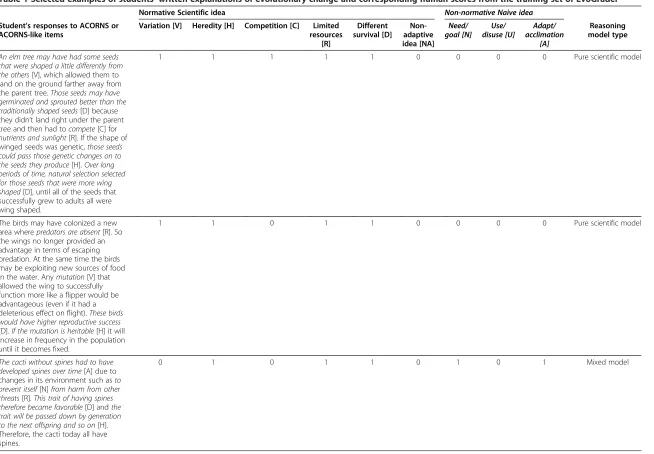
A very large and diverse human-scored corpus is needed to build classifiers that are capable of accurately predicting the presence or absence of concepts in new samples of written responses. The current version of EvoGrader makes use of 10,270 scored evolutionary explanations written by 2,978 participants (e.g., non-majors, first-year biology majors, senior biology majors, anthropology majors, and experts in evolutionary science [PhD students, post-doctoral fellows, and full-time faculty]). For each of the six key concepts and three naive ideas that have been defined in the evolution education literature (for details, see Nehm et al. 2010), a response was scored by human raters as present (1) or absent (0). Table 1 provides examples of student explanations from the corpus along with human-generated scoring patterns. Two raters (a PhD student in biology education and an evolution expert) scored these explanations and demonstrated acceptable inter-rater hu-man agreement (>0.81 kappa) for all normative scientific ideas and non-normative naive ideas. On average, it took four minutes to score the presence or absence of nine ideas
Moharreriet al. Evolution: Education and Outreach2014,7:15 Page 3 of 14
in one explanation. In total, it took approximately 685 hours for the two raters to generate the corpus that EvoGrader utilizes (note that these scored explanations were a byproduct of other research studies, and were not only gen-erated for machine-learning purposes). The final scored corpus used for system training was based on consensus scores between the two human raters.
The back-end of EvoGrader relies on the supervised machine learning tools of LightSIDE Labs’open-source pro-gram known as LightSIDE (Mayfieldet al.2013). LightSIDE performs three important functions in EvoGrader: feature extraction,model construction, andmodel validation. Using the human-scored corpus as a training set, algorithms are sought that yield nine unique scoring models (correspond-ing to the nine concepts). Offline, us(correspond-ing the human-scored corpus as a training set, LightSIDE develops scoring models for each of the nine concepts (see Table 1). The goal of this process is to find classifiers that fit the training dataset maximally, and subsequentlypredictscores on new datasets with high accuracy. Two approaches are used to determine whether these goals are met: cross validation and human expert review.
To build the nine scoring models offline, the human-scored corpus is imported into the LightSIDE application. Feature extraction in LightSIDE begins by turning each response in the corpus into a“bag of words”(Harris 1954). This approach simplifies text representation and reduces the dimensionality of the feature space. An inherent as-sumption in the bag of words representation is that words are considered independent of their place in the text. All of the words that have appeared at least once in the corpus
are entered into a‘corpus dictionary.’Highly frequent neu-tral words (e.g., “the, of, to”), punctuations (e.g., “,”), and very infrequent words (e.g.,“shall”) are removed from the corpus in order to minimize noise. The remaining words are significant and as long as they appear at a frequency above a cutoff value they will be included in the dictionary. Stemming may also be used, which treats words with the same stem (e.g., the stem “adapt” is common to “adapt”, “adapting”, and“adaptation”) as a single word. Bigram mod-eling (Cavnar and Trenkle 1994) may also be used and allows for the creation of double-word terms (e.g.,“passing on”,“differential survival”) in the dictionary.
It is important to emphasize that different concepts typically require different feature extraction settings (e.g., unigrams vs. bigrams, stemming vs. non-stemming, low vs. high cutoff values) (see Haet al.2013). For example, two bigram features – ‘had_to’, ‘so_that’— are comprised of highly frequent neutral words (e.g., had, to, so, that); never-theless, for some concepts–such as the non-normative concept of evolutionary needs/goals–they are crucial for building effective scoring models. The statistically opti-mized conditions forfeature extractionfor all nine scoring algorithms in EvoGrader are shown in Table 2.
Table 1 Selected examples of students’written explanations of evolutionary change and corresponding human scores from the training set of EvoGrader
Normative Scientific idea Non-normative Naive idea
Student’s responses to ACORNS or ACORNS-like items
Variation [V] Heredity [H] Competition [C] Limited resources
[R]
Different survival [D]
Non-adaptive idea [NA]
Need/ goal [N]
Use/ disuse [U]
Adapt/ acclimation
[A]
Reasoning model type
An elm tree may have had some seeds that were shaped a little differently from the others[V], which allowed them to land on the ground farther away from the parent tree.Those seeds may have germinated and sprouted better than the traditionally shaped seeds[D] because they didn’t land right under the parent tree and then had tocompete[C] for
nutrients and sunlight[R]. If the shape of winged seeds was genetic,those seeds could pass those genetic changes on to the seeds they produce[H].Over long periods of time, natural selection selected for those seeds that were more wing shaped[D], until all of the seeds that successfully grew to adults all were wing shaped.
1 1 1 1 1 0 0 0 0 Pure scientific model
The birds may have colonized a new area wherepredators are absent[R]. So the wings no longer provided an advantage in terms of escaping predation. At the same time the birds may be exploiting new sources of food in the water. Anymutation[V] that allowed the wing to successfully function more like a flipper would be advantageous (even if it had a deleterious effect on flight).These birds would have higher reproductive success
[D]. If the mutation is heritable[H] it will increase in frequency in the population until it becomes fixed.
1 1 0 1 1 0 0 0 0 Pure scientific model
The cacti without spines had to have developed spines over time[A] due to changes in its environment such asto prevent itself[N]from harm from other threats[R].This trait of having spines therefore became favorable[D] andthe trait will be passed down by generation to the next offspring and so on[H].
Therefore, the cacti today all have spines.
0 1 0 1 1 0 1 0 1 Mixed model
Moharreri
et
al.
Evolution:
Education
and
Outreach
2014,
7
:15
Page
5
o
f
1
4
http://ww
w.evolution-outreach.com
/content/7
particular response. The outputs of the feature extraction stage are these feature vectors.
Once feature extraction has been completed, model building and validation begin. In order to build scoring models, decision functions must be generated that are based on running the learning algorithm on the feature vectors. The objective of this process is to build binary classifiers for each concept that are capable of accurately predicting the presence or absence (1/0) of a concept in a given explanation. Unpublished research (Nehm, unpublished data) suggests that Sequential Minimal Optimization (SMO) (Platt 1999) is the most effective algorithm for the corpus used in EvoGrader.
Each binary classifier represents a decision function for one of the concepts. Therefore, SMO training is performed nine times (once for each concept). For each concept, inputs to the SMO training algorithm include feature vectors and corresponding human scores for that concept. SMO training is an iterative process that repeatedly chooses weight factors for the dictionary words based on the feature vectors and human scores for that concept. These iterations (again, for each individual concept) will continue until the binary classi-fier that is generated at the end of the iteration is able to classify all of the responses correctly with certain error threshold. Training the classifiers is a one-time process.
To validate each of these nine classifiers (for each of the nine concepts), ten-fold cross-validation is performed on each concept model. The cross-validation process involves segregating the corpus intoksubsets (e.g., ten-fold refers to 10 subsets) and performing model construction withk–1 subsets (e.g., nine subsets if ten-fold cross-validation is used); model validation is performed with the last subset.
The ten-fold cross-validation approach used in EvoGrader repeats this process 10 times and averages the results so that each subset can be validated once.
The training corpus may contain the data misclassified by the cross-validation process (Muhlenbach et al. 2004). Although the reasons for the misclassified data are usually the mislabeling of the data or spelling errors, the reasons are not apparent in many cases because of the complexity of the machine learning algorithm. In such cases, we can remove the misclassified data from the original training corpus and re-train the scoring algorithm using the new corpus (Muhlenbachet al.2004).
After feature extraction and model construction are completed for the nine binary classifiers, their performance is compared to performance thresholds (90% accuracy, and 0.8 kappa coefficients). If they fail, they are subjected to feature refinement. For example, using bigrams and unigrams might produce better performance than using unigrams alone (see Ha et al. 2013, for details on this process). Once the scoring models meet these benchmarks, they are saved and used by the front-end scoring component of EvoGrader.
Component 2: Front-end scoring. The scoring models generated in the back-end component of EvoGrader are used in the front-end component to classify each new response as “present” or “absent” for each of the nine concepts. To perform prediction, each new response is converted into a vector representation (as discussed above). Using the weights generated previously in the SMO training step, the system calculates whether the vector belongs to the “absent” class or to the “present” class.
Table 2 Concept types, names, and descriptions of EvoGrader scoring models
Concept type Concept name Concept description Methods used to optimize scoring models
Normative scientific idea
Variation The presence and causes (mutation/ recombination/sex) of variation
Unigram, Stemming, Removing Stopwords, Removing misclassified data
Heritability The heritability of variation (The degree to which a trait is transmitted from parents to offspring)
Unigram, Bigram, Stemming, Removing Stopwords, Removing misclassified data
Competition A situation in which two or more individuals struggle to get resources that are not available to everyone
Unigram, Stemming, Removing Stopwords
Limited resources Limited resources related to survival/reproduction, such as food and predators, and reproduction (such as pollinators)
Unigram, Stemming, Removing Stopwords, Removing misclassified data
Differential survival/ The differential reproduction and/or survival of individuals
Unigram, Bigram, Stemming, Removing Stopwords
Non-adaptive idea Genetic drift and related non-adaptive factors contributing to evolutionary change
Unigram, Stemming, Removing Stopwords
Non-normative naïve idea
Adapt/acclimation Adjustment or acclimation to circumstances (which may subsequently be inherited)
Unigram, Bigram, Stemming, Removing Stopwords, Removing misclassified data
Need/goal Goal-directed change; needs as a direct cause of evolutionary change
Unigram, Bigram, Stemming, Removing misclassified data
Use/disuse The use (or lack of use) of traits directly causes their evolutionary increase or decrease
The scoring component of EvoGrader is supported by Amazon’s Elastic Cloud service (EC2). EC2 provides resize-able, on-demand computation capacity in the ‘cloud’. In terms of scalability of the hosting service, EC2 is an appro-priate fit for EvoGrader because ‘bursty’ http traffic and sudden processing loads for scoring large datasets is anti-cipated to be common; it is difficult to predict when users will upload data files for analysis. Hosting EvoGrader on a virtual private cloud provides a flexible web service envir-onment that is capable of rescaling processing and memory power to maintain a reasonable response time for all of the users irrespective of the number of concurrent users.
The front-end scoring component of EvoGrader includes: (a)system-calls for prediction and generation of the compre-hensive result file,and (b)interpretation and visualization. We discuss each of these components in turn.
System-calls for prediction and generation of the compre-hensive result file. EvoGrader requires users to format student response data prior to upload into the web portal. Step-by-step video instructions are provided in the web portal (and written instructions are included in the Additional file 1). In brief, student identifiers and typed explanations are pasted into separate cells in a spreadsheet and the file is then saved in .csv (comma separated values) format. Response files can contain an unlimited number of typed explanations to up to eight different ACORNS items in one run (unlimited numbers of runs can be performed). File setup usually takes less than five minutes.
After upload to the EvoGrader portal, the system performs a round of preprocessing and verifies that the response file has been formatted properly. Then, for each item, scoring model files from the back-end training com-ponent are used to execute online scoring using LightSIDE. As noted above, LightSIDE is a standalone application, and therefore its prediction engine cannot service clients directly over the web. EvoGrader’s front-end performs this function. The application server generates a system call to invoke the local LightSIDE predictor. This system call will send an interrupt message to the operating system on the application server, and will initiate the scoring process using the parsed response file and the pre-constructed scoring models. In files that include responses to multiple items, EvoGrader generates temporary files for each item and passes them sequentially to the LightSIDE prediction engine. The automated scoring process usually takes less than an hour and the results are stored on the application server. As soon as the final temporary file corresponding to the last item is scored, the application server merges all of the results to produce a unified comprehensive result file for all of the items included in that run. At this stage, another system call from LightSIDE invokes loading of a java servlet that provides a downloadable result file.
Interpretation and visualization.The downloadable result file contains raw scoring results for all of the concepts and
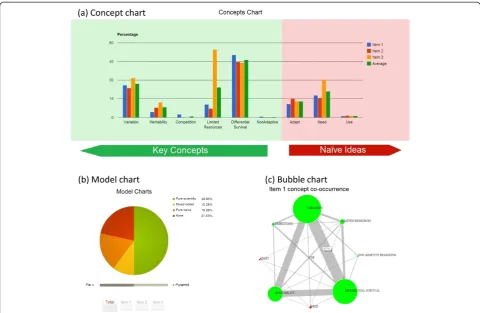
reasoning models. However, instructors do not need to download any files to discover actionable insights about their student response file. EvoGrader automatically generates charts and tables to help instructors interpret and visualize response patterns (Figure 2). Using Java servlet technology on the application server, as soon as the result file is gener-ated, in the background a parallel thread starts executing a general analysis of the results to generate required data for tables and charts. This parallel processing enhances resource and time utilization. Bar charts, pie charts, and bubble charts, visually represent types of reasoning models and concept use patterns in the sample (See Figure 2).
Using the EvoGrader system
Although it is apparent that the computational machinery that EvoGrader employs is complex (see above), using the system is easy. Users only need to know how to: (1) use spreadsheets, (2) upload a CSV file to the web, and (3) use an online web application. Complete step-by-step instruc-tions are included in video format on the EvoGrader web-site, and written instructions are included in the Additional file 1 for this paper. Overall, the system was designed to be usable to anyone with very basic computer skills.
Research questions
Prior work has demonstrated the utility of machine-learning and text analysis methods for scoring written evolutionary explanations (e.g., Beggrow et al.; Ha and Nehm 2012; Nehm and Haertig 2012). The present study goes beyond this prior work to analyze the efficacy of new scoring models derived from a much larger and more diverse human-scored corpus and optimized for use in an online environment (i.e., in the EvoGrader online portal). In addition to testing how well EvoGrader scores ACORNS instrument items, we also examine how well EvoGrader scores “ACORNS-like” items (i.e., not the 86 items designed for use in EvoGrader, but similar open-response evolution items). Because different assessment prompts and contexts have been shown to influence students’ideas (and the corresponding language used to express these ideas, see Nehm and Ha 2011), it is an open question as to whether EvoGrader might be able to effectively grade written responses to ACORNS-like questions developed by other researchers. Some instructors may want to use their own short-answer questions, or they may have already collected students’ essays relating to natural selection before they became aware of the ACORNS instrument. For these reasons, it would be useful to know how well the system works with such responses. In short, the empirical ques-tions addressed in this study are: (1) How well do the new scoring models in the EvoGrader portal perform compared to trained human scorers? And (2) How well does the EvoGrader portal perform on ACORNS-like items? In order to compare EvoGrader performance to human
Moharreriet al. Evolution: Education and Outreach2014,7:15 Page 7 of 14
performance in these two contexts, several different methods are employed using two new student response corpora.
Methods
Human vs. computer scoring of evolutionary explanations: concepts and models
In order to evaluate EvoGrader’s scoring performance, EvoGrader-generated scores were compared to the human-generated scores. Two different categories of scores were compared: first, those for six normative scientific concepts (variation, heritability, competition, limited resources, differential survival/reproduction, and non-adaptive ideas (e.g., genetic drift) and those for three non-normative ideas (needs and goals [teleology], use and disuse [‘use-inheritance], and adapt/acclimation) (see Table 2 for detailed descriptions of these concepts). All of these ideas have been commonly found in research on student thinking about evolution (e.g., Bishop and Anderson 1990; Nehm and Reilly 2007).
In addition to studying concept use patterns in the written responses, we also examined students’ overall reasoning patterns (i.e., holistic models). Specifically, we used the cognitive models outlined by Nehm et al.(2009)
to categorize each student response into one of four categories: a scientific model (including only normative scientific ideas), a mixed model (including both scientific and naïve ideas), a naïve model (including only non-normative naive ideas), or no model (rephrasing the question, providing extraneous information, or not answering the question directly).
The scoring rubrics of Nehmet al.(2010) were used to guide the production of human-generated scores. Detailed examples of student responses, and how to score them, are included in this 40-page rubric set. Two trained human raters who demonstrated sufficient inter-rater agreement (>0.80 kappa for all normative scientific ideas and non-normative naive ideas) produced these scores. Consensus scores between the two raters were used for all statistical comparisons to EvoGrader.
correlation. Cohen’s kappa accounts for chance agreements between raters, and is a widely-used measure quantifying inter-rater reliability in education and medical research. In our study, the two raters were EvoGrader and a trained human scorer. Although different studies have suggested different cutoff scores for Cohen’s kappa, the benchmarks suggested by Landis and Koch (1977) and Fleiss (1971) were used in the evaluation of EvoGrader performance: ‘almost perfect’: 0.81-1.00 (Landis and Koch 1977) and ‘excellent’: 0.75 –1.00 (Fleiss 1971) (see Bejar (1991) and Ha et al.([Ha et al. 2011]) for additional details about these tests).
Raw agreement percentages are also reported (the percentage of total agreements between EvoGrader and the human rater). Note that this raw measure does not account for chance agreements, but it provides a very intuitive metric of correspondence.
Precision and recall are widely used measures in informa-tion retrieval studies (Ha et al. 2013; Su 1994). Precision indicates the percentage of correct predictions among total positive predictions, whereasrecallindicates the percentage of correct predictions among total positive cases. Precision refers to how frequently EvoGrader overestimates correct responses. For example, precision will decrease when the scoring model predicts that a particular concept is shown in the student’s response when in fact it is not. In contrast, recall refers to how many responses containing correct concepts were appropriately classified. Therefore, recall will decrease when the scoring models fail to detect a concept. Precision and recall exhibit a trade-off relationship; when one increases, the other decreases. Consequently, a composite measure of precision and recall known as F1is
often used (i.e., the harmonic mean of precision and recall). Spearman’s rank correlation coefficients were also used to calculate correspondence between two different‘holistic’ measures: total key concept scores and total naïve idea scores. Although Pearson correlation coefficients have been used to quantify such correspondence in previous studies (Beggrow et al.; Ha and Nehm 2012), Spearman’s rank cor-relation is more appropriate in the present study because the range of scores for a single item was small and the distribution was not normal. Quality benchmarks for Pearson correlation coefficients have been established in bioinformatics; many bioinformatics studies consider Pearson correlation coefficients > 0.9 to be‘nearly identical’ (e.g., Satoet al.2005; Zhu et al.2002) and so we adopted this benchmark for our Spearman’s rank correlation tests.
Participant samples used to test scoring performance Two new student response corpora were used to compare EvoGrader performance to human-rater performance. The first corpus included 1100 student answers written in response to 86 different ACORNS items. This sampling strategy was used to produce a conservative estimate of
EvoGrader performance. All of these responses were from students enrolled in introductory biology classes at one public Midwestern university.
The second corpus was produced in response to an “ACORNS-like”item that was developed by a researcher as part of an unrelated study. The second corpus (n = 1100) contained students’ responses to a question about the evolution of orchid leaves. These data were collected from undergraduates at 59 different institutions. In sum, 2200 written explanations were independently scored for the presence or absence of evolutionary concepts by both EvoGrader and by humans.
Results
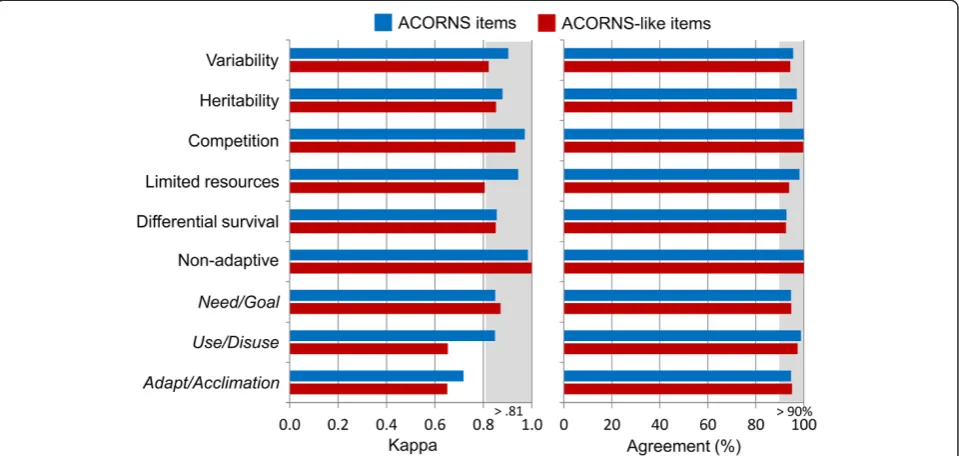
Table 3 illustrates five correspondence measures (i.e., kappa values, agreement percent, precision, recall, and F1scores)
for the six key concepts (i.e.,variation, heritability, differen-tial survival, competition, limited resources, and non-adaptive ideas). As shown in Table 3, the kappa values for all six key concepts exceeded the ‘almost perfect’ (>0.81) level, and raw percentage agreement levels reached or exceeded 95% for ACORNS responses. In contrast, for ACORNS-like responses, kappa values for the limited re-sources concept did not reach the‘almost perfect’ (>0.81) level (0.806). However, kappa values for the other five key concepts exceeded the ‘almost perfect’ (>0.81) level (See Figure 3).
For naïve ideas, the kappa values and agreement percent-ages for needs/goals and use/disuse exceeded the ‘almost perfect’(>0.81) kappa value and nearly reached or exceeded the 95% agreement level. However, the naïve ideas of ‘adapt/acclimation’did not reach the 0.75 kappa value that Fleiss (1971) considered to be an excellent kappa value. Nevertheless, the raw agreement percentage for adapt/ acclimation almost reached 95%. For the naïve ideas detected in ACORNS-like responses, the kappa values and agreement percentages for needs/goals also exceeded the ‘almost perfect’(>0.81) kappa value and nearly reached the 95% agreement level. However, the naïve ideas of use/disuse and adapt/acclimation did not reach the 0.70 kappa level.
Prior to reporting the human-EvoGrader kappa and raw agreement correspondence measures for the four evolutionary reasoning models (e.g., scientific models, mixed models, naïve models, and no models), it is im-portant to note that whereas binary coding characterized the concept presence/absence data reported above, qua-ternary (4*4) coding characterized the reasoning model data. Consequently, the quaternary human-computer model agreement will be less probable than the binary concept agreement. Nevertheless, kappa agreement values for model types were strong and exceeded 0.81; agreement percentages were also robust at 88.4% (See Figure 4). On the other hand, the kappa and agreement percentages for ACORNS-like items were lower than
Moharreriet al. Evolution: Education and Outreach2014,7:15 Page 9 of 14
Table 3 Performance measures for EvoGrader for ACORNS (n = 1100 written explanations) and ACORNS-like written responses (n = 1100 written resppnses) (n = 2200 total written explanations)
Concept frequency (%) Kappa Agreement (%) Precision Recall F1
Concept type Concept ACORNS ACORNS-like ACORNS ACORNS-like ACORNS ACORNS-like ACORNS ACORNS-like ACORNS ACORNS-like ACORNS ACORNS-like
Normative scientific idea
Variation 35.3 21.5 0.903 0.822 95.6 94.4 97.0 93.9 90.5 78.8 93.6 85.7
Heritability 14.7 22.3 0.879 0.852 97.1 95.2 95.1 97.5 84.6 80.4 89.5 88.1
Competition 1.6 2.2 0.971 0.932 99.9 99.7 100.0 100.0 94.4 87.5 97.1 93.3
Limited resources 20.5 22.4 0.944 0.806 98.2 93.9 96.4 99.4 94.7 73.2 95.5 84.3
Differential survival 46.2 55.8 0.855 0.851 92.8 92.6 93.2 94.6 91.1 92.0 92.1 93.3
Non-adaptive idea 3.0 0.1 0.984 1.000 99.9 100.0 100.0 100.0 97.0 100.0 98.5 100.0
Non-normative naïve idea
Need/Goal 22.8 29.0 0.849 0.871 94.7 94.8 89.4 95.2 87.3 86.5 88.3 90.6
Use/Disuse 4.1 4.3 0.848 0.653 98.8 97.4 86.4 72.5 84.4 61.7 85.4 66.7
Adapt/Acclimation 10.6 9.7 0.718 0.651 94.7 95.1 76.1 94.9 73.5 52.3 74.8 67.5
al.
Evolution:
Education
and
Outreach
2014,
7
:15
Page
10
of
14
outreach.com
/content/7
those for ACORNS responses (kappa: 0.766, agreement percentage: 84.8%).
Spearman’s rank correlations of total key concept and naïve idea scores for the ACORNS responses were 0.927 (p< < .01) and 0.835 (p< < .01), respectively. On the other
hand, Spearman’s rank correlation total scores for key concepts and naïve ideas for the ACORNS-like responses were slightly lower at 0.890 (p< < .01) and 0.837 (p< < .01), respectively.
In sum, EvoGrader performed very well at the concept and reasoning model level for ACORNS items, and did fairly well when provided with responses to “ACORNS-like”items.
Discussion
The scoring efficacy of EvoGrader
In undergraduate biology education, few formative assess-ment systems exist for helping students practice building scientific explanations using core ideas (such as evolution and natural selection) (see National Research Council 2012). The EvoGrader system is one of the first non-commercial online tools to use machine learning to evaluate evolution-ary explanations. Our research findings demonstrate the efficacy of the system using responses to both ACORNS and ACORNS-like assessment items. EvoGrader successfully scores and reports the key concepts, naïve ideas, and evolutionary reasoning models contained within students’ written explanations of evolutionary changes within an hour (or slightly longer for > 5000 written explanations).
Compared to commonly used benchmarks of statistical correspondence, EvoGrader-generated key concept scores are “almost perfect” (kappa > 0.81) and “nearly identical” (correlation > 0.9) to human-generated scores. Specifically, the kappa coefficients for all six key concepts (e.g.,variation, heritability, competition, limited resource, differential survival/reproduction, non-adaptive idea) exceeded 0.81, Figure 3Human-EvoGrader grading correspondence measures for individual concepts (see text for detailed descriptions and examples of each concept). Blue bars = ACORNS items and Red bars = ACORNS-like items. Shaded areas indicate robust scoring quality.
Figure 4Evolutionary reasoning models diagnosed by a trained human rater and the EvoGrader system (total n = 2,200). See text for descriptions of model types. Top graph: N = 1,100 written explanations for ACORNS items. Bottom graph: 1,100 written explanations for ACORNS-like items.
Moharreriet al. Evolution: Education and Outreach2014,7:15 Page 11 of 14
and those for competition, limited resources, and non-adaptive ideas exceeded 0.91. The correlation between EvoGrader-generated and human-scored total key concept scores was 0.927.
EvoGrader scoring models for naïve ideas displayed robust but slightly lower agreement compared to the results for key concepts. EvoGrader detected the naïve ideas of needs/goals(0.849) anduse/disuse(0.848) above the bench-mark of kappa (0.81). In contrast,adapt/acclimationhad a kappa score of 0.718 and a raw agreement of 94.7%. Despite EvoGrader’s slightly lower performance on this naïve idea, the correlation between human- and EvoGrader-generated total naïve idea scores was 0.835.
It should be noted that the frequency of each concept differs in the response corpus (see Table 3). Compared to the most common naïve idea (needs/goals, 25.9% of total responses), the percentage of adapt/acclimationideas was only 10.2% of total responses. Thus, the weaker kappa performance of the scoring model foradapt/acclimationis due, in part, to the fact that it was not very common in our particular response corpus.
Finally, perhaps the most important measure of students’ evolutionary explanations is a holistic judgment of their quality. Kappa coefficients for the four reasoning models all exceeded the “almost perfect” level (kappa = 0.821). Given these results, EvoGrader-generated scores can be consid-ered comparable to human holistic judgments of the quality of evolutionary explanations.
EvoGrader can be used to score students’ written responses to ACORNS-like instruments, although scoring quality is not as robust. This result is in line with what we know about machine-learning methods (see Introduction). Given that (a) students’responses are known to be strongly influenced by the prompts provided to them and the item features in these prompts (see Nehm and Ha 2011) and (b) students’language is used to build machine-learning scor-ing models, the success of EvoGrader’s scorscor-ing algorithms will be dependent on the training corpus. Our empirical results support this line of reasoning and demonstrate that EvoGrader showed better performance for ACORNS responses relative to ACORNS-like responses. Nevertheless, with larger training corpora from more diverse items, it is possible that EvoGrader could be improved to be less dependent on item features. Indeed, our results show that EvoGrader accurately detected many key concepts and naïve ideas in ACORNS-like items. This is a promising finding that suggests that more broad-based scoring models are possible.
EvoGrader in the classroom
EvoGrader’s robust and rapid performance suggests that it could be a useful assessment tool in advanced high school and undergraduate biology classes. Three main uses for the EvoGrader system include: (1) a diagnostic pre-assessment
tool to help classroom teachers and university faculty plan evolution instruction; (2) a homework/instructional activity for use during an evolution unit or course; and (3) as a value-added measurement tool for quantifying learning gains in an instructional unit or course. At present, the EvoGrader system is not meant for use as a high-stakes test; that is, the system was developed as a tool to help instruc-tors better understand student thinking and reasoning about evolution and how that understanding changes over time.
Diagnostic pre-tests can be of great value in planning and designing instruction: they help to identify the knowledge, practices, and naive ideas that students utilize to explain evolution, and reveal the quality of explanation and com-munication skills. Course management systems or free survey software may be used to gather student responses to ACORNS items before a class begins. Depending upon the student response patterns, differentiated instructional activities can be designed to address common naive ideas, explain key concepts, or illustrate causally robust scientific explanations. Diagnostic pre-tests help to target instruction on particularly problematic topics characteristic of a popu-lation of students.
EvoGrader may also be used as an instructional tool to help students practice explaining evolutionary change across a variety of scenarios (e.g., antibiotic resistance in bacteria, plant leaf size change, mammal digit evolution). It may also be used to help students consider what features characterize a robust scientific explanation, and practice developing an evolutionary explanation (see National Research Council 2012).
EvoGrader may also be used as a tool to measure the ways in which students’ evolutionary reasoning changes before and after a course or instructional unit. Currently, most concept inventories require the use of the same items before and after an intervention. Naturally, one would expect improvements given that the same items have been administered. With more than 80 items in the EvoGrader system, many alternative items exist for pre-post testing.
Future work planned for the EvoGrader system includes (1) more rapid grading, so that open-ended “clicker questions”can be graded in real time; (2) the improvement of scoring models for existing concepts; and (3) the expansion of concepts that the system can reliably score.
Adapting the software architecture of EvoGrader to other domains
two distinct ways (see Figure 1): a scoring track and a train-ing track. As mentioned earlier, the scortrain-ing track is openly accessible to all instructors to upload their response files. The system subsequently generates scores, performs analyses, and displays visualizations of results. The training track is the customizable side of the system, and it is only accessible for the users with administrative privileges. Such users are allowed to update the training dataset, and are able to reconstruct the scoring models based on their own human-scored training sets. This feature adds flexibility to EvoGrader’s core functions.
For various reasons, the training dataset may need to be modified over time. This is useful in cases in which: additional human-scored data have become available, new concepts have been identified and scored, changes have been made in scoring rubrics, improved classification approaches have been developed, or misclassified data need to be removed from the corpus. Very similar to the scoring track scenario, in the training track (after upload-ing the new trainupload-ing set), a system call is generated on the application server to invoke the LightSIDE model building engine with the proper feature set configurations (see Figure 1). Therefore, LightSIDE will use the SMO training iteratively over the new training set to generate new scoring models. After building these scoring models using the training track, any response file that is provided by instructors will be scored, analyzed, and interpreted using the new scoring models. In sum, although EvoGrader is a specialized tool, its architecture is generic with respect to the training data.
Science educators who are interested in developing an automated scoring tool in their own domain can follow the same approach and mirror EvoGrader’s architectural configuration (Figure 1). The first step is developing clear scoring rubrics and then gathering and scoring a sufficiently large and diverse corpus of responses. The next step is to identify the supervised machine learning algorithm that best characterizes domain-specific features. Validation measures (such as those used with EvoGrader, see above) may be used to empirically evaluate the performance of the scoring algorithm (see Beggrow et al. in press; Haet al. 2011; Nehmet al.2012b for examples). LightSIDE is the core of EvoGrader, and is an open-source tool that can be modified; it provides different classifica-tion algorithms and validaclassifica-tion metrics suited to many different purposes and may be used for any type of machine-learning purpose. Once robust scoring models have been developed using the tools in LightSIDE, a web application similar to EvoGrader’s front-end component (see Figure 1) can be developed with a focus on concept-specific representations and interpretations. In short, the basic architecture of EvoGrader provides a low-cost template for the development of other automated scoring tools in other domains.
Conclusions
While it is clear that technological advances and the demand for richer and more informative types of tests have begun to change the field of educational assessment in the United States (Duncan 2013), nearly all evolution assess-ments remain in multiple-choice formats. Educators must begin to embrace new tools and technologies and use them to develop more meaningful measures of evolutionary thinking and reasoning (National Research Council 2012). EvoGrader is one small step in this important direction.
Additional file
Additional file 1:User guide.
Abbreviations
ACORNS:Assessing COntextual reasoning about natural selection; SMO: Sequential minimal optimization.
Competing interests
The authors declare that they have no competing interests.
Authors’contributions
KM was responsible for computer system design, MH was responsible for analysis of data, and RHN was responsible for study design. MH and RHN were equally responsible for data collection. All authors were equally responsible for the drafting of the manuscript. All authors read and approved the final manuscript.
Acknowledgements
We thank National Science Foundation REESE grant 0909999 and NSF TUES grants 1338570 and 1322872 for funding portions of this work. Any opinions, findings, and conclusions or recommendations expressed in this publication are those of the authors and do not necessarily reflect the views of the NSF. Please see www.evograder.org for additional information.
Author details
1Department of Computer Science and Engineering, The Ohio State University, 2015 Neil Avenue, 43210 Columbus, OH, USA.2Center for Science and Mathematics Education, Stony Brook University, 092 Life Sciences Building, 11794 Stony Brook, NY, USA.3Center for Science and Mathematics Education, and Department of Ecology and Evolution, Stony Brook University, 092 Life Sciences Building, 11794 Stony Brook, NY, USA.
Received: 6 January 2014 Accepted: 19 May 2014
References
American Association for the Advancement of Science (2011) Vision and Change in Undergraduate Biology Education. AAAS, Washington, DC
Asadi N, Lin J. Document vector representations for feature extraction in multi-stage document ranking. Information Retrieval doi:10.1007/s10791-012-9217-9. in press Beggrow EP, Ha M, Nehm RH, Pearl D, Boone WJ. Assessing scientific practices using
machine-learning methods: How closely do they match clinical interview performance? Journal of Science Education and Technology doi:10.1007/s10956-013-9461-9. in press
Bejar II (1991) A methodology for scoring open-ended architectural design problems. Journal of Applied Psychology 76(4):522
Bishop BA, Anderson CW (1990) Student conceptions of natural selection and its role in evolution. Journal of Research in Science Teaching 27(5):415–427
Cavnar WB, Trenkle JM (1994) N-Gram-Based Text Categorization. Proceeding of the Symposium on Document Analysis and Information Retrieval. University of Nevada, Las Vegas
Demastes SS, Settlage J, Good R (1995) Students’conceptions of natural selection and its role in evolution: Cases of replication and comparison. Journal of Research in Science Teaching 32(5):535–550
Duncan A (2013) Why we need high-speed schools. Scientific American 309(2):69–71
Moharreriet al. Evolution: Education and Outreach2014,7:15 Page 13 of 14
Fleiss J (1971) Measuring nominal scale agreement among many raters. Psychological Bulletin 76:378–382
Ha M, Nehm RH (2012) Using Machine-Learning Methods to Detect key Concepts and Misconceptions of Evolution in students’Written Explanations. Paper to be Presented at the National Association for Research in Science Teaching. Indianapolis, Indiana
Ha M, Nehm RH, Urban-Lurain M, Merrill JE (2011) Applying computerized scoring models of written biological explanations across courses and colleges: Prospects and limitations. CBE Life Sciences Education 10:379–393
Ha M, Dennis S, Nehm RH (2013) Optimizing Machine-Learning Models for Automated Computer Scoring of Natural Selection Concepts. Paper in proceedings of the National Association for Research in Science Teaching, Rio Grande, Puerto Rico Harris Z (1954) Distributional structure. Word 10:146–162
Haudek KC, Prevost LB, Moscarella RA, Merrill J, Urban-Lurain M (2012) What are they thinking? Automated analysis of student writing about acid–base chemistry in introductory biology. CBE Life Sciences Education 11(3):283–293
Landis JR, Koch GG (1977) The measurement of observer agreement for categorical data. Biometrics 33:1159–1174
Mayfield E, Adamson D, Rosé C (2013) LightSIDE: Researcher’s User Manual. Muhlenbach F, Lallich S, Zighed DA (2004) Identifying and handling mislabelled
instances. Journal of Intelligent Information Systems 22(1):89–109 National Research Council (2012) A framework for K-12 science education: Practices,
crosscutting concepts, and core ideas. The National Academies Press, Washington, DC
Nehm RH, Ha M (2011) Item feature effects in evolution assessment. Journal of Research in Science Teaching 48(3):237–256
Nehm RH, Haertig H (2012) Human vs. computer diagnosis of students’natural selection knowledge: testing the efficacy of text analytic software. Journal of Science Education and Technology 21(1):56–73
Nehm RH, Reilly L (2007) Biology majors’knowledge and misconceptions of natural selection. BioScience 57(3):263–272
Nehm RH, Schonfeld IS (2008) Measuring knowledge of natural selection: a comparison of the CINS, an open‐response instrument, and an oral interview. Journal of Research in Science Teaching 45(10):1131–1160
Nehm RH, Schonfeld IS (2010) The future of natural selection knowledge measurement: a reply to Anderson et al. (2010). Journal of Research in Science Teaching 47(3):358–362
Nehm RH, Kim SY, Sheppard K (2009) Academic preparation in biology and advocacy for teaching evolution: biology versus non‐biology teachers. Science Education 93(6):1122–1146
Nehm RH, Ha M, Rector M, Opfer JE, Perrin L, Ridgway J, Mollohan K (2010) Scoring Guide for the Open Response Instrument (ORI) and Evolutionary Gain and Loss Test (ACORNS). Technical Report of National Science Foundation REESE Project 0909999.
Nehm RH, Beggrow EP, Opfer JE, Ha M (2012a) Reasoning about natural selection: diagnosing contextual competency using the ACORNS instrument. The American Biology Teacher 74(2):92–98
Nehm RH, Ha M, Mayfield E (2012b) Transforming biology assessment with machine learning: automated scoring of written evolutionary explanations. Journal of Science Education and Technology 21(1):183–196
Opfer JE, Nehm RH, Ha M (2012) Cognitive foundations for science assessment design: Knowing what students know about evolution. Journal of Research in Science Teaching 49(6):744–777
Platt J (1999) Fast Training of Support Vector Machines Using Sequential Minimal Optimization. In: Schölkopf B, Burges CJC, Smola AJ (ed) Advances in Kernel Methods—Support Vector Learning. MIT Press, Cambridge, MA, pp 185–208 Sato T, Yamanishi Y, Kanehisa M, Toh H (2005) The inference of protein–protein
interactions by co-evolutionary analysis is improved by excluding the information about the phylogenetic relationships. Bioinformatics 21(17):3482–3489 Su LT (1994) The relevance of recall and precision in user evaluation. Journal of the
American Society for Information Science 45(3):207–217
Zhu Z, Pilpel Y, Church GM (2002) Computational identification of transcription factor binding sites via a transcription-factor-centric clustering (TFCC) algorithm. Journal of Molecular Biology 318(1):71–81
doi:10.1186/s12052-014-0015-2
Cite this article as:Moharreriet al.:EvoGrader: an online formative
assessment tool for automatically evaluating written evolutionary
explanations.Evolution: Education and Outreach20147:15.
Submit your manuscript to a
journal and benefi t from:
7Convenient online submission
7Rigorous peer review
7Immediate publication on acceptance
7Open access: articles freely available online 7High visibility within the fi eld
7Retaining the copyright to your article