
R E V I E W
Open Access
The Transposon Registry
Supathep Tansirichaiya
1,2, Md. Ajijur Rahman
1,3and Adam P. Roberts
1*Abstract
Transposable elements in prokaryotes are found in many forms and therefore a robust nomenclature system is needed in order to allow researchers to describe and search for them in publications and databases. Here we provide an update on The Transposon Registry which allocates numbers to any prokaryotic transposable element. Additionally, we present the completion of registry records for all transposons assigned Tn numbers from Tn1onwards where sequence data or publications exist.
Keywords:Transposon, Tn, Registry, Conjugative transposon, Composite transposon, Integrative conjugative transposon, Antimicrobial resistance, Accessory function, Horizontal gene transfer, Plasmid
Introduction and background
A diverse array of transposable elements (TEs) can be found in the genomes of most prokaryotes where their evolutionary strategies for replication and mobil-ity are often inextricably linked with fundamental roles in the evolution and adaptation of their hosts.
Defined as “specific DNA segments that can
repeat-edly insert into one or more sites in one or more
ge-nomes” [1] an increasing variety of TEs are being
discovered, facilitated by the normalisation of rapid whole genome sequencing and analysis. The oppor-tunity for a researcher to be able to use a
number-based, characteristic-free (in terms of the TE
genome), nomenclature system to assign a unique name to a new TE means that the sequence of, and associated publications on, the newly described TE will be searchable and the nomenclature system can deal with any manner of genetic variation within TEs and their hosts.
The Transposon Registry is a nomenclature system for the assignment of Tn numbers for bacterial and archaeal autonomous TEs, including unit transposons,
composite transposons, conjugative transposons
(CTns)/Integrative Conjugative Elements (ICEs), Mo-bilisable transposons (MTns)/Integrative moMo-bilisable elements (IMEs) and mobile genomic islands. The online registry is well established and has been
utilised extensively over the last decade assigning over 700 Tn numbers to researchers to date. It excludes insertion sequences (ISs), which are managed by
ISfinder database (www-is.biotoul.fr) and other TEs
such as introns and inteins for which other databases already exist, and non-autonomous TEs such as inte-gron cassettes and MITES. It is also worth noting that alternative nomenclature guidelines have been
proposed for the ICEs and IMEs which uses “ICE” or
“IME” followed by a two or three letter acronym of
the host and a sequential number [2]. There is
how-ever cross-over between these two nomenclature
sys-tems as the “Tn” part of a newly designated Tn
number from The Transposon Registry can be written as “CTn” (for conjugative transposon) or “ICE” or in-deed “MTn” or “IME” as preferred [1] which enables researchers to cope with findings from metagenomes where host identification may not be possible. In this short review we provide a historical perspective, thoughts on future directions for TE annotation and nomenclature and an update on The Transposon Registry.
What’s in a name?
Why should researchers contemplate naming a newly identified TE? It is useful to name a mobile genetic element such as a TE so the discoverer and other researchers can specifically refer to it. This is becom-ing increasbecom-ingly important as our understandbecom-ing about the influence of TEs upon their hosts becomes more apparent. Epidemiological and evolutionary studies
© The Author(s). 2019Open AccessThis article is distributed under the terms of the Creative Commons Attribution 4.0 International License (http://creativecommons.org/licenses/by/4.0/), which permits unrestricted use, distribution, and reproduction in any medium, provided you give appropriate credit to the original author(s) and the source, provide a link to the Creative Commons license, and indicate if changes were made. The Creative Commons Public Domain Dedication waiver (http://creativecommons.org/publicdomain/zero/1.0/) applies to the data made available in this article, unless otherwise stated. * Correspondence:[email protected]
1Department of Tropical Disease Biology, Liverpool School of Tropical Medicine, Pembroke Place, Liverpool L3 5QA, UK
Full list of author information is available at the end of the article
Tansirichaiyaet al. Mobile DNA (2019) 10:40
throughout biology require names in order to refer to any mobile and / or evolving entity, whether this is a macro-scale population or a molecular scale unit such as DNA. This is particularly appropriate when de-scribing mobile genetic elements due to their
recom-binatorial nature, and their ability to spread
prolifically between different hosts, and within their hosts around the planet. Using higher order names such as composite transposon or resistance plasmid does not allow for the fine scale details to be de-scribed following comparative analysis within the in-creasingly large DNA sequence databases and the proliferation of microbial genome sequences.
A historical perspective on Tn numbers
The nomenclature of transposable elements was first discussed in a meeting on DNA Insertions at Cold Spring Harbor in 1976. A set of rules for the nomen-clature were modified based on the proposal from D.E. Berg and W. Szybalski, which was subsequently revised in 1979, due to development of early DNA
se-quencing techniques [3, 4]. Insertion sequences and
transposable elements were named separately by hav-ing IS and Tn as a prefix, respectively, followed by a sequential number in italics such as IS1, IS2 and Tn1, Tn2, etc. The administration and allocation of num-bers were carried out by the late Dr. Esther Lederberg from Stanford University Medical School, CA, USA.
The names and locations of registrants for Tn1 to
Tn4685 were published previously [5, 6]. The
alloca-tions were continued up to Tn5500 and above but
were not published as a list and allocation ceased when Dr. Lederberg stopped running the plasmid ref-erence centre.
Subsequently, a variety of nomenclature systems were adopted by different research groups, especially for novel types of TE, due to the discontinuation of the se-quential numbering system and the need to name mo-bile genetic elements being studied as outlined above.
To fill this gap the “Tn Registry”was launched in 2006,
hosted by University College London, London, UK and
an accompanying description published in 2008 [1]. It
began assigning Tn numbers from Tn6000to avoid any
duplicative assignations as there are published records
within the 5000 range (see Additional file 1: Table S1).
A set of criteria, was also proposed to determine
whether a new Tn number is appropriate [1],
summa-rized in Fig.1.
The Transposon Registry
In 2017 the Tn registry moved to Liverpool School
of Tropical Medicine (LSTM), Liverpool, UK,
(https://transposon.lstmed.ac.uk/) and was upgraded,
updated and renamed “The Transposon Registry”.
The registry is now fully searchable and can be up-dated by users as and when their sequences are de-posited and when their publications arise by linking their individual records to accession numbers and
digital object identifiers respectively. In order to ob-tain a Tn number, users simply register and request as many as they need when they need them; there is no reason to request surplus numbers as we are not going to run out. Subsequent to its relocation to LSTM, we have collated and backfilled The
Trans-poson Registry with all published records from Tn1
to Tn5999, where either a publication or a sequence
is available. It is worth noting that many records assigned previously do not have a sequence or publi-cation associated with them. This we think is in part
because researchers were assigned blocks of numbers by traditional postal methods to use as and when they were needed, something which is no longer ne-cessary due to the online nature of The Transposon Registry. We have also updated the records from
Tn6000 onwards where users have not yet had the
opportunity to do so.
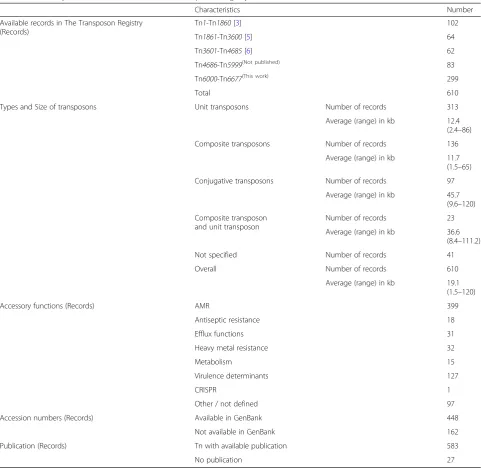
The current, complete information on all available records in The Transposon Registry is summarized
in Table 1, including available metadata on the
types, size, original host, accession numbers,
Table 1Summary of all available records in The Transposon Registry based on the data in Additional file1
Characteristics Number
Available records in The Transposon Registry (Records)
Tn1-Tn1860[3] 102
Tn1861-Tn3600[5] 64
Tn3601-Tn4685[6] 62
Tn4686-Tn5999(Not published) 83
Tn6000-Tn6677(This work) 299
Total 610
Types and Size of transposons Unit transposons Number of records 313
Average (range) in kb 12.4 (2.4–86)
Composite transposons Number of records 136
Average (range) in kb 11.7 (1.5–65)
Conjugative transposons Number of records 97
Average (range) in kb 45.7 (9.6–120)
Composite transposon and unit transposon
Number of records 23
Average (range) in kb 36.6 (8.4–111.2)
Not specified Number of records 41
Overall Number of records 610
Average (range) in kb 19.1 (1.5–120)
Accessory functions (Records) AMR 399
Antiseptic resistance 18
Efflux functions 31
Heavy metal resistance 32
Metabolism 15
Virulence determinants 127
CRISPR 1
Other / not defined 97
Accession numbers (Records) Available in GenBank 448
Not available in GenBank 162
Publication (Records) Tn with available publication 583
No publication 27
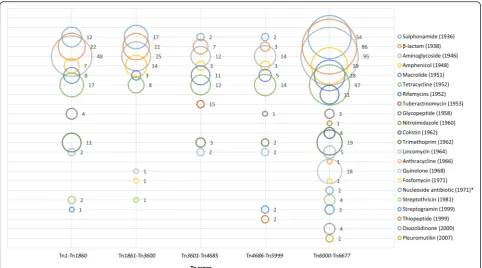
accessory functions and references (Table 1). The accessory functions assigned to cargo genes primar-ily include antimicrobial resistance and show that antibiotic resistance genes against all major anti-biotic classes are increasingly found to be associated with transposons and an increase in the numbers of antibiotics to which resistance is conferred by
trans-poson located genes (Fig. 2 and Additional file 2:
Table S2). Also noted are antiseptic resistance, heavy metal resistance, efflux functions, metabolic capability and virulence factor and CRISPR func-tions. It is interesting to note the trends observable with respect to the hosts of transposons being
re-ported (Fig. 3). It is clear that more transposons are
being reported in Acinetobacter and Klebsiella and
that the diversity of transposon hosts is increasing, presumably as sequencing becomes more common
place. As the identification of the host species is
not a requirement for the nomenclature system, transposable elements identified from metagenomic
studies are also included, e.g. Tn6032 and Tn6300.
Details of all the entries within the Transposon
Registry are provided in the Additional file 1: Table
S1.
Future perspectives and conclusions
As research into TE biology continues its migration from primarily experimental biology, where mobility is proven, to a more comparative genomics approach it is likely that the available bioinformatic tools which are used to identify
TEs (reviewed in [7] and references therein) will be
im-proved, both in terms of their application for interrogating different host species, and delineating different classes of TE. The complexity of TEs; their variety and biology, con-tinue to be better understood and the nomenclature will need to catch up to cope with this increasing knowledge [7]. It is worth reiterating here, the call for a formal dis-cussion within the international community to fully ad-dress the problematic issues of TE nomenclature and
come up with an agreeable system which can
accommodate all classes of TE we see [7,8] and be future proof to accommodate those that we as yet can only im-agine. Until that time, we will continue to operate and up-date The Transposon Registry with any missing or inaccurate records highlighted by the community. We wel-come inclusion of TEs named using other systems to be in-cluded within The Transposon Registry and call on the community to provide these details if they wish for them to be included.
Fig. 3Number of Transposon records displayed by host at genera level. The range within the 5 columns are representative of the previously published lists [3–5] and before and after allocation by the Tn Registry (starting at Tn6000)
Supplementary information
Supplementary informationaccompanies this paper athttps://doi.org/10. 1186/s13100-019-0182-3.
Additional file 1: Table S1.Details of transposon records available in The Transposon Registry (DOCX 529 kb)
Additional file 2: Table S2.List of transposons associated with antibiotic resistance genes (DOCX 24 kb)
Acknowledgements
The authors would like to Mr. Diderik van Halsema at the Liverpool School of Tropical Medicine for his vision of utility for the scientific community. We would also like to thank all those involved in the project at Manta Ray Media Ltd., London, UK for their development expertise and continued platform support.
Authors’contributions
APR conceptualised and implemented The Transposon Registry. ST and APR wrote the manuscript. ST and MAR compiled data. ST generated the figures and tables. All authors read and approved the final manuscript.
Funding
Not applicable
Availability of data and materials
The dataset used to generate Figs.2and3and all tables is available in the Additional file1: Table S1 and Additional file2: Table S2.
Ethics approval and consent to participate
Not applicable.
Consent for publication
Not applicable.
Competing interests
The author declares that they have no competing interests.
Author details 1
Department of Tropical Disease Biology, Liverpool School of Tropical Medicine, Pembroke Place, Liverpool L3 5QA, UK.2Department of Clinical Dentistry, Faculty of Health Sciences, UiT the Arctic University of Norway, Tromsø 9037, Norway.3Department of Pharmacy, University of Rajshahi, Rajshahi 6205, Bangladesh.
Received: 23 July 2019 Accepted: 9 September 2019
References
1. Roberts AP, Chandler M, Courvalin P, Guédon G, Mullany P, Pembroke T, et al. Revised nomenclature for transposable genetic elements. Plasmid. 2008;60(3):167–73.
2. Burrus V, Pavlovic G, Decaris B, Guedon G. Conjugative transposons: the tip of the iceberg. Mol Microbiol. 2002;46(3):601–10.
3. Campbell A, Berg DE, Botstein D, Lederberg EM, Novick RP, Starlinger P, et al. Nomenclature of transposable elements in prokaryotes. Gene. 1979; 5(3):197–206.
4. Campbell A, Starlinger P, Berg DE, Botstein D, Lederberg EM, Novick RP, et al. Nomenclature of transposable elements in prokaryotes. Plasmid. 1979; 2(3):466–73.
5. Lederberg EM. Plasmid reference center registry of transposon (Tn) allocations through July 1981. Gene. 1981;16(1–3):59–61.
6. Lederberg EM. Plasmid reference center registry of transposon (Tn) and insertion sequence (IS) allocations through December 1986. Gene. 1987; 51(2–3):115–8.
7. Arkhipova IR. Using bioinformatic and phylogenetic approaches to classify transposable elements and understand their complex evolutionary histories. Mob DNA. 2017;8(1):19.
8. Arensburger P, Piégu B, Bigot Y. The future of transposable element annotation and their classification in the light of functional genomics -what we can learn from the fables of Jean de la Fontaine? Mob Genet Elem. 2016;6(6):e1256852-e.
Publisher’s Note
![Fig. 1 Flow chart for the determining whether a transposon suitable for a new Tn number based on the guidelines published previously [1]](https://thumb-us.123doks.com/thumbv2/123dok_us/631592.2063395/2.595.59.537.88.333/flow-determining-transposon-suitable-number-guidelines-published-previously.webp)
![Fig. 3 Number of Transposon records displayed by host at genera level. The range within the 5 columns are representative of the previouslypublished lists [3–5] and before and after allocation by the Tn Registry (starting at Tn6000)](https://thumb-us.123doks.com/thumbv2/123dok_us/631592.2063395/5.595.58.538.90.627/transposon-displayed-columns-representative-previouslypublished-allocation-registry-starting.webp)
