Page 374
PATTERNS IN ENGINEERING – ADJECTIVE CONSTRUCTIONS Ilina Doykova
Medical University of Varna, 55 ‘Marin Drinov’ str., Varna, Bulgaria
Abstract
The paper investigates the recurrent use of predicative patterns in Engineering texts. Three adjective patterns and the complexity of their valency properties are explored with the WordSmith Tool (Scott, 2013) in a technical corpus. The small collection of specialist texts highlights the specifics of technical texts and identifies key patterns to be incorporated into practical activities and teaching resources for an improved language performance. The analysis reveals the modification and the complementation possibilities of predicative adjectives in the ESP lexicon, the function of the locative, directional and spatial prepositions, the occurrence of non-human into the sentence core and the use of di-valent patterns as characteristic features of technical language.
Key words: engineering texts, corpus-based analysis, key words in context, lexical patterns
1. INTRODUCTION
Technical language is still underrepresented in existing electronic reference corpora as compared to business, law or medical English. The present study is based on a self-compiled corpus of technical articles used in an ESP module for first year students in engineering at an intermediate level of language competence (Appendix 1 - List of Engineering topics).
Research points that technical texts use the precise language of description of products, processes or aspects of production without deviations from the concise and factual presentation of the information. Verbosity and vagueness of expression contradict the main principles of language economy, objectivity and non-ambiguous use of vocabulary.
The language of work instructions and procedure documents is analyzed by Bartholomew (1993) on the organization of the sentence information, the structure of written reports and McKenna (1997) on the Theme-Rheme organization of technical texts. Charney and Carlson (1995) discuss the appropriateness of model texts as resource for engineers and Brusaw (2011) investigates the manuals, aiming to improve writing. Biber, Conrad and Reppen (1998) emphasize the need for teaching materials that acknowledge the frequency of words and structures, extracted from corpus and Barlow (1992) suggests that, among other uses, a corpus and a concordancer can be applied in language analysis of text books and facilitate the teacher in generating suitable activities and exercises for the classroom.
Technical texts are always data-based and therefore they exhibit a specific genre repertoire with such features as the use of distinctive lemmas and terminology, use of impersonal structures and passive constructions and above all, structural formulas of expression.
One particular feature, noticed in technical texts, is the recurrent use of adjective patterns as a lexico-grammatical means for information structuring. The identification of predicative adjective patterns, significant in technical language and their extraction by linguistic tools is described in Doykova, Seizova-Nankova (2013). The detailed reference of the applied method is based on frequency and key word counts, the concordance and the collocation functions.
Page 375 2. PREDICATIVE ADJECTIVE PATTERNS
Predicative adjectives possess valency properties where one or more positions/slots are filled with obligatory, optional or contextually dependent complements of a certain structure. Complements can be phrases, nexus constructions (non-finite clauses) or finite clauses respectively. These patterns are mono-, di- and tri-valent carriers. Minimal propositions such as ‘The castings are accurate’ often require further specification of the adjective meaning (extensions) and thus form complex predicates in the technical domain.
The next section is a collection of sample corpus sentences to exemplify typical patterns and their use in context. The first pattern [P1] is exemplary of the mono-valent use or predicative adjectives with zero complementation (intransitive use). The adjective head as a di-valent carrier is represented in pattern [P2] with a finite or non-finite clause complement and the third pattern [P3] is representative of prepositional complements.
P1 [Adj] + [0]
light, smooth, high, ductile, tough, brittle, large, simple, long, cheap, common, thick, low
acidic, optical, electronic, magnetic, elastic, static, movable considerable, versatile, accessible, advisable, acceptable, predictable
polished, improved, outdated, tempered, reduced, refined, retained, reused, deformed, accomplished, forged, spoilt, advanced
P2 [Adj] + [to-INF] / [that-CL]
easy (to), able (to), hard (to), possible (to), impossible (to), difficult (to), necessary (to), convenient (to), advantageous (to), expensive (to)
clear (that), essential (that), important (that), difficult (that), useful (wh-), profitable (wh-)
P3 [Adj] +[PP]
smooth (in), economical (in), important (in), available (in), permanent (in), unique (in), essential (in), useful (in), accurate (in), located (in), absorbed (into), fixed (on), hard (on), proportional (to), perpendicular (to), parallel (to), attached (to), equal (to), central (to), similar (to), required (for), useful (for), composed (of), free (of), true (of), fixed (with), provided (with), available (with), equipped (with), inclined (at), symmetrical (about).
Table 1. Types of predicative adjective patterns in Engineering texts
The KeyWord List below is a result of a comparison between high frequency adjectives, extracted from the technical corpus and the BNC as a reference corpus:
Abrasive, accurate, automatic, annealing, axial, brittle, burnt, clamping, closed, coarse, cold, composite, compressed, compound, complex, conical, connecting, corrosive, cylindrical, deformed, desired, diesel, degassed, different, dimensional, ductile, economical, elastic, electrical, external, extruded, fitted, fixed, forged, hard, hardened, helical, hexagonal, high, hollow, horizontal, important, indirect, internal, large, low, longitudinal, mechanical, mild, movable, necessary, nominal, nonferrous, ordinary, perpendicular, plastic, plasticizing, proportional, raw, reciprocating, required, rigid, rolling, rotatory, rotary, sectional, semi-fabricated, similar, single, skilled, small, soft, solar, soldered, strong, suitable, superfinishing, tapered, tensile, tensional, tempered, thermoforming, thermosetting, thin, tight, ultimate, unsuitable, useful, vertical, versatile (90).
Page 376
The predicative construction [P1] represents the predicator and functions as a main verb with an extension, introducing various dimensions. The verb be is a stative verb, used as a copula in many technical phrases (to be equipped with, to be fitted to, to be suited for, to be derived from, be smooth in, be economical in, be useful for, be unsuitable for, be parallel to, be central to, be equal to, etc.). Morphologically simple and derivative evaluative adjectives with reference to quality are frequent in [P1]:
• Two types of solder are normally available.
• Programs for product quality and for the maintenance of machines are essential.
• Products must be disposed of in ways that are both economically and ecologically acceptable.
Adjectives with subordinate clause complements are the most frequent patterns. Complements in pattern [P2] may be optional or obligatory, providing an evaluative attitude towards the content of the clause. The Subject of every sentence is impersonal, explicitly stated and non-agentive. The strategy to emphasize the topic (or the theme) by moving it to the end of the sentence (extraposition) is a typical grammatical device together with clefting and the extensive use of passive voice constructions where the object is transformed into a subject. The anticipatory it in Subject position allows for a more impersonal reading than in [P1] type with the place of the Rheme being reserved for the predicative adjective. Adjective heads with a finite clause complement are important, essential, necessary, desirable, profitable, suitable, possible, clear:
• In most applications, it is desirable that simulation tools be used to compare the different solutions that are possible.
• Before soldering two metals, it is very important that their surfaces are first thoroughly cleaned. • Only a few mm of metal can be removed by this process, and it is therefore necessary that most of
the metal removal has been done previously by other machining processes.
• It is essential that tool wear be kept to a minimum, if the dimensional accuracy of the components being produced is to be maintained.
Adjective heads, complemented by a non-finite clause [to-INF] are cheap, advantageous, convenient, easy, economical, possible, necessary:
• It may also be advantageous to purchase large subassemblies or specialized components from outside suppliers.
• It is more economical to use group technology and manufacture families of parts with similar features using the same sequence of processes, than it is to manufacture them individually.
• In some cases, it may be cheaper and more convenient to purchase standard mass produced components than to manufacture them.
• The joint between the cylinder and the head has to be a temporary one, because it is necessary to
remove the head when the engine needs reconditioning.
Page 377
Pattern [P3] functions as a main verb with extensions that introduce various dimensions. The stative copula verb be predicates a property, a resulting state or a particular location by a two- and a three-dimensional preposition. Corpus samples of this last type require the prepositional phrase complements or [Adj] + [PP (about / against / as / at / for / from / of / than / to / in / on / over / upon)].
The prepositions in and into convey static and dynamic spatial relations respectively. They belong to the containment schema and may express either real or abstract goals.
• Steel is unique in its ability to exist both as a soft material which can be easily machined, and after heat treatment as a hard material out of which metal cutting tools can be made.
• Elastic and plastic deformations are both useful in engineering applications.
• Barrel finishing eliminates hand finishing and is therefore very economical in the use of labour.
The two-dimensional preposition on is a static one and denotes the location (contact or support) of an entity in the material world. However, it may indicate conscious reflexive acts or circumstances:
• Thermoplastics soften when heated and become hard on cooling.
Direct or indirect causes are normally introduced by the prepositions of and from and distinguish the source and the idea of ‘separation’:
• The steel now acquires a completely new fine grain structure which makes it stronger, more homogeneous, and free of stress.
Zero-dimensional prepositions in corpus (with, to, for) express the notion of accompaniment as a typically human attribute and reference to inanimate objects is either ungrammatical or metaphorically interpreted. Spatial prepositions (at, to) are static as they denote a place (location on a line/surface) or orientation in the occurrence schema. However, they may also denote abstract space:
• These gears are used to couple shafts that are parallel to each other.
• A try square is used to check if two surfaces are perpendicular to each other. • This is a document that is central to the whole manufacturing process.
The preposition for introduces a purpose or an intention with the Subject position occupied by a non-human entity:
• Water soluble oils are cheap and efficient coolants and are suitable for the machining of most steel components.
• Aluminium oxide wheels are better suited for materials of higher tensile strength, such as most types of steel, wrought iron, tough bronzes, etc.
Page 378 3. SENTENCE INFORMATION STRUCTURE
The typical subject possesses the features [-animate, - human, -personal]. It is either explicitly stated at the beginning of the sentence or extraposed (anticipatory it in initial position). These two strategies are used to focus attention on the non-agentive entity and realize different Theme-Rheme information configurations depending on what is considered most important.
From the point of view of syntax Arguments are not always obligatory, but implicitly present (dependent on, convenient to, equipped with, suitable for, fixed on). The main uncertainty regarding implicit Arguments is whether or not they are available in syntax as NPs, PPs or ready-made units. the information associated with a word in the mental lexicon (i.e. the mental dictionary) cannot be predicted by rules. Therefore, Herbst, Schüller (2008) describe the relations between a predicate and its Argument(s) as participant roles. The theme, patient, instrument, state of affairs, effected/affected and the predicative roles (where the complement identification, equation, characterization or description) are all possible semantic roles in technical texts and examples are given below:
Theme (entity which undergoes a change of location or possession, or whose location is being specified in a place or seen as moving from one place to another):
• In a vertical milling machine, the spindle head is perpendicular to the work table.
Patient (something undergoing a process or physically affected by an action with an implicit agent): • Thermoplastics soften when heated and become hard on cooling.
Effected (the outcome or the result of the action described by the verb):
• Die casting moulds are very precisely made and the castings produced are very accurate in their dimensions.
State of affairs
• Embossing is similar tocoining, and involves plastic flow of the metal.
Instrument
• A common data base is necessary to enable the entire process from the design stage to the manufacturing stage to be automated.
However, the multiple semantic roles, available with the two-place predicates may contain an inherent third participant as an alternative strategy to the use of more complex three-place predicates. Usually the human Agent is unexpressed syntactically:
• Stress is required (by sb.) to plastically deform a metal, and this causes strain (or work) hardening. • Broaching of internal spirals is also possible (for sb.) by using special broaches and rotating the
workpiece, in a way similar to that in which screw threads are cut using taps.
Page 379
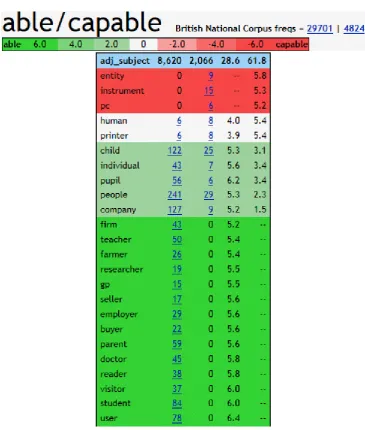
The adjective able in attributive and predicative use requires entities with the features [+ human], [+ animate] or [+ personal]. However, in the technical corpus these features are all negative and the componential analysis shows that all subjects are invariably non-human (working processes, gears, shaft, products, component, cast iron, cells).
A referential comparison with the British National Corpus (BNC) and The Sketch Engine allows for an interesting observation. In BNC both the attributive and the predicative use of the adjective are reserved for human subjects, while non-human entities (instruments) co-occur with capable (Table 2).
Table 2. A Sketch engine comparison - able vs. capable
Page 380
• Bevel gears are able totransmit motion between two shafts inclined at an angle to each other, but are more expensive to make.
• Cold working processes are able to manufacture products that have a better finish, closer tolerances, and thinner walls than those manufactured by the use of hot working processes.
• Cast iron is a very useful material, because in liquid form it is able to flow easily into moulds. • The cells are only able to generate electricity from a narrow band of the solar spectrum, depending
on the electronic bandgap of the material.
Different copula verbs (become, make, remain) may be used to distinguish between absolute (time stable) and temporary states:
become soft / hard / hot
become heated
become elongated
become brittle
become hardened
become ductile
become loose
become resistant
make free / glass hard
make tight
make larger / stronger / tougher
make necessary
make possible
make homogeneous
remain competitive
remain closed
The verb make requires a human Agent, which infers a transformation to a recipient. In the samples below the Agent is omitted and the verb meaning is equivalent to the resultative pattern [P1]:
• The manufacturing processes can be carefully analyzed, improved, and made more efficient. • The steel acquires a completely new fine grain structure which makes it stronger, more
homogeneous and free of stress.
• Hardened steel acquires a needle like grain structure called martensite which makes it glass hard.
CONCLUSIONS
Adjective patterns demonstrate the hybrid nature of property concepts and act as functional equivalents of basic syntactic models, expropriating the function of the main verb in the sentence. The stative reading of the patterns meets the genre requirements for impersonal and resultative language.
The analysis reveals some strategic facts about creating teaching resources, based on a corpus of specialized texts. Adherence to a limited set of patterns and their repetition, no experimenting and introduction to the wider specter of possibilities available in language is to set limits in order to facilitate understanding and focus attention on content and repetition. Variety is typical for English but in technical language it could cause confusion. The strategy to use key patterns raises students’ self-confidence and contributes to effective communication.
Compared to the conventional textbook-based teaching of specialized knowledge, the corpus-based approach, outlined in the present paper is less time consuming, condensed and focused on specifics thus contributing to the quality of ESP modules.
Page 381 REFERENCES
Bartholomew, B 1993. A descriptive framework for identifying schematic elements and patterns in certain science and engineering reports. New York.
Barlow, M 2002. Corpora, concordancing and language teaching. Proceedings of the 2002 KAMALL International Conference. Korea.
Bhatia, VK 1993. Analysing genre: language use in professional settings. Longman.
Biber, D, Conrad, S & Reppen, R 1998. Corpus linguistics: investigating language structure and use. Cambridge:CUP.
Brusaw, Ch & Alred, GJ 2011. Handbook of Technical Writing, St. Martin's Press.
Charney D, & Carlson, R 1995. Learning to Write in a Genre: What Student Writers Take from Model Texts Source: Research in the Teaching of English, Vol. 29, No. 1
Doykova, IT & Seizova-Nankova, TM 2013. Predicative Adjectives in ESP - A Corpus-based Methodology. Dynamics, Interdisciplinarity, Diversity, Constantin Preslavsky University Press.
Gross, D, Fisher, U & Miller, GA 1989. The Organization of Adjectival Meanings. Journal of Memory and Language, Vol. 28.
Cruse, D 2011. Meaning in Language: an introduction to semantics and pragmatics. Oxford: Oxford University Press
Gläser, R 1990. Fachtextsorten im Englischen. Tübingen: Gunter Narr Verlag.
Herbst, T & Schüller, S 2008. Introduction to Syntactic Analysis: A Valency Approach (Narr Studienbücher).
Jayendran, A 2007. Englisch für Maschinenbauer. Lehr- und Arbeitsbuch, Viewegs Fachbücher der Technik.
McKenna, B 1997. How engineers write: An empirical study of engineering report writing. Appl. Linguistics, vol. 18, No. 2.
Mishan, F 2005. Designing Authenticity into Language Learning Materials. Intellect Books.
Web resources and tools:
Collins Cobuild Advanced Learner’s English Dictionary <http://www.mycobuild.com>
Merriam-Webster's Online Dictionary <http://www.merriam-webster.com>
The British National Corpus <http://corpus.byu.edu/bnc>
The Sketch Engine <http://www.sketchengine.co.uk/>
Page 382