Framing the policy debate over spirits excise tax
in Poland
Mateusz Zato
nski
1,2,*, Benjamin Hawkins
2, and Martin McKee
21
Health Promotion Foundation, Warsaw, Poland and
2London School of Hygiene and Tropical Medicine,
15-17 Tavistock Place, London WC1H 9SH, UK
*Corresponding author. E-mail: [email protected]
Summary
Industry lobbying remains an obstacle to effective health-oriented alcohol policy. In 2013, an increase in excise tax on spirits was announced by the Polish government. This article presents a qualitative analysis of the public debate that ensued on the potential economic, health and social effects of the policy. It focuses on how competing groups, including industry actors, framed their position and sought to domin-ate the debdomin-ate. Online archives of five Polish national newspapers, two spirits trade associations, and par-liamentary and ministerial archives were searched. A thematic content analysis of the identified sources was conducted. The overall findings were compared with existing research on the framing of the Minimum Unit Pricing (MUP) debate in the UK. A total of 155 sources were analysed. Two main frames were identified:health, andeconomic. The spirits industry successfully promoted theeconomicframe in their own publications and in the media. The debate was dominated by arguments about potential growth of the grey market and losses in tax revenue that might result from the excise tax increase. The framing of the debate in Poland differed from the framing of the MUP debate in the United Kingdom. The Polish public health community was unsuccessful in making health considerations a significant element of the alcohol policy debate. The strategies pursued by UK health advocates offer lessons for how to make a more substantial impact on media coverage and promote health-oriented legislation.
Key words:alcohol industry, alcohol policy, corporate, lobbying, Poland
INTRODUCTION
The alcohol industry globally is dominated by a small number of transnational alcohol corporations (TACs) (Moskalewicz and Simpura, 2000;Babor and Robaina, 2013). To date, these economically powerful actors have not been subject to the same levels of scrutiny as tobacco corporations and some governments view them as import-ant partners in tackling alcohol-related problems (Gilmore et al., 2011;McCambridgeet al., 2014). Although there are growing calls for governments to reject this approach, TACs continue to have a significant impact on alcohol pol-icies globally (Knaiet al., 2015;Hawkinset al., 2016).
TACs oppose whole population approaches which seek to reduce aggregate consumption and thus sales vol-umes and profits. Instead, they favour measures targeting the most visible manifestations of alcohol misuse, such as public drunkenness, which affect only a relatively small number of people and thus have little impact on overall sales (McCambridgeet al., 2013;Hawkins and Holden, 2014). As part of this strategy, TACs have attempted to frame policy debates in ways amenable to their underly-ing business interests (Miller and Harkins, 2010;
Hawkins and Holden, 2013, Katikireddi et al., 2014).
VCThe Author 2016. Published by Oxford University Press. All rights reserved. For Permissions, please email: [email protected]
Consequently, understanding how the public debate on alcohol-related health policy in a given country is framed is crucial for those engaged in promotion of healthy pub-lic popub-licies (Hawkins and Holden, 2013).
There is a slowly growing body of English-language re-search on alcohol industry lobbying but this is mainly con-cerned with countries of Western Europe, North America and Australia (Bourdillon, 2005;Bondet al., 2010;Miller and Harkins, 2010;Beccaria and Rolando, 2015). A far smaller literature exists on the former communist coun-tries in Eastern Europe that joined the European Union (EU) between 2004 and 2007 (hereafter called EU10) (Varvasovszky and McKee, 1998; Cebasek-Travnik, 2007). Addressing this gap in the literature is especially important as alcohol-attributable mortality for men in the EU10 is still over twice that in Western Europe, and 40% higher for women (Zatonski 2008,2013).
Poland offers a potentially seminal case study that can contribute to understanding the lobbying efforts of the alco-hol industry in this region and help plan effective policies to target the contribution of alcohol to the East-West health gap. It accounts for almost half of the entire population of EU10 countries (Bishop, 2004), and exhibits trends in alco-hol consumption that are typical of the wider region (Moskalewicz and Simpura, 2000). Historically, Poland has
been a vodka-drinking country with over 35% of the alco-hol consumption made up of hard spirits (Zatonski, 2008), and it is currently the fourth largest vodka producer in the world, and over 90% of vodka production in the country is owned by TACs (We˛glewski, 2012; ZPPPS, 2013). Previous reductions in the price of vodka in Poland were followed by rapid increases in alcohol sales (Zatonski et al., 2015). Recorded alcohol consumption has increased in Poland in the last 15 years and estimated total consumption in 2011 amounted to 10.23 l of pure alcohol per capita per annum, up from 8.16 in 1990 (WHO Regional Office for Europe 2015). The Polish Spirits Industry (ZPPPS) is the largest industry trade association representing over 70% of the market of spirits in Poland (ZPPPS, 2013). The Polish Vodka Association (PVA) is an organisation devoted to the global promotion of Polish vodka. The Polish State Agency for Prevention of Alcohol Related Problems (PARPA) is a dedicated agency of the Polish Ministry of Health, and the chief public health organisation gathering alcohol experts, issuing expert opinion on alcohol legislation policy, and providing education to the public (PARPA,2014).
In September 2013, the then Polish Prime Minister Donald Tusk declared that, as part of the review of excise tax levels performed annually in order to harmonise tax-ation with other EU member states, the excise tax on hard
Box 1:Selected quotations.
Health frame
‘State institutions are obliged to shift the consumption of alcohol towards lighter alcohols’ (Majszczyk, 2013)—Viceminister of Finance Hanna Majszczyk.
‘Growth of the grey market [resulting from the increased excise tax] was not just dangerous for legal producers, but above all for the health of consumers’ (Drewnowska, 2014)—Director of Diageo Poland, Krzysztof Michalski, inRzeczpospolitadaily.
‘In the age of the financial crisis some countries are taking the correct step towards strengthening their budget and public health through raising the excise tax on alcoholic beverages’ (PARPA, 2013b)—PARPA website
Economic frame
‘Increasing the alcohol excise tax is a way of increasing revenue which we consider quite safe’ (Szczepanska, 2013b )—Prime Minister Tusk inPuls Biznesudaily‘.
[After the excise tax increase] trips to Germany to buy strong alcohol will suddenly become an at-tractive option’ (15 procent a 2013)—15 procentFacebook account.
‘As a result of the increase in spirits excise tax some of the strong alcohol producers might not sur-vive’ (Piasecki, 2014)—Rzeczpospolitadaily.
‘The increase in prices will cause an expansion of the grey market: illicit distilling of liquor, smug-gling from the east, disinfecting spirits’ (Prusek, 2013b)—President of PVA, Andrzej Szumowski, in Gazeta Wyborczadaily.
spirits would be increased by 15%, effective from 1 January
2014(Ministry of Finance, 2014). This represented the larg-est single tax rise on alcohol products in Poland in a decade. It would have a significant impact on the price of vodka, thus fulfilling the World Health Organisation’s recommen-dation of using fiscal measures to tackle harmful alcohol consumption (Wagenaaret al., 2009). The proposed tax in-crease precipitated a heated public discussion over the mer-its and drawbacks of the policy, characterised by intensified alcohol industry lobbying and significant media coverage. This article seeks to analyse this debate, exploring how competing interest groups framed their positions and sought to dominate the discourse. In this way, it hopes to under-stand better the strategies of the alcohol industry in Poland and the broader EU10 region, thereby facilitating the for-mulation of effective responses by public health advocates.
This article applies the concept of framing in its ana-lysis. Lakoff has written that frames ‘shape [. . .] what counts as a good or bad outcome of our actions’ (Lakoff, 2004, p. XV). Actors involved in a policy debate can choose to foreground and background certain aspects of a policy debate. This way the same situation can be pre-sented or framed in multiple different ways by different actors, with the objective of bringing about particular pol-icy responses (Fischer, 2003;van Hulst and Yanow, 2014). Divergent framings of policy problems inevitably lead to contestation, as the actors compete to define the option at hand and shape the outcomes which prevails (Rein and Scho¨n, 1994). Policy actors may frame issues in ways that position them as key participants in the debate and favour their desired outcomes (Schattschneider, 1960). In the case of health policy, the political priorities and underlying be-lief systems of corporate actors, whose main driver is profit maximisation, are very different from actors whose priority is the advancement of population health.
Previous research has demonstrated that significant levels of ‘knowledge transfer’ occur within the global-ised alcohol industry so that alcohol producers in differ-ent countries often use similar lobbying strategies (Bond et al., 2010;Hawkins and Holden, 2013). This article attempts to identify whether this ‘knowledge transfer’ is also apparent in the case in the Polish spirits excise tax debate. To this end, it took the methodological lead from existing research on the framing of alcohol pricing policy debates in the UK (e.g. Room, 2004; Babor, 2009;Bondet al., 2010;Milleret al., 2011;Hawkins et al., 2012;Babor and Robaina, 2013;McCambridge et al., 2014;Pattersonet al.2015), and used the UK case as a point of comparison for understanding the Polish policy debates.
METHODS
This study examined the public debate that ensued from the decision of the Polish government to increase the spirits ex-cise tax in 2013. In line with previous research on alcohol policy debates in the UK and the centrality of the media in shaping public debates (Hiltonet al., 2014;Rowellet al., 2014;Woodet al., 2014;Katikireddi and Hilton, 2015;
Pattersonet al., 2015), print media were selected as the main source base for the study. Online archives of five na-tional media outlets representing a spectrum of the Polish print media market, as defined by publication type and pol-itical alignment, were searched. The two broadsheets with the highest circulation were included (the centre-left leaning
Gazeta Wyborcza, and the liberal-conservative
Rzeczpospolita), the largest tabloid and top-selling daily
newspaper (Fakt), as well as the two most popular business publications (Puls BiznesuandForbes Polska).
Targeted searches of articles published between 1 January 2013 and 7 July2014were conducted. Online archives without date indexing were screened manually. The first article overtly referencing the economic effects of the spirits excise tax in a major Polish daily news-paper was published on 28 May 2013 (Author Unknown, 2013a). After 28 February2014, the volume of articles referring to the new excise tax began to de-crease in printed media. Therefore, 28 May 2013 and 28 February 2014 were chosen as the beginning and end points of the research; all articles published between these dates were retrieved and screened for relevance.
possibility to veto the tax increase after it was approved by the Sejm) and the website of PARPA.
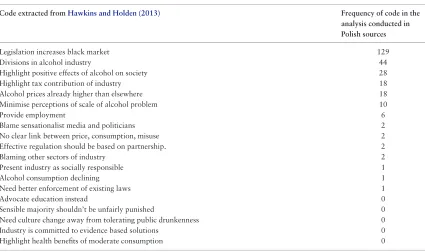
Sources were coded and analysed by the first author using an adapted version of the Thematic Content Analysis method (Joffe and Yardley, 2004). Initial codes were derived from research by Hawkins and Holden on the fram-ing of the debate on minimum unit pricfram-ing (MUP) in the United Kingdom (Hawkins and Holden, 2013), with fur-ther codes developed inductively (Table 1). Due to the lim-ited text, manual coding was undertaken, developing descriptive accounts of the themes. The most frequently recurring themes were used to identify and categorise dom-inant frames in the debate about excise tax. A basic quanti-tative content analysis was also conducted; themes were described numerically and their frequency was calculated within and across different groups of sources and over time.
RESULTS
OverviewThe search strategy yielded a total of 1141 sources from print media, spirits industry websites, governmental re-cords and parliamentary debates. Of these, 86.4% (n¼986) were excluded as they either did not mention the alcohol excise tax, mentioned it only cursorily or indirectly or were published outside the study period (this was veri-fied manually in online archives where it was not possible
to constrain the search to the desired dates). Of the remain-ing 155 sources, almost two-thirds (n¼97) originated from print media. The print media were most likely to cite spirits industry representatives (44 instances), followed by political sources associated with Platforma Obywatelska (28 instances), the political party in power in Poland at the time. Opposition politicians were cited in three instances and members of the public health community only once.
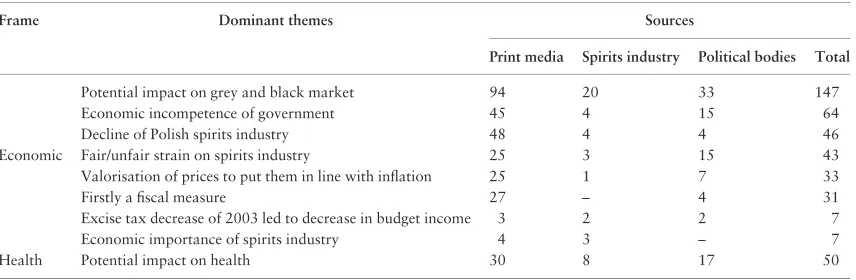
Table 2 shows the dominant themes that emerged, grouped into two overarching frames—economic and
health. Theeconomicframe comprised themes in which
the excise tax increase was mentioned in terms of its pu-tative economic impact (on state and on industry) and the economic rationale that underpinned it. Thehealth
frame referred to themes in which the excise tax was pre-sented primarily in terms of its potential health impact. There was a third,symbolicframe, whereby the excise tax was presented primarily as a symptom of other fac-tors, such as Poland’s European aspirations, and the cul-tural meaning of the spirits industry for Poles. However, these were peripheral and are not explored further here. See Box 1 for a selection of quotations.
Economic frame
Theeconomicframe was dominant in all types of
sour-ces. Public discussions about economic effects of the in-crease of the excise tax, the economic impact it would Table 1:Initial codes extracted fromHawkins and Holden (2013)and their appearance in Polish sources
Code extracted fromHawkins and Holden (2013) Frequency of code in the
analysis conducted in Polish sources
Legislation increases black market 129
Divisions in alcohol industry 44
Highlight positive effects of alcohol on society 28
Highlight tax contribution of industry 18
Alcohol prices already higher than elsewhere 18 Minimise perceptions of scale of alcohol problem 10
Provide employment 6
Blame sensationalist media and politicians 2
No clear link between price, consumption, misuse 2 Effective regulation should be based on partnership. 2
Blaming other sectors of industry 2
Present industry as socially responsible 1
Alcohol consumption declining 1
Need better enforcement of existing laws 1
Advocate education instead 0
have on the alcohol industry, as well as what it has to say about the economic competence of the Polish gov-ernment, were central to the debate, both among the op-ponents and supporters of the tax.
Potential impact on the grey and black market
The question of whether the tax increase will encour-age people to circumvent authorized channels of distri-bution to sell goods at lower prices was the single most important theme to emerge in the debate over the spi-rits excise tax. In the print media, the coverage of this theme was higher than that of the potential impact of the excise tax increase on health throughout the period of analysis, with an exception of May–August 2013, when the two themes were mentioned a similar number of times.
The spirits industry warned that the tax increase would encourage smuggling (Wozniak, 2013a) and il-legal spirits production, with devastating losses for re-tailers (POHiDet al., 2013). The industry argued that this would be exacerbated by the higher tax on spirits in Poland than in neighbouring countries (15 procent, 2013a).
Ministry of Finance representatives rejected industry claims with assurances that the grey market was under control (Kapica, 2013a) and that the excise tax in Poland was below the EU average (Kapica, 2013b). However, the print media rarely reported these argu-ments—while 69% of all the mentions of the negative effects of the excise tax on the grey market identified in the sources originated from the print media, only 28% of mentions of counterarguments defending the excise tax did so.
Economic incompetence of the government
The second most frequently recurring dominant theme was that the legislation exemplified the economic in-competence of the government. This theme was slightly more pronounced in print media sources, as well as in sources from the Polish Parliament, than in spirits industry publications. Opposition MPs were particularly keen to claim that the increase would re-sult in a loss of jobs (Szarama, 2013), and that it was simply a ‘cash grab’ by the government which sought money in the pockets of taxpayers (Elsner, 2013). While the tabloid daily Fakt, in particular, did pick up the ‘cash grab’ argument a number of times (Author Unknown, 2013b), business media focused on ques-tioning the government’s over-optimistic prognoses of budget revenue from the increased taxation (Szczepanska, 2013a ).
Decline of the Polish spirits industry
The industry complained that increased tax would wor-sen the already dire state of the Polish spirits producers (POHiD et al., 2013), a view repeated frequently in media outlets (Prusek, 2013a). The Ministry of Finance opposed these arguments, arguing that the spirits indus-try was in a good financial state and even improving in recent years (Kapica, 2013a), but these statements were not picked up by the print media.
Fair/unfair strain on the spirits industry
Claims that the tax rise was unfair to the spirits indus-try, given the different taxation regime for beer and wine, were particularly pronounced in sources from political bodies. Representatives of the government and the Ministry of Finance justified the sole focus on spi-rits, noting that the excise tax per 1% of alcohol con-tent was lower for spirits like vodka than for any other Table 2:Dominant themes (with five or more mentions in the sources) and frames
Frame Dominant themes Sources
Print media Spirits industry Political bodies Total
Potential impact on grey and black market 94 20 33 147
Economic incompetence of government 45 4 15 64
Decline of Polish spirits industry 48 4 4 46
Economic Fair/unfair strain on spirits industry 25 3 15 43 Valorisation of prices to put them in line with inflation 25 1 7 33
Firstly a fiscal measure 27 – 4 31
Excise tax decrease of 2003 led to decrease in budget income 3 2 2 7 Economic importance of spirits industry 4 3 – 7
alcoholic beverage (Parafianowicz, 2013). The press, in general, was more likely to cite spirits industry spokes-persons who suggested that a smaller increase of excise tax on all the alcohol beverages would be a better solu-tion than placing the entire fiscal burden on spirits (Prusek, 2013b;Drewnowska, 2014). The representa-tives of the Polish brewers’ associations are quoted in the media a few times, opposing such ideas, recalling that the spirits’ industry has traditionally enjoyed privi-leged fiscal treatment compared to beer producers (Drewnowska, 2013).
Health frame
Health-related themes comprised only a fraction of the economic-related ones, accounting for 10% of all men-tions in print media sources, 14% in spirits industry sources and 17% in sources from political bodies. Health arguments were used a handful of times by gov-ernment spokespersons, usually as an auxiliary reason for increasing the excise tax. They were also sporadic-ally used by the alcohol industry, which highlighted the risk of adverse effects for the Polish population from any potential increase in consumption of illegal and un-tested alcohol.
Potential impact of the excise tax on health
In a number of sources, predominantly those from gov-ernmental and parliamentary records, as well as PARPA, it was suggested that the increase in excise tax was partly motivated by the health politics of the gov-ernment (Parafianowicz, 2013), as a fiscal method to en-courage Poles to limit their drinking (Kapica, 2013a). The media often derided the government’s plans, sug-gesting that it was not the duty of the Ministry of Finance to deal with health (Szczepanska, 2013b). However, the business newspapers in particular gener-ally attempted to give space to the pro-health arguments of the government.
A similar number of sources rejected the health claims made for the excise tax by suggesting it would in fact have negative health consequences as Poles would switch to cheaper, untested illegal alcohol (Wozniak, 2013b), that health measures were not necessary at all as Poles drink less than the EU average (15 procent, 2013b), or that drinking in Poland was simply inevitable (Elsner, 2013). The print media also echoed these senti-ments a number of times, often quoting spirits industry representatives (Drewnowska, 2014).
DISCUSSION
Dominance of theeconomicframe
The policy debate in Poland was centred around the
eco-nomicframe, while thehealthframe remained marginal
and the debate was not informed by any public health considerations. The TACs successfully promoted the
economic frame, which gave them, as economic actors,
an advantage in setting the terms of the debate. The in-dustry selectively cited powerful precedents, echoing the arguments used during the excise tax debate in Finland in 2003, when the industry successfully lobbied for a re-duction in taxes because of the threat of imports of cheaper products from Estonia, soon to join the European Union (Makela and Osterberg, 2009). The al-cohol industry in Poland also repeatedly warned that should prices in Poland rise higher than in neighbouring EU countries, an uncontrolled flow of spirits from across the border will ensue (15 procent, 2013a). Meanwhile, the government’s counterarguments were less clear and relied on complex calculations that were difficult to in-terpret and suggested only minimal decreases in con-sumption and increases in revenue.
Faced with this, the media picked up the much clearer suggestions from industry officials, so that indus-try sources, mostly from trade associations, became the most frequently quoted group of stakeholders in the print media. The government did not attempt to invoke the evidence of how changes in alcohol taxation im-pacted upon health outcomes in other countries, as in Finland where the tax cuts noted above were followed by a sharp increase in alcohol-related deaths (Makela and Osterberg, 2009). It played to the industry’s strengths and failed to reframe the debate away from the economic arguments.
Lack of involvement of public health community in the policy debate
As the sources analysed here suggest, before the legisla-tive process began, the print media gave roughly equal attention to the dominanteconomic frame—grey mar-ket—and thehealthframe. As soon as Prime Minister Tusk announced the excise tax increase, the situation changed and thehealthframe became marginalised by
the economic frame promoted by the spirits industry.
(Ferfecki, 2013). Even in its own publications, PARPA addressed the excise tax very infrequently, referring to it only in two short articles on its website, and in one re-port, the latter only mentioning the excise tax in passing (Boguckiet al., 2013; PARPA, 2013a, b).
It is outside the remit of this study to judge whether the Polish public health community tried and failed to get the pro-health message out in the media, or whether such attempts simply failed to materialise. Nonetheless, in any case, the lack of a strong public health voice in the excise tax debate in Poland remains in stark contrast with the active role taken by public health activists in similar debates in countries such as the UK, where a uni-fied and well-co-ordinated public health lobby brought the MUP onto the agenda in face of strong industry op-position (Holden et al., 2012; Holden and Hawkins, 2013;Hiltonet al., 2014). Arguably, the absence of any concerted attempt to frame the argument in health terms in Poland meant that the industry had no need to engage with and respond to a public health critique of their position.
Differences from the MUP debate in UK
Research has indicated that TACs pursue consistent and highly integrated political strategies globally, including attempts to frame policy debates in the same way in dif-ferent countries (Bondet al., 2010;Miller and Harkins, 2010;Hawkins and Holden, 2013). The comparison of the Polish case with similar analyses of debates on alco-hol policies, including pricing, in the UK, has only partly supported these findings. While some consistency in in-dustry framing across these countries has been found, important differences also emerge.
In the debate over the excise tax increase, the Polish spirits industry repeated some of the claims made by the British alcohol industry in regards to the introduction of MUP; e.g. that the policy change will cause an expan-sion of the black market (Hawkins and Holden, 2013;
Hilton et al., 2014;Katikireddi and Hilton, 2015), or that the alcohol industry is a major contributor to the state budget and a driver of national economy (Holden and Hawkins, 2013; McCambridge et al., 2014). Vodka, as with whisky in Scotland (Holden and Hawkins, 2013), was presented as a symbol of the coun-try and, therefore, deserving special protection. The div-isions in the alcohol industry, which were highlighted in the British MUP debate (Holdenet al., 2012;Hawkins and Holden, 2013;Hiltonet al., 2014), were also visible in Poland as the spirits producers attempted to shift the burden of the excise tax onto the other segments of the alcohol industry.
However, other themes prominent in alcohol policy and pricing debates elsewhere were only peripheral in the Polish case. For instance, unlike how alcohol produ-cers in the UK proposed responsibility deals or voluntary self-regulation that would replace compulsory legisla-tion (Babor, 2009; Miller et al., 2011; Hawkins and Holden, 2013), the Polish spirits industry rarely at-tempted to present itself as a responsible actor and po-tential partner for health policymakers. This may reflect a perceived lack of need to address health concerns, given their marginal presence in the policy debate. On the contrary, themes which were prominent in the Polish debate, such as the negative economic impact that the tax increase would have on the alcohol industry, were peripheral in the debate in the UK (Hawkins and Holden, 2013;Katikireddi and Hilton, 2015).
Certain themes that appeared in the UK debate were completely absent in Poland. The Polish spirits industry did not draw on notions of individual responsibility and freedom of choice in arguing for light-touch regulation (Hawkinset al., 2012;McCambridgeet al., 2013). Nor did it propose any education programmes for children that could replace the fiscal measures proposed by the government (Babor, 2009; Miller and Harkins, 2010;
Katikireddi and Hilton, 2015). It did not try to frame the alcohol problem as primarily an issue of crim-inal justice and an irresponsible minority of alcohol abusers (McCambridge, 2012; Hilton et al., 2014;
Woodet al., 2014).
In campaigning elsewhere against effective interven-tions such as increased taxation, TACs have been shown to utilise a broad set of arguments ranging from portray-ing themselves as socially responsible actors who can be trusted to self-regulate, to proposing alternative policies focused on high-risk individuals and away from more ef-fective population-based measures. As this article shows, many of these themes were marginal or non-existent in the excise tax debate in Poland. While the economic ar-guments of the British alcohol industry were frequently echoed by the Polish spirits industry during the excise tax debate, the health arguments, unlike in the UK, were only used in a token fashion.
Limitations
alcohol industry uses many different approaches to transmit its messages, including social media, product placement in movies and reports from industry-funded think tanks. A comprehensive assessment would con-sider all of these. While it is impossible to identify all relevant aspects of the industry strategies to shape the policy debate via media analysis of this kind, examining the public statements made by industry actors offer im-portant insights into the policy positions they adopt and thus their underlying commercial interests. In the ab-sence of access to internal documents, researchers must use publicly available statements in their attempts to de-termine industry strategy.
The comparison of the alcohol pricing debate in Poland to studies of the MUP debate in the UK was also subject to certain constraints since the two legislative changes proposed—increase in tax versus MUP affected the alcohol industry in slightly different ways (Sharma et al., 2014). Finally, while the present study only included public documents, UK studies also used inter-views and consultations with policy actors which might have helped identify a different range of themes.
CONCLUSION
The findings suggest that the public debate on alcohol policy in Poland was dominated by the views of the alco-hol industry and other opponents of the legislation. The legislation eventually passed and the increase was imple-mented. However, the government was forced to prom-ise that the spirits excprom-ise tax will not be increased again in the next two years (Author Unknown,2014).
Rein and Scho¨n (1994) identified how policy framing is key to the process of political contestation. It is, how-ever, difficult to talk of contestation in a case in which one stakeholder achieves such a dominant position in a crucial element of the information environment that is the media (Miller and Harkins, 2010). The alcohol in-dustry imposed economic considerations as the principal frame of the excise tax policy debate in Poland, making it easier to foreground the negative potential outcomes of a tax increase, and successfully placing itself as the source of information most frequently echoed by the media. Within thehealthframe, which remained second-ary through most of the duration of the policy debate, the advantages and disadvantages of the tax increase were contested much more closely.
The present research suggests that a more effective involvement of health advocates in seeking to place health, rather than narrow budgetary considerations, at the heart of the debate on any fiscal legislation regarding alcohol products, could help to strengthen health policy.
The Polish public health community could usefully draw on examples of best practice by their counterparts in countries such as the UK and become much more active participants in public debates over alcohol policy.
ACKNOWLEDGEMENTS
We would like to acknowledge the invaluable input of Dr Martin Gorsky, Professor Witold Zatonski, and Ms Aleksandra Herbec for their helpful comments and literature suggestions. Sole responsibility for this research lies with the authors.
FUNDING
B.H. was funded in part by the National Cancer Institute, US National Institutes of Health [grant num-ber R01-CA091021]. The contents of this paper are solely the responsibility of the author and do not neces-sarily represent the official views of the funders.
REFERENCES
15 procent (2013a) Czy wiecie [Did you know], 28 October 2013, http://www.facebook.com/15procentwiecej (last ac-cessed 7 July 2014).
15 procent (2013b) Jednym z koronnych argumentow [One of the principal arguments], 30 October 2013, http://www.face book.com/15procentwiecej (last accessed 7 July 2014). Author Unknown (2013a) Polscy przedsie˛biorcy dopłacaja˛ do
produkcji wodki [Polish enterpreneurs lose money on vodka production]. Agora SA, Gazeta Wyborcza, Warsaw. Author Unknown (2013b).Rety! Nawet wodka dro zeje [Gosh!_
Even vodka is getting more expensive]. Ringier Axel
Springer Polska, Fakt, Warsaw.
Author Unknown (2014) W 2015 roku bez podwyzek akcyzy na_ wyroby tytoniowe i alkohol [In 2015 there will be no to-bacco and alcohol excise tax increase], 25 July 2014, http:// biznes.onet.pl/wiadomosci/kraj/mf-w-2015-r-bez-podwy zek-akcyzy-na-wyroby-tytoniowe-i-alkohol/dkqjh (last ac-cessed 7 August 2014).
Babor, T. F. (2009) Alcohol research and the alcoholic beverage industry: issues, concerns and conflicts of interest.
Addiction,104, 34–47.
Babor, T. F. and Robaina, K. (2013) Public health, academic medicine, and the alcohol industry’s corporate social re-sponsibility activities.American Journal of Public Health, 103, 206–214.
Beccaria, F. and Rolando, S. (2015) The Italian politics of alco-hol: the creation of a public arena at the end of the 20th cen-tury.International Journal of Drug Policy,26, 662–669. Bishop, K. (2004)Labour Market Characteristics of Countries
Joining the European Union in May 2004. Office for
Bogucki, M., Gała˛zka-Sobotka M., Gierczynski J., Grygiewicz J. (2013) Ekonomiczne aspekty skutkow picia alkoholu w Europie i w Polsce [The economic aspects of alcohol
drink-ing in Europe and in Poland]. Uczelnia Łazarskiego,
Warsaw.
Bond, L., Daube, M. and Chikritzhs, T. (2010) Selling addic-tions: similarities in approaches between Big Tobacco and Big Booze.Australasian Medical Journal,3, 325–332. Bourdillon, F. (2005) Les lobbies agroalimentaires contre la
sante´ publique.Sante Publique,17, 515–516.
Cebasek-Travnik, Z. (2007) Slovenia: alcohol today—could a country be addicted to alcohol?Addiction,102, 11–14. Drewnowska, B. (2013)Podwyzka akcyzy mo_ ze nie omina˛_ c
pol-skich browarow . Gremi Business Communication,
Rzeczpospolita, Warsaw.
Drewnowska, B. (2014)Whisky zyskuje, wodka traci [Whisky is
gaining, vodka is losing]. Gremi Business Communication,
Rzeczpospolita, Warsaw.
Elsner, W. (2013) Speech in Sejm, 9 October 2013, http://www. sejm.gov.pl/Sejm7.nsf/wypowiedz.xsp?posiedzenie¼51&dz ien¼1&wyp¼84&view¼1 (last accessed 4 July 2014). Ferfecki, W. (2013)Alkohol nakre˛ca przeste˛pcow [Alcohol is
driving the criminals]. Gremi Business Communication,
Rzeczpospolita, Warsaw.
Fischer, F. (2003) Reframing Public Policy: discursive Politics
and Deliberative Practices. Oxford University Press, Oxford.
Gilmore, A. B., Savell, E. and Collin, J. (2011) Public health, corporations and the new responsibility deal: promoting partnerships with vectors of disease? Journal of Public
Health (Oxf),33, 2–4.
Hawkins, B. and Holden, C. (2013) Framing the alcohol policy debate: industry actors and the regulation of the UK beverage alcohol market. Critical Policy Studies, 7, 53–71.
Hawkins, B. and Holden, C. (2014)0Water dripping on stone0?
Industry lobbying and UK alcohol policy.Policy & Politics, 42, 55–70.
Hawkins, B., Holden Eckhardt, C. J. and Lee, K. (2016) Reassessing policy paradigms: a comparison of the global to-bacco and alcohol industries. Global Public Health, 21, 1-19.
Hawkins, B., Holden, C. and McCambridge, J. (2012) Alcohol industry influence on UK alcohol policy: a new research agenda for public health. Critical Public Health, 22, 297–305.
Hilton, S., Wood, K., Patterson, C. and Katikireddi, S. V. (2014) Implications for alcohol minimum unit pricing advocacy: what can we learn for public health from UK newsprint coverage of key claim-makers in the policy debate?Social Science & Medicine,102, 157–164.
Holden, C. and Hawkins, B. (2013) ’Whisky gloss’: the alcohol industry, devolution and policy communities in Scotland.
Public Policy and Administration,28, 253–273.
Holden, C., Hawkins, B. and McCambridge, J. (2012) Cleavages and co-operation in the UK alcohol industry: a qualitative study.BMC Public Health,12, 483.
Joffe, H., Yardley, L. (2004)Content and Thematic Analysis,
Research Methods for Clinical and Health Psychology.
Sage, London, pp. 56–68.
Kapica, J. (2013a) Response to interpellation nr 21580, 4 November 2013, http://www.sejm.gov.pl/Sejm7.nsf/ InterpelacjaTresc.xsp?key¼0F78A71A&view¼null (last ac-cessed 4 July 2014).
Kapica, J. (2013b) Response to interpellation nr 22794, 17 December 2013, http://www.sejm.gov.pl/sejm7.nsf/Interpe lacjaTresc.xsp?key¼381F7E16&view¼1t (last accessed 5 July 2014).
Katikireddi, S. V., Bond, L. and Hilton, S. (2014) Changing pol-icy framing as a deliberate strategy for public health advo-cacy: a qualitative policy case study of minimum unit pricing of alcohol.Milbank Quarterly,92, 250–283.
Katikireddi, S. V. and Hilton, S. (2015) How did policy actors use mass media to influence the Scottish alcohol minimum unit pricing debate? Comparative analysis of newspapers, evidence submissions and interviews. Drugs: Education,
Prevention and Policy,22, 125–134.
Knai, C., Petticrew, M., Durand, M. A., Scott, C., James, L., Mehrotra, A.et al. (2015) The Public Health Responsibility deal: has a public–private partnership brought about action on alcohol reduction?Addiction,110, 1217–1225. Lakoff, G. (2004)Don’t Think of an Elephant!: know Your
Values and Frame the Debate: the Essential Guide for
Progressives. Chelsea Green Pub. Co., White River
Junction, Vt.
Majszczyk, H. (2013) Speech in Sejm, 9 October 2013. http:// www.sejm.gov.pl/Sejm7.nsf/wypowiedz.xsp?posiedzenie¼51 &dzien¼1&wyp¼85&view¼1 (last accessed 4 July 2014). Makela, P. and Osterberg, E. (2009) Weakening of one more
al-cohol control pillar: a review of the effects of the alal-cohol tax cuts in Finland in 2004.Addiction,104, 554–563. McCambridge, J. (2012) Dealing responsibly with the alcohol
industry in London.Alcohol and Alcoholism,47, 635–637. McCambridge, J., Hawkins, B. and Holden, C. (2013) Industry
use of evidence to influence alcohol policy: a case study of submissions to the 2008 Scottish government consultation.
PLoS Medicine/Public Library of Science,10, e1001431.
McCambridge, J., Hawkins, B. and Holden, C. (2014) Vested interests in addiction research and policy. The challenge cor-porate lobbying poses to reducing society’s alcohol prob-lems: insights from UK evidence on minimum unit pricing.
Addiction,109, 199–205.
McCambridge, J., Kypri, K., Miller, P., Hawkins, B. and Hastings, G. (2014) Be aware of drink aware. Addiction, 109, 519–524.
Miller, D. and Harkins, C. (2010) Corporate strategy, corporate capture: food and alcohol industry lobbying and public health.Critical Social Policy,30, 564–589.
Ministry of Finance, (2014), Stawki akcyzy [Excise tax rates], http://www.finanse.mf.gov.pl/akcyza/stawki-akcyzy;jsessio nid¼429C205E7108FFB6A772B11004F734CF (last ac-cessed 6 July 2014).
Moskalewicz, J. and Simpura, J. (2000) The supply of alcoholic beverages in transitional conditions: the case of Central and Eastern Europe.Addiction,95, S505–5S522.
Parafianowicz, A. (2013) Response to interpellation nr 22130, 12 December 2013, http://www.sejm.gov.pl/sejm7.nsf/ InterpelacjaTresc.xsp?key¼1135B59A&view¼1o (last ac-cessed 4 July 2014).
Piasecki, M. (2014)Arytmetyka zawodzi w akcyzie [Arithmetics
does not work for the excise tax]. Gremi Business
Communication, Rzeczpospolita, Warsaw.
PARPA. (2013a) Tansze piwo w Danii [Cheaper beer in Denmark], May 2013, http://www.parpa.pl/index.php/wia domosci-ze-swiata/rok-2013 (last accessed 5 July 2014). PARPA. (2013b) Kto poda˛zy krokami Polski i Finlandii? [Who_
will follow Poland and Finland?], October 2013, http:// www.parpa.pl/index.php/wiadomosci-ze-swiata/rok-2013 (last accessed 5 July 2014).
PARPA. (2014) About the Agency, http://fas.nazwa.pl/parpa_ en/ (last accessed 4 July 2014).
Patterson, C., Katikireddi, S. V., Wood, K. and Hilton, S. (2015) Representations of minimum unit pricing for alcohol in UK newspapers: a case study of a public health policy debate.
Journal of Public Health (Oxf),37, 40–49.
POHiD, Polska Izba Handlu, Stowarzyszenie Polska Wodka, Zwia˛zek Gorzelni Polskich and Zwia˛zek Pracodawcow Polski Przemysł Spirytusowy, 2013, Apel do posłow i sen-atorow RP o zmniejszenie planowanej podwy zki podatku_ akcyzowego na napoje spirytusowe [Appeal to Polish MPs and senators for the decrease of the planned increase in the spirits’ excise tax], Warsaw.
Prusek, T. (2013a) Podatek akcyzowy nape˛dza zakup wodki [The excise tax is fuelling vodka sales]. Gazeta Wyborcza, Warsaw Agora SA.
Prusek, T. (2013b) Budzet dostanie kaca po wy_ zszej akcyzie i_ drozszej w_ odce? [Will the budget be hungover after higher excise tax and more expensive vodka?]. Gazeta Wyborcza, Warsaw Agora SA.
Rein, M., and Scho¨n, D. (1994)Frame Reflection: toward the
Resolution of Intractable Policy Controversies. Basic Books,
New York.
Room, R. (2004) Disabling the public interest: alcohol strategies and policies for England.Addiction,99, 1083–1089. Rowell, A., Evans-Reeves, K. and Gilmore, A. B. (2014) Tobacco
industry manipulation of data on and press coverage of the il-licit tobacco trade in the UK.Tobacco Control,23, e35–e43. Schattschneider, E. E. (1960)The Semisovereign People. Holt,
Rinehard and Winston, New York.
Sharma, A., Vandenberg, B. and Hollingsworth, B. (2014) Minimum pricing of alcohol versus volumetric taxation: which policy will reduce heavy consumption without ad-versely affecting light and moderate consumers?PLoS One, 9, e80936.
Szarama, W. (2013) Interpellation nr 22130, 24 October 2013, http://www.sejm.gov.pl/sejm7.nsf/InterpelacjaTresc.xsp? key¼1120E123&view¼1o (last accessed 4 July 2014). Szczepanska, M. (2013a) Procenty, ktore nie zaprocentuja˛
[Percentages which will not yield anything]. Bonnier
Business, Puls Biznesu, Warsaw.
Szczepanska, M. (2013b)Wodka dro zsza, ale nar_ od trzezwy
[Vodka is more expensive, but the nation is sober]. Bonnier
Business, Puls Biznesu, Warsaw.
van Hulst, M. and Yanow, D. (2014) From Policy “Frames” to “Framing”: theorizing a more dynamic, political approach,
The American Review of Public Administration.
Varvasovszky, Z. and McKee, M. (1998) An analysis of alcohol policy in Hungary. Who is in charge? Addiction, 93, 1815–1827.
Wagenaar, A. C., Salois, M. J. and Komro, K. A. (2009) Effects of beverage alcohol price and tax levels on drinking: a meta-analysis of 1003 estimates from 112 studies.Addiction,104, 179–190.
We˛glewski, M. (2012)Polskie wodki w re˛kach Rosjan? [Polish
vodkas in the hands of Russians?]. Ringier Axel Springer
Poland, Newsweek Polska, Warsaw.
WHO Regional Office for Europe. (2015)European Health for
All Database (HFA-DB). WHO Regional Office for Europe,
Copenhagen.
Wood, K., Patterson, C., Katikireddi, S. V. and Hilton, S. (2014) Harms to ‘others’ from alcohol consumption in the min-imum unit pricing policy debate: a qualitative content ana-lysis of UK newspapers (2005–12). Addiction, 109, 578–584.
Wozniak, B. (2013a) Podwyzka akcyzy na alkohole spirytusowe_ spowoduje wzrost szarej strefy, 9 September, http://www. portalspozywczy.pl/alkohole-uzywki/wiadomosci/pod wyzka-akcyzy-na-alkohole-spirytusowe-spowoduje-wzrost-szarej-strefy,90495.html (last accessed 6 July 2014). Wozniak, B. (2013b) Krucjaty przeciw alkoholowi nie ogranicza˛
spozycia [Crusades against alcohol will not decrease con-_ sumption], 9 September 2013, http://www.portalspo zywczy.pl/alkohole-uzywki/wiadomosci/krucjaty-przeciw-alkoholowi-nie-ogranicza-spozycia,89276.html (last ac-cessed 6 July 2014).
Zatonski, W. (2008) Closing the Health Gap in European
Union. Cancer Epidemiology and Prevention Division,
Maria Sklodowska-Curie Memorial Cancer Centre and Institute of Oncology, Warsaw.
Zatonski, W. (2013) Ill Health Prevention and Treatment, Review of Social Determinants and the Health Divide in the
WHO European Region: final Report, M. Marmot. UCL
Institute of Health Equity, London.
Zatonski, W. A., Sulkowska, U., Zatonski, M. Z., Herbec, A. A. and Muszynska, M. M. (2015) Alcohol taxation and prema-ture mortality in Europe.The Lancet,385, 1181.
ZPPPS. (2013)Wpływ społeczno-gospodarczy branzy spirytuso-_
wej w Polsce 2011–2012 [The socio-economic impact of
the spirits’ industry in Poland 2011–2012]. Zwia˛zek