The Genomic Standards Consortium
Standard operating procedure for optimal identification
of mycobacteria using 16S rRNA gene sequences
Enrico Tortoli
Regional Reference Center for Mycobacteria, Careggi University Hospital, 50134 Florence, Italy
Corresponding author: Enrico Tortoli ([email protected])
Keywords: Mycobacterium; identification; genetic sequencing; 16S rRNA; INSDC partners; genetic database.
Summary
Genetic sequencing is increasingly used for the identification of bacteria and for many of them, including mycobacte-ria, the analysis of the 16S rRNA gene represents the gold standard. Sequencing technology has greatly improved in recent years and now allows one to obtain good quality electropherograms also in non specialized settings. The in-terpretation of the electropherograms still lacks however precise rules and the achievement of an incorrect identifica-tion from an excellent sequence is very frequent, in particular for organism like mycobacteria which are very closely related to each other at the genetic level. Without claiming to be authoritative or comprehensive, this note aims to provide a few simple directions suitable to steer the choice of the best possible identification.
Introduction
The accurate identification of bacteria is becoming more and more problematic, mainly because of the steady increase of the number of species. The problem is even more complex for what concerns the members of the genus Mycobacterium which
are genetically more closely related to each other in comparison to microorganisms belonging to other genera [1].
The phenotypic approach based on biochemical and cultural investigations accompanied for many years the glorious history of the International Working Group of Mycobacterial Taxonomy [2-5]. The use of such methods for identification pur-poses is currently inconceivable. The almost 150 species presently recognized would need the in-vestigation of a huge number of features even in the unrealistic hypothesis they were 100% dis-criminative and error free.
In mycobacteriology, the switch from the pheno-typic approach to the genopheno-typic one has not been as quick as in other microbiological fields. A large popularity was in fact gained in the 1990s by the chemotaxonomic methods based on the analysis of cell wall lipids. Their discriminative power was quite low when using thin layer chromatography
[6], but it was considerably better with gas-liquid chromatography [7] or the high performance liq-uid chromatography [8,9]. In the last years, how-ever, even the most advanced chromatographic methods failed to discriminate within important groups of mycobacteria, in particular the rapid growers, the so called Mycobacterium avium -intracellulare-scrofulaceum (MAIS) complex and
the group of species related to Mycobacterium si-miae [1].
tech-nique, limited at first to highly specialized labora-tories, has become in recent years very popular mainly due to the robustness of the chemistry (based on the Big Dye Terminator technology) and to the excellent performance of modern automatic instrumentations.
A number of targets useful for identification pur-pose have been detected within the genome of mycobacteria. The 16S rRNA gene, in particular the trait including the first 500 bp, as the determi-nation of the full gene is needed in a limited num-ber of cases, is universally considered the first choice. The best alternative to 16S rRNA appears to be the hypervariable 400 bp fragment of the
hsp65 gene [12]. Other, more variable, regions are
preferably used as a second step: the internal transcribed spacer (ITS), notably for the differen-tiation of the members of the Mycobacterium avium intracellulare complex [13], and the rpoB,
for the rapid growers [14]. Less commonly inves-tigated targets include recA [15], sodA [16] and gyrB [17]. The analysis of a combination of
se-quences from several genes has been suggested to increase the discriminatory power [18].
The identification based on genetic sequencing relies on the use of programs able to compare the query sequence with the ones available in a nuc-leotide database. The most popular such program, BLAST (Basic Local Alignment Research Tool) [19], which is based on multisequence alignment, is capable, in few seconds, to find the more similar sequences among the ones available in the data-base.
The aim of this standard operating procedure is to propose an answer to the FAQ (frequently asked question) “I got a good quality 16S rDNA electro-pherogram from my Mycobacterium strain, how
can I be confident that the quality of my identifica-tion is good, too?” It reflects the opinion of the au-thor about the different steps that need to be tak-en into account whtak-en dealing with idtak-entification of mycobacteria using sequence data.
The databases
The features of the database used play a central role. The available genetic databases can be gross-ly allotted to two major types: the controlled ver-sus uncontrolled databases. Usually the libraries of the controlled databases, either commercial or free-access, include only validated sequences
de-rived from reference strains. The best known commercial database can be accessed, by sub-scribers, through the MicroSeq ID Analysis soft-ware and is intended for the interpretation of the sequences obtained with the MicroSeq Bacterial Identification kits (Applied Biosystems) [20].
database [21], well known is als
Among uncontrolled databases, the partners of the international nucleotide sequence database
collaboration
and
Unfortunately, the qualitative standard of existing databases is nowadays inadequate. Controlled da-tabases include sequences of excellent quality fur-thermore characterized by correct assignments at the species level; however, their inveterate lack of updates, along with the exclusion of any of the se-quences presented by strains other than refer-ence, heavily limit their usefulness. MicroSeq in-cludes at present only 82 Mycobacterium species,
while the number of officially recognized ones is now close to 150. In RIDOM, which has no more been updated since 2003 because of lack of fund-ing, only 93 are present.
Differently from controlled databases, INSDC partners accept the external submission of any nucleic acid sequence of at least 50 bp. The advan-tages of this policy are the real-time updating of the database and the inclusion of sequences de-rived from thousands of organisms in adjunct to those of reference strains. The quality of se-quences is sometimes unsatisfactory because of the presence of frequent ambiguities and because of their limited length. Even more disturbing is the presence of sequences arbitrarily labeled, at times with clearly erroneous species attribution. Fur-thermore, the frequent presence of multiple over-lapping sequences clutters the database without any utility for the user.
From the sequence to species identification
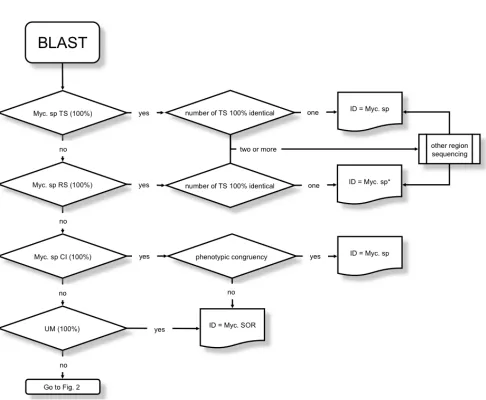
Following the BLAST of the query sequence, two scenarios are possible depending on the presence or absence of one or more identical sequences in the database.
Contrary to common opinion, the label of a se-quence 100% identical to the query cannot be as-sumed outright as the correct identification of the test strain. The presence of misassigned se-quences in uncontrolled databases is well known [23]; in adjunct to gross errors (presumably due to sequence exchange at the moment of the sub-mission), there are many sequences originating from very roughly characterized strains. Only in cases of complete identity to a sequence obtained from a reference strain, or better from a type strain, the identification can be relied upon, as the incidence of misidentifications among reference strains is quite low, albeit not zero [24,25].
A good number of sequences in INSDC partners are only labeled as belonging to the
Mycobacte-rium genus; although useless for identification
purposes, such entries still provide important in-formation: some strains possibly identical to the query have been isolated by others who, in the absence of evidence, judiciously decided not to classify them at the species level.
An unresolved general taxonomic problem is the definition of the minimal sequence diversity ex-ceeding the variability within a species and being sufficient to claim diversity of species; regarding mycobacteria, very poor consensus has been achieved using such cut-off levels for the 16S rRNA. The application of strict mathematical lim-its to biological entities is always questionable, all the more in the case of Mycobacterium taxonomy
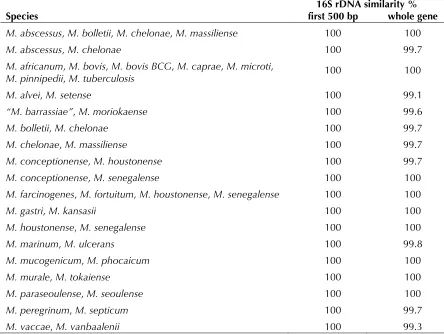
where almost 50% (no. 70) of the species officially recognized as distinct are characterized by genetic similarities >99% with one or more species of the genus; among them, several clusters of species even share identical 16S rDNA sequences (Table 1).
Table 1.Mycobacterium species sharing identical 16S rDNA sequences.
Species first 500 bp16S rDNA similarity %whole gene
M. abscessus, M. bolletii, M. chelonae, M. massiliense 100 100
M. abscessus, M. chelonae 100 99.7
M. africanum, M. bovis, M. bovis BCG, M. caprae, M. microti,
M. pinnipedii, M. tuberculosis 100 100
M. alvei, M. setense 100 99.1
“M. barrassiae”, M. moriokaense 100 99.6
M. bolletii, M. chelonae 100 99.7
M. chelonae, M. massiliense 100 99.7
M. conceptionense, M. houstonense 100 99.7
M. conceptionense, M. senegalense 100 100
M. farcinogenes, M. fortuitum, M. houstonense, M. senegalense 100 100
M. gastri, M. kansasii 100 100
M. houstonense, M. senegalense 100 100
M. marinum, M. ulcerans 100 99.8
M. mucogenicum, M. phocaicum 100 100
M. murale, M. tokaiense 100 100
M. paraseoulense, M. seoulense 100 100
M. peregrinum, M. septicum 100 99.7
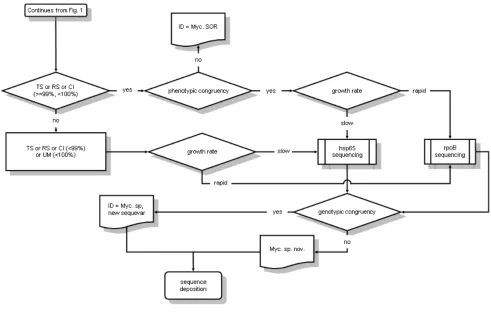
The impossibility of using a cut-off further compli-cates the identification of mycobacteria for which the BLAST does not find any 100% identical en-tries. The passive acceptance of the identification corresponding to the entry with the highest simi-larity may be responsible for misidentification in a substantial number of cases. The reliability of an identification based on a similarity ranging from
≥99 to <100%, is strongly dependent, besides the
value of such percentage, on the characteristics of
the database entry involved (type strain, clinical isolate, etc.). In case of similarity <99%, the prob-ability of a correct identification becomes ex-tremely low. The aforesaid percentages refer to the most common situation, in which a sequence spanning the first third of the 16S rDNA has been determined; the use of shorter sequences intro-duces a further variable affecting the confidence of the identification.
Figure 2. TS = type strain; RS = reference strain; CI = clinical (or environmental) isolate; UM = unnamed my-cobacterium; OTRS = species other than recognized
Suggestions to the database user
The complexity of the path leading from a se-quence to the identification (Figures 1 and 2) is evidently in contrast to the opinion of most mi-crobiologists using genetic sequencing for the speciation of mycobacteria. The achievement of a good quality electropherogram is commonly con-sidered the critical point of the whole process, while the identification itself is regarded as a mere formality with the first entry emerging from the database being automatically considered the op-timal choice. Actually, the quality of the electro-pherograms is a matter of technical skill, the ex-cellence of the identification is a matter of thought and insight, capabilities difficult to learn. The fol-lowing short guidance aims to provide basic tips and to point out the most common traps.
• Every sequence present in INSDC
partners comes with relevant annota-tions which offer precious hints. The frequently reported source of the
strain allows the recognition of the more reliable reference strains from clinical or environmental isolates. The name of the submitter is important too, as his reputability allows grading the trustworthiness of the entries. The year of submission may be help-ful, as very old sequences can be af-fected by the outdated techniques used. In the presence of identical se-quences with different species attri-bution, one of which belonging to a novel species, it is common to see that the other had been submitted years before the description of the new spe-cies.
refer-ence strain even if more similar ones do exist. A careful check of mis-matches often substantially reduces their number as some of them are ei-ther due to the presence of ambi-guous nucleotides in the database se-quence or to incorrect interpretation of the electropherogram. Should the mismatches be confirmed the best choice is probably to leave the strain unidentified as its unsatisfactory si-milarity with the closest reference strain makes even more daring its at-tribution to other species whose ref-erence strains present lower similari-ty.
• In the species with double ribosomal
operon the possible presence of mi-nor polymorphism between the two copies, although very rare, should not be neglected [26].
• An identification obtained in compar-ison with a reference strain should be pursued whenever possible, as there is no guarantee that the entries re-lated to non-reference strains are correctly labeled. Therefore, it is at times better to disregard the best matching entry and to consider one of the more closely related reference strains, although it is characterized by a lower similarity percentage.
• The presence of multiple entries a s-signed to the same species, among the most closely related, increases the confidence of the identification. In contrast, the presence of a single en-try related to the species “A” among several related to the species “B” should warn against the reliability of the first one. The possibility exists, however, of the presence of multiple sequences presenting the same incor-rect attribution with the first errone-ous submission misleading the sub-sequent submitters.
• For many sequences of reference
strains this important information is sometime missing in the database; in cases in which a bibliographic
refer-ence is provided a quick glance at the paper can clarify the point.
• The presence of reference strains e r-roneously labeled, as they have been named in the pre-genomic era, is like-ly. The lack of a close similarity be-tween their sequence and the one of the type strain should be considered suspiciously.
• Many species names associated to
database entries lack standing in the literature; the consultation of the list of officially recognize
point. In case of identity with one such sequence, the query organism remains unidentified. Unculturable mycobacteria, whose description as novel species is not possible, represent the exception to the rule.
• In the output of BLAST search, the order of entries does not always re-flect the similarity score; it is recom-mended to order them by clicking on the header of the Maximum identity column.
• The detection of isolates possibly b e-longing to a novel species, whose se-quence is identical to one already de-posited by others, should lead to con-tact the submitters and to combine the strains. The amount of the sample is a major value in taxonomic studies while sp. nov. descriptions based on a single isolate are not advisable [1].
Suggestions to the database submitter
Obviously the best help to the users of uncon-trolled databases is provided by the quality of the submissions. From this point of view it is extreme-ly important that the authors:
• Carefully check their submissions.
• Provide information about the nature of the strains (type strain, reference strain, clinical isolate, etc.).
process, by giving references to rele-vant publications.
• Avoid labeling a sequence with a species name in cases in which such belonging is not evidence based.
• Avoid submitting multiple entries when they are identical or when an identical sequence is already present in the database, but systematically submit every new sequence found.
• Suggest to the author, or to the data-base editorial staff, the correction of any error detected in sequences or strain data.
• Avoid giving tentative names to new strains prior the sp. nov. description.
An important issue to have clear in mind is that the improvement of uncontrolled databases relies almost solely on the auto-control of the submis-sions.
Acknowledgements
We thank Prof. Pasquale Urbano for critically reviewing the manuscript.
References
1. Tortoli E. Impact of genotypic studies on myco-bacterial taxonomy: the new mycobacteria of the 1990s. Clin Microbiol Rev 2003; 16:319-354
2. Wayne LG, Good RC, Krichevsky MI, Beam RE, Blacklock Z, Chaparas SD, Dawson D, Froman S, Gross W, Hawkins J, et al. First report of the co-operative, open-ended study of slowly growing mycobacteria by the International Working Group on Mycobacterial Taxonomy. Int J Syst Bacteriol
1981; 31:1-20
3. Wayne LG, Good RC, Krichevsky MI, Blacklock Z, David HL, Dawson D, Gross W, Hawkins J, Vincent Lévy-Frébault V, McManus C, et al. Fourth report of the cooperative, open-ended study of slowly growing mycobacteria by the In-ternational Working group on Mycobacterial Taxonomy. Int J Syst Bacteriol 1991; 41:463-472
4. Wayne LG, Good RC, Krichevsky MI, Beam RE, Blacklock Z, David HL, Dawson D, Gross W, Hawkins J, Jenkins PA, et al. Second report of the cooperative, open-ended study of slowly growing mycobacteria by the International Working Group on Mycobacterial Taxonomy. Int J Syst Bacteriol
1983; 33:265-274
5. Wayne LG, Good RC, Krichevsky MI, Blacklock Z, David HL, Dawson D, Gross W, Hawkins J, Jenkins PA, Juhlin I, et al. Third report of the co-operative, open-ended study of slowly growing mycobacteria by the International Working Group on Mycobacterial Taxonomy. Int J Syst Bacteriol
1989; 39:267-278
6. Brennan PJ, Heifets M, Ullom BP. Thin-layer chromatography of lipid antigens as a means of identifying nontuberculous mycobacteria. J Clin Microbiol 1982; 15:447-455
7. Guerrant GO, Lambert MA, Moss CW. Gas-chromatographic analysis of mycolic acid clea-vage products in mycobacteria. J Clin Microbiol 1981; 13:899-907
8. Butler WR, Guthertz LS. Mycolic acid analysis by high-performance liquid chromatography for identification of Mycobacterium species. Clin Mi-crobiol Rev 2001; 14:704-726
9. Tortoli E, Bartoloni A. High-performance liquid chromatography and identification of mycobacte-ria. Rev Med Microbiol 1996; 7:207-219. 10. Tortoli E, Pecorari M, Fabio G, Messinò M, Fabio
A. Commercial DNA-probes for mycobacteria in-correctly identify a number of less frequently en-countered species. J Clin Microbiol 2010; 48
:307-310
11. Böttger EC. Approaches for identification of mi-croorganisms. Despite longer experience with fat-ty acid profiles, DNA-based analysis offers several advantages. ASM News 1996; 62:247-250. 12. McNabb A, Eisler D, Adie K, Amos M, Rodrigues
2004; 42:3000-3011
13. Mijs W, de Haas P, Rossau R, van der Laan T, Rigouts L, Portaels F, van Soolingen D. Molecular evidence to support a proposal to reserve the de-signation Mycobacterium avium subsp. avium for bird-type isolates and M. avium subsp. hominis-suis' for the human/porcine type of M. avium. Int J Syst Evol Microbiol 2002; 52:1505-1518
14. Adékambi T, Colson P, Drancourt M. rpoB-based identification of nonpigmented and
late-pigmenting rapidly growing mycobacteria. J Clin Microbiol 2003; 41:5699-5708
15. Blackwood KS, He C, Gunton J, Turenne CY, Wolfe J, Kabani AM. Evaluation of recA se-quences for identification of Mycobacterium spe-cies. J Clin Microbiol 2000; 38:2846-2852
16. Zolg JW, Philippi-Schulz S. The superoxide dis-mutase gene, a target for detection and identifica-tion of mycobacteria by PCR. J Clin Microbiol 1994; 32:2801-2812
17. Kasai H, Ezaki T, Harayama S. Differentiation of phylogenetically related slowly growing myco-bacteria by their girB sequences. J Clin Microbiol 2000; 38:301-308
18. Stackebrandt E, Frederiksen W, Garrity GM, Gri-mont PA, Kampfer P, Maiden MCJ, Nesme X, Rossellò-Mora R, Swings J, Truper HG, et al. Re-port of the ad hoc committee for the re-evaluation of the species definition in bacteriology. Int J Syst Evol Microbiol 2002; 52:1043-1047
19. Altschul SF, Madden TL, Shäffer AA, Zhang J, Zhang Z, Miller W, Lipman DJ. Gapped BLAST and PSI-BLAST: a new generation of protein data-base search programs. Nucleic Acids Res 1997; 25:3389-3402
20. Hall L, Doerr KA, Wohlfiel SL, Roberts GD. Eval-uation of the MicroSeq system for identification of mycobacteria by 16S ribosomal DNA sequencing and its integration into a routine clinical myco-bacteriology laboratory. J Clin Microbiol 2003; 41:1447-1453
21. Harmsen D, Dostal S, Roth A, Niemann S, Roth-ganger J, Sammeth M, Albert J, Frosch M, Richter E. RIDOM: Comprehensive and public sequence database for identification of Mycobacterium spe-cies. BMC Infect Dis 2003; 3:26
22. Chun J, Lee JH, Jung Y, Kim M, Kim S, Kim BK, Lim YW. EzTaxon: a web-based tool for the iden-tification of prokaryotes based on 16S ribosomal RNA gene sequences. Int J Syst Evol Microbiol 2007; 57:2259-2261
23. Turenne CY, Tschetter L, Wolfe J, Kabani A. Ne-cessity of quality-controlled 16S rRNA gene se-quence databases: identifying nontuberculous Mycobacterium species. J Clin Microbiol 2001; 39:3637-3648
24. Turenne CY, Cook VJ, Burdz TV, Pauls RJ, Thibert L, Wolfe JN, Kabani A. Mycobacterium parascro-fulaceum sp. nov., novel slowly growing, sco-tochromogenic clinical isolates related to Myco-bacterium simiae. Int J Syst Evol Microbiol 2004;
54:1543-1551
25. Simmon KE, Low YY, Brown-Elliott BA, Wallace RJ, Jr., Petti CA. Phylogenetic analysis of Myco-bacterium aurum and Mycobacterium neoaurum with redescription of M. aurum culture collection strains. Int J Syst Evol Microbiol 2009; 59
:1371-1375