Time Synchronization and Communication Program of
Wireless Sensor Network for Online Monitoring of
Electrical Equipment
https://doi.org/10.3991/ijoe.v13i07.7278Yuxia Shen
Jiyuan Vocational and Technical College, Jiyuan, Henan, China [email protected]
Abstract—In wireless sensor networks, for improving the time
synchroniza-tion perfromance of online monitoring and applicasynchroniza-tion of ZigBee protocol, a scheme is designed. For this objective, first of all, the ZigBee protocol specifi-cation is summarized, a profound analysis of the hardware abstraction architec-ture of TinyOS operating system is made; the advantages of the ZigBee proto-col compared with the traditional radio technology are comparatively analyzed. At the same time, the node design block diagram based on CC2430 and related development system is provided. In the TinyOS2.x operating system, we ana-lyze CC2430 application program abstract architecture, and on this basis, give the realization process of program design. The research results showed that we achieve an on-line monitoring system based on ZigBee protocol, which has re-alistic significance of applying ZigBee protocol in wireless sensor network of electrical equipment online monitoring. Based on the above research, it is con-cluded that the online monitoring system can collect the temperature parameters of the monitored object in real time that it can be widely applied in wireless sensor networks.
Keywords—Electrical equipment, wireless sensor network, time
synchroniza-tion, communication program
1
Introduction
insula-tion; sensor aging or failure will cause the loss of state information amount; sensor configuration change may need to modify the source program of the system software.
These defects put forward new requirements for the electrical equipment in tech-nique, and the emergence of wireless sensor network makes it an ideal choice. Wire-less sensor is a new type of network technology generated with the rapid development of micro electromechanical technology, low energy consumption radio frequency (Radio Frequency, RF) technology, and sensor technology. A large number of sensor nodes, in self-organized network, can obtain real-time detection region information, data reaches a sink node after a single hop or multi hop transmission in the network, and users, according to the returned data from the network, make the appropriate analysis processing and publish monitoring tasks. Wireless sensor network has a po-tential application prospect in military applications, environmental observation and forecasting system, medical care, intelligent home furnishing, building condition monitoring and so on.
The traditional radio technology that wireless sensor network uses is very power-consuming, and it takes up more computing and communication resources, which is a bottleneck for wireless sensor networks with limited resources. The application field of wireless sensor network does not require too high bandwidth, but only requires low latency and low power consumption, and the ZigBee protocol just meets this require-ment. ZigBee protocol is a standard wireless network protocol designed for low rate measurement and control network. It has many advantages, such as low complexity, low cost, low power consumption, high security and so on [2]. ZigBee protocol is especially suitable for industrial monitoring application environment with low data transmission rate, small equipment spacing and difficult power supply. CC2430 is a radio frequency chip based on ZigBee protocol. Based on this, this paper designs online monitoring system based on ZigBee protocol in the TinyOS2.x operating sys-tem, which is an experimental study for wireless sensor network using ZigBee proto-col in the electrical equipment on-line monitoring.
2
Introduction to Theory and Technology
2.1 Summary of ZigBee protocol
ZigBee protocol is a new low cost and low power short distance wireless commu-nication technology. The underlying technology of ZigBee is based on IEEE802.15.4, the physical layer and the MAC layer directly refer to the technical standards of IEEE802.15.4, and ZigBee protocol make a standardization for its network layer protocol and API. Its objective function is automatic control, which uses frequency modulation technology, and the frequency bands used are 2.4GHz (ISM), 868MHz (Europe) and 915MHz (USA) [3]. They are unlicensed band, and the effective cover-age is 10 ~ 75m. When the network rate is reduced to 28kb/s, the transmission range can be extended to 134m, thus having higher reliability.
2.low power consumption: in a low power standby mode, two ordinary No. 5 batter-ies can be used 6 months to two years, while Bluetooth technology can only work for a few weeks, and WiFi can only work several hours;
3.low cost: ZigBee data transmission rate is low and the protocol is simple, so it greatly reduces the cost;
4.large network capacity: each network can accommodate thousands of nodes; 5. short time delay: delay are usually between 15 ~ 30ms;
6.it provides data integrity check and authentication function, using AES-128 en-cryption algorithm;
7.small effective range: the effective data covers the range between 10 ~ 75m [4];
8.use frequency of 2.4GHz, 868MHz (Europe) and 915MHz (United States),
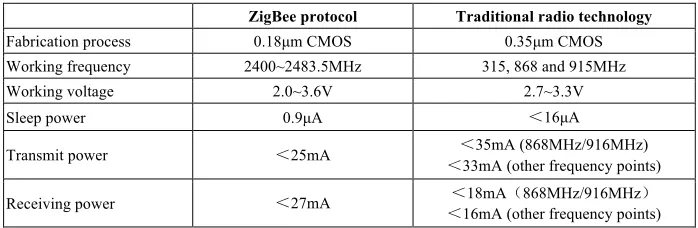
unli-censed band. The comparative analysis between ZigBee and traditional radio tech-nology is shown in table 1.
Table 1. Comparative analysis between ZigBee protocol and traditional radio technology ZigBee protocol Traditional radio technology Fabrication process 0.18µm CMOS 0.35µm CMOS Working frequency 2400~2483.5MHz 315, 868 and 915MHz
Working voltage 2.0~3.6V 2.7~3.3V
Sleep power 0.9µA 16µA
Transmit power 25mA 35mA (868MHz/916MHz)
33mA (other frequency points)
Receiving power 27mA 18mA868MHz/916MHz
16mA (other frequency points)
2.2 Radio frequency module CC2430
Wireless RF chip CC2430 is the first 2.4GHz RF system single chip that is suitable for the ZigBee protocol produced by Chipcon company, which is suitable for low power short distance communication occasions (such as wireless sensor network node). The CC2430 module uses ZigBeeSoC radio frequency chip CC2430-F128 produced by TI company, and the chip integrates the high performance 8051 core, ADC, UART and so on; it supports the ZigBee protocol stack; the user may use all resources on the chip. CC2430 chip uses the previous CC2420 chip architecture, and integrates ZigBee radio frequency (RF) front-end, memory and microcontroller on a single chip. It uses 1 8-bit MCU (8051), with 128KB programmable flash memory and 8KB RAM, and it also includes analog digital converter (ADC), several Timers, AES-128 timer coprocessor, watchdog-timer, 32kHz oscillator sleep mode timer, reset circuit, power-on-reset, brown-out-detection, and 21 programmable I/O pins. The ultra-short time characteristics of conversion of CC2430 sleep mode to active mode are particularly suitable for applications requiring very long battery life.
cable, no serial cable. The left side of the circuit is the designed serial conversion circuit, which is the medium for CC2430 and PC communication.
2.3 TinyOS architecture
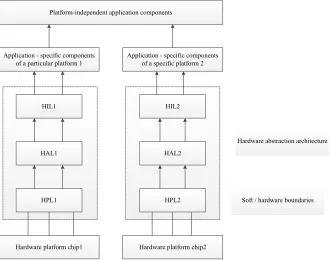
The program design of this chapter is based on the TinyOS2.x, as shown in figure 1. We define 3-layer hardware abstraction architecture in TinyOS: hardware presenta-tion layer (HPL), hardware adaptapresenta-tion layer (HAL), and hardware interface layer (HIL). It effectively combines the component model with 3 different abstraction lay-ers. In the system, it is mainly used to shield the characteristics of the upper layer, and the upper part and the physical hardware are isolated to facilitate the transplant of the system. In function, the hardware abstract component is equivalent to the driver of the underlying hardware, and the upper components call through the interface.
Platform-independent application components
Application - specific components
of a particular platform 1 Application - specific components of a specific platform 2
HIL1
HAL1
HPL1
HIL2
HAL2
HPL2
Hardware platform chip1 Hardware platform chip2
Hardware abstraction architecture
Soft / hardware boundaries
Fig. 1. TinyOS hardware abstract architecture
CC2430 application
Timer UartC LedsC
APP
AlarmMilli32
C HalCC2430SimpleUartC
Timer Serial Port Port
HAL
HPL
HW
HW
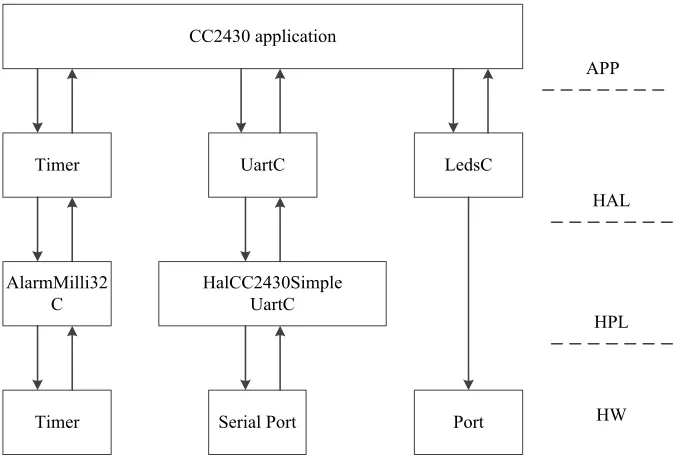
Fig. 2. CC2430 application program abstract architecture
The arrow in figure 2 shows the interface between the components, the down arrow refers to the command provided by the lower layer, and the up arrow is an event trig-gered by the lower component. The current CC2430 hardware abstract components do not support serial stack, but only perform the serial operation through the command and event provided by Serial Byte Comm under UartC; the CC2430 module provides two LED indicators, to show the current program simple information for judging the situation of the implementation of the program, in which LED1 is controlled by P1.0, and LED2 is controlled by P1.3.
2.4 Serial program design
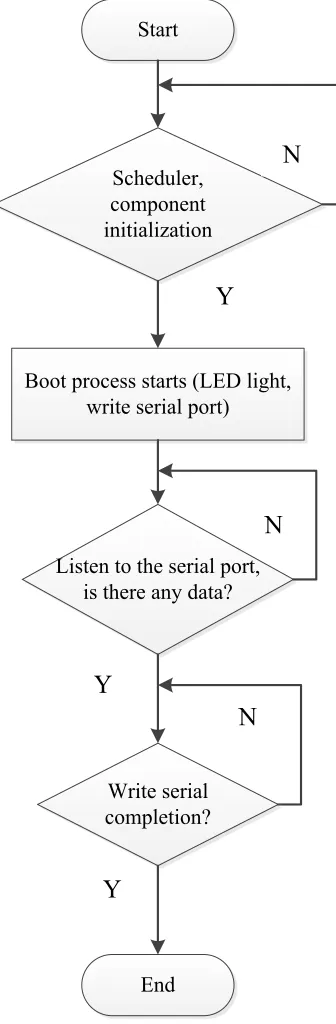
This section explains the process of transplantation of the program with a serial communication program transplantation as an example, and the serial communication program is of instructive significance in the follow-up receiving, analysis, and display in the PC of wireless sensor network data based on ZigBee protocol. The basic flow chart of the program is shown in figure 3.
Start
Scheduler,
component
initialization
Boot process starts (LED light,
write serial port)
Write serial
completion?
Listen to the serial port,
is there any data?
End
N
Y
N
Y
N
Y
The hardware programming tool used in the paper is SmartRF Flash Programmer. It is ChipCon flash programmer, which only supports Windows operating system. Using it to write .hex document compiled in Cygwin into the CC2430 RF chip so that it can operate.
The serial port reading and writing procedures of the PC use LabVIEW to compile. LabVIEW has abundant graphics and signal processing function, which has great advantages for the follow-up receiving, graphics rendering, and data analysis of wireless sensor network data based on ZigBee protocol [5]. Serial program parame-ters setting is: serial port COM1, the baud rate 115200, 8 data bits, no parity codes, and 1bit stop bit.
On the basis of the ZigBee protocol, we profoundly analyze the hardware abstrac-tion architecture of TinyOS operating system, and provide the abstract architecture of CC2430 applications under the TinyOS2.x operating system. Based on this, we real-ize the CC2430 program transplant, which is a kind of innovative experimental rese-arch compared with the existing theory.
3
Materials and Methods
3.1 Monitoring system composition
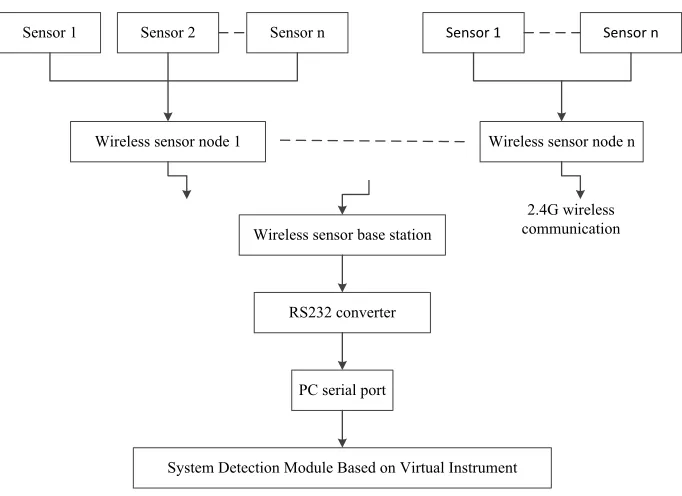
The structure diagram of the online monitoring system based on ZigBee protocol is shown in figure 4. Monitoring sensor node is provided with a motor inside buried thermal resistance (called heat resistance), suitable for motor windings and the motor core temperature measurement. Using platinum resistance as temperature sensor and display instrument to measure the temperature of motor winding or stator iron core, also applying to other mechanical devices with similar temperature measurement requirements [6]. The installation is very simple, directly displaying the actual tempe-rature of the coil.
Sensor 1 Sensor 2 Sensor n !"#$%&'( !"#$%&'#
Wireless sensor node 1 Wireless sensor node n
Wireless sensor base station
RS232 converter
PC serial port
System Detection Module Based on Virtual Instrument
2.4G wireless communication
Fig. 4. System structure diagram
3.2 Monitoring system software
Remote data communication module
Database management module
Historical Trends Module
Parameter setting module
Human - machine interface monitoring main module
Data analysis out of the module
Data acquisition module
Real-time monitoring module
Event module
Fig. 5. Monitoring system software diagram
4
Results
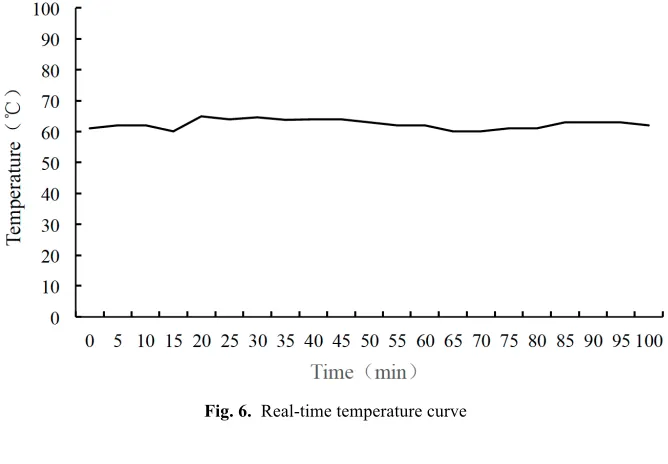
Figure 6 shows the real-time temperature change curve of the generator winding temperature under the operating condition collected by the monitoring system, and table 2 is a part of the monitoring temperature parameter variation values. From Fig. 6 and table 2, it is known that when the generator is in the normal working state, the measured temperature of winding phase A is between 54-64 DEG, lower than the alarm value of 115 DEG C (the motor winding insulation is class F) [8]; the winding B phase temperature is between 55-62 DEG C, below the alarm value; the winding C phase temperature is between 53-61 DEG C, similarly below the alarm value, in line with the test parameters value requirements. The experimental results show that the on-line monitoring system based on ZigBee technology can collect and display the change of working condition parameters in real time.
Table 2. Part of monitoring temperature parameter change value Monitoring points Temperature parameters change value The alarm value
The winding A phase 54-64! 115!
The winding B phase 55-62! 115!
The winding C phase 53-61! 115!
In this paper, we make an experimental study on the application of ZigBee protocol in wireless sensor networks. First of all, the ZigBee specification is summarized, and a profound analysis of the hardware abstraction architecture of TinyOS operating system is made; in addition, a comparative analysis of the advantages of TinyOS2.x operating system compared with the TinyOS1.x is performed, and the design diagram of CC2430 and the related development systems are given. On the basis of analyzing CC2430 application abstract architecture in the TinyOS2.x operating system, we give the realization process of program design, realize a wireless sensor network on-line monitoring system based on ZigBee protocol, and carry out the related experiments. The experimental results show that the online monitoring network system can real-time collect the temperature parameters in the monitoring object.
5
Conclusion
In this research direction, according to the characteristics of wireless sensor net-work for electrical equipment online monitoring, combined with the characteristics of the existing wireless sensor network communication technology and the existing wireless sensor network time synchronization algorithm, a wireless sensor network time synchronization scheme is designed for electrical equipment online monitoring and relevant communication program development and communication technology improvement. The experimental research is made on ZigBee protocol applied in wireless sensor networks. Based on the analysis of the abstract architecture of CC2430 application in TinyOS2.x operating system, the realization process of the program design is given, and the related experiment are carried out. At the same time, an online monitoring system based on ZigBee protocol is realized. The experiments show that the system can collect the temperature parameters of the monitored object in real time. That is to say, the system has very good performance and it is of great significance in the monitoring process.
6
References
[1] Keskin, M. E. (2017). A column generation heuristic for optimal wireless sensor network design with mobile sinks. European Journal of Operational Research, 260(1): 291-304. https://doi.org/10.1016/j.ejor.2016.12.006
Wireless Sensor Network. Journal of Computational and Theoretical Nanoscience, 13(8): 5281-5287. https://doi.org/10.1166/jctn.2016.5415
[3] Farash, M. S., Turkanovi!, M., Kumari, S., & Hölbl, M. (2016). An efficient user authenti-cation and key agreement scheme for heterogeneous wireless sensor network tailored for the internet of things environment. Ad Hoc Networks, 36: 152-176. https://doi.org/10.1016/j.adhoc.2015.05.014
[4] Guo, L., Li, Y., & Cai, Z. (2016). Minimum-latency aggregation scheduling in wireless sensor network. Journal of Combinatorial Optimization, 31(1): 279-310. https://doi.org/10.1007/s10878-014-9748-7
[5] Zaini, J., Hameau, F., Taris, T., Morche, D., & Audebert, P. (2016, June). Channel aware receiver front end for low power 2.4 GHz Wireless Sensor Network: A system level analy-sis. In New Circuits and Systems Conference (NEWCAS), 2016 14th IEEE International (pp. 1-4). IEEE.
[6] Anand, V., Agrawal, D., Tirkey, P., & Pandey, S. (2016). An Energy Efficient Approach to Extend Network Life Time of Wireless Sensor Networks. Procedia Computer Science, 92: 425-430. https://doi.org/10.1016/j.procs.2016.07.332
[7] Saranya, S., Viswanathan, S., & Jayakumar, D. (2016). The Role of Wireless Sensor Net-work in Tracking Wild Animals Crossing Forest Boundaries. Programmable Device Cir-cuits and Systems, 8(5): 105-107.
[8] Keskin, M. E. (2017). A column generation heuristic for optimal wireless sensor network design with mobile sinks. European Journal of Operational Research, 260(1): 291-304. https://doi.org/10.1016/j.ejor.2016.12.006
7
Author
Yuxia Shen is with Jiyuan Vocational and Technical College, Jiyuan, Henan, Chi-na ([email protected]).