THE CONVENTIONAL SA IN TEACHING READING
AT SMPN 4 PRINGSEWU
(A Thesis)
By
AGATHA WURI YAYI SAPUTRI
MASTER IN ENGLISH LANGUAGE TEACHING STUDY PROGRAM LANGUAGE AND ARTS EDUCATION DEPARTMENT
TEACHER TRAINING AND EDUCATION FACULTY LAMPUNG UNIVERSITY
THE CONVENTIONAL SA IN TEACHING READING
AT SMPN 4 PRINGSEWU
By
AGATHA WURI YAYI SAPUTRI
A Thesis
Submitted in a partial fulfillment of The requirements for S-2 Degree
MASTER IN ENGLISH LANGUAGE TEACHING STUDY PROGRAM LANGUAGE AND ARTS EDUCATION DEPARTMENT
TEACHER TRAINING AND EDUCATION FACULTY LAMPUNG UNIVERSITY
i
THE EFFECTS OF INTEGRATING JIGSAW WITHIN SA
(SCIENTIFIC APPROACH) IN COMPARISON TO
THE CONVENTIONAL SA IN TEACHING READING
AT SMPN 4 PRINGSEWU
By
Agatha Wuri Yayi Saputri
The objectives of the research are to find out whether there was a significant difference on students’ reading comprehension achievement between those who were taught using integrated Jigsaw-SA and the conventional SA, to investigate which reading aspect was best practiced by the integration of these techniques, as well as how the implementation of integrated Jigsaw-SA in teaching reading was. To achieve the objectives of the research, the research was conducted quantitatively and qualitatively. It involved experimental and control classes. Students of the seventh grade of SMPN 4 Pringsewu were taken as the sample. The data were gathered through a reading comprehension test, observation, and interview.
ii
CURRICULUM VITAE
The writer is Agatha Wuri Yayi Saputri. She was born on August 14th, 1978 in Bandar Lampung. She is blessed to be the fourth child of Drs. M. Edi Yuwono
and late Ch. Suratmi, and a wife to Yanuarius Yanu Dharmawan, S.S., M.Hum.
She started her formal education at SD Sejahtera I Kedaton in 1985 and graduated
in 1991. Then, she continued her study at SMP Xaverius Tanjungkarang and
graduated in 1994. She chose to enroll to general high school in Pringsewu and
was registered as a student in SMU Xaverius Pringsewu. After graduating in
1997, she was accepted as a student of English Program of Teacher Training and
Education Faculty of Lampung University.
She started teaching at SD Sejahtera I Kedaton when she was in her third semester
of college. In 2002, she taught English at SMA BPK Penabur Bandar Lampung
for a year while finishing her study. She graduated from Lampung University in
2003 and started teaching English at SMP Xaverius 2 Bandar Lampung until she
was accepted as a civil servant in 2010.
During her service time as a civil servant, she has taught in two state junior high
iii
iv
By offering praise and greatest gratitude to Lord Jesus for His blessing, I would
like to dedicate this piece of work to:
My beloved partner in life, Yanuarius Yanu Dharmawan, S.S., M.Hum.
My beloved parents, Drs. Martinus Edi Yuwono and late Christophora
Suratmi
My beloved siblings and the in laws, Anton & Elly, late Beni & late Ade,
Alex & Yusti, Rika & Anton
My fabulous friends of the third batch of Master of English Education
Lampung University
v
- From His abundance, we have all received one
gracious blessing after another.
(John 1:16)
- Cherish every moment of life.
vi
Praise to Lord Jesus Christ for His great mercy and blessing that He has provided
the writer with good health and faith to finish her final task of writing her thesis.
Sincere gratitude and honor are addressed to all people who have helped and
supported the writer in accomplishing her final task, as without their outstanding
supports, encouragements and assistances, this piece of work would never come
into existence. Therefore, the writer would like to acknowledge her respect and
gratitude to:
1. Prof. Ag. Bambang Setiyadi, M.A., Ph.D. as the first advisor, for his
advice, motivation, care and ideas in encouraging the writer to complete
her research.
2. Dr. Ari Nurweni, M.A. as the second advisor, for her tender patience,
suggestions, ideas in supporting the writer to finish her research.
3. Prof. Dr. Patuan Raja, M.Pd. as the first examiner, for his advices, ideas,
and careful review for the writer in completing her thesis.
4. Dr. Flora, M.Pd. as the second examiner, academic advisor and head of
English Education Master Program for her great support, motivation, and
care in encouraging the writer to finish her study.
5. Drs. Rahmanto, M.Pd. as the principal of SMPN 4 Pringsewu for the
permission and support to conduct the research.
6. Rusmiati, S.Pd. as the English teacher of grade seven in SMPN 4
vii
8. Beloved family and colleagues for their endless encouragement, love and
prayers.
9. Emilda Oktaviani, M.Pd., Fefiyana, M.Pd., Melina Sari, M.Pd., Rinna
Slamet, M.Pd., and Shirtha El Rusyda, M.Pd. for their assistance and
support in accomplishing this thesis.
10.All lovely friends of the third batch of Master of English Education.
Last but not least, the writer welcomes any suggestions and constructive criticisms
for the improvement of this thesis as she fully realizes that this thesis is not
perfect and may have some weaknesses. Finally, the writer expects that this thesis
would be beneficial to the development of education and those who are interested
in the same field.
Bandar Lampung, 15 Januari 2018 The writer,
viii
Page
ABSTRACT ... i
CURRICULUM VITAE ... ii
DEDICATION ... iv
MOTTO... v
ACKNOWLEDGEMENTS ... vi
LIST OF CONTENTS ... viii
LIST OF APPENDICES ... x
LIST OF TABLES ... xi
LIST OF CHARTS ... xii
I. INTRODUCTION 1.1 Background of the Problem ... 1
1.2 Research Questions... 7
1.3 The Objectives of the Research ... 7
1.4 The Scope of the Research ... 8
1.5 The Uses of the Research ... 8
1.6 Definition of Key Terms ... 9
II. FRAME OF THEORIES 2.1 Previous Studies Related to the Topic .……….…. 11
2.2 The Nature of Reading ... 15
2.3 The Concept of Teaching Reading ... 16
2.4 Curriculum……….……… 18
2.5 Curriculum 2013 ……….…… 20
2.6 Scientific Approach ………….……….…….. 22
2.7 Constructivism ………..………...……. 25
2.8 Jigsaw Technique ……….………. 28
2.9 Jigsaw Technique within Scientific Approach ... 33
2.10Theoretical Assumption ………... 39
2.11 Hypotheses ... 41
ix
3.5 Data Collecting Techniques………. 45
3.5.1 ReadingTest ……….. 45
3.5.2 Observation ...……… 46
3.5.3 Interview ... 47
3.6 Validity and Reliability ... ……….. 49
3.6.1 Validity and Reliability of the Reading Test ... 49
3.6.1.1 Validity of the Reading Test ... 50
3.6.1.2 Reliability of the Reading Test ... 52
3.6.1.2.1 Reliability of the Test Items ... 53
3.6.1.2.2 Difficulty Level of the Test Items ... 54
3.6.1.2.3 Discrimination Power of the Test Items .... 56
3.6.2 Validity and Reliability of the Qualitative Data ... 57
3.7 Research Procedures ...………... 57
3.8 Data Analysis ... 59
3.8.1 Hypotheses Testing ... 61
3.8.2 Typological Analysis ... 63
IV. RESULTS AND DISCUSSIONS 4.1 Results of the Research ... 64
4.1.1 Result of the Try Out Test... 65
4.1.2 Result of the Reading Comprehension Test ... 65
4.1.2.1 Students’ Reading Comprehension Achievement.. 66
4.1.2.2 Students’ Reading Comprehension Aspects ... 69
4.1.3 Result of the Observation ... 73
4.1.4 Result of the Interview ... 74
4.2 Discussion of the Result ... 77
4.2.1 Integrating Jigsaw Technique within SA Promoted Students’ Reading Comprehension Achievement better than the Conventional SA ... 77
4.2.2 The Aspects of Reading Best Promoted through the Integration of Jigsaw Technique within SA ... 80
4.2.3 The Implementation of Integrating Jigsaw Technique within SA for Teaching Reading... 83
V. CONCLUSIONS AND SUGGESTIONS 5.1 Conclusions... 100
5.2 Suggestions ... 101
5.2.1 Suggestions for English Teachers ... 101
5.2.2 Suggestions for Other Researchers ... 101
x
Appendix Page
Appendix 1. Research Schedule ... 108
Appendix 2. Students’ Report Scores... 109
Appendix 3. Inter-raters’Content and Construct Validity Analysis ... 113
Appendix 4. Result of the Content and Construct Validity Analysis .... 119
Appendix 5. Reliability Testing ... 122
Appendix 6. Result of the Try Out Test ... 125
Appendix 7. Difficulty Level and Discrimination Power Analysis ... 127
Appendix 8. Lesson Plan for the Experimental Class... 129
Appendix 9. Lesson Plan for the Control Class ... 133
Appendix 10. Reading Comprehension Try Out Test Instrument ... 141
Appendix 11. Reading Comprehension Test Instrument ... 145
Appendix 12. Result of the Reading Comprehension Test ... 149
Appendix 13. Independent t-Test Analysis ... 151
Appendix 14. T-Table ... 152
Appendix 15. Observation Sheets ... 153
Appendix 16. Interview Guidance ... 162
Appendix 17. Interview Transcripts ... 163
Appendix 18. Interview Analysis ... 180
Appendix 19.Student’s Answer Sheets ... 183
Appendix 20. Letter of Research Permission ... 186
xi
Table Page
Table 2.1 The Integration of Jigsaw Technique within Scientific
Approach ... 34
Table 3.1 Indicators for Observation Sheet ... 46
Table 3.2 Indicators for Guidance Questions ... 48
Table 3.3 Basic Competence 4.7.1 ... 51
Table 3.4 Reading Test Table of Specification... . 52
Table 4.1Distribution Frequency of Experimental Class’ Reading Test Scores ... ... 66
Table 4.2Distribution Frequency of Control Class’ Reading Test Scores ... 67
Table 4.3 Summary of Reading Test Scores ... 67
Table 4.4 Analysis of Reading Test Scores ... 68
Table 4.5 Identifying Main Idea Achievement ... 69
Table 4.6 Identifying Supporting Details Achievement... 70
Table 4.7 Identifying Reference Achievement... 71
Table 4.8 Making Inference Achievement ... 71
Table 4.9 Understanding Vocabulary Achievement ... 72
Table 4.10 Summary of Reading Aspects Achievement... 72
Table 4.11Summary of Students’ Activities during the Learning Process... 73
Table 4.12 Summary of the Interview ... 75
xii
Chart Page
CHAPTER I
INTRODUCTION
The first chapter describes background of the problem, formulation of the problems and research questions, research objectives, research uses, the scope of the research and definition of key terms.
1.1 Background of the Problem
Curriculum does not occur in isolation. As Schubert (1986) states that curriculum is socially, politically and culturally constructed. It is obvious that those revisions are logically consequences of political issue, government system, social cultural, economic, science and technology change in the living of state community. Further, he also states that curriculum improvement is serious and inescapable. Thus, the presence of the factors surround curriculum must be taken into account in its creation and implementation.
2010), state the need of graduates with the ability to acquire, interpret, and evaluate data to learn, reason and solve problem. Thus, schools must not isolate themselves from changes.
Richards (2013) defines the term curriculum as an overall plan or design for a course and how the content for a course is transformed into a blueprint for teaching and learning which enables the desired learning outcomes to be achieved. While Finocchiaro, cited in Muth’im (2014, p.1095), defines curriculum as “the knowledge, information, skills, activities, materials, etc. which are included in the teaching of any subject”. Indonesian government refers curriculum to a set of planning and organization of aim, content, and learning material as the guidance to learning activity to achieve a particular educational objective (Republic of Indonesia Act, No.20 /2003). The growth of social, political and cultural life on Indonesia has brought the newest curriculum which is expected to counter the global challenges. The latest curriculum implemented in Indonesian National Education System is the 2013 curriculum with all of its characteristics to prepare graduates to have scientific mind set.
Based learning, Project Based learning, and Discovery learning. These learning models are required to be implemented in learning process of all subjects including language learning.
The Scientific Approach (SA) as one of the suggested models of learning in curriculum 2013 proposes a scientific learning procedure namely observing, questioning, collecting data, associating, and communicating. Decree of Education and Cultural Ministry number 103/2014 provides the guidance to implement the learning model. The procedure of implementing SA states that learner are required to be involved in the stages of observing, questioning, collecting information, associating, and communicating. Learners observe subject matter with their senses by watching, reading, and/or listening. Then learners are expected to raise their curiosity on the subject matter that they have observed. The next step requires learners to actively collect new information on the subject matter. After that, learners are guided to analyze the new information they have got, draw conclusion and internalize it into their knowledge. Finally, learners are given chance to communicate their new knowledge and skill.
create their own new understanding on the basis of interaction between what they already know and believe and ideas and knowledge with which they come into contact. While Hoover, cited in Mvududu & Burgess (2012), states two important notions of constructed knowledge. The first is that learners construct new understanding using what they have already known. The second one is learners remain active throughout the process of learning. Moreover, Piaget and Inhelder, cited in Mvududu & Burgess (2012), believe that the fundamental of learning is discovery. Discovery learning encourages learners to build on past experiences and knowledge, use their intuition, imagination and creativity, and search for new information to discover facts, correlations and new truths. Learning does not equal absorbing what was said or read, but actively seeking for answer and solutions. In addition, Vygotsky, cited in Yang and Wilson (2006), claims that learning occurs through dialogue. The dialogue refers to the interaction with source of ideas or knowledge. Thus, the notions of constructivism are definitely what scientific approach tries to achieve.
The term “scientific” is of course commonly used in the science field while in
implementing SA in teaching English to reach the goal of teaching and learning English in the classroom. Further, Amalia and Hartono (2015) emphasize that there is an urgent need to investigate SA because of the confusion in implementing the new curriculum launched by Ministry of Education and Culture in 2013. Both researches came to the findings that SA can be implemented in language learning with combination of Genre Based Approach (GBA). Moreover, Sarosa (2014) reveals that many English teachers got troubled in understanding and implementing the concept of SA into their classroom activities. He also stresses that they were lack of information on SA in English learning process. In accordance to Sarosa’s finding, Jaedun et al. (2014) came to a conclusion that
English teachers were not ready to implement the required learning models suggested by curriculum 2013. In contrast to Indonesian researchers’ findings on SA procedure, which obviously developed on constructivism learning theory, Taber (2011) claims that constructivism is applicable for teaching at all levels and in all disciplines when teachers pay more attention on the instructions.
The findings of the previous researches have shown the effectiveness of Jigsaw in teaching reading especially in college and intermediate high school level. However, learners on primary level are also important to get more attention on the development of their reading comprehension. Treatments should be applied to facilitate learners on primary level to deal with reading materials as well. Thus the researcher is interested in implementing Jigsaw technique to teach reading to junior high school level which will be integrated into SA.
1.2 Research Questions
Referring to the background of the problem, the formulation of the problems in this research is formulated in the following research questions:
1. Is there any significant difference between students’ reading comprehension achievement after being taught through the integration of Jigsaw technique within SA and the conventional SA?
2. What aspect of reading will be best practiced through the integration of Jigsaw technique within SA?
3. How is the implementation of integrating Jigsaw technique within SA for teaching reading?
1.3 Objectives of the Research
also tries to find out the aspect of reading best practiced and describe how the integrated Jigsaw-SA technique is implemented in teaching reading.
1.4 The Scope of the Research
The research was conducted in the seventh grade class of junior high school students in which English is a new compulsory subject for them. The research dealt with classroom interaction in SMPN 4 Pringsewu. SMPN 4 Pringsewu is one of the piloting schools of the implementation of curriculum 2013, thus it has implemented the curriculum for almost 5 years. The researcher designed a classroom interaction, in which she integrated Jigsaw technique within SA. The scores of students’ achievement ontheir reading comprehension test were taken as the data. The data were also gained from observation and interview with the students to describe their experience in learning through the integration of Jigsaw technique within SA.
1.5 The Uses of the Research
This research is hopefully useful both theoretically and practically; 1. Theoretically
To see whether the result of this research is relevant or not to the previous theories.
2. Practically
- For the teacher to broaden teachers’ understanding about Scientific Approach and Jigsaw technique in language learning.
1.6 Definition of Key Terms
Definition of terms aims at avoiding misunderstanding about the terms in the research. The terms are:
1. Curriculum 2013
Curriculum 2013 is the latest curriculum applied in Indonesia. The curriculum required learner-centered learning activities. One of the characteristics of this curriculum is the requirement to undergo scientific model of learning in the learning activities. The curriculum emphasizes the learning process to cover the aspects of students’ attitude, knowledge and skills.
2. Scientific Approach
Scientific Approach is a learning model that requires scientific procedure to be implemented in classroom learning activity in the 2013 Indonesian Curriculum, that is a series of steps namely observing, questioning, collecting data, associating, and communicating.
3. Jigsaw Technique
4. Reading
Reading is a receptive skill. It is the process of gaining information of a written text. The process of comprehending a text involves physical and mental activities. It requires readers to relate the information in the text to their knowledge and surrounding. Thus, reading is an active skill as well.
CHAPTER II
FRAME OF THEORIES
The second chapter delineates theories which are relevant with the research. The discussion of the chapter concerns with the previous related studies, the nature of reading, the concept of teaching reading, definitions of curriculum, curriculum 2013, scientific approach, constructivism, and Jigsaw technique. The model of integrating Jigsaw technique within Scientific Approach will be described as well.
2.1 Previous Studies Related to the Topic
The latest model of learning that is adapted in Indonesian curriculum uses the underlying concept of constructing learners’ knowledge is the Scientific
Approach (SA).
Several studies dealing with curriculum 2013 implementation in English Language Teaching (ELT) and SA implementation in language learning have been done by some researchers. Dealing with curriculum 2013 implementation, the first was Sahirudin (2013). He investigated the obstacles in implementing curriculum 2013 in ELT class. He concluded that the obstacles came from policy makers, teachers and learners as well. Then Muth’im (2014) delineates the essence of curriculum 2013 and claims that the implementation of the new curriculum should be a challenge for English teacher to improve their knowledge, creativity and skills in teaching. Further, Ahmad (2014) found out that the constraints of implementing curriculum 2013 in ELT lies in the teachers’ mindset that refuse the change in curriculum. In line with Ahmad’s research, Nur and
Several researches on SA have also been conducted. First, Atmazaki (2013) concluded that SA would be effective as the students became the centre of the activities. He also stated that the implementation of Genre Based Approach (GBA) would be appropriate in the classroom activities which are designed with SA. It is shown by the materials that are arranged based on text types. Then, Suharyadi (2013) explored the implementation of Scientific Approach in GBA. He concluded that SA is a series of steps that cannot replace language learning approach. It is because language is not an exact science while the term “scientific” closely related to exact or natural science. Moreover, Amalia and Hartono (2015) analyzed the integration of GBA in the steps proposed by SA. They came to the conclusion that GBA was well integrated in SA steps. They described that the steps of GBA could be implemented in the procedure of SA. Meanwhile, Kartikawati (2015) and Wahyudin and Sukyadi (2015) found a similar finding in their researches dealing with the implementation of SA steps in EFL classroom interaction. They found out that during the implementation, it was difficult to implement all the stages suggested by the curriculum.
Some researches on Jigsaw technique implementation had been conducted. In 2010, Meng claimed that Jigsaw is one of the most effective ways of teaching English reading. Moreover, Mengduo and Xiaolig (2010) had implemented this technique to integrate the four skills of language and concluded that it is an effective way to promote students’ participation and enthusiasm as well as
a useful technique for language learners to learn in the EFL classroom. Al-Salkhi (2015) described the effectiveness of Jigsaw technique on learners’ achievement and learning motivation. Likewise, Adhami and Marzban (2014) stated that Jigsaw task is effective to be implemented on reading for EFL learners.
Some researchers have also investigated the effectiveness of Jigsaw technique in promoting students’ achievements related to the aspects of reading. Firstly, Turi
Those researches had been conducted to college and intermediate level learners. Thus, the researcher is interested in implementing this technique to early level learners that is the seventh grade students of junior high school.
2.2 The Nature of Reading
Reading as one of the four language skills is a receptive one. It means that by reading someone is gaining or comprehending information. Nuttall (1994, p.4) describes reading as the process of getting a message from a text. This is the ability to interpret what the information or meaning developed in printed materials. As reading has the aim of understanding, Widdowson (cited in Liu, 2010) defines reading as the process of getting linguistic information via print.
Though reading is a receptive skill, it is far from being passive as in fact it is an active process. While reading, readers relate information in the text to what they already know. Knowledge about the world around them helps them comprehend the meaning of the words or sentences. Alderson (cited in Liu, 2010) states that readers are also thinking about what they are reading: what it means to them, how it relates to other things they have read, to things they know, and to what they expect to come next in the text.
understanding. Hunt (cited in Hermida, 2009) defines it as a process shaped partly by the text, partly by the reader's background, and partly by the situation the reading occurs in.
2.3 The Concept of Teaching Reading
Teaching a foreign language means to teach the four skills of speaking, listening, reading, and writing. The purpose of teaching reading is to study on the particular printed material and to comprehend the message the writer tried to communicate. However, since 1970’s, teaching reading has got more attention
and been emphasized on how the students deal with unfamiliar texts on their own in order to achieve full comprehension. Nutall (cited in Yazar, 2013) claims that the general aim of teaching reading is to facilitate students to read without help any unfamiliar authentic texts.
Teaching reading will also related to teaching the aspects of reading that students must be familiar with. They are main idea, specific information, reference, inference, and vocabulary. Milan (cited in Kuning, 2015) states that students should master five reading skills. They are identifying main idea, identifying details, making references, making inferences, and understanding vocabulary. This is in line with King and Stanley (cited in Riani et al., 2014) who affirm that there are five components in reading texts that may help the students in understanding a text. They are finding factual information, finding main idea, finding the meaning vocabulary in the context, identifying reference, and making inference. All of the aspects should be mastered in reading comprehension skills are described as follows:
1. Main idea is the idea that becomes the core of the whole paragraph. It is the most important idea stated in the topic sentence and supported by supporting sentences in a single paragraph (Suparman, 2012)
2. Specific information or supporting idea is the ideas which develop the main idea by giving the specific definitions that is related to the topic sentence. This is in line with Suparman (2012) who states that supporting details is the sentences or statements which develop the main idea by giving reasons, examples, facts, statistics, and quotations.
They refer the readers to other parts of the text. Therefore, in order to identify reference students should know the intended thing pointed by the writer. 4. Inference is the conclusion that readers make after reading the text. Nation
(2008) describes making inference as taking messages from the text that are not explicitly stated.
5. Vocabulary is the fundamental stock of words that one has in order to communicate well. Nation (2008) affirms that word recognition during reading is affected by vocabulary knowledge; similarly vocabulary knowledge will be affected by word recognition.
To summarize, in designing reading lessons a teacher must take into account the purpose of teaching reading. The aspects of reading must also be reflected on the activities so that reading will result in students’ comprehension of the text
independently. Lastly, the activities should be organized in pre, while, and post reading activities.
2.4 Curriculum
Curriculum is the whole plan of learning that must be followed by learners in a certain period of time. Pratt and Barrow and Milburn (cited in Su, 2012) state that the word “curriculum” is derived from the Latin verb currere, “to run.” “Currere”
became a diminutive noun and meant a “racing chariot” or “race track.” In
For those reasons, a curriculum is required as mounts to students in achieving the learning objectives.
Furthermore, the curriculum can also be used as a consideration in some respects. Schubert (1986) deliberates curriculum as a consideration of perspectives, paradigms, and possibilities. Perspectives are the basic development of beliefs or assumptions on curriculum. Paradigms are the conceptual or framework through which problems are perceived. And possibilities will provide the responses for the needs or answers for the problems.
The definition of curriculum according to the Indonesian government is a set of planning and organization of aim, content, and learning material as the guidance to learning activity to achieve a particular educational objective (Republic of Indonesia Act No.20 /2003). Further, it describes two dimensions of curriculum. The first one is planning and organizing the purpose, content, and materials. And the second one is the way how to implement it in the learning process.
2.5 Curriculum 2013
Curriculum 2013 was raised in 2013 as its name suggests. When it was introduced to the public, there were many pros and cons. This is because something new might change completely a thing that has been done before. But actually the new curriculum is simply to adjust to a current circumstance that is to emphasize the improvement of the student's character.
Decree of Education and Cultural Ministry number 58/2014 states that the characteristics of curriculum 2013 are as follows:
1. Developing a balance among the spiritual and social attitudes, knowledge, and skills, and applying them in various situations in schools and communities;
2. Placing schools as a part of the society that provide learning experiences which allow learners to apply what they have learned in schools to the society and take the society as a learning resource;
3. Providing enough time to develop the attitudes, knowledge, and skills; 4. Developing competencies in class core competencies which are elaborated
more detail in the subject's basic competencies;
5. Developing the class core competencies as elements of organizing basic competencies. All the basic competencies and learning processes are developed to achieve the competencies stated in the core competencies; 6. Developing basic competencies based on the principles of accumulative,
Curriculum 2013 aims to prepare the 2013 Indonesian human resources to have the ability to live as individuals and citizens who are able to have faith in God, be productive, creative, innovative, and capable of contributing to the society, nation, state, and world civilization.
Moreover, Ministry of Education and Culture (2015) elaborates some revisions dealing to the implementation of curriculum 2013 as follows:
1. Strengthening learning pattern which centered on the learners. Learners must have choices on the materials studied and their learning styles to achieve the same competencies
2. Strengthening interactive learning (interaction among teachers-learners-society-environment, source / other medias);
3. Strengthening networking learning (for learners to gain knowledge from anyone and anywhere that can be contacted and obtained via the internet); 4. Strengthening active discovery learning (student active learning is
reinforced by scientific learning approach);
5. Strengthening individual and group learning patterns (team-based); 6. Strengthening multimedia-based learning;
7. Strengthening classical based learning with regard to the development of special characteristics of every learner;
8. Strengthening multidiscipline learning; and 9. Strengthening critical learning.
scientific models of learning come forward as provision in the implementation of curriculum 2013. One of them is the Scientific Approach.
2.6 Scientific Approach (SA)
Indonesia government has suggested the use scientific based learning in all subjects in the curriculum of 2013 (Decree of Education and Cultural Ministry number 103/2014). One of the scientific models of learning suggested by the curriculum is SA; the curriculum suggests teaching that covers learners’ aspects of attitude, knowledge and skills. It is claimed to be an effective way of learning as it apply series of scientific procedure. The procedure will facilitate learners to have creative and critical way of thinking, communicative and collaborative skills as well.
As a guidance to implement scientific based learning, the government has described the principle of learning and procedure of SA in the Decree of Education and Cultural Ministry number 103/2014.
The principles of learning are as follow: 1. Learners are facilitated to discover;
2. Learners learn from vary learning resources;
3. The process of learning implements scientific approach; 4. Competency-based learning;
5. Integrated learning;
7. Applicative skills-based learning;
8. Development of balance, sustainability and linkage between hard-skills and soft skills;
9. Learning that promotes habit and empowers learners to be lifelong learners; 10. Learning that applies the values by giving exemplary (Ing Ngarso Sung
Tulodo), encouraging willingness (Ing Madyo Mangun Karso), and developing the creativity of the learners in the learning process (Tut Wuri Handayani);
11. Learning that takes place at home, school, and in the society;
12. The use of information and communication technologies to improve the efficiency and effectiveness of learning;
13. The recognition of learners individual differences and cultural backgrounds; and
14. Fun and challenging learning environment
1. Observing
In this step, students are provided with objects, real objects, or phenomena. They observe with their senses (read, hear, listen, watch, etc) with or without medias.
2. Questioning
The second step is questioning. Students are expected to make and ask questions, discuss about the information they have not known, asking for additional information, or asking for clarification.
3. Collecting information/Experimenting
The third step requires students to explore the world around them, try, demonstrate, imitate, do experiment, read different resources, and collect information from different sources. The step is intended to develop various learning objectives, the attitudes, skills, and knowledge
4. Associating
This step leads the students to work on the information they have gathered, analyze, categorize, associate, and relate them to the related phenomenon/information in order to find pattern and draw conclusion. 5. Communicating/Networking
In this step, learners collaborate with their peers. They present report in forms of chart, diagram, or table. Students are also required to make written report and present it orally.
new knowledge. Therefore the concept of constructivism is needed to be elaborated.
2.7 Constructivism
Some theorists pertain to some definitions of constructivism. They are Piaget (1970s), Vygotsky (1970s), Taber (2011), and Richardson (2003). The theories support one to another. Taber (2011) states that constructivism as educational theories comprises of ideas about how human learning occurs, and the factors that tend to channel learning. Further, he also states that constructivist’sview suggest learning process happens by which human come to experience their surrounding and interpreted them. Thus, individual has to actively construct a meaningful interpretation of what being seen or heard.
inferred that constructivism as a learning theory suggests that effective teaching learning need to be both student-centered and teacher-directed.
Recently, Bhattacharjee (2015) defines constructivism as a philosophy of learning founded on the premise that, by reflecting on ones experiences, they will construct their own understanding of the world they live in. Further, he also describesWilson and Cole’ concepts which are considered as central to the constructivist instructional design. They are:
1. Learning is embedded in a rich authentic problem-solving environment; 2. Authentic versus academic contexts for learning are provided;
3. Provisions for learner control are incorporated;
4. Errors are used as a mechanism to provide feedback on learners’ understanding; and
5. Learning is embedded in social experience.
Moreover, Richardson (2003) states that constructivist pedagogy process involves the following characteristics:
1. Attention to the individual and respect for students’ background and developing understanding of and beliefs about elements of the domain (this could be described as student-centered)
3. Planned and often unplanned introduction of formal domain knowledge into the conversation through direct instruction, reference to text, exploration of a web site, or some other means.
4. Provision of opportunities for students to determine, challenge, change or add existing beliefs an understanding through engagement in task that are structured for this purposed.
5. Development of students’ meta-awareness of their own understandings and learning processes.
Additionally, principles of constructivist in foreign language teaching are described by Wolff (cited in Aljohani, 2017). He outlines the features of foreign language teaching on constructivist lines as follows:
1. It is based on action-orientedness and cooperative learning, creative forms of classroom work, learning by projects, and, LBT (learning by teaching) are essential in the constructivism classroom.
2. More concentration on the learner-centeredness which means more individualization of learning, and autonomy of learner.
3. Process-related awareness is essential in the constructivist classroom and learning awareness, language awareness, and intercultural awareness. 4. Holistic language experience is the soul of this theory in the language
classes, which depends on content-orientedness, authentic and complex learning environment.
their surroundings. The interaction will facilitate learners to construct new knowledge. Learners will actively construct their own knowledge. This process of constructing knowledge will be facilitated through one of teaching techniques known as Jigsaw Technique.
2.8 Jigsaw Technique
The Jigsaw technique was originally developed by Elliot Aronson in 1970s in Austin, Texas. Aronson (cited in Irawan, 2014) enlightens that the idea behind Jigsaw technique is just like Jigsaw puzzle. Each piece (it refers to the students) of a puzzle is important for the completion and understanding of the final product. Then, every student plays their important role in achieving the final goal of a learning process.
Jigsaw technique is under the principle of cooperative learning method. Related to cooperative learning, T. Roger and Johnson (2002) argue that cooperative learning efforts may be expected to be more productive when they meet the following conditions:
1. Clearly perceived positive interdependence 2. Considerable promotive (face-to-face) interaction
3. Clearly perceived individual accountability and personal responsibility to achieve the group’s goals
4. Frequent use of the relevant interpersonal and small-group skills
Further, Mengduo and Xiaoling (2010) describe Jigsaw as a group learning activity where each member of a group is assigned a different part of material. Then all the students from different groups who have the same learning material gather together and form an “expert group” to discuss and communicate with each other until they all master the material. Later, the students will return back to their home group to teach the material to other members of their group.
To implement Jigsaw technique, several principles must be taken into account. Johnson, Johnson and Holubec, cited in Dyna (2013), state that there are five principles of Jigsaw strategy. They are:
1. Positive interdependence. Each student should do some effort for the group success by making unique contribution to the joint effort.
2. Face to face promotive interaction. Each group members should explain orally how to master the material or solve the problem, teaching the others, check other member understands, discuss concept and link the present leaning with the past one.
3. Individual accountability for the group achievement. The size of the group should be small because small group enhance greater individual accountability. Later the teacher should test the students randomly by asking one of the students to present their group orally.
5. Group processing. Each group should discuss how well they achieve in their goals and maintain effective working relationship. Besides, they should discuss what actions are helpful and what behavior needs to continue or change
Those principles support what Aronson (2016) elaborates on the steps of implementing Jigsaw technique in classroom activity. He describes the steps as follows:
1. Students are divided into 5 to 6 persons in a Jigsaw group. These groups should diverse in ability, race, gender and ethnicity.
2. The teacher appoints one student in each group to be the group leader. These leaders should be the most matter student in the group.
3. The material is divided into 5 - 6 segments and distributed for each member of the group.
4. Each student ought to study their own part of material
5. The teacher gives time for students to read and understand the part of the material given.
6. Next is forming the groups in which the students should gather to those who have the same material. Each group will be the “expert group”. In this group the students have to discuss the main point of the material, solve the problem and rehearse the presentation they are going to make.
7. Students return to their home/Jigsaw group and teach their peers in their Jigsaw group.
9. The teacher floats from group to group in order to observe the process. Teacher may intervene if the students find difficulties. If there is a student in the group that dominates the discussion, it is the role of the leader to handle it. The teacher can whisper to the group leaders until the group leaders can handle it themselves.
10. Finally, the teacher gives a quiz on the material so that the student can learn something instead of thinking that it is only for fun and games.
Another theory related to the stages of implementing Jigsaw technique is mentioned by Albaghdadi, et al. (cited in Al-Salkhi, 2015). They propose the design of Jigsaw model in three main stages namely planning, implementing, and evaluating stages.
A) Planning stage:
1. Purpose identification: the main purpose of Jigsaw strategy is to acquire the organized knowledge through specialty groups. Also, the necessary behavioral objectives of each study subject need to be identified. 2. Designing study material: the teacher is responsible for preparing the
study material and tools such as textbooks, references, articles, video tapes, drawings, etc.
3. Grouping the students according to their interests, previous experience, and achievement level. However, the group should be heterogeneous to enable low performers learn from high performers.
B) Implementing Jigsaw stage C) Evaluating stage
The stages described above are actually a brief summary on Aronson’s details on Jigsaw technique.
The principles and elaborations of Jigsaw technique are carried out by Mengduo and Xiaoling (2010) with their conclusion on the advantages of applying the technique. They state some benefits of using Jigsaw technique. They believe that Jigsaw technique brings about the following advantages:
1. Learners are eager to participate in the learning process and are responsible for the work and achievement while being held accountable by their peers; students have more chance to appreciate differences and share experiences through individual participation and instruction ;
2. The Jigsaw classroom stimulates students’ motivation and increases enjoyment of the learning experience and promotes a great deal of negotiation for meaning;
3. The Jigsaw classroom reduces students’ reluctance and anxiety to participate in the classroom activities while increasing self-esteem and self-confidence;
Referring to the advantages elaborated above, it is obvious that Jigsaw technique might well facilitate learners to achieve what the curriculum 2013 has required. Thus, integrating it into SA will expectedly support what the curriculum expects to achieve as the result of the learning process.
Aside from the advantages of implementing Jigsaw in the classroom, the disadvantages of its implementation must also come into account. Tewksbury (cited in Novita, 2016) elaborates the disadvantages of Jigsaw implementation as follow:
1. It takes much time to organize the group.
2. If students do not get into their group quickly enough or read their initial texts quickly enough, it will run out of time.
3. If one or two students do not participate, a whole group will lose out on a piece of text.
4. The class situation becomes noisy.
5. A teacher cannot monitor all groups at once.
6. It only depends on students’ information that basically have the same level of proficiency.
2.9 Jigsaw Technique within Scientific Approach
However, Jigsaw raises students’ accountability and responsibility. The
integration of Jigsaw technique within SA is shown in the table below.
Table 2.1 The Integration of Jigsaw Technique within Scientific Approach
Scientific
Approach
Jigsaw Technique Jigsaw Technique within SA
- Observing - Questioning - Collecting Information - Associating - Communicating
- Students are divided into 5
to 6 persons in a Jigsaw
group
- The teacher appoints one
student in each group to be
the group leader
- The material is divided into
5 - 6 segments and
distributed for each member
of the group
- Each student ought to study
their own part of material
- The teacher gives time for
students to read and
understand the part of the
material given
- Forming the expert groups
in which the students should
gather to those who have the
same material
- Students return to their
home/Jigsaw group and
Pre-Reading
- Topics are introduced
- Jigsaw groups are formed
- Chief of each group is appointed.
- Within the Jigsaw groups, each chief
leads the discussion to decide who will
be responsible for certain topic
described by the teacher earlier.
While-Reading Observing
- Expert groups are formed and chief of
each group is appointed.
- Chiefs of the group get instruction on
how to lead the group to meet the
targeted learning objectives
- Reading materials are assigned to the
group to be observed and discussed
- Each group will have different piece
of material. (descriptions of person,
animal, object, and place)
- Each group member will observe/read
teach their peers in their
Jigsaw group
- Each student presents their
part
- The teacher floats from
group to group in order to
observe the process
- The teacher gives a quiz on
the material
Questioning
- Each group member is given chance to
initiate their questions/opinions related
to the material they observe/read.
Collecting Information
- Each member of the expert groups will
make notes on important information
found in the text such as the main idea,
the pronoun, details and new
vocabulary
Associating
- Students’ worksheet is assigned to
each expert group.
- Each expert group will solve the
problems presented in the worksheet.
- Each member of expert group must be
ensured that they can deliver the
material and problems they have
solved well when they are back in
their Jigsaw groups.
Communicating
- The members of expert group return to
their Jigsaw group.
- Every Jigsaw member has a chance to
report the result of their expert group
discussion and give explanation to any
comment or questions related to
their knowledge.
- Every group member works together
to solve the problems in the last
worksheet assigned by the teacher
which contains all of the materials
discussed in the expert groups. Thus,
they will make a network to work
together in order to complete each
other’s knowledge.
Post-Reading
- Teacher leads the student to conclude
the material.
- Teacher gives the students chance to
discuss their problems during the
learning process.
In Pre-Reading Activities, topic of discussion is introduced. Then, Jigsaw groups are formed. Students are grouped by using numbers. Each student will have a number ranges from 1 to 8. The students with the same number will be in the same Jigsaw group. Each group will consist of 4–5 students. Next, chief of each group is appointed and instructed on how to lead the group. The chief leads the discussion to decide who will be responsible for certain topics described by the teacher earlier that is descriptions of person, animal, object, and place.
Observing will be the first step. In this step, expert groups are formed. There will
be 4 expert groups based on the topics of the material. Chiefs of the group will get instruction on how to lead the group to meet the targeted learning objectives. Then, reading materials are assigned to the group to be read. Each group will have different piece of material. The reading materials will be constructed with some coding such as colored, bolded, italicized, and underlined words in order to trigger students’ curiosity. Thus, while they are observing the material they will
also be lured to question about the text they are reading.
Then, the students will come to the Questioning step. The principle of giving the students opportunity to discuss and deliver questions or ideas on what they have observed is accommodated in this step.
Next is the collecting information step. In this step each member of the expert groups will practice to read/pronounce, make notes on important information found in the text such as the main idea, the pronoun, details and new vocabulary. This step facilitates the principle of collecting information in which they gather new information by making records on the new information they have discussed.
and problems they have solved well as when they are back in their Jigsaw groups, they will have to take turn to elaborate their understanding to their peers. These activities will implement the principle of associating knowledge in which the students can work on the information they have gathered previously, use them to solve the problems assigned and draw conclusion.
The last step in SA is the Communicating/ Networking. In this step, the members of expert group will return to their Jigsaw group. They will have a chance to report the result of their discussion in their expert groups and give explanation to any comments or questions related to his/her topic. Everyone will have a chance to communicate the information they have. They will take turn to elaborate their understanding to their peers then they will work together to solve all the problems assigned to their group. Thus, each Jigsaw group will have all the topics assigned in the expert groups. They will complement each other. This is done as the implementation of communicating and networking principle. This activity is aimed to ensure that each group member collaborates with their peers in order to comprehend the topics well.
2.10 Theoretical Assumption
Scientific Approach is the new learning model implemented in the latest curriculum in Indonesia that is curriculum 2013. This model of learning is implemented in all subjects including English learning. A series of scientific learning procedure namely observing, questioning, collecting information/experimenting, associating, and communicating are suggested in this model. Each step is designed with the objective of creating students with creative and critical way of thinking, as well as communicative and collaborative skills by actively involved in finding and constructing new knowledge.
Constructivism describes the development of cognitive knowledge individually and socially. Learners have the ability to gain their knowledge by themselves and through interaction among them. Further, constructivism learning promotes learners to the effectiveness of learning by discovering or finding out the new knowledge by themselves. Through this method, learners will be driven to learn actively. The activity will involve the development of learners’ attitude through their interaction with their surrounding and models that are shown by the teachers. They will develop their cognitive as they construct their knowledge. And they will also improve their skill as they have experiences in using their knowledge in practices.
enhance students’ achievement in English. Specifically in reading skill, some
researchers have enlightened that Jigsawtechnique can promote students’ reading achievement in the aspect of identifying main idea and vocabulary use.
Due to the previous theories and researches, it is important to investigate further the effectiveness of integrating Jigsaw technique into Scientific Approach implementation in facilitating students’ development in their reading comprehension achievement. Through qualitative analysis, it can describe genuine classroom interactions among students. Teacher’s guidance and students
activities in the classroom can also be analyzed to know how the students act in responseto the teacher’s guidance or instruction. Quantitatively, the research can reflect the effectiveness of integrating Jigsaw technique into SA implementation to accommodate learner to develop their reading comprehension achievement.
2.11 Hypotheses
Based on the theories and the assumptions above, the researcher proposed the hypotheses as follows:
H01 : There is no significant difference between the students’ reading
comprehension achievement after being taught through the integration of Jigsaw technique within SA and the conventional SA.
HA1 : There is a significant difference between the students’ reading
comprehension achievement after being taught through the integration of Jigsaw technique within SA and the conventional SA.
H02 : There is no difference in the percentage scores of each aspect of reading
achievement.
HA2 : The percentage score of an aspect of reading achievement is the highest
among the others.
CHAPTER III
RESEARCH METHOD
This chapter describes research design, variables, population and sample, setting, data collecting techniques, validity and reliability, procedures, and hypothesis testing of the research.
3.1 Research Design
The research used static-group comparison design. The design of the research was as follows:
K1 X1 T K2 X2 T
(Setiyadi, 2006) K1 was the experimental group which had the treatment of integrated Jigsaw within SA (X1). K2 was the control group. This group got the regular treatment that was SA (X2). As the design of the research was pre-experimental, both groups were chosen with some criteria to match the objectives of the research. After both groups got the treatment, they had the same test (T). The data gathered were analyzed by using independent sample t-test.
3.2 Variables of the Research
Conducting a research will involve the presence of variables. Variables can be classified into independent and dependent. Kaur (2013) defines independent variable as an active variable that manipulates the values of another variable. Moreover, he also defines dependent variable as the variable that is affected by the independent variable.
3.3 Population and Sample of the Research
The Population of the research was the seventh grade students of SMPN 4 Pringsewu. There were seven classes of grade seven at SMPN 4 Pringsewu. Two out of seven classes were chosen as the sample. As the research was a pre-experimental one, the samples were chosen to match several purposes. The researcher used purposive sampling in order to represent the objectives of the research (Setiyadi, 2006). Students of 7th grade was chosen as the subject of the research since the research was intended to investigate whether the implementation of Jigsaw technique within SA would give positive effect to early learners of English achievement in reading comprehension or not.
3.4 Research Setting
The research was conducted in SMPN 4 Pringsewu. It was considered to be the place where the research conducted since it has been implementing curriculum 2013 for almost 5 years. The researcher designed an English classroom learning activities for the seventh graders which integrate Jigsaw technique into SA. The researcher took the data from students’ reading comprehension test scores, observation during the learning activities and interview after the learning activities.
3.5 Data Collecting Techniques
The data needed to answer the research questions of the research was collected through some techniques, thus it needed some instruments as well. To answer the first and second research questions, a test was administered. Further, observation and interview were conducted to answer the third research question. The instruments needed in the research were a reading test, observation sheet, and interview guidance.
3.5.1 Reading Test
3.5.2 Observation
Observation is commonly carried out in a qualitative research to investigate natural phenomenon on the research subjects. The researcher’s role was as an observer of the interaction; she observed and took notes on the natural phenomenon occurred during the learning activities. Field notes or observation sheets were used to record important points during the classroom interaction.
[image:63.595.109.513.429.735.2]The observation sheet was constructed based on the procedure of Scientific Approach suggested in the Decree of education and cultural ministry number 103/2013 as well as the objectives of implementing SA. The indicators were specified as follows:
Table 3.1 Indicators for Observation Sheet
No SA steps Activities Indicators
1 Observing Students are provided with
objects, real objects, or
phenomena. They observe with
their senses (read, hear, listen,
watch, etc) with or without
medias.
- Students listen or read carefully
2 Questioning Students are expected to make
and ask questions, discuss
about the information they have
not known, asking for
additional information, or
asking for clarification
- Students deliver questions
- Students deliver ideas
3 Collecting
Information
Students are expected to
explore the world around them,
try, demonstrate, imitate, do
experiment, read different
resources, and collect
information from different
sources.
- Students try to pronounce the
new words
- Students try to read the
sentences in the text
- Students make note
4 Associating Students work on the
information they have gathered,
analyze, categorize, associate,
and relate them to the related
phenomenon/information in
order to find pattern and draw
conclusion
- Students do the task
- Students discuss the problem
to be solved
- Students have ideas on how to
do the task
- Students make conclusion
5 Communicating /
Networking
Students collaborate with their
peers
- Students communicate well in
delivering their presentation
- Students respond to their
peer’s presentation
3.5.3 Interview
The interview was a semi structured one in which some guidance questions were provided yet further questions developed in the field were possible. The questions were constructed referring to the indicators specified based on the procedure of Scientific Approach suggested in the Decree of education and cultural ministry number 103/2013 and the objectives of implementing SA. The indicators were specified into the following guidance questions
Table 3.2 Indicators for Guidance Questions
No SA Steps Indicators Guidance Questions
1 Observing - Students listen or read
carefully
- Did everyone read the text
carefully?
2 Questioning - Students deliver questions
- Students deliver ideas
- Students ask for
clarification
- Did anyone ask anything
about the text?
- Did anyone try to answer
the questions arise in the
group?
- Did anyone ask for
clarification on the
information?
3 Collecting Information - Students try to pronounce
the new words
- Students try to read the
sentences in the text
- Students make note
- Did everyone actively
seek for information?
- Did everyone mention or
read any words or
sentences?
- Did everyone make notes?
4 Associating - Students do the task
- Students discuss the
problem to be solved
- Did everyone involve in
doing the task?
- Students have ideas on how
to do the task
- Students make conclusion
how to finish the task?
- Did everyone cooperate
well to finish the task?
- Did anyone try to make
conclusion?
5 Communicating /
Networking
- Students communicate well
in delivering their
presentation
- Students respond to their
peer’s presentation
- Did everyone
communicate well in
delivering their
information?
- Did anyone communicate
their agreement or
disagreement on their
peers’ work?
3.6 Validity and Reliability
To gain relevant data for both quantitative and qualitative research, validity and reliability of the instrument must be ensured. Cohen et al. (2007) describes validity as refers to a demonstration that a particular instrument in fact measures what is purports to measure. Meanwhile, reliability is described as consistency over time and over similar samples.
3.6.1 Validity and Reliability of the Reading Test
construct validity of the items. The reliability of the items was measured by SPPS version 23.
3.6.1.1 Validity of the Reading Test
Validity refers to the preciseness of an instrument in measuring what is supposed to measure. The content and construct validity of the test were measured. Content validity refers to the extent to which the test items represent the materials should be measured (Setiyadi, 2006). While construct validity refers to the extent to which the items represent particular constructs or concepts (Cohen et al., 2007). To make sure that the reading test had content and construct validity, the researcher used inter-rater to analyze the items.
Some experienced teachers were asked to be raters to analyze the validity of the test items. They were Damiana Sri Murwani, S.Pd (English teacher of SMPN 2 Adiluwih, Pringsewu) as the first rater, Andy Mukriadi, S.Pd, M.Pd (Supervisor of English teacher in Pringsewu Regency) as the second rater, and Prapti Yuono, S.Pd (English teacher of SMPN 3 Gadingrejo, Pringsewu) as the third rater. The researcher chose those raters with the criteria of certified teachers and they had passed the 2016 teachers’competency test. Thus, she considered them as qualified raters to assess the validity of the reading test items.
lesson plan and suggested by the curriculum that is the Basic Competence 4.7.1. The criteria are presented in the table below.
Table 3.3 Basic Competence 4.7.1
Basic Competence Indicators
4.7.1 Understanding the social function, text
structure, and language aspects of
spoken and written short and simple
descriptive text related to people,
animals, objects, and places
contextually.
1. Written texts.
2. Descriptive texts
3. Short texts
4. Simple texts
5. The topics presented are about :
a. People
b. Animal
c. Object
d. Place
The result of the inter-rater analysis on the content validity (Appendix 4) shows that all of the raters agreed that the items had represented the content suggested by the curriculum that is short simple written descriptive texts on people, animal, object, and place in students’ surrounding. Therefore, it can be concluded that the
items had the content validity.
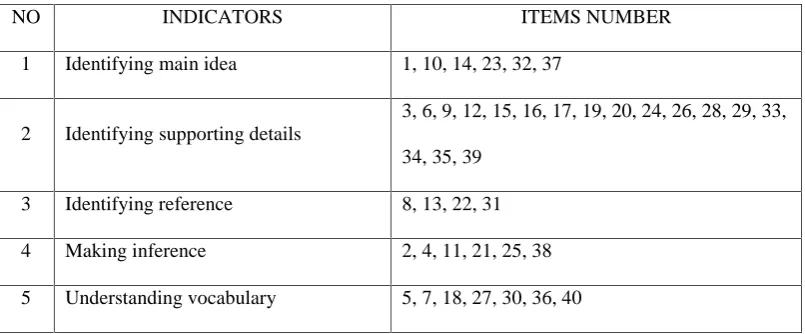
Table 3.4 Reading Test Table of Specification
NO INDICATORS ITEMS NUMBER
1 Identifying main idea 1, 10, 14, 23, 32, 37
2 Identifying supporting details
3, 6, 9, 12, 15, 16, 17, 19, 20, 24, 26, 28, 29, 33,
34, 35, 39
3 Identifying reference 8, 13, 22, 31
4 Making inference 2, 4, 11, 21, 25, 38
5 Understanding vocabulary 5, 7, 18, 27, 30, 36, 40
The result of the inter-rater analysis on the construct validity (Appendix 4) shows that the raters agreed on 95% of the items that is 38 out of 40 items were constructed based on the appropriate reading aspects that should be measured while the other 5% that is 2 out of 40 were not. The items were item number 2 and 38. Raters I and III (66.7%) agreed that the items were measuring the aspect of making inference, while rater II determined them as measuring the aspect of identifying supporting details.
However, as 2 out of 3 or 66.7% of the raters had the same opinion on items number 2 and 38, it can be taken into account that the items matched the aspect that should be measured that is making inference. Thus, as a whole the reading test can be concluded to have construct validity.
3.6.1.2 Reliability of the Reading Test