Optimization of microwave assisted mechanical extraction of oil
from canola seeds by using Response Surface Methodology
Patil Aniket
*, Singh A K a
(Department of Processing and Food Engineering, Punjab Agricultural University, Ludhiana, Punjab, 141004 India)
Abstract: Present investigation was undertaken with the overall objective of optimizing the microwave assisted pressing parameters, i.e. microwave time, moisture content, heating temperature and heating time for increasing the oil recovery from canola seeds of GSC-6 variety. Response surface methodology was adopted in the experimental design and Box Bhenken design of four variables was chosen. The range of parameters for the experiments was microwave time (2-4 min), moisture content (5%-15%), heating temperature (60-1000℃) and heating time (4-6 min) and single chamber oil expeller was used for oil expelling. The effect of independent variables, i.e. moisture content, microwave duration and heating temperature on oil yield and residual oil in cake were found significant, however, the effect of the heating time was found non-significant. Microwave time, moisture content and heating temperature affected the acid value and the peroxide value of the oil. Heating temperature affected the viscosity of the oil.
Keywords: Box Bhenken design, microwave treatment, canola seeds and oil recovery
Citation: Aniket P., and A. K. Singh. 2016. Optimization of microwave assisted mechanical extraction of oil from canola seeds by using Response Surface Methodology. Agricultural Engineering International: CIGR Journal, 18 (2):297-308.
1 Introduction
1Canola is an important oilseed crop in many countries and is considered to be the second most abundant source of edible oil in the world. Worldwide canola production is predicted to exceed 15 million tonnes by 2015 (Tan et al., 2011). Canola quality
varieties are commonly developed from either of the two species, i.e. Brassica napus and Brassica campestris. With the development of canola cultivars, the use of rapeseed oil has increased in major producing countries including Canada. The characteristics of canola include
higher yield, relatively shorter duration of the crop, a healthy cooking medium, and livestock feed as oil meal contains less than 30 micromoles glucosinolates per gram of defatted meal(Kumaret al., 2009).
There are two main processes commercially available for defattening and deoiling plant products: extraction and
Received date: 2015-11-27 Accepted date: 2016-03-30
*Corresponding author: Patil Aniket, Department of Processing and Food Engineering, Punjab Agricultural University, Ludhiana, Punjab, 141004, India. Email: [email protected].
pressing (Terigar et al., 2011). The methods of extraction employed depend on the type of seed, the seed characteristics and the oil content of the seed (Lawson et al., 2010). Mechanical pressing is the most popular
method of oil separation from vegetable oilseeds in the world. The safety and simplicity of the mechanical pressing is advantageous over the solvent extraction equipment. A chemical free protein rich meal is obtained by mechanical presses unlike the solvent extraction method (Singh and Bargale, 2000). To
increase the oil extraction, pretreatments are being used of which two techniques i.e. microwave and enzyme pretreatments have been observed to increase the oil yield as well as maintain the quality of oil (Uquicheet al., 2008; Azadmard-Damirchiet al.,2010; Elhamet al.,2012).
Microwave energy is a superior alternative to several other thermal treatments. Microwaves are non-ionizing
298 June, 2016 AgricEngInt: CIGR Journal Open access at http://www.cigrjournal.org Vol. 18, No.2 produced as a result of the orientation of the dipoles in
the altering electromagnetic field (El-Badrawy et al., 2007). The microwave heating rate is influenced by
many factors such as microwave power level, frequency, initial temperature, dielectric properties of the material, and design of microwave applicator; with the exception of dielectric properties (Terigar et al., 2011). Microwave pretreatment improves oil extraction yield and quality, direct extraction capability, lower energy
consumption, faster processing time and reduced solvent levels compared with conventional methods (Azadmard-Damirchi et al., 2011).
The present study was aimed to study the effect of microwave duration, moisture content, heating
temperature and heating time on oil recovery and to use RSM for further optimization to enhance the yield using the influential process variables from Canola seeds of variety GSC-6.
2 Materials and methods
Canola seeds: Seeds of commercially available canola variety (GSC-6) were procured from Punjab
Agricultural University Farms in India. The seeds were stored in polyethylene bags until analysis.
2.1 Proximate analysis
The canola seeds were analyzed for fat, protein, fiber and ash contents. The fat, protein, fiber and ash contents were determined according to the AOAC official
method (AOAC, 2000).
(i) Fat content: 5 g sample was placed in thimble
and oil was extracted in a pre-weighed beaker using petroleum ether in Soxhlet apparatus. The beaker was then heated to evaporate petroleum ether. Final weight of the beaker was taken and used for the estimation of crude fat content of sample.
(ii) Protein contents: Protein content was
determined by available nitrogen in the sample as shown in following Figure by Micro Kjeldhal method. One gram sample was digested in 25 ml of sulphuric acid (H2SO4) at 420ºC using 5 g K2SO4 + 0.5 g CuSO4 as
catalyst mixture. Digested sample was cooled and 20 ml of deionised water was added to the sample. After adding 25 ml NaOH (40%), the sample was then distilled
and the ammonia liberated was collected in boric acid with five to seven drops of indicator solution and then titrated with standard acid (0.1 N HCl) to estimate the protein content.
(iii) Ash Content: Weigh about 5 g sample into the crucible and burnt on the hot plate. Place the crucible
and lid in the furnace at 550°C for 6 h to ensure that impurities on the surface of crucible are burned off. Cool the crucible in the desiccator (30 min). After cooling the crucibles to room temperature, the residue left (ash) in crucibles were weighed.
(iv) Fiber Content: Two grams of moisture and fat
free sample was first digested with 150 ml boiling 1.25% sulphuric acid solution for 30 min. After acid digestion the mixture was filtered through muslin cloth and washing of residue with hot water was carried out to remove traces of acid. Then alkali digestion was performed with 150 ml of 1.25% sodium hydroxide
solution for 30 min. Again the mixture was filtered through muslin cloth and then the residue was washed with hot water till free from alkali; dried overnight at 110°C and weighed. The crucible was heated in the muffle furnace at 600°C for 2 h. Then it was allowed to cool and weighed again.
2.2 Microwave roasting of canola seeds:
Seeds placed in petri dishes (100 g in each petri dish) were roasted in a consumer-model microwave oven at a frequency of 2450 MHz (900W) for 2, 3 and 4 min. After roasting, canola seeds were allowed to cool to
ambient temperature and thoroughly mixed prior to oil extraction.
2.3 Oil extraction by pressing
After microwave roasting, thoroughly canola oil was obtained by pressing 150 g of canola seeds with a
determined by employing the use of the following Equation 1 (Olaniyan, 2007):
The percent oil yield =
100
W
W
S OE
(1) Where,
WOE = weight of oil expressed, g;
WS = weight of sample before expression, g.
The residual oil in the pressed cake was obtained by
Soxhlet extraction.
2.4 Experimental design and statistical analysis
The four-level Box-Behnken design with four independent variables (moisture content, microwave
duration, heating temperature and heating time) was applied for responses (oil yield, residual oil in cake, acid value, peroxide value, density and viscosity) functions
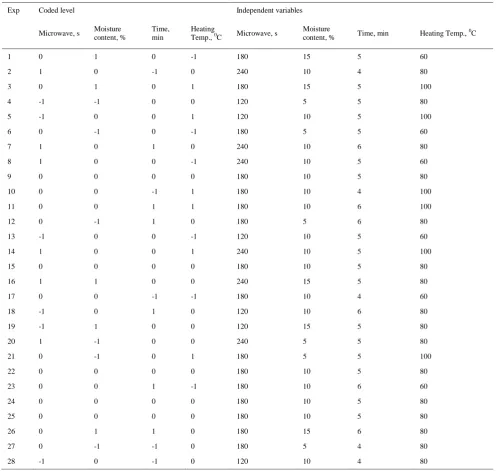
fitting. This design was selected due to the small number of experiments required to estimate complex response functions. For the four-level three-factorial Box-Behnken experimental design, a total of 29 experimental runs are necessary. The uncoded and coded independent variables and experimental design are
listed in Table 1. Box-Behnken design allows on the efficient estimation of the first and second order coefficients.
Table 1 Three-level Box-Behnken design with coded and actual variable
Exp Coded level Independent variables
Microwave, s Moisture content, %
Time, min
Heating
Temp., 0C Microwave, s
Moisture
content, % Time, min Heating Temp.,
0
C
1 0 1 0 -1 180 15 5 60
2 1 0 -1 0 240 10 4 80
3 0 1 0 1 180 15 5 100
4 -1 -1 0 0 120 5 5 80
5 -1 0 0 1 120 10 5 100
6 0 -1 0 -1 180 5 5 60
7 1 0 1 0 240 10 6 80
8 1 0 0 -1 240 10 5 60
9 0 0 0 0 180 10 5 80
10 0 0 -1 1 180 10 4 100
11 0 0 1 1 180 10 6 100
12 0 -1 1 0 180 5 6 80
13 -1 0 0 -1 120 10 5 60
14 1 0 0 1 240 10 5 100
15 0 0 0 0 180 10 5 80
16 1 1 0 0 240 15 5 80
17 0 0 -1 -1 180 10 4 60
18 -1 0 1 0 120 10 6 80
19 -1 1 0 0 120 15 5 80
20 1 -1 0 0 240 5 5 80
21 0 -1 0 1 180 5 5 100
22 0 0 0 0 180 10 5 80
23 0 0 1 -1 180 10 6 60
24 0 0 0 0 180 10 5 80
25 0 0 0 0 180 10 5 80
26 0 1 1 0 180 15 6 80
27 0 -1 -1 0 180 5 4 80
June, 2016 AgricEngInt: CIGR Journal Open access at http://www.cigrjournal.org Vol. 18, No. 2 300 Response surface methodology (RSM) was used to
study the simultaneous effects of four experimental factors (microwave time, moisture content, heating
temperature and heating time) on oil yield, residual oil in cake and quality parameters of the pressed canola oil and to find optimum conditions for a multivariable system. RSM allowed the development of a predictive mathematical model based on the experimental data, which can be employed for interpolation. Design expert
was used for the optimization and for plotting the contour maps.
2.5 Oil analysis
Determination of density, acid value, FFA, and peroxide value of the extracted oil was carried out
according to the standard AOAC (1980) methods.
Viscosity of oil samples was determined by using Bohlin CVO 100 Rheometer
3 Results and discussion
3.1 Proximate analysis
Results of the proximate analysis of the control sample and microwaved canola seeds are shown in Table 2. The petroleum ether extracted oil contents of non-microwaved canola oilseeds of variety GSC-6 was 33.8%. By microwave treating seeds for 120 s, 180 s
and 240 s, the oil content of increased significantly (P < 0.05). The moisture contents of the control canola oilseeds of were 8.0%. Contents of protein, fiber, and ash were 19.60%, 11.50% and 4.13% respectively. Microwave treatment of the seeds did not affect the fiber, ash, and protein contents significantly (P > 0.05).
The longer the roasting time, the greater was the loss
in weight of the seeds. This loss in weight may reflect total volatile substances, but it was considered to be mostly due to the loss of moisture. This trend agreed with the findings of Anjum et al. (2006); Yoshida et al. (2001); Yoshida and Kojimoto (1994) who reported the loss in weight of sunflower seeds and sesame seeds.
3.2 Oil yield and residual oil yield
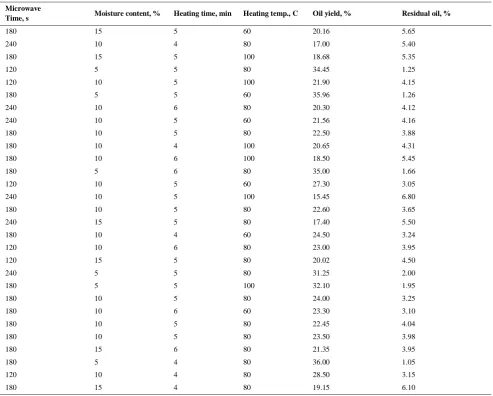
The oil yield and residual oil in cake of the microwave treated canola are listed in Table 3. Oil yield and residual oil (%) results ranged between 15.45% to 36% and 1.05% to 6.8%, respectively. The highest oil
yield (36%) was obtained from oilseeds pre-treated with microwave for 180 s, moisture content 5%, heating temperature 80°C and 4 min heating time. Whereas, the lowest oil yield (15.45%) was obtained at 240 s
microwave treatment, 10% moisture, 100℃ heating
temperature and 5 min heating time. The control samples gave an oil yield of 30.40%. It was observed that the oil yield increased after pre-treating the seeds
with microwave treatment. This was also observed by Azadmard-Damirchi et al., (2010),Uquiche et al. (2008); Mgudu et al. (2012) on rapeseed, Chilean hazelnut and castor seeds respectively. A high extraction yield can be obtained because the cell membrane is rupture by
microwave radiation generating permanent pores thus enabling the oil to move through the permeable cell walls. Uquiche et al., (2008) observed that microwave pretreatment affected both cell walls and the membrane cell (bilayers of lipids and proteins acting as biological barriers).
Table 2 Proximate analysis of roasted/unroasted canola oilseeds*
Contents Control
Microwaves
120s 180s 240s
Fat 33.80 ± 0.52c 35.06 ± 0.70bc 36.53 ± 0.80a 34.80 ± 0.40bc
Protein 19.59 ± 0.20a 19.64 ± 0.23a 19.37 ± 0.39a 19.68 ± 0.18a
Fiber 11.50 ± 0.5a 12.33 ± 0.57a 12.97 ± 0.50a 12.50 ± 0.50a
Ash 4.13 ± 0.50a 4.20 ± 0.40a 3.66 ± 0.46a 3.73 ± 0.41a
Note: *Values are means ± SD, calculated as percentage for of duplicate samples analyzed individually in triplicate. Mean values in the same row followed
The oil recovery data were analysed employing multiple regression technique. It shows that the model predicting increased oil yield is significant at 5% level of significance. P values more than 0.05 indicate that the model terms are not significant. The R2 and the adjusted R2 values for the studied response variables, were higher than 0.90, hence there is a close agreement between the experimental results and theoretical values predicted by the proposed models.
The predictive best fit regression equation for increased oil yield is:
Oil Yield = +23.03 -2.45A -7.62B -0.31 C -1.99D
+0.47AB +1.65AC -0.25AD +0.57BC +0.11BD -0.28CD -0.97A2 +4.84B2 -0.012C2 -0.83D2
Residual oil yield = +3.76 +0.66A +1.82B -0.085C
+0.63D +0.062AB -0.52AC +0.38AD -0.69BC -0.25BD +0.32CD +0.33A2 -0.65B2 +9.167E-003C2 +0.38D2
Where, A is microwave; B is moisture content; C is heating time; D is heating temperature.
3.3 Effect of process parameters on oil yield
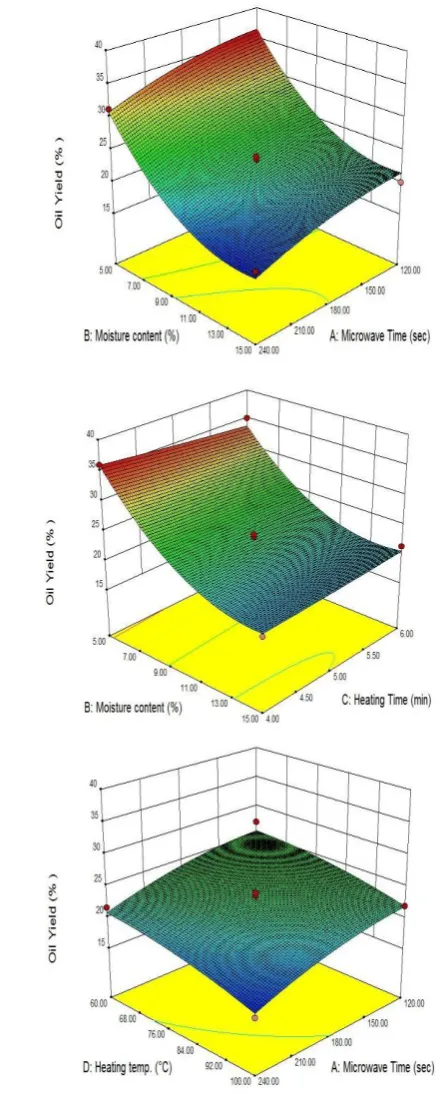
The effect of moisture content, microwave duration,
heating time and heating temperature oil yield is shown in Figure 1. Moisture content had a significant effect on the oil yield. As the moisture content increased, the oil yield decreased. This is because of sliding of seeds along the rotating screw as moisture acts as lubricant in barrel resulting in insufficient friction and less crushing
force is applied on the seeds. Same was observed by Akinoso et al., (2006) and Orhevba et al., (2013) on sesame seed and neem seed kernel oil respectively.
Table 3 Results of process parameters on oil recovery and residual oil content
Microwave
Time, s Moisture content, % Heating time, min Heating temp., C Oil yield, % Residual oil, %
180 15 5 60 20.16 5.65
240 10 4 80 17.00 5.40
180 15 5 100 18.68 5.35
120 5 5 80 34.45 1.25
120 10 5 100 21.90 4.15
180 5 5 60 35.96 1.26
240 10 6 80 20.30 4.12
240 10 5 60 21.56 4.16
180 10 5 80 22.50 3.88
180 10 4 100 20.65 4.31
180 10 6 100 18.50 5.45
180 5 6 80 35.00 1.66
120 10 5 60 27.30 3.05
240 10 5 100 15.45 6.80
180 10 5 80 22.60 3.65
240 15 5 80 17.40 5.50
180 10 4 60 24.50 3.24
120 10 6 80 23.00 3.95
120 15 5 80 20.02 4.50
240 5 5 80 31.25 2.00
180 5 5 100 32.10 1.95
180 10 5 80 24.00 3.25
180 10 6 60 23.30 3.10
180 10 5 80 22.45 4.04
180 10 5 80 23.50 3.98
180 15 6 80 21.35 3.95
180 5 4 80 36.00 1.05
120 10 4 80 28.50 3.15
302 June, 2016 AgricEngInt: CIGR Journal Open access at http://www.cigrjournal.org Vol. 18, No.2
Figure 1 Response 3D surface and contour plots for effect of different factors on oil recovery of microwave
pre-treated seeds
With the increase in heating temperature the oil recovery was found to be decreased. Kartika et al. (2006) also observed the similar for sunflower seed. While Acheheb et al. (2012) observed that the oil yield
increased up to 40℃ after this the oil yield decreased.
The reduction of oil yield due to increase in temperature would be due to reduction of cake plasticity caused by
water loss at high temperature. Lanoiselle (1994) reported that the temperature and moisture content had a significant combined effect on oil extraction from
sunflower seeds.
Microwave duration also affected oil yield. Oil yield deceased with an increase in the microwave time. There was a lower decrease in oil yield from 2 to 3 min but the oil yield decreased more after 3 min of microwave treatment. Kittiphoom and Sutasinee (2015) observed
that oil yield increased significantly when microwave pretreatment times was increased from 0 to 60 s however, further increase in microwave pretreatment time from 90-150 s for microwave power did not show any significant improvement. But Azadmard-Damirchi et al.,
(2010) and Uquiche et al., (2008) reported that increasing the treatment time also had a positive effect on the oil extraction yield for rapeseed and Chilean hazelnut. The residual oil percent was significantly affected by moisture content, heating temperature and microwave treatement.
3.4 Microwave roasting effects on physical and
chemical properties of canola oil
3.4.1 Acid value and FFA
The acid value and free fatty acid content of microwave pre-treated canola oil ranged from 3.15 to 5.13 and 1.58 to 2.58 respectively (Table 4). The moisture content and heating temperature affected the acid number of the oil as in Figure 2. With the increase
in moisture content and heating temperature the acid value of the oil increased. The microwave treatment also affected the acid value. With the increase in microwave time the acid and FFA value also increased. The similar results were obtained by Yoshida and
Kajimoto (1994) and Ozdemir et al., (2006) on sesame oil and tehina oil respectively. The effect of heating time was found non-significant. The free fatty acid content of extracted oil vary the same as acid number of the oil with the optimization factors. The R2 was 0.7861 while the
The multiple regression analysis results the following equations:
Acid Value = +3.69 +0.23A +0.29B -0.082C +0.38D
-0.025AB +0.052AC -1.000E-002 AD +0.040BC +0.027BD -0.038CD +0.26A2 +0.22B2 +0.22C2 +0.39D2
FFA= +1.85+0.11A +0.15B -0.040C +0.19D
-1.000E-002AB +0.027AC -5.000E-003AD +0.017BC +0.015BD -0.020CD +0.13A2 +0.11B2 +0.11C2 +0.20D2
Table 4 Results of process parameters on acid number and peroxide value for microwave pre-treated
seeds
Microwave, s Moisture
content, % Heating time, min
Heating
temp., ℃
Acid Number,
mgKOH/g FFA, %
Peroxide value,
meq/kg
180 15 5 60 4.25 2.13 8
240 10 4 80 4.19 2.10 9
180 15 5 100 5.13 2.58 11
120 5 5 80 3.15 1.58 6
120 10 5 100 4.60 2.31 8
180 5 5 60 3.81 1.91 6
240 10 6 80 4.56 2.29 12
240 10 5 60 4.10 2.06 9
180 10 5 80 3.83 1.92 10
180 10 4 100 4.88 2.45 10
180 10 6 100 4.20 2.11 10
180 5 6 80 3.72 1.87 10
120 10 5 60 3.88 1.95 6
240 10 5 100 4.78 2.40 12
180 10 5 80 3.60 1.81 9
240 15 5 80 4.85 2.43 16
180 10 4 60 4.05 2.03 10
120 10 6 80 4.32 2.17 8
120 15 5 80 3.85 1.93 9
240 5 5 80 4.25 2.12 8
180 5 5 100 4.58 2.30 8
180 10 5 80 3.75 1.88 8
180 10 6 60 3.52 1.77 7
180 10 5 80 3.80 1.91 6
180 10 5 80 3.48 1.75 9
180 15 6 80 4.39 2.20 10
180 5 4 80 3.95 1.98 8
120 10 4 80 4.16 2.09 9
304 June, 2016 AgricEngInt: CIGR Journal Open access at http://www.cigrjournal.org Vol. 18, No.2 Figure 2 Response 3D surface and contour plots for
effect of different factors on acid number of oil from microwave pre-treated seeds
3.4.2 Peroxide value
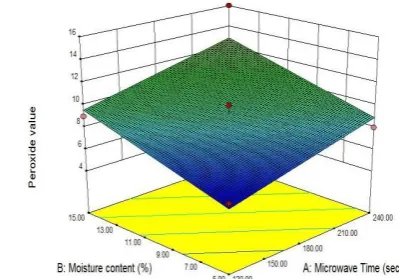
The peroxide value of microwaved canola oil was 6.00 to 16.00 (Table 4). The moisture content had a significant effect on the peroxide value of the oil. Akinoso et al. (2010) also observed the same for sesame oil. Peroxide value depends on the number of factors
such as exposure to air, the method of extraction and the type of fatty acids in oil. The high moisture content helps in oxidation of oil which results in rancidity. Heating temperature also had an effect on the peroxide value. Peroxide value increased with the increase in
heating temperature. Adeeko and Ajibola (1990) also observed the same for mechanically expressed groundnut oil. This is due to the heating during extraction as heat favours the oxidation of fatty acids mostly polyunsaturated fatty acids.
Microwave treatment also had an effect on the peroxide value. Peroxide value increased with the
increase in microwave time this behavior was due to the presence of reactive radicals that might be formed by exposure to microwave. This was also observed by Uquiche et al. (2008) and Oomah et al. (1998) on hazelnut and grapeseed respectively. Figure 3 shows the effect of all the factors. The predicted R2 is in
reasonable agreement with the adjusted R2.
The predictive best fit regression equation for peroxide value is
Peroxide Value = +9.24 +1.67A +2.00B -0.42C +1.08D
Figure 3 Response 3D surface and contour plots for
effect of different factors on peroxide value of oil from microwave pre-treated seeds
3.4.3 Density
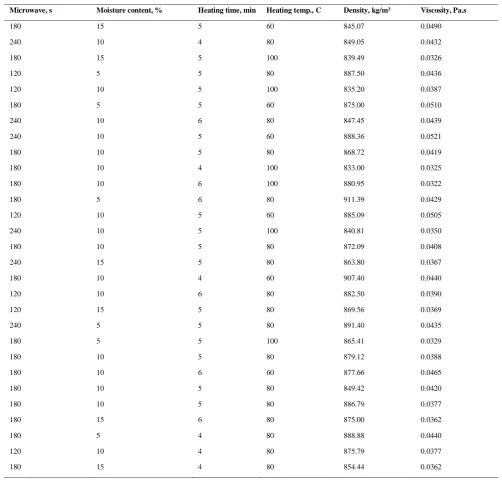
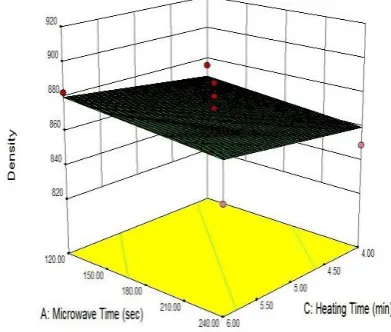
The density of microwave pre-treated canola seed oil ranged from 833.00 to 911.39 kg/m³ (Table 5). The moisture content of seeds and the heating temperature had
a significant effect on the density of oil. As the moisture content increased, there was a decrease in the density of the oil extracted. Increasing the heating temperature decreased the density of oil. Porter and Lammerink (1994) also observed the same. The microwave
treatment and heating time had no significant effect on the density of extracted oil as in Figure 4. The predicted R2 is in reasonable agreement with the adjusted R2. The predictive best fit regression Equation for density is
Table 5 Results of process parameters on oil quality parameters for microwave pre-treated seeds
Microwave, s Moisture content, % Heating time, min Heating temp., C Density, kg/m³ Viscosity, Pa.s
180 15 5 60 845.07 0.0490
240 10 4 80 849.05 0.0432
180 15 5 100 839.49 0.0326
120 5 5 80 887.50 0.0436
120 10 5 100 835.20 0.0387
180 5 5 60 875.00 0.0510
240 10 6 80 847.45 0.0439
240 10 5 60 888.36 0.0521
180 10 5 80 868.72 0.0419
180 10 4 100 833.00 0.0325
180 10 6 100 880.95 0.0322
180 5 6 80 911.39 0.0429
120 10 5 60 885.09 0.0505
240 10 5 100 840.81 0.0350
180 10 5 80 872.09 0.0408
240 15 5 80 863.80 0.0367
180 10 4 60 907.40 0.0440
120 10 6 80 882.50 0.0390
120 15 5 80 869.56 0.0369
240 5 5 80 891.40 0.0435
180 5 5 100 865.41 0.0329
180 10 5 80 879.12 0.0388
180 10 6 60 877.66 0.0465
180 10 5 80 849.42 0.0420
180 10 5 80 886.79 0.0377
180 15 6 80 875.00 0.0362
180 5 4 80 888.88 0.0440
120 10 4 80 875.79 0.0377
306 June, 2016 AgricEngInt: CIGR Journal Open access at http://www.cigrjournal.org Vol. 18, No.2
Figure 4 Response surface and contour plots for effect of different factors on density of oil from microwave
pre-treated seeds
3.4.4 Viscosity
The viscosity of the microwave pre-treated canola seed oil was in a range of 0.0322 to 0.0521 pa s (Table 5). The heating temperature and the moisture content had a significant effect on the viscosity of the oil. The viscosity of the oil decreased with the increase in
temperature. This was also reported by Diamante and Lan (2014) for some vegetable oils including canola. As observed by Diamante and Lan (2014), the canola oil viscosity decreased from 0.0462 Pas to 0.0108 Pas as temperature increased from 300C to 900C. The moisture content also had an inverse relationship with viscosity.
This was also observed by Adejumo et al. (2013). The microwave treatment and heating duration had no significant effect on the oil viscosity as is shown in Figure 5. The predicted R2 is in reasonable agreement with the adjusted R2.
The predictive best fit regression equation for peroxide value is:
Viscosity = +0.041 +6.667E-004A -2.525E-003 B
+2.583E-004C -7.433E-003D
Figure 5 Response 3D surface and contour plots for effect of different factors on viscosity of oil from microwave
pre-treated seeds
4. Conclusion
conclusion reached was that microwave pre-treatment can be used as a desirable alternative to conventional oil extraction techniques and could be applied to canola oil
extraction before pressing to improve oil yield. Maximum oil yield of 36% was obtained. MW pre-treatment helps in the rupture of the cell wall making cell permeable and enabling the oil to move through the permeable cell walls. There was a little effect of microwaves on the oil quality of canola. The study
found that optimum condition for mechanical extraction of canola (GSC-6) using is 5% moisture content, 120 s microwave time, 6 min heating time and 60°C heating temperature with predicted values 87.90%, oil recovery and 1.72% residual oil in cake, acid number 3.72,
peroxide value 4.10, density 909.22 kg/m2, viscosity 0.0501 Pa.s. The effect of all the parameters except heating time was found to be significant on oil yield. Microwave time, moisture content and heating temperature affected the acid value and the peroxide value of the oil. Heating temperature affected the viscosity of the oil while other parameters had no effect.
References
Acheheb, H., R. Aliouane, and A. Ferradji. 2012. Optimization of oil extraction from Pistacia atlantica Desf. seeds using hydraulic press. Asian Journal of Agricultural Research, 6(2):73-82.
Adeeko, K. A., and O. O. Ajibola. 1990. Processing factors affecting yield and quality of mechanically expressed groundnut oil. Journal of Agricultural Engineering Research, 45 (1):31-43.
Adejumo, B. A., S. G. Inaede, and T. S. Adamu. 2013. Effect of moisture content on the yield and characteristics of oil from moringa oleifera seeds. Academic Research International, 4(4):160-170.
Akinoso, R, S. A. Aboaba, and T. M. A. Olayanju. 2010. Effects of moisture content and heat treatment on peroxide value and oxidative stability of un-refined sesame oil.
African Journal of Food, Agriculture, Nutrition and
Development 10.10.
Akinoso, R., J. C. Igbeka, and T. M. Olayanju. 2006. Process optimization of oil expression from sesame seed (Sesamum indicum Linn.). Agricultural Engineering International: CIGR Journal, 3:1-7
Anjum, F., F. Anwar, A. Jamil, and M. Iqbal. 2006. Microwave roasting effects on the physico-chemical composition and oxidative stability of sunflower seed oil. Journal of the American Oil Chemists' Society, 83(9):777-784. AOAC. 1980. Official methods of analysis. In Association of
official analytical chemists. Washington DC, USA. AOAC. 2000. Official methods of analysis. In Association of
official analytical chemists. Washington DC, USA. Azadmard-Damirchi, S., F. Habibi-Nodeh, J. Hesari, M. Nemati,
and B. F. Achachlouei. 2010. Effect of pretreatment with microwaves on oxidative stability and nutraceuticals content of oil from rapeseed. Food Chemistry, 121(4):1211-1215.
Azadmard-Damirchi, S., K. Alirezalu, and B. F. Achachlouei. 2011. Microwave pretreatment of seeds to extract high quality vegetable oil. World Academy of Science, Engineering and Technology,81(81):72-75
Diamante, L M., and T. Lan. 2014. Absolute viscosities of vegetable oils at different temperatures and shear rate range of 64.5 to 4835 s− 1. Journal of Food Processing
2014.
El-Badrawy, E. E. Y., A. R. M. El-Zainy, A. O. Shalaby, and N. Y. El-Sayed. 2007. Effect of microwave roasting on chemical composition of peanut seeds and comparing it with the ordinary roasting process. Proceedings of Annual Conference Credit & Accreditation. Vol 11, (pp 939-56). Mansoura University, Egypt.
Elham, M., R. Shahrooz, and R. Nazaruddin. 2012. Effect of microwave pretreatment on the oil yield of mango seeds for the synthesis of a cocoa butter substitute.
Journal of Food Processing & Technology, 3(6):1-7. Kartika, I. A., P. Y. Pontalier, and L. Rigal. 2006. Extraction of
sunflower oil by twin screw extruder: Screw configuration and operating condition effects.
Bioresource Technology 97(18):2302-2310.
Kittiphoom, S., and S. Sutasinee. 2015. Effect of microwaves pretreatments on extraction yield and quality of mango seed kernel oil. International Food Research Journal,
22(3): 960-964.
Kumar, A., P. Sharma, L. Thomas, A. Agnihotri, and S. S. Banga. 2009. Canola cultivation in India: scenario and future strategy. 16th Australian research assembly on Brassicas (pp 0-5). Ballarat, Victoria.
Lanoiselle, J. L. 1994. Contribution to study of hydraulic pressing of oleo proteaginous seeds: Mechanism of pressing and modeling. Ph.D. diss, University of Paris, France
308 June, 2016 AgricEngInt: CIGR Journal Open access at http://www.cigrjournal.org Vol. 18, No.2 solvent extraction of soybean oil. Journal of
Engineering and Applied Sciences, 5(10):51-55. Mgudu, L., E. Muzenda, J. Kabuba, and M. Belaid. 2012.
Microwave-assisted extraction of castor oil. Proc International Conference on Nanotechnology and
Chemical Engineering (pp 47-55). Bangkok, Thailand Olaniyan, A. M. 2007. Development of mechanical expression
rig for dry extraction of shea butter from shea kernel.
Journal of Food Science and Technology,
44(5):465-470.
Oomah, B. D., J. Liang, D. Godfrey, and G. Mazza. 1998. Microwave heating of grapeseed: Effect on oil quality.
Journal of Agricultural and Food Chemistry,
46(10):4017-4021.
Orhevba, B. A., O. Chukwu, V. Oguagwu, and Z. D. Osunde. 2013. Effect of moisture content on some quality parameters of mechanically expressed neem seed kernel oil. International Journal of Engineering Science,
2(2013):1-7.
Ozdemir, F., M. Golukcu, and M. Erbas. 2006. Influence of different microwave seed roasting processes on the changes in quality and fatty acid composition of tehina (Sesame butter) oil. Akdeniz Üniversitesi Ziraat Fakültesi Dergisi, 19(2):207-216.
Porter, N. G., and J. P. Lammerink. 1994. Effect of temperature on the relative densities of essential oils and water. Journal of Essential Oil Research 6(3):269-277. Singh, J., and P. C. Bargale. 2000. Development of a small
capacity double stage compression screw press for oil expression. Journal of Food Engineering,
43(2):75-82.
Tan, S. H., R. J. Mailer, C. L. Blanchard, and S. O. Agboola. 2011. Canola proteins for human consumption: extraction, profile, and functional properties. Journal of Food Science,76(1):16-28.
Terigar, B. G., S. Balasubramanian, C. M. Sabliov, M. Lima, and D. Boldor. 2011. Soybean and rice bran oil extraction in a continuous microwave system: from laboratory-to pilot-scale. Journal of Food Engineering, 104(2): 208-217.
Uquiche, E., M. Jerez, and J. Ortiz. 2008. Effect of pretreatment with microwaves on mechanical extraction yield and quality of vegetable oil from Chilean hazelnuts (Gevuina avellana Mol). Innovative Food Science and Emerging Technologies,
9(4):495-500.
Yoshida, H., and G. Kojimoto. 1994. Microwave heating effects composition and oxidative stability of sesame (Sesamum indicum) oil. Journal of Food Science,
59(3):616-625.