299
In May-June 2002, as part of a survey of a variety of taxa in the James Bay region of Ontario and Québec, we surveyed the herpetofauna of this region in order to exploit roads that have not been previously surveyedby herpetologists, to provide data for future compar-isons, and to compare current observations with pre-vious surveys (Schueler 1973; Schueler and Karstad 1975). The logistical difficulties of travel, distance from
A Herpetological Survey of the James Bay Area of Québec and Ontario
J
EAN-F
RANÇOISD
ESROCHES1, F
REDERICKW. S
CHUELER2, I
SABELLEP
ICARD, and L
OUIS-P
HILIPPEG
AGNON1
Cégep de Sherbrooke, Département des Techniques de bioécologie, 475 du Cégep, Sherbrooke, Québec, J1E 4K1 Canada 2Bishops Mills Natural History Centre, RR#2, Bishops Mills, Ontario, K0G 1T0 Canada
Desroches, Jean-François, Frederick W. Schueler, Isabelle Picard and Louis-Philippe Gagnon. 2010. A herpetological survey of the James Bay area of Québec and Ontario. Canadian Field-Naturalist 124(4): 299–315.
In May-June 2002, as part of a survey of a variety of taxa in the James Bay region of Ontario and Québec, we surveyed the poorly documented herpetofauna of this region. In Ontario we visited sites near Moosonee that FWS had previously surveyed in 1971-1972, and continued ongoing herpetological monitoring around Cochrane. In Québec we surveyed the inland James Bay Road, and roads to four settlements along the coast. American Toad (Anaxyrus americanus), Spring Peeper (Pseudacris crucifer), and Wood Frog (Lithobates sylvaticus) were widespread and abundant throughout. Blue-spotted Salamander (Ambystoma laterale) and Garter Snake (Thamnophis sirtalis) were widespread and common in Québec and at the study site near Cochrane. We obtained the first taped calls and voucher specimen of the Boreal Chorus Frog (Pseudacris maculata) from Québec, and failed to find it at the settlement and airport of Moosonee where it had been present in 1972. A significant range extension was for the Two-lined Salamander (Eurycea bislineata), which we found 200 km north of its previously known range in northwestern Québec. Despite extensive searches, the species was not found north of 52°05'N. The Mink Frog (Lithobates septentrionalis) was widespread and relatively common in Québec, but was sought but not found in Ontario. The Leopard Frog (Lithobates pipiens) was only found at two Québec sites, including one where it was reported in 1974, but it has not been found at any of the Ontario sites where it was found in the 1970’s. We present some suggestions for the further study of the herpetofauna of the area, and review evidence for contacts between eastern and western lineages of widespread species.
En mai et juin 2002, dans le cadre d’un inventaire faunique dans la région de la baie James, en Ontario et au Québec, nous avons inventorié la faune herpétologique, laquelle est très peu documentée dans cette région. En Ontario nous avons visité des sites près de Moosonee, que l’un de nous (FWS) avait inventorié en 1971-1972, puis nous sommes allés aux environs de Cochrane. Au Québec l’inventaire s’est majoritairement fait le long de la route de la baie James et des routes d’accès aux villages. Le Crapaud d’Amérique (Anaxyrus americanus), la Rainette crucifère (Pseudacris crucifer) et la Grenouille des bois (Lithobates sylvaticus) sont répandus et communs sur toute l’aire d’étude. La Salamandre à points bleus (Ambystoma
laterale) et la Couleuvre rayée (Thamnophis sirtalis) sont répandues et communes au Québec et près de Cochrane. Nous avons réalisé les premiers enregistrements de chants et collecté le premier spécimen de Rainette faux-grillon boréale (Pseudacris
maculata) pour le Québec, et n’avons pu la retrouver à Moosonee et à son aéroport, où l’espèce avait été recensée en 1972. La seule extension d’aire significative a été faite pour la Salamandre à deux lignes (Eurycea bislineata), trouvée à 200 km au nord de son aire de répartition connue dans le nord-ouest du Québec. Malgré des recherches intensives, elle n’a pas été vue plus au nord que 52°05’N. La Grenouille du Nord (Lithobates septentrionalis), est répandue et relativement commune au Québec mais n’a pu être trouvée en Ontario. La Grenouille léopard (Lithobates pipiens) a seulement été recensée à deux endroits au Québec, incluant un site où l’espèce avait été trouvée en 1974, mais n’a pu être trouvée en Ontario dans les sites où on la retrouvait dans les années ‘70. Nous présentons quelques suggestions de futures études sur l’herpétofaune de cette région, et discutons des liens entre les formes de l’ouest et celles de l’est pour les espèces répandues.
Key Words: amphibians,Ambystoma laterale, Blue-spotted Salamander,Eurycea bislineata, Two-lined Salamander,Anaxyrus americanus, American Toad,Pseudacris crucifer, Spring Peeper,Pseudacris maculata, Boreal Chorus Frog,Lithobates
sylvaticus, Wood Frog,Lithobates pipiens, Leopard Frog,Lithobates septentrionalis, Mink Frog,Thamnophis sirtalis,
Thamnophis sirtalis sirtalis,Thamnophis sirtalis pallidulus, Garter Snake, distribution, range extension, first record, amphibian decline, morphometry, boreal, James Bay, Québec, Ontario.
academic centres, and especially low species diversity, have left the herpetofauna of the James Bay area poorly documented and infrequently studied. Increased human activity in the area makes it important to determine the current status of species, and global warming makes it especially important to delimit northern range limits, in order to be able to document anticipated northward range expansions. Previous herpetological studies in the James Bay drainage of northwestern Québec and northeastern Ontario include Williams 1920; Gaige 1932; Bleakney 1959; Ashton et al. 1973; Schueler 1975; Schueler and Cook 1980, Bleakney 1954; Cook 1964; McCoy and Durden 1965; MacCulloch and Bider 1975; and Cook 1983.
Our goals in the two provinces were somewhat dif-ferent. On most of the Québec route we were under-taking initial surveys, similar to those undertaken in 1971-1974 (Schueler 1973; Schueler and Karstad 1975), while in Ontario (and Lac Douay, Québec) we were re-visiting sites we had surveyed before, in some cases many times, and revisiting places where we could document the failure to find species found there in the past, and give GPS geographic co-ordinates for several sites located only verbally in those publications. We also sought other taxa such as small mammals, cray-fishes, and terrestrial and freshwater molluscs (Québec results in Picard and Desroches 2003*).
Study Area and Chronology
Figure 1 shows our route and the area studied. The James Bay area contains many wetlands, oligotrophic lakes, bogs and boggy creeks. Large rivers flow into the Bay, those in Ontario mostly dammed for hydro-electric power in the 1930’s, while those in Québec were impounded and diverted in the 1970’s (Lacasse 1983) or planned (Hydro-Québec 2006*). The average daily annual air temperature ranges from about -2.5°C and the extremes of mean annual temperatures are about – 26°C and 21°C. The extremes of temperature are – 48°C and 36.5°C and the average annual total precipitation is 600-900 mm (Société d’énergie de la Baie James 1978; Environment Canada 2006*).
The south and west shores of James Bay are grassy tidal flats with irregular patches of shrubby willows, which we visited at the mouth of Whitetop Creek in the Moose River estuary northeast of Moosonee, and at Cabbage Willows Bay, on the west shore of Rupert Bay west of Waskaganish. This zone is very dynamic because of the combined effects of wind and ice and isostatic rebound from the weight of Wisconsinian gla-ciers. Around Rupert Bay the ground rises as much as 3 mm/year (Champagne 1982). Our topographic maps (based on 1955 aerial photos) plotted many of the sites where we heard Boreal Chorus Frogs at Cabbage Wil-lows in the open water of the bay, and there have been major changes in the landscape around our camp there within living memory (Bill Jolly, personal communi-cation). This zone of grassy and shrubby vegetation
encroaches on the Bay, and is encroached on by the inland Spruce-dominated Boreal Forest. Tidal ampli-tude is often augmented or diminished by the strength and direction of the wind. The vegetation in these flats is a sward of grass and widely spaced shrubs (mostly
Salix and Alnus). Near our Whitetop Creek camp, Ontario, there are many small ponds in depressions in the ground and in backwater channels of small creeks, while near our Cabbage Willows Bay camp, Québec, there are almost no ponds in theSalix/Alnuszone. On 23-30 May 2002 Larry Frazer (LF) and FWS travelled by train and boat to sites around Moosonee and on the west bank of the mouth of the Moosonee River that had been surveyed in 1971-1972 (Schueler 1973).
From 14-23 May 2002 Aleta Karstad and FWS (and FWS & LF, 30-31 May) continued monitoring around Cochrane that began with a visit in 1972 (see avian results in Schueler et al. 1974). The Ontario Clay Belt around Cochrane is rolling or flat lacustrine clays with
PopulusandPiceaforest, extensively cleared for grass-based agriculture, with largeSphagnum/Picea mariana
(Black Spruce) muskegs. Our Long Lake study site south of Cochrane, at the Hwy 11 Long Lake picnic area, 48°55'N, 80°58'W, is where a paved highway was left behind in smoothing a curve. Poplar woods, muskeg, and the shore of a narrow lake are in close juxtaposition to a permanent borrow pit pond and small
Typhamarsh where Wood Frogs have bred abundant-ly. Ruts in a 2 km clay trackway in the woods along the lake hold water in which amphibians both resort and breed. Areas along this trackway were clearcut in 1999-2000. FWS, Aleta Karstad, and others have made autumnal visits here in 1972 (Schueler et al., 1974), 1977, 1983-1987, 1989, 1990, 1992, 1993, 1995, 1997, 2000, and 2001, and spring visits in 1983 and 1997.
From 1-28 June 2002, all the authors and LF sur-veyed the James Bay region of northwestern Québec by road, west of 77°W, from 48°30' to nearly 54°N lat-itude. Most of the area in Québec is located in the Canadian Shield, with Black Spruce and moss forest grading into Black Spruce and lichen forest north of 52°N. The Black Spruce is the most abundant tree, but Balsam Fir (Abies balsamea) and Jack Pine (Pinus
banksiana) are also common, and some deciduous tree species, such as the Paper Birch (Betula papyrifera) and the Trembling Aspen (Populus tremuloides) are found in sheltered and southern sites.
Methods
road-hunting at night in areas where we anticipated that breeding amphibians would cross roads. Because we were generally not staying in camps more than overnight, permanent stations with traps and drift fences were not used, and because oviposition habitats are scattered through extensive wetlands, we did not under-take the fine-mesh dipnetting that would have been necessary to capture small larvae of some species. Because we concentrated our attention on small-scale aquatic habitats, we did not adequately survey habitats where terrestrial Redback Salamanders (Plethodon
cinereus) might have been found. We recorded our location by GPS, and associated each observation with air temperature and other weather conditions. All speci-mens preserved during the 2002 survey are deposited at the Canadian Museum of Nature (CMNAR 35488-35622), and all the records are deposited in the data-bases of the Ontario Herpetofaunal Summary (OHS) (and subsequently the Ontario Herp Atlas) and the Québec Atlas of Amphibians and Reptiles (AARQ). All amphibian and snake measurements for Québec were taken by JFD from preserved specimens in July 2003 (except a few snakes released after measure-ment). Digital calipers were used for amphibian meas-urements and a metric tape for snakes measmeas-urements. Snout-vent length (SVL) was taken from the tip of the snout to the end of the cloacal slit in salamanders, and from the tip of the snout to the cloacal opening in anu-rans and snakes. In snakes, scale counts were done twice to reduce the possibility of mistake. Tadpole labi-al tooth row formula follows Altig (1970).
In Ontario we attempted to sample all species at the Long Lake study area. We drove roads and listened at sites near potential hibernation sites and breeding wet-lands throughout the area to try to find Leopard Frogs in areas where we had found them in 1971 and 1972, and explored habitats around Cochrane for Mink Frogs. We took the Ontario Northland train to Moosonee, and travelled by boat to camp at several sites on the shores of the Moose River around and northeast of Moosonee, exploring surrounding areas on foot. From 27-29 May we camped at the mouth of South White-top Creek (51°22.3'N 80°26.6'W), 600m SW of our 1971-72 camp at the mouth of North Whitetop Creek (51°22.5'N 80°26.2'W, Schueler 1973; Schueler et al. 1974).
In Québec we surveyed the inland James Bay Road, and the roads to the four rivermouth Cree villages: Waskaganish (Rupert River, 51°29'N 78°45'W), East-main (EastEast-main River, 52°15'N 78°30'W), Wemindji (Maguatua River, 53°00'N 78°48'W), and Chisasibi (La Grande River, 53°47'N 78°54'W). Potentially productive herpetological/malacological habitats were marked on a 1:50 000 topographic map, and we stopped at 5-10 of these preselected stations each day, espe-cially targetting streams forEuryceasalamanders and rocky lakes for freshwater limpets. We drove roads and listened at night on the roads around some settlements.
The roads reach the tidal mouths of the rivers, but only at Chisasibi is the open coast accessible by road. Cabbage Willows Bay was reached by boat, and we camped from 10-13 June at a traditional local camp on the Novide River (51°30.9'N 79°16.7'W).
We summarize calling for anuran species by latitude and date. For most species this includes only evening and nocturnal calling (20h00 – 03h00) because diurnal calling is of more inconsistent intensity.
ForLithobateswhich seem to have declined in north-eastern Ontario, we compiled tables of the number of records of the apparently declining species against the commonLithobates sylvaticusin FWS’s observation database, and compared them with the number of records by other observers in the OHS database from Cochrane District (OHS records to entry number 264574, March 2005, from Michael Oldham (Ontario Herpetofaunal Summary 2005*)). FWS’s data entry is not complete for all years, and the activities pursued and areas visited were not always the same, but in all decades most activity has been monitoring and explo-ration in the Clay Belt centred on the Long Lake study area. We use our data to form hypotheses of changes in relative abundance which we test as contingency tables of others’ observations in the OHS data.
Our species distribution maps plot our records with OHS records and museum and literature records.
Results
Eight species of amphibians and one reptile were found during the survey; Blue-Spotted Salamander (Ambystoma laterale), Two-lined Salamander (Eurycea bislineata), American Toad (Anaxyrus americanus), Spring Peeper (Pseudacris crucifer), Boreal Chorus Frog (Pseudacris maculata), Wood Frog (Lithobates
sylvaticus), Leopard Frog (Lithobates pipiens), Mink Frog (Lithobates septentrionalis) and Garter Snake (Thamnophis sirtalis).
Table 1 gives nocturnal air temperatures and average time of sunset at the average latitude of records for the weeks of the survey. Environment Canada (2010*) ranked this spring as “neutral” on the “El Niño South-ern Oscillation“ pattSouth-ern of weather variation. Along our route there was little rain (we experienced rain only on 15, 16, 24, 29, and 31 May, 7, 16, 18, 20, and 21 June, usually for short periods). This lack of rainfall was not characteristic of the region in 2002, as it often rained heavily after we had left an area. We encountered fall-ing snow on 16 to 20 and 24 May, and 2 and 5 June.
Ambystoma lateraleBlue-Spotted Salamander, Salamandre à points bleus
observed, but the failure to find larvae is doubtless due to the lack of fine-mesh dipnetting. As specimens died during transportation and were preserved in formalin, it was impossible to genetically determine if they were pureA. lateraleor hybrids. However, measurements (SVL (average 53.8 mm; range 50.0-60.4 mm), head width (7.5 (6.9-8.1) mm) and internarial distance (2.97 mm (2.59-3.40) mm; n = 6) do not suggest that they are anything but pureA. laterale(Lowcock et al. 1992). The species is also known from many collec-tions in previous years from the Long Lake study area (CMNAR specimens, OHS records) and is widespread in northeastern Ontario (MacCulloch 2002). Fifteen specimens we have previously submitted for genetic examination from Long Lake study area and elsewhere in the Ontario Clay Belt are pureA. laterale(LL; Jim Bogart, University of Guelph,in litt.15 February 2005).
Eurycea bislineataTwo-lined Salamander, Salamandre à deux lignes:
The Two-lined Salamander was sought in 16 differ-ent rivers and brooks (Table 2 and Figure 3) in Québec. Habitat at most of them seemed adequate for the spe-cies: clear running water, rocky shores, substrate of sand and gravel, and adjacent forest, but the species was found in only 4 stations. All were under rocks at the margin of rivers except for two larvae that were on the bottom in water. The most northern record was made at Eastmain Rd, 18.1km WNW the James Bay Road, where a rocky brown-water river runs under the road in three large culverts, 52°05'N, representing a range extension of about 200 km to the north (see dis-tribution maps in: Cook 1984; Petranka 1998). North TABLE1. Weekly nocturnal air temperatures during the 2002 James Bay herpetological survey.
Mean, minimum and maximum air temperatures recorded in our databases from 22h00-24h00 for each week during the 2002 James Bay herpetological survey. Latitudinal range and number of anuran auditory records and time of sunset (EDT, from Garmin GPS software) for the average location of calling records, are also presented.
Cochrane early (14-16 May, 48°32’ – 48°55’ N) 10.0°C (0-12.5°C): 22 records, 20h58 Moosonee area (24-29 May, 51°16’ – 51°22’ N) 9.4°C (0-14°C): 43 records, 21h23 Cochrane late (30-31 May, 48°55’– 49°8’ N) 14.8°C (14-16°C): 19 records, 21h17 Québec Week 1: (1-7 June, 48°13’ – 51°29’ N) 11.8°C (8°-13°C): 59 records, 21h20 Québec Week 2: (8-14 June, 51°13’ – 51°35’ N) 4.0°C (-2.5°-12°C): 58 records, 21h32 Québec Week 3: (15-21 June, 51°21’ – 53°48’ N) 12.8°C (7°-20°C): 110 records, 21h37 Québec Week 4: (22-28 June, 46°51’ – 53°58’ N) 15°C (15°-15°C): 20 records, 21h38
FIGURE 2. Observations of the Blue-spotted Salamander (Ambystoma laterale), around James Bay. triangles = our observations in May and June 2002, open circles = previous records.
FIGURE3. Observations of the Two-lined Salamander (Eurycea
bislineata), around James Bay. filled circles =Eurycea present (June 2002), triangles =Euryceanot found despite search in suitable habitat (June 2002), open circles = previous records ofEurycea.
of here, no specimens were found despite many search-es. Our observations are the most northern in the James Bay area, but the species has been reported farther north east of our study area: 190 km farther north about 260 km east in northern Québec (Fortin 2006), and to almost 53°30'N in Labrador (Maunder 1997; Fortin 2005).
Streams in the Clay Belt are gravelly only in short stretches at riffles, and this may explain the apparent absence of this salamander in the southernmost part of our study area in Québec (as proposed by (Bider and Matte 1996) and in the Ontario Clay Belt. The only northern Ontario records are along the Abitibi River, halfway between Fraserdale and Moosonee, in the Onakawana River (Kamstra 1983), and Mowbray Creek, a tributary of the Opisatika River (8 Sept. 1990, ROM 20673, collected by G. Mornal, and S. De Forlet).
Anaxyrus americanusAmerican Toad, Crapaud d’Amérique
The American Toad was observed or heard at 95 dif-ferent locations in Québec (103 records, 69 auditions, 2 on road), and 28 in Ontario (35 records, 21 auditions, 9 on road), throughout the study area except the ex-treme south of our Québec route, which we visited dur-ing a cold spell. (Figure 4). When we first arrived in the Cochrane area, toads were not calling and were active on the roads, but when we were at Moosonee, and for much of the rest of the survey, the breeding season was at its peak, many index 3 choruses were heard, and we saw eggs and tadpoles in some places. Eggs were seen
T A B L E 2 . S tr e a m s s e a rc h e d fo r th e T w o -l in e d S a la m a n d e r in J a m e s B a y , Q u é b e c , in J u n e 2 0 0 2 . L o c a ti o n H a b it a t D a te P re s e n c e A lo n g J a m e s B a y ro a d , 5 0 ° 5 6 .7 3 'N 7 7 ° 3 8 .8 2 'W P e b b le a n d s o ft -m u d b ro o k 2 7 J u n e 2 0 0 2 N o W a s k a g a n is h a c c e s s ro a d , 5 1 ° 1 9 .5 3 'N 7 8 ° 1 7 .4 7 'W R o c k y d a rk b ro w n w a te r c re e k in b u rn e d B la c k S p ru c e fo re s t 1 4 J u n e 2 0 0 2 N o R u p e rt R iv e r, 5 1 ° 2 9 .5 3 'N 7 8 ° 4 1 .3 3 'W L a rg e ri v e r, c le a r w a te r, ro c k y b o tt o m 1 1 J u n e 2 0 0 2 Y e s (C M N A R 3 5 4 8 8 ) P o n ta x I R iv e r, 5 1 ° 4 4 .0 2 'N 7 7 ° 2 3 .0 2 'W C le a r-w a te r ri v e r, g ra v e l b o tt o m , ro c k y s h o re s 1 5 J u n e 2 0 0 2 Y e s (C M N A R 3 5 5 3 4 ) J o li c o e u r R iv e r, 5 1 ° 5 2 .9 8 'N 7 7 ° 2 5 .7 3 'W C le a r b ro w n -w a te r ri v e r, g ra v e l a n d ro c k y b o tt o m 1 6 J u n e 2 0 0 2 Y e s (C M N A R 3 5 5 3 5 ) E a s tm a in a c c e s s ro a d , 5 2 ° 4 .9 2 'N 7 7 ° 3 3 .6 3 'W R o c k y b ro w n -w a te r ri v e r, u n d e r ro a d in 3 la rg e c u lv e rt s 1 8 J u n e 2 0 0 2 Y e s (C M N A R 3 5 5 5 1 ) E a s tm a in R iv e r, 5 2 ° 1 9 .3 0 'N 7 7 ° 0 6 .3 0 'W S a n d y fl o w in g b ro o k b e lo w lo w B e a v e r ( C a st o r c a n a d e n si s ) d a m 1 9 J u n e 2 0 0 2 N o O p in a c a R iv e r, 5 2 ° 2 3 .6 0 'N 7 7 ° 1 5 .1 0 'W C le a r ri v e r, ro c k y b o tt o m a n d s h o re s 1 9 J u n e 2 0 0 2 N o P il ip a s R iv e r, 5 2 ° 3 9 .8 2 'N 7 7 ° 2 3 .4 5 'W C le a r-w a te r ri v e r, 5 m w id e , g ra v e l a n d ro c k y b o tt o m 1 9 J u n e 2 0 0 2 N o A lo n g J a m e s B a y ro a d , n e a r k m 1 4 3 , 5 2 ° 4 0 .8 3 'N 7 7 ° 2 2 .2 5 'W C le a r-w a te r ri v e r, 5 m w id e , ro c k y b o tt o m , s h o re s w it h a ld e rs 2 7 J u n e 2 0 0 2 N o W e m in d ji a c c e s s ro a d , 5 3 ° 0 .7 5 'N 7 8 ° 4 6 .2 7 'W C le a r-w a te r ri v e r, 4 m w id e , g ra v e l b o tt o m 2 6 J u n e 2 0 0 2 N o A lo n g J a m e s B a y ro a d , 5 3 ° 2 7 .9 3 'N 7 7 ° 3 5 .0 8 'W C le a r-w a te r ri v e r, 5 -1 0 m w id e , g ra v e l b o tt o m 2 0 J u n e 2 0 0 2 N o A lo n g J a m e s B a y ro a d , a t k m 5 6 6 , 5 3 ° 2 8 .7 0 'N 7 7 ° 3 6 .1 0 'W C le a r-w a te r s tr e a m , 3 m w id e , g ra v e l a n d ro c k s o n b o tt o m 2 5 J u n e 2 0 0 2 N o C h is a s ib i a c c e s s ro a d , 5 3 ° 4 2 .5 8 'N 7 7 ° 5 5 .9 8 'W D a rk b ro w n -w a te r s tr e a m , 4 m w id e , ro c k y b o tt o m 2 4 J u n e 2 0 0 2 N o L o n g u e -P o in te ro a d , n o rt h o f C h is a s ib i, 5 3 ° 4 8 .0 ’N 7 8 ° 3 9 .8 'W C la y e y b ro w n -w a te r b ro o k /c re e k w it h ro c k /c o b b le b e d 2 3 J u n e 2 0 0 2 N o L o n g u e -P o in te ro a d , n o rt h o f C h is a s ib i, 5 3 ° 5 5 .3 7 ’N 7 8 ° 5 1 .2 3 'W C le a r-w a te r ri v e r, 3 0 m w id e , ro c k y b o tt o m a n d s h o re s 2 3 J u n e 2 0 0 2 N o
FIGURE 4. Observations of the American Toad (Anazyrus
americanus), around James Bay. triangles = our obser-vations in May and June 2002, open circles = previous records.
in Québec side from 7 to 20 June. Table 3 presents the maximum nocturnal call index for the species, by lat-itude and date. Our results confirm that the American Toad is a common and widespread species in the study area. Its range goes 300 km further north in Québec (Cook 1984; Desroches and Rodrigue 2004) and it is widespread in northern Ontario (MacCulloch 2002).
Pseudacris cruciferSpring Peeper, Rainette crucifère
The Spring Peeper was found at 86 different loca-tions in Québec (89 records, 83 calling), and 35 in Ontario (48 records, 45 calling), throughout the study area (Figure 5 and Table 4). This species is widespread in the southern half of the James Bay area of Ontario (MacCulloch 2002) and Québec (Desroches and Rod-rigue 2004). Our northernmost record (53°48'N) at Radisson is about 36 km north of the previous range limit in Québec (MacCulloch and Bider 1975). Nei-ther eggs nor tadpoles were observed, but fine dip-netting was not undertaken.
Pseudacris maculataBoreal Chorus Frog, Rainette faux-grillon boréale
In James Bay Boreal Chorus Frogs are at the east-ern limit of their range, which extends narrowly around the shores of the Bay to the Moose River. Schueler (1973) speculated that this river might have been a bar-rier that the species had not crossed in dispersing from the west, but the calls of Boreal Chorus Frogs were reported from Cabbage Willows Bay in 1991 (Bider and Matte 1996), strongly suggesting that the range of the species extended into Québec, and inspiring our visit to the site.
In Québec, we found this species only at Cabbage Willows Bay on the west side of Rupert Bay (Figure 6). It was heard from 10-12 June at 14 different loca-tions on the flatlands of the Bay, which represents half of the stations where at least one anuran was heard at Cabbage Willows Bay. Other species heard with the Boreal Chorus Frogs were American Toads (up to index 3), Spring Peepers (up to index 2) and Wood Frogs (few calls). A single specimen was seen and TABLE3. Calling index for American Toads, recorded in 2002 in the James Bay area. Number of evening and nocturnal ( after 20h00) stations where the species was heard at index1 (few calling)/ index 2 (small chorus)/ index 3 (full chorus) at the indicated dates and latitudes (maximum index recorded for each site on each day).
Latitude/ date 14–15 May 25–30 May 1–7 June 8–14 June 15–21 June 22–28 June
53° to 54° – – – – 5/1/0 5/0/0
52° to 53° – – – – 9/8/8 none
51° to 52° – 2/0/3 1/6/1 3/4/3 0/0/1 none
50° to 51° – – 1/0/1 – – none
48°30’ to 50° none 01/02/03 none – – none
TABLE4. Calling index for Spring Peepers, recorded in 2002 in the James Bay area. Number of evening and nocturnal (after20h00) stations where the species was heard at index1 (few calling)/ index2 (small chorus)/ index3 (full chorus) at the indicated dates and latitudes (maximum index recorded for each site on each day).
Latitude/ date 14–15 May 25–30 May 1–7 June 8–14 June 15–21 June 22–28 June
53° to 54° – – – – 2/7/5 4/1/0
52° to 53° – – 0/0/8 – 6/6/14 1/0/1
51° to 52° – 1/0/11 0/4/2 5/6/5 2/0/0 0/1/0
50° to 51° – – – – – none
48°30’ to 50° 0/1/11 0/0/5 – – – 1/1/0
FIGURE5. Observations of the Spring Peeper (Pseudacris
cru-cifer), around James Bay. triangles = our observations in May and June 2002, open circles = previous records.
caught, on 10 June (51°31.48'N; 79°16.31'W) CMNAR 35522, a green male, SVL 33.39 mm, tibia 14.02 mm [42% of SVL]). Most Boreal Chorus Frog calling was heard during the daylight hours, at a maximum air temperature of 15°C, but some were heard during the night at 0 and 4°C. Water temperature was 16°C in one of the ponds from which calling was heard, on 12 June 12h20, while the air was 14°C. We heard only 1-2 males calling at each station, suggesting either that the population was sparse, or that the breeding season was at its end during our visit to Cabbage Willows Bay (calling had not been intense at Whitetop Creek two weeks earlier). Very small tadpoles with external gills (CMNAR 35622), in the pond where the male Boreal Chorus Frog was caught at Cabbage Willows, may have been of this species or the more abundant Spring Peeper.
In 1971-72 FWS marked the southern range limit of Boreal Chorus Frogs at Store Creek in Moosonee (51°16.26'N 80°30.61'W, Schueler 1973). The OHS contains only one post-1970s record from Moosonee (211741, 31 May 1991 “Moosonee, 3 found, shrubs, mixed forest adj[acent] area, pond along roadside” by Steve LaForest). In 2002 Boreal Chorus Frogs were not heard from the settlement of Moosonee, nor from the grassy-boggy clearing around the airport, where they were heard in 1972 (north to 51°17.9'N 80°35.6'W). At the airport the habitat still seems adequate, but in town many of the ditches along the streets have been filled in since 1972. We both listened generally around
Moosonee during our 2002 visit, and walked the entire street grid of the settlement on the night of 26-27 May (22h30-01h45, air 8.3-3.0°C). Boreal Chorus Frogs were heard all around Whitetop Creek (south-ernmost audition 3.2 km SW mouth S Whitetop Creek 51°21.17’N 80°28.68’W), though the low intensity of the calling heard (Table 5) suggests that the peak of the breeding season had passed before we arrived there.
Boreal Chorus Frog habitat is restricted to grassy flat land with shrubby willows (front cover), some of it below the extreme high tide line. Plants found in the breeding pools (Spartinasp.) at Cabbage Willows demonstrate that water was more or less brackish. At Whitetop Creek most calling was from ponds among theSalixsavanna well above the usual high-tide level (Figure 8), but there were almost no ponds in this zone at Cabbage Willows.
The Boreal Chorus Frog was reported from Cabbage Willows Bay in 1991 (Bider and Matte 1996) but no photos, sound recordings, or voucher specimens were taken, so our records and the sightings and auditions by others at Cabbage Willows Bay and at three sites TABLE5.Calling index for Boreal Chorus Frogs, recorded in 2002 in the James Bay area. Number of stations where the species was heard at index 1 (few calling)/ index 2 (small chorus)/index3 (full chorus).
Location/date 27–29 May 10–13 June
Whitetop Creek, Ontario 09/04/01 – Cabbage Willows Bay, Québec – 15/0/0
FIGURE6. Observations of the Boreal Chorus Frog (Pseudacris
maculata), around James Bay. triangles = our obser-vations (June 2002), # = Fortin et al. 2003 (June 2002) and Ouellet et al. (May-June 2003), open circles = previous records.
FIGURE7. Observations of the Wood Frog (Lithobates
sylvati-cus), around James Bay. triangles = our observations in May and June 2002, open circles = previous records.
Pseudacris maculata
just west, southeast and northeast of Cabbage Willows Bay, on the east coast of James Bay (Fortin et al. 2003; Ouellet et al. 2009) are the first authentic records from Québec. The restriction of the species to barely-supratidal habitats suggests that changes to the salinity of Rupert Bay by projected hydroelectric projects may imperil the species here (Picard and Desroches 2003*).
Lithobates sylvaticusWood Frog, Grenouille des bois
This species is the most frequently seen amphibian in the James Bay area. In Québec we found it at 84 dif-ferent sites (87 records of which 19 were calling and 18 were eggs) and in Ontario 62 records from 45 sites, of which 47 were calling records, and 10 were eggs (Fig-ure 8 and Table 6). Most auditory records from 14-16 May around Cochrane, and at Moosonee, were index
3 choruses, but these were not actively breeding, as the frogs could not be approached, and no concentrations of egg masses were laid at those chorus sites that could be visited. Scattered egg masses were laid in the ruts along the track at Long Lake. Most of the Québec records are sightings and captures of individuals rather than auditions, reflecting the later season when we vis-ited this area. We heard no index 3 choruses in Québec. Eggs were found at 18 sites in Québec, ranging from 1-20 masses per site, and most of the tadpoles col-lected were this species. Hatching was observed on 4, 5, and 6 June. Extreme temperature fluctuations in May, may have disrupted normal movement to mass oviposition sites: no eggs were laid in ponds at Long Lake where breeding usually occurs, while 18
egg-TABLE6. Calling index for Wood Frogs, recorded in 2002 in the James Bay area. Number of evening and nocturnal (after 20h00) stations where the species was heard at index1 (few calling)/ index2 (small chorus)/ index3 (full chorus) at the indi-cated dates and latitudes (maximum index recorded for each site on each day).
Latitude/ date 14–15 May 25–30 May 1–7 June 8–14 June 15–21 June 22–28 June
53° to 54° – – – – 2/0/0 none
52° to 53° – – – – 3/1/0 none
51° to 52° – 0/5/12 5/0/0 6/0/0 none none
50° to 51° – – 1/0/0 – – none
48°30’ to 50° 0/2/7 3/0/0 3/0/0 – – none
masses were found at 8 sites in ruts along the track west of the lake, which averaged 6738 L in rectangular volume (length×width×depth; range: 900 – 10000 L, st.dev. = 3440 L; data in Schueler et al.2010*). The only large clusters of egg masses noted were an estimated 30-40 masses seen from the stopped train in a shallow dark-water Grass/Carex ditch at Coral Rapids, Ontario (50°13.1'N 81°41.0'W – perhaps at the very same site where eggs were seen in 1972, Schuel-er 1973: 413).
The average SVL for males was 41.73 mm (36.79-47.39, n = 30) and 45.09 mm (40.46-52.17, n = 16). The ratio between the tibia length and the SVL was 0.50 for both sexes, ranging from 0.45 to 0.57 in males (n = 30) and from 0.46 to 0.56 (n = 16 for females).
The mid-dorsal pale line, or stripe, is known to be relatively frequent in northern populations of Wood Frogs from Ontario and Québec, with respective fre-quencies of up to 76% and 45% reported (Schueler and Cook 1980). In 2002, 58% of the Wood Frogs observed in Québec were striped. In the most recent sizeable sample from Long Lake, 14% of breeding adults from 1997 were striped (22 of 154), the same frequency reported from there in samples from August of 1971 (the site described as “along highways in the vicinity of Cochrane,” Schueler and Cook 1980). No Wood Frogs were actually seen around Moosonee in 2002; historically about 55% of the frogs from there are striped (1938-1939 and 1971-1972, Schueler and Cook 1980: 1646). For comparison, about 2% in east-ern Ontario and 2.5% in southwesteast-ern Québec are striped (FWS and JFD, unpublished data).
Tadpoles of James Bay area Wood Frogs differ from those of the same species in southern locations, in hav-ing a tooth-row formula of2⁄
3(2 upper rows [anterior]
and 3 lower [posterior]) instead of3⁄
4. This was noticed
in Wood Frog tadpoles from Hudson Bay by Altig (1970). All our James Bay Wood Frogs tadpoles (from Québec) have a tooth-row formula of2⁄
3.
The Wood Frog is a common and widespread spe-cies in the James Bay area. It ranges north of the area studied in 2002, as far as 350 km along the coast and 500 km inland in Québec (Cook 1984; Desroches and Rodrigue 2004) and is widespread all over northern Ontario (MacCulloch 2002).
Lithobates pipiensLeopard Frog, Grenouille léopard
The Leopard Frog was found at only two stations: Douay Lake and Opinaca River, Québec (Figure 9). The latter is about 120 km south of the northernmost record of the species in the area (MacCulloch and Bider 1975). Two or three males were heard calling at Douay Lake (49°34.8'N 78°4.6'W) at 17h50 on 3 June 2002, at an air temperature of 13°C. The Leop-ard Frog was reported from this lake in 1974 (Schueler and Karstad 1975). At Opinaca River (52°23.6'N 77°15.1'W), only a single juvenile was found on the shore of a bedrock river with fast current, a habitat that does not correspond to the breeding needs of the TAB
species. It may have come from upstream or adjacent marshy or boggy habitat.
The Leopard Frog seems uncommon on the Québec side of James Bay, though we may have visited many areas during the post-breeding period when the species isn’t highly apparent. This species is associated with grassy habitats (Wright and Wright 1949; Dole 1971; Schueler 1982), though Schueler (1973) noted a greater use of aquatic habitats in the James Bay area. Ade-quate habitats may be scarce on the Québec side of James Bay. Douay Lake, where we heard Leopard Frogs, is bordered with grassy open habitat instead of the usual Sphagnum and Ericaceae shore. Several places between Lac Douay and Matagami appeared suitable forLithobates pipiens,including flat meso-trophic sedgey wetlands on the outskirts of Matagami, but we were not able to visit these. The only other rec-ords of the species in James Bay region in Québec,
are from Point Comfort (Logier and Toner 1961, now Cabbage Willows Bay) and from Nathalie Lake, some 120 km north of Opinaca River (MacCulloch and Bider 1975). Adult people in several of the coastal settlements we visited, and from Fort Albany, Ontario, told us that “big green frogs” were seen when they were children, while youths and children seemed not to know about such frogs; a careful assembly of oral tradition should accompany any investigation of the species status in the region.
Leopard Frogs were not heard or seen at breeding sites or on roads near potential hibernation sites near where were captured in 1971 and 1972 around Coch-rane and Moosonee (Table 7), nor near sites where juveniles were found on 16 Sept 1992, south of Val Gagne on Taylor Twp Rd 4 (48°35.2'N 80°38.2'W, CMNAR 35679-35682). Since 1995 FWS has visited every place where he found Leopard Frogs in 1971-1972, in reasonable conditions for finding this species, without success. Leopard Frogs were heard calling on 14 May 2002 at one of the northernmost known Ontario populations, Casey Marsh, 12.3 km NE New Liskeard, Timiskaming District, 47°35'N 79°33'W in the upper Ottawa River drainage.
The widespread failure to find this species in north-ern Ontario has suggested the hypothesis that there has been a general decline throughout the Arctic drainages of Ontario (Anonymous [Schueler] 1993*; Weller and Green 1997; Seburn and Seburn 1997*; 2000). Declines have been suspected as far south as Algonquin Park in Ontario (Brooks et al.2003).
Our data suggest a decline around 1977, and a 2×2 G test for OHS records from before and after 1978 is highly significant (Table 8, G = 29.94249 p << 0.001). The close agreement between the relative frequencies in FWS’s and “others” records of the species suggests that there has been a real decline in the apparency of Leopard Frogs to herpetological observers, and that our observations are typical of those of all observers.
While the Leopard Frog is still common in southern Québec and Ontario, it suffered widespread declines in western Canada around 1976-1980 (Koonz 1992; Seburn and Seburn 2000). These declines happened in the populations from the Prairies, from Alberta to Manitoba, which are biogeographically linked to west-ern James Bay populations by the possession of the TABLE8. Relative frequency of records of Leopard and Wood Frogs in Cochrane District by F.W. Schueler and by other observers in the Ontario Herpetofaunal Summary. The number ofL. pipiensrecords are given as as a percentage of the num-ber ofL. sylvaticusrecords.
Source and years Lithobates pipiens/Lithobates sylvaticus
FWS 1971-1977 28 / 64 – pre-decline – 44% ofLithobates sylvaticusrecords OHS pre 1980 41 / 89 – 46% of Lithobates sylvaticusrecords
FWS 1983-1990 0 / 107 – observers unaware of decline – 0%
OHS 1981-1991 4 / 89 – 4% of Lithobates sylvaticusrecords
FWS 1992-2002 4 / 183 – aware of decline inL. pipiens– 2%of L. sylvaticusrecords OHS 1992-2002 0 / 2 (data entry or submission evidently incomplete)
FIGURE9. Observations of the Leopard Frog (Lithobates
pip-iens), around James Bay. triangles = our observations in May and June 2002, open circles = previous records.
western mtDNA haplotype in some frogs from Atta-wapiskat, though those from Moosonee had the east-ern haplotype (CMNAR 1971-1972 specimens, Hoff-man and Blouin 2004).
Lithobates septentrionalisMink Frog, Grenouille du Nord
This frog was found at 17 different locations in Québec (20 records, 9 calling), all through the study area (Figure 10 and Table 10). Relatively few adults were seen or captured, perhaps due to the fact that this frog is highly aquatic and relatively wary. The species prefers boggy habitat (MacCulloch and Bider 1975), which are well represented on the study area, but which were not extensively entered in our survey. Over-wintered tadpoles were observed at six locations; the largest number seen was about 150.
It seems that the Mink Frog is fairly common and widespread in the Québec part of the study area. The known range of this frog goes 450 km farther north than this study examined inland in Québec but not along the coasts of James Bay (see maps in Cook 1984; Desroches and Rodrigue 2004).
In Ontario, Mink Frogs, like Leopard Frogs, seem less widespread than in the 1970’s. In 2002 we did not hear or encounter any in our searches and listening around Cochrane, in Moosonee, or at Whitetop Creek, where we had found them in the 1970’s. FWS found Mink Frogs in a brief visit to Commando Lake in Cohrane in 1971 (CMNAR 14799), but in 2002 he searched lakes in, and south of, Cohrane’s Dury Park to check Rey Brisson’s suggestion (personal commu-nication) that the lakes there are “just like” what
Com-mando Lake was like when he was a boy, and when ‘greenish frogs’ were abundant there. Commando Lake now has mowed shores and domestic Mute Swams (Cygnus olor); searches since 1997 had not found any
Lithobatesthere until one of three Mink Frogs seen was captured in May 2010 (Schueler et al.2010*).
Our data (Table 9) suggest a decline around 1990, and counts of OHS records again closely parallel ours in frequency, with Mink Frogs much less frequent after 1990 (G = 14.02 p<<0.005; but note that 50 of the ‘1990 and after’ OHSL. sylvaticusrecords come from 1990-1991; compare the last line of Table 8).
Bleakney (1958) was the first to report that Mink Frogs in northern Québec breed in June at the same time as the American Toad, the Spring Peeper, and the Wood Frog. He found it unusual that a frog would breed simultaneously in northern and in southern loca-tions. The air temperature for our observations, north of 51°N when Mink Frogs were heard calling, varies TABLE10. Calling index for Mink Frogs, recorded in 2002 in
the James Bay area of Québec. Number of evening and noc-turnal (after 20h00) stations where the species was heard at index 1/ index 2/ index 3 at the indicated dates and latitudes (maximum index recorded for each site on each day).
Latitude/ 1–7 8–14 15–21 22–28
date June June June June
53° to 54° – – – diurnal
52° to 53° – – 1/2/2 none
51° to 52° none none diurnal none
50° to 51° none – – none
48°30' to 50° none – – diurnal
TABLE9. Relative frequency of records of Mink and Wood Frogs in Cochrane District by F.W. Schueler and by other observers in the Ontario Herpetofaunal Summary. The number ofLithobates septentrionalisrecords is given as a percentage of the number ofL. sylvaticusrecords.
Source and years Lithobates septentrionalis/Lithobates sylvaticus
FWS 1971-1987 40 / 167 – 24% ofLithobates sylvaticusrecords
OHS pre-1990 33 / 129 –26% ofLithobates sylvaticusrecords FWS 1990-2002 6 / 187 – 3% ofLithobates sylvaticusrecords
OHS 1990 & after 1 / 52 –2% ofLithobates sylvaticusrecords
FIGURE10. Observations of the Mink Frog (Lithobates
septen-trionalis), around James Bay. triangles = our observa-tions in May and June 2002, open circles = previous records.
from 24.5°C to 27.5°C by day and from 13°C to 14°C by night (after 20h00). On the week of 15-21 June 2002, between 22h00 and 23h30, choruses of Mink Frogs were heard at index 3 at the same time that Toads and Peepers were calling at index 3 and Wood Frogs at index 2. A female taken on 16 June had enlarged oviducts but had not ovulated, one taken on 27 June extruded eggs as she was handled. It is not known why the breeding season of the Mink Frog is about the same in southern and northern Québec (between 45°N and 54°N), but the longer duration of days in summer in the north may result in a faster accumulation of degree-days of warmth.
The average SVL of males was 54.18 mm (45.96-61.95, n = 5) and for females it was 67.26 mm (58.38-71.32, n = 7). For females this relatively large size is consistent with other samples from Ontario and Qué-bec, but the size of males is lower than that reported for northern males (60-64 mm snout-urostyle length; Schueler 1975). If the step cline in size described by Schueler (1975) is due to the addition of another year of growth to the life cycle (as Pace [1974] suggested forLithobates spenocephalus), then mature frogs from the northern part of our area might be expected to be smaller than those from the south.
Thamnophis sirtalisGarter Snake, Couleuvre rayée
The Garter Snake is the only reptile found during the survey. It was found on 15 locations throughout the study area in Québec (Figure 11). Several shed skins were found and these were identified by the dor-sal scale row count (always 19) and keeled scales. Many of these observations were made near metal culverts embedded in rock fill under the paved James Bay Road. Our northernmost record (53°47.7'N) at Longue-Pointe, near Chisasibi, is about 24 km north of the previous range limit (MacCulloch and Bider 1975). The species is also known from previous years from the Long Lake study area (CMNAR specimens, OHS records), and one was seen in a clearcut there on 31 May 2002.
All the 14 Garter Snakes captured and examined in Québec during the survey had a yellowish dorsal line and orange to red lateral lines. Bleakney (1959) stated that Garter Snakes from northern Ontario (Abitibi and James Bay areas) often had orange or red stripes, but without distinguishing lateral and dorsal stripes. Snakes from Long Lake are sometimes entirely yellowish with no lateral red, but sometimes are “washed with orange-ochre,” “creamy colour, red only between ante-rior scales,” “brightly white-checkered, with lateral red,” “dingy olive – orangy-red between scales on anterior1⁄
3of body,” or “vividly red” over the head and
entire anterior third of the body (FWS field notes). Maps in the literature (see: Bleakney 1959; Cook 1984; Conant and Collins 1998) suggest that the boun-dary betweenT. s. sirtalisandT. s. pallidulusruns at or a little east of the Ontario-Québec border, associated with a west-east cline in ventral scale counts (Bleakney 1959). Our qualitative assignment to subspecies, based
on colour pattern (stripedvscheckered in appearance, see Cook 1984), for 11 Québec James Bay snakes, was 8pallidulusand 3sirtalis. Ventral and subcaudal scale counts, the quantitative characters which differ between the subspecies (Bleakney 1959), also suggests our snakes were intermediate betweenT. s. sirtalisand
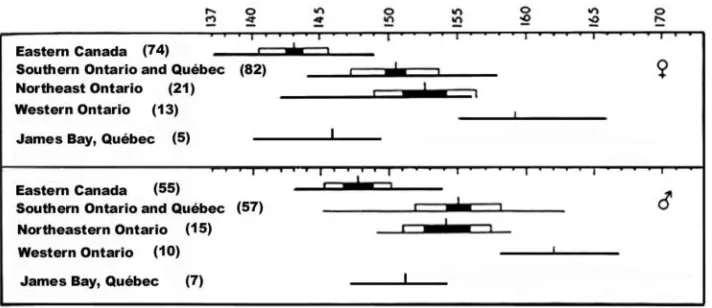
T. s. pallidulus(Figure 12). Our ventral scale counts were 151.0 ± 3.2 for males (n = 7) and 145.8 ± 3.8 (n = 5) for females; subcaudal scale counts were 73.1 ± 4.3 for males (n = 7) and 65.3 ± 5.0 for females (n = 4).
The only previous report of the litter size of Garter Snakes from the James Bay area was 6 embryos in a
circa 70 cm SVL female taken on 17 July 1973 (MacCulloch and Bider 1975). This snake also con-tained one small egg which likely would have been aborted (F. R. Cook, personal communication). Aver-age counts of embryos for northern locations in west-ern Canada are 12.5 and 18.5 (Larsen et al. 1993), and 10-30 in southern Québec and Ontario (J-FD and FWS, unpublished data; Gregory and Larson 1993). Over the species’ range, litter sizes average 27 (Ernst and Ernst 2003). Eight southern Quebec Garter Snakes dissected by JFD contained 12 to 25 embryos (mean = 16.8). Our three pregnant females from James Bay, Québec (taken 4-15 June) contained 35 (65cm SVL), 28 (55.6cm SVL) and 18 (60.4cm SVL) embryos. Litters born to females taken in September of previ-ous years at the Long Lake study area averaged 31 FIGURE11. Observations of the Garter Snake (Thamnophis
sirtalis), around James Bay. triangles = our observa-tions in May and June 2002, open circles = previous records.
young (25 [born in captivity the next June], 37 [born 14-15 Sept.], 32 [born 16-17 Sept]). There is no evi-dence here for a small northern litter size.
The Garter Snake seems to be widespread in the study area, both in rocky and sandy areas in Québec, and in Clay Belt areas like Long Lake and north along the Ontario Northland tracks to James Bay in Ontario. According to local people, there are populations of snakes on some islands in Rupert Bay. The species was also found on Jacob Island just north of Rupert Bay (Ouellet et al.2009). The huge volumes of bro-ken rock fill at the culverts where we found 70% (16/23) of our snakes (or shed skins) in Québec may provide hibernacula, but all we can say about hiberna-tion in the Clay Belt is that snakes are found at Long Lake in both May and September.
Discussion
The herpetofauna of the area we surveyed, along about 1 200 km of roads, is remarkably uniform. We found only one significant northern range limit (Two-lined Salamander), and the Boreal Chorus Frog is the only species regionally restricted to a habitat that is not widespread in the area. Four species have their known northern range limit near the northern limit of the study area (Blue-spotted Salamander, Spring Peeper, Leopard Frog and Garter Snake).
The apparent declines of Lithobates pipiens and
Lithobates septentrionalis in Ontario are troubling. These species need dedicated monitoring by local nat-uralists or a concerted season-long survey of all the sites where they have been found in the past (e.g., Table 7), and other sites with favourable habitat fea-tures (e.g., Schueler, 2000*).
James Bay thrusts subarctic conditions far south into central North America, so that the transition between subarctic and warm temperate conditions is perhaps as steep in the 1400 km between Moosonee and
Bal-timore as it is anywhere. This partial barrier, and the contrasted conditions east and west of the Bay, means that phylogenetic contacts between eastern and western stocks are expected here, imposed on the general pat-tern of postglacial northward dispersal from southern refugia (Cook 1983). Several species have been stud-ied in sufficient detail to make this possible:
Ambystoma lateraleseems homogeneous through the region (J. P. Bogart, in litt.), but hybrids with
Ambystoma jeffersonianum(LLJ and LJ genotypes) were collected in Abitibi in 2005, just south of the area studied here (J.-F. Desroches and J. P. Bogart, person-al observation). Genetic evperson-aluation of some James Bay specimens would be needed to evaluate the status of the species in this area.
Eurycea bislineata is of Appalachian origin, and may be restricted to rocky watersheds in James Bay and absent from most of the Clay Belt.
Cook (1983) found the easternmost morphological signs of intergradation with the prairie ToadAnaxyrus
americanus hemiophrys in samples from Whitetop Creek and Moosonee, suggesting early dispersal though grassland habitats of the dewatered Lake Agassiz basin and other post-glacial grasslands.
Austin et al.(2002) concluded that the entire Bore-al Forest west to Manitoba was populated by
Pseu-dacris cruciferfrom refugia east of the Appalachians, and that western lineages of this species had not spread very far north, perhaps because they had been held south by grassland habitats of the Prairie Peninsula and on the dewatered Lake Agassiz which provided eastward corridors for grassland species.
Lemmon et al.(2007) showed that Saint Lawrence and south-central Ontario populations with P. triseriata morphology are geneticallyP. maculata, and must have re-evolved the triseriata morphology from Boreal ancestors that spread through the northern grasslands now represented by the shores of James Bay (Moriarty, personnal communication).
The boundary between eastern and western popu-lations ofLithobates sylvaticus, which is marked by hints of non-interbreeding and indirect evidence of morphological difference, has not been mapped north of the vicinity of Quebec City (Lee-Yaw et al. 2008). Andrée-Michelle D’Aoust-Messier is surveying this species around James Bay to map the distribution of genotypes and to see how they are associated with the tadpole tooth formula or with morphological traits of adults (see D’Aoust-Messier and Lesbarrères 2010*). In a mtDNA study of geographic variation in
Lithobates pipiensthroughout its range, only a 1971 sample from Attawapiskat contained both eastern and western haplotype specimens (Hoffman & Blouin 2004). This western influence on the west side of James Bay was perhaps foretold by Schueler’s (1973) noting colour differences between frogs from Attawa-piskat and Moosonee, but Schueler (1982) found only intermediate values of the east-west variable SPOT-TING, and high values of the aquatic-habitat variable GLANDS around the Bay, without enough samples west and south of the Bay to detect a stepped cline that might have reflected the ranges of the two haplo-types in Ontario.
Our study area is supposed to span the junction betweenThamnophis s. sirtalis/pallidulus, at the south end of the Bay (Bleakney 1959; Cook 1984; Conant and Collins 1998). In New York and New England, this subspecies difference corresponds to the “eastern” and “maritime” lineages of Rye (2000). In western Ontario Rye found that the change in colour pattern (Thamnophis s. sirtalis/parietalis) occurred far west of the contact zone between the “eastern” and “west-ern” genetic lineages, and that there was an eastward cline of decreasing ventral count that was not stepped or interrupted at the contact between the lineages (Rye 2000, figure 3.13).
Acknowledgments
Many people and institutions made the James Bay Expedition possible. Ginette Crochetière, Jasmine Larouche, and Johanne Deziel provided accommoda-tion during our visits in James Bay villages. Rey and Carole Brisson, patrons of boreal herpetology, provid-ed their customary lavish support in Cochrane, through an otherwise very stressful time for their family. Ale-ta KarsAle-tad and Larry Frazer accompanied us on some trips, and provided logistic support from home. The Cree Band Councils helped with authorization and in organisation. Bill Jolly ferried us to Cabbage Willows Bay, and Wayne Tomatuk took us around the Moose
River. Initial maps of species records were made by Matt Keevil and Daniel Ouellett. The former Eastern Ontario Biodiversity Museum, Mountain Equipment Coop, and Aux Quatre Points Cardinaux provided ma-terial assistance. Michèle Steigerwald’s help in cata-loguing and integrating specimens into the Canadian Museum of Nature collection was invaluable, and Fran-cis Cook has encouraged us in all our northward ven-tures. This survey was made possible with the financial support of Frank Ross and Donna Richoux and of the Société de la faune et des parcs du Québec, with its program “Faune-Nature.” A review of the manuscript by Ross MacCulloch was helpful. We thank everyone for this assistance, and hope that our discoveries repay their efforts.
Documents Cited
(marked * in the text)Anonymous [F. W. Schueler].1993. Northeastern Ontario
Leopard Frogs. Ontario Herpetological Summary Newslet-ter, April 1993: 3.
D’Aoust-Messier, A.-M.,andD. Lesbarrères.2010.
Conser-vation of northern biodiversity: population genetics pat-terns observed in populations of Wood Frogs (Lithobates
sylvaticus) in the James Bay area. CARCNET meetings, Wolfville, Nova Scotia. http://www.carcnet.ca/past_meet ings/2010/abstracts2010.pdf
Environment Canada.2006. Canadian Climate Normals or
Averages 1961-1990. http://www.climate.weatheroffice. ec.gc.ca/climate_normals/index_1961_1990_e.html
Environment Canada.2010. Comparing El Niños – El Niño
and La Niña Years 1950-2010 – http://www.ec.gc.ca/adsc-cmda/default.asp?lang=En&n=E0ABE4B3-1 (accessed 24 Oct 2010).
Hydro-Québec.2006. Eastmain-1-A Powerhouse and Rupert
Diversion. http://www.hydroquebec.com/eastmain1a/en/ index.html.
Lee-Yaw, J. A., J. T. Irwin,andD. M. Green.2008.
Post-glacial range expansion from northern refugia by the wood frog,Rana sylvatica, Molecular Ecology 17: 867–884.
Mossman, M. J.1990. 3 April 1990. Wisconsin Frog and
Toad Survey Newsletter.
Ontario Herpetofaunal Summary.2005. OHS database.
Records from Cochrane District extracted on 12 March 2005. Database managed by Natural Heritage Information Centre, Ontario Ministry of Natural Resources, Peterbor-ough, Ontario. (see http://www.mnr.gov.on.ca/MNR/nhic/ herps/ohs.html).
Picard, I.andJ.-F. Desroches.2003. Inventaire faunique
de la région de la baie James, 2002. En collaboration avec la Société pour la nature et les parcs du Canada (SNAP). Rapport réalisé pour la Société de la faune et des parcs du Québec, Québec, 28 pages + 2 appendices.
Schueler, F. W. 2000. Northern Ontario Ducks Unlimited
Marshes: Refugia for Leopard Frogs? CARCNET 5th An-nual Meeting, Penticton, British Columbia, 22-25 Septem-ber 2000.
Schueler, F. W., A. Karstad,andA. Zieleman.2010. Results
Seburn, D. C.,andC. N. L. Seburn.1997. Northern Leopard Frog survey of northern Ontario: report on a declining amphibian. Unpublished report to the Wildlife Assessment Unit of the Ontario Ministry of Natural Resources, Thun-der Bay.
Literature Cited
Altig, R.1970. A key to the tadpoles of the continental United
States and Canada. Herpetologica 26 : 180-207. Austin, J. D., S. C. Lougheed, L. Neidrauer, A. A. Chek,
andP. T. Boag.2002. Cryptic lineages in a small frog:
the post-glacial history of the spring peeper,Pseudacris
crucifer(Anura: Hylidae). Molecular Phylogenetics and Evolution 25: 316-329.
Ashton, R. E., S. I. Guttman,andP. Buckley.1973. Notes
on the distribution, coloration, and breeding of the Hudson Bay Toad,Bufo americanus copei(Yarrow and Henshaw). Journal of Herpetology 7: 17-20.
Bider, J.-R.,andS. Matte.1996. The Atlas of amphibians
and reptiles of Québec. St. Lawrence Valley Natural History Society and Ministère de l’Environnement et de la Faune du Québec. Québec. 106 pages.
Bleakney, J. S.1954. Range extensions of amphibians in
Eastern Canada. Canadian Field-Naturalist 68: 165-171.
Bleakney, J. S.1958. A zoogeographical study of the
amphib-ians and reptiles of Eastern Canada. National Museum of Canada, Bulletin 155 (Biological Series 54). 119 pages.
Bleakney, J. S.1959.Thamnophis sirtalis sirtalis(Linnaeus)
in Eastern Canada, redescription ofT. s. pallidulaAllen. Copeia 1959: 52-56.
Brooks, R. J., D. Strickland,andR. J. Rutter.2003.
Rep-tiles and Amphibians of Algonquin Provincial Park. Friends of Algonquin Park, Whitney, Ontario. 48 pages.
Champagne, P.1982. Morphologie littorale de la baie de
Rupert. Le Naturaliste Canadien 109: 375-384.
Conant, R.,andJ. T. Collins.1998. A field guide to Reptiles
and Amphibians of Eastern and Central North America, 3rdedition. Houghton Mifflin Company. Boston and New York, U.S.A. xviii + 616 pages.
Cook, F. R.1964. A northern range extension forBufo
amer-icanuswith notes onB. americanusandRana sylvatica. Canadian Field-Naturalist 78: 65-66.
Cook, F. R.1983. An analysis of toads of theBufo
ameri-canusgroup in a contact zone in Central Northern North America. Publications in Natural Sciences (3). Natural Mu-seum of Natural Sciences, National MuMu-seum of Canada. Ottawa, Canada. 89 pages.
Cook, F. R.1984. Introduction to Canadian amphibians and
reptiles. National Museum of Natural Sciences, National Museums of Canada. Ottawa, Canada. 211 pages.
Desroches, J.-F.,andD. Rodrigue.2004. Amphibiens et
reptiles du Québec et des Maritimes. Éditions Michel Quintin. Québec. 288 pages.
Dole, J. W. 1971. Dispersal of recently metamorphosed
Leopard Frogs,Rana pipiens. Copeia 1971: 221-228.
Ernst, C. H.,andE. M. Ernst.2003. Snakes of the United
States and Canada. Smithsonian Books, Washington and London. 668 pages.
Fortin, C.2006. Extension de l’aire de répartition nordique
de la salamandre à deux lignes. Bulletin de la Société de géographie du Québec 1 : 5-7.
Fortin, C.2005. Sortie herpétologique sur la Côte-Nord et
au Labrador : de Natashquan à St. Lewis. Le Naturaliste canadien 129 : 50-56.
Fortin, C., M. Ouellet, and M.-J. Grimard. 2003. La
rainette faux-grillon boréale : présence officiellement vali-dée au Québec. Le Naturaliste Canadien 127: 71-75.
Gaige, H. T.1932. The status ofBufo copei. Copeia 1932:
134.
Gregory, P. T.,andK. W. Larsen.1993. Geographic
varia-tion in reproductive characteristics among Canadian pop-ulations of the common garter snake (Thamnophis sirtalis). Copeia 1993: 946-958.
Hoffman, E. A.,andM. S. Blouin.2004. Evolutionary
histo-ry of the Northern Leopard Frog: Reconstruction of phy-logeny, phylogeography, and historical changes in popula-tion demography from mitochondrial DNA. Evolupopula-tion 58: 145–159.
Kamstra, J.1983. Northern range extension of the Two-lined
Salamander,Eurycea b. bislineata,in Ontario. Canadian Field-Naturalist 97: 116.
Koonz, W.1992. Amphibians in Manitoba. Pages 19-20in
Declines in Canadian amphibian populations: Designing a national monitoring strategy.Edited byC. A. Bishop and K. E. Pettit. Canadian Wildlife Service Occasional Paper 76. Ottawa, Canada.
Lacasse, R.1983. Baie James, une épopée. Éditions Libre
Expression, Québec. 653 pages.
Larsen, K. W., P. T. Gregory,and R. Antoniak.1993.
Reproductive ecology of the common garter snake Tham-nophis sirtalisat the northern limit of its range. American Midland Naturalist 129: 336-345.
Lee-Yaw, J. A., J. T. Irwin,andD. M. Green.2008.
Post-glacial range expansion from northern refugia by the wood frog,Rana sylvatica. Molecular Ecology 17: 867-884.
Logier, E. B. S.,andG. C. Toner.1961. Check list of the
amphibians and reptiles of Canada and Alaska. The Royal Ontario Museum Contribution 53, Toronto. 92 pages.
Lowcock, L. A., H. Griffith,andR. W. Murphy.1992. Size
in relation to hybridity, ploidy, and breeding dynamics in Central Ontario populations of theAmbystoma
laterale-jeffersonianumcomplex. Journal of Herpetology 26: 46-53.
MacCulloch, R. D.2002. The ROM field guide to
amphib-ians and reptiles of Ontario. Royal Ontario Museum and McClelland & Stewart Ltd., Toronto. 168 pages.
MacCulloch, R. D.,andJ. R. Bider.1975. New records of
amphibians and Garter Snakes in the James Bay area of Québec. Canadian Field-Naturalist 89: 80-82.
Maunder, J. E.1997. Amphibians of Newfoundland and
Labrador: status changes since 1983. Pages 93-99 in
Amphibians in decline: Canadian studies of a global prob-lem.Edited byD. M. Green, Herpetological Conservation, Volume 1. Society for the Study of Amphibians and Rep-tiles. St. Louis, Missouri. USA.
McCoy, C. J.,andC. J. Durden.1965. New distribution
records of amphibians and reptiles in Eastern Canada. Canadian Field-Naturalist 79: 156-157.
Moriarty, E. C.,andD. C. Cannatella.2004. Phylogenetic
relationships of the North American chorus frogs ( Pseu-dacris: Hylidae). Molecular Phylogenetics and Evolution 30: 409-420. http://www.bio.fsu.edu/chorusfrog/Moriarty %20and%20Cannatella%202004.pdf
Moriarty Lemmon, E., A. R. Lemmon, J. A. Lee-Yaw, J.
T. Collins,andD. C. Cannatella.2007. Phylogeny-based
Ouellet, M., C. Fortin,andM.-J. Grimard.2009. Distribu-tion and habitat use of the Boreal Chorus Frog (Pseudacris maculata) at its extreme northeastern range limit. Her-petological Conservation and Biology 4: 277-284.
Pace, A. E.1974. Systematic and biological studies of the
leopard frogs (Rana pipienscomplex) of the United States. Miscellaneous Publications, Museum of Zoology, Uni-versity of Michigan 148:1-140.
Petranka, J. W.1998. Salamanders of the United States and
Canada. Smithsonian Institution Press, Washington and London, USA. 587 pages.
Rye, L. A.2000. Analysis of areas of intergradation between
described. subspecies of the common garter snake,
Tham-nophis sirtalis, in Canada. unpublished Ph.D. thesis, University of Guelph. ix + 107 pages.
Schueler, F. W.1973. Frogs of the Ontario Coast of Hudson
Bay and James Bay. Canadian Field-Naturalist 87: 409-418.
Schueler, F. W.1975. Geographic variation in the size of
Rana septentrionalisin Québec, Ontario, and Manitoba. Journal of Herpetology 9: 177-185.
Schueler, F. W.1982. Geographic variation in skin
pigmen-tation and dermal glands in the Northern Leopard Frog,
Rana pipiens.Publications in Zoology, National Museum of Natural Sciences, National Museums of Canada 16: 1-80.
Schueler, F. W.,andF. R. Cook.1980. Distribution of the
middorsal stripe dimorphism in the wood frog,Rana syl-vatica, in eastern North America. Canadian Journal of Zoology 58: 1643-1651.
Schueler, F. W.,andA. R. Karstad.1975. Notes on the
dis-tribution and habitat of amphibians and turtles in north-western Québec. Canadian Field-Naturalist 89: 57-59.
Schueler, F. W., D. H. Baldwin,andJ. D. Rising.1974.
The status of birds at selected sites in Northern Ontario. Canadian Field-Naturalist 88: 141-150.
Seburn, D.,andC. Seburn.2000. Conservation priorities
for the amphibians and reptiles of Canada. World Wildlife Fund Canada and Canadian Amphibian and Reptile Con-servation Network. 92 pages.
Société d’énergie de la Baie James.1978. Connaissance
du milieu des territoires de la Baie James et du Nouveau-Québec. Société d’énergie de la Baie James, Service Envi-ronnement, Québec. 297 pages.
Weller, W. F.,andD. M. Green.1997. Checklist and current
status of Canadian amphibians. Pages 93-99inAmphibians in decline: Canadian studies of a global problem. Herpeto-logical Conservation, Volume 1,Edited byD. M. Green, Society for the Study of Amphibians and Reptiles. St. Louis, Missouri. USA.
Williams, M. Y.1920. Notes on the fauna of the Moose
River and the Matagami and Abitibi tributaries. Canadian Field-Naturalist 34: 125.
Wright, A. H.,andA. A. Wright.1949. Handbook of frogs
and toads of the United States and Canada, Third edition. Cornell University Press, Ithaca and London. 640 pages.