International Journal of Transformations in Business Management http://www.ijtbm.com (IJTBM) 2017, Vol. No.7, Issue No. IV, Oct-Dec e-ISSN: 2231-6868, p-ISSN: 2454-468X
92
INTERNATIONAL JOURNAL OF TRANSFORMATIONS IN BUSINESS MANAGEMENT
LOGISTICS PERFORMANCE WITH REFERENCE TO
INDIAN SCENARIO: EVALUATION AND
ASSESSMENT
Rakshit Dhiman Department of commerce
Maharaja Agrasen Institute Of Management Studies
1. OVERVIEW
The supply chain inside the textiles/apparel enterprise is complicated. Bruce M, Daly L (2004) argues that regularly the supply chain of textile/clothing industry is exceptionally long, with some of the events involved. So, there is a demand for careful management of the delivery chain to
Reduce lead times
Reduce Cost
Achieve Quick Response
Remain Competitive
Retailer assumes a crucial part of the entire production network, and they typically manage makers. All the arrangement on costs, quality, and conveyance dates are made straightforwardly with the maker. In any case, once in a while, there are purchasing specialists amongst retailers and producer and the purchasing operators in the particular nation manages maker on consult on all issues and convey the merchandise to the retailer according to plan. In this circumstance, the agreement is amongst retailer and purchasing operators and the purchasing specialists and producer. From the creator encounter, it saw that a portion of the retailers has their purchasing offices in significant assembling nations, so they have a superior control on arranging a booking.
International Journal of Transformations in Business Management http://www.ijtbm.com (IJTBM) 2017, Vol. No.7, Issue No. IV, Oct-Dec e-ISSN: 2231-6868, p-ISSN: 2454-468X
93
INTERNATIONAL JOURNAL OF TRANSFORMATIONS IN BUSINESS MANAGEMENT
client arranges adequately. The exploration represents how organizations in the area figure out how to benefit the requests for speed and effectiveness while reacting with adaptability to request vacillations.
1.1 Supply Chain Structure
The inventory network in the material and garments area is represented by Figure underneath. There is a stream of data spoke to by dabbed lines, while the sharp edges talk to the flow of merchandise. The bearing of the bolts shows a request pull-driven framework. The data stream cycle comprises of a request from client or retailers to the maker or now and then to the purchasing operators. The generation office acts as needs be and conveys the item according to an arranged calendar. At each connection in the generation anchor to one side of the appropriation focus in Figure, there are a few organizations. With a specific end goal to make merchandise, data, and installments stream easily, various coordination and business administrations are required. Contingent upon the size and improvement of the host economy, such policies are given by the lead firm in the inventory network or independent specialist co-ops in the further developed nations.
Huge retailers taking a shot at lean approach ordinarily recharge their stores on a week after week premise
Purpose of offers information are separated and broke down finished the end of the week and recharging orders put with the producer on Monday morning.
The maker is commonly required to take care of the request within seven days, which infers that the producer will dependably need to convey more significant inventories of completed merchandise than the retailer.
The dress division is both work severe and low wage industry and a dynamic, inventive part, contingent upon which showcase fragments one concentration upon. This section isolates into two market fragments.
International Journal of Transformations in Business Management http://www.ijtbm.com (IJTBM) 2017, Vol. No.7, Issue No. IV, Oct-Dec e-ISSN: 2231-6868, p-ISSN: 2454-468X
94
INTERNATIONAL JOURNAL OF TRANSFORMATIONS IN BUSINESS MANAGEMENT
After getting the renewal arrange, the producer will fill it from its stock and afterward on the premise of the hole between outstanding stock and the coveted stock level, will influence a creation to request to the generation plant, of which the maker may have a few in various areas. The retailers may arrange substantial amounts of, say, shirts spread over multiple makers in a few low-wage nations. Keeping in mind the end goal to guarantee that the shirts are comparable and can offer under a similar mark, the purchaser frequently purchases texture and extras in mass and gives its attire providers these sources of info. Moreover, purchasers frequently likewise determine the plan and help the makers in providing the coveted quality.
1.2 Delivery Model of Textile/Apparel Industry
Figure 1: Delivery Model of Textile/Apparel Industry
The apparel value chain is organized around five main parts:
Raw material supply, including: natural and synthetic fibers;
International Journal of Transformations in Business Management http://www.ijtbm.com (IJTBM) 2017, Vol. No.7, Issue No. IV, Oct-Dec e-ISSN: 2231-6868, p-ISSN: 2454-468X
95
INTERNATIONAL JOURNAL OF TRANSFORMATIONS IN BUSINESS MANAGEMENT
Production networks made up of garment factories, including their domestic and overseas subcontractors;
Export channels established by trade intermediaries; and
Marketing networks at the retail level
As cited by Au K. F, Ho D (2002) at Cooper et al. (1997), SCM requires all parties involved in producing and delivering a product to take a holistic approach to manage and integrate key business processes in order to achieve a smooth flow of information and product along a supply chain so, it is not limited to improving the relationship and co-ordination between buyers and manufacturers.
To adopt this management approach successfully, organizations may have to restructure and realign their working relationships and operating systems with other related parties.
Supply chains integration can be divided into two modes 1. Internal Integration
2. External Integration
2. RESEARCH METHODOLOGY
This would include planning the survey including inquiries on the goals of the study, trailed by inspecting and after that examination of results.
An overview was led crosswise over critical players in the business covering vehicle makers, segment producers and logistics specialist co-ops (Logistics Service Providers) to comprehend the present patterns and activities in the material/clothing inventory network, to recognize the critical regions for thought and the territories of core interest. For the motivation behind benchmarking, the accompanying measurements of examinations utilize:
Selection criteria for Logistics Service Providers
Collaboration between manufacturers and Logistics Service Providers
Customer service
Technology
Impact of logistics on manufacturing
2.1 Selection of Parameters
1. Selection of Logistics Service Providers
The selection criteria for Logistics Service Providers was evaluated on five broad parameters which are as below
Operating Geographies
Technology
Cost
Nature of service
International Journal of Transformations in Business Management http://www.ijtbm.com (IJTBM) 2017, Vol. No.7, Issue No. IV, Oct-Dec e-ISSN: 2231-6868, p-ISSN: 2454-468X
96
INTERNATIONAL JOURNAL OF TRANSFORMATIONS IN BUSINESS MANAGEMENT
These broad parameters were finalized after consultation with textile/apparel industry supply chain managers of key organizations and also through some industry reports like the one from CII institute of logistics, and discussion in conference of Textile/apparel SCM 2008 meet in India.
2. Collaboration with Logistics Service Providers
The parameters for functional collaboration were finalized as
Service parts
Reverse
Outbound
Inbound
The parameters for operational collaboration were finalized as
Cost Reduction
Transportation
Inventory management and replenishment
Demand forecasting and planning
These broad parameters were finalized after consultation with textile/apparel industry supply chain managers of key organizations and also through some industry reports like the one from CII institute of logistics, and discussion in conference of Textile/apparel SCM 2008 meet in India.
3. Barrier to Customer Service
The parameters that were finalized are as below
In-transit security/ Pilferage
Delays in Transit
Documentation
Lack of alternative mode of transport
Difficulties in scheduling
High Logistics cost
These broad parameters were finalized after consultation with textile/apparel industry supply chain managers of key organizations and also through some industry reports like the one from CII institute of logistics, and discussion in conference of Textile/apparel SCM 2008 meet in India.
4. Impact of Primary Logistics Issues on Supply Chain Performance
International Journal of Transformations in Business Management http://www.ijtbm.com (IJTBM) 2017, Vol. No.7, Issue No. IV, Oct-Dec e-ISSN: 2231-6868, p-ISSN: 2454-468X
97
INTERNATIONAL JOURNAL OF TRANSFORMATIONS IN BUSINESS MANAGEMENT
Issues in reverse logistics
Technology penetration in logistics industry
Lack of wide logistics service portfolio
Poor logistics infrastructure
Highly fragmented and unorganized logistics industry
Losses due to contingencies
Other secondary issues that were also surveyed were as below
Poor packaging equipment
Customer collaboration
Labor policies
Government interventions
Rising real estate prices
Rising fuel costs
These broad parameters were finalized after consultation with textile/apparel industry supply chain managers of key organizations and also through some industry reports like the one from CII institute of logistics, and discussion in conference of Textile/apparel SCM 2008 meet in India.
2.2 Sampling Techniques
Non probability inspecting was utilized for this reason. The method utilized was accommodation inspecting through email to industry specialists.
Convenient Sampling – I had utilized testing in light of my accommodation to send letters overviews. Since email was an advantageous approach to reach over a few people at only a tick of the mouse, it was better as far as reach and access as opposed to individual meetings. However, the example size might be one-sided, as in, incorporated an accomplished gathering of individuals, since my email contacts were for the most part in the material/clothing and material/attire segments industry.
2.3 Data Collection
Data was mainly collected through primary research by conducting a mail survey having set of questions about logistics service providers (Logistics Service Providers). The responses were obtained from a sample of 55 people.
International Journal of Transformations in Business Management http://www.ijtbm.com (IJTBM) 2017, Vol. No.7, Issue No. IV, Oct-Dec e-ISSN: 2231-6868, p-ISSN: 2454-468X
98
INTERNATIONAL JOURNAL OF TRANSFORMATIONS IN BUSINESS MANAGEMENT
3. RESEARCH FINDINGS AND ANALYSIS
3.1 Need Gap Analysis
The need to advance logistics cost would increment with material/attire producers arranging imaginative models for systematic multimodal transport.
3.2 Selection of Logistics Service Providers
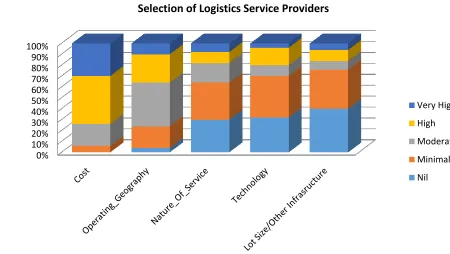
Makers regularly see logistics as a cost focus instead of as a differentiator in the commercial center. The issue is an absence of understanding into the genuine open door. For instance, an expansive rate (30%) of the makers studied positioned working geologies/scope and starting expense of specialist co-ops and armada estimate/framework as ―very high in their contemplations for choosing a Logistics Service Providers. Right around 30% of the makers thought about the idea of administration as ―minimal intheir determination.
Figure 2: Parameters used to select Logistics Service Providers
While armada estimate/framework is one of the key contemplations for choosing a logistics specialist co-op, the business is very divided with around 80% of the individuals having maybe a couple trucks and under 10% of the individuals having more than five trucks.
All the above parameters were significantly important, which was proven statistically by conducting an independent t-test (95% confidence level; about the mean value 3) the results of which are tabulated in Table 1 of appendix.
0% 10% 20% 30% 40% 50% 60% 70% 80% 90% 100%
Selection of Logistics Service Providers
Very High
High
Moderate
Minimal
International Journal of Transformations in Business Management http://www.ijtbm.com (IJTBM) 2017, Vol. No.7, Issue No. IV, Oct-Dec e-ISSN: 2231-6868, p-ISSN: 2454-468X
99
INTERNATIONAL JOURNAL OF TRANSFORMATIONS IN BUSINESS MANAGEMENT 3.3 Functional Collaboration with Logistics Service Providers:
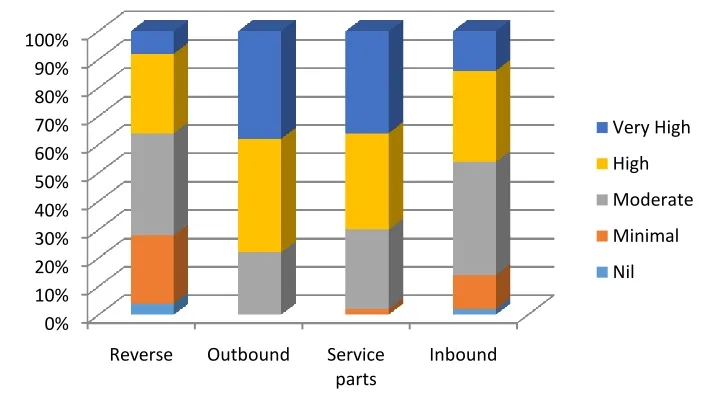
While 40% of the manufacturers indicated moderate levels of collaboration with Logistics Service Providers in the traditional areas of outbound and inbound logistics, only 15% of the manufacturers indicated ―very high levels of collaboration in the emerging area of service parts. The Indian textile/apparel industry in the near future is expected to focus significantly on service parts business following the global trend.
Figure 3: Level of collaboration with Logistics Service Providers across functions
Figure 4: Improvement areas for collaboration with Logistics Service Providers
While at this stage outbound logistics (nearly 80% of the respondents) and inbound logistics (about 45% of the respondents) are still recognized as areas for improved collaboration with
0% 10% 20% 30% 40% 50% 60% 70% 80% 90% 100%
Inbound Service Parts
Reverse Outbound
Very High
High
Moderate
Minimal
Nil
0% 10% 20% 30% 40% 50% 60% 70% 80% 90% 100%
Reverse Outbound Service parts
Inbound
Very High
High
Moderate
Minimal
International Journal of Transformations in Business Management http://www.ijtbm.com (IJTBM) 2017, Vol. No.7, Issue No. IV, Oct-Dec e-ISSN: 2231-6868, p-ISSN: 2454-468X
100
INTERNATIONAL JOURNAL OF TRANSFORMATIONS IN BUSINESS MANAGEMENT
Logistics Service Providers, 65% of the respondents recognize the need to improve collaboration in service parts logistics. This provides significant opportunities for both the Logistics Service Providers and the manufacturer in their journey of growth and profitability. All the above parameters except service parts were significantly important, which was proven statistically by conducting an independent t-test (95% confidence level; about the mean value 3) the results of which are tabulated in Table 2 and Table 3 of appendix.
3.4 Operational Collaboration with Logistics Service Providers:
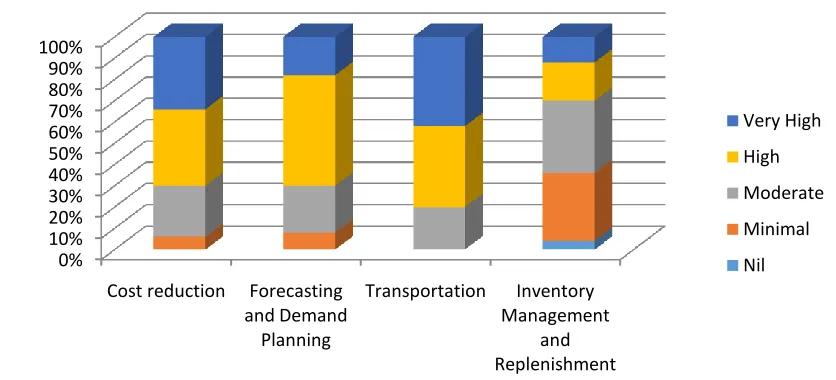
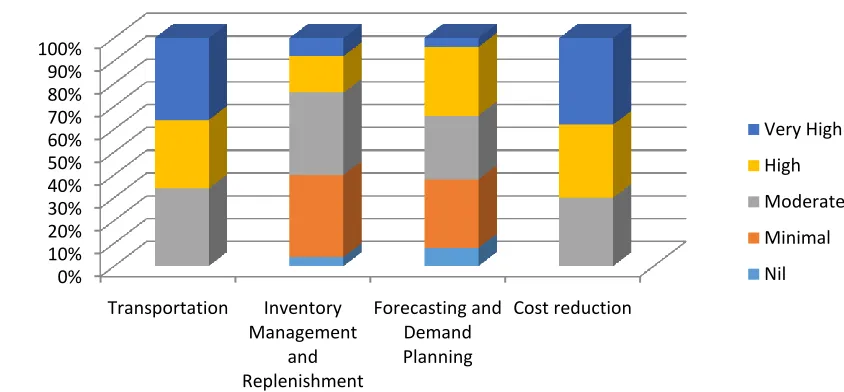
Around 47% of the producer's rate logistics cost as ―very high in the determination of Logistics Service Providers, and around 70% demonstrated that Logistics Service Providers need to concentrate on cost decrease maybe mirroring the cost weight on the makers. In any case, just 24% of the producers have demonstrated ―very abnormal amounts of coordinated effort with their Logistics Service Providers for the reason. Those associations that have teamed up with Logistics Service Providers have picked up ―high levels of advantages. This emphatically shows a requirement for makers to work with Logistics Service Providers over the three zones of cost lessening, stock administration and recharging and, determining and request arranging.
Figure 5: Level of collaboration with Logistics Service Providers across Operations
0% 10% 20% 30% 40% 50% 60% 70% 80% 90% 100%
Cost reduction Forecasting and Demand
Planning
Transportation Inventory Management
and Replenishment
Very High
High
Moderate
Minimal
International Journal of Transformations in Business Management http://www.ijtbm.com (IJTBM) 2017, Vol. No.7, Issue No. IV, Oct-Dec e-ISSN: 2231-6868, p-ISSN: 2454-468X
101
INTERNATIONAL JOURNAL OF TRANSFORMATIONS IN BUSINESS MANAGEMENT
Figure 6: Benefits achieved through collaboration
All the above parameters were significantly important, which was proven statistically by conducting an independent t-test (95% confidence level; about the mean value 3) the results of which are tabulated in Table 4 and Table 5 of appendix.
3.5 Customer Service
High Logistics Cost and In-Transit Security ―very high among manufacturers as barriers to customer service. High Initial costs to purchase a transportation medium, poor infrastructure in forms of roads are the main reason for these obstacles. This coupled with the fact that around 40% of the traffic load is taken by 4% of the national highways contribute to the delays. It is, therefore, no surprise that manufacturers rank reliability and on-time deliveries as the most prominent area of focus by the Logistics Service Providers. However, only 10% of the respondents plan to use multiple modes of transportation. Organizations are therefore not planning to deviate from their current system of freight movement by road.
0% 10% 20% 30% 40% 50% 60% 70% 80% 90% 100%
Transportation Inventory Management
and Replenishment
Forecasting and Demand Planning
Cost reduction
Very High
High
Moderate
Minimal
International Journal of Transformations in Business Management http://www.ijtbm.com (IJTBM) 2017, Vol. No.7, Issue No. IV, Oct-Dec e-ISSN: 2231-6868, p-ISSN: 2454-468X
102
INTERNATIONAL JOURNAL OF TRANSFORMATIONS IN BUSINESS MANAGEMENT
Figure 7: Barriers to customer service
All the above parameters were significantly important, which was proven statistically by conducting an independent t-test (95% confidence level; about the mean value 3) the results of which are tabulated in Table 6 of appendix.
Figure 8: Areas requiring focus by Logistics Service Providers
Just about 40% of the respondents intend to have a high dependence on Logistics Service Providers for lessening the logistics cost. Organizations are hoping to outsource non-conventional logistics prerequisites, for example, switch logistics, stock administration, arrange preparing, circulation, and marking and bundling. This is in accordance with the worldwide pattern examined before, despite the fact that now of time associations are
0% 10% 20% 30% 40% 50% 60% 70% 80% 90% 100%
Very High
High
Moderate
Minimal
Nil
0% 10% 20% 30% 40% 50% 60% 70% 80% 90% 100%
Integration Optimizing finished goods stock
Reducing logistics cost
Reducing in-transit damages
Reliability and On time performance
Very High
High
Moderate
Minimal
International Journal of Transformations in Business Management http://www.ijtbm.com (IJTBM) 2017, Vol. No.7, Issue No. IV, Oct-Dec e-ISSN: 2231-6868, p-ISSN: 2454-468X
103
INTERNATIONAL JOURNAL OF TRANSFORMATIONS IN BUSINESS MANAGEMENT
concentrating on territories like cost, armada estimate/other framework and working geologies.
Expanded scope of administrations offered by the coordination’s specialist organizations is one of the noteworthy prerequisites of the material/clothing production network.
All the above parameters were fundamentally vital, which was demonstrated factually by directing a free t-test (95% certainty level; about the mean esteem 3) the aftereffects of which are arranged in Table 7 of reference section.
3.6 Technology
Broad executions of the ERP and on-line arrange handling took after by CRM describe OEMs/part makers. In any case, the advantages accomplished from the implementations have not been ―very high particularly for ERP and on-line arrange preparing. Developing advancements like RFID is at an incipient stage.
The absence of advantages accomplished powers associations into re-actualizing of the same in the following three years. Around 70% of the makers have made arrangements for a broad usage of ERP while 40% of them have just shown to have done as such. An all-around actualized exchange handling framework at the maker’s end would expand the deceivability and improve the execution of procedures in regions like stock administration, request arranging and planning. This could conceivably drive extending joint effort amongst producers and Logistics Service Providers.
While esteem included administrations by Logistics Service Providers demonstrate as one of the critical drivers of coordination’s technique, half of the respondents have arranged ―extensive usage of the stockroom administration framework (WMS) in the following three years. More than 33% have orchestrated ―extensive execution of the TMS. It would be normal that Logistics Service Providers, as opposed to makers, would put resources into innovations like TMS and WMS. To that degree, there have all the earmarks of being an inconsistency between the requirement for outsourcing esteem added administrations to Logistics Service Providers and executing such advancements
3.7 Impact of coordination on Supply Chain Performance
International Journal of Transformations in Business Management http://www.ijtbm.com (IJTBM) 2017, Vol. No.7, Issue No. IV, Oct-Dec e-ISSN: 2231-6868, p-ISSN: 2454-468X
104
INTERNATIONAL JOURNAL OF TRANSFORMATIONS IN BUSINESS MANAGEMENT
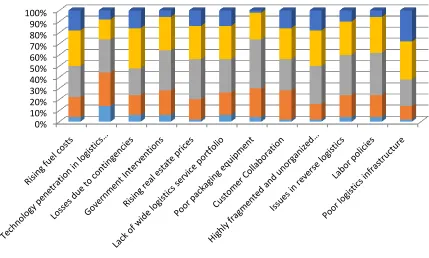
Figure 9: Logistics issues and their impact on Supply chain performance
The size and discontinuity in the logistics business could be purposes for a portion of the key issues looked by producers. High land costs, human asset difficulties and interests in innovation are factors that would conceivably drive union in the business in India in accordance with worldwide patterns.
All the above parameters were altogether imperative, which was demonstrated factually by leading an autonomous t-test (95% certainty level; about the mean esteem 3) the consequences of which are arranged in Table 8 of addendum.
4. SUMMARY OF FINDINGS
The cost has been viewed as the most vital factor with a specific end goal to pick an appropriate coordination specialist organization. Presently numerous coordination’s supplier organizations are giving a one-stop answer for the customers. It incorporates process from acquirement of crude materials to bundling of final results. So on the off chance that one gathering is giving this merged arrangement then that specific convention is favored.
Foundation issue in India is one of the fundamental hindrances in coordination administration. Expanded fuel costs are likewise assuming a negative part. The most recent pattern in fuel costs is a reasonable sign that in future coordination specialist co-op will think on substitute vitality source to execute their transportation administrations. What one of the principle concern material maker are confronting is the security of the completed items. The
0% 10% 20% 30% 40% 50% 60% 70% 80% 90% 100%
Very High
High
Moderate
Minimal
International Journal of Transformations in Business Management http://www.ijtbm.com (IJTBM) 2017, Vol. No.7, Issue No. IV, Oct-Dec e-ISSN: 2231-6868, p-ISSN: 2454-468X
105
INTERNATIONAL JOURNAL OF TRANSFORMATIONS IN BUSINESS MANAGEMENT
security worries with the condition and nature of the issue when it scopes to end shoppers is high. Coordination specialist co-ops need to take after a very much characterized process which will guarantee the quality and state of the items.
At this moment many material producers are not utilizing the coordination specialist organizations in gauging and request arranging. Be that as it may, they have begun understanding its significance, and in future, we can envision heaps of movement on this front by the coordination specialist organizations
5. CONCLUSION
There have been numerous endeavors in the current past to decide measurements to gauge the execution of supply chains in the material industry. It is fascinating to take note of that the more significant part of the execution estimation frameworks distributed in writing depends on a predetermined number of studies. Past endeavors of creating execution estimation frameworks have recognized a broad number of investigations. These investigations have not been particular to materials and clothing. As appeared, there have been a set number of studies concerning material and clothing specific execution estimation. This shows a chance to improve both the production network and the material and attire administration writing with an investigation of industry-particular execution measures. By distinguishing the measurements that are being utilized by material and attire organizations, research can bolster industry – Only through understanding the requirements of agencies would academic be able to look into help industry change.
The review comes about took into account recognizable proof of particular execution measurements. Measurements for gaging the execution of providers were observed to be fundamentally unique. The best five provider execution measurements for the material industry were perceived to be quality, on-time conveyance, cost, lead time, and adaptability. Measurements utilized by organizations to gauge interior execution were additionally observed to be substantially unique.
This investigation concentrates on building up a comprehension of the material and attire industry. The principal conclusion is that organizations vary as for understanding store network administration and measuring the execution of supply chains. Varying provider measures, interior measures, and store network measures founded for agencies in the industry.
International Journal of Transformations in Business Management http://www.ijtbm.com (IJTBM) 2017, Vol. No.7, Issue No. IV, Oct-Dec e-ISSN: 2231-6868, p-ISSN: 2454-468X
106
INTERNATIONAL JOURNAL OF TRANSFORMATIONS IN BUSINESS MANAGEMENT
coordination’s suppliers has a coordinate effect on the coordination’s proficiency. Additionally, the majority of the coordination specialist co-ops have lesser introduction to present day improvements in coordination business, polished methodology in the market, and so forth. Adding to these misfortunes is the different geographic variety of India which requires differed coordination’s aptitude for every locale; this structures a noteworthy test for 3PL specialist organizations.