The Open Journal of Occupational Therapy
The Open Journal of Occupational Therapy
Volume 4
Issue 1 Winter 2016 Article 6
January 2016
Using Technology to Increase Physical Activity in Health
Using Technology to Increase Physical Activity in Health
Profession Students
Profession Students
Mary Ann Stark
Bronson School of Nursing, Western Michigan University - USA, [email protected]
Kelly Elrod
Sara Haller
Western Michigan University - USA, [email protected]
Andrea Mahon
Follow this and additional works at: https://scholarworks.wmich.edu/ojot
Part of the Occupational Therapy Commons, and the Other Medicine and Health Sciences Commons
Recommended Citation Recommended Citation
Stark, M., Elrod, K., Haller, S., & Mahon, A. (2016). Using Technology to Increase Physical Activity in Health Profession Students. The Open Journal of Occupational Therapy, 4(1). https://doi.org/10.15453/
Using Technology to Increase Physical Activity in Health Profession Students Using Technology to Increase Physical Activity in Health Profession Students
Abstract Abstract
Health profession students may need help establishing and maintaining positive health behaviors when they are in college. This study explored the effectiveness of text messaging as an innovative method for promoting an increase in daily physical activity. A convenience sample (N = 134) was recruited from students at a college of Health and Human Services in Michigan. The participants were randomized into an intervention or control group (n = 67 each). The intervention group received daily affective text messages encouraging more physical activity by taking more steps. The control group received only messages reminding them to report their number of steps. All of the participants received a pedometer, completed a demographics and daily habits questionnaire, and completed the Perceived Stress Scale (PSS). There was no significant difference between the intervention and control groups in their number of daily steps. However, the most inactive participants had a significant increase in steps during the study period. Health profession students’ lifestyle behaviors have consequences, as they become caregivers in our dynamic, demanding health-care system. For those with the greatest need for physical activity, encouraging such activity via text messaging may improve their ability to care for themselves and their clients.
Keywords Keywords
health promotion, health profession students, interprofessional, mobile devices, text messaging, physical activity
Cover Page Footnote Cover Page Footnote
The authors acknowledge funding provided by the Lee Honors College at Western Michigan University.
Credentials Display
Mary Ann Stark, PhD, RNC; Kelly Elrod, MSN, RN-BC; Andrea Mahon, BSN, RN; Sara Haller, BSN, RN
Copyright transfer agreements are not obtained by The Open Journal of Occupational Therapy (OJOT). Reprint permission for this Topics in Education should be obtained from the
corresponding author(s). Click here to view our open access statement regarding user rights and distribution of this Topics in Education.
DOI: 10.15453/2168-6408.1145
As health-care profession students balance
the demands and stresses of academic performance,
the health-care environment, and their personal
lives, they may forego some positive health
behaviors at the time when they most need to
establish healthy habits. A healthy lifestyle is
beneficial to everyone’s personal health and
well-being, but it is especially important to those who
care for others. Health profession students may
have an increased risk for physical inactivity due to
rigorous academic schedules and the time demands
of clinical practice. In addition, being in a
demanding health-care environment can expose
health profession students to added emotional and
physical stress. Living a healthy lifestyle, however,
may protect their health and contribute to their
success as they prepare to be productive
professionals in the future.
Background and Literature Review
Approximately 30%-50% of college
students do not participate in an adequate amount of
physical activity (Hawker, 2012; Kamarudin &
Omar-Fauzee, 2007; Keating, Guan, Piñero, &
Bridges, 2005). The reasons they cite for
inadequate physical activity include not having
enough time, wanting to do other things with their
time, lack of support from friends and family,
embarrassment, and environmental factors
(Kamarudin & Omar-Fauzee, 2007; Keating et al.,
2005). Clément, Jankowski, Bouchard, Perreault,
and Lepage (2002) found that nursing students
decreased their physical activity levels to meet
important academic time constraints, such as
homework deadlines. Finding a practical
intervention that would encourage health profession
students to be physically active might reap health
benefits while potentially decreasing stress and
depressive symptoms (Elliot, Kennedy, Morgan,
Anderson, & Morris, 2012). To explore this
possibility, several health-promotion interventions
for college students have been tested.
Boyle, Mattern, Lassiter, and Ritzler (2011)
designed a college class that encouraged enrolled
students to increase their physical activity during
the semester. The students chose whether they
wanted to work with a peer mentor to reach this
goal. The researchers found that female students
who chose to receive help from a peer mentor
increased their physical activity. It is interesting to
note that over the course of the semester, physical
activity decreased for participants in both groups—
those who worked with a mentor and those who did
not—but the decrease was less for the participants
who worked with a peer mentor. In another study,
nursing students were required to set a
health-promotion goal of their choosing and make a plan to
achieve that goal. This intervention was successful
in increasing physical activity as well as several
other positive health behaviors (Stark,
Manning-Walsh, & Vliem, 2005). These studies suggest that
some educational interventions may help promote
student health, although, according to Pawloski and
Davidson (2003), other attempts have not been
effective.
It appears that finding other innovative ways
to motivate health profession students is important
if they are going to make positive changes in their
messaging may be a means to reach busy, mobile,
young adults (Fjeldsoe, Marshall, & Miller, 2009;
Militello, Kelly, & Melnyk, 2012). In a systematic
review of studies using text messaging to improve
pediatric and adolescent health behaviors, Militello
et al. (2012) found that most studies using text
messaging as an intervention addressed disease
management rather than health promotion. Only
three of the studies that met their inclusion criteria
used text messaging for improving physical activity.
Of these three (Gerber, Stolley, Thompson, Sharp,
& Fitzgibbon, 2009; Prestwich, Perugini, &
Hurling, 2009; Sirriyeh, Lawton, & Ward, 2010),
only one was effective. Militello et al. suggested
that the newness of the technology might explain
the lack of more studies.
The study by Sirriyeh et al. (2010) looked at
four different experimental groups of adolescents
between 16 and 19 years of age. They included (a)
a control group, (b) a group that received one text
message per day over 2 weeks with affective
messages, (c) a group that received one text
message per day over 2 weeks with instrumental
messages, and (d) a group that received one text
message per day over 2 weeks with a combination
of affective messages and instrumental messages.
The groups were then split into physically active
and inactive participants. Physical activity
increased across the entire sample, including the
control group. However, the group of inactive
participants receiving affective messages showed
the greatest improvement in increasing physical
activity. This group’s increase in physical activity
was significantly higher than the inactive group
receiving instrumental messages or a combination
of messages.
Text messages on mobile devices can reach
large groups of people who may not be ill and are
not regularly seen by a health professional. In their
review of studies using mobile devices, Militello et
al. (2012) found that text messages tailored to each
recipient/participant in specific ways (e.g., using
names, participant personal goals, gender, and
personal circumstances) were well received and the
participants had a low attrition rate. On the other
hand, studies using generalized mass text messages
that were not tailored to participants were
associated with higher attrition rates. Successful
text messages were positive and frequent.
Study Purpose
While there are many behaviors that
promote a healthy lifestyle, the purpose of this
study was to test an intervention to improve health
profession students’ health behaviors by increasing
their physical activity. After reviewing the
literature, we designed a study to send affective text
messages as the intervention to increase the number
of steps participants took daily. We used affective
messages as suggested by Sirriyeh et al. (2010), on
whose work the current study was modeled. The
messages were frequent (daily) and positive. The
specific research question for this study was: Is
there a difference in the daily number of steps
between students who receive positive affective text
messages and those who do not?
2 The Open Journal of Occupational Therapy, Vol. 4, Iss. 1 [2016], Art. 6
Method
Participants
A convenience sample of 134 participants from a college of Health and Human Services located in southwest Michigan was recruited after
the authors obtained institutional IRB approval.
Potential participants were notified of the study
through an e-mail announcement sent to all students
in the college. The researchers also recruited health
profession students in a busy atrium in the building
where health profession courses are offered. To be
included in the sample, a student had to (a) be
enrolled in at least one course in one of the
college’s health profession programs; (b) be able to
read, write, and understand English; (c) have a cell
phone with text messaging capability; (d) be willing
to receive up to two text messages per day for 14
days; and (e) be willing to send at least one text
message per day to report the number of his or her
steps for that day. Possible participants were
excluded if they had faculty or staff status. Those
who had a known physical disability that limited
mobility also were excluded because steps were
being measured for the study. The participants
were randomly assigned to the intervention or
control group (n = 67 per group).
Procedure
After health profession students decided to
join the study and gave their informed consent, they
participated in three data collection processes.
First, the participants completed a study-specific
questionnaire designed by the researchers; it
included demographic information and some
questions about their daily life that might influence
their physical activity. To gather data about the
number of steps taken each day, the participants
were given a pedometer. Finally, the Perceived
Stress Scale (PSS) by Cohen, Kamarck, and
Mermelstein (1983) was used to measure perceived
stress. (Cronbach’s alpha for this 10-item scale was
0.87 in this study.)
The study lasted for 14 days, beginning in
late January 2013. This study length was chosen
because Sirriyeh et al. (2010) found significant
changes in behavior during a 14-day period in their
study.
When the pedometers were given to the
study participants, specific instructions were
included in an attempt to promote the likelihood of
consistent responses. They were asked to wear the
pedometer on the waistband of their pants on the
right hip, lined up with the knee. The participants
were instructed to attach the pedometer at the start
of every day, immediately after arising, and to wear
it until bedtime. They were instructed to report the
number of steps they recorded each day, text
message the number to the researchers before going
to bed, and then reset the pedometer to zero so it
would start over when they put it on the next
morning. The participants reported only their daily
number of steps.
The mean from the first two days of the
study provided the baseline number of steps for
each participant. Starting on the third day of the
study, those in the intervention group received one
text message each day encouraging them to increase
their number of steps for that day. The scripts for
were affective, were developed by modifying the
text messages used by Sirriyeh et al. (2010) in their
study (see Table 1). The participants in the
intervention group received their daily text message
at 4 p.m.; the participants in the control group did
not receive a text message at that time. This time
was chosen to reduce possible contamination with
the control group. By 4 p.m., most of the
participants in the intervention group would be
finished with classes and clinical practice sessions
where they might be with participants in the control
group. Also, this time was early enough so the
participants would have time to exercise or
participate in an activity to increase their number of
steps. Both groups then received a text message
around 9 p.m. reminding them to text message their
number of steps for that day.
Table 1
Affective Text Messages
1. Physical activity can make you feel happier. Enjoy your steps!
2. You can feel proud of yourself for the steps you have taken!
3. Taking steps today may help you feel that you can cope with problems better.
4. Increasing your number of steps can make you feel more energized!
5. The steps you take today may make you feel more confident.
6. The steps you take each day may help you focus in class. 7. Enjoy taking those steps today. It may make you feel less
stressed.
8. Increasing your number of steps may put you in a good mood for the day.
9. Physical activity can make you feel more motivated. 10. Increasing your number of steps can make you feel more
energized!
11. Physical activity can make you feel in charge of your life! 12. Increasing your steps each day can increase your
self-esteem.
Data Analysis
The data were entered, cleaned, and
analyzed in SPSS 20.0. Appropriate parametric and
nonparametric analyses were conducted to address
the research question. An alpha of 0.05 was
determined a priori.
Results
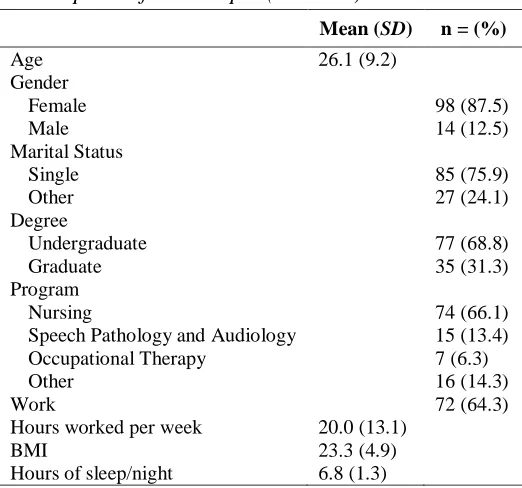
The participants were randomly assigned to the intervention (n = 67) or control (n = 67) group. Of those who enrolled, 13 did not provide any step counts and an additional nine only reported data once. These participants were eliminated from the data analysis, leaving a sample of 112 (see Table 2). There were more participants remaining in the intervention group (n = 58) than in the control group (n = 54). However, the groups were equivalent in age, BMI, employment, and gender.
Table 2
Description of the Sample (N = 112)
Mean (SD) n = (%)
Age 26.1 (9.2)
Gender
Female 98 (87.5)
Male 14 (12.5)
Marital Status
Single 85 (75.9)
Other 27 (24.1)
Degree
Undergraduate 77 (68.8)
Graduate 35 (31.3)
Program
Nursing 74 (66.1)
Speech Pathology and Audiology 15 (13.4) Occupational Therapy 7 (6.3)
Other 16 (14.3)
Work 72 (64.3)
Hours worked per week 20.0 (13.1)
BMI 23.3 (4.9)
Hours of sleep/night 6.8 (1.3)
4 The Open Journal of Occupational Therapy, Vol. 4, Iss. 1 [2016], Art. 6
In addition to demographic variables,
several variables thought to influence the number of steps also were collected. BMI was calculated from self-reported height (in inches) and weight (in pounds). Mean BMI was 23.3 (SD = 4.9), with a range from 16.1 to 44.0. Self-reported hours of sleep ranged from 2.5 to 12 hours nightly, with a mean of 6.8 (SD = 1.3).
Overall Outcomes
The research question asked if there was a difference in the daily number of steps between those students who received positive affective text messages and those who did not. The mean number of steps reported by the participants for the first 2 days of the study before the intervention started (Time 1- baseline) was calculated for all of the participants. The mean number of steps reported by all of the participants also was calculated for the 12 days after the text messages were received by the intervention group (Time 2).
There was no significant difference between the Time 1 and Time 2 step numbers for all of the participants (paired t = 0.216, df = 111, p = .829). When the Time 1 and Time 2 step numbers for the control group and the intervention group were calculated separately, neither group had a statistically significant change in the number of steps (control paired t = -0.013, df = 53, p = .990; intervention paired t = 0.237, df = 57, p = .813).
Inactive Participants
Because some of the participants were very active before the intervention, we recognized that they might not increase their number of steps after the intervention began. However, those who were
the most inactive might be the ones who could benefit most from an intervention, consistent with the findings of Sirriyeh et al. (2010). After
examining a histogram of the baseline step numbers
of all of the participants, we selected those who
were the most inactive and were at least one
standard deviation below the mean (3,000 or fewer steps a day) to examine whether they increased their number of steps during the course of the study. Since these participants (n = 17) were already inactive, increasing their physical activity could be very beneficial. Of this small subgroup, ten were in the intervention group and received the affective text messages. Thirteen of the participants in this subgroup of 17 (76.5%) increased their number of steps while participating in the study. Three of the four participants who did not increase their step numbers were in the control group and did not receive the messages. Thus, only one of the participants who received the intervention in this inactive subgroup did not increase her number of steps. Overall, the inactive subgroup had a
significant increase in steps during the study period (paired t = -3.89, df = 16, p = .001). The mean number of steps rose from a baseline of 1,754.3 (SD = 942.0) to a mean of 5,645.0 (SD = 4,004.3).
Stress, Sleep, and Steps
Because the participants were all students in
rigorous health profession programs, we considered
whether there was a relationship between perceived
stress and the daily number of steps. Because
demands on their time due to educational
requirements might cause students stress, we looked
number of steps. The mean PSS score for this
sample was 15.5 (SD = 6.1). When calculated by Pearson’s r, there was no relationship between the mean number of steps and perceived stress (r = -.02, p = .878).
We also considered whether there was a relationship between sleep and the daily number of steps in the health profession students in this sample. There was a significant and very weak negative correlation between the hours of sleep per night and the baseline number of steps (i.e., before the intervention) (r = -.02, p = .022). This would have no clinical significance.
Health Status Self-Assessment
When the participants completed the initial demographic questionnaire, they were asked
whether they felt they got enough daily physical
activity to be healthy. This provided a subjective
assessment of their physical activity prior to starting
the study. Because these students regularly perform
assessments on clients, we believed it was
appropriate to ask them for an assessment of their
own physical activity.
Two of the 112 participants did not answer
the question. Those who answered the question and
reported that they did not get enough daily exercise
(n = 69) had significantly fewer steps per day before
the intervention began (mean number of steps =
6,121.9; SD = 3,700.9) than those who reported
getting enough exercise (n = 41; mean number of
steps = 8,078.4; SD = 3,736.4) (t = -2.67, df =
83.53, p = .009). This indicates that these health
profession students had a fairly accurate assessment
of their own physical activity, which may be the
first step in improving healthy behaviors.
The participants were asked on the
demographic questionnaire for other indicators of
their health status. Since being overweight or obese
could make physical activity difficult, we calculated
BMI for all of the study participants. The mean
BMI for the entire sample was 23.3 (SD = 4.9);
19.6% (n = 22) of the participants were overweight,
while 8.9% (n = 10) were obese. While some of the
participants did not work, nine (8.0%) of the
participants worked 40 or more hours per week.
Overall, the picture of this sample of health
profession students revealed that some students engaged in unhealthy behaviors, including inactivity, perceived stress, an unhealthy weight, and lack of sleep.
Discussion
Health profession students are valuable to
the future health of our country and health-care
system. Encouraging physical activity in these
students, especially those who are generally
inactive, is a worthy goal. The World Health
Organization (WHO, 2012) recommends 150 min
per week of moderate intensity aerobic activity—
which may include brisk walking, housework, or
dancing—or 75 min per week of vigorous intensity
activity, such as running, competitive sports, or fast
cycling. Physical activity of 10,000 steps per day
has been recommended to achieve this goal
(Albright & Thompson, 2006). Regular physical
activity, defined by WHO as bodily movement that
requires energy expenditure, is necessary to reduce
one’s risk for many diseases, such as Type II
6 The Open Journal of Occupational Therapy, Vol. 4, Iss. 1 [2016], Art. 6
diabetes, metabolic syndrome, cardiovascular
disease, and several forms of cancer, including
colon and breast cancer (Centers for Disease
Control and Prevention [CDC], 2011). Physical
activity also can help control one’s weight and can
even help improve mood and mental health while
strengthening muscles and bones and increasing
longevity (CDC, 2011).
As mentioned previously, the intervention
chosen for this study was modeled after Sirriyeh et
al. (2010). The results of our study, however, did
not match those of Sirriyeh et al. Although the
same time period for the study and similar text
messages were used, we did not find that physical
activity increased with affective text messages in
our larger sample. The significant increase in the
number of daily steps in the subgroup of
participants who, at baseline, were one standard deviation or lower than the mean is a positive finding and this increase in physical activity is similar to the increase reported by Sirriyeh et al.
In previous research, Boyle et al. (2011) reported that students’ physical activity decreased over the course of the semester. This may be because academic demands tend to increase. Final exams and deadlines for papers are likely to place demands on time at the end of the semester. Our study was conducted early in the semester, so it is unknown what our findings might have been from a study conducted later in the semester.
While not the primary goal of this study, we found that our sample of health profession students engaged in some unhealthy lifestyle behaviors. In addition to some of the participants being inactive,
the participants’ nightly sleep ranged from 2.5 hours to 12 hours. Adequate sleep plays an important role
in academic and personal life. Sleep deprivation
can lead to depressive symptoms and poor academic
performance (Brooks, Girgenti, & Mills, 2009;
Buboltz, Brown, & Soper, 2001; Forquer, Camden,
Gabriau, & Johnson, 2008). In addition, more than
one quarter of our sample (n = 32, 28.6%) had a
BMI above 25, putting them at risk for chronic
diseases, such as diabetes and hypertension. Thus,
finding interventions that can address other health
risks that students may have would also be
beneficial.
While the intervention and control groups
did not differ in demographic characteristics, some
of their attributes might explain why some of the
participants have difficulty incorporating healthy
behaviors into their daily lives. For example, most
were women, who generally are the caregivers
when there are children or older family members
needing care. All 17 participants in the inactive
subgroup were women, and 10 of the 17 were
single. This was a lower percentage (58.8%) when
compared to the entire sample (75%), perhaps
indicating that comparatively more in the inactive
group were married and responsible for others in the
home.
Limitations of Study and Outcomes
counting the number of steps taken. Other forms of physical activity, such as swimming and biking, could not be measured. Third, because the
pedometer step counts were self-reported we were
unable to independently verify the counts that the
participants reported. Also, the participants did not
report the length of time they wore the pedometers. Fourth, this study was conducted in Michigan in
late January and early February when physical
activity can be limited by weather. The cold and
snow could have discouraged the participants from walking outside. Also, there was a snow day when
the university was closed during the data collection
period. If the study had been conducted at a
different time, the results might have been different.
Fifth, the length of the study may have been a
limitation. Two weeks might not be long enough to
make a difference in behavior. Finally, only 2 days
of pretest baseline data were collected before
starting the intervention. The pattern of physical
activity each of the participants had prior to
enrolling in the study is unknown; by their own
admission, many of the participants did not get
enough physical exercise.
Suggestions for Future Research
Since using affective text messages is an inexpensive intervention to encourage physical activity, more research is warranted. In the future, personalized and tailored rather than general messages should be used to test their effectiveness, in keeping with the findings of Militello et al. (2012). More research is needed to understand the many factors that influence health behaviors in young health professionals; physical activity is just
one. How to incorporate healthy behaviors into academic preparation is an area of study that should be explored in depth.
Conclusion
The benefits of physical activity may be
helpful for students as they prepare to enter the
health-care system. Lifestyle decisions they make
will affect their future health, productivity, and
effectiveness as health-care professionals. With the
academic, family, and financial demands that
students experience, finding interventions that
encourage healthy behaviors may help them
establish a healthy lifestyle that will benefit them in
the future.
References
Albright, C., & Thompson, D. L. (2006). The effectiveness of walking in preventing
cardiovascular disease in women: A review of the current literature. Journal of Women’s Health, 15(3), 271-280. http://dx.doi.org/10.1089/jwh.2006.15.271 Boyle, J., Mattern, C. O., Lassiter, J. W., & Ritzler, J. A.
(2011). Peer 2 peer: Efficacy of a course-based peer education intervention to increase physical activity among college students. Journal of American College Health, 59(6), 519-529.
http://dx.doi.org/10.1080/07448481.2010.523854 Brooks, P. R., Girgenti, A. A., & Mills, M. J. (2009). Sleep
patterns and symptoms of depression in college students. College Student Journal, 43(2), 464-472. Buboltz, W. C., Brown, F., & Soper, B. (2001). Sleep habits
and patterns of college students: A preliminary study. Journal of American College Health, 50(3), 131-135. http://dx.doi.org/10.1080/07448480109596017 Centers for Disease Control and Prevention (CDC). (2011).
Physical activity and health. Retrieved from
http://www.cdc.gov/physicalactivity/everyone/health/ index.html
Clément, M., Jankowski, L. W., Bouchard, L., Perreault, M., & Lepage, Y. (2002). Health behaviors of nursing students: A longitudinal study. Journal of Nursing Education, 41(6), 257-265.
Cohen, S., Kamarck, T., & Mermelstein, R. (1983). A global measure of perceived stress. Journal of Health and Social Behavior, 24, 385-396.
http://dx.doi.org/10.2307/2136404
8 The Open Journal of Occupational Therapy, Vol. 4, Iss. 1 [2016], Art. 6
Elliot, C. A., Kennedy, C., Morgan, G., Anderson, S. K., & Morris, D. (2012). Undergraduate physical activity and depressive symptoms: A national
study. American Journal of Health Behavior, 36(2), 230-241. http://dx.doi.org/10.5993/AJHB.36.2.8 Fjeldsoe, B. S., Marshall, A. L., & Miller, Y. D. (2009).
Behavior change interventions delivered by mobile telephone short-message service. American Journal of Preventive Medicine, 36(2), 165-173.
http://dx.doi.org/10.1016/j.amepre.2008.09.040 Forquer, L. M., Camden, A. E., Gabriau, K. M., & Johnson, C.
M. (2008). Sleep patterns of college students at a public university. Journal of American College Health, 56(5), 563-565.
http://dx.doi.org/10.3200/JACH.56.5.563-565 Gerber, B. S., Stolley, M. R., Thompson, A. L., Sharp, L. K.,
& Fitzgibbon, M. L. (2009). Mobile phone text messaging to promote healthy behaviors and weight loss maintenance: A feasibility study. Health Informatics Journal, 15(1), 17-25.
http://dx.doi.org/10.1177/1460458208099865 Hawker, C. L. (2012). Physical activity and mental well-being
in student nurses. Nurse Education Today, 32(3), 325-331.
http://dx.doi.org/10.1016/j.nedt.2011.07.013 Kamarudin, K., & Omar-Fauzee, M. S. (2007). Attitudes
toward physical activities among college students. Pakistan Journal of Psychological Research, 22(1-2), 43-54.
Keating, X. D., Guan, J., Piñero, J. C., & Bridges, D. M. (2005). A meta-analysis of college students’ physical activity behaviors. Journal of American College Health, 54(2), 116-126.
http://dx.doi.org/10.3200/JACH.54.2.116-126 Militello, L. K., Kelly, S. A., & Melnyk, B. M. (2012).
Systematic review of text-messaging interventions to promote healthy behaviors in pediatric and
adolescent populations: Implications for clinical practice and research. Worldviews on Evidence-Based Nursing, 9(2), 66-77.
http://dx.doi.org/10.1111/j.1741-6787.2011.00239.x Pawloski, L. R., & Davidson, M. R. (2003). Physical activity
and body composition analysis of female
baccalaureate nursing students. Nurse Education in Practice, 3(3), 155-162.
http://dx.doi.org/10.1016/S1471-5953(02)00109-9 Prestwich, A., Perugini, M., & Hurling, R. (2009). Can the
effects of implementation intentions on exercise be enhanced using text messages? Psychology and Health, 24(6), 677-687.
http://dx.doi.org/10.1080/08870440802040715 Sirriyeh, R., Lawton, R., & Ward, J. (2010). Physical activity
and adolescents: An exploratory randomized
controlled trial investigating the influence of affective and instrumental text messages. British Journal of Health Psychology, 15(4),
825-840. http://dx.doi.org/10.1348/135910710x486889 Stark, M. A.,Manning-Walsh, J., & Vliem, S. (2005). Caring
for self while learning to care for others: A challenge for nursing students. Journal of Nursing Education, 44(6),266-270.
World Health Organization (WHO). (2012). Physical activity. Retrieved from