1794
Dr. Mohammad Knio
1, AFMJ Volume 3 Issue 11 November 2018
Volume 3 Issue 11 November- 2018, (Page No.-1794-1800)
DOI:10.31142/afmj/v3i11.04, I.F. - 4.614
© 2018, AFMJ
The Effective Valorization of Resources for the Economic Development of
Tyre
Dr. Mohammad Knio
1, Mr. Georges Bellos
2 1International University of Beirut, School of Business, Saloumi Road, Lebanon 2Graduate Student at the Lebanese University, Dekwene, Lebanon
Abstract: The main topic of this project is to assess the current situation of tourism in Tyre and to identify and interpret the reasons behind the failure or success of the tourism industry in the area. The main problem that Tyre is facing is the ineffective use of assets, wrong ingrained principles and the weaknesses in human capital. In order to analyze the situation, we conducted a study through a quantitative descriptive approach and used questionnaires and interviews as data collection methods. Results showed that sustainable tourism development in Tyre is contingent due to the presence of all necessary resources (following Mitrut, & Constantin, 2008; Shunnaq et al., 2008). However, Tyre lacks proper administrative management and organization of its scarce resources. All results emphasized on the importance of human capital in the development of any tourist destination.
Introduction
Tourism has become one of the major industries that contribute directly to a country’s GDP. However, just like any other industry, tourism components should be well valorized and conserved for an effective development (e..g. Mitrut, & Constantin, 2008). Valorization of resources literally means “adding value” to raw materials. In tourism, this implies the efficient and effective use of resources (natural, man-built…) for optimal economic benefits as well as minimal negative impacts on environment and society. Tyre is one of the Lebanese cities that are abundant with necessary resources for tourism development (c.f. Mitrut, & Constantin, 2008). However, this can only happen when the factors of developments are studied, managed, organized and used in the proper way.
Research Problem: The success or failure of tourism in Tyre relies greatly on the conception and utilization of tourism players of local resources as well as their attempts for development of tourism activities. The study helps in assessing the current situation of Tyre and in highlighting the weaknesses as well as providing alternatives and ways to make better use of resources.
Research Question: How will the valorization of resources
aid in the development of tourism in Tyre?
Research Aim: The aim of this project is the asses the current situation in Tyre and study the effect of resources whether human or physical in the economic development of the area through tourism practices (c.f. Abu Aliqah, & Al-rfou', 2010). The argiments of Mitrut, & Constantin (2008) will help us here.
Objectives: Besides being my hometown, Tyre has
tremendous potential for a successful tourism dynamism. Because of its rich history and yet wealthy land, Tyre can
inevitably achieve a promising economic development and well-being of the nation (e.g. Mitrut, & Constantin, 2008\; Abu Aliqah, & Al-rfou', (2010).
Literature Review
Tyre And Its Inventory Of Resources
Historically, Tyre1 was an important Phoenician kingdom. It controlled maritime trade, and caused the spreading religion in the ancient world, throughout its history in the Iron Age (Bellos, 2017-2018). The city originally consisted one of two distinct urban centers, Tyre itself, which was on an island just off shore (Surru), and the associated settlement of Ushu2 on the adjacent mainland (Carayon, 2008). It was noted that Alexander the Great connected the island to the mainland by constructing an artificial mole during his siege of the city, demolishing the old city to reuse its cut stone (c.f. Sader, 2016-17). Many civilizations successively settled in Tyre from Phoenicians, Greeks and Romans to Crusaders and Ottoman Turks. The city was inscribed as a world heritage site in 1984 (Grace Homsy, personal communication).
Just as it was located since its foundation in the Early Bronze Age, its location stayed the same today (c.f. Al Sawi., 2018). This Lebanese coastal city acts today as the major district of the south province. It is directly located on
1 Romanized as Sour
2Ushu was an ancient mainland city that supplied the city with water, supplies and burial grounds, as it is common knowledge that scholars believe today it lies underneath Tell Rachidiyeh. (c.f. Bellos, 2017-2018)
3aSource:
1795
Dr. Mohammad Knio
1, AFMJ Volume 3 Issue 11 November 2018
the shore of the Mediterranean Sea. Today, there are stillmany valuable remains mainly from the Roman era. Tyre is the fourth largest city in Lebanon and has the largest sandy beach in the country, known as The Tyre Coast Nature Reserve (Al Sawi., 2018).
The Lebanese economy is based on several industries, the major ones being banking, tourism, food processing, jewelry, cement, textiles, mineral and chemical product, wood and furniture products, and metal fabrication (Al Sawi, 2018). Despite the political crises, tourism was and still is the major source of revenue to Lebanon. The diverse atmosphere and ancient history make Lebanon a paramount destination. Although Lebanon has been facing major issues affecting its economic structure, it is slowly rebuilding itself. Lebanon offers plenty of tourism resources and culture diversity from roman ruins, castles, caves, historical churches and mosques, beaches, natural reserves, nightlife to its spectacular cuisine. Tyre itself has a handful of resources that contribute directly to national tourism product. Based on its tourism potentials, Tyre is not far from
playing a considerable role in supporting the overall Lebanese economy.
On the other flip, banking is one of Lebanon’s most successful industries contributing in more than 6% of the national GDP3a. Today Tyre has 10 banks (Table 1), over an area that doesn’t exceed 4 km², which are mostly active in trade finance, project finance and private banking.
The diverse resources available in Tyre give rise to tourism practices in the area. Tourism-linked resources of Tyre are divided into 2 categories: natural and man-made resources. By tourism-inked we mean resources that directly and indirectly aid in the development of the tourism sector of Tyre (Mitrut, & Constantin, 2008). In general, natural resources occur naturally within the environment, without any human intervention. They include: climate, landscape and fauna and flora (e.g. Grynspan, 2012). Broadly, natural resources consist of the geographical location, topography, landscape, flora and fauna, and weather and climate (c.f. Grynspan, 2012).
Table 1: Banks in Tyre
Bank Branch Province Area & District Phone
Bank Audi s.a.l
Tyre South
Lebanon Tyre
07/345196-7-8
Bank Med s.a.l 07/351251-03/332243
Bank of Beirut s.a.l 07/740051-742149
Bank of Beirut s.a.l 07/348232-3-4
Banque du Liban 07/740471
Banque Libanaise Pour Le Commerce s.a.l 07/343100-1
Banque Libano-Francaise s.a.l 01/791332-03/791332-ext:7212
Banque Misr Liban s.a.l 07/343052-740244
BBAC s.a.l 07/343651-2-03/265505
Blom Bank s.a.l 07/740900-741649-742903
Tyre, so as Lebanon, has a Mediterranean climate characterized by four distinct seasons. Sour is a coastal city making its summer, from June to September, hot and humid with little or no rain, whereas winter, from December to mid-March, is cool and rainy. Autumn and spring are warm and pleasant. Autumn is a transitional season with a gradual lowering of temperature and little rain however spring occurs when the winter rains cause the vegetation to revive. The climate alone is not a determinant of travel but it constitutes an important factor to the visitor and to the local tourism enterprises. From here we get the notification that Tyre with its calm beach and golden shore is a perfect summer vacation as visitors can swim, dive and Jet Ski in the warm and crystal-clear Mediterranean water or simply enjoy the tan. Regarding its biodiversity, Tyre has the lowest3 rate of forest cover in Lebanon along with Nabatieh.
3 See: Perera, 2013.
Its fauna and flora diversity is very limited to be bound to the Tyre Coast Nature Reserve4 (TCNR).
TCNR is the largest sandy beach in Lebanon. Beside encompassing the beautiful stretch of golden sandy shore it is also considered as a haven for many plants, animals, birds and insects. It forms a nesting site for endangered loggerhead and Green Sea Turtles. Tyre Coast Reserve is of great marine importance due to the freshwater estuaries coming from artesian wells of Ras El-Ain and springs out flowing to the sea. The TCNR is divided into three zones: (1) Tourism zone, the beach area. (2) Agricultural and Archeological zone. (3) Conservation zone including Phoenician Springs of Ras El Ain, and a large area for agricultural.
Education is essential for local development; the educational system in Tyre is still in its developing phase as we can see major universities having branches there (c.f. Mitrut, &
1796
Dr. Mohammad Knio
1, AFMJ Volume 3 Issue 11 November 2018
Constantin, 2008). On the down side, not all universitieshold hospitality and tourism studies in their programs. The Lebanese University, Faculty of Tourism and Hospitality Management, was opened in Tyre until 2012. As for vocational schools, they provide the required knowledge for students, which helps them get in the working field faster
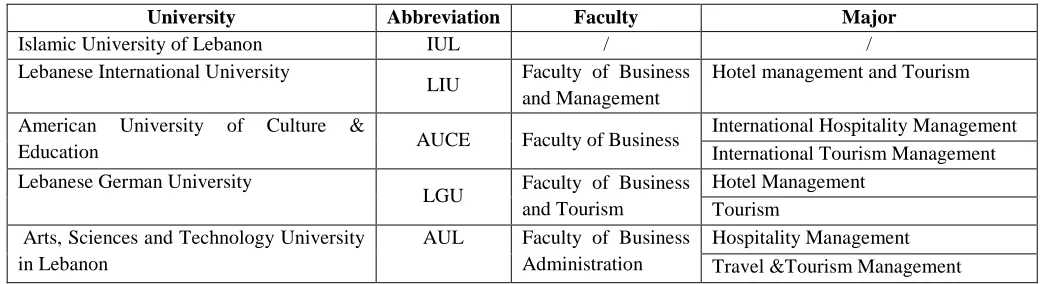
because career schools take less time than universities to complete a specific study. Moreover, those schools emphasize their teaching and training on practical skills to enhance the student ability to perform. Table 2 shows the lost of educational institutions found in tyre.
Table 2: Universities in Tyre
University Abbreviation Faculty Major
Islamic University of Lebanon IUL / /
Lebanese International University
LIU Faculty of Business and Management
Hotel management and Tourism
American University of Culture &
Education AUCE Faculty of Business
International Hospitality Management International Tourism Management Lebanese German University
LGU Faculty of Business and Tourism
Hotel Management Tourism
Arts, Sciences and Technology University in Lebanon
AUL Faculty of Business Administration
Hospitality Management Travel &Tourism Management
Institutions are organizations founded for specific purposes whether religious, educational, professional, or social. Institutions play a vital role in ruling and implementing regulations that facilitate the execution of tourism activities among service providers, hence supporting local tourism development (c.f. Mitrut, & Constantin, 2008).
Tyre is abundant with associations and institutions5, regardless of their degree of effectiveness. Socio-cultural associations in Tyre include Rural Development association and the Cultural Movement of Tyre (e.g. Briedenhann, & Wickens, 2003; Saule, 2004; Mitrut, & Constantin, 2008; Perera, 2013). Because of Tyre’s nature, the presence of environmental associations is inevitable, including the Institution of the Development of people and the Environment and Tyre Coast Nature Reserve (c.f. Briedenhann, & Wickens, 2003; Saule, 2004; Mitrut, & Constantin, 2008). According to Mitrut, & Constantin (2008) and to Abu Aliqah, & Al-rfou', (2010), women empowerment and economic development are closely related. In one direction, development alone can play a major role in driving down inequality between men and women; in the other direction, empowering women may benefit development (e.g. Mitrut, & Constantin, 2008; Chertejian, 2018). That’s why Tyre has women’s associations such as the Mothers Committee and Southern Women’s Beit6 Association.
The superstructure of a destination includes the facilities that have been developed to respond to visitors needs and wants. Superstructure includes: hotels, restaurants, car rental, conference centers, recreation and entertainment
5Human beings form association to fulfill their aims and objectives. Along with this they form some rules,
regulations and procedures which are known as institution. 6House
facilities. Technology and information systems are key components of the superstructure. Technology indicates aircrafts, telecommunication and computer-related matters whereas information is the ability of the destination to study the market, get information about its competitors as well as having the feedback on the satisfaction of visitors. For instance, there is more that six car rental companies in Tyre, the major ones being: Fares Rent A Car, EcoCar and Shoughari Rent A Car. Regarding travel agencies, Tyre has a fair share of this business. It has almost 10 travel agencies that book worlwide.
Finally, concerning the superstructure of Tyre, the last has a group of hotels (Table 3), restaurants (Table 4), travel agencies, car rental and entertainment facilities. Restaurants in Tyre are diversified, and its considered as a dynamic market. This is because, every other time a new restaurant opens. Still, the major ones are found in Table 4. Not to mention the worldwide fast food restaurant chains such as KFC, McDonald’s, PizzaHut, etc. the Table 4 omitted to mention, Restaurant le Phenicien at Tyre’s Harbour.
Table 3: Hotels:
Table 4: Restaurants
1797
Dr. Mohammad Knio
1, AFMJ Volume 3 Issue 11 November 2018
ancient ruins of the city are spread upon 3 areas: (1) TheAl-Mina Site. It includes the Roman Baths, and the Crusader Cathedral. (2) The Al-Bass Site. It includes the monumental stone archway, aqueducts lining an ancient Roman road, a massive Roman and Byzantine necropolis, and the largest and best-preserved Roman hippodrome in the world. Major work was done on this site, and the works of Patricia Bikai (see: Bikai, 1978) and Maria-Eugenia Aubet (See: Aubet et al., 2016) are good starting points to study the Phoenician Necropolii on this site. And (3) the Old City. It includes the Khan al-Ashqar, and the Old Souks. The city alsp has a museum known as the Lebanese Museum for Marine and Wildlife. Every year a festival, Tyre Festival, is held in the city between the months of june and july. The festival celebrates the lebanese culture and features everything from musical performances to poetry and lectures. Usually the festival is held in one of the city’s venues (Roman theatre...). Sadly both, the musem and the festival, no longer exist.
Moreover, the Tomb of Hiram the king of Tyre is one of the historical resources of Tyre, as this king was very important as a mediator in the city’s international relations, as it held ties with other Phoenician cities and with both Kings David and Solomon (c.f. Bellos, 2017-2018). With all that is previously mentioned, it is made clear the importance of resources for not only the development of the tourism industry but for its set off and existence (Mitrut, & Constantin, 2008). The significance of resources rises as the dependency of the country’s economy on tourism dynamism.
Theories of Valorization of Local Resources
The tourism industry has a vested interest in protecting the natural and cultural resources that are the core of its business (Perera, 2013). It contributes to the development which is economically, ecologically and socially sustainable, despite the impact on natural resources and environment than most other industries (c.f. Mitrut, & Constantin, 2008; Shunnaq et al., 2008; Grynspan, 2012). It is also based on the enjoyment and appreciation of local culture, built heritage, and natural environment, as such that the industry has a direct and powerful motivation to protect these assets (c.f. Perera, 2013). According to Scholars like Mitrut, & Constantin (2008), tourism can play a positive part in increasing consumer commitment to sustainable development principles. This mainly provides an economic incentive to conserve natural environments and habitats which might otherwise be allocated to more environmentally damaging land uses, thereby, helping to maintain bio-diversity7.
7
Source: World Travel & Tourism Council and International Hotel & Restaurant Association Report
8aSee Rebecca Grynspan’s report published at the UN Headqaurters in NC in September 2012.
Many Tourism-dependent countries have based their tourism activities on a commitment to minimize impact on the environment, conserve natural resources, engage in active and passive environmental education of their guests, and contribute to the local economy (Grynspan, 2012). This can be applied through: the use of new technology, policies, waste management, environmental education, energy and water conservation, and support for local communities and culture.
All resource preservation options have been taken into consideration due to the major advantages of such an industry. According to Mitrut, & Constantin (2008), tourism can be superior to other industries due to: job creation (direct and indirect jobs), rise in standards of living, contribution to sustainable development (e.g. Shunnaq et L., 2008), it tends to have low start-up costs, feasible in a wide range of areas and regions, continually growing sector, and the industry is aware of the need to protect the resources on which it is based (local culture, built and natural environment) and it is committed to these resources’ preservation and enhancement.
Moreover, properly managed tourism should incorporate the following elements: (1) Conservation of biodiversity, (2) Sustaining the well-being of local people, (3) Interpretation/learning experience, (4) Conservation of non-renewable resources, and (5) Focus on local participation, ownership and business opportunities.
Al Sawi (2018) considers that many governments are realizing that tourism can only be beneficial when the ecological, cultural and economic goals are held in balance (c.f. Perera, 2013). So when a country pursues a coordinated tourism effort it can enhance the diversification of local economies. Tourism has been identified as a catalyst to stimulate economic growth, increase the viability of underdeveloped regions and improve the standard of living of local communities.
1798
Dr. Mohammad Knio
1, AFMJ Volume 3 Issue 11 November 2018
Following Mitrut, & Constantin (2008), Shunnaq et al.(2008) and Grynspan (2012), it is believed that “natural resources necessarily play a central role in promoting sustainable development”. This is understood as "meeting the needs of this generation – without compromising the ability of future generations to meet theirs”. For this to be true countries need to use and manage the limited natural resources available to them – efficiently, judiciously, and responsibly.” said Rebeca Grynspan who is an Associate Administrator of UNDP8a. Nevertheless, throughout the world, developing countries, with a rich resource base of pristine natural and cultural treasures, hold significant comparative advantage in their potential to attract tourists in search of authentic new experiences. (Grynspan, 2012) Many studies where made not only on the importance of tourism but also on how proper management of resources in an effective and efficient manner, can aid in the development of the local community (e.g. Mitrut, & Constantin, 2008). In this context, and following Mitrut, & Constantin (2008), our study sheds the light on the impact of an efficient valorization of coastal resources on the development (social and economic) of Tyre.
Finally, the valorization of Resources and Local Development involves a lot of countries rely on tourism to develop their economy whereas others depend on other sectors to enhance their economy (e.g. Mitrut, & Constantin, 2008). Tourism has become fundamental because tourist expenditure is being injected directly into the tourism
business and thus developing the economy. At the same time, the country can share its culture and authenticity with the visitors. One of the main regions that depend on coastal tourism is Antalya (c.f. Al Sawi, 2018) So, in order to determine the factors that may lead to tourism development in Tyre, based on coastal tourism, the best case to refer to in the literature to is the case of Antalya, the largest coastal region of Turkey on the Mediterranean that shares several characteristics with Tyre (c.f. Mitrut, & Constantin, 2008).
Research Methodology
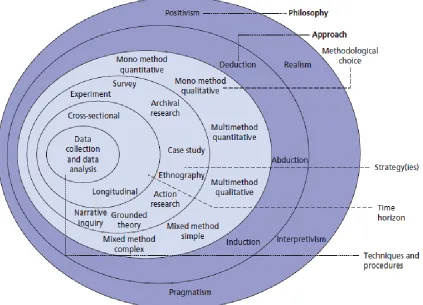
Using the onion research, presented by Saunders et al. (2003 p. 83), we decided to design a survey that was used to gather data about the attitudes of the stakeholders, through unstructured questionnaires as our Data collection method. Therefore, we oppetec for a qualitative study following Saunders onion (Figure 1). This was following arguments from Mitrut, & Constantin (2008) and Li (2013), based on how local authorities and business owners, reacted towards the development of tourism and the usage of local resources. Because we believe that engaging the work of both groups is essential for the success of tourism development in Tyre. Individual interviews and questionnaires were administrated to the: (1) Union of Tyre Region Municipalities, (2) Tyre Municipality, (3) Restaurants, (4) Hotels, and (5) Travel Agencies.
1799
Dr. Mohammad Knio
1, AFMJ Volume 3 Issue 11 November 2018
Data collection was conducted during the month of Aprilfrom owners, managers and employees. Data collection was based on two stages: a delivery and a recollection one. If a face-to-face interview was done, we noted down what was being said. This is to minimize the time needed for data collection. The distribution stage was based on the community’s location and the notable existence of tourism in Tyre region. (Saunders et al., 2003)
Among the 25 distributed questionnaires, 23 were recollected with a response rate of 68%8. Out of the 23, 5 questionnaires were returned incomplete, hence invalid for the study. Of the 25 questionnaires, 2 were lost and not presented to us while recollecting the data. It must be noted that the period in which the distribution and recollection occurred, was during the off-peak season. (Saunders et al., 2003)
Items used in the questionnaire to assess the perception of local patrimony by local authorities and the private sector are derived from related tourism literature (online articles and universities courses on sustainability and planning). The questionnaire is composed of two parts: the first part contains personal information about the person filling the questionnaire; the second part contains statements regarding the perception of people to tourism in Tyre and the extent of their knowledge and awareness of the importance of the sector to the local economy and how informed they are about tourism practices of others in the same region. (Saunders et al., 2003)
In total the questionnaire contained 24 questions or statements. The first part, personal information, contains type of business, occupation, gender, age and level of education. Whereas the second part of the questionnaire is composed mostly of open-ended questions. (Saunders et al., 2003)
To recapitulate9, this research aims to investigate how tourism stakeholders perceive tourism in Tyre and their attitude towards further local development (c.f. Mitrut, & Constantin, 2008; Li, 2013). Moreover, this research helps in identifying whether resources are optimally used and valorized in favor of tourism practices and local development (Mitrut, & Constantin, 2008). So, in order to reach our aims, we first obtained a profile identifying the stakeholders of tourism development in the region (e.g. Mitrut, & Constantin, 2008; Li, 2013), and then made visits to complete the questionnaires, and conduct interviews when needed following the data collection methods listed in Saunders et al. (2003).
8The questionnaire had 19 questions and some interviewees were not informed enough to answer about 6 of them. 9Process used to collect information and data.
10a
Source: Shunnaq et al., 2008.
Findings and Results
The analysis of data is a major step after completing the questionnaire, utilizing techniques liate in Saunders et al. (2003 P. 83). This allows for the inspection, transformation and modeling of data with the goal of discovering useful information, suggesting conclusions and supporting decision making. Data analysis has multiple approaches and techniques for variety of purposes. But, what comes to mind when most interviewees think of Tyre is not a single one. They believe that Tyre is remarkable for its culture, heritage, cuisine, entertainment, beach and its religious importance (c.f. Perera, 2013).
Accurate statistics on the profile of tourist is highly important for tourism success. Knowing tourists interested in your country, helps you target this market and increase tourism in the desired area. Unfortunately, we lack statistics in most areas of Lebanon. There is no study to identify tourists to Tyre. And most businesses hold no records. Even the municipality has a vague overview on who comes to Tyre. But what they know for granted is that Tyre has something for everyone. Moreover, the presence of the UNIFIL, as interviewees pointed out, is of great benefit to the area; where most UNIFIL members get their family members for vacation in Lebanon and Tyre precisely. (c.f. Saunders et al., 2003)
Most business owners and managers blamed the municipality for the current situation of tourism in Tyre, regardless of whether they have a positive or negative assessment of the tourism industry in Tyre (e.g. Horst, 2009). Respondents claimed that the municipality lacks the power, policies and operational plan to conduct the most suitable tourism development plan (Mitrut, & Constantin, 2008). However Mr. Mhanna stressed on the future plans of Tyre towards a more sustainable approach with the Territorial Network (TNET) for capacity building and development. (Saunders et al., 2003; Mitrut, & Constantin, 2008 ; Shunnaq et al., 2008)
And it is directed mainly for local development and employment. Some of the plans mentioned are: (1) Rejuvenation of Shamea Castle with Italian funds. And, (2) the employment of Kuwaiti funds for the building a mall in Shamea area for revitalizing the area through employment and increase number of visitors: (1) Building a heritage restaurant near Borak Ras El Ein. (2) Students trail in Deir Kefa, where there is a Roman Castle and wells. And, (3) training projects for tourist guides (c.f. Saunders et al., 2003; Perera, 2013)
1800
Dr. Mohammad Knio
1, AFMJ Volume 3 Issue 11 November 2018
(3) Political instability. (4) Unproductive relation with theMinistry of Tourism. (5) Absence of resident’s awareness. (6) Insufficient personal initiative. (7) Absence of the spirit of cooperation among citizens. Our interview with the mayor ended with him hoping for a better future for Tyre and Lebanon as a whole and wishing that we be the hope of this country. (Saunders et al., 2003)
Conclusions and Recommendations
The effective and efficient use of resources for the well being of the society and the increasing number of visitors relies greatly on developing a strategy. The development of a strategic tourism plan10a for a destination is an articulation of the strategic priorities and direction that have been identified by stakeholders for the planning, development, management and marketing of a region (Mitrut, & Constantin, 2008; Li, 2013). Strategic Plans for destinations have been called Destination Management Plans, Tourism Action Plans or Sustainable Tourism Plans in different regions across the world (c.f. Shunnaq et al., 2008).
A strategic plan for destination management is essential for the long-term success and sustainability of a destination. Strategic destination planning is a cyclical process that requires ongoing monitoring and review and the flexibility to adapt to changing conditions. The lack of a strategic plan is a major issue concerning the tourism industry in Lebanon and precisely in Tyre, resulting in loss of resources, cash flow issues and unproductive employees. Still, a lot can be done with what is at hand. The coast development is a must. Tyre can not only rely on the summer tents regardless of the fact that they ensure income for over 300 families and employment (Mitrut, & Constantin, 2008).
The coast has potential for sustainable economic growth. However, some measures should be taken: (1) Tents should be organized and managed properly for the ease access and comfort of visitors. (2) Installing instructions all along the shore. (3) Recruit lifeguards. (4) Following Perera (2013), to fine people who litter, and damage natural or cultural sites. (5) Specify an area along the shore for people who do not want to stay in tents. (6) Provide water activities for a small fee. (8) Develop water shows and schools for teaching water sports.
Regarding the unutilized non purpose built attractions (ruins); local authorities should fund planning for their optimal use for generating traffic and income to the area. A trail can be developed linking all the historical and cultural attractions of Tyre (Perera, 2013). School and college groups as well as visiting families can be a suitable market for wanting trails. Signboards and directions should be clear enough to let tourist and locals wander on their own to explore Tyre. Moreover shuttle services can be adapted to aid not only in transporting tourist but also for minimizing the negative impacts on the environment.
Marketing is a must in a successful tourist destination. The tourism marketing is the application of the principles and techniques of marketing to the general field of tourism. Marketing is a part of the strategic plan of a destination, it includes: market research, identifying target market, and developing the marketing mix. Marketing in Tyre is kept minimal with its advantages being ignored. Effective marketing keeps the destination on the “places to go to” list. And the local authorities are not making use of this, and again funding is the main obstacle.
A successful destination management plan is illustrated here-under the following chart (Figure 2):
Seasonality has become one of the features of the tourism industry. It refers to the existence of unevenness and fluctuation of visitor numbers during the course of the year. Seasonality10 can be primarily caused by natural factors or
10
Source:http://www.academia.edu/8670280/SEASONALIT Y_IN_TOURISM_causes_implications_and_strategies
institutional factors. And Tyre is affected by both. However, any successful tourist destination plan should aim for minimizing the undesirable effects of seasonality. Following the arguments of Ping (2013), winter is the low season of Tyre, where stakeholders and decision makers should target domestic visitors and follow the price differential strategy utilizing sales promotions or other marketing strategies.
Destination Management
Planning
Analyze the global
operating environment
Identify strategies that
contribute in achieving
the destination’s vision
Define the destination’s
vision
Analyze the current
situation in the
destination
Implement the strategy
Monitor and evaluate
1800
Dr. Mohammad Knio
1, AFMJ Volume 3 Issue 11 November 2018
Awareness is still a major issue affecting the success oftourism in an area. When people are unaware of the benefits of something, they will do absolutely nothing to keep the good things flowing. Most of the results found in the questionnaire and based on personal observations; testify to lack of awareness and poor understanding of the importance of tourism and the things that contribute to a successful tourism sector. This will lead to undesirable impacts on the environment and on the society.
According to Perera (2013), building cultural awareness is the cornerstone for an effective tourism industry and it can be attained by improving education, public awareness and involvement through: (1) Encouraging the involvement of local community, schools and other stakeholders in education and training programs, as Ping Li suggested. (2) Provide visitors with information about the area, and the importance of conservation. (3) The sustainable use of resources (Shunnaq et al., 2008), enforced by rules and regulations. (4) Development of educational centers and events (c.f. Mitrut, & Constantin, 2008).
By far, we came up with the outcome that the resources of Tyre are ineffectively used, managed, marketed and sustained. This is not only due to the presence of ignorant and unaware people of sustainable tourism development, but also for the persistence of unproductive and inefficient laws and regulations (Mitrut, & Constantin, 2008; Shunnaq et al., 2008; Al Sawi, 2018).
References
1. Abu Aliqah, K. & Al-rfou', A. (2010). The Role of Tourism Sector on Economic Development in Jordan during the Period (1990-2008).
2. Al Sawi, M., 2018. The Effective Valorization of Resources for the Economic Development of Tyre. Unpublished Report presented at The Lebanese International university, Spr. 2018.
3. Aubet, M.-E., Francisco J. Núñez, F.J., & Trellisó, L., 2016. “Excavations in Tyre 1997–2015. Results and Perspectives”. Berytus, LVI, p. 3-14.
4. Bellos, G.S.G., (2017-2018). Évolution culturelle du peuplement de l'âge du Fer dans la Phénicie du Nord. Unpublished MA Thesis Submitted to the Lebanese University.
5. Bikai, P.-M., 1978. The Pottery of Tyre. Warminster: Aris & Phillips.
6. Briedenhann, J. & Wickens, E. (2003). Tourism routes as a tool for the economic development of rural areas—vibrant hope or impossible dream? Tourism Management, 25.
7. Chertijian, R., 2018. Gender Discrimination in Leadership Style. Unpublished MBA Thesis submitted to the Lebanese International University, on June 2018.
8. Grynspan, R. (2012). The Role of Natural Resources in promoting Sustainable Development, presented on the occasion of the Opening of the 67th UN General Assembly side event on “The
Role of Natural Resources in Promoting
Sustainable Development”, UN Headquarters, New York, 28 September 2012. Retrieved from
http://www.ar.undp.org/
9. Horst, T. (2009). Tourism and Economic Development in Mountain Regions an Economic Assessment. Annals of Faculty of Economics. 4. 858-860.
10. Li, P. (2013). Comparisons of stakeholders’ perceptions and attitudes of tourism impact in Mt Qiyun, Anhui Province, China. (Thesis, Doctor of Philosophy (PhD)). University of Waikato, Hamilton, New Zealand.
11. Mitrut, C & Constantin, D. (2008). Quantitative
and Qualitative Dimensions of Tourism
contribution to Regional Development in Romania. The Case of Cultural Tourism presented at the 48th Congress of the European Regional Science Association, University of Liverpool, U.K. 27 – 31 August 2008.
12. Perera, K. (2013). The Role of Museums in Cultural and Heritage Tourism for Sustainable Economy in
Developing Countries. Presented at the
International Conference on Asian Art, Culture and Heritage, August 2013.
13. Tichaawa, T & Mhlanga, O. (2015). Residents' perceptions towards the impacts of tourism development: the case of Victoria Falls, Zimbabwe from http://www.ajhtl.com/uploads
14. Shunnaq, M., Schwab, W. A., & Reid, M. F. (2008). Community development using a sustainable tourism strategy: a case study of the Jordan River Valley tourist way. International Journal of Tourism Research, 10(1), 1-14.
15. Saule, M. (2004). Rural Tourism as a tool for Local Development, Diagnosis of the French area of Haute-Correze.