Utilisation of Waste Plastic in Manufacturing of
Paver Blocks
S. Arjun Kumar S. Ganesh Babu
UG Student UG Student
Department of Civil Engineering Department of Civil Engineering
KPR Institute of Engineering and Technology, Coimbatore, Tamil Nadu, India
KPR Institute of Engineering and Technology, Coimbatore, Tamil Nadu, India
B. Gowri Kumar S. Afrid Sukkur
UG Student UG Student
Department of Civil Engineering Department of Civil Engineering
KPR Institute of Engineering and Technology, Coimbatore, Tamil Nadu, India
KPR Institute of Engineering and Technology, Coimbatore, Tamil Nadu, India
K. S. Elango Assistant Professor Department of Civil Engineering
KPR Institute of Engineering and Technology, Coimbatore, Tamil Nadu, India
Abstract
Due to population growth, usages of plastic materials are increasing day by day, most of the plastic materials are dumped as landfill and they are not effectively reused in most of the applications. Numerous researches in most were carried out using waste rubber in pavement construction. So the aim of this project is to replace cement with waste plastic in paver block and to reduce the cost of paver block in compared to that of conventional concrete paver block at present nearly 56 lakhs tons of waste plastic is produced in India per year. The degradation rate of plastic waste is also very slow process. And in addition with waste plastic waste lime sludge from paper industry which replaces fine aggregate. In this project we have used waste plastic and lime sludge in different proportions with sand. The paver bocks were prepared and tested and the results were discussed elaborately.
Keywords: Plastics, Compressive strength, Leachate, Oven Test, Sludge
_______________________________________________________________________________________________________
I. INTRODUCTION
Used Plastic bags, pieces of plastic sheets and bottles of diverse sizes, colors and textures are found flying around freely, scattered In the streets, swimming in the gutters, posing a serious environmental threat. These keep the environment dirty and cause blockages to our sewer system. Several attempts were made to discourage plastic bags and other plastic products but yield no result due to its Versatility in daily use. Recycle process and reused of plastic waste products amount for vast manpower and huge processing cost resultantly very small amount of plastic waste is recycled and used and rest going into landfills, incinerators and dumps. Now the question arise how to effectively minimize the impact of plastic waste with minimum cost many researchers have tried for the utilization of plastic waste and few have suggested its utilization in concrete in many forms.
The utilization of waste in the construction industry has two glaring dividends, one, environmental impact is addressed by disposal of the waste and second, the economic impact and this waste has the edge of being available large quantity, everywhere and at low value. Keeping in view the disposal issues of plastic waste, its utility in concrete is studied and experimental by various researches. They have worked on the use of pulverized plastic in concrete as partial replacement of cement as binding material. Testing was conducted on the sample casted by using waste plastic and lime sludge in the laboratory to study the variation of paver block property from conventional paver block.
and 1.0%. The suitability of recycled plastic as partial replacement to coarse are coarse aggregate in concrete mix to study effect on compressive strength, modulus of elasticity, Split tensile strength and flexural strength properties . Different concrete mix were prepared with varying proportions (0%, 20%, 30% & 40%) of recycle plastic aggregate obtained by heat treatment of plastic waste (160-200 centigrade) in plastic granular recycling machine.
II. MATERIALS AND METHODS
Materials
Waste Plastic:
Plastic waste used in making paver block was collected from the surrounding shops (Figure 1). It includes plastic bags. The plastic bag used is about 50 microns. The basic properties are provided below which are collected through journal papers.
Fig. 1: Waste plastics
Lime Sludge:
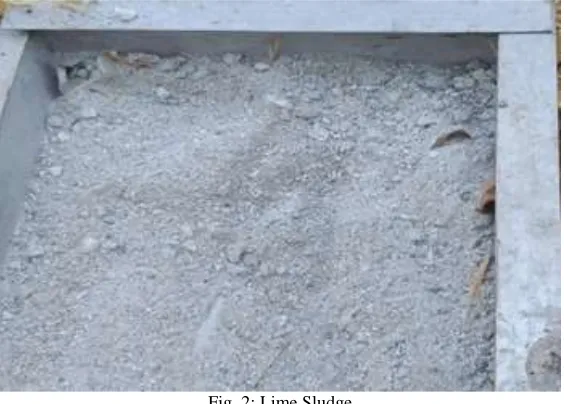
The lime sludge used in the present study was collected from SESHAYEE Paper Mill, Pallipalayam, Erode (Figure 2). Chemical composition and engineering properties of 20 samples of lime sludge, produced from the lime calcination process, were determined in order to evaluate its potential applications as an engineering construction material.
Fig. 2: Lime Sludge
Manufactured Sand:
Manufactured sand (M-Sand) is popularly known by several names such as Crushed sand, Rock sand, Green sand, UltraMod Sand, Robo sand, Poabs sand, Barmac sand, Pozzolana sand etc. IS 383-1970 (Reaffirmed 2007) recognizes manufacture sand as Crushed Stone Sand’. M-Sand of Specific gravity 2.64 is used.
Mix Design
Table - 1 Mix Proportion
MIX ID
WASTE PLASTIC (Kg/m3)
FINE AGGREGATE
% of replacement Lime Sludge
(kg\m3) % of replacement
M sand (kg\m3)
M0 779.72 0 0 100 1559.45
M1 779.72 20 311.89 80 1247.56
M2 779.72 40 623.78 60 935.67
M3 779.72 60 935.67 40 623.78
M4 779.72 80 1247.56 20 311.89
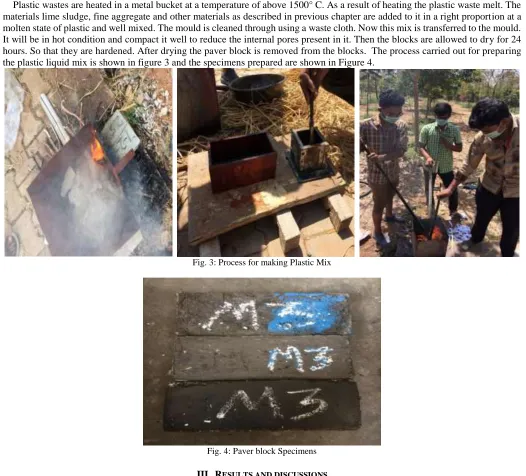
Plastic wastes are heated in a metal bucket at a temperature of above 1500° C. As a result of heating the plastic waste melt. The materials lime sludge, fine aggregate and other materials as described in previous chapter are added to it in a right proportion at a molten state of plastic and well mixed. The mould is cleaned through using a waste cloth. Now this mix is transferred to the mould. It will be in hot condition and compact it well to reduce the internal pores present in it. Then the blocks are allowed to dry for 24 hours. So that they are hardened. After drying the paver block is removed from the blocks. The process carried out for preparing the plastic liquid mix is shown in figure 3 and the specimens prepared are shown in Figure 4.
Fig. 3: Process for making Plastic Mix
Fig. 4: Paver block Specimens
III. RESULTS AND DISCUSSIONS
Mechanical Properties
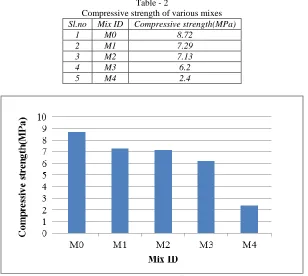
Compressive Strength Test
Table - 2
Compressive strength of various mixes Sl.no Mix ID Compressive strength(MPa)
1 M0 8.72
2 M1 7.29
3 M2 7.13
4 M3 6.2
5 M4 2.4
Fig. 5: Compressive strength of various mixes
Water Absorption Test
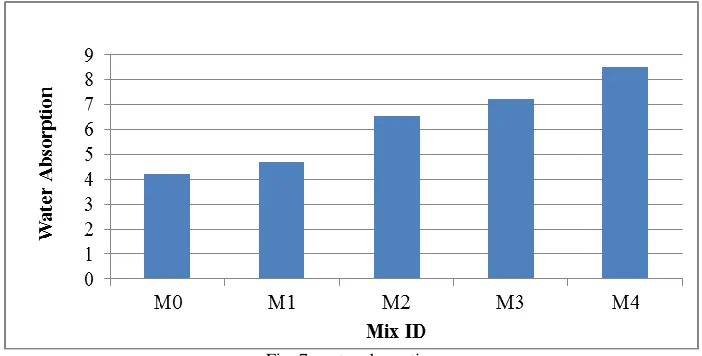
In this test first paver block block is weighed in dry condition and they are immersed in water for 24 hours. After that they are taken out from water and wiped out with cloth. Then the difference between dry and wet paver block percentage are calculated. Test conducted is shown in Figure 6. Table 3 represents the water absorption percentage of different mixes.
Fig. 6: Water Absorption Test
Table – 3
Water Absorption of various mixes Sl.no Mix id Water absorption (%)
1 M0 4.2
2 M1 4.7
3 M2 6.5
4 M3 7.2
5 M4 8.5
Fig. 7: water absorption
Leachate Test
A leachate is any liquid that, in the course of passing through matter, extracts soluble or suspended solids, or any other component of the material through which it has passed. Leachate is a widely used term in the environmental sciences where it has the specific meaning of a liquid that has dissolved or entrained environmentally harmful substances that may then enter the environment. It is most commonly used in the context of land-filling of industrial waste. Table 4 represents Leachate test values of various mixes.
Table - 4
Leachate Test of various mixes
Mix ID Ca Ba K Na μg/litre
M0 1.4 0.4 0.1 1057
M1 2.7 1.2 0.2 2523
M2 3.1 1.4 0.3 2845
M3 2.9 1.3 0.24 3074
M4 3.2 1.5 0.4 3865
Oven Test
As the paver block is made of plastic we need to know its melting point hence oven test is performed. The paver block is kept in oven for 2 hours in oven and after 2 hours its condition is verified.
Table - 5 Oven Test of various mixes
SPECIMEN TEMPERATURE (0C) REMARKS
M0 50 100 150 No change No change Melts M1 50 100 150 No change No change Melts M2 50 100 150 No change No change Melts M3 50 100 150 No change No change Melts M4 50 100 150 No change No change Melts
IV. CONCLUSION
1) The properties such as compressive strength, water absorption, leachate test and oven tests were made for paver blocks and the following conclusions may be drawn,
2) From the experimental investigation, it has been observed that paver blocks made by using waste plastics shows enhanced compressive strength at the age of 7 days.
3) The plastic paver block possesses more advantages which include cost efficiency, removal of waste products thus abolishing the land requirement problem for dumping plastic.
5) This method is suitable for the country which has difficult to dispose recycled the plastic waste. 6) The manufacturing cost is reduced due to utilization of waste plastic and lime sludge.
7) Though the compressive strength is low when compared to the conventional concrete paver block, it can be used in gardens, pedestrian path and cycle way. Henceforth, it can be used in less traffic and pathways.
REFERENCES
[1] Broiovsky J., MatéjkaMartinec P., YoucefGhernouti., “Concrete Interlocking Paving Blocks Compression Strength Determination Using Non-Destructive Methods”, The 8th International Conference of the Slovenian Society for Non-Destructive Testing, ISSN: 00088846, September 2005, 91-97.
[2] Ganjian E., Jalull G., Sadeghi-Pouya., RaghatateAtul., “Reducing Cement Contents of Paving Blocks by Using Mineral Waste and by-Product Materials”, Journal of Materials in Civil Engineering, volume 27 Article number 04014106, January 2015.
[3] Kashiyani B.K., Pitroda J., Shah B., Praveen Mathew et., “Effect on Compressive Strength and Water Absorption of Interlocking Paver Block by Addition of Polypropylene Fiber”, Journal of International Academic Research for Multidisciplinary, ISSN 2320-5083, Volume 1, Issue 3, April 2013, 66-77. [4] M. Ravikumar C., Anilkumar, H. Prashanth M. D., Reddy Venkat, R.L Ramesh, “Experimental Studies on Iron Ore Tailing based Interlocking Paver”,
International Journal of Earth Sciences and Engineering, ISSN 0974-5904, , Volume 05, No. 03, june 2012, 501-504.
[5] NavyaG.,j V Rao J., Zainab z. Ismail., “Influences of polyester fiber on concrete paver blocks”, IOSR Journal of Mechanical and Civil Engineering , e-ISSN: 22784684, p-e-ISSN: 2320-334X, Volume 11, Issue 4, Jul Aug. 2014, 70-75.
[6] Raval A.D., Patel I., Pitroda J., Suganthy p., “Ceramic Waste Effective Replacement Of Cement For Establishing Sustainable Concrete”, International Journal of Engineering T rends and Technology, ISSN: 2231-5381, Volume 4 Issue 6, June 2013, 2324-2329.
[7] Sarkar H., Halder P.C., Ryntathiang T.L., Khileshsarwe., “Behavior of Interlocking Concrete Block Pavement over Stone Dust Grouted Subbase”,International Journal of Advanced Structures and Geotechnical Engineering, ISSN 2319-5347, Vol. 03, No. 01, January 2014 44-48 .
[8] Sharma S., Mall R., Raza K., Bhogayata., “Effect of waste brick kiln dust with partial replacement of cement with adding super plasticizer in construction of Paver Blocks”, International Journal of Science, Engineering and Technology Research, ISSN: 2278 ~ 7798, Volume 3, Issue 9, September 2014, 2261-2266. [9] Vaz Aaron Darius,D’SouzaDonal Nixon, KaliveerNoothan, Satish K.T Amar S.M., M.Elzafraney., “Geopolymer Paver Blocks”, Proc. Of Int. Conf. On
Advances in Civil Engineering ISBN no.978-1-63248-065-1, 2012,173-178.
[10] Yeole R C., Varma M. B., Pramod S. Patil., “Comparison of Mix Designs of Paver Blocks using Waste Rounded Steel Aggregates and Rubber Pa ”, International Journal of Emerging Technology and Advanced Engineering, ISSN 2250-2459, Volume 4, lsuue 10 , Octomber 2014, 523-527.