R E S E A R C H
Open Access
Application driven, AMC-based cross-layer
optimization for video service over LTE
Yongil Kwon
*, Doug Young Suh, Sung Chun Kim and Een Kee Hong
Abstract
In this paper, we propose a cross-layer optimization scheme in which the application layer controls the medium access network (MAC) and physical (PHY) layers in long-term evolution (LTE, from 3rd generation partnership project [3GPP] release 8) to maximize the quality of video streaming services. We demonstrate how to optimize quality using the equi-signal-to-noise ratio (equi-SNR) from the lower layer and the equi-peak signal-to-noise ratio (equi-PSNR) from the upper layer in the two-dimensional domain, consisting of a bit rate (R) and packet loss ratio (PLR). The proposed approach outperforms the conventional approach, which operates regardless of the
application-specific requirements for quality of service (QoS) and quality of experience (QoE) in PHY.
Keywords:SVC, AMC, CLO, QoS, LTE
1. Introduction
User demand for mobile multimedia services has exploded. However, current mobile multimedia services have weaknesses such as fading, congestion, insufficient resources, and time-varying conditions. These problems need to be addressed. Studies on improving (QoS) can be classified into three categories: [1]. real-time video service optimization based on wireless channel states; [2]. wireless resource allocation based on video charac-teristics; and [3] a hybrid of categories [1] and [2].
The authors of references [1-3] proposed scheduling and allocation methods using the available mechanisms and parameters in the medium access network (MAC)/ physical (PHY) layers of wireless networks. In addition, Fang [4] and Ha [5] improved the service quality by considering packet loss using cross-layer optimization (CLO) between whole layers.
Video is made up of packets with different priorities. Average video quality could be adaptively improved by protecting the more important packets from error and filtering out less important packets at a low bit rate (R). The cross-layer methods mentioned above adapt the video layer to already-determined MAC/PHY conditions. Even under the same mobile conditions, however, var-ious combinations of (R, packet loss ratio [PLR]) are possible based on the choice of modulation and
channel-coding scheme. If the target block error rate (BLER) is set too low, the available bit rate will also be low. Since most mobile channels have fixed transmission parameters suitable for non-real-time data services, it is important that MAC/PHY parameters are chosen differ-ently, based on the service requirements of real-time video services.
Haghani [6] suggested a method of improving video quality by classifying the significance of frames in a video stream and transmitting them as packets of differ-ent priorities that correspond to those in IEEE 802.16 QoS classes. In referenced paper [7], a method that allo-cates bit rate by predicting the quality of the video after recovery from packet losses along the wireless channel was suggested. This method searches for the optimal point yielding the best video quality using various rate control methods, such as fine granular scalability (FGS) or H.264/MPEG-4 scalable video coding (SVC). FGS guarantees apropos degradation, but its rate-distortion
(R-D) performance is so poor that it has become
obsolete.
We focused on a third method for improving QoS. At a signal-to-noise ratio (SNR) measured in the lower layers, all possible combinations of (R, PLR) for all pos-sible modulation and coding scheme (MCS) levels yield the equi-SNR graph. The upper layer (including the video layer and transport layer) provides equi-PSNR graphs, which are also sets of (R, PLR) combinations, * Correspondence: [email protected]
Kyung-Hee University, Suwon, Korea
and result in the same PSNR. An optimal point can be found at the highest PSNR that lies on the equi-SNR graph of the current SNR. The optimal operation point is determined to be its nearest MCS point along the selected equi-SNR graph. This enables the highest PSNR achievable for a given set of mobile channel conditions. Since both equi-SNR and equi-PSNR graphs are inde-pendently prepared, the computational burden can be dramatically reduced.
Section 2 describes related background technologies in LTE and SVC. Section 3 introduces the proposed appli-cation-driven adaptive modulation and coding (AMC) scheme. The performance of the proposed method is demonstrated using experiments in Section 4. Section 5 concludes this paper.
2. Background
Following CLO, in this paper, the lower layers are based on 3GPP LTE [8], which includes AMC and hybrid-auto repeat request (H-ARQ), while the upper layers use for-ward error correction (FEC) and H.264/MPEG-4 SVC video streams.
2.1 MAC and PHY layers in 3GPP LTE
Available bit rate (R) and BLER pb are determined according to the SNR between the node base transceiver station (Node B) and the user equipment (UE). Bit rate in the PHY layer is determined by an MCS including H-ARQ.
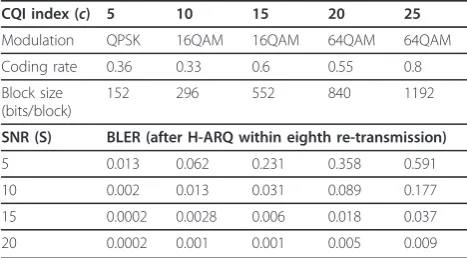
The symbol rates of quadrature phase shift keying (QPSK), 16 quadrature amplitude modulation (QAM), and 64QAM are 2:4:6, and their symbol block sizes are 480, 960, and 1440 bits, respectively. Coding rates range from 0.3 to 0.8. A combination of a modulation mode and a coding rate is called a MCS. The MCS level is selected adaptively according to a predefined target BLER and time-varying channel quality information (CQI), particularly SNR [8]. As we can see in Table 1 there are five CQI levels. Block sizemcis determined by CQI levelc.
A block is the minimum transmission unit of orthogo-nal frequency division multiplexing (OFDM), while a packet is the minimum transmission unit in the trans-port layer. If the size of a packet is larger than that of a block, the packet may be segmented into blocks in the transmitter and assembled in the receiver. If the size of a packet is M, it is divided into n= [(M +mc - 1)/mc] blocks. As suggested in [1], a damaged block and its corresponding packet are assumed to be discarded, so that the PLR of the PHY layer is
PPHY,c(S,N)= 1−(1−Pb(S,c))n,
where Pb(S, c) is BLER andnis the number of blocks in a packet. For a given SNR (S) and video packet size, a set of (R, PPHY) is determined by AMC (Figure 1).
2.2 SVC and FEC
Rate control and unequal error protection techniques are used for adaptation to (R, PPHY) provided by the MAC/PHY layers. SVC [9] is useful because it can be used for simultaneously encoding video streams and includes more kinds of scalability, such as spatial scal-ability and quality scalscal-ability.
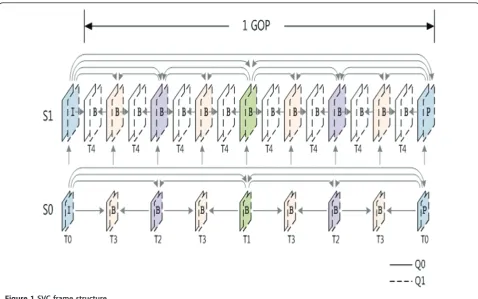
Figure 2 shows a case in which there are six layers with a combination of two spatial scalability layers and three temporal scalability layers. (Quality [Q] scalability is not used.) The spatial and temporal resolutions of the base layer (the lowest layer) are quarter common-inter-mediate-format (QCIF, 176 × 144) and 15 Hz, while those of the highest layer are CIF (352 × 288) and 30 Hz. The priority of the lower layer is higher than that of the upper layer, since the upper layer will not be decoded correctly, if the lower layer is lost.
Figure 2 shows rate-distortion curves for video sequences encoded in the SVC architecture. The dynamic range in bit rate ranges from 134 kbps to more than 600 kbps. The PSNR of a missing picture is calcu-lated by comparing the original picture with the tempo-rally nearest decoded picture. Since PSNR is calculated in CIF size, the base layer image has to be up-sampled before PSNR calculation.
RS(N, K, PPHY) is the residual PLR in the application layer.Papp is calculated depending on the coding ratio K/N and number of video packetsK. Through theRS(N,
where Nis the total number of transported packets, including both video and parity packets.K and Nare selected to maximizeKby satisfying the constraintsPapp
<Ptarget and R ×
T
S >MN(bytes), where T is a group
Table 1 CQI table and BLER correspond to SNR
CQI index (c) 5 10 15 20 25
Modulation QPSK 16QAM 16QAM 64QAM 64QAM
Coding rate 0.36 0.33 0.6 0.55 0.8
Block size (bits/block)
152 296 552 840 1192
SNR (S) BLER (after H-ARQ within eighth re-transmission)
5 0.013 0.062 0.231 0.358 0.591
10 0.002 0.013 0.031 0.089 0.177
15 0.0002 0.0028 0.006 0.018 0.037
20 0.0002 0.001 0.001 0.005 0.009
Kwonet al.EURASIP Journal on Wireless Communications and Networking2011,2011:31 http://jwcn.eurasipjournals.com/content/2011/1/31
of pictures (GOP) of the period in seconds andMis the packet size in bytes. In this paper,Ptarge =10-5. (If T= 1 s andPtarge = 10-5, and the mean time between failures
is 105 s, an outage is expected once every day on
average.)
3. Application-driven AMC
We propose a cross-layer optimization method where AMC is driven by the application layer, i.e., the video
service. In the same two-dimensional space of (R, PLR), equi-SNR curves are generated by the PHY layer, while equi-PSNR curves are generated by the application layer. Using two sets of curves, the MCS which enables the highest PSNR can be selected for a given SNR.
3.1. Generation of the equi-SNR curve
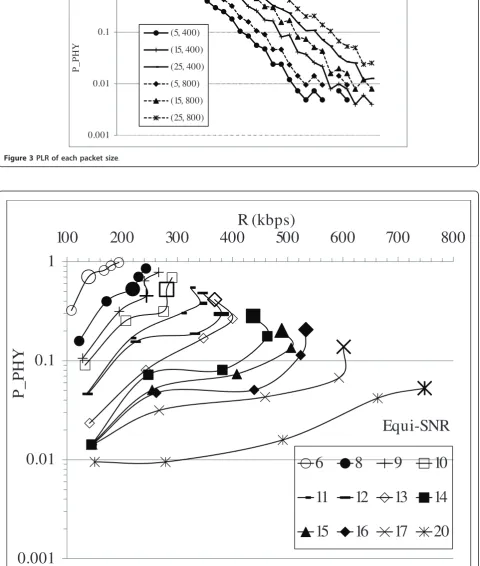
Figure 3 shows thatPPHYis determined by SNR from the MAC/PHY layer and packet sizeM, whereMdenotes the packet size of video data. We assume that the bit rate of the video stream is constant. Using the results of PLR and the CQI table, we can define a set of bit rateRand PLR
PPHY(R, PPHY), as a vector ¯v in the two-dimensionalR -PPHYspace. Conventionally, only one v is selected as an operation point with respect to the predefined target BLER. For a given SNR and a given maximum retransmis-sion number of H-ARQ, however, at most five different
¯
V’s can be used, since |C| = 5, and the set ofv¯’s is defined as the equi-SNR curve. For immediate adaptation in a time-varying condition, there are sufficient SNR values; these equi-SNR curves can be generated before providing video service in theR - PPHYspace.
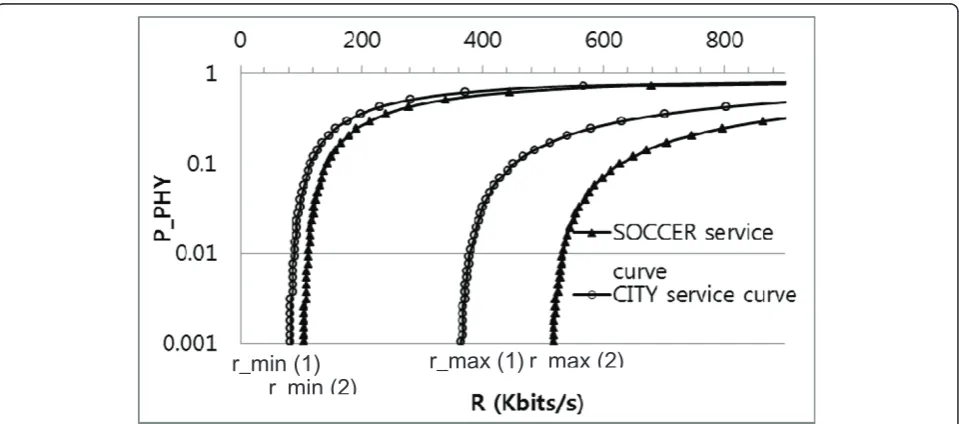
Figure 4 gives an equi-SNR graph of all possible operation points at every given SNR. Among them, only one point, bigger than the others, is selected by the con-ventional scheme. It is questionable whether the selec-tion is good for any applicaselec-tion.
Figure 1SVC frame structure.
20 25 30 35 40
0 100 200 300 400 500 600
PS
N
R
(d
B
)
R(Kbits/s) CITY 352x288
SOCCER 352x288
Figure 2R-D curve (frame rate: enhance 30 Hz, base 15 Hz, QP: enhance 28, base 30, resolution: enhance CIF, base QCIF,
0.001
0.01 0.1 1
-8 -4 0 4 8 12 16 20 24
P_
P
H
Y
SNR(dB)
(5, 400)
(15, 400)
(25, 400)
(5, 800)
(15, 800)
(25, 800)
Figure 3PLR of each packet size.
0.001
0.01
0.1
1
100
200
300
400
500
600
700
800
P_
P
H
Y
R (kbps)
6
8
9
10
11
12
13
14
15
16
17
20
Equi-SNR
Figure 4Equi-SNR graph (CQI(c): 5-25, SNR: 6-20).
Kwonet al.EURASIP Journal on Wireless Communications and Networking2011,2011:31 http://jwcn.eurasipjournals.com/content/2011/1/31
3.2. Generation of the equi-PSNR curve
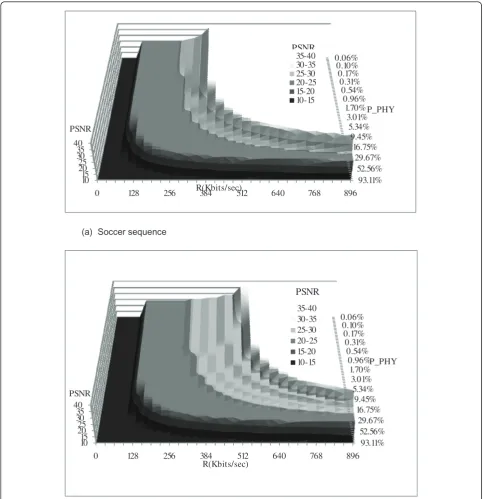
In the sameR-PPHY space, video service range (VSR)Ř can be represented two-dimensionally, as shown in Figure 5.Řincludes the bit rates of both video packets and parity packets. If PPHY is almost zero, no parity is included and all bit rates are used for video data.Ř cor-responds to the top line from rmin to rmax. As PPHY increases (vertically moving down), parity data are added to satisfy the loss by constraintPapp <Ptarget. This results in exponentially decreasing lines on both sides.
ˇ
R=
(R,PPHY)|r>rN
K,RS(N,K,PPHY)=Papp≤Ptarget, K=
τ×T
M×8bits per bytes, rmin≤r≤rmax
Within theŘ, we can calculate the maximum PSNR at eachR, PPHYpoint. Then, the set of points representing the same PSNR is defined as the equi-PSNR curve. Fig-ure 5 shows equi-PSNR curves of the lowest and highest PSNR values, while Figure 6 shows all equi-PSNR graphs as a contour map.
3.3. Application-driven AMC
The equi-SNR curve for a given SNR value is the trace of all possible sets of (R, PPHY), while the equi-PSNR curve for a given PSNR value is a trace of (R, PPHY) sets that result in the video quality of the given PSNR when FEC is optimally applied. Both equi-SNR curves and equi-PSNR curves are drawn in the two-dimensional (R,
PPHY) space. As we mentioned in the introduction, an optimal operation point is found by overlapping those two sets of curves. For each measured SNR value, an optimal service point (R, PPHY) can be found if at least one equi-SNR curve exists in the VSR and the equi-SNR
and equi-PSNR curves are convex. An equi-SNR curve ¯
V has connections for discrete points v¯ for all CQI levels.
¯
V(S,M,A)=¯v|¯vc(S,M,A)={RcPPHY,c}, c= 5,10,. . ., 25
,
where c is a CQI level, M is packet size, S is SNR value, andAis the number of allocated resource blocks (A= 1 in this paper).
An equi-PSNR curve with a PSNR of q is defined as
¯
Qq={(R,PPHY)q = max(sl,fl)PSNR(R,PPHY)},
where sl and fl represent scalability level and parity level (i.e., FEC level), respectively. The bit rates of video data are determined by sl. Sums of bit rates of video data and parity data should not exceed R, and residual PLR resulting from fl should be less than the target PLR
Ptargetwhen PLR resulting from the MAC/PHY layers is PPHY. Using these two kinds of curves in the (R, PPHY) space, the optimal operation point can be identified.
Rc∗,P∗PHY
= arg max q(v¯s) ¯
v=V¯(S,M,A)
At the same time, the optimal CQI level c* can be determined. This operation point provides the best video quality under certain conditions, which are SNR, packet size, and number of resource blocks.
4. Experiments and discussion
The video sequences “City” and“Soccer” were used for experiments. Since spatial complexity of both sequences is high while the temporal complexity of “Soccer” is much higher than that of“City”, the highest quality of
UBPLQ
UBPD[U PD[
U PLQ
“City” is achieved at lower bitrate as shown Figure 2. Therefore, their video service areas vary, as shown in Figure 5 in Section 3.2. They are encoded in six layers, including two spatial layers and five temporal layers (the base has four temporal layers). The two spatial layers are composed of QCIF and CIF, while the three tem-poral layers have frame rates from 15 to 30 Hz. Video packet size is fixed atM = 400 bytes and Ptarget, which is the target PLR in the application layer, is 10-5.
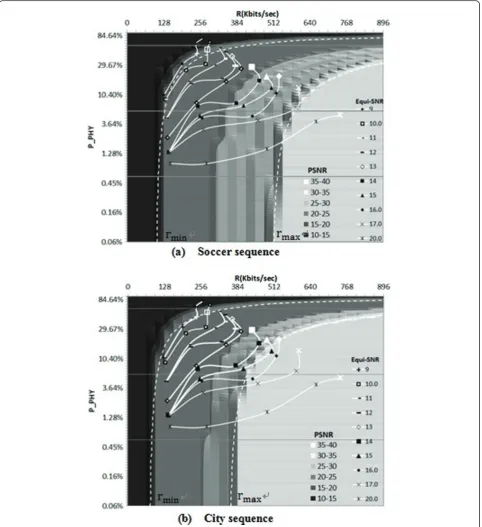
Figure 6 shows contour maps of equi-PSNR curves for City and Soccer, respectively. The highest plateaus at the upper and right corners correspond to video quality when all layers are correctly received and decoded. Gray regions represent VSR. As the video service area of each sequence is different, the slope of their contour line is also different. These differences show distinct characteristics when SNR and equi-PSNR curve are merged.
Figure 6PSNR over (R, PPHY) from the application layer. (a) Soccer sequence. (b) City sequence. Kwonet al.EURASIP Journal on Wireless Communications and Networking2011,2011:31
http://jwcn.eurasipjournals.com/content/2011/1/31
Figures 4 and 6 are merged into Figure 7. The equi-SNR curves in Figure 4 are drawn in white-colored lines. The equi-PSNR curves are denoted as a black-and-white contour map in which a brighter region means higher video quality. In this graph, the white points are conventional points according to the target BLER (10-1). We can find four other points that have
different PSNRs. In the VSR, the vector of maximum VSR points is defined as MCS=¯r(r=rmax)∈R. The
operation points nearest to MCS yield the best PSNR
quality. We derive the optimal CQI point c* as follows:
c∗= minMCS− ¯vs.
AD-AMC ensures maximum video quality in time-varying situations. The conventional MCS selection scheme is not optimal for a video service, which is less sensitive to information loss and requires a higher bit rate than a normal data service with the same condi-tions. In this paper, we used only one resource block (i.e., A= 1). For video of higher resolution, more than one resource block (A> 1) providing a higher bit rate will be used. The optimal CQI point at the maximum bit rate (R) must be selected for the Soccer sequence, as it has a wider video service range than the City sequence does; furthermore, a resource-saving selection must be made for the City sequence, as it is in an area where the equi-SNR curve is over the limit.
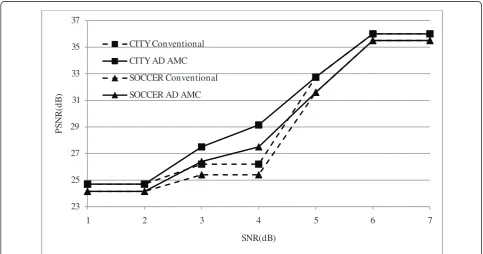
As shown in Figure 8, at the two extremes of the highest SNR and lowest SNR, the proposed method does not seem to have any gain while the UE, the mobile device in LTE, moves in the cell area. At the lowest SNR, even the lowest-quality video cannot be delivered at all. At the highest SNR, resources are so abundant that all video data can be delivered. In a nor-mal situation with an SNR range from 12 to 20 dB, the proposed method outperforms the conventional MCS selection scheme by 2 to 3 dB in terms of PSNR.
5. Conclusions
This paper proposes an active cross-layer design in which the application layer controls MAC/PHY opera-tion. MAC/PHY operation is currently controlled to
maximize the channel utility of non-real-time data ser-vices. For higher total throughput, channel resources may be consumed primarily by a few terminals whose SNRs are high enough, while others“starve.”The service requirements of real-time multimedia services, however, are different from those of non-real-time services. The real-time service should regard characteristics of the video sequence over (R, PLR) rather than use a fixed target BLER, since each sequence has the same condi-tion set. As mobile multimedia services become more popular, operation policies must adapt to their demands. We have demonstrated the effects of application-dri-ven MAC/PHY operation, in which modulation type and channel-coding level are determined to maximize QoS. Among the possible operation points at a certain SNR, maximizing PSNR is selected as an operation point that satisfies the BLER constraint regardless of application. In most cases, operation points for multime-dia services are selected at a higher bit rate and higher BLER compared to those of non-real-time services. By virtue of scalable video coding and FEC for the recovery of lost packets, the proposed method achieved at most a 5 dB gain in PSNR.
We also described a technique to isolate the lower layers from the upper layers of the system without los-ing the benefits of cross-layer optimization by simplify-ing the interfaces between the two. Both equi-PSNR curves from the application and transport layers and equi-SNR curves from the MAC/PHY layers are mapped
23
Figure 8Average PSNR of UE moving in the cell area.
Kwonet al.EURASIP Journal on Wireless Communications and Networking2011,2011:31 http://jwcn.eurasipjournals.com/content/2011/1/31
onto the same two-dimensional space of (R, PPHY). The equi-PSNR curves in the (R, PPHY) space can be pre-pared independently of the equi-SNR curves, and vice versa. By using these two kinds of curves, which are pre-pared before service, cross-layer optimization during service is simply used to measure SNR and to determine a maximum PSNR point along the corresponding equi-SNR curve. Even though the MAC/PHY scheme has been altered so that new equi-SNR curves are built, the same PSNR curves can be used with the new equi-SNR curves. This approach will enable users to switch video-coding techniques or to switch mobile communi-cation modality more easily in the further development of cross-layer design.
Abbreviations
AMC: adaptive modulation and coding; BLER: block error rate; CLO: cross-layer optimization; CQI: channel quality information; FEC: forward error correction; FGS: fine granular scalability; GOP: group of pictures; H-ARQ: hybrid-auto repeat request; MAC: medium access network; MCS: modulation and coding scheme; OFDM: orthogonal frequency division multiplexing; PLR: packet loss ratio; QAM: quadrature amplitude modulation; QCIF: quarter common-intermediate-format; QoE: quality of experience; QoS: quality of service; QPSK: quadrature phase shift keying; SNR: signal-to-noise ratio; SVC: scalable video coding; VSR: video service range.
Acknowledgements
This paper was partly supported by the IT R&D program of MKE/KEIT (KI001814, Game Theoretic Approach for Crosslayer Design in Wireless Communications) and MKE (The Ministry of Knowledge Economy), Korea, under the ITRC (Information Technology Research Center) support program supervised by the NIPA (National IT Industry Promotion Agency) (NIPA-2011-(C1090-1111-0001)).
Competing interests
The authors declare that they have no competing interests.
Received: 6 September 2010 Accepted: 7 July 2011 Published: 7 July 2011
References
1. S Shankar, M van der Schaar, Performance analysis of video transmission over IEEE 802.11a/e WLANs. IEEE Trans Veh Technol.56(4), 2346–2362 (2007)
2. F Foukalas, V Gazis, Cross-layer design proposals for wireless mobile networks: a survey and taxonomy. IEEE Commun Surv.10(1), 70–85 (2008) 3. M Van der Schaar, Cross-layer wireless multimedia transmission: challenges,
principles, and new paradigms. IEEE Wirel Commun Mag.12(4), 55–58 (2005)
4. T Fang, L Chau, GOP-based channel rate allocation using genetic algorithm for scalable video streaming over error-prone networks. IEEE Trans Image Process.15(6), 1323–1330 (2006)
5. H Ha, C Yim, Layer-weighted unequal error protection for scalable video coding extension of H.264/AVC. IEEE Trans Consumer Electron.54(2), 736–744 (2008)
6. E Haghani, S Parekh, A quality-driven cross-layer solution for MPEG video streaming over WiMAX networks. IEEE Trans Multimedia.11(6), 1140–1147 (2009)
7. MK Jubran, M Bansal, Accurate distortion estimation and optimal bandwidth allocation for scalable H.264 video transmission over MIMO systems. IEEE Trans Image Process.18(1), 106–116 (2009)
8. S Sesia, I Toufik, LTE, the UMTS long term evolution: from theory to practice. (2009) ISBN 978-0-470-69716-0
9. Text of ISO/IEC 14496-4:2001/PDAM 19 Reference Software for SVC, Joint Video Team (JVT) of ISO-IEC MPEG & ITU-T VCEG, N9195 (2007)
doi:10.1186/1687-1499-2011-31
Cite this article as:Kwonet al.:Application driven, AMC-based
cross-layer optimization for video service over LTE.EURASIP Journal on Wireless Communications and Networking20112011:31.
Submit your manuscript to a
journal and benefi t from:
7Convenient online submission 7Rigorous peer review
7Immediate publication on acceptance 7Open access: articles freely available online 7High visibility within the fi eld
7Retaining the copyright to your article