Current applications of propeller flaps in
reconstruction of trunk wounds
Shawn Moshrefi, Gordon K. Lee
Division of Plastic & Reconstructive Surgery, Stanford University Medical Center, Palo Alto, CA 94305, USA.
Correspondence to: Dr. Shawn Moshrefi, Division of Plastic & Reconstructive Surgery, Stanford University Medical Center, Palo Alto, CA 94305, USA. E-mail: [email protected]; Dr. Gordon K. Lee, Division of Plastic & Reconstructive Surgery, Stanford University Medical Center, Palo Alto, CA 94305, USA. E-mail: [email protected]
How to cite this article: Moshrefi S, Lee GK. Current applications of propeller flaps in reconstruction of trunk wounds. Plast Aesthet Res 2017;4:204-8.
Quick Response Code: Topic: Complex Reconstruction of the Face, Breast and Wounds with Microvascular Free Flaps Open Access
DOI: 10.20517/2347-9264.2017.33
Plastic and
Aesthetic Research
www.parjournal.netAim: Propeller flaps provide excellent reconstructive options for defects of many etiologies. Trunk wounds are a commonly encountered issue for the plastic surgeon and multiple techniques to address them should be prepared for implementation. Propeller flaps are a subject rarely brought up as an option to address these wounds. The authors sought to elucidate this topic in the current plastic surgery literature available. Methods: A PubMed search was conducted based upon the defined inclusion and exclusion criteria and publications reviewed in detail. Search terms included "trunk wound propeller flap", "trunk propeller flap", and "freestyle trunk wound flap". Duplicate studies were excluded. Data was extracted from each study pertaining to trunk wounds and reconstructions with propeller flaps. Results: The electronic search yielded 49 results with 21 studies ultimately meeting inclusion criteria. A total of 365 flaps were described collectively amongst the included studies. Among them, 190 propeller flaps addressing trunk defects were performed across all studies reviewed to address a total of 165 defects of the trunk: 14 abdomen, 101 back, 50 chest defects and adjacent respective flaps were utilized for surgical reconstruction. Overall, cancer excision wounds were by far the most prevalent with 105 cases (59.0%). Defect sizes of those specified in the articles ranged from 2 cm × 5 cm to 30 cm × 24 cm. Of the 190 propeller flaps identified, 63 total complications were identified. The most common complication was 48 total cases of transient venous congestion (25.3%). The second most common complication was partial flap necrosis (6.3%). No total flap loss was noted. There were 2 cases of seroma (1.1%) and 1 case of wound breakdown (0.5%).
Conclusion: Propeller flaps are a viable reconstructive option for trunk wounds and should
be in the armamentarium of plastic and reconstructive surgeons. Few studies are available in the literature regarding propeller flap reconstruction in trunk wounds. More aggregate data is needed in order to further review, evaluate, and refine propeller flap techniques and results. ABSTRACT
Key words:
Propeller flaps, trunk wounds,
microvascular dissection
Article history:
Received: 29 Apr 2017 First Decision: 16 Oct 2017 Revised: 27 Nov 2017 Accepted: 27 Nov 2017 Published: 30 Nov 2017
This is an open access article licensed under the terms of Creative Commons Attribution 4.0 International License (https://creativecommons.org/licenses/by/4.0/), which permits unrestricted use, distribution, and reproduction in any medium, as long as the original author is credited and the new creations are licensed under the identical terms.
For reprints contact: [email protected]
INTRODUCTION
The concept of the per forator flap was first
introduced in 1988 by Kroll and Rosenfield[1] as
well as independent work introduced in 1989 by
Koshima and Soeda[2]. Since then, the concept of
As is true of most plastic surgery, the propeller flap can be utilized in essentially any part of the body so long as plastic surgical principles are adhered to and meticulous surgical attention is directed toward flap design, dissection, and ultimately to reconstruction. While clinical application is broad, the focus of this article is in review of propeller flaps for trunk wound reconstruction.
METHODS
A PubMed Booleansearch was conducted searching for the terms “trunk wound propeller flap”, “trunk propeller flap”, and “freestyle trunk wound flap”. The results of this search were compiled and duplicates excluded. The remaining publications were vetted based on the inclusion and exclusion criteria noted below. The publications were then reviewed in detail.
Inclusion criteria for this study were that the studies be a case study, case report, case series, clinical trial, reply to another study with new patient data, cohort analysis, or other retrospective or prospective studies identifying trunk wounds as the reconstructive defect. Additionally, a propeller flap had to be utilized for surgical reconstruction. Exclusion criteria for the study were that the publication was not entirely in the English language, publication not reproducibly accessed, paper did not provide enough detail regarding surgical intervention to determine if propeller flap technique was utilized, pedicled perforator flaps were not utilized in propeller fashion, or that the paper was primarily a review of the literature.
RESULTS
The results of the PubMed online search yielded 49 publications. After excluding duplicates, 35 publications remained. These 35 were reviewed in detail and the publications vetted based on the inclusion and exclusion criteria noted above. Twenty-onearticles remained for further in-depth review.
Of these 21 articles, 13 articles were case series, 8 articles were case studies/reports, and no clinical trials or cohort studies were identified. The oldest article found in the search dated back to August 2009.
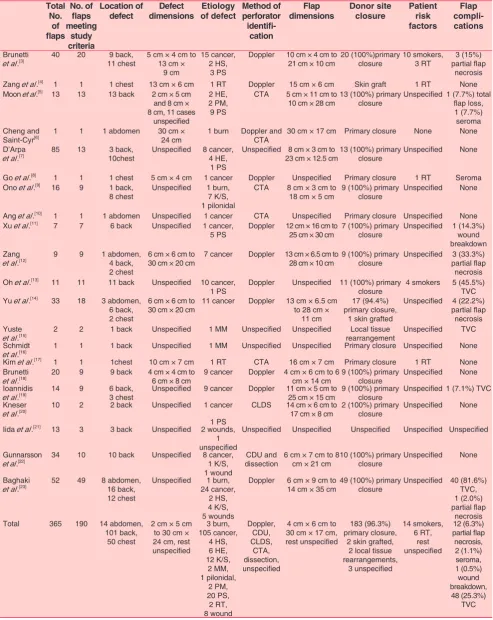
A total of 365 flaps were described collectively amongst the included studies. Among them, 190 propeller flaps addressing trunk defects were performed across all studies reviewed to address a total of 165 defects of the trunk: 14 abdomen, 101 back, 50 chest defects and adjacent respective flaps were utilized for surgical reconstruction. The
discrepancy between the total number of flaps utilized and the total number of defects was that in some cases more than one propeller flap was utilized for reconstruction of a site.
Etiologies of the defects addressed resulted from burns, wounds, pressure sores, hidradenitis suppuritiva, hardware exposures, keloids and/or scars, myelomeningoceles, pseudomeningoceles, pilonidal disease, radiation wounds, and cancers of various types. One case had an unspecified cause of the defect. Overall, cancer excision wounds were by far the most prevalent with 105 cases (59.0%). Defect sizes of those specified in the articles ranged from
2 cm × 5 cm to 30 cm × 24 cm. Please see Table 1[3-23]
for the breakdown of each etiology related to each defect for each included study in the review.
Perforators for the flaps were identified most commonly by handheld Doppler ultrasound. Other methods of perforator identification included color Doppler ultrasonography (CDU), combined laser Doppler spectrophotometry, computed tomography angiography (CTA), and dissection with visual identification and palpation. Some studies did not specify the method of perforator identification. Of the studies that specified flap dimensions, the propeller flaps ranged from 4 cm × 6 cm to 30 cm × 17 cm.
Of the 190 propeller flaps identified, 63 total complications were identified. The most common complication was 48 total cases of transient venous congestion (25.3%). The second most common complication was partial flap necrosis (6.3%). No total flap loss was noted. There were 2 cases of seroma (1.1%) and 1 case of wound breakdown (0.5%).
DISCUSSION
The propeller flap concept and technique has continued to evolve in idea and application. The benefits of utilizing a propeller flap include locoregional reconstruction, reliable anatomy based upon the
angiosome and perforasome concepts[24], minimization
of donor site morbidity, and design that is largely limited only by ability to close primarily.
The evolution of the propeller flap has included multiple modifications both in application and technique. Papers indicating flap degrees of rotation less than 180 degrees were described and utilized successfully. Some series utilized this as a workhorse in propeller flap reconstruction for trunk wounds.
Table 1: Aggregate results of all papers included in study Total No. of flaps No. of flaps meeting study criteria Location of
defect dimensionsDefect of defectEtiology Method of perforator
identifi
cation
Flap
dimensions Donor site closure Patient risk factors
Flap
compli
cations
Brunetti
et al.[3] 40 20 11 chest9 back, 5 cm × 4 cm to 13 cm × 9 cm
15 cancer, 2 HS,
3 PS
Doppler 10 cm × 4 cm to
21 cm × 10 cm 20 (100%)primary closure 10 smokers,3 RT partial flap 3 (15%) necrosis Zang et al.[4] 1 1 1 chest 13 cm × 6 cm 1 RT Doppler 15 cm × 6 cm Skin graft 1 RT None Moon et al.[5] 13 13 13 back 2 cm × 5 cm
and 8 cm × 8 cm, 11 cases
unspecified
2 HE, 2 PM, 9 PS
CTA 5 cm × 11 cm to
10 cm × 28 cm 13 (100%) primary closure Unspecified1 (7.7%) total flap loss, 1 (7.7%)
seroma Cheng and
Saint-Cyr[6] 1 1 1 abdomen 30 cm × 24 cm 1 burn Doppler and CTA 30 cm × 17 cm Primary closure None None D’Arpa
et al.[7] 85 13 10chest3 back, Unspecified 8 cancer,4 HE, 1 PS
Unspecified 8 cm × 3 cm to
23 cm × 12.5 cm13 (100%) primary closure Unspecified None
Go et al.[8] 1 1 1 chest 5 cm × 4 cm 1 cancer Doppler Unspecified Primary closure 1 RT Seroma Ono et al.[9] 16 9 1 back,
8 chest Unspecified 1 burn,7 K/S, 1 pilonidal
CTA 8 cm × 3 cm to
18 cm × 5 cm 9 (100%) primary closure Unspecified None
Ang et al.[10] 1 1 1 abdomen Unspecified 1 cancer CTA Unspecified Primary closure Unspecified None Xu et al.[11] 7 7 6 back Unspecified 1 cancer,
5 PS Doppler 12 cm × 16 cm to 25 cm × 30 cm 7 (100%) primary closure Unspecified 1 (14.3%) wound breakdown Zang
et al.[12] 9 9 1 abdomen,4 back, 2 chest
6 cm × 6 cm to
30 cm × 20 cm 7 cancer Doppler 13 cm × 6.5 cm to 28 cm × 10 cm 9 (100%) primary closure Unspecified partial flap 3 (33.3%) necrosis Oh et al.[13] 11 11 11 back Unspecified 10 cancer,
1 PS Doppler Unspecified 11 (100%) primary closure 4 smokers 5 (45.5%) TVC Yu et al.[14] 33 18 3 abdomen,
6 back, 2 chest
6 cm × 6 cm to
30 cm × 20 cm 11 cancer Doppler 13 cm × 6.5 cm to 28 cm × 11 cm
17 (94.4%) primary closure,
1 skin grafted
Unspecified 4 (22.2%) partial flap necrosis Yuste
et al.[15] 2 2 1 back Unspecified 1 MM Unspecified Unspecified rearrangementLocal tissue Unspecified TVC Schmidt
et al.[16] 1 1 1 back Unspecified 1 MM Unspecified Unspecified Primary closure Unspecified None Kim et al.[17] 1 1 1chest 10 cm × 7 cm 1 RT CTA 16 cm × 7 cm Primary closure 1 RT None Brunetti
et al.[18] 20 9 9 back 4 cm × 4 cm to 6 cm × 8 cm 9 cancer Doppler 4 cm × 6 cm to 6 cm × 14 cm 9 (100%) primary closure Unspecified None Ioannidis
et al.[19] 14 9 6 back,3 chest Unspecified 9 cancer Doppler 11 cm × 5 cm to 25 cm × 15 cm 9 (100%) primary closure Unspecified1 (7.1%) TVC Kneser
et al.[20] 10 2 2 back Unspecified 1 cancer 1 PS
CLDS 14 cm × 6 cm to
17 cm × 8 cm 2 (100%) primary closure Unspecified None Iida et al.[21] 13 3 3 back Unspecified 2 wounds,
1 unspecified
Unspecified Unspecified Unspecified Unspecified Unspecified
Gunnarsson
et al.[22] 34 10 10 back Unspecified 8 cancer,1 K/S, 1 wound
CDU and
dissection 6 cm × 7 cm to 8 cm × 21 cm 10 (100%) primary closure Unspecified None
Baghaki
et al.[23] 52 49 8 abdomen,16 back, 12 chest
Unspecified 1 burn, 24 cancer,
2 HS, 4 K/S, 5 wounds
Doppler 6 cm × 9 cm to
14 cm × 35 cm49 (100%) primary closure Unspecified 40 (81.6%) TVC, 1 (2.0%) partial flap
necrosis Total 365 190 14 abdomen,
101 back, 50 chest
2 cm × 5 cm to 30 cm × 24 cm, rest unspecified 3 burn, 105 cancer, 4 HS, 6 HE, 12 K/S, 2 MM, 1 pilonidal, 2 PM, 20 PS, 2 RT, 8 wound Doppler, CDU, CLDS, CTA, dissection, unspecified
4 cm × 6 cm to 30 cm × 17 cm, rest unspecified
183 (96.3%) primary closure,
2 skin grafted, 2 local tissue rearrangements, 3 unspecified 14 smokers, 6 RT, rest unspecified 12 (6.3%) partial flap necrosis, 2 (1.1%) seroma, 1 (0.5%) wound breakdown, 48 (25.3%) TVC
to find that the highest rate of complication was with venous congestion but that no permanent flap loss was noted in any case. All cases of venous congestion identified were transient, whether they were managed expectantly or with some intervention (i.e. leeches,
derotation of flap, etc.). The other complications were
with much less frequency and reviewing the patient’s risk factors, they did not seem to adversely affect the outcomes. Unfortunately, many series did not identify preoperative risk factors in patients and so drawing conclusions from this are limited in this review. In addition, of those that did specify the risks factors, the patient-specific data was often combined with flaps of other areas of the body and/or there was not enough detailed information provided to determine if the complications occurred in those with risks factors (i.e. transient venous congestion occurrence in relation to patients that smoked).
Interestingly, none of the etiologies for the defects mentioned in any of the studies were traumatic. This may be that trunk wounds are generally not as likely to be traumatic compared to lower extremity wounds. Anecdotally, traumatic wounds do raise some concern in the reconstruction of a wound using a propeller flap as the perforator may be captured in the zone of injury.
One of limitations of this study is that the search terms and search database is limited. One of the challenges of broadening this search would be to search for each propeller flap by a described name or technique (i.e. LICAP flap) as it relates to the trunk, which would be much more extensive of a search. However, this provides an opportunity for further delving into the literature and providing a larger review that may be more inclusive than the broader search terms listed as part of our study. Another notable limitation is that publication bias of positive findings with relation to propeller flap outcomes of the studies currently available.
Variability in design of propeller flaps of course depends upon the shape, size, depth, and location of the defect. In general, axes of the flaps designed should be based perpendicular or oblique on the trunk
and in parallel in extremities[7,24].
When identifying perforators for dissection, it is the authors’ preferred method to do so via handheld Doppler ultrasound as well as visual inspection upon
dissection. Ono et al.[25] provided a recent publication
in 2017 with an excellent overview with preoperative modalities to identify perforators. While CTA, MRA, and CDU have grown tremendously as modalities in
addition to multi-detector row computed tomography, the authors find these modalities time consuming and costly in a climate of American healthcare costs that continue to rise. However, there is significant value in these modalities in the authors’ opinions with respective to complex reconstruction or those of reoperative reconstructive fields. Some colleagues at our institution utilize these modalities routinely and so there remains no consensus nor compelling data in the literature to support use of these methods over handheld Doppler ultrasound or even dissection with direct visualization. Indeed, a palpable pulse of the perforator in question is always a reassuring finding and indicator of flap viability. In keeping dissection principles in mind, we try to adhere in line with the
findings of Wong et al.[26] in that a 3-cm pedicle length
dissection is attempted to be obtained when safe. This is particularly prudent when utilizing degrees of rotation beyond 90 degrees in propeller fashion, but is only done when skeletonization is deemed appropriate and safe.
As discussed in the Tokyo criteria of 2011, the perforator-based propeller flap can be rotated a
maximum of 180 degrees for wound reconstruction[27].
This has to do with torsion and kinking of the pedicle, ultimately which can lead to flap compromise and loss. If flap compromise in the form of venous congestion develops, return to the operating room and releasing the flap from its inset position is of the first consideration. Following this, if the compromise is not addressed then the flap should be rotated back to the donor site and observed for improvement. Still if minimal or no improvement is noted, dissection of the flap to its pedicle should occur to ensure the vascular leash is not the complicating factor.
With respect to management of the donor site, the
authors agree with the conclusion of D’Arpa et al.[7] in
the decision tree of when a perforator-based propeller flap is utilized for reconstruction. Specifically, if the donor site cannot be closed primarily, then a free flap reconstructive option is sought first that would lead to less to donor site morbidity and improved cosmesis. In other words, a perforator-based propeller flap may be designed as large as the defect dictates so long as the donor site may be closed primarily. As with all reconstructions in plastic surgery, each defect poses its own challenges and nuance that the plastic and reconstructive surgeon must take into consideration prior to surgical intervention.
surgeons. Despite its broad applicability and use, little is published regarding propeller flap reconstruction in trunk wounds. More aggregate data is needed in order to further review, evaluate, and refine propeller flap techniques and results.
DECLARATIONS
Authors’ contributions
Inception of the study, study design, and written manuscript: S. Moshrefi, G.K. Lee
Financial support and sponsorship None.
Conflicts of interest
There are no conflicts of interest.
Patient consent Not applicable.
Ethics approval Not applicable.
REFERENCES
1. Kroll SS, Rosenfield L. Perforator-based flaps for low posterior midline defects. Plast Reconstr Surg 1988;81:561-6.
2. Koshima I, Soeda S. Inferior epigastric artery skin flaps without rectus abdominis muscle. Br J Plast Surg 1989;42:645-8.
3. Brunetti B, Tenna S, Poccia I, Persichetti P. Propeller flaps with reduced rotational angles: clinical experience on 40 consecutive reconstructions performed at different anatomical sites. Ann Plast Surg 2017;78:202-7.
4. Zang M, Guo L, Liu Y. Propeller medial arm flap: a plan “B” for reconstruction of radiation ulcer of the chest wall. J Plast Reconstr Aesthet Surg 2014;67:1769-70.
5. Moon SH, Choi JY, Lee JH, Oh DY, Rhie JW, Ahn ST. Feasibility of a deepithelialized superior gluteal artery perforator propeller flap for various lumbosacral defects. Ann Plast Surg 2015;74:589-93. 6. Cheng A, Saint-Cyr M. Use of a pre-expanded “propeller” deep
inferior epigastric perforator (DIEP) flap for a large abdominal wall defect. J Plast Reconstr Aesthet Surg 2013;66:851-4.
7. D’Arpa S, Cordova A, Pignatti M, Moschella F. Freestyle pedicled perforator flaps: safety, prevention of complications, and management based on 85 consecutive cases. Plast Reconstr Surg 2011;128:892-906. 8. Go JY, Lim SY, Mun GH, Bang SI, Oh KS, Pyon JK. Recycling
delayed perforator flap: Deep inferior epigastric artery perforator-based propeller flap from a prior vertical rectus abdominis musculocutaneous flap. J Plast Reconstr Aesthet Surg 2011;64:1238-41.
9. Ono S, Chung KC, Hayashi H, Ogawa R, Takami Y, Hyakusoku H. Application of multidetector-row computed tomography in propeller flap planning. Plast Reconstr Surg 2011;127:703-11.
10. Ang GG, Rozen WM, Chauhan A, Acosta R. The pedicled ‘propeller’deep inferior epigastric perforator (DIEP) flap for a large abdominal wall defect. J Plast Reconstr Aesthet Surg 2011;64:133-5. 11. Xu Y, Hai H, Liang Z, Feng S, Wang C. Pedicled fasciocutaneous flap
of multi-island design for large sacral defects. Clin Orthop Relat Res 2009;467:2135-41.
12. Zang M, Yu S, Xu L, Zhao Z, Zhu S, Ding Q, Liu Y. Intercostal artery perforator propeller flap for reconstruction of trunk defects following sarcoma resection. J Plast Reconstr Aesthet Surg 2015;68:822-9. 13. Oh TS, Hallock G, Hong JP. Freestyle propeller flaps to reconstruct
defects of the posterior trunk: a simple approach to a difficult problem. Ann Plast Surg 2012;68:79-82.
14. Yu S, Zang M, Xu L, Zhao Z, Zhang X, Zhu S, Chen B, Ding Q, Liu Y. Perforator propeller flap for oncologic reconstruction of soft tissue defects in trunk and extremities. Ann Plast Surg 2016;77:456-63. 15. Yuste V, Delgado J, Silva M, Rodrigo J, Albiñana F. The double
gluteal myocutaneous propeller flap for the coverage of massive myelomingoceles. J Plast Reconstr Aesthet Surg 2014;67:737-8. 16. Schmidt VJ, Horch RE, Dragu A, Beier JP, Eyüpoglu IY, Hirsch A,
Kneser U. Myocutaneous propeller flap based on the superior gluteal artery (SGA) for closure of large lumbosacral meningomyelocoele defects: a case report. J Plast Reconstr Aesthet Surg 2012;65:521-4. 17. Kim DY, Kim HY, Han YS, Park JH. Chest wall reconstruction with a
lateral thoracic artery perforator propeller flap for a radiation ulcer on the anterior chest. J Plast Reconstr Aesthet Surg 2013;66:134-6. 18. Brunetti B, Tenna S, Aveta A, Poccia I, Segreto F, Cerbone V,
Persichetti P. Posterior trunk reconstruction with the dorsal intercostal artery perforator based flap: clinical experience on 20 consecutive oncological cases. Microsurgery 2016;36:546-51.
19. Ioannidis S, Spyropoulou GA, Sadigh P, Shih HS, Jeng SF. Pedicled free-style perforator flaps for trunk reconstruction: a reliable method. Plast Reconstr Surg 2015;135:602-9.
20. Kneser U, Beier JP, Schmitz M, Arkudas A, Dragu A, Schmidt VJ, Kremer T, Horch RE. Zonal perfusion patterns in pedicled free-style perforator flaps. J Plast Reconstr Aesthet Surg 2014;67:e9-17. 21. Iida T, Narushima M, Yoshimatsu H, Mihara M, Kikuchi K, Hara
H, Yamamoto T, Araki J, Koshima I. Versatility of lateral cutaneous branches of intercostal vessels and nerves: anatomical study and clinical application. J Plast Reconstr Aesthet Surg 2013;66:1564-8. 22. Gunnarsson GL, Jackson IT, Westvik TS, Thomsen JB. The freestyle
pedicle perforator flap: a new favorite for the reconstruction of moderate-sized defects of the torso and extremities. Eur J Plast Surg 2015;38:31-6.
23. Baghaki S, Diyarbakirlioglu M, Sahin U, Kucuksucu MA, Turna A, Baca B, Aydın Y. Extended locoregional use of intercostal artery perforator propeller flaps. Microsurgery 2017;37:293-9.
24. Saint-Cyr M, Wong C, Schaverien M, Mojallal A, Rohrich RJ. The perforasome theory: vascular anatomy and clinical implications. Plast Reconstr Surg 2009;124:1529-44.
25. Ono S, Hayashi H, Ohi H, Ogawa R. Imaging studies for preoperative planning of perforator flaps: an overview. Clin Plast Surg 2017;44:21-30.
26. Wong CH, Cui F, Tan BK, Liu Z, Lee HP, Lu C, Foo CL, Song C. Nonlinear finite element simulations to elucidate the determinants of perforator patency in propeller flaps. Ann Plast Surg 2007;59:672-8. 27. Pignatti M, Ogawa R, Hallock GG, Mateev M, Georgescu AV,