Flipped Classroom: Maximizing Face Time in Teaching
and Learning
Filomena T. Dayagbil, Angeline M. Pogoy, Emiliano Ian B. Suson II and Carmel Vip Derasin
Cebu Normal University, the Philippines
Date Submitted: September 5, 2017 Originality: 92%
Date Revised: December 26, 2017 Plagiarism Detection: Passed
ABSTRACT
The focus of this quasi-experimental study was to assess the effectiveness of flipped classroom as a pedagogical strategy in teaching courses across disciplines. Specifically, the study looked into the performance of the two hundred thirty-eight (238) purposively chosen students in the conventional and flipped classes in the different courses such as Literature of the Philippines, Nursing Informatics and Field Study1. Furthermore, it also examined the students’ motivation and engagement level in different groups and the challenges in the implementation of a flipped classroom. Pre-test –Post-test design supported by qualitative data was used. Data were gathered using the validated questionnaires and interviews done with focus group discussion (FGD) and triangulation to crosscheck its trustworthiness. T-test and thematic analyses were utilized in analyzing the data. Results revealed that students performed better in their flipped classes across disciplines. They were highly motivated and engaged in their respective classes for they can study the lessons at their own pace, time and place. Scaffolding for instructional delivery through technology like videos, online modules, and activities prepared by the professors provided students the avenue to maximize learning. Internet access and slow connection made the flipped classes difficult for professors and students. Despite the limitation of the educational technology to engage learners, flipped classroom was effective in maximizing face time in teaching and learning across the three (3) courses and three (3) different programs. Thus, flipping classes for blended learning for instructional delivery was innovatively responsive in this 21st century.
Keywords: flipped classroom, student performance, motivation, engagement, quasi-experimental design
INTRODUCTION
The changing landscape of 21st-century education calls for responsive and innovative teaching strategies that maximize learning. Attention has been focused on developing pedagogies that make use of educational technology to engage learners. One such pedagogy is flipped classroom. The flipped classroom has been gaining popularity in the academic community and actuality media (Atteberry, 2013 and Plaisent, Dayagbil, Pogoy, & Prosper 2016). Flipped classroom is also referred to as "reverse teaching," "flipped learning," "backward classroom" or "reverse instruction”
(Hofamn, 2014). In the flipped class, students watch and listen to lectures/videos online prior to class. Class time is devoted to solving difficult problems, working in groups, collaborating, researching, crafting and creating. Classrooms become laboratories, and yet content delivery is preserved. Students in a flipped class learn at a different pace. They can repeat, rewind, and re-watch lessons at their own pace. They can re-watch the subject matter for their class anywhere in any device and teachers spend more time helping students and explaining difficult concepts while in class. The flipped classroom is designed to create
a classroom experience that inspires lifelong learning.
A review of researches on flipped classroom reveals positive feedback. Students increase their desire to learn more because of engaging activities and authentic tasks. In a study at Clintondale High School, Michigan, the dropout rate decreased as teachers started to flip their classes. The study concluded that using the flipped classroom allowed educators to control and managed the teaching-learning process and shared online resources (Alvarez, 2012). However, there are limited quantitative, evidence-based research findings on its effectiveness (Jensen et al., 2014). Flipped classroom as an approach in teaching has limited research studies as noted by Abeysekera and Dawson (2015). Even if many question the approach's real effectiveness, the majority seem to favor this revolutionary approach (Lape et al., 2014; Plaisent et al. 2016).
In the Philippines, the traditional one size fits all model of teaching and lecturing has been challenged since it results in limited concept engagement among students. Nowadays, teachers use strategies that engage millennial learners. Although some teachers used technology enabling strategies in teaching, a good number of them still hang on to the conventional face to face teaching. Despite the many advantages reported in other parts of the country, some teachers and future teachers in the Philippines are not aware or do not even know flipped classroom. In a study by Plaisent et al. (2016) on the perception of Filipino pre-service teachers on flipped classroom, it was revealed that flipped classroom is not well known in the Philippines. This could probably be attributed to the readiness and access of Filipino learners to technology. A lot of Filipino families in far-flung areas still do not have access to videos and online lectures via the internet. However, as education advances, the use of flipped classroom in teaching and learning has slowly gained attention and popularity in the Philippines.
Despite the relative success of this new method, there is a need to add up to the limited body of knowledge and literature on the effectiveness of flipped classrooms in the
Philippines. It could be significant to evaluate the academic outcomes of students in flipped classes including students’ motivation and engagement level and teachers’ best practices in integrating educational technology in teaching and learning using flipped class.
As an enabling strategy in Philippine higher education, the focus of this study is to assess the effectiveness of flipped classroom as a pedagogical strategy in teaching courses across disciplines. Specifically, the study looks into the performance of the students in the conventional and flipped classroom in the different courses such as Literature of the Philippines, Nursing Informatics and Field Study1. Furthermore, it also examines the students’ motivation and engagement level in different groups, the challenges and the best practices in the implementation of flipped classroom.
Literature Review
A flipped classroom is a pedagogical approach in which direct instruction from group learning is moved to individual learning. Group learning is transformed into a dynamic, interactive learning environment where the educator guides students as they apply concepts and engage creatively in the subject matter (FLN, 2014). The success of the flipped classroom relies on four aspects (FLN, 2014). First, the purpose of the flipping must be well understood. The students must be oriented on why they have to access the video or any material online before they report to the class. In this way, they will have an idea that classroom engagement would be spent on challenging activities and interaction instead of looking at the video. Second, the approach suggests that all digital materials have to be shared online. Third, the work in the classroom should focus on understanding through exercises, group work, and feedback by the teacher. Lastly, the process shall be assessed by all. Flipping the class means students study and do their online at their pace and place with the help of the instructor. Educational technology and activity are major components of the flipped classroom model. Flipped classroom model is one of the ways teachers begin bringing more technology into the students' learning environment.
The concept of flipped class was initially conceived in 2007 when two Chemistry teachers, Bergmann and Sams, recorded their lectures for their students who were absent in their class. It was found out to be effective. What started a solution of helping those who missed their classes turned out to be a transformative approach that has gained global interest in all levels of the educational ladder.
Flipped classroom finds its anchor on constructivist pedagogy that focuses on student-centered learning, in which teacher acts more as a planner and facilitator for social interactions while the students manage their learning according to their needs (Mazur, 2013). Moreover, Mazur (2013) opines that active learning characterizes flipped classes in which multiple intellectual stimulations are used as instructional methods from reading to communicating, watching the video, using computer simulations and many more.
There are identified benefits of the flipped classroom. Milman (2012) said that students had increased their time as they engaged themselves for instruction online rather than listening to a lecture done by their teachers in their classroom. According to Towle (2014) "flipping the classroom" had effects in higher learning outcomes, improved knowledge retention, improved critical thinking skills and clinical judgment of the nursing students. Flipping the classroom is a blended learning approach that sets the platform for knowledge application. Class time is emphasized so that students can solve, create, critique, and synthesize in a dynamic and engaging environment at their own pace and time.
It was suggested that the flipped classroom technique is good for teaching procedural knowledge. Another advantage of this approach is the use of mobile devices by the students anytime and anywhere, and lessons can be viewed as often as needed to understand a topic (Frydenberg, 2012). The use of the flipped classroom is a large shift from the traditional-classroom method of delivery. In a flipped classroom, learning shifts from teachers' to
students' and face to face time flipped from teacher centered to learner-centered. Replacing direct instruction that is the explicit scripted presentation or delivery of instruction to a flipped classroom which is from the class time with video lectures and other online activities observed outside of the classroom allows for more class time to be used for active learning and effective teaching (Bergmann et al., 2012).
Limitations of the flipped class pedagogy according to Talbert (2012) may include but not limited to the following: the quality of video lectures done by the teacher is different in an actual class setting; students feelings of abandonment when learning on their own; students' adjustment in the mode of teaching which is different in the traditional lecture-style of teaching; and students' opposition to taking responsibility for learning on their own.
There is no single best way of flipping the classroom (Bull et al., 2012). However, a typical flipped class starts with students viewing a short video, podcasts, online lectures about the subject matter outside the class whether at home or in school. Teachers can choose free resources to upload their videos or use existing videos that explain the intended topics. While watching the video, students take notes, summarize and ask questions. When students report to class, interactive activities are provided by the teacher to develop concepts. With the teacher as facilitator, students talk about important concepts in the video or lecture, discuss, compare answers, work on practice problems, take concept quizzes to prove understanding, create own scenarios, and work on authentic tasks. The teacher's role in a flipped class is to create an engaging and supportive environment for students that lead to the development of concepts and higher order thinking skills. The teacher may also provide remediation to revisit concepts, and skills students do not understand.
The greatest challenge in a flipped classroom is teacher preparation. Teachers need to develop or look for instructional resources and plan engaging activities in class. The process could be time-consuming and requires careful planning. CNU Journal of Higher Education, Volume 12 (2018)
McPherson and Nunes (2004) have indicated that efficient and educationally sound use of these technologies needs careful planning, resourcing, and support. Tucker (2012) claimed that teachers using the flipped classroom model agree that viewing the recorded videos online at their own time is not enough to make this approach effective. However, it is the integration of these online resources for instruction that makes the difference of the teaching-learning process.
METHODOLOGY
This research study utilized the quasi-experimental design with Pre-test – Post-test supported by qualitative data.
Quantitative data included were the teacher made validated pre-post tests for the identified courses in each college namely; Literature of the Philippines from the College of Arts and Sciences (CAS), Nursing Informatics from the College of Nursing (CN) and Field Study1 from the College of Teacher Education (CTE). Content validity of the test is determined via the opinions of three (3) experts in the respective courses. After the test is administered to students, item analysis of the test is carried out by calculating the difficulty and distinctiveness of the questions of the test, validity and reliability survey is performed, inappropriate questions are excluded, KR-20 reliability coefficient is calculated and the test achieved its final form. The motivation and engagement questionnaire was adapted from Hart, Stewart, and Jimerson (2011). Fifteen (15) items were used for motivation and ten (10) items for engagement level which were validated and tested for its reliability of Cronbach's alpha of 0.743 and 0.764 respectively.
Qualitative data comprised the challenges and practices in the implementation of a flipped classroom. Data were gathered through students' journal and the researchers' interviews and observation. Focus Group Discussion (FGD) and triangulation were conducted to crosscheck the worthiness of the information gathered. Coding, narrative inquiry, and thematic analysis were also utilized for a deeper meaning and understanding in
the implementation of the flipped classroom in different courses across the discipline.
Research participants and respondents were the two hundred thirty-eight (238) students from the different colleges of Cebu Normal University enrolled in the first semester of the school year 2016-2017. There were fifty (50) students from the college of arts enrolled in Literature of the Philippines, Forty-four (44) nursing students enrolled in Nursing Informatics, and one hundred forty-four (144) education students enrolled in Field Study 1 course. Through pair-wise matching, two groups of students enrolled for each course were used as the experimental and control group. The research study for flipped classroom entailed technology engagement online for an off class, varied activities during on-class and the traditional teaching for the control group.
Control groups were taught the conventional way in which the lesson was dependent on the text previously assigned. Lecture-discussion was the main strategy. There were no videos or movies used to supplement the lesson during the period of the study. Activities in the class centered on either individuals or group outputs done inside the classroom only. Pen and paper tests were given as part of formative and summative assessments in the classroom.
On the other hand, the experimental groups were given activities in which they could do alone or in groups using a technology platform such as Edmodo. An online group was created, and all activities were uploaded on the platform. In Field Study 1 Course, links on video clip like the Interview with Jeff Bliss (https://www.youtube .com/watch?v=bKjqjpePhTc) and movies on “Munting Tinig” and “Freedom Writers” for lessons on the personal and professional teachers and the teaching-learning process were uploaded. Movies like “Beautiful Mind” and “Gifted” were used for the understanding of the learners. Lectures on the students' learning environment
were uploaded through, and powerpoint
presentations like “The Heart of a Teacher” and “The Power of the Teacher” were also uploaded.
Nursing Informatics was about the technological integration of hospital-based data sets and health records into nursing informatics concept and practice. Lessons on basic use of nursing informatics and theories, the role of the nurses in health informatics, application of health informatics systems and legal implications, and the current nursing informatics in the Philippines were taught using video clips on computer hardware, troubleshooting and necessary servicing from TESDA files uploaded in youtube. Teacher-made powerpoint presentation of Practice use of Data Standards and patient health record, clinical health records, and patient medical records. Lectures on the various diseases thru Edmodo cloud upload where utilized for students’ requirements on the web-based and online clinical decision support.
Literature of the Philippines is a survey of the literacy pieces produced by prolific writers in the different regions of the country. The approach in both control and experimental groups is historical biographical in nature. For the experimental group, an online class was created utilizing Edmodo cloud. Individual students access the activities to be done during "off class" time. Movies and recordings of stage plays were used in order to present the literary pieces. Powerpoint presentations and video clips were also uploaded in preparation for the "on-class” discussions.
RESULTS AND DISCUSSION
This section presents the performance of the students in the flipped and traditional or conventional classrooms including the motivation and engagement level. Challenges are also presented.
Students’ Performance
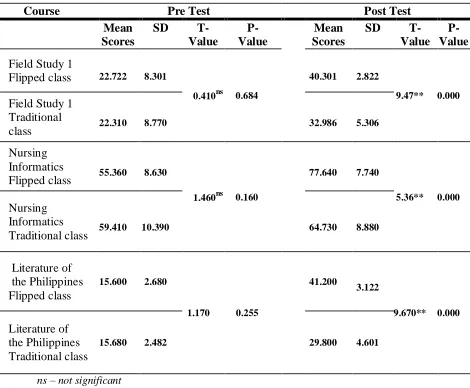
The results of the difference of the pre-post test results of students in flipped classrooms and the traditional classes from the different colleges are presented in Table 1
Table 1. Difference of the pre-post test results of the students in a flipped classroom and the traditional class in different courses
Course Pre Test Post Test
Mean Scores
SD T- Value
P- Value
Mean Scores
SD T- Value
P- Value
Field Study 1
Flipped class 22.722 8.301
0.410ns 0.684
40.301 2.822
9.47** 0.000
Field Study 1 Traditional
class 22.310 8.770 32.986 5.306
Nursing Informatics
Flipped class 55.360 8.630
1.460ns 0.160
77.640 7.740
5.36** 0.000
Nursing Informatics
Traditional class 59.410 10.390 64.730 8.880
Literature of the Philippines Flipped class
15.600 2.680
1.170 0.255
41.200 3.122
9.670** 0.000
Literature of the Philippines Traditional class
15.680 2.482 29.800 4.601
ns – not significant ** - highly significant at α = 0.01 ** - highly significant at α = 0.01 Field Study 1: n= 144 Nursing informatics: n= 44 Literature of the Philippines: n=50
There was no significant difference of the pre-test mean scores of the students in the flipped and traditional classes across three courses offered in the three colleges, implying that students’ performance was comparable in both classes prior to exposure to different ways of teaching. Significant scores were observed in courses with students exposed to flipped classrooms. Students performed better in the flipped classes than the traditional classes across selected courses. These findings confirmed that flipped classroom had several benefits for learners to increase their academic achievement (Davies et al., 2013) and improved students' engagement in their lessons (Millard, 2012). According to Lemmer (2013), it had created an atmosphere that responded to the students' preferences and accountabilities for their learning as cited by Pape et al. (2012). It also provided topics that were intended according to their learning profiles (Bergmann et al., 2013).
In the flipped classrooms, there were different phases with varied activities offered compared to direct instruction in the traditional way of teaching the different courses across three programs offered in the three colleges. Furthermore, the significant increase of the students' performance must have contributed to the nature of the flipped classroom where they can CNU Journal of Higher Education, Volume 12 (2018)
study and work at their own pace and time. This would imply that as college students they are more comfortable treated as independent learners working on their own pace outside the four-walled classroom. This is possible using technology as prepared by their teachers. Moreover, the generation is more adept in using technology in learning. The use of lessons online allow the students view many times and study again as needed (Educause Learning Initiative, 2012) that made the content more available (Acedo, 2013) if they could not do it in the class (Halili and Zainuddin, 2015).
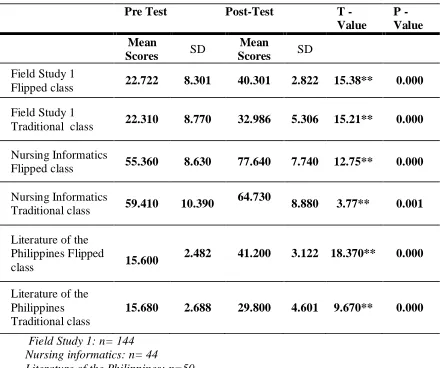
The researchers further looked into the difference of the students’ performance within groups. Table 2 presents the improvement of students’ scores of the students from different colleges exposed to a flipped classroom and the traditional way of teaching the different courses.
Table 2. Pre-post test results of the students in a flipped classroom and the traditional class in different courses
** - highly significant at α = 0.01
Field Study 1: n= 144 Nursing informatics: n= 44 Literature of the Philippines: n=50
Test items per course taught across discipline had a different total number of items. There were fifty (50) items validated for Field Study 1, one hundred (100) validated items for Nursing Informatics and fifty (50) items in Literature of the Philippines. There was a very significant mean gain as reflected in the scores of the students in flipped classes and the traditional classes across disciplines. The increase of the mean scores of the
students’ post-tests whether exposed to flipped classes or traditional teaching means that both strategies are effective. Students learn regardless of the strategy employed by the teachers. According to Kousar (2010), students learn when there is a proper application of any instructional strategy. However, students in this study performed better when they are exposed to a flipped classroom.
Students’ Motivation
The level of students’ motivation in the flipped and traditional classes are presented in Table 3.
Table 3. Students’ motivation level in flipped and traditional classes across disciplines
* - significant at α = 0.05 ** - highly significant at α = 0.01 Ranges for the weighted mean
Range Description 1.00 – 1.80 Not Motivated 1.81 – 2.60 Moderately Motivated 2.61 – 3.40 Motivated 3.41 – 4.20 Highly Motivated 4.21 – 5.00 Very Highly Motivated
There was a significant difference between the students' motivation level in the flipped and traditional classes. Generally, students in both classes were highly motivated. However, the level of motivation in the flipped classes was significantly higher compared to the students in the traditional classes. Maher et al. (2013) noted that students enjoyed more in their flipped classes with a worthwhile learning experience. Meanwhile, in the study of Baker (2000), students had encouraging insights toward the strategy because accessible resources provided them a mechanism for their learning. Moreover, Ruddick (2012) said that students found online lessons and resources very beneficial. Furthermore, students Pre Test Post-Test T
-Value P - Value Mean
Scores SD Mean Scores SD
Field Study 1
Flipped class 22.722 8.301 40.301 2.822 15.38** 0.000 Field Study 1
Traditional class 22.310 8.770 32.986 5.306 15.21** 0.000 Nursing Informatics
Flipped class 55.360 8.630 77.640 7.740 12.75** 0.000 Nursing Informatics
Traditional class 59.410 10.390
64.730
8.880 3.77** 0.001
Literature of the Philippines Flipped
class 15.600
2.482 41.200 3.122 18.370** 0.000
Literature of the Philippines Traditional class
15.680 2.688 29.800 4.601 9.670** 0.000
Motivation Level
Description T-Value
P-value
Field Study 1
Flipped class 4.28
Very Highly Motivated
6.89** 0.000
Field Study 1
Traditional class 3.79
Highly Motivated Nursing Informatics
Flipped class 4.05
Highly Motivated
2.73** 0.012
Nursing Informatics
Traditional class 3.78
Highly Motivated
Literature of the
Philippines Flipped class 4.10
Highly Motivated
5.85** 0.000
Literature of the Philippines Traditional class
3.49 Highly
Motivated
and parents' feedback on the flipped classroom was tremendously positive (Johnson, 2012). These contentions were supported by the student respondents saying:
I like most about watching movies because it motivates me how to become a good teacher. It gives me an idea of what is really in the field of teaching. After watching those films, they become an eye opener to me on what kind of teacher I will become someday. It leads me to realize, to become a teacher is not only about teaching the subject matter but also how to touch the hearts of the learners CTE 63
My most favorite part of our off-class is that the technology that we used for our lesson is very up-to-date that it appears very alluring to us students. Also, in our off-class lessons, we can navigate or research the internet in learning and researching the provided lesson CN 15
I like it most when we watched films and documentary videos outside the classroom. Even if we are not in school, we still have learnings because of the off-class. Through the internet, we still have a connection with our teacher. CAS 12
Since flipped classroom maximized face time (Pape et al., 2012), classroom interactive teaching and learning as mentioned by Millard (2012) helped the students to be more captivated and motivated to learn This finding affirmed that flipped classroom across disciplines is an active learning model (Toto and Nguyen, 2009) where online resources made the students actively engaged in doing their learning activities (Milman, 2012). Students and teachers interaction was also noted in this study that confirmed the study of Bergmann et al. (2013).
Students’ Engagement
Engagement refers to the students'
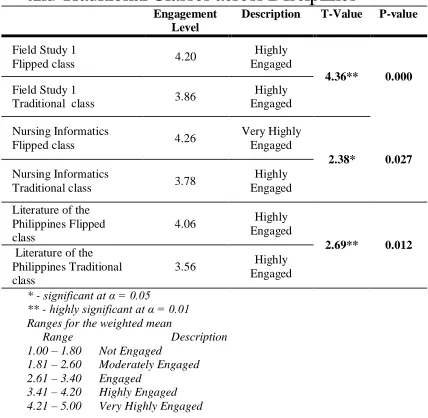
involvement and active participation in the teaching-learning process. Table 4 presents the students' engagement level in the flipped classroom and traditional classes.
Table 4. Students’ Engagement Level in Flipped and Traditional Classes across Disciplines
Engagement Level
Description T-Value P-value
Field Study 1
Flipped class 4.20
Highly Engaged
4.36** 0.000
Field Study 1
Traditional class 3.86
Highly Engaged Nursing Informatics
Flipped class 4.26
Very Highly Engaged
2.38* 0.027
Nursing Informatics
Traditional class 3.78
Highly Engaged Literature of the
Philippines Flipped class
4.06 Highly
Engaged
2.69** 0.012
Literature of the Philippines Traditional class
3.56 Highly
Engaged
* - significant at α = 0.05 ** - highly significant at α = 0.01 Ranges for the weighted mean
Range Description 1.00 – 1.80 Not Engaged 1.81 – 2.60 Moderately Engaged 2.61 – 3.40 Engaged 3.41 – 4.20 Highly Engaged 4.21 – 5.00 Very Highly Engaged
Students taught using flipped, and traditional classes were highly engaged. The activities provided by the teachers in both classes enabled involvement and active participation among the students. However, it can be gleaned from the table that there was a significant difference in the students' engagement level in the flipped and traditional classes in the Field Study 1 course. This means that education students were very highly engaged in their flipped classroom than those students in the traditional class. The videos and lectures they accessed online, and the activities provided by the teacher facilitated engagement in the teaching-learning process. The online resources found on the internet on theories and principles of teaching and actual teaching practice in the field provided the education students with opportunities for engagement. This was confirmed by the student who said that:
"What I like most in my off-class lessons is that I am given the opportunity to explore the new technology and applications that stimulate me as a learner. It makes me more creative and independent in doing the course requirement. Though tiresome, I enjoy the varied activities ‘coz I can do them at my place, time and pace. For me, it was very engaging". CTE38
CNU Journal of Higher Education, Volume 12 (2018)
Engagement of education students in a flipped classroom made them active independent and creative learners outside the classroom setting which was also affirmed by Fulton (2012). Moreover, in Nursing Informatics, there was a significant difference in the level of engagement between the two (2) groups. Nursing students were very highly engaged in the flipped class. They were actively involved in activities culled from a variety of sources in-class and off-class like watching videos and actively listening to lectures and demonstrations. Since the students are millennial, they had more access to computers and are more adaptive to non-traditional teaching methods. They have characteristics unique to the digital age era. Nursing Students using devices and gadgets such as iPod, Laptops, Smartphones, and IPAD tablets are a common occurrence. Lectures and traditional classroom and laboratory hours, although typical, from a professor's point of view, are now be enhanced by online video classes, use of electronic references, and other electronic modes which facilitated active participation of students. Students were more engaged and motivated to learn due to the variety of sources. This type of learning provided them authentic learning experiences instead of the pure traditional lecturing in the classroom. These results were found in statements such as:
“Technology supports our learning. This gives rise to critical thinking enhancement and allows us to familiarize and know more of what the lessons are. I hope other CI’s will also share notes or lecture online. Thanks in advance. – CN 9 And;
“When there are videos presented since I am a visual learner, I could learn easily.” – CN 3
“When we perform activities related to the lessons that we learn…because these activities can be applied in real life situations. When we do workshop and reinforcement activities. It gets to test our skills, not just our cognitive capacities.” – CN 13
Students enrolled in Literature of the Philippines were also highly engaged in the
flipped and traditional classes. However, a significant difference in the engagement level of the students in both groups was evident. Students were more highly engaged in their flipped classroom than students in the traditional class. This finding is supported by the student who said that:
“… what I like most about our off-class lessons is that I don’t need to go to school to learn and to pass my activities. I am free to choose where to do it and when to pass it as long as it is before the due date. I like it most when we watched films and documentary. Watching those films, made me reflect and realize as a Filipino even if the teacher is not discussing it with me.”. CAS 22
To sum, students engaged in flipped classrooms regardless of their course were very highly engaged. According to Fulton (2012), teachers using technology in the flipped classroom noted improved student performance, interest, and engagement. Students can access the course content outside their classroom as cited by Abeysekera and Dawson (2015). Hands-on activities and application of the lessons learned online allowed students to be more engaged while learning (Boyer, 2013; Ash, 2012; Demski, 2013 and Horn, 2013). The videos and the interactive lessons facilitated engagement including the real workshop (of hands-on activities and application of knowledge in class) that engaged the students in the teaching-learning process. The finding affirmed that the flipped classroom is an active learning model (Toto and Nguyen, 2009). Online resources made the students active in doing their learning activities than passive (Milman, 2012). Students and teachers interaction was also noted in this study that confirms the study of Bergmann et al. (2013).
Practices of the Flipped Classroom and the Traditional Classes
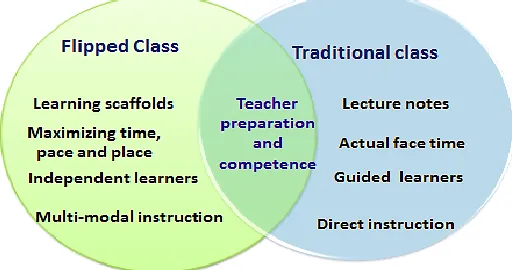
In the implementation of the flipped classroom and traditional classes, notable practices were evident. Figure 1 shows the prevailing practices identified using the thematic analysis.
Figure 1. Practices in the implementation of flipped and Traditional Classes
At the heart of the flipped and traditional class was the preparation and competence of the teachers. Teachers or professors in both classes had to prepare the lessons and instructional materials ahead of time. They had to use their expertise in designing interactive and engaging lessons. The professors during the implementation took more time in the preparation of the lessons in the flipped classroom than the traditional classes. They had to prepare online modules with varied online activities. When students were exposed to the flipped classes through Edmodo, professors evaluated, assessed and gave comments and suggestions to the students' outputs during off-class which were followed up during the on- class sessions. It took the professors' mastery of their course content, pedagogical skills and the right attitude towards the profession. According to Sawchuk (2011), the most important school-based factor that affects students' achievement is the teacher.
On the other hand, in the traditional classes, activities were conducted in class, so there was no need for the teachers to upload videos or online lectures for students to access. Classroom strategy was limited to direct instruction and the teachers provided activities while the students were in the class. The actual face time in their class discussion and activities for the application of the lessons helped students to focus and clarify their lessons. Students in the traditional classes learned the lesson with the guidance and supervision of their professors. Lewis (2002) cited that teachers make sure that all the content is covered in the given period. So, students during examinations got better scores even with the limited time and application. Thus, traditional teaching through direct instruction is still an effective
strategy. This is manifested in the answers of the following students:
“In our class, our professors gave the lecture while we listen attentively to come up with our notes to study which were very helpful during examinations.”CN39
" …I can ask my professor about the lessons that I found difficult and unclear, and she could easily clarify them for me…so during examinations I was very sure of my answers to the test items and concepts for it was thoroughly discussed in the class" CTE 126, CAS 36
Direct instruction as a traditional way of teaching is a highly organized teacher-directed approach, with the target behavior or objective where teachers prepared or gave notes. According to Ryder et al., (2006), this pedagogy emphasizes the interaction between teachers and students. Students were provided with direct instruction of the lessons and are spoon-fed with the concepts (Kirschner et al., 2006).
In flipped classes across courses, more learning scaffolds prepared by the professors were uploaded and used by the students in different time, place and pace that suit their needs which maximized their time for independent learning. The varied modes of instruction motivated and engaged the students for better learning opportunities through technology that also fit their learning styles. This was supported by the students who said that:
“…during off-class, I was interested and
so engaged in the variety of interactive
online activities in learning the lessons online at my own pace and time." CTE 68
"With Edmodo, I feel comfortable learning and relearning the lesson which took me time to comprehend." CAS 24
"There were more uploaded files for individual viewing and studying that makes my lessons easier." CN16
Results of the study indicated that use of instructional module, field study, on-class method, off-class, online learning management system: Edmodo, and independent study, through the implementation of the flipped classroom model, was successful. This contention was common to the students across discipline as stated.
“I like how the classroom setting is electronically advanced and modern as it makes the learning experience easier and more efficient. It allows us to make use of our time effectively and makes room for more rest and social interaction which I believe is just as important as learning in class.” – CN 9
Thus, learning takes place when students gain knowledge through activities, projects, and discussions (Ultanir, 2012) which was more enhanced in a flipped classroom for they became active independent learners (Minhas et al., 2012; Sams, 2013). Being active learners mean better grades than passive learners. According to Strayer (2008), through flipped classroom, students become more aware of their learning process. Students had more opportunities to gain a sense of how the tools and ideas they learned are used in the real world (Toto and Nguyen, 2009).
Challenges in the Implementation of the Flipped and Traditional Classes
The challenges met in the flipped class were more focused on computer accessibility and internet usage. The students unanimously mentioned more often the slow internet connectivity that hounds the Philippine internet connectivity scale. There are several possible reasons why the Philippine internet connectivity is a major problem such as poor internet access policy, network traffic access, less bandwidth subscription, and multiple users high download activity (Crawford, S. 2012). Additionally, these students in the flipped class would be able to download notes and powerpoint, but these were done
in multiple sessions due to the availability of computer units and due to Internet Service Providers (ISP) throttling data exchanges. Furthermore, the ISP's are implementing Data Capping to individual users for a certain period of time and day. Thus, these elements hinder students in accessing the modules, notes, videos, pertinent files uploaded by the teacher. These challenges affect students' engagement and motivation in learning. These are supported by the statement in the study as:
“Students will be needing a fast internet connection especially when accessing videos, which we cannot really predict because there are times when the internet is slow” – CTE 39
“Internet connectivity is not predictable and consistent, predisposing it to certain on-spot problems during downloads and online tasks” – CAS 31
“…lack of a stable internet connection or a slow computer processor. So we proceeded to internet cafes with better internet and equipment.” CN 8
In the traditional class, one of the identified challenges is the conducive learning environment. Students said that their engagement and motivation and performance are affected because of the distractions and noise. This is supported in the study as stated:
"The distractions are everywhere. Open windows, noisy students outside, school activities are simultaneously done during school days." – CN 6
Furthermore, the time constraints in note taking and attention span also decreased interest during long discussions and classroom interaction. Another reason that affected student performance was the absence of the teachers due to unscheduled appointments or meetings that need to be attended first. Thus, this would need a make-up session of the missed concepts. Moreover, the time for taking down notes of the lecture of the teachers was also identified as a challenge. This was supported by a nursing student's statement:
“…necessitates a lot of time, effort and resources in taking down notes.” – CTE 97
"No Teacher means "Class Assignment" which is due tomorrow." – CAS 15
"Some instructors are just too fast in their discussions. Also, some teachers are rushing to finish a lesson because of time constraints." –CN 22
“What I like most are the examples and illustrations that the professor provided during lectures because they make us understand the concept faster. But if they’re not around, we are missing more topics”– CN 34
"On class. You gotta be attentive. One missed the lesson and missed teacher, and you are missing out." – CAS 37
In the instructional process, both the traditional and flipped classes are faced with challenges that may affect the students' performance, engagement, and motivation in learning. This means that professors should be very keen and sensitive to the needs of their students to attain the instructional objectives of the courses that they are teaching.
CONCLUSION
This study has proven that both flipped and traditional classes enabled the students to learn the course competencies. Motivation and engagement are also evident in both classes. However, flipped classroom as an instructional model is an effective strategy in maximizing face time in teaching and learning across the three courses in three different college programs. The strategy elicits higher motivation and facilitates students' maximum engagement in various activities at their own pace, place and time that has improved their academic performance despite the limitation of computer and internet access and use. Thus, flipping classes as instructional delivery are innovatively responsive in the 21st century.
REFERENCES
Abeysekera, L. and P. Dawson, 2015, "Motivation and cognitive load in the flipped classroom: definition, rationale, and call for research." Higher Education Research and Development 34(1):1-14
Acedo, M. (2013). Ten pros & cons of a flipped classroom. Retrieved March 13, 2017, from http://www.teachthought .com/uncategorized/10-pros-cons-flipped-classroom
Alvarez, B. (2012). “Flipping the Classroom: Homework in Class, Lessons at Home,” Education Digest, vol. 77(8), April, p. 18-21
Ash, K. (2012). Educators view flipped model with a more critical eye. Education Week, 32(2), S6-S7.
Attebery, E. (2013). Flipped classrooms may not have any impact on learning. USA Today.
Bergmann, J., Overmyer, J., & Wilie, B. (2013, July 9). The flipped class: What it is & what it is not. The Daily Riff. Retrieved July 11, 2015, from http://www.thedailyriff. com/articles/the-flipped-class-conversation-689.php
Bergmann, Jonathan and Aaron Sams (2012). "How the Flipped Classroom Is Radically Transforming Learning." The Daily Riff, http://www.thedailyriff.com/articles/how-the-flipped-classroom-is-radically-transforming-learning-536.php. Date accessed: April 6, 2016
Boyer, A. (2013). The flipped classroom: Catering for difference. Teacher Learning Network, 20(1), 28-29.
Bull, G., Ferster B. and Kjellstrom, W. 2012, Inventing the Flipped Classroom. Learning and Leading With Technology 40 (1) retrieved from http://www.learning and leading –digital.com/learning and leading. Date accessed: April 2, 2016
Crawford, Susan. 2012, It’s Time to Fix the Pitifully Slow, Expensive Internet Access in the U.S..https://www.wired. com/2012/12/hey-dont-forget-about-internet-access-in-the-u-s/
Davies, R., Dean, D., & Ball, N. (2013). Flipping the classroom & instructional technology integration in a college-level information systems spread sheet course. Educational Technology Research & Development, 61(4), 563-580. http://dx.doi.org/10.1007/s11423-013-9305-6
Educause Learning Initiative. (2012). Seven things you should know about flipped classrooms. Retrieved December 20, 2016, from https://net.educause.edu/ir/library/pdf/ELI 7081.pdf
Fulton, K. (2012). Upside down & inside out: Flip your classroom to improve student learning. Learning & Leading with Technology, 39(8), 12-17.
FLN the Flipped Learning Network (2014). http://flipped learning.org/site/default.aspx?PageID=1
Frydenberg, Mark (2012). “Flipping Excel.” Proceedings of the Information Systems Educators Conference, Volume 29, Number 1914, 1-11.
Halili, S., & Zainuddin, Z. (2015). Flipping the classroom: What we know & what we don’t. The Online Journal of Distance Education & e-Learning, 3(1), 15-22.
Hoffman, E. S (2013). Beyond the flipped classroom: Redesigning a research methods course for instruction. Contemporary Issues in Education Research 7(1), 51-62.
Horn, M. (2013). The Transformational potential of flipped classrooms: Different strokes for different folks. Education Next, 13(3), 78-79.
Jensen, J.L. et al. 2015, "Improvements from a Flipped Classroom May Simply Be the Frits of Active Learning." Cbe-Life Sciences Educaiton 14 (1)
Johnson, G. (2012). Students, please turn to YouTube for your assignment. Education Canada, 52(5), 16-18.
Kirschner, P.A., Sweller, J., & Clark, R.E. (2006). Why minimal guidance during instruction does not work: An analysis of the failure of constructivist, discovery, problem-based, experiential, and inquiry-based teaching. Educational Psychologist, 41, 75-86.
Kousar, R (2010). The effect of direct instruction model on intermediate class achievement and attitudes toward English grammar. Journal of College Teaching and Learning 7, 99-103
Lemmer, C. (2013). A view from the flip side: Using the inverted classroom to enhance the legal information literacy of the international LL.M. student. Law Library Journal, 105(4), 461-491.
Lewis, C. C. (2002). Lesson study: A handbook of teacher-led instructional change. Philadelphia, PA: Research for Better Schools.
Maher, M., Lipford, H., & Singh, V. (2013). Flipped classroom strategies using online videos. Technical Report, Center for Education Innovation, University of North Carolina, Charlotte. http://cei.uncc.edu/sites/default /files/CEI%20 Tech%20Report%203.pdf accessed August 28, 2016.
Milman, Natalie B. (2012). “The Flipped Classroom Strategy: What Is It and How Can It Best Be Used?” Distance Learning, Volume 9, Number 3, 85-87.
Minhas, P., Ghosh, A., & Swanzy, L. (2012). The Effects of Passive and Active Learning on Student Preference and Performance in an Undergraduate Basic Science Course. Anatomical Sciences Education, 5(4), 200-207.
Pape, L., Sheehan, T., & Worrell, C. (2012). How to do more with less: Lessons from online learning. Learning & Leading with Technology, 39(6), 18-22.
Plaisent, M., Dayagbil, F., Pogoy, A. and Prosper B. (2016) Is Flipped Classroom a Tendency or a Fad? The Point of View of Future Teachers in the Philippines. Hershey, USA: IGI Global, 2016 – a chapter of Mobile and Blended Learning innovations for improved Learning Outcomes.
Rakow, S. (2007)All means all: Classrooms that work for advanced learners. Middle Ground, The Magazine of Middle
Level Education, 11(1), 10-12.
Ryder, R.J., Burton, J.L., & Silberg, A. (2006). Longitudinal study of direct instruction effects from first through third grades. The Journal of Educational Research, 99,179-191.
Sawchuk, Stephen. (2011) EWA Research Brief: What Studies Say About Teacher Effectiveness.National Education Writers Association.
Strayer, J. F. (2008). The effects of the classroom flip on the learning environment: A comparison of learning activity in a traditional classroom and a flip classroom that used an intelligent tutoring system. Dissertation Abstracts International Section
Talbert, Robert (2012). “Inverted Classroom.” Colleagues, Volume 9, Number 1, Article 7, http://scholarworks. gvsu.edu/colleagues/vol9/iss1/7
Toto, R., & Nguyen, H. (2009, October). Flipping the work design in an industrial engineering course. Paper presented at the 39th ASEE/IEEE Frontiers in Education Conference, San Antonio, TX.http://dx.doi.org /10.1109/FIE.2009.5350529
Towle, Antoinette, Breda, Karen ” Teaching the Millennial Nursing Student: Using a "Flipping the Classroom" Model, Nursing and Health 2(6): 107-114, 2014 http://www.hrpub.org.DOI: 10.13189/nh.2014 .020601, Copyright © 2014 Horizon Research Publishing
Tucker, B. (2012), the Flipped Classroom. Retrieved March 21, 2013, from http://educationnext.org/theflipped-classroom/
Ultanir, E. (2012). An Epistemological Glance at the Constructivist Approach: Constructivist Learning in Dewey, Piaget, and Montessori.