Chicago Journal of International Law
Chicago Journal of International Law
Volume 1 Number 2 Article 18
9-1-2000
Sovereignty and Multilateralism
Sovereignty and Multilateralism
Kal Raustiala
Follow this and additional works at: https://chicagounbound.uchicago.edu/cjil
Recommended Citation Recommended Citation
Raustiala, Kal (2000) "Sovereignty and Multilateralism," Chicago Journal of International Law: Vol. 1: No. 2, Article 18.
Available at: https://chicagounbound.uchicago.edu/cjil/vol1/iss2/18
Sovereignty and Multilateralism
Kal Raustiala*
I.
THE NEW SOVEREIGNTY'The recent surge of interest in sovereignty, exemplified by this symposium,
reflects the empirical reality of 21st century international relations. There are more
multilateral agreements and more multilateral institutions addressing more areas of
policy than ever before. While debates over the extent to which the current era is truly
the high-water mark for interdependence exist,
2it is the degree and nature of the
linkages between previously domestic policy and international law and institutions
that are noteworthy, and that have sparked, across the political spectrum, concern
with global governance and its implications for sovereignty.
As Stephen Krasner's excellent new book makes dear, sovereignty has always
been a plastic norm in practice. As a concept it is used in varying ways and to denote
different things The motivating question behind most thoughtful discussions of the
impact of global governance on United States sovereignty is not whether institutions
such as the World Trade Organization ("WTO") somehow have seized US
decision-* Acting Professor, UCLA School of Law. [email protected]. This essay is an extended version
of comments given at the American Enterprise Institute Conference. I thank the organizers at AEI for inviting me to participate. Many thanks to Steve Charnovitz, Greg Shaffer, and Richard Steinberg for helpful comments on an earlier draft, and to Lara Stemple for support throughout the process.
1. With apologies to the late Abe Chayes and to Toni Chayes; Abram Chayes and Antonia Handler Chayes, The New Sovereignty (Harvard 1995).
2. An early but durable example is Kenneth N. Waltz, Theory of International Politics 139-143
(Addison-Wesley 1979). Similarly, Krasner argues that the traditional Westphalian view of sovereignty was in fact often violated in the past to suit the great powers, hence the current preoccupation with the "retreat" or "porosity" of sovereignty is ahistorical. See generally Stephen D. Krasner, Sovereignty: Organized Hypocrisy (Princeton 1999).
3. Krasner distinguishes four types of sovereignty. Westphalian, domestic, international legal, and
Cicagojournaf of7nternationafLaw
making powers. This notion of sovereignty-sovereignty as formal control-is not seriously in doubt. The important question is instead a subtler one: whether the development and expansion of multilateral institutions are systematically altering our customary modes of domestic law and politics. Put differently, the question is: have we delegated away a significant part of our capacity for, and manner of, self-government in the process of international cooperation.
In his article5
in this symposium, John McGinnis turns this question on its head. The true threat to sovereignty, he argues, is precisely our customary modes of law and politics. Contemporary American politics, which McGinnis understands through the lens of public choice theory, is naked interest-group politics. Interest groups compete to use the state as a vehicle for rent-seeking and for imposing their normative visions, and attendant policies, on the majority. In this the few and well-organized benefit at the expense of the many. (The reverse presumption, as many have noted, of Footnote 4 of Carolene Products.)6
Rent-seeking by discrete interest-groups was aided by the advent of the New Deal and the rise of the 20th century bureaucratic regulatory state. McGinnis argues it is now further extended and reinforced by the expansion of international law and institutions. Rather than global governance per se, it is the tyranny of faction and the pervasiveness of rent-seeking and redistribution-often in the form of economic protectionism-which is in fact the major threat to our
sovereignty.
Against this threat the WTO and its norm of non-discrimination acts as an
exemplary bulwark. Echoing Tumlir
7Hudec, and others, McGinnis argues that, far
4- In other words, black helicopters are not the issue. For a very interesting extended analysis of the implications of international law and institutions for US sovereignty, see Jeremy Rabkin, Why
Sovereignty Matters (AEI Press 1998). As I discuss below, in my view the central problem is less the
loss of sovereignty than the concomitant-given the current characteristics of international law and insttudons-loss of democracy in decisionmaking. Sovereignty relinquished can be empowering: the creation of the United States, for example, involved a reallocation of sovereignty to the new federal government that was collectively welfare-enhancing for the stares. And at a more basic level the transfer of sovereignty, however fictionalized, inherent in social contract theories of the state is viewed as necessary for human freedom. Reallocations of sovereignty involving a loss of democratic process are often more troubling. For a similar view see Phillip R. Trimble, Globalization, International
Institutions, and the Erosion of National Sovereignty and Democracy (review of Thomas M. Franck, Fairness in International Law and Institutions (Oxford 1995)) 95 Mich L Rev 1944, 1948 (1995): 'The creation of activist international institutions necessarily entails more loss of national sovereignty, and unless international lawmaking and institutions are indeed further transformed, the consequence could be the erosion of democracy as well. The loss of sovereignty does not trouble me, but the loss of democracy is another matter."
s. John 0. McGinnis, The Political Economy of Global Multilateralism, 1 ChiJ Intl L 381 (2000). 6. United States v Carolene Products Co, 304 US 144,148-149 (1938).
7. Jan Tumlir, Protectionism: Trade Policy in Democratic Societies 61-70 (API Press 1985). As Robert
Hudec notes in a review of Tumlir's work, "rumlir argued that removal of the power to discriminate would by itself make a substantial contribution to the reform of domestic constitutional process, indirectly, because discrimination is often the key element in the type of deals made within the'black
Sovereignty andL.Muftifaterafism
from threatening sovereignty, multilateral free trade Agreements act to protect sovereignty properly understood. The WTO polices and checks rent-seeking policies at the domestic level, vindicating the (often unexpressed) will of the majority.
McGinnis' particular contribution to this line of thought is to link the rent-seeking/sovereignty argument to contemporary concerns about the growing ambit of international law. He argues that other multilateral efforts, such as environmental or human rights agreements, lack the democracy-enhancing qualities that free trade agreements such as the WTO possess. Indeed, most forms of multilateralism are highly suspect because they have the opposite qualities-they enhance not democracy but the power of the state and therefore of special interests. They represent and promote the extension of that power to the global level. As a result, he suggests, the proper conservative view of multilateralism should be discriminating, not dismissive. Trade multilateralism should be favored and other types of multilateralism disfavored, and this preference mix is not simply reflexive but principled.
I want to commend McGinnis for making this argument, which, though deeply flawed in my view, is also engaging on many levels. I also think if he is right he has presented a very compelling case for why the WTO is in fact a threat to sovereignty-and I can only imagine what Seattle would have been like if his ideas had been widely circulated among the protestors.
In the remainder of this essay I explore several issues raised by the linkages between sovereignty and multilateralism. In Part II, I critique McGinnis' positive claims about multilateral cooperation, and his attempt to normatively distinguish international trade law from other forms of multilateralism. Part III then inquires into the nature of the "democracy problem" in international law. I argue that a focus on the substance of international legal agreements is not compelling. I present a basic framework for analysis of the democracy problem, and use it to suggest a better approach, which instead focuses on the structure and process of international lawmaking. Part IV then briefly considers the question of sovereignty in light of recent theorizing on the changing nature and meaning of sovereignty. Part V concludes.
box' of unchecked executive power." Robert E. Hudec, The Role ofJudicial Review in Preserving Liberal Foreign Trade Policies in Essays on the Nature of International Trade Law 133, 139 (Cameron May 1999). S. Robert E. Hudec, 'Circumventing" Democracy: The Political Morality of Trade Negotiations, 25 NYU J
Ind L & Polit 311 (1992). Hudec has a more nuanced and equivocal position than does McGinnis,
but the central idea-thar omnibus international trade deals are more democratic than the protectionist policies that emerge from rent-seeking in Congress-is similar.
Ciicagojournafoflnternationa(Law
IL DISCRIMINATING MULTILATERALISM
At a certain level of generality the persuasive powers of
McGinnis'
argument about global governance rest, to follow his analogy, on whether one favors or disfavors the changes wrought by the New Deal and the post-war rise of the modern regulatory state9 (He clearly does not favor these changes.) At an even higher level of generality, the critical issues are one's conceptualizations of democracy and sovereignty and hence of what is and is not democracy-, or sovereignty-, enhancing. But let me first bring the inquiry down to earth by engaging more closely the New Deal analogy"0 and the positive claim that types of multilateralism can be fruitfully distinguished on normative grounds: that international trade agreements-and here I will, following McGinnis, use the WTO as a proxy-somehow embody simple negative rights that are ably policed by judicial bodies whereas other regulatory treaties-and I will use international environmental agreements as a proxy-embody complex positive rules that require intrusive, sovereignty-threatening international bureaucracies.The first part of this claim I will call the "non-discrimination norm" argument. The WTO's multilateralism is sovereignty- and democracy-enhancing, this argument goes, because it polices the redistributive excesses of the modern welfare state by forcing governments to adhere to a norm of non-discrimination in economic commerce. Following Tumlir, it suggests that "Protectionism is a constitutional failure" and thus the WTO a beneficial, corrective force." I will call the second part of the claim the "international bureaucrats" argument. Other multilateral agreements are comparatively disfavored because they create international bureaucrats who make policy through international law rather than simply enforce negative rights. This McGinnis claims promotes and extends rent-seeking to the global level, is democracy-reducing, and is a threat to our sovereignty.
A. Non-discrimination and the WTO. The core problem with the
"non-discrimination norm" argument in favor of a powerful WTO is that the WTO agreements contain much more than a simple non-discrimination rule. The Uruguay Round agreements, which took nearly a decade to negotiate and cover thousands of pages, include regulatory rules of great complexity that go far beyond the simple picture McGinnis paints. Perhaps the most grievous offender is the Trade-Related Intellectual Property accord ('TRIPs").
9. John Ruggie famously termed the juxtaposition of the modem welfare state with liberal international economic institutions the "compromise of embedded liberalism." John Gerard Ruggie, International Regimes, Transactions, and Cbange: Embedded Liberalism in the Postwar Economic Order, in Stephen D. Krasner, ed, International Regimes 195,209 (Cornell 1983).
lo. The New Deal was invoked as an important precursor and model for the post-war international architecture in Anne-Marie Burley, Regulating the World: Multiateralism, International Law, and the Projection of the New Deal Regulatory State, in John Gerard Ruggie, ed, Multilateralism Matters (Columbia 1993).
11. This aphorism is attributed by Hudec to Tumlir. See Hudec, Essays at 133 (cited in note 7).
4o.
x
No. z
Soveregnty anduftifateralism
TRIPs was included in the Uruguay Round agreements largely at the behest of the US, a leading producer of pharmaceuticals, Hollywood films, compact discs, and other products that depend heavily on intellectual property protection. TRIPs addresses much more than discrimination against foreign products. TRIPs' central focus is in fact the setting of "minimum standards;" the agreement affirmatively sets floors for various facets of intellectual property protection that apply to all WTO parties.12 TRIPs contains, among others, rules that not only dictate globally-uniform patent lengths (20 years, which was 3 years longer than the former US patent length and thus required a change in US domestic law), but also the structure of domestic civil and criminal remedies required to police violators and enforce intellectual property rights. The latter obligations in particular go to the heart of what we might consider core domestic policy-the organization of the domestic judicial system.
While TRIPs is noteworthy for the degree of its positive, regulatory focus, and in particular for its detailed provisions regarding domestic legal procedures, it is not an anomaly within the WTO. The Technical Barriers to Trade and Sanitary and Phytosanitary accords similarly contain rules, such as the requirement of scientificaly-based risk assessment, the requirement of regulatory consistency, and the presumptions given to international standards such as the Codex Alimentarius, that go well beyond non-discrimination per se.3 In the Australian Salmon case,14 for example, Australia's regulations on salmon imports were found to be in violation of the SPS agreement because the SPS-required risk assessment relied too much on "unknown and uncertain elements." While these rules are aimed at liberalization, they do so by using positive regulatory rules that prescribe both the substance and process of domestic policy. Other WTO rules, such as those on countervailing duties and anti-dumping, also go well beyond non-discrimination but have a far more questionable liberal pedigree.
In these ways-and others-the WTO organizes, rather than simply liberalizes, international trade. The WTO agreements are in the aggregate broadly liberalizing, but, in a complex world of interdependent states, liberalization entails an increasing
12. For extensive overviews of the legal provisions see Friedrich-Karl Beier and Gerhard Schricker, eds,
From GATT to TRIPs-The Agreement on Trade-Related Aspects of Intellectual Property Rights (Max
Planck Institute 1996); David Gervais, The TRIPs Agreement. Drafting History and Analysis (Sweet & Maxwell 1998); and Rochelle Cooper Dreyfuss and AndreasF. Lowenfeld, Two Achievements of the
Uruguay Round: Putting TRIPs and Dispute Settlement Together, 37 VaJ Ind L 275 (1997).
13. For an overview of SPS and TBT, see Donna Roberts, Preliminary Assessment of the Effects of WTO
Agreement on Sanitary and Pbytosanitary Trade Regulations, 1 J Ind Econ L 377 (1998); Steve Charnovitz, Improving the Agreement on SPS, in Gary P. Sampson and W. Bradnee Chambers, eds,
Trade, Environment, and the Millenium 171 (UN University 1999).
14. World Trade Organization, Report of the Appellate Body, Australia-Measures Affecting the
Importation of Salmon, 'WT/DS18/AB/R, para 129 (Oct 20, 1998); Charnovitz, Trade, Environment
at 178 (cited in note 13).
Cbicagojourna of 7nternationa(iLaw
focus on complex, so-called "behind-the-border" issues." Far from a simple norm of
non-discrimination, the WTO agreements contain exactly the sort of
domestic-focused, policy-constraining and policy-determining rules that characterize most
forms of multilateralism, including multilateral environmental accords.
This characteristic is, moreover, not limited to the text of the WTO agreements
themselves. The WTO dispute settlement system is perhaps the most famous
outcome of the Uruguay Round. Dispute settlement in the WTO also involves, as
recent jurisprudence makes clear and legal theory should make unsurprising, more
than just the simple application of a non-discrimination norm. For example, in the
1998
Shrimp-Turtle
6case, which involved US measures related to the import of sea
turtle-safe shrimp, the WTO Appellate Body explicitly endorsed an "evolutionary"
interpretation of the GATT Article XX environmental exceptions. (The Article XX
clauses are exceptions to the general disciplines of the GATT, such as national
treatment or most-favored nation status.) The text of Article XX, the Appellate Body
noted in its decision, was crafted "more than 50 years ago" and "is not 'static' in its
content or reference but is rather 'by definition, evolutionary.
17In other words the
scope and meaning of the GATT exceptions, and hence of the core GATT rules
themselves, can and do evolve. The competence to assess that evolution is apparently
the Appellate Bodys.
It is true that the terms of the Dispute Settlement Understanding that created
the WTO dispute system purport to restrict the Appellate Body and the panels from
adding to or diminishing the rights of the parties. But this restriction is difficult to
square with ideas like an evolutionary doctrine of GATT interpretation. And indeed
it is probably intrinsic to the creation of a judicialized process of dispute resolution
that some policymaking power will be exercised by the created judiciary. The WTO
agreements contain both rules and standards, and, as Joel Trachtman has argued, part
of the function of the WTO dispute resolution system is the incremental
development of these standards ex post by the dispute settlement bodies. That the
incremental development of standards ex post may be in certain circumstances more
efficient than the negotiation of more detailed rules ex ante
9does not gainsay the fact
that the WTO Agreements not only create positive regulatory standards but they do
so by shifting some measure of policy-making power to an international
quasi-judiciary.
i5. For a general discussion, see Robert Z. Lawrence, Albert Bressand, and Takatoshi Ito, A Vision for
the World Economy: Openness, Diversity, and Cohesion (Brookings 1996).
16. World Trade Organization, Report of the Appellate Body, United States-Import Prohibition of
Certain Shrimp and Shrimp Products, WT/DS58/AB/R (Oct 12, 1998).
17. Id at VI(B)(1), citing the Nambia Advisory Opinion (1971) of the International Court ofJustice.
i8. Joel Trachtman, The Domain of WTO Dispute Resolution, 40 Harv Ind LJ 333 (1999).
19. Id. Trachtman discusses the benefits and detriments of rules versus standards in the international trade context.
Soveregnty and.Auftifateralism
In short, when looked at empirically and in totality,,the WTO is engaged in much more positive regulation and rule development, both in the WTO agreements and in the work of the dispute settlement bodies, than one would guess from the "non-discrimination norm" claim. The non-discrimination norm argument simply does not reflect the evidence.
B. The Globalizing Welfare State and the Global Environment Let me shift the focus to the other half of McGinnis' argument, the "international bureaucracies" claim vis-a-vis other kinds of multilateralism such as environmental protection. McGinnis correctly identifies externalities and global commons problems as legitimate grounds for multilateral cooperation for the environment. But he then suggests a number of countervailing problems that, he argues, on balance match or overwhelm these grounds. These include the claim that multilateral environmental agreements are rigid accords that impose uniform, and hence inefficient, standards on all parties; that multilateral environmental agreements require intrusive international bureaucracies to monitor and police implementation and compliance; and that multilateral environmental agreements are likely inferior to international common law actions.'
Each of these claims echoes a critique of government regulation generally. Regardless of their veracity elsewhere, in the context of multilateral environmental cooperation nearly all of these countervailing problems are false or overstated. I will make four basic points in this regard.
First, the claim that multilateral environmental treaties invariably impose uniform regulatory standards on parties is empirically false. Many, such as the Kyoto Protocol,2' explicitly impose differential regulatory obligations not only on members of the Organization for Economic Co-operation and Development ("OECD") vis-a-vis non-OECD states but also within the OECD itself. (Differentiation in obligations between OECD and non-OECD states is almost a requirement in contemporary international environmental law). Similarly, the Long-Range Transboundary Air Pollution regime varies its regulatory standards based on the particular environmental conditions present in different areas' -a sort of jurisdictional differentiation that should be congenial to many conservatives.
Second, the notion that concerns over compliance with international environmental obligations inevitably entail intrusive bureaucracies operating inside the
20. See McGinnis, 1 ChiJ Intl L 388-92 (cited in note 5).
21. Kyoto Protocol To the Framework Convention on Climate Change ("FCCC") (1992) at
<www.unfccc.de> (visited Sep 16, 2000).
22. The "Annex B" states have different emissions targets for the first commitment period, ranging from
an 8% reduction in the case of France to a 10% increase in the case of Iceland, based on 1990 levels.
For an overview, history, and analysis see Michael Grubb, Christiaan Vrolijk and Duncan Black,
The Kyoto Protocol' A Guide and Assessment (Royal Institute of International Affairs 1999).
23. See the discussion of the "critical loads" concept in David Hunter, James Salzman, and Durwood
Zaelke, eds, International Environmental Law & Policy (Foundation 1998).
Cbicago.Journafof 7nternationa(Law
territories of parties to monitor compliance-relevant activities ignores much of what
we know about the role and production of treaty compliance.' The positive study of
compliance with international law is in its infancy, but one thing seems clear:
compliance with international regulatory agreements is rarely the direct result of the
legally-binding nature of international rules, It is instead a largely political and
structural process, driven by many variables: national interest; the structure of the
underlying problem and of strategic action; the legal standard employed; linkage
politics, power, and the structure of the international system; norms of behavior; and
domestic political and market pressures.' Legality per se plays only a small role. This
is as true of the WTO as it is of the Montreal Protocol on Substances That Deplete
the Ozone Layer. Compliance with international environmental regimes is generally
considered high,' and while analysts grapple with the precise causality of these
regimes, none of the regimes relies upon an intrusive international bureaucracy,
particularly one operating inside the territories of the parties, for its success.2 As an
aside, while some multilateral environmental agreements do contain provisions for site
visits to ascertain or substantiate factual claims by the parties,' so does the Trade
Policy Review Mechanism in the WTO.2
Third, the notion that some kind of international common law action could and
should take the place of multilateral environmental agreements is, in my view, fanciful.
One central lesson to emerge from the history of public international law is that
international adjudication barely exists and rarely works. The WTO is in fact quite
anomalous in this respect, for reasons that relate to the nature of international trade
and the fact that the ability to retaliate through the authorized suspension of trade
24. For a general discussion, see Kal Raustiala, Compliance and Effectiveness in International Regulatory Cooperation, Case W Res J Ind L (forthcoming 2000); Beth Simmons, Compliance with International
Agreements, Ann Rev Polit Sd (1998); Ronald B. Mitchell, Compliance Theory: An Overview, in James
Cameron, et al ed, Improving Compliance with International Environmental Law 3 (Earthscan 1995); Chayes and Chayes, New Sovereignty (cited in note 1).
z. See Kal Raustiala and Anne-Marie Slaughter, Compliance, in Walter Carlnaes, Thomas Risse, and
Beth Simmons, eds, The Handbook of International Relations (forthcoming).
26. See, for example, Harold K Jacobson and Edith Brown Weiss, Assessing the Record and Designing
Strategies to Engage Countries, in Harold K Jacobson and Edith Brown Weiss, eds, Engaging Countries: Strengthening Compliance with International Envrionmental Accords 511 (MIT 1998).
27. On effective environmental cooperation, see Oran R. Young, ed, The Effectiveness of International
Environmental Regimes: Causal Connections and Behavioral Mechanisms (MIT 1999) and David G.
Victor, Kal Raustiala, and Eugene B. Skolnikoff, eds, The Implementation and Effectiveness of
International Environmental Commitments (MIT 1998).
28. For example, the FCCC, the Ramsar Convention (on wetlands), and the World Heritage
Convention.
29. See Donald B. Keesing, Improving Trade Policy Reviews in the World Trade Organization (Institute for
International Economics 1998).
r0
ol.
iNo. z
Soveretnty andc .utifateratism
benefits creates deterrence and forces implementation and compliance.' I have no sense of how or why a quasi-common law action would work in an anarchical international system, what tribunal(s) would be employed, or how the problems of compliance with international rules-whatever they may be-are not simply replicated, if not exacerbated, under this proposal.
Finally, the fact remains that many problems, such as ozone depletion, are truly transboundary or global in nature. Any meaningful effort to solve them requires multilateral cooperation. That cooperation in almost all cases involves government delegates formally negotiating international agreements, which are then adjusted over time by those same delegates.1 The degree to which there are agency problems with this delegation varies, but the negotiators are not "international bureaucrats." The international bureaucracies that do exist-the treaty secretariats-are quite small and almost completely powerless. The Ozone Secretariat, for example, which administers the Montreal Protocol, consists of about ten staff members in a short hallway of the
UN building outside Nairobi. The specter of powerful, intrusive international
environmental bureaucracies, which runs through McGinnis' article, is highly overstated. Such bureaucracies in reality exist only to a quite limited degree. Ironically, that degree is far more pronounced in international trade law, where the WTO Secretariat, which has a staff of 500, is widely known to play more of a role in dispute settlement deliberations, than it is in international environmental law.
III. WHAT IS THE DEMOCRACY PROBLEM IN INTERNATIONAL LAw.
My claim above is that the empirical predicate for both the "non-discrimination norm argument, and for the "international bureaucracies" argument, is simply not there. Discriminating between multilateralisms on the basis of these arguments is
3o. The WTO dispute resolution system is often cited as a model for other areas of international law; see, for example, Ernst-Ulrich Petersmann, Dispute Settlement in International Economic Law-Lessons
for Strengthening International Dispute Settlement in Non-Economic Areas, 2J Inl Econ L 189 (1999). On
the WTO vis-i-vis other international tribunals, see Jonathan I. Charney, The Impact on the
International Legal System of the Growth of International Courts and Tribunals, 31 NYUJ Intl L & Polit
697, 701 (1999) (stating that ".. .a comparison of the number of cases handled by the International Court of Justice and those handled by the highest courts of states, or even several other standing international dispute settlement tribunals shows that the International Court ofJustice's caseload is relatively low.") The formal dispute resolution procedures that are boilerplate in international environmental agreements have, to my knowledge, never been invoked, with the possible exception of the recent decision by the International Tribunal for the Law of the Sea in the "Bluefin Tuna" cases. See International Tribunal for the Law of the Sea, Southern Bluefin Tuna Cases, Order for Provisional Measures (Aug 27, 1999), <http://www.un.org/Depts/los/ ITLOS/Order-tuna34.htm> (visited September 16, 2000). The Law of the Sea Convention, while it has environmental elements, is at the fringes of international environmental law.
31. This adjustment process is not without its normative problems, particularly where binding majority
vote is the mode of change. See below and Kal Raustiala, Democracy, Sovereignty, and the Slow Pace of
International Negotiations, 8 Intl Envir Aff 3 (1996).
Cbicagojournaf of 7nternationaf Law
unjustified and unpersuasive. But even if it were, McGinnis' article would provide a manifesto for anti-VTO forces. It does so because it suggests that there is a democratic argument for a WTO that regulates, and regularly strikes down32, duly-enacted domestic legislation. This view is diametrically opposed to what many see as the democratic concern with the WTO, and hence raises the question: what is the true nature of the democracy problem in international law?
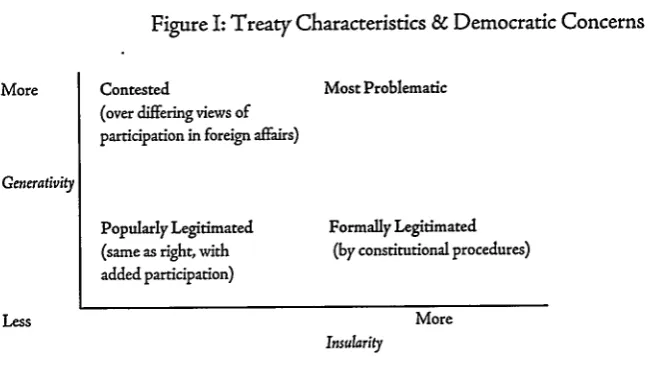
A. Generativity and Insularity. From a normative standpoint of concern with the theory and practice of democracy,33 I would suggest, as a very basic first cut, and contra McGinnis, that there are two key problems with much contemporary international law: generativity and insularity. By generativity I mean the ability of international institutions to produce new substantive rules that modify or extend a given legal agreement.35 By insularity I mean both the degree of transparency and of
non-executive branch (for example, legislative/public) participation in the international institution and its decisions."
Both of these problems are real, and have become increasingly salient as international law has progressively strengthened and expanded.37 Foreign affairs are, in the US and elsewhere, traditionally the province of the executive branch. Legislative and judicial roles, not to mention public input, are limited both in the negotiation of treaties and in their operation and adjustment." Transparency of decision-making in many international institutions as a result is quite low. And while treaties are often analogized to contracts between governments, treaties are sometimes constitutive in
32. I use this term loosely. The WTO cannot literally strike down domestic legislation, though it can
have this effect in practice.
33. There are dearly many theories and practices of democracy. Here I only refer to the most basic,
simple notion of accountable, representative rule.
34. An alternative depiction is that the problem is one of legitimacy. But since legitimacy is a perception based on varied factors, stressing legitimacy may just beg the question of what is considered legitimate in a given polity. The meaning of legitimacy and of the legitimacy problem in international law is analyzed in detail in Dan Bodansky, The Legitimacy of International Governance: A
Coming Challenge for International Environmental Law?, 93 AmJ Intl L 596 (1999). As Bodansky notes,
the central issue may be legitimacy but democracy is in fact the touchstone of legitimacy in the contemporary era.
3S. A paradigmatic case is the Montreal Protocol, which has extended the ambit of its regulation several
times since the Protocol came into force, and can do so through majority rule.
36. I thus do not address the issue of insularity in the negotiation of international agreements. Here the
issues are more complicated and I defer them to a future article. On accountability and international lawmaking processes generally, see Paul B. Stephan, Accountability and International Lawmaking- Rules,
Rents, and Legitimacy, 17 NwJ Intl L & Bus 681 (1996-97).
37. An early piece on the topic is Karl Kaiser, Transnational Relations as a Threat to the Democratic Process,
25 Intl Org 706 (1971).
38. Executive branch dominance is explored in Joel R. Paul, The Geopolitical Constitution: Executive
Expendiency and Executive Agreements, 86 Cal L Rev 671 (1998). A plea for less judicial deference in
foreign affairs generally is contained in Thomas M. Franck, Political Questions/Judicial Answers (Princeton 1992).
Sovereignty andcLuftiaterafismu
that they give rise to rule-making processes. In some contemporary international law,
such as the WTO, new rules develop and old rules evolve in unforeseen ways
post-ratification. State consent has long been the core basis of conventional international
law, but the rise of non-consensual decisionmaking procedures (for example, those
with majority or supra-majority rules) undermines even this, limited, basis.39These two problems-generativity and insularity-are also closely related conceptually. The most problematic international agreements are treaties that give rise to ongoing, generative, and closed decision processes.
For example, from an insularity perspective there is little problem with a non-generative, duly-ratified treaty. This is because we have an established and legitimate-though sometimes circumvented-process for Senate advice and consent,4' and by definition in a non-generative treaty we know in advance what the rules are. A generative treaty that contains well-defined rules and roles for stakeholders-in other words, a generative treaty that is non-insular-may also be unproblematic. This is, however, a much more complex question that touches upon contested normative issues, such as the appropriate role of interest groups in international affairs specifically and politics generally. To the degree that generativity and insularity are combined, questions of accountability and democracy arise. These characteristics of generativity and insularity are best thought of as continuous rather than binary. They are depicted spatially below in Figure I:
39. For a brief survey, see David A. Wirth, Reexamining Decision-Making Processes in International
Environmental Law, 79 Iowa L Rev 769 (1994). See also Raustiala, 8 Intl Envir Aff 3 (cited in note
31); Bodansky, 93 Am J Intl L 596 (cited in note 34). Bodansky suggests that as international
environmental law expands and deepens, effective lawmaking and adjustment will require non-consensus decisionmaking. Non-non-consensus decisionmaking is currently found in, inter alia, the Montreal Protocol, the Articles of Agreement of the World Bank and IMF, the World Health Organization, and various treaties of the European Union. Customary international law poses similar problems.
4o. There are two caveats here from a US perspective. First, this is true unless we see the President and
the Senate colluding in some deal to benefit themselves at the expense of the nation-an unlikely outcome. Second, the precise constitutional scope of the treaty power remains terra incognita, and so some non-generative treaties, duly ratified or not, might be impermissible on constitutional grounds. On the constitutional scope of the treaty power, see Rabkin, Why Sovereignty Matters (cited in note 4), and Curtis A. Bradley, The Treaty Power and American Federalism, 97 Mich L Rev 390
(1998).
41. The formal Senate procedures are not always employed. I see the two-house approach used in many
agreements as equally legitimate from a political standpoint. On the constitutionality debate over the two-house approach see, for example, Bruce Ackerman and David Golove, Is NAFTA ConstitutionaL',
108 Harv L Rev 801 (1995).
Cbicagojournalof 7nternationa(Law
Figure I: Treaty Characteristics & Democratic Concerns
More Contested Most Problematic
(over differing views of participation in foreign affairs)
Generativity
Popularly Legitimated Formally Legitimated (same as right, with (by constitutional procedures)
added participation)
Less More
Insularity
The 'WTO falls somewhere in the center, approaching the upper right "most
problematic" quadrant. Its generative characteristics flow from two factors. First, the
active dispute settlement process in practice elaborates and defines WTO rules and
standards ex post. GATT Article XX(g), for example, which addresses "exhaustible
natural resources," was almost surely not considered, by the original GATT
negotiators or even by many of the Uruguay Round negotiators, to encompass living
species such as sea turtles. But the WTO Appellate Body, using its "evolutionary"
theory of interpretation, has declared that it does encompass living creatures. In doing
so, it announced a new rule of international trade law. Second, the incorporation of
otherwise non-binding international standards, such as the Codex
Alimentarius,
that
provide presumptions of compliance or regulatory safe harbors with WTO
obligations produces generativity when those international standards change and
evolve ex post. The WTO is also fairly insular-though that insularity is diminishing
as the WTO more actively embraces non-governmental organizations." For example,
one aspect of the Appellate Bodys decision in
Shrimp/Turtle
was the explicit
acceptance of non-governmental amicus briefs, whose status in the dispute process
previously was unclear.
Generativity is not unique to international law. It is common in domestic law. It
is a core facet of our modern administrative state, which was largely created by
generative grants of power to administrative agencies. In domestic affairs the
generativity problem raised by administrative agencies is addressed through
administrative law: by having judicial review of agency discretion; by demanding an
42. Greg Shaffer, The World Trade Organization Under Cballenge: Democracy and the Law and Politics of the WTO's Treatment of Trade and Environment Matters, Harv Envir L Rev (forthcoming 2000); Dan Esty, Non-Governmental Organizations at the World Trade Organization: Cooperation, Competition, and
Exclusion, 1 J Intl Econ L 123 (1998); Steve Charnovitz, Participation of Non-Governmental
Organizations in the World Trade Organization, 17 U PaJ Ind Econ L 331 (1996).
Sovereinty andc(Juftilateralism
intelligible principle in the delegation of power-in practice often a very low standard; through direct Congressional oversight and budgetary control; and by replicating the larger political process through the Administrative Procedures Act and subsequent rules and rulings elaborating these procedural demands.43 (This last method directly addresses insularity, moving as it were from the lower right to the lower left in the space defined in Figure 1.) The world of the 20th century compelled the creation of an administrative state, and we tried to react accordingly by granting generative powers to the new agencies but then cabining the policy process and ensuring popular participation in many spots along the way.4' In the late 20th and now the 21th century we have begun to realize that the contemporary world demands international cooperation. We have accordingly begun to create generative international institutions, but the parallel control and accountability schemes have not been provided.
This is not to say that international institutions are very independent, but rather to say that they, like many administrative agencies, largely work as the agents of the executive branch(es) and face even less oversight by legislators and the general public. This state of affairs fuels the claims of a democratic deficit claims that were loudly heard in Seattle.
These claims, to be sure, are often overstated. The arguments that the WTO dispute process is illegitimate because it is dosed and unaccountable at times ring hollow because WTO panels, and especially the Appellate Body, are much like domestic courts, which few seem to mind. Domestic courts are both quite generative and very insular, and are explicitly intended to be so. But perhaps the difference between domestic courts and WTO panels is the long acceptance of domestic courts in the larger constitutional scheme of the US and the knowledge that we have transparent political procedures for staffing them, an active practice of dissent, extensive openness to amicus curiae, and the means to overrule judicial decisions that do not depend, as in the WTO, on achieving political consensus. Moreover, the long history of courts in the US political process means that they are not only widely perceived as legitimate, but that we have reacted and adjusted to them. Courts are
43. Administrative procedures can also be interpreted as forms of oversight; see, for example, Mathew
D. McCubbins, Roger G. Noll, and Barry R Weingast, Administrative Procedures as Instruments of
Political Control, 3 J L Econ & Org 243 (1987) and Mathew D. McCubbins, Roger G. Noll, and Barry R Weingast, Structure and Process, Politics and Policy: Administrative Arrangements and the Political
Control of Agencies, 75 Va L Rev 431 (1989). Many areas of domestic law that have foreign affairs
aspects, including the State Department generally and aspects of US trade policy, are exempted from the APA on the grounds that they are not domestic policy. Louis Henkin, Foreign Affairs and
the US Constitution 261 fnt (Clarendon 2d ed 1996). See also Hudec, Essays at 150-151 (cited in note 7).
44. See Richard Stewart, The Reformation of American Administrative Law, 88 Harv L Rev 1669 (1975); Martin Shapiro, Who Guards the Guardians? (Georgia 1988). For a historical treatment see Stephen Skowronek, Building a New American State (Cambridge 1982).
Cbicagojournafof Internationa(Law
built into our expectations and models of the domestic policy process. Conversely,
WTO panels seem to come out of the blue to many people. Yet the fact that certain
interest groups, such as environmentalists, were asleep at the wheel during the
Uruguay Round is not in itself a principled reason to suggest that the generative grant
is improper.
There are no easy solutions to the twin problems of generativity and insularity in
international law. The administrative law analogy suggests some candidates, though it
is not decisively clear that the better analogy for multilateral regulation is the
administrative process, rather than, say, the judicial process.
45Of course, for free trade
theorists like McGinnis the generative nature and insularity of the WTO is a solution
rather than a problem. Insularity cures the defects of our special interest-encrusted,
post-New Deal state. The generativity of court-like bodies is positive because courts
generate decisions with at most only principled, rather than political, input from
interest groups.
One might also counter the claim that the generativity and insularity of the
WTO are undesirable in a different way. In a globalizing world, a generative and
insular WTO can enhance democracy (broadly understood) by protecting the
interests of foreign parties who are un- or under-represented in the domestic political
process.
'Unlike McGinnis' argument, which suggests that the WTO is
sovereignty-and democracy-enhancing because it protects the majority of citizens against
organizationally-privileged rent-seekers, this argument looks to a larger "polity" than
just US citizens. The protection of foreign interests that may be "stakeholders" but
lack formal representation is the primary benefit. Whether and how foreign
individuals should figure into our domestic political processes is a difficult normative
question that I do not engage here. I simply note that the idea that foreign interests
per se should be protected or even acknowledged in domestic politics and law is not
widely subscribed to in the US.
Even accepting these kinds of claims arguendo, there is still the question of
whether in fact we knowingly agreed to enact something like this when the US created
4s. I intend to analyze these prescriptive issues in greater depth in a future, longer, article. I have
previously looked at the links between the development of administrative law and multilateral cooperation for the purposes of positive theorizing. Kal Raustiala, The "Participatory Revolution" in International Environmental Law, Harv Envir L Rev (1996). On the relevance of administrative law see
also Wirth, 79 Iowa L Rev at 776 (cited in note 39): "At a high level of generality the analogy between international procedures, in which diplomats and other technical experts ordinarily represent governments, and domestic administrative law is a good one, at least in the field of the environment." Another frequent criticism of WTO panels in the environmental community is that they are composed entirely of trade experts with little or no knowledge of, or concern with, environmental protection.
46. I thank Greg Shaffer for making this point. The problems of prejudice to outsiders, and the concept of virtual representation, is of course familiar in our own constitutional jurisprudence on restrictions on interstate commerce.
Sovereignty and .Aukilatera lism
and became a member of the WTO. Much of the popular dissent in Seattle related to
a sense of bait-and-switch-WTO critics argued that they thought they were getting
international trade agreements and instead discovered roving, quasi-constitutional
rules (generativity) emanating from inaccessible tribunals in Geneva (insularity).
Ultimately, the pro-WTO arguments suggest that these supposed vices are
virtues. And for McGinnis the ends (the rollback of the New Deal state and thepurging of allegedly rent-seeking policies) justify the means. Since I only partly
endorse the ends and reject the means, this is an area of deep disagreement.
B. Democracy and Process Yet the disagreements go further. I query McGinnis'
fundamental view of democracy as simply substantive, and the associated claim that
the external purging of faction is intrinsically pro-democratic. On the latter point, my
suspicion reflects my sense that the current system, at least as far as the WTO is
concerned, is already factionalized. The factions represented, however, are largely
one-sided: business interests that effectively use trade policy, and in particular the office of
the US Trade Representative, to their benefit. The Thai Cigarettes, Kodak-Fuji, and
Bananas cases
47illustrate this use well, as does the treatment of agriculture generally.'
The public choice theory that McGinnis embraces suggests that the majority often
loses to protectionist factions, and thus trade rules that disempower these factions are
pro-majority and hence pro-democracy. There is a certain truth to this claim, but it
rests on the assumption that the majority's only political preference is for economic
gain. The fact that for every bootlegger there is often a Baptist belies that
assumption.
49But what is most salient is that the access of the Baptists to the
international (and domestic) trade law process is, unlike the access of the bootleggers,
very limited.
I also hold a fundamentally different, more procedural view of what democracy
entails. Broadening the scope of popular and interest-group participation in
international law-making is, in my view, not anti-democratic but pro-democratic.
47. See World Trade Organization, Notification to Thailand from Committee on Technical Barriers to Trade,
G/TBT/Noti97/769; World Trade Organization, Report of the Panel, Japan-Measures Affecting
Consumer Photograpbic Film and Paper, WT/DS44/R (Mar 31, 1998); World Trade Organization,
Report of the Appellate Body, European Communities-Regime for the Importation, Sale and Distribution
of Bananas, WT/DS27/AB/R (Sep 9,1997).
48. See also Joel R Paul, Review of Robert E. Hudec, Essays on the Nature of International Trade Law, 94 Am J Intl L 206 (2000).
49. The Baptists and bootleggers metaphor refers to the (perhaps apocryphal) alliance between Baptists
and bootleggers against the legalization of alcohol. As Robert Howse and Donald Regan argue, while these coalitions may be common the Baptists are often stronger in international trade-relevant cases and hence the measures at issue should not be seen as primarily protectionist. It is precisely the Baptists' dominance over the bootleggers domestically that leads to legislation with international effects. See Robert Howse and Donald Regan, The Product-Process Distinction: An Illusory Basis for
Disciplining Unilateralism in Trade Policy, <http://www.wto.org/english/res e/reser.e/resem-e.htm>
(visited Sep 16,2000).
Clicagojournafof§Internationa(Law
Interest groups cannot be purged from contemporary democratic politics. They will always exist. Hence we should seek to ensure that international legal processes are open and transparent, and that as many sorts of groups can participate as possible. Transparency and participation are, moreover, positive goals, not merely reactionary adjustments. 50 Interest groups are important manifestations of political attention and
activity that should be channeled, not blocked.51 As the locus of political decision-making increasingly shifts upwards, away from the state and toward the international level, rules and processes should be adjusted to permit interest groups to follow suit.
This is not to deny that enhanced transparency and widened participation in the political process is often problematic. Sunshine is not a panacea. In fact, it may affirmatively worsen the situation if information is asymmetric and participation not
balanced
2Less participatory processes and institutions are not necessarily less
preferable because they are less democratic: courts are clearly intended to be, under
our constitution, counter-majoritarian and relatively non-participatory. The Federal
Reserve's policy process also is not participatory, and few believe it should be. But
when major policy decisions are made through international law that not only have
significant ramifications for domestic policy and politics but also directly address the
content of domestic policy and politics, the institutions responsible for those decisions
should more closely resemble, in process, the accepted and legitimate practices that are
broadly shared by liberal democratic states."' This is particularly true when the
so. The importance of transparency is stressed in Jeffrey L. Dunoff, Institutional Misfits: The GATT, the
ICJ & Trade-Environment Disputes, 15 MichJ Intl L 1043, 1117 (1994); see also Wirth, 79 Iowa L Rev 769 (cited in note 39); Bodansky, 93 AmJ Intl L 596 (cited in note 34); and Trimble, 95 Mich L Rev at 1964 (cited in note 4).
s. Political preferences vary not only over outcomes but also in intensity.
52. For example, the Reciprocal Trade Agreements Act of 1934, by delegating more power in trade
negotiations to the executive, may have ultimately improved the democratic character of the trade process over the special interest log-rolling that prevailed in the Smoot-Hawley era. For this argument see Hudec, 25 NYU J Intl L & Polit at 313 (cited in note 8). Hudec suggests, however, that broader representation of interests in the negotiation and implementation phases of trade law represents a moderate response to the perceived democracy deficit, a claim that was loudly heard in Seattle. Balance in participation can also be assessed in terms of North and South. As Shaffer notes, the reality of greater public access and participation in the WTO or other multilateral contexts is that Northern interests will predominate. Shaffer, Harv Envir L Rev (forthcoming 2000) (cited in note 42). For discussion of access and participation in the international environmental context, see Kal Raustiala and David G. Victor, Conclusions, and generally the chapters in Part II, in Victor, Raustiala, and Skolnikoff, eds, Implementation and Effectiveness (cited in note 27).
53. A similar point in made in Bodansky, 93 Am
J
Intl L at 619 (cited in note 34). Doing so raises important implications about prevailing hegemonies in the international legal system. As many have noted, international law is a fundamentally western legal system. Some suggest further that colonialism is central to the creation of international law. See, for example, Antony Anghie, Franciscode Vitoria and the Colonial Origins of International Law, 5 Soc & Legal Stud 321 (1996). Remaking
international legal processes in line with the domestic practices of western polities can be seen as an extension of this. See also Trimble, 95 Mich L Rev at 1955-6 (cited in note 4). I put this issue aside here, but it is a potentially important one, if only from a practical legitimacy perspective.
Sovereignty andutilaterafism
policies in question relate to central popular concerns such as environmental protection, health, food safety, or labor rights. Broader participation in international law may hold risks, but the alternative proffered by McGinnis-decision by the WTO-is even less attractive.
IV. SOVEREIGNTY IN THE CONTEMPORARY WORLD
I want to close by briefly addressing the question of what we mean by sovereignty. I have argued above that it is less sovereignty than participatory democracy that is the value at issue in global governance. As noted above, sovereignty is a variegated concept. Many analysts conceive sovereignty in terms of local (domestic) authority and control, and thus the shifting of authority and control to outside (international) institutions or forces represents a loss of sovereignty. This is a valid conception, particularly favored by those resistant to multilateralism. Yet as Abram Chayes and Antonia Handler Chayes have argued, sovereignty may really mean something quite different in the contemporary world. In their words,
The largest and most powerful states can sometimes get their way through sheer exertion of will, but even they cannot achieve their principal purposes-security, economic wellbeing, and a decent level of amenity for their citizens-without the help and cooperation of many other participants in the system .... That the
contemporary international system is interdependent and increasingly so is not news. Our argument goes further. It is that, for all but a few of self-isolated nations, sovereignty no longer consists in the freedom of states to act independently, in their perceived self-interest, but in membership in good standing in the regimes that make up the substance of international lifei To be a player, a state must submit to the pressures that international regulations impose.... Sovereignty, in the end, is status-the vindication of the states existence as a member of the international54
system.
This reconceptualization of sovereignty recognizes two very important things. First, that states are intricately linked by shared problems that require multilateral solutions. Climate change is a paradigmatic example: no single country acting alone, even the US, can halt the process of anthropogenic climate change. In such cases, a multilateral approach-though not necessarily a universal approach-is a necessity. Second, this reconceptualization recognizes that state-society relations in today's world are fundamentally different than they were, say, in the 18th century. The 20th century has witnessed a redefinition of the legitimate social purposes to which state power is expected to be deployed." This change alters the incentives of governments with regard to multilateral cooperation. If contemporary societies demand solutions to problems like global climate change, then states must cooperate multilaterally to satisfy that demand and fulfill their social role.
54. Chayes and Chayes, New Sovereignty at 27 (cited in note 1).
5s. Ruggie makes this point with regard to the domestic economy international regulation. See Ruggie,
International Regimes at 201 (cited in note 9).
Chicagojourna of Internationaf£aw
In the Chayes' vision, participation in multilateral institutions, far from reducing sovereignty, paradoxically instantiates sovereignty. Like McGinnis' argument, this argument about sovereignty turns received wisdom on its head, suggesting that what is conventionally seen as a threat is in fact a boon. Unlike McGinnis, however, the Chayes' claim has a wide ambit and encompasses all contemporary forms of multilateralism. They recognize that popular concern with the global environment, with human rights, with arms control, with labor rights, and so forth is not just evidence of rent-seeking gone global but rather (and mainly) expressions of normal and good politics. This politics often demands multilateral cooperation. Participation in such multilateralism is part and parcel of what it means to be a sovereign state.
It is important to underscore that the Chayes' concern with and definition of sovereignty are different than those of this symposium, and the comparison cannot be pushed too far. In particular, they do not examine in any detail the problems posed by the encroachment of international institutions on domestic policy, nor do they explore the twin problems of generativity and insularity. That contemporary sovereignty demands or is produced through multilateralism says nothing about how that multilateralism impacts democratic practices at the domestic level. The Chayes' focus is instead on compliance and the development of a theory that can explain state compliance with international commitments. But the notion of the "new sovereignty" they introduce is nonetheless important and relevant. This conceptualization of sovereignty stimulates attention to the underlying changes in the international environment, and suggests that a conversation about sovereignty and multilateralism in todays world, versus one in the time of the Framers', differs more than just in terms of the current proliferation of multilateral treaties. The causes and meaning of that proliferation are centrally important.
V. CONCLUSION
The threats to sovereignty and democracy from multilateral cooperation are not large but they are real. These threats arise from the generative nature of much contemporary international law and from the executive branch dominance and insularity so common in foreign affairs. Multilateralism cannot be normatively parsed by substance alone into favored and disfavored categories. The claim that trade liberalization, as embodied in major international accords like the WTO, is a uniquely desirable form of multilateralism that is sovereignty- and democracy-enhancing is unpersuasive.
It is the process of multilateral lawmaking, rather than the substance, that largely creates tensions with democracy and sovereignty. When the modern administrative state became a functional imperative, we responded by creating administrative procedures to cabin its power and ensure adequate political participation in the process. Because international cooperation is now a functional imperative in so many areas, we are increasingly choosing to regulate at the international level, through
Sovereqn~y anLd-uftifateraftsm
international law and multilateral institutions. As a result we need to consider the same issues of structure and process internationally. We must develop and refine institutional responses to the politics and process of this new regulatory domain. Sovereignty traditionally conceived will necessarily be compromised. But these institutional responses should aim to ensure that when lawmaking rises to the global level participatory democracy is not left behind.