32
DETERMINING EFFICIENCY AND RANKINGS BANK BRANCHES OF
MELLI IRAN USING METHOD OF DATA ENVELOPMENT ANALYSIS
(DEA)
(CASE STUDY WEST AREA OF RASHT)
Reza Aghajan Nashtaei
Department of Business Management, Islamic Azad University, Rasht Branch, Rasht, Iran
Mohammad Tajaddodi Paskiabi
M.A. of Business Management, Islamic Azad University, Rasht Branch, Rasht, Iran (Corresponding Author)
Abstract
In this paper discussed to evaluate the efficiency and causes of inefficiency bank branches of
melli Iran in west area of Rasht Using method of Data Envelopment Analysis. Finally, rankings
them using this method. For this reason we examined 17 branch were active under the
supervision of this area and in 2012 using method of DEA and CCR model in two mode Input
and Output by DEA-solver software. The results obtained show that only 3 branch from the 17
branch were efficient and the rest were inefficient. Based on this branches were ranked and
suggestions presented for educing inefficient of branches and reach them to maximum efficiency
by modeled from branches of reference.
Keywords : Bank Branches, Efficiency, Method of Data Envelopment Analysis
Introduction
Banks as one of the major financial institutions are responsible important role in the economy
that are including equipping deposits, intermediation, and easing payment flow and allocation of
credits. In less developed countries and economies in transition that do not have developed
financial markets, generally, banks are the only institutions that were capable of financial
intermediaries and also they can be presented in different ways of credit help to reduce risk
investments. (Basar 2006)
In our country banks can also play an important role, because additionally intermediaries of
being in the money market due to inadequate development of capital market plans have major
role in the financing and long-term economic plans. Due to the raising standards of financial and
the importance of commercial and specialized banks in country will be necessary using strict
criteria for evaluate the performance of banks. (Khataei & Yousefi 2007)
Banking is activities that has significant role in the beginning and continuation of production and
service and also it has a major impact on economic growth. Hence if in the domain of banking be
adopted appropriate monetary policy and along it the various banks to fulfill their activities as
optimal, the aims can create significant change in national economy. (Pour Kazemi 2007)
Previous Research
33
100% efficiency. Causes of inefficiency was factors such as poor management, branch
size, number of employees and operating costs. (Kord Et al. 2011)
2.
Smild & Matheos in 2012 by efficiency analyzing of multi-directional from efficiency
patterns in the Chinese banks during 1997 to 2008 have indicated differences between
efficiency among different subgroups accordance with set of be investigated data by
MEA. Especially attention to case from joint stock banks and state-owned banks in China
have been investigated through experimental tests that are there differences efficiency
models of these two types of banks? Or only are different at efficiency levels. (Bahiraei
& Hamedi 2012)
3.
A research was performed by Borhani in 1998 about 32 commercial banks in Iran for
the period 1993-1995. This research deals to investigated allocative efficiency (cost
efficiency) of commercial banks in Iran. Results showed the average of efficiency for
commercial banks in Iran is equal to %73. (Borhani 1998)
4.
Alizadeh Sane (1999) in research deals to evaluation of 119 branches of Saderat Bank
using the 4 assumption (Returns of constant, variable, increasingly and decreasing to
scale). Results have shown that average efficiency of constant return to scale is 0.74
and variable return to scale is 0.89. (Alizadeh Sane 1999)
Efficiency
Efficiency is one of the most important evaluation indexes of optimum performance for
economic units. Firms is efficient from combined certain data achieved maximum output. Using
this approach can be separated efficiency to two part of internal efficiency (Private Efficiency)
and external efficiency (Social Efficiency). Internal efficiency is related to firm actions optimize
assuming institutional constraints imposed on firms. External efficiency is related to optimize the
effects of firm activities in the economy. (Amiri & Raeis Safari 2006)
The simplest and broadest definition of efficiency provided by Peter F Drucker. He says :
Efficiency is doing right works. Therefore Efficiency is comparison between resources that we
expect be consumption for achieving the goals, objectives and specific activities with resources
will consumption in this way. (Afsharian Et al. 2011)
Type of Efficiency
Technical EfficiencyIt is Ability of a unit to obtain the maximum output with a group of constant inputs. This
efficiency is influenced by practices performance and its scale is unit or agent. Technical
efficiency is difference between ratio of output to observed input or ratio of output to input in the
best conditions. (Gulumser Et al. 2010)
Allocative efficiency
It is the ability a unit in optimum usage from inputs for production with regard to price and
technology as cost be minimal. In this efficiency it is assumed that the organization in term of
technically is efficient completely. (Nigmonov 2010)
Economic Efficiency
34
and also allocation efficiency With regard to factors and products cost and level of certain and
constant from technology show amount of inputs utilization in optimum size. (Chen 2010)
Scale Efficiency
It is Reflect ratio current efficiency of unit to efficiency in optimal scale its manufacturing unit.
In fact, scale efficiency is represents the optimal scale production of production unit. (Falah
2007)
Data Envelopment Analysis (DEA)
Cause of the widespread acceptance of this method than other methods is existence of examine
the complex relationships and often unknown between multiple outputs. DEA has provided a
new attitude to activities that already have been assess by other methods. Using this method
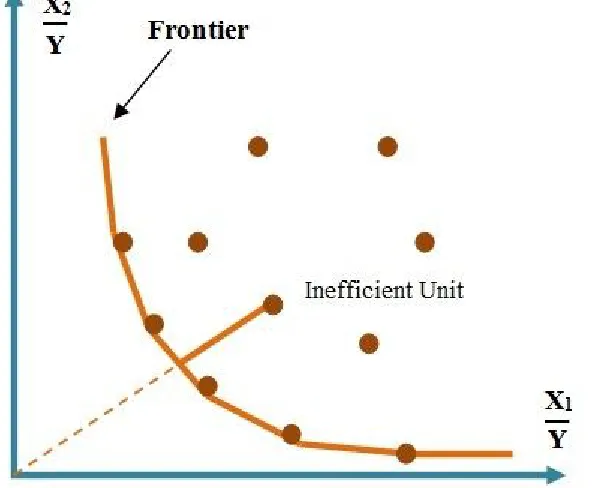
decision making units are divided to both efficient and inefficient. Determine the efficiency is
performed using DEA model based on distance of every decision making unit from efficiency
frontier and the type being its image on frontier.
Figure 1 : Data Envelopment Analysis Model
(Fiorentino Et al. 2006)
Research Data (Inputs - Outputs) Concepts of Input and Output
35 Inputs
Costs (X1) : This input is obtained from composition of deferred claims costs and doubtful receivable Number of Employees (X2) : This input is entered to model of deterministic DEA as the number of
people.
Outputs
Deposits (Y1) : This output is obtained from combination of three factors : Long-term Investment
Deposits, Savings Deposits, and Current Deposits of Government, Corporate and Entities. Facilities (Y2) : This output is included all granted facilities by branches.
Number of Banking Services (Y3) : In this study, most services is taken into consideration like ratio
credits provided.
Research Methodology
In this study for data analysis was used DEA-SOLVER software and data using CCR model of input based and output based. Selected branches were ranked respectively efficiency and were presented strategies for improving efficiency of inefficient branches and how their reach to level of efficient branches. DEA model defines how implement efficiency of measure units for inefficient units. These models are special method for researchers that are interested to multi-output efficiencyin contrast several data. There are two general direction in DEA : Focus on inputs in the model of based input and also focus
on outputs in the model of based output. (Muhammad 2008)
CCR model after determining the efficient frontier curve defines decision maker units are where this boundary and to achieve efficient frontier should be chosen what combination of inputs and outputs. It is not possible unless by determine of the input and output coefficients for each unit. In DEA models with input views we are seeking to obtain technical inefficiency extent that should be reduced in inputs as output does not change and unit placed in efficient frontier. (Kord Et al. 2011)
Conclusions
The Results of the Models of CCR-Input, CCR-Output and Branches Rankings Using DEA Technique
According to the obtained averages from results inefficiency of the branches determined in two cases CCR-Input and CCR-Output and were rankings.
Rankings Efficient and Inefficient Units
Based on branches rankings that was performed in 2012 branches score and rank obtained through their average monthly in year . Accordingly branches be rankings annually. The results obtained are as follows
:
Efficient Units in 2012 by CCR Model of Based Input 1. Unit 14
2. Unit 1 3. Unit 12
Inefficient Units in 2012 by CCR Model of Based Input with Average Yearly to the Most Inefficient 1. Unit 10 , %12.36
36 8. Unit 7 , %26.86
9. Unit 16 , %28.24 10. Unit 11 , %31.50 11. Unit 3 , %35.15 12. Unit 2 , %35.98 13. Unit 8 , %43.88 14. Unit 17 , %57.48
Efficient Units in 2012 by CCR Model of Based Output 1. Unit 14
2. Unit 1 3. Unit 12
Inefficient Units in 2012 by CCR Model of Based Output with Average Yearly to the Most Inefficient
1. Unit 10 , %18.43 2. Unit 5 , %16.03 3. Unit 6 , %28.81 4. Unit 9 , %32.20 5. Unit 13 , %36.09 6. Unit 15 , %45.19 7. Unit 4 , %49.25 8. Unit 16 , %52.28 9. Unit 3 , %53 10. Unit 7 , %55.72 11. Unit 2 , %61.95 12. Unit 11 , %75.75 13. Unit 17 , %107.41 14. Unit 8 , %160.86
Suggestions of Research
1. Use of efficient branches as reference for increase the efficiency of inefficient branches and reviews and compare weaknesses Inefficient branches with reference branches to improve their situation.
2. Reducing the cost of branches to be prepared for platform for increased facilities grant and also increase income of branches.
3. Optimal use of existing human resources and their reduced size of values obtained by DEA. 4. More effective use of existing fixed assets and increase long-term investment deposits, savings
deposits, and current deposits of government, corporate and entities.
5. Increased facilities granted that of course depends on the increase in deposits and receiptoverdue receivables and suspected of branches.
6. Decentralization of funds in some specific Branches
7. Causes reviews to lack of deposits in some branches and eliminate the shortcomings relating to it. 8. Causes reviews to reduction granted facilities of some branches and increase in receipt overdue
receivables.
9. Causes reviews to sharp decline in the number of banking services in some branches.
References
37