i
tif c n
e C
i o
c n
S f
l e
a r
n e
o n
i c
t e
a 2
nr 0
et 1
1
n I
ISC 2011
Proceeding of the International Conference on Advanced Science,
Engineering and Information Technology 2011
Hotel Equatorial Bangi-Putrajaya, Malaysia, 14 - 15 January 2011
ISBN 978-983-42366-4-9
ISC 2011
International Conference on Advanced Science, Engineering and Information Technology ICASEIT 2011
Cutting Edge Sciences for Future Sustainability Hotel Equatorial Bangi-Putrajaya, Malaysia, 14 - 15 January 2011
SR
IE AV IUN IT
NI
ESE
D K
O B
IN N
R AG
JA A
L S
A A
E N
P M
N A
A L
U A
T Y
A S S A I
REP
N I
NOI TAI COSSA STNEDUTS NA IENSOD
Organized by Indonesian Students Association Universiti Kebangsaan Malaysia
Proceeding of the
Multi-leg Searching by Adopting Graph-based
Knowledge Representation
Siti Zarinah Mohd Yusof#, Vijanth Sagayan Asirvadam*, Mohd Fadzil Hassan+
#, +
Computer and Information Sciences Department, *Electrical and Electronics Department Universiti Teknologi PETRONAS
Bandar Seri Iskandar, Tronoh, Perak, Malaysia
E-mail: #[email protected]
Abstract— This research explores the development of multi-leg searching concept by adopting graph-based knowledge representation. The research is aimed at proposing a searching concept that is capable of providing advanced information through retrieving not only direct but continuous related information from a point. It applies maximal join concept to merge multiple information networks for supporting multi-leg searching process. Node and edge similarity concept are also applied to determine transit node and alternative edges of the same route. A working prototype of flight networks domain is developed to represent the overview of the research.
Keywords— Graph-based Knowledge Representation, Graph Theory, Maximal Join, Node Similarity, Edge Similarity.
I. INTRODUCTION
Internet is becoming a significant element in travel industry as it provides a vast communication network that links computer worldwide [1]. Airlines passengers could obtain information such as destination, flight schedules, price and discount, airlines bookings and other related services which are displayed in the Internet [1]. In an airline website, usually users could view destinations network or a routes map from a specific departure city (origin) as a pre-trip guidance to make flight ticket reservation.
In making reservation, users have few choices in selecting type of air journey that they intent to pursue. The choices available are one-way journey, round-trip or multi-city journey. One way journey is considered as a trip in a continuous direction from origin to the final destination without a return to the origin [1]. If users want to have a return, they could choose round trip journey. Both types of journey would only involve one-leg searching as the process only retrieves direct destination from a point to another point.
Multi-city or multi-leg journey is a trip from the origin to the outward destinations in an itinerary plan. Users are needed to select a number of destinations of this type. Multi-leg searching would ease the selection process. It would not only retrieve direct destination from an origin but a number of continuous destinations. The outcome would be very beneficial as people do not always know exactly where they could go. Before a number of continuos destinations could
be retrieved, multiple flight connections from different airlines are needed to be unified in order to form broader, sufficient information.
Few literature surveys regarding existing flight
connection systems and graph related areas are initiated. From the findings, most of the researches focus on producing optimal path for multi-city journey from given destinations instead of searching and proposing the destinations to users. This preliminary study brings a motivation to conduct a detailed research on multi-leg searching presented in this paper.
A multi-leg searching concept that is capable of providing advanced information through retrieving not only direct but continuous information from a point is discussed throughout the paper (i.e.: continuous destinations that users could go further from an origin for multi-city journey). The scope of information network is expanded to support multi-leg searching process. Common destinations and routes among multiple flight connections would be figured out to efficiently support the concept.
II. RELATED WORK
Related work has been done in flight connection systems and applied graph-based knowledge representation concept. Detailed explanations of both areas are as follows:
A. Flight Connection Systems
There exist many researches that are focusing on air flight schedule or itinerary planner. In [2], the authors used a mixed initiative system, a kind of dialog established between the user and the system. The system makes suggestion even if no one satisfies completely the user criteria (called partial or soft constraint) satisfaction. This is an alternative to most of existing online booking engines use a sequential model. In sequential model, users enter the search criteria, clicks on the search button and waits until the results are displayed in a list format, which the involved processes are very tedious.
In [3], the authors presented a budget travel planning that leverages state-of-the-art semantic web technology to aggregate related web resources and reason on them to provide automated travel planning service. This research is proposed to solve problem in searching for all related information to make a travel plan. In [4], the author proposed a development of a multi-agent system that will allow the creation of itineraries through the given tourist’s travel preferences including travel period, number of people, zones and tourist service of interest. This work is presented to design a good itinerary as it is essential if it is expected to enjoy the travel.
In [5], the author presented a flight meta-search engine that is based on Metamorph framework. Metamorph provides mechanisms to model web forms together with the interactions which are needed to fulfil a request and can generate interaction sequences that pose queries using these web forms and collect the result. It shows how data can be extracted from web forms (rather than the data behind the web forms) to generate a graph of flight connections between cities. The authors implemented a system that uses a flight connection graph and a query planner to limit the number of requests by checking only the most promising paths.
From these surveys, it is understood that air flight passengers would have a number of preferences or criteria in making reservation. Besides, air flight passengers require extra information to ease them in making a travel plan. Although there are huge amount of information regarding flight connection in the internet, it is placed in a distributed manner. Centralizing the information would simplify the searching process.
B. Graph-based Knowledge Representation
As this research works with lots of information, graph-based knowledge representation would be one of the research areas that could be the best way to represent multi-level searching concept. Ryszard Raban emphasized the advantage of using graphical logic in his work [6]. He stated that the graphs are not used as just another graphical representation of information system requirements, but the full power of this graphical logic system has been employed to fully and precisely capture type definitions, referential integrity constraints and global constraints [6].
Maximal join has been seen as a potential concept in graph-based knowledge representation that would meet the objective of expanding the information network. Simon Polovina explained that the joining of graphs facilitates inference because more projections can be made into bigger graphs [7]. In addition, Simon Polovina mentioned in his work that maximal join, which extends the notion of join in SQL in database systems, defines the optimal method by which graphs are joined [7].
Michel Chein and Marie-Laure Mugneir described the effect of maximal join operation which is to maximally join, or merge, connected subgraphs of two graphs [8]. In addition, Simon Polovina mentioned that maximal join occurs when graphs are joined on the most common, or maximally extended, projection [7]. Dickson Lukose in his work explained that two graphs can be joined on maximally extended common projections. Multiple graphs could result if there is more than one maximally extended common projection [9].
In [9] and [10], maximal join has also been applied using tool as a conceptual graph manipulation functions or operator. Maximal join has been widely used in merging graph. This method is seen as a good method to be applied in the research.
III. METHODOLOGY
There are three main elements that would be used throughout the research- Maximal Join, Node Similarity and Edge Similarity. The methodology used to pursue this research are broadening information network using Maximal Join and finding node and edge similarity. A sample prototype has been developed to represent the overview of the searching concept.
A. Broadening Information Network Using Maximal Join
In order to provide multi-leg searching, the information network involved should be connected with sufficient information. An information network could be expanded by merging it with another network. Maximal join operation is applied to merge those networks.
As referred to [8], maximal join operation would maximally join, or merge, connected subgraphs of two graphs. According to Michel Chein and Marie-Laure Mugnier, the simplest way of joining two graphs is by using external join operation which consists of merging two concept nodes of two disjoint graphs [8]. Before maximal join operation is performed, condition for merging concept nodes and a condition for merging relation nodes have to be defined first as well as the strategies for exploring the graph.
B. Finding Node and Edge Similarity
Node and edge similarity are necessary to be figured out. Node similarity would determine point to merge disjoint graphs and as a point of route transit; transit from one graph to another graph. Meanwhile, edge similarity would determine number of alternatives of the same route. For
instance, assume that node a in graph X is similar to node b
in graph Y. As the nodes are similar, these nodes would be
the merging point of graph X and Y. The nodes would also
be the transit point from graph X to graph Y. Assume that
edges represent two available alternatives of going through the same route. In order to determine node and edge similarity, labeled graphs concept plays a vital role.
C. Prototype Development
In parallel with the literature surveys and analysis, a sample prototype is being developed to represent the overview of proposed searching concept. A case study is selected and data sample used in the prototype are taken from prominent website within the area of the case study. The developed prototype is shown in section IV. Case study used for the prototype is destination networks of Low Cost Carriers (LCC) in Malaysia such as Air Asia and Fire Fly. The data sample are taken form their respective websites.
IV. RESULT AND DISCUSSIONS
Graph-based knowledge representation is used to explain the concept of maximal join, node similarity and edge similarity. A simple prototype is presented at the end of this section to represent the overview of the searching concept. The networks are represented using graph to show how the similarities are being measured and how the merging process is happened. Based on the case study, two flight networks of different LCC would be represented as two disjoint graphs.
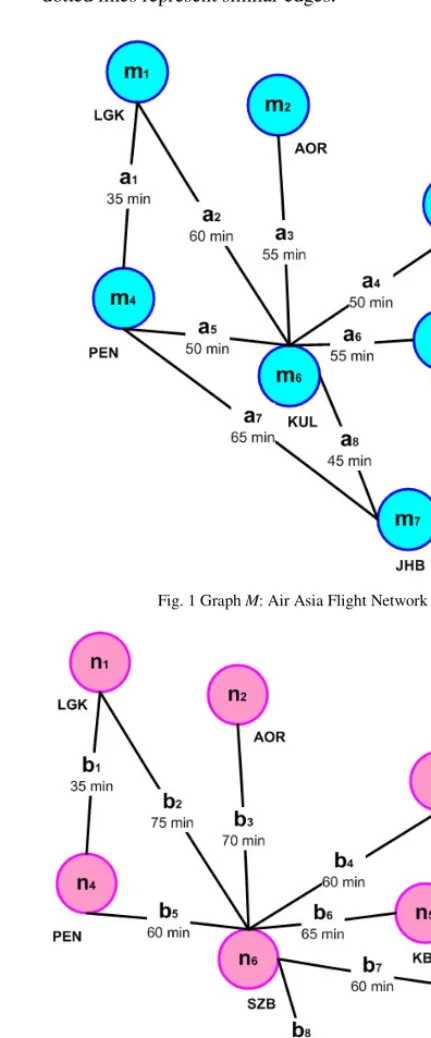
Fig. 1 shows graph M that represents destinations provided
by Air Asia adapted from [12]. In the other hand, Fig. 2
shows graph N that represent destinations provided by Fire
Fly adapted from [13]. Nodes and edges in both graphs are labeled with information that would be used in determining the similarities. Label of nodes is shown in Table 1 meanwhile edges are labeled with duration of journey.
A. Node and Edges Similarity
The similarity of node and edge could be determined through side information assigned to each node and edge or in specific term, it is called label. According to [11], two nodes will be similar if they have similar in/out neighbors. Based on Fig. 1 and 2, it is shown that many similar nodes are available as these nodes have the same neighbours and
airport codes. Node m6 and n6 also could be considered as
similar as both nodes have the most common neighbours. In addition, label of nodes in Table 1 shows that both nodes have the same city name, Kuala Lumpur. Therefore, these nodes would be one of the transit points available between
graph M and graph N. These two nodes best at presenting
transit node concept as it enables passengers go to n7 from
graph M.
It is also shown that similar nodes found in the graphs are connected by edges. These connecting edges are considered as similar thus provide alternatives of going through the same route. The best example that could be extracted from
Fig. 1 and Fig. 2 is edge a1 and edge b1. The labels of
journey duration are the same and these edges are
connecting similar node between m1/n1 and m4/n4. From the
graph, it is best to describe that there are two available service provider alternatives if users want to take a route from LGK to PEN, either by Air Asia or Fire Fly.
B. Maximal Join
In order to broaden main information network, disjoint networks need to be merged. However, the merging point
needs to be figured out first. Maximal join occurs when graphs are joined on the most common, or maximally extended, projection. Based on the previous discussion, node
m6 and node n6 have the most common neighbours. These
nodes are also considered to have the most common or
maximally extended, projection. Therefore, node m6 and
node n6 would be best merging point that unified graph M
and graph N. Fig. 3 shows the merged graphs of graph M and
N. The green nodes represent similar nodes and the red
dotted lines represent similar edges.
Fig. 1 Graph M: Air Asia Flight Network
TABLE 1
LABELS OF NODES
Labels of Graph M(m,a) Label of Graph N(n,b)
airport_codes city_name airport_codes city_name
1 LGK Langkawi LGK Langkawi
2 AOR Alor Setar AOR Alor Setar
3 TGG Kuala
Terangganu TGG
Kuala Terangganu
4 PEN Penang PEN Penang
5 KBR Kota Bharu KBR Kota Bharu
6 KUL Kuala
Lumpur SZB
Kuala Lumpur
7 JHB Johor Bahru KTE Kerteh
8 JHB Johor Bahru
Fig. 3 Merged Graphs
C. Prototype
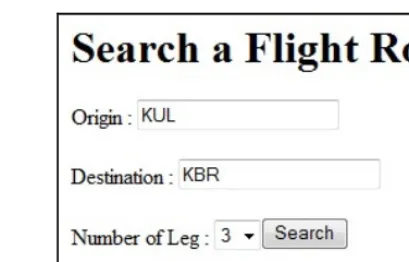
In delivering the overview of the research concept, a simple prototype has been developed. PHP: Hypertext Preprocessor has been chosen as the best server-side scripting language in developing it. As it supports many databases including mySQL, the prototype could be easily connected to PHPmyAdmin which is being installed together with PHP in XAMPP software. Data sample used in this prototype is taken from two LCC website - Air Asia and Fire Fly. These data is then combined into a database which is presented as merged graphs. Fig. 4 shows the search page snapshot of the prototype. Current development only includes from first leg till third leg searching presented as Number of Leg in Fig. 4. First destination would be one of the constraints for the searching process. From the first destination, this prototype would suggest further continuous destinations that users could travel. The searching result
would be filtered according to assigned constraints which would not be discussed in this paper as the paper is only focusing on the graph-representation part.
Fig. 4 Search Page Snapshot
Table 2 shown below is the result of multi-leg searching process which would be produced when users click on the Search button in Fig. 4. Multi-leg searching concept is represented by the produced result for first, second and third leg searching. From first destination, Kota Bharu (KBR), user would identify next destination and continuous destinations that they could travel further. As shown in the table, there are columns named Cycle to First Destination and Cycle to Origin. These columns are another two assigned constraints to mark the destinations which have a return to first destination or origin. As described before, SZB and KUL are considered as similar nodes which are also considered as the merging and transit point between Air Asia and Fire Fly graphs. If users from KBR return to SZB, it means that the users are going back to Kuala Lumpur. However, users could have a transit from SZB to travel to KTE using Fire Fly which the route is not provided by Air Asia. If users travel to PEN from SZB before going to LGK, users have the alternatives to choose whether they want to fly to LGK using Air Asia or Fire Fly as both LCC provide the same route.
V. FUTURE DIRECTIONS
For future works, detailed graph-based knowledge representation with a combination of constraints will be figured out. In parallel with the research progress, the prototype development also needs to be continued and the searching process needs to be enhanced by adopting constraints in order to produce the most relevant and efficient results to users especially in suggesting destinations that follow optimal path concept.
VI.CONCLUSIONS
TABLE 2
MULTI-LEG SEARCHING OUTPUT
Chosen Route
Origin Destination Service
Provider
KUL KBR Air Asia
First Leg Searching
Origin Destination Service
Provider
Cycle to Origin
KBR SZB Fire Fly 0
KBR KUL Air Asia 1
Second Leg Searching
Origin Destination Service
Provider
Cycle to First Destination
Cycle to Origin
SZB JHB Fire Fly 0 0
SZB KTE Fire Fly 0 0
SZB TGG Fire Fly 0 0
SZB KBR Fire Fly 1 0
SZB LGK Fire Fly 0 0
SZB AOR Fire Fly 0 0
SZB PEN Fire Fly 0 0
Third Leg Searching
Origin Destination Service
Provider
Cycle to First Destination
Cycle to Origin
JHB SZB Fire Fly 0 0
JHB PEN Air Asia 0 0
JHB KUL Air Asia 0 1
KTE SZB Fire Fly 0 0
TGG SZB Fire Fly 0 0
TGG KUL Air Asia 0 1
LGK PEN Fire Fly 0 0
LGK SZB Fire Fly 0 0
LGK PEN Air Asia 0 0
LGK KUL Air Asia 0 1
AOR SZB Fire Fly 0 0
AOR KUL Air Asia 0 1
PEN SZB Fire Fly 0 0
PEN LGK Fire Fly 0 0
PEN LGK Air Asia 0 0
PEN KUL Air Asia 0 1
PEN JHB Air Asia 0 0
REFERENCES
[1] J. Semer-Purzycki, A Practical Guide to Fares and Ticketing, USA: Delmar, 2001.
[2] M. Torrens, P. Hertzog, L. Samson and B. Faltings, “Reality: A Scalable Intelligent Travel Planner”, ACM, 2003.
[3] Y. Yang, S. Tang, Y. Xu, and Y. Xu, “A Budget Travel Planning System Using Ontologies for Web Information Aggregation”, IEEE, 2006. [4] M. Valdes and C. Cubillos, “A Multiagent System for Touristic Travel
Planning”, IEEE, 2009.
[5] B. Krupl and R. Baumgartner, “A Flight Meta-Search Engine with Metamorph”, ACM, 2009.
[6] R. Raban, “Information Systems Modeling with CGs Logic”, unpublished.
[7] S. Polovina, “Combining Graph”, An Introduction to Conceptual Graphs, Berlin Heidelberg: Springer-Verlag, 2007.
[8] M. Chein and M.L Mugnier, Graph-based Knowledge Representation: Computational Foundations of Conceptual Graphs, London: Springer-Verlag, 2009, ch. 8.
[9] Lukose, “CGKEE: Conceptual Graph Knowledge Engineering Environment”, unpublished.
[10]W. Mineau, “The Extensional Semantics of the Conceptual Graph Formalism”, unpublished
[11]L. Ninove, “Graph Similarity Algorithms”, Mathematical Engineering Department, Universit ´e catholique de Louvain, 2005, unpublished. [12] Air Asia Flight Schedule, Air Asia Sdn. Bhd., retrieved on 18
November 2010, Avalable: www.airasia.com/iwov-resources/my/common/pdf/AirAsia/flightschedule/fullFlightScheduleR epot.pdf