Evaluation of a BIBD Based Directional MAC Protocol for
Wireless Ad Hoc Networks
G. Boggia*, P. Camarda*, C. Cormio*, and L. A. Grieco*
Abstract: The use of directional antennas in wireless ad hoc networks can significantly improve global performance due to a high spatial channel reuse. Nevertheless, its introduction poses new location dependent problems related to the MAC protocol. In this paper, the Balanced Incomplete Block Design theory has been exploited to develop a new MAC protocol for wireless ad hoc networks using directional antennas. It is a time slotted protocol, which is highly scalable. Moreover, it can provide a high number of concurrent communications, depending on the number of directional antennas mounted on each node, great fairness in bandwidth sharing and significant energy saving. In particular, energy saving provided by our scheme is consistently higher compared to those of usual directional MAC protocols for the following reasons. Firstly, control packets are sent only over fairly selected beams rather than over all the available ones. Secondly, our protocol provides a filtering, i.e. a fair selection, of the nodes that can try the access to the medium in each time slot. Simulation results validate the advantages of our protocol by proving high spatial reuse, great fairness and significant energy saving and by showing that it improves the overall system performance.
Keywords: Directional Antennas, Medium Access Control, Spatial Reuse, Wireless Ad Hoc Networks.
1 Introduction 1
Wireless ad hoc networks are configuring and self-organizing wireless networks, used when there is no possibility to set up a network infrastructure. They have several advantages that imply their wide use in telecommunications: fast deployment, performances not critically dependent on the infrastructure, possibility of high frequency and spatial reuse. Their applications include home networking, military and emergency networks [1]. Currently, the wireless Network Interface Cards are equipped with omnidirectional antennas, which spreading out energy in all directions, have limited performance [2]. Thus, many research efforts have been recently carried out to build wireless ad hoc networks based on directional antennas [3].
A directional antenna is an antenna characterized by a narrow beam in the desired direction. Such antennas can be divided into traditional and smart ones. Traditional directional antennas (e.g., Helix, Yagi-Uda, aperture horn, reflector, and so on) focus the transmit and receive power in a single direction [4]. Instead, a
Iranian Journal of Electrical & Electronic Engineering, 2009. Paper first received 2 Apr. 2009 and in revised form 15 May 2009. * Authors are with the “DEE, Dip. di Elettrotecnica ed Elettronica”, Politecnico di Bari, v. Orabona 4, 70125, Bari, Italy.
E-mails: (g.boggia; camarda; c.cormio; a.grieco)@poliba.it
smart antenna is an array with digital signal-processing capabilities; it can be classified into two categories: switched beam and adaptive array. In a switched multibeam antenna [1] only one beam is selected for transmission or reception, usually the one which receives the strongest signal. The beam-selection technique looks at the signal level every few seconds to determine the beam to use. In an adaptive array the output signal is obtained by weighting and combining the signal from several antenna elements.
Directional antennas offer a lot of benefits [3] with respect to omnidirectional antennas. By focusing all the transmission power in a direction, they have a higher gain providing, with the same transmission power, a longer transmission range in the considered direction; this means fewer number of hops required to reach an intender receiver. Other advantages are: improved spatial reuse, that is the capability to allow multiple concurrent transmissions; reduced interference, as the signal power is concentrated in a narrow beam; improved security, as an eventual eavesdropper should be located in the same direction of the signal. To more exploit the advantages provided by directional antennas, new MAC protocols are needed. In fact, the use of these antennas in a wireless network can cause new location-dependent carrier sensing problems, such as the
deafness, the new hidden terminal problem, and the exposed terminal problem [5].
The deafness problem [3] [5]-[8] is caused when a transmitter fails to communicate with its intended receiver, which has its beam oriented in a different direction. The transmitter assumes that congestion is the cause of failure, and increases exponentially the contention window before attempting retransmission. After a great number of transmission failures, the contention window becomes large and, consequently, the transmitter counts down a higher and higher backoff. This can imply the freezing of the node.
In [6], the ToneDMAC protocol is proposed to solve deafness. It is based on Out-of-band tones used to aid nodes in distinguishing deafness from congestion as cause of failures.
The Directional MAC with Deafness Avoidance Collision Avoidance (DMAC-DACA) protocol, explained in [7], discusses for the first time a different type of deafness, namely deafness due to being in the Deaf Zone. The above kind of deafness can block the nodes in a wide area and, therefore, it is more significant than simple deafness, which only blocks two nodes. It occurs when an intended receiver lies in the coverage area of an ongoing transmission and, for this reason, it is unable to receive the Request To Send (RTS) frame from a transmitter. In fact, the signal power of the ongoing transmission prevents it to sense the signal power related to the RTS packets. In [7], the DMAC-DACA scheme proposes a solution to the problem of deafness due to being in the Deaf Zone. It is based on the mechanism of sweeping Request To Send/Clear To Send (RTS/CTS) frames. A similar mechanism is proposed in [8] where Circular-DMAC mitigates deafness by sending multiple RTS and CTS packets.
Also the Circular Directional MAC (CDR-MAC) protocol proposed in [9] exploits a circular directional transmission of the RTS control packets, spreading around a station information about the intended communication. When a node receives the directional RTS, after tracking the sender direction using a simple scheme, it blocks the transmission over the beams that could interfere with the ongoing communication.
The Hybrid MAC (HMAC) in [10] proposes a hybrid algorithm for mitigating deafness. There are two possible approaches to mitigate deafness: proactive and reactive. The proactive approach sends directional control packets over all the beams which are not not blocked by the Directional Virtual Carrier Sensing. On the other hand, the reactive approach deals with sending the directional control packets only over the beams that have potential transmitters for that node. The first approach implies high overhead while the second one is complex to implement, so a trade-off is needed. For this
reason, the HMAC exploits an algorithm which is hybrid among the two previously exposed.
The Opportunistic Directional MAC (OPDMAC) in [11] introduces a solution to decrease the effects of deafness without creating additional overhead. It also increases the spatial reuse and the channel utilization by minimizing the idle waiting time for the wireless medium. The former is achieved by exploiting transmission opportunities in other directions when the node is forced to backoff due to unreceived CTS or acknowledgement from a certain direction.
The new hidden terminal problem, addressed in [3] [6] [7] [12], arises when a terminal is not aware of an ongoing transmission and can cause collision. It can be due to unheard RTS, when a node does not hear a RTS packet having the beam towards a different direction, or to asymmetry in gain, when sender and receiver are out of each other range with one of them in omnidirectional mode an the other one in directional mode (in this last case they could be within range if they both transmit and receive directionally).
In particular, the Directional MAC with Power Control and Directional Receiving (DMAC-PCDR) [12], takes care of mitigating the new hidden terminal problem considering also of the interference caused by directional minor lobes. The protocol exploits the mechanism of rotating directional receiving antenna beams and has three access modes whom it uses depending on the location information.
Directional antennas offer a more extended range, implying more nodes exposed to interference. The exposed terminal problem arises when two transmissions are not allowed to proceed simultaneously, even though they do not interfere with each other. The Directional Network Allocation Vector (DNAV) [5] [13] [14] can alleviate this problem as it records the forbidden directions, allowing communications in the remaining ones. It is a table which keeps track of the directions toward which a transmission is forbidden. When a node receives, from a certain angle, a control packet destined to another node, it dynamically updates the field of the DNAV related to that direction with the value indicated in the duration field of the control packet. The beam which could transmit/receive in that direction is disabled for the time set in the DNAV. Therefore, setting the DNAV allows to disable, for the time of transmission, only the beam which would produce interference with the ongoing transmissions. The other beams can be used for concurrent communications. This feature allows several simultaneous transmissions even in a single hop network in which, otherwise, there could be just one communication at time.
The previously proposed directional MAC protocols do not face efficiently the deafness problem as they resort to mechanisms which cause energy wasting, like
Out-of-band tones or sweeping RTS/CTS. The new protocol presented in this paper handles the deafness problem without using additional messages or packets, thus in the most efficient way. It alleviates the hidden terminal problem, as the RTS packet is not sent directionally, like most part of directional MAC protocols, but over more than a beam, so that other nodes but the intended receiver could be aware of the ongoing transmission. The protocol also faces the exposed terminal problem by using the virtual carrier sensing mechanism of DNAV.
In particular, the contribution of this paper is a new slotted directional MAC protocol for wireless ad hoc networks. It aims to reduce deafness problem in an efficient way and to provide a fair bandwidth sharing among nodes. It also guarantees energy saving, thanks to a scheme based on the mathematical theory of Balanced Incomplete Block Design (BIBD) [15] [16], which implies a fair selection of the nodes to be awake in each time slot. The proposed protocol is highly scalable, a key requirement of wireless ad hoc networks because of their adaptable nature.
The simulation results demonstrate the effectiveness of the proposed algorithm in terms of spatial channel reuse and fairness in bandwidth sharing. Results also prove that energy saving is consistent compared to the classic directional MAC protocols.
The paper is organized as follows: Section 2 summarizes the mathematical theory of BIBD and introduces the new protocol. In Section 3 we evaluate the protocol performance through computer simulation and in Section 4 we present the conclusions.
2 BIBD Based Directional MAC
In this Section we briefly summarize the BIBD theory and propose a new MAC protocol for wireless ad hoc networks with directional antenna.
2.1 BIBD Theory
The term block design refers to an arrangement of distinct objects into a specified number of blocks such that each block contains exactly the same number of objects, and all the objects occur in the same number of blocks. In particular, if we consider v distinct objects and b blocks each including k distinct objects, the whole number of combinations of these objects taken k at a time gives
k v
blocks. If the block design has fewer
than
k v
blocks, it is called incomplete. Moreover, the incomplete block design is also balanced if each pair of objects occurs together in the same number of blocks.
Therefore, a BIBD is an arrangement of v distinct object into b blocks such that each block contains exactly k distinct objects, each occurring in exactly r
different blocks. Moreover, every pair of distinct objects i and j occurs in exactly λ blocks. Thus, a specific BIBD is defined by the 5-tuple (v,b,r,k,λ).
The five parameters are not independent, but they follow two basic relations:
) 1 ( ) 1
( − = −
=
v k
r vr bk
λ (1)
Each BIBD has the correspondent v × b matrix, called the incidence matrix of the design. The rows are labeled with the objects of the design and the columns with the blocks. We put a marker in the (i,j)-th cell of the matrix if variety i is contained in block j. Each row of the incidence matrix has r markers, each column k
ones. Fig. 1 shows the incidence matrix related to the (4,4,3,3,2) BIBD design.
2.2 Proposed Protocol
Starting from the BIBD theory described above, in the following a new BIBD Based Directional MAC Protocol is described in detail. The purpose of the protocol is to guarantee energy saving, spatial reuse, and fairness, minimizing deafness. To explain the proposed protocol, let us consider a single hop wireless ad hoc network and let the time axis be divided in time slots of fixed duration. We suppose that all stations are synchronized. Example of synchronous algorithms are given in [17] and [18] where synchronization is provided through sending beacon messages at specific time intervals. We want to assure that, in case of a greedy traffic, each station has the same opportunity to access the channel, avoiding situations in which a particular station monopolizes it for a long time. A further objective is to assure that each couple of nodes has periodically a given number of chances to communicate.
We assume that each node is equipped with v
directional antennas, whose beams have a width equal to the ratio between the round angle and v. For sake of generality, the node orientation respect to an azimuthal reference system is random.
Time axis is divided in slots of fixed duration. Only
k of the v antennas mounted on each node are active in each slot. With reference to b consecutive time slots, r
is the number of time slots in which an antenna is active and λ represents the times each couple of antennas is active in a time slot. Since each couple of nodes in the network can communicate through a couple of beams, the previous property guarantees that each couple of nodes has λ chances to communicate in b slots if there are no ongoing transmissions which could create interference in the same direction.
All the nodes have the same incidence matrix stored in memory and, time slot after time slot, they have all the same beam pattern according to the active beams
indicated by the matrix. At the beginning of a slot, a node with pending data sends a RTS frame using the k beams active in the slot. RTS is sent using classic CSMA/CA algorithm [19]. A node which is in idle or backoff state hears the channel omnidirectionally. When it receives a RTS packet, it switches off all the beams but the one that received the signal with the maximum power. Then it sends a CTS packet directionally on that beam. The transmitter selects the beam that received the CTS with the maximum power and sends DATA directionally only using that beam. Also the ACK packets are sent directionally. If a node which is in idle state overhears a RTS or a CTS destined to another node, it blocks the related beams in order to defer all the possible transmissions over those beams during the current time slot and to avoid interference.
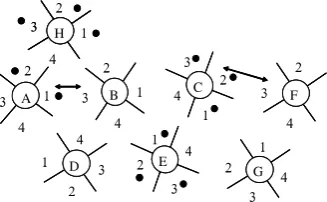
The BIBD Based Protocol solves the deafness problem thanks to its slotted structure, with consequent performance improvements on channel usage. In the proposed protocol the deafness problem is faced in the following way: in a time slot, each node has in active state only the k beams indicated in the incidence matrix. Transiting from a time slot to the contiguous one, a node changes its active beams, i.e., changes the beam pattern. This implies that a transmitter, in the following time slot, could no more cover its current receiver with one of the active beams. This scheme avoids situations in which a node keeps transmitting to the same receiver for a long time, i.e., it is forced to change its intended receiver thanks to the BIBD architecture. Furthermore, at the beginning of each slot, all the contention windows are reset. We provide an example of how the protocol faces deafness in the scenario in Fig. 2. Let us suppose nodes C and F are communicating by using respectively beams 2 and 3 while all the other beams are switched off. G has packets for C and sends it a RTS packet. C does not receive it and G increases the contention window before selecting a new backoff to attempt access again. Anyway, at the end of the time slot, the contention window of all nodes will be reset, thus reducing the impact of deafness. Moreover, as soon as the communication between C and F is interrupted, C is able to receive the RTS from G.
Also the exposed terminal problem is solved, as the protocol exploits the DNAV like all the previously proposed directional protocols.
The proposed protocol mitigates the hidden terminal problem as a transmitter sends RTS packet over k beams rather than one, therefore a higher number of nodes which are not involved in the communication are aware of the ongoing transmission.
Another main feature of proposed protocol is energy saving. The beam activity management provided by this protocol, guarantees a fair selection of the nodes which are allowed to communicate in each slot, thus causing the switching off of the remaining ones. This provides
supplementary energy saving respect to that implied by the use of directional antennas.
The protocol is highly scalable given that the incidence matrix is identical for all the nodes in the network. This means that, even if new stations join the network, the matrix could be sent in broadcast periodically so that each new node can receive and store it for the next slots.
A simple example scenario is showed in Fig. 2 and illustrates the active beams useful for transmission of RTS control packets in the first time slot (see the related incidence matrix in Fig. 1). Fig. 1 shows how to manage the beam activity in case of v =4 antennas on each node. In the example scenario, nodes in transmission mode (i.e., A, H, C, E) can send a RTS packet to the intended receivers (i.e., B, D, F, G) using all the marked beams. B, D, F and G, in case of reception of the RTS packet, reply with a directional CTS. In the example, only A and C cover their intended receivers with one of the active beams. As we are supposing for simplicity a single-hop environment, node F overhears over beam 3 the RTS packet sent by A to B and makes the beam 3 inactive. In this way, interference between the couples A-B and C-F during the current time slot is avoided.
Obviously only the communications which do not interfere with each other can go on simultaneously. In the second time slot, which makes reference to the second slot of the incidence matrix, the active beams to send the RTS control packet change, so that different nodes could cover the intended receivers with the new beam pattern.
Fig. 1. Example of BIBD with parameters (4,4,3,3,2).
Fig. 2. Example scenario with v=4 directional antennas on
each node. H
B C F
D A
E
G 1
2
3
4 4
3
2
1
4
3 2
1 2
4 3
1 4
3 2 1
4
3
2 4
2
1 3
3
4 1 2
H H
B C F
D A
E
G 1
2
3
4 4
3
2
1
4
3 2
1 2
4 3
1 4
3 2 1
4
3
2 4
2
1 3
3
4 1 2
3 Simulation Results
We evaluate the performance of the BIBD Based Directional MAC Protocol using an ad hoc simulation tool written in C language. The objective of our investigation is to demonstrate, in a preliminary way, that our protocol allows a fair and high channel spatial reuse.
The simulation scenario is made of Nu nodes
(ranging from 20 to 100) which are randomly placed according to a uniform distribution on a 1000 m × 1000 m square grid, where the dimension of the grid is d = 1000 m. The number N of antennas mounted on each node varies from 4 to 11. The simulation parameters, together with the related values, are summarized in Table 1. Nodes can communicate directly and each node hosts a greedy traffic source.
Table 1. Simulation Parameters.
Parameter Value
Nu [20;100]
d 1000 (m)
N [4;11]
The parameters to set before the simulation starts are
Nu and N. Then the simulator randomly chooses, for
each node, the x and y coordinates and the angular orientation of the beams with respect to an absolute azimuthal reference system. Successively, the simulator randomly select Nu/2 couples of nodes that will
communicate during the b consecutive time slots. For each couple, the simulator determines the line which connects transmitter and receiver and checks, in each time slot, that it is included in the angle swept by the k
transmitter’s beams which are active in the time slot, i.e., the k beams marked as active in the column of the BIBD incidence matrix related to that time slot. If the above condition is accomplished, the receiver is in directional coverage of the transmitter, i.e., the transmitter covers the receiver with one of its active beams. In this manner, the total number of couples in directional coverage is evaluated.
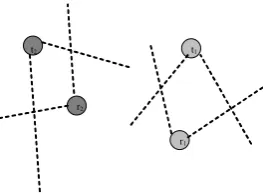
Then it geometrically determines, among the couples in directional coverage, the couples which can communicate simultaneously without interfering, i.e., the number of concurrent communications. Let us consider the example in Fig. 3, where t1 and r1 are transmitter and receiver of couple 1, while t2 and r2 are transmitter and receiver of couple 2. We suppose that couple 2 is communicating directionally while couple 1 is going to begin a directional communication. Interference between the two couples 1 and 2 occurs in each of the following cases:
Fig. 3. Example for the compatibility condition.
• t1 sees t2 and t2 sees t1 under the same beam
used to communicate with the respective receivers • t1 sees r2 and r2 sees t1 under the same beam
used to communicate with the respective receiver and transmitter
• r1 sees t2 and t2 sees r1 under the same beam
used to communicate with the respective transmitter and receiver
• r1 sees r2 and r2 sees r1 under the same beam
used to communicate with the respective transmitters
Every b slots, the simulator repeats the procedure of selecting nodes’ coordinates, angular orientations and couples of transmitter and receiver.
Simulating the above scenario 1000 times for each couple of values N and Nu, we evaluated the average
number of couples in directional coverage in b slots. We also evaluate the average number of concurrent communications in b slots.
The chosen sets of BIBD parameters related to the considered values of v = N are respectively (4,4,3,3,2), (5,5,4,4,3), (7,7,3,3,1), (8,14,7,4,3) and (11,11,5,5,2), as highlighted in Table 2.
Table 2. BIBD Parameters.
N BIBD Tuple
4 (4,4,3,3,2) 5 (5,5,4,4,3) 7 (7,7,3,3,1) 8 (8,14,7,4,3) 11 (11,11,5,5,2)
In Fig. 4, we can see the average number of couples in directional coverage.We can detect that the maximum value is obtained for N=5, regardless of Nu. This
depends on the BIBD parameters. In fact, if we consider a number of objects v=5, the related set of parameters is (5,5,4,4,3).It is easy to notice that, in this case, the ratio between k and v is maximum compared to the other considered sets, i.e., the number of active beams over the total number is maximum, allowing to cover a wider area of the surrounding space.
t2
r2
t1
r1
4 5 6 7 8 9 10 11 0 5 10 15 20 25 30 35 40
N - Number of directional antennas on each node
E [ N d c ] - A v er a g e n u m b er o f co u pl es i n d ir . c o v e ra g e
Nu= 20 Nu = 40 Nu = 60 Nu = 80 Nu = 100
Fig. 4. E[Ndc] -Average number of couples in directional
coverage.
4 5 6 7 8 9 10 11
2 3 4 5 6 7 8 9 10 11 12
N - Number of directional antennas on each node
E [ N c c ] - a v e ra g e n u m b e r o f c o m p a ti b le c o u p le
s Nu = 20 Nu = 40 Nu = 60 Nu = 80 Nu = 100
Fig. 5. Average number of concurrent communications.
Fig. 5 shows the average number of concurrent communications achieved in b consecutive slots with the proposed protocol. We can highlight a growing trend in the curves, as the higher is the number of directional antennas mounted on each node, the higher is the spatial reuse, concentrating the signal power in a narrower beam. It is evident that the curve trend is not perfectly linear with respect to the number of directional antennas.
In fact, the number of concurrent communications is influenced by the number of couples in directional coverage, which is related to the BIBD parameter set, not linear dependent on the number of objects v.
Another issue in this protocol is the capability to achieve a significant energy saving. It is possible to distinguish between two different aspects for energy saving, respectively related to (i) the limited directional coverage and (ii) the limited use of the beams.
(i) In particular, in classical protocols using directional antennas where the concept of BIBD is not used, the transmitter sends the RTS packets using all the available beams. In the proposed protocol, only the beams which result to be active according to the incidence matrix can be used. On the other hand, the receiver can receive with all the available beams when idle. The consequence is that, while in classical solutions all the couples are in directional coverage and can try to access the channel, in our protocol only a
ratio of them can access the medium. The reduction of the number of the couples that try the access is a filtering which helps to reduce collisions.
It also implies energy saving compared to the case all the couples try the access to the medium competing and causing interference with each other, and it is related to the ratio of 11 node pairs which are not allowed to share the medium in a given time slot because not in directional coverage.
Es1 can be then simply computed by using Eq. (2):
u u s N c N
E = −
1 (2)
where Nu represents the number of nodes in the network
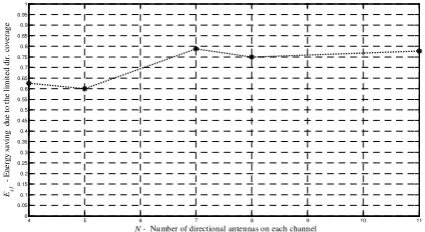
and c is the average number of nodes in directional coverage in each slot. The results about this type of energy saving, Es1, are shown in Fig. 6 and depend on N
while they are independent from Nu as the curves for
different values of Nu perfectly overlap. The highest
values of Es1 are achieved for N =7 and N = 11, as in
correspondence of these values the number of couples in directional coverage is minimum.
(ii) Another type of energy saving, Es2, is the one
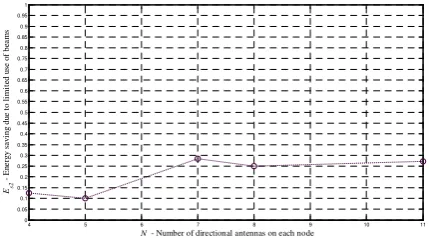
related to the use of a limited number of beams during the control signalling. In particular, in classic directional MAC protocols, each node uses all the available beams to send RTS packets during the control signalling. In our scheme a transmitter uses the k beams active in that time slot over v for sending RTS, and thus the global energy consumption is reduced. Fig. 7 shows the results compared to the case in which all the beams are used during the control packet exchange.
The Es2 can be simply computed as the ratio of the
beams which are inactive during the RTS exchange and the total number of beams, by using Eq. (3):
v k v v N k v N E u u s − ⋅ = ⋅ − ⋅ = 2 1 ) ( 2
2 (3)
The values of Es2 are not negligible especially for
N =7 and N = 11, where the ratio k/v is higher
compared to the one for the other values of N. Also in this case the results depend only on N, because the BIBD parameters only depends on the number of antennas, while they are independent from Nu.
4 5 6 7 8 9 10 11
0 0.05 0.1 0.15 0.2 0.25 0.3 0.35 0.4 0.45 0.5 0.55 0.6 0.65 0.7 0.75 0.8 0.85 0.9 0.95 1
N - Number of directional antennas on each channel
E s1 E n e rg y s a v in g d u e to t h e li m it e d d ir . co v e ra g e
Fig. 6. Energy saving due to the limited directional coverage
In Fig. 8 we show interference among node pairs during the data transmission. We assumed that, when a node receives an RTS or CTS destined to another node, it blocks the beam on which it received the packet with the maximum power in order not to cause interference. We will refer to the case in which this assumption is taken as case a). This assumption implies that only the couples which are compatible, i.e. which would not cause interference to each other, are allowed to transmit simultaneously in a time slot.
On the opposite, without the above assumption, i.e., supposing that a node overhearing a RTS or CTS does not make the related beam inactive (we will refer to this case as case b), the couples of nodes which are incompatible will cause a consistent interference to each other. In Fig. 8 some results about the interference ratio in case b are shown. The interference “int” is related to the ratio of node pairs that can cause interference to each other if they exchange data simultaneously during a time slot, and it is computed with Eq. (4):
u u
N cmp N − =
int (4)
where cmp is the average number of compatible couples in each time slot.
As we expected, the values are very high and increase with Nu while decrease with N, as the number
of compatible couples increases. The non linearity of these curves are due to the non linear dependence of
cmp on the BIBD parameter set, as shown in Figure 5. It is worth noticing a correlation between the trend of the Es1 and Es2 curves, as the number of couples in directional coverage is related to the number of beams active over the total, i.e., to the BIBD parameter set of
N.
Another protocol feature to point out is fairness, we measured through the Jain’s fairness index [20], usually exploited to measure the fairness with whom network resources and the available frequency range are partitioned among different flows. Jain’s fairness index can be calculated by the following Eq. (5):
∑
∑
= =
× =
N
i i
N
i i
j
x N
x F
1 2 2
1 )
(
(5)
where N is the number of nodes and xi is the average
number of channel accesses of node i in b consecutive slots.
Fig. 9 displays, for each of the considered value for N and Nu, a fairness index very close to 1 because, as we
already explained in the previous Section, the slotted nature of the proposed protocol and the variation of the beam pattern in each slot according to the incidence matrix, provides to each node the same opportunity to access the channel. This means that there is a perfectly fair partitioning of the bandwidth in the network.
4 5 6 7 8 9 10 11
0 0.05 0.1 0.15 0.2 0.25 0.3 0.35 0.4 0.45 0.5 0.55 0.6 0.65 0.7 0.75 0.8 0.85 0.9 0.95 1
N - Number of directional antennas on each node
E
s2
E
ne
rg
y
s
av
in
g
d
ue
t
o
l
im
it
ed
u
se
o
f
b
ea
m
s
Fig. 7. Energy saving due to limited use of beams.
4 5 6 7 8 9 10 11
0.8 0.82 0.84 0.86 0.88 0.9 0.92 0.94 0.96 0.98
N - number of directional antennas on each node
A
v
e
ra
g
e
i
n
te
rf
er
e
n
c
e
ra
ti
o
i
n
c
a
se
b
)
Nu = 20 Nu = 40 Nu = 60 Nu = 80 Nu = 100
Fig. 8. Average interference ratio in case (b).
0,95 0,96 0,97 0,98 0,99 1
20 40 60 80 100
Nu - Number of nodes
F
ai
rn
e
ss
i
n
d
ex
N=4 N=5 N=7 N=8 N=11
Fig. 9. Fairness index.
4 Conclusion
In this paper we proposed a new MAC directional protocol which efficiently addresses the deafness problem and provides high spatial reuse, great fairness and significant energy saving compared to the classical directional protocols. Moreover, it is highly scalable. The results, obtained in case of greedy traffic sources, highlight that spatial reuse increases with the number of antennas mounted on each node and in dependence on the related BIBD parameter set. A consistent energy saving has been proved to be provided due to the filtering of the nodes which are allowed to access the channel in each slot and the selection of the beams active in each time slot for control signaling. The two types of energy saving are correlated between them. The results also show that the protocol is absolutely fair
about the bandwidth sharing as it assures to all the nodes in the network the same chances to access the channel. Further research would compare the proposed protocol with analogous ones, such as those proposed in [6]-[8].
Acknowledgment
This work is partially funded by Apulia Region projects DIPIS and PS 121.
References
[1] Winters J. H., Technologies E., and LLC, “Smart antenna techniques and their application to wireless ad hoc networks,” IEEE Wireless Communications, pp. 77–83, Aug. 2006.
[2] Hongning D., Kam-Wing N., and Min-You W., “An overview of MAC protocols with directional antennas in wireless ad hoc networks,” in Proc. of
Int. Conf. on Wireless and Mobile
Communications, ICWMC, Bucharest, Romania, Jul. 2006
[3] Choudhury R. R., Yang X., Rananathan R., and
Vaidya N. H., “On designing MAC protocols for wireless networks using directional antennas,”
IEEE Trans. on Mobile Computing, Vol. 5, No. 5, pp. 477–491, May 2006.
[4] Ramanathan R., “On the performance of ad hoc
networks with beamforming antennas,” in Proc. of ACM International Symposium on Mobile Ad Hoc Networking and Computing (MOBIHOC), Long Beach, CA, USA, Oct. 2001.
[5] Choudhury R. R., Yang X., Vaidya N. H. and
Ramanathan R., “Using directional antennas for medium access control in ad hoc networks,” in
Proc. of ACM the Annual Int. Conf. on Mobile Computing and Networking (MOBICOM), Atlanta, GA, USA, 2002.
[6] Choudhury R. R. and Vaidya N. H., “Deafness: a
MAC problem in ad hoc networks when using directional antennas”, in Proc. of IEEE Int. Conf. on Network Protocols (ICNP), Berlin, Germany, Oct. 2004.
[7] Li Y. and Safwat A. M., “DMAC-DACA:
Enabling efficient medium access for wireless ad hoc networks with directional antennas”, in Proc. of, 1st Int. Symposium on Wireless Pervasive Computing, Phuket, Thailand, Jan. 2006.
[8] Gossain H., Cordeiro C. and Agrawal D. P.,
“MDA: An efficient directional MAC scheme for wireless ad hoc networks”, in Proc. of IEEE Globecom, Nov. 2005.
[9] Korakis T., Jakllari G., and Tassiulas L.,
“CDR-MAC: a protocol for full exploitation of directional antennas in ad hoc wireless Networks,” IEEE Trans. on Parallel and Distributed Systems, Vol. 7, pp. 145–155, Feb. 2008.
[10] Jain V., Gupta A. and Agrawal D. P.,
“On-demand medium access in multihop wireless networks with multiple beam smart antennas,”
IEEE Trans. on Parallel and Distributed Systems, Vol. 19, No. 4, pp. 489– 502, Apr. 2008.
[11] Bazan O. and Jaseemuddin M., “An opportunistic
directional MAC protocol for multihop wireless networks with switched beam directional antennas”, in Proc. of IEEE International Conference on Communications (ICC), Beijing, China, May 2008.
[12] Takatsuka Y., Takata M., Bandai M. and
Watanabe T., “A MAC protocol for directional hidden terminal and minor lobe problems”, in
Proc. of Wireless Telecommunications Symposium (WTS), pp. 210–219, Apr. 2008.
[13] Takai M., Martin J., Bagrodia R. and Ren A.,
“Directional virtual carrier sensing for directional antennas in mobile ad hoc networks”, in Proc. of ACM International Symposium on Mobile Ad Hoc Networking and Computing (MobiHoc), Lausanne, Switzerland, Jun. 2002.
[14] Takatsuka Y., Nagashima K., Takata M., Bandai
M. and Watanabe T., “A directional MAC protocol for practical smart antennas”, in IEEE Globecom, San Francisco, CA, USA,Nov. 2006.
[15] Hall M., Combinatorial Theory. John Wiley &
Sons, 1998.
[16] Anderson I., Combinatorial Design and
Tournaments. Oxford Science Publications, 2006.
[17] Xu Z., Hedetniemi S., Goddard W. and Srimani
P., “A synchronous self-stabilizing minimal domination protocol in an arbitrary network graph”, in 5th international workshop on distributed computing (IWDC), Kolkata, India, Dec. 2003.
[18] Boggia G., Camarda P., Fiume O. and Grieco L.,
“CF-MAC and H-MAC protocols for energy saving in wireless ad hoc networks”, in IEE VTC’05 Spring, Stockholm, Sweden, May 2005.
[19] Yao Z., Fan P. and Cao Z., “An enhanced CSMA-CA mechanism for multihop ad hoc networks”, in
Proc. of the 5th Int. Symposium on Multi-Dimensional Mobile Communications, Sep. 2004.
[20] Jain. R, “The art of computer systems performance analysis”, John Wiley and Sons, 1991.
Gennaro Boggia received, with
honors, the Dr. Eng. Degree in Electronics Engineering in July 1997
and the Ph.D. in Electronics
Engineering in March 2001, both from the ‘Politecnico di Bari’, Italy. Since September 2002, he has been with the department of ‘Elettrotecnica ed Elettronica’ at the ‘Politecnico di Bari’, Italy, where he is currently Assistant Professor. From May 1999
to December 1999, he was visiting researcher at the ‘TILab’, TelecomItalia Lab (formerly CSELT, Centro Studi e Laboratori Telecomunicazioni), Italy, where he was involved in the study of the Core Network for the next releases of universal mobile telecommunications system (UMTS). In 2007, he was visiting researcher at FTW (Vienna), where he was involved in activities on passive and active traffic monitoring in 3G networks. He has authored or coauthored more than 50 papers in international journals or conference proceedings. His research interests span the fields of Wireless Networking, Cellular Communication, Queueing Networking, and Network Performance Evaluation.
Pietro Camarda received a
University Degree in Computer Science from the University of Bari, Italy, in 1978. Since 1986, he has
been with the department of
‘Elettrotecnica ed Elettronica’ at the ‘Politecnico di Bari’, Italy, where he
is currently a Professor of
Telecommunications. He was
visiting scholar from October 1986 to December 1987 at Computer Science Department of the University of California, Los Angeles, with the supervision of Professor Mario Gerla. He has been involved in various research areas, mainly: LAN/MAN Architectures and Protocols, Optical Networks, Network Reliability, Cellular Radio Networks, Telecommunication Services, etc. He is the author of more than 100 research papers on these topics. In the past few years he has focused mainly on wireless networks (cellular networks, wireless LANs, and ad hoc networks), developing topics that include Resource Allocation based on Neural Networks, Header Compression Schemes for Wireless Networks, Authentication Protocols in Wireless Networks, Bandwidth Allocation and QoS in WLANs,MAC protocols for ad hoc networks, etc.
Claudia Cormio was born in Terlizzi
(BA), Italy in 1982. In 2006, she received her Dr. Eng. Degree in
Electronics Engineering
(Telecommunications) from the
‘Politecnico di Bari’, Italy, in March 20. She is pursuing her Ph.D. at the Telematics Lab, Politecnico di Bari, Italy, since May 2006. She worked as a visiting researcher at the Broadband Wireless Networking Laboratory, School of Electrical and Computer Engineering, Georgia Institute of Technology, Atlanta, from August 2008 to May 2009. Her current research interests include MAC protocols in Wireless Ad Hoc networks and Cognitive Radio Networks.
Luigi Alfredo Grieco received,
with honors, the Dr. Eng. Degree in Electronic Engineering in October 1999 from ‘Politecnico di Bari’, Italy. He received the Ph.D. in
Information Engineering on
December 2003 from ‘Università di Lecce’. Since January 2005 he holds an assistant professor position in Telecommunications at
‘Politecnico di Bari’, ‘Dip.
Elettrotecnica ed Elettronica (DEE)’. His main research interests are: congestion control in packet switching networks, QoS in WLAN and WPAN, energy efficient MAC protocols for wireless ad hoc networks, real-time video processing using Cellular Nonlinear Networks. He has authored 70 scientific papers about these topics, published on international journals
and conference proceedings.