International Journal of Engineering
J o u r n a l H o m e p a g e : w w w . i j e . i rNew Technique for Global Solar Radiation Forecast using Bees Algorithm
H. Bagheri Tolabi* a, M. H. Moradib, F. Bagheri Tolabi a
a Faculty of Engineering, Islamic Azad University, Khorramabad Branch, Iran b Faculty of Engineering, Bu Ali Sin University, Hamedan, Iran
P A P E R I N F O
Paper history:
Received 09 February 2013
Received in revised form 16 March 2013 Accepted 18 April 2013
Keywords:
Bees Algorithm Global Solar Radiation Experimental Coefficients Statistical Regression Techniques Intelligent Techniques
A B S T R A C T
Solar radiation estimation is integral part for various solar energy systems which requires precise and expensive devices to gage the solar radiation for a particular region. However, researches have proposed different techniques to estimate the solar radiation that hinder using such devices so far. Nonlinear nature and excessive dependence on the meteorological parameters of these methods forced researchers to look for quick and efficient techniques to solve related issues and find solar radiation for a particular region. In this paper, a new method based on the Angstrom model is introduced which estimates the monthly average daily global solar radiation on a horizontal surface by Bees Algorithm as a heuristic and population-based search technique implemented in MATLAB software. The experimental coefficients for Angstrom model are calculated for six different climate regions of Iran using proposed program written in the software. The obtained results proved the efficiency and predominance of the new method to find a more accurate level of solar radiation.
doi:10.5829/idosi.ije.2013.26.11b.14
1. INTRODUCTION1
Global Solar Radiation (GSR) is the most important parameter in design and development of various solar energy systems [1, 2]. Solar radiation data provide information on quantity of the sun's energy strikes on a surface at any region on earth, during a particular time period [3, 4]. In developing countries, where GSR measurements are usually made only at few sites as cost and availability of such devices become a limiting factor [5].
Many studies in the past conducted using available geographic and meteorological parameters such as minimum and maximum temperature, solar radiation hours, relative moisture, elevation, rainfall, cloudiness, wind speed which all produced different models to predict and assess solar radiation [6]. However, Angstrom [7] proposed the first empirical relation of GSR estimation based on applying sunshine hours for a long time. Prescott [8] modified Angstrom model further to be known as Angstrom-Prescott model. Page [9] showed the coefficients of the Angstrom-Prescott
1*Corresponding Author Email:[email protected] (H. Bagheri
Tolabi)
model, is believed to be applicable to any place in the world. Bahel et al. [10] developed a worldwide correlation based on radiation data and sunshine hours for 48 stations around the world, with different meteorological and geographical profiles. A new time-dependent model was proposed by Yeboah-Amankwah and Agyeman [11]. Ninomiya [12] considered the effect of rainy days. Burari et al. [13] developed a model for estimation of global solar radiation in Bauchi with special regression coefficients. Chandel et al. [14] proposed a model based on temperature. Other multi parameter models were presented by Trabea et al. [15], Ojosu and Komolafe [16] and Garg and Garg [17].
Due to complex and nonlinear nature of proposed models, robust solution techniques are required to solve the problem which can be classified in two general groups: Statistical Regression Techniques (SRTs) and intelligent methods. In the statistical regression literatures category, Zabara [18], Samuel [19], Newland [20], Yazdanpanah [21], Sivamadhavi and Samuel [22] attempts to estimate GSR by regression techniques based on aforementioned method or new proposed models for different places in the world. In the intelligent literatures category, Mellit et al. [23] offers an artificial neural network model for prediction solar
radiation data with application of sizing stand-alone photovoltaic power system. Other studies in this category includes: a fuzzy model for the prediction of solar radiation [24], genetic algorithm optimization of wavelet neural network for daily solar radiation prediction [25] and a new model for predicting GSR using Particle Swarm Optimization (PSO) technique [26].
In this study, Bees Algorithm (BA) as a heuristic technique is applied to estimate monthly average daily GSR on horizontal surface for six different climate cities of Iran. The remainder of this paper is organized in the following manner: In section 2, concept of Bees algorithm and overall its progress is reviewed. Proposed methodology to find the optimal experimental coefficients based on Angstrom model is investigated in section 3. Obtained results of applying the new method on the sample regions and some comparisons between the generated outcomes and corresponding SRT results as well as real measured data are presented in section 4. Finally, section 5 contains a summary of the results and conclusions.
2. BEES ALGORITHM (BA)
A new heuristic optimization technique mimicking the bee behavior was developed in 2005 by Pham et al. [27, 28]. In order to exploit larger number of food sources in nature, the colony of bees can extend itself simultaneously over long distances and in multiple directions. In fact, flower patches with more nectar that acquire less effort should observe more bees, while, patches with less nectar should receive fewer bees. The Bees Algorithm equilibrates between the global and the local search. The BA randomly explores the solution space looking for areas of potential optimality. The neighborhood search is based on a random distribution of bees in a predefined neighborhood range. For each selected site, bees are randomly distributed to find a better solution. As shown in Figure 1, only the best bee is chosen to advertise its source after which the centre of the neighborhood field is shifted to the position of the best bee (i.e. from A to B). Then, Bees Algorithm exploits the optimal areas by conducting a local search, until either a satisfactory solution is found, or a defined number of iterations have been reached.
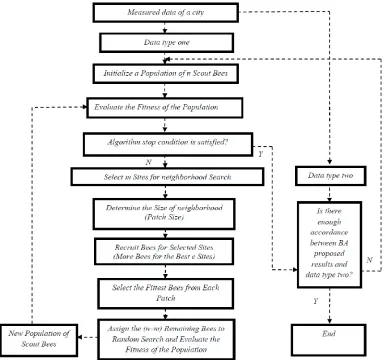
The process begins by scout bees dispatched randomly from one patch to another in search of suitable flower patches. The algorithm includes neighborhood and global search [29, 30].
The algorithm needs a number of parameters to be set: scout bees number (n), number of sites selected out of n viewed sites (m), number of best sites out of m chosen sites (e), number of bees employed for the best e sites (nep), number of bees used for the other (m-e)
selected sites (nsp), initial size of patches (ngh) that includes site, its neighborhood and stop criterion. The basic Bees algorithm is as follows [31]: Step1. Initialize population by random solutions. Step2. Evaluate the fitness of population.
Step3. While (stopping condition not met) //creating new population.
Step4. Choose sites for neighborhood search.
Step5. Employ bees for chosen sites and evaluate fitness.
Step6. Select the best bee from each patch.
Step7. Allocate remaining bees to search randomly and evaluate their fitness.
Step8. End While.
First, the algorithm begins by scout bees placed randomly in the search space. Second, the suitability of sites visited is investigated and bees with the highest fitness are chosen as “selected bees” and mark the sites viewed by them as neighbourhood search space. Third, the algorithm seeks out the chosen sites in the neighbourhood, staffing more bees to search the best sites. The bees are selected directly according to the criterion associated with sites being observed. Suitability values are also employed to determine the probability of the bees selected. Searches in the neighbourhood of the best e sites that represent more suitable solutions are further decomposed by deploying more bees to follow them to other chosen bees. In next step, for each patch only the bee with the highest fitness is selected to establish the next bee population. At last, the remaining bees in the population are assigned randomly around the search space for new solutions. These steps are repeated until the conditions are no longer satisfied [31].
3. PROPOSED METHODOLOGY
calculate the Angstrom model coefficients and predict the monthly average daily global solar radiation on a horizontal surface for the sample regions by Bees algorithm. Angstrom model (Angstrom 1924, Prescott 1940) is presented by Equation (1).
) (
O
O S
S B A H
H = +
(1)
where, H is the monthly average radiation on surface,
O
H equals the monthly average radiation in absence of atmosphere, S equals the monthly average Sunshine hours, SO equals the monthly average of daytime at a
special location , a and b are the experimental coefficients (for methodology details , refer to [32]).
O
H
H and SSO parameters have been measured
separately for both data types for all cities. Tables 2 and 3 illustrate typical HHO and SSO measured values on
sixteen sample months for Hamadan and Tabriz cities. These sample months are 1, 11, 21, 31, 41, 51, 61, 71, 81, 91, 101, 111 months based on data type 1 and 121, 131, 141, 151 months for data type 2 series. Data type1 is applied to BA algorithm implemented in MATLAB software to explore the experimental coefficients based on Angstrom model. Figure 3 illustrates the procedure to determine the coefficients using proposed method according to the raw data. The optimal coefficients are calculated based on minimization an objective function that is defined as Equation (2).
å
=
-= n
i i i X
Y OF
1 2 )
( (2)
where, Yi =(H HO)reali and Xi=(H HO)suggestedi are the actual and forecasted monthly average daily GSR falling on a horizontal surface, respectively, and
n
, illustrating the cumulative observations. As shown in Figure 3, data type 1 as a population of scout Bees is applied to BA program written in MATLAB (2011a) software. After applying Bees Algorithm which it was paid to details in the previous section as well as described in Figure 3, by satisfying the stopping criteria algorithm (In this paper, the number of iterations), the proposed values of algorithm are compared with data type 2. If there was sufficient corroboration between two values, the proposed results would be accepted; otherwise the process would be repeated until the acceptable values are generated. The accuracy of BAsuggested experimental coefficients are investigated by using two statistical indicators, absolute fraction of variance (R2) and Root Mean Square Error (RMSE). R2 and RMSE are described by Equations (3) and (4), respectively:
å
å
= =
-= n
i i
n
i i i
X Y X R
1 2 1
2 2
) (
) (
1 (3)
n Y X RMSE
n
i
i i
å
=-= 1
2
) (
(4)
(Xi,Yi and n have been defined in Equation (2)).
Figure 1. The neighborhood search
Figure 2. Geographical positions of six tested regions of Iran.
TABLE 1. Information of tested cities
City name Longitude E Latitude N Altitude (m) Data type 1 collected space Data type 2 collected space
Esfahan 51.67 32.62 1550.4 1985 -2001 2002-2005 Hamadan 48.53 34.87 1741.5 1985 -2001 2002-2005
Kerman 56.97 30.25 1753.8 1984 -2001 2002-2005
Mashhad 59.63 36.27 999.2 1980-2000 2001-2003
Orumieh 45.05 37.67 1328.0 1985 -2001 2002-2004
4. RESULTS AND DISCUSSION
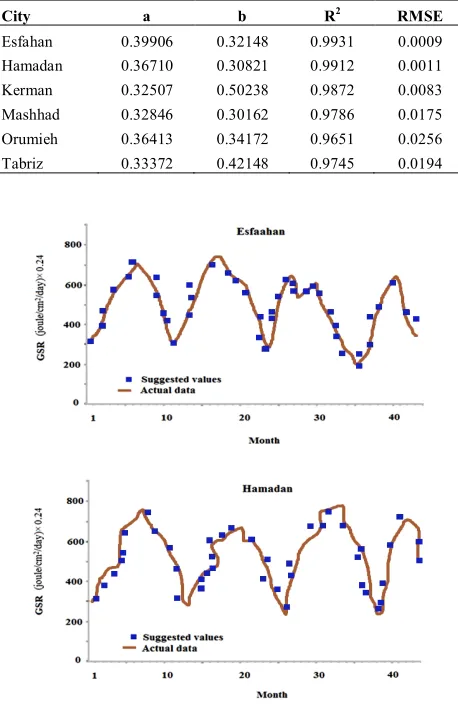
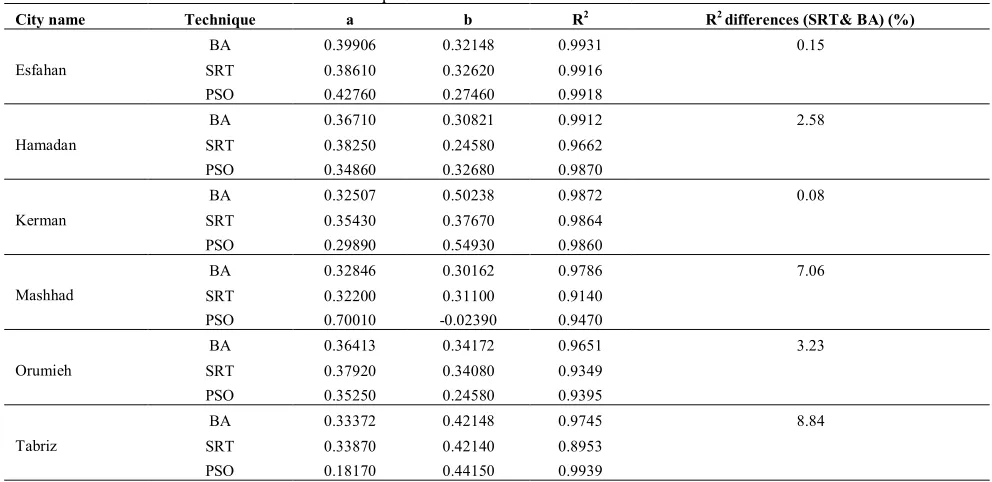
The application of Bees algorithm on six cities using the parameters values shown in Table 4 proved that performance of BA is satisfactory. The satisfying factor is number of iterations and it has been considered equal to 300. Table 5 illustrates the suggested experimental coefficients a and b, based on Angstrom model using BA algorithm, as well as delta between proposed coefficients R2 and RMSE indicators for all six cities. As shown in Table 5, the suggested experimental coefficients for all cities have R2 greater than 96.5%, and RMSE values less than 0.025, showing BA results corroborate the actual measured data. Minimum deviation from delta was reported for Esfahan with a=0.39906 and b=0.32148 and maximum was for Orumieh by a=0.36413 and b=0.34172. In addition, experimental coefficients obtained by BA, PSO and Statistical regression techniques [26] and respective R2
values for all locations are compiled in Table 6. As shown in Table 6, all proposed experimental coefficients by BA in comparison to statistical regression techniques results proved to be more accurate for all cities, as well as in comparison to PSO have greeter R2 values for all cities except Tabriz. Therefore, obtained experimental coefficients for Angstrom model based on BA have more acceptable performance than the SRT and PSO. Maximum delta observed between R2 values of applying two techniques BA and SRT, was 8.84% and Minimum was 0.08% for Tabriz and Kerman, respectively. Finally, actual and proposed BA values on monthly average daily GSR on the validation period illustrated for all six cities in Figure 4.
5. CONCLUSION
This study proposed a new technique based on Bees algorithm using MATLAB software to predict the
monthly average daily global solar radiation on horizontal surface for six different climate cities in Iran. The performance of Bees algorithm to determine experimental coefficients were evaluated using two statistical indicators: Absolute fraction of variance and Root mean square error. As illustrated, coefficients generated by Bees algorithm have absolute fraction of variance values greater than 95% and Root mean square errors less than 0.025, which confirms algorithm accurately estimated global solar radiation on horizontal surface for all six regions. Furthermore, some comparisons between experimental coefficients obtained
by Bees algorithm, particle swarm optimization, and statistical regression techniques results for all locations were performed. The results conformed proposed experimental coefficients by the new method was more accurate than others, as well as collation between the actual measured and new proposed technique values for monthly average daily global solar radiation on the validation period for all six cities proved the proximity of predicted and valid data values.
TABLE 2. Sample measured values of HHO and SSO for both data types of Hamadan city.
Data type Months HHO SSO
1 1 0.510 0.447
1 11 0.485 0.485
1 21 0.513 0.512
1 31 0.424 0.421
1 41 0.423 0.398
1 51 0.500 0.423
1 61 0.681 0.779
1 71 0.554 0.878
1 81 0.529 0.891
1 91 0.844 0.850
1 101 0.759 0.633
1 111 0.796 0.774
2 121 0.620 0.619
2 131 0.597 0.598
2 141 0.591 0.678
2 151 0.693 0.700
TABLE 4. Parameters used in the Bees algorithm
Parameter Value
n: number of scout bees 70 m: number of sites selected out of n visited sites 8 e: number of best sites out of m selected sites 2 nep: number of bees recruited for best e sites 26 nsp: number of bees recruited for other (m-e) selected sites 6
ngh: neighborhood size 5
Number of iterations 300
TABLE 3. Sample measured values of HHO and SSO for both data types of Tabriz city.
Data type Months HHO SSO
1 1 0.419 0.523
1 11 0.493 0.212
1 21 0.655 0.735
1 31 0.873 0.820
1 41 0.700 0.791
1 51 0.670 0.813
1 61 0.715 0.895
1 71 0.403 0.319
1 81 0.512 0.600
1 91 0.697 0.732
1 101 0.478 0.600
1 111 0.581 0.591
2 121 0.400 0.400
2 131 0.493 0.641
2 141 0.448 0.823
2 151 0.500 0.615
TABLE 5. New BA proposed experimental coefficients with accuracy evaluation of results through R2 and RMSE
indicators
City a b R2 RMSE
Esfahan 0.39906 0.32148 0.9931 0.0009 Hamadan 0.36710 0.30821 0.9912 0.0011 Kerman 0.32507 0.50238 0.9872 0.0083 Mashhad 0.32846 0.30162 0.9786 0.0175 Orumieh 0.36413 0.34172 0.9651 0.0256 Tabriz 0.33372 0.42148 0.9745 0.0194
Figure 4. Actual and BA proposed values of monthly average daily GSR comparison for Esfahan, Hamadan, Mashhad, Kerman, Tabriz and Orumieh.
TABLE 6. A comparison between BA and SRT results for all cities.
City name Technique a b R2 R2 differences (SRT& BA) (%)
Esfahan
BA 0.39906 0.32148 0.9931 0.15
SRT PSO
0.38610 0.42760
0.32620 0.27460
0.9916 0.9918
Hamadan
BA 0.36710 0.30821 0.9912 2.58
SRT PSO
0.38250 0.34860
0.24580 0.32680
0.9662 0.9870
Kerman
BA 0.32507 0.50238 0.9872 0.08
SRT PSO
0.35430 0.29890
0.37670 0.54930
0.9864 0.9860
Mashhad
BA 0.32846 0.30162 0.9786 7.06
SRT PSO
0.32200 0.70010
0.31100 -0.02390
0.9140 0.9470
Orumieh
BA 0.36413 0.34172 0.9651 3.23
SRT PSO
0.37920 0.35250
0.34080 0.24580
0.9349 0.9395
Tabriz
BA 0.33372 0.42148 0.9745 8.84
SRT PSO
0.33870 0.18170
0.42140 0.44150
0.8953 0.9939
6. REFERENCES
1. Bristow, K. L. and Campbell, G. S., "On the relationship between incoming solar radiation and daily maximum and minimum temperature", Agricultural and Forest Meteorology, Vol. 31, No. 2, (1984), 159-166.
2. Tiris, M., Tiris, C., and Erdalli, Y., "Water heating system using solar energy", DE Patent App. 1,997,107,859. (1997)
3. Almorox, J. y. and Hontoria, C., "Global solar radiation estimation using sunshine duration in spain", Energy Conversion and Management, Vol. 45, No. 9, (2004), 1529-1535.
5. Chen, R., Ersi, K., Yang, J., Lu, S. and Zhao, W., "Validation of five global radiation models with measured daily data in china",
Energy Conversion and Management, Vol. 45, No. 11, (2004), 1759-1769.
6. Almorox, J., "Estimating global solar radiation from common meteorological data in aranjuez, spain", Turkish Journal of Physics, Vol. 35, No., (2011), 53-64.
7. Angstrom, A., "Solar and terrestrial radiation. Report to the international commission for solar research on actinometric investigations of solar and atmospheric radiation", Quarterly Journal of the Royal Meteorological Society, Vol. 50, No. 210, (1924), 121-126.
8. Prescott, J., "Evaporation from a water surface in relation to solar radiation", Transactions of the Royal Society of South Australia, Vol. 64, No. 1940, (1940), 114-118.
9. Page, J. K., "The estimation of monthly mean values of daily total short wave radiation on vertical and inclined surfaces from sunshine records for latitudes 400 n -40 0s, in Proceedings of UN Conference on new sources of energy", (1961), 378-390. 10. Bahel, V., Bakhsh, H. and Srinivasan, R., "A correlation for
estimation of global solar radiation", Energy, Vol. 12, No. 2, (1987), 131-135.
11. Yeboah-Amankwah, D. and Agyeman, K., "Differential
Ångstrom model for predicting insolation from hours of sunshine", Solar Energy, Vol. 45, No. 6, (1990), 371-377. 12. Ninomiya, H., "Study on application of amedas meteorological
data to the simulation of building heat environment", , University of Tokyo. (1994)
13. Burari, F., Sambo, A. and Mshelia, E., "Estimation of global solar radiation in bauchi", Nigerian Journey of Renewable Energy, Vol. 9, (2001), 34-36.
14. Aggarwal, R. and Pandey, A., "New correlation to estimate global solar radiation on horizontal surfaces using sunshine hour and temperature data for indian sites", Journal of Solar Energy Engineering, Vol. 127, (2005), 417.
15. Trabea, A. and Shaltout, M., "Correlation of global solar radiation with meteorological parameters over Egypt",
Renewable Energy, Vol. 21, No. 2, (2000), 297-308.
16. Ojosu, J. and Komolafe, L., "Models for estimating solar radiation availability in south western Nigeria", Nigerian Journal of Solar Energy, Vol. 16, No., (1987), 69-77. 17. Garg, H. and Garg, S., "Prediction of global solar radiation from
bright sunshine hours and other meteorological parameters", in Solar-India, Proceedings of the National Solar Energy Convention, Allied Publishers, New Delhi, (1982), 1.004-1.007. 18. Zabara, K., "Estimation of the global solar radiation in Greece",
Solar & Wind Technology, Vol. 3, No. 4, (1986), 267-272.
19. Samuel, T., "Estimation of global radiation for Sri Lanka", Solar Energy, Vol. 47, No. 5, (1991), 333-337.
20. Newland, F., "A study of solar radiation models for the coastal region of south China", Solar Energy, Vol. 43, No. 4, (1989), 227-235.
21. Yazdanpanah, H., Mirmojarabian, R. and Barghi, H., "Estimation of solar global radiation on horizontal surface in isfahan", Journal of Geography and Environmental Planning (Persian), Vol. 37, No., (2010), 95-104.
22. Sivamadhavi, V. and Selvaraj, R. S., "Robust regression technique to estimate the global radiation", Indian Journal of Radio & Space Physics, Vol. 41, No. 1, (2012), 17-25. 23. Mellit, A., Menghanem, M. and Bendekhis, M., "Artificial
neural network model for prediction solar radiation data: Application for sizing stand-alone photovoltaic power system", in Power Engineering Society General Meeting, IEEE, (2005), 40-44.
24. Iqdour, R. and Zeroual, A., "A rule based fuzzy model for the prediction of solar radiation", Revue Des Energies Renouvelables, Vol. 9, No. 2, (2006), 113-120.
25. Wang, J., Xie, Y., Zhu, C. and Xu, X., "Daily solar radiation prediction based on genetic algorithm optimization of wavelet neural network", in Electrical and Control Engineering (ICECE), International Conference on, IEEE. (2011), 602-605.
26. Behrang, M., Assareh, E., Noghrehabadi, A. and Ghanbarzadeh, A., "New sunshine-based models for predicting global solar radiation using pso (particle swarm optimization) technique",
Energy, Vol. 36, No. 5, (2011), 3036-3049.
27. Pham, D., Ghanbarzadeh, A., Koc, E., Otri, S., Rahim, S., and Zaidi, M., "The bees algorithm. Technical note", Manufacturing Engineering Centre, Cardiff University, UK, (2005), 1-57. 28. Pham, D., Ghanbarzadeh, A., Koc, E., Otri, S., Rahim, S., and
Zaidi, M., "The bees algorithm–a novel tool for complex optimisation problems", in Proceedings of the 2nd Virtual International Conference on Intelligent Production Machines and Systems (IPROMS). (2006), 454-459.
29. Seeley, T., The wisdom of the hive: The social physiology of honey bee colonies, Harvard University Press, Cambridge MA. (1996)
30. Alfi, A. and Khosravi, A., "Constrained nonlinear optimal control via a hybrid BA-SD", International Journal of Engineering, Vol. 25, No. 3, (2012), 197-204.
31. Gholipoura, R., Khosravia, A. and Mojallali, H., "Parameter estimation of loranz chaotic dynamic system using bees algorithm", International Journal of Engineering-Transactions C: Aspects, Vol. 26, No. 3, (2012), 257.
New Technique for Global Solar Radiation Forecast using Bees
Algorithm
RESEARCH NOTE
H. Bagheri Tolabia, M. H. Moradib, F. Bagheri Tolabi a
a Faculty of Engineering, Islamic Azad University, Khorramabad Branch, Iran b Faculty of Engineering, Bu Ali Sin University, Hamedan, Iran
P A P E R I N F O
Paper history:
Received 09 February 2013
Received in revised form 16 March 2013 Accepted 18 April 2013
Keywords:
Bees Algorithm Global Solar Radiation Experimental Coefficients Statistical Regression Techniques Intelligent Techniques
هﺪﯿﮑﭼ
ناﺰﯿﻣدروآﺮﺑ ﺪﯿﺷرﻮﺧﺶﺑﺎﺗ
ﺮﺘﻣارﺎﭘﻦﯾﺮﺗﻢﻬﻣ ﺖﻬﺟ
ﻒﻠﺘﺨﻣعاﻮﻧاﯽﺣاﺮﻃ يﺪﯿﺷرﻮﺧيﺎﻫﻢﺘﺴﯿﺳ
ﺖﺳا .
لﻮﺼﺣﺖﻬﺟ
ﻖﯿﻗدراﺪﻘﻣ يﺪﯿﺷرﻮﺧﺶﺑﺎﺗ رد
ﻪﻘﻄﻨﻣﮏﯾ صﺎﺧ تاﺰﯿﻬﺠﺗ ﺖﻤﯿﻗﯽﻧاﺮﮔ درﻮﻣ
زﺎﯿﻧ زاﯽﮐﺪﻧاداﺪﻌﺗردﺎﻫنآﻦﯿﻣﺎﺗﻪﮐﺖﺳا
يﺎﻫهﺎﮕﺘﺴﯾا ﺖﺳاﺮﯾﺬﭘنﺎﮑﻣاﮏﯿﺘﭘﻮﻨﯿﺳ
.
،ﺎﺘﺳارﻦﯾارد رﻮﻈﻨﻣﻪﺑﯽﻔﻠﺘﺨﻣيﺎﻫلﺪﻣ
دروآﺮﺑ يﺪﯿﺷرﻮﺧﺶﺑﺎﺗ نﺎﻘﻘﺤﻣﻂﺳﻮﺗ
دﺎﻬﻨﺸﯿﭘ ﺪﻧاهﺪﺷ زايﺪﻨﻣهﺮﻬﺑ موﺰﻟﻪﮐ ﯽﯾﺎﻫهﺎﮕﺘﺳدﻦﯿﻨﭼ
ار ﺪﻧزﺎﺳﯽﻣﻊﻔﺗﺮﻣ
.
ﻦﯾاﯽﮕﺘﺴﺑاووهﺪﭽﯿﭘ،ﯽﻄﺧﺮﯿﻏﺖﯿﻫﺎﻣ
ﯾﺎﯿﻓاﺮﻐﺟﻪﻘﻄﻨﻣﮏﯾﯽﺳﺎﻨﺷاﻮﻫﻒﻠﺘﺨﻣيﺎﻫﺮﺘﻣارﺎﭘﻪﺑﺎﻫلﺪﻣ ﺎﺑﯽﯾﺎﻫرﺎﮑﻫارلﺎﺒﻧدﻪﺑﻪﮐﺖﺳاﻪﺘﺷادنآﺮﺑارنﺎﻘﻘﺤﻣ،ﯽ
ﺪﻨﺷﺎﺑصﺎﺧﻪﻘﻄﻨﻣﺮﻫياﺮﺑﺶﺑﺎﺗراﺪﻘﻣﻦﺘﻓﺎﯾ،ﺖﯾﺎﻬﻧردوﺎﻫلﺪﻣﻦﯾاﻞﺣﺖﻬﺟﻻﺎﺑﺖﻋﺮﺳوﺖﻗد
.
،ﻪﻟﺎﻘﻣﻦﯾارد ﮏﯾ
،مﺮﺘﺴﮕﻧالﺪﻣيﺎﻨﺒﻣﺮﺑﺪﯾﺪﺟشور ﮏﻤﮐﺎﺑ
ﺪﯾﺪﺟﻢﺘﯾرﻮﮕﻟا ،ﺎﻫرﻮﺒﻧز
ﮏﯾناﻮﻨﻋﻪﺑ ﻢﺘﯾرﻮﮕﻟا
ﯽﻓﺎﺸﺘﮐا و ﯽﻨﺘﺒﻣﺮﮔﻮﺠﺘﺴﺟ
دروآﺮﺑرﻮﻈﻨﻣﻪﺑﺖﯿﻌﻤﺟﺮﺑ هﺎﻣردﻪﻧازورﻂﺳﻮﺘﻣﯽﻠﮐﺶﺑﺎﺗ
ﺢﻄﺳيورﺮﺑ ﻦﯿﻣزﯽﻘﻓا
ﯽﻓﺮﻌﻣ هﺪﺷ ﺖﺳا
.
ﺐﯾاﺮﺿ ﯽﺑﺮﺠﺗ
لﺪﻣ موﺮﺘﺴﮕﻧآ
ﺶﺷ ياﺮﺑ
ﻪﻘﻄﻨﻣ ﯾاﻮﻫوبآ ﯽ ﻒﻠﺘﺨﻣ ناﺮﯾا ﻪﻣﺎﻧﺮﺑزاهدﺎﻔﺘﺳا ﺎﺑ يدﺎﻬﻨﺸﯿﭘ
ﻪﺘﺷﻮﻧ هﺪﺷ رد مﺮﻧﻂﯿﺤﻣ
-راﺰﻓا MATLAB ،
ﺪﻧا هﺪﺷﻪﺒﺳﺎﺤﻣ .
ﻪﺴﯾﺎﻘﻣ ﻦﯿﺑ هﺪﻣآﺖﺳدﻪﺑﺞﯾﺎﺘﻧ زا
شور يدﺎﻬﻨﺸﯿﭘ
شورو
،ﺮﮕﯾديﺎﻫ ويﺮﺗﺮﺑ
يﻻﺎﺑﯽﯾارﺎﮐ ﮏﯿﻨﮑﺗ
ﺪﯾﺪﺟ ﻦﯿﻤﺨﺗﺖﻬﺟاريدﺎﻬﻨﺸﯿﭘ ﺶﺑﺎﺗ
ﺪﻨﮐﯽﻣﺖﺑﺎﺛيﺪﯿﺷرﻮﺧ .