Fragmentation Pattern of Fluorine Atom by
Electron Impact
Nidhi
Research Scholar,
Department of Chemistry, Baba Mast Nath University, Rohtak, INDIA. email:[email protected].
(Received on: January 14, 2018)
ABSTRACT
The total ionization cross-sections of Fluorine atom due to electron impact for threshold ionization energy to 1100 eV have been studied. The present cross sections are compared to existing experimental cross sections as well as to theoretical predictions. The correlation between the total electron scattering cross section and the number of target-molecule electrons is discussed. One of the purposes of this work is to calculate the electron impact ionization cross-sections of the Flourine atom by employing the useful features of Semi- empirical model at given energy.
Keywords: Electron impact, Cross section, Ionization.
I. INTRODUCTION
The determination of total cross section for electron scattering from atoms and molecules at electron energies 1100 eV. The cross-section measurements at these energies are required to develop theoretical models in understanding the interaction process and in applications in atmospheric physics, astrophysics, plasma physics and chemical physics1-2.
ionosphere of earth are mainly formed due to the ionization of the neutral constituent of atmosphere by solar radiations leading to production of energetic free electrons and ions. These energetic electrons further excite the neutral particles and these excited states of particles on decay to lower states give rise to fluorescence. This is an important component of day glow. These ionized and excited species also produce the atmospheric emission known as aurora. Hence for the proper understanding of the different phenomena occurring in upper atmosphere, we need a wide knowledge of atomic and molecular Collision processes3-5.
II. THEORY
Cross sections of many different types of molecules and atoms can be determined by various experimental techniques during the last decades. Electron impact ionization of rare gas ions is an important process in high-energy chemical processes, such as in planetary atmospheres and in plasma physics.
Even though the cross sections for singly and multiply charged ions decline rapidly with increasing stage of ionization, multiple ionization processes are important in fusion plasmas and in other environments with an abundance of energetic electrons.
Electron impact ionization of a positive ion may occur directly, when one or more electrons are ejected from an outer or from an inner shell or indirectly, via formation of an intermediate auto ionizing state which cans be formed in two ways. Firstly, the incident electron may excite the target ion from an inner shell into short-lived auto ionizing states, which subsequently decay via Auger transitions. Secondly, direct inner shell ionization may be followed by single or multiple auto ionization, either by cascading transitions or by simultaneous ejection of two or more electrons6-16.
III. FORMULATION
The present calculations are carried out using the modified semi empirical formalism developed by Jain-Khare. In brief, the single differential cross sections in the complete solid angle (Ώ= 4𝜋 = ∫ 2𝜋𝑠𝑖𝑛𝜃𝑑𝜃) is known as a function of secondary electron energy ε corresponding to the production of ith type of ion in the ionization of a molecule by incident
electron of energy E is given by
) ...( sin 2 1 ln , , 1 ) , , ( 0 2 2 2 3 3 0 2 20 d I
E E S E I E I E C K W df W I E W E E R a W E Q i I E
k i i
i i i
i
i
WhereW (=ε + Ii) is defined as energy loss suffered by the incident electron.
Ii = the ionization threshold for the production of ith type of ion,
a0= the Bohr radius,
Ci= collision parameter,
Si= number of ionizable electrons,
R= Rydberg constant and
θ = the scattering angle respectively.
In the present formulation, the dipole oscillator strengths dfi / dw are the key parameters.
The oscillator strength or appearance potential is in direct ratio or directly proportional to the photo ionization cross section. We have used partial photo ionization cross section data set in the energy range provided by Brion using (e, 2e) spectroscopy. The accuracy of the determined oscillator strength scales was estimated to be better.
In the photon energy range, we have used their measured total valence photo absorption oscillator strength data and for higher photon energy range the same were extrapolated by Thomas-Reiche-Kuhn (TRK) sum rule. The total photo absorption cross sections have been distributed into ionic fragments considering the constant ionization efficiency to be above the dipole breakdown limit of 25eV. However, its evaluation is possible quantum mechanically using the suitable wave functions and transition probabilities corresponding to the production of cations.
In case of dissociative ionization of polyatomic molecule, we have no reliable probabilities corresponding to different dissociative ionization processes. The collision parameter and energy parameter ε0 are evaluated as for other polyatomic molecules. The
vertical onsets or the ionization potentials corresponding to the various cations are also given along with the photo ionization measurements. In the present evaluations of cross sections, the estimated uncertainty is more or less the same as for the measurement of photo-ionization cross sections. The double differential cross sections as a function of energy and angle were evaluated by the differentiation of equation of semi empirical formula with respect to the solid angle Ώ as follows:
,
,
.
)
,
,
(
E
W
Q
E
W
Q
i i t
i
The double differential cross sections are angular dependant in all the scattering geometries and hence the oscillator strength must be angle dependent. In this context, we have used the angular oscillator strengths that were derived in the optical limit (Bethe regime) where angular-momentum-transfer k→ 0,
1
/
4
1
cos
,
0
/
,
)
,
,
(
W
K
P
2df
W
dW
df
i
iWhere β is an energy dependent asymmetric parameter. Its evaluation is difficult due to the lack of wave functions of molecular ions in ground and excited states. In valence shell ionization of atomic molecules, we have computed β as the ratio of the Bethe spectral transitions Si(W) to the dipole matrix squared Mi2 (W). The oscillator strength appeared in
𝑄𝑖(𝐸) = ∫ 𝑄𝑖(𝐸, 𝑊)𝑑𝑊
and the counting or total electron impact ionization cross section is obtained by
𝑄𝑖𝑇(𝐸, 𝑊) = ∑ 𝑄𝑖 𝑖
(𝐸, 𝑊)
IV. RESULTS AND DISCUSSION
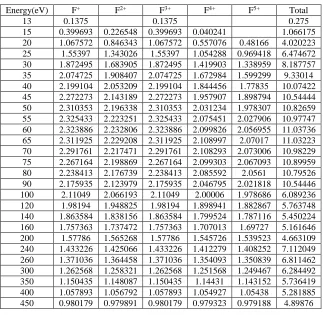
Now we calculate the partial ionization cross section measurements for the Flourine atom from threshold to 1100 eV modified Jain-Khare Semi-empirical model. Table 1and Table 2 shows the measured partial cross sections for the formation of F+, F2+, F3+, F4+, F(Total).
In figure 1, 2, 3, 4, 5& 6 represents the production of F+, F2+, F3+, F4+ and total
ionization cross section of Flourine Atom. The present results for partial and total ionization cross sections satisfy the necessary consistency checks to access their consistency and reliability.
Table 1: Partial Ionization Cross Section of Flourine atom 10-21 m2 Energy(eV) F+ F2+ F3+ F4+ F5+ Total
13 0.1375 0.1375 0.275
500 0.913941 0.914218 0.913941 0.914533 0.914684 4.571317 550 0.856789 0.857452 0.856789 0.858378 0.858724 4.288132 600 0.806922 0.807863 0.806922 0.80923 0.809709 4.040646 650 0.763016 0.764152 0.763016 0.765826 0.766416 3.822426 700 0.724026 0.725308 0.724026 0.727205 0.727853 3.628418 750 0.689172 0.690543 0.689172 0.692605 0.693302 3.454794 800 0.657792 0.659235 0.657792 0.6614 0.662143 3.298362 850 0.629389 0.630883 0.629389 0.633127 0.633887 3.156675 900 0.603556 0.605072 0.603556 0.607365 0.608141 3.02769 950 0.579926 0.581471 0.579926 0.583791 0.58458 2.909694 1000 0.558246 0.559799 0.558246 0.562131 0.562917 2.801339 1050 0.538264 0.53981 0.538264 0.542148 0.542943 2.701429 1100 0.519783 0.521328 0.519783 0.523661 0.524454 2.609009
V. CONCLUSION
The oscillator strengths obtained for the ionic target are observed to be under estimated by the empirical law whereas the latter overestimates the data corresponding to neutral argon. The generalized oscillator strength is deduced from high-energy ionization cross sections17-31.
REFERENCES
1. G. Garcia and F. Blanco, Phys. Rev. A 62, 044702 (2000).
2. A. Zecca, G. P. Karwasz, and R. S. Brusa, J. Phys. B 33, 843 (2000).
0 200 400 600 800 1000 1200
-0.2 0.0 0.2 0.4 0.6 0.8 1.0 1.2 1.4 1.6
cro
ss
se
ct
io
n
energy(eV))
0 2 4 6 8 10
0 2 4 6 8 10
4. L.G. Christophorou and J.K Olthoff Phys. Chem. Ref. Data Vol.35, No.1, 31-53 (2006). 5. L.G. Christophorou and J.K Olthoff J. Res Natt. Inst. Stad. Vol.107, 63 (2002).
6. Je Hudson, C Vallance, M Bart And Pw Harlard, J Phys. B. 34, 3025 (2001).
7. M Bart, Pw Harlard, Je Hudson And C Vallance, Phys. Chem Chem Phys., 3, 800 (2001). 8. R Rejoub, BG Lindsay and RFStabbings, J Chem. Phys. 115, 5053 (2001).
9. R Rejoub, BG Lindsay and RF Stabbings, J Chem. Phys. 34, 1289 (2001). 10. R Rejoub, BG Lindsay and RF Stabbings, J Chem. Phys. 114, 10225 (2001). 11. K Leiter, P Scherier, G Walder and Td Mark IJMS Ion Processess 87, 209 (1989). 12. H Deutsch and T D Mark, Int. J. Mass Spectrum, Ion Process 79, R1 (1987)
13. T.D. Mark, G.H. Dunn (Eds.), Electron Impact Ionization Springer Verlag, Viena, (1985). 14. Y-K Kim and M.E. Rudd, Phys, Rev. 50, 3954 (1994).
15. W. Hwang, Y,-K, Kim and M.E Rudd, J. Chem. Phys. 104, 2956 (1996).
16. Y.-K. Kim W. Hwang, N.M. Weinberger, M.A. Ali, and M.E. Rudd, J. Chem. Phys. 106, 1026 (1997).
17. R.S. Schappe, T. Walker, L.W. Anderson and C.C. Lin, Phys. Rev. Lett. 76, 4328 (1996). 18. C.J. Patton, K.O. Lozhkin, M.B. Shan, J. Geddes and H.B. Gilbody, J. Phys. B: At. Mol.
Opt. Phys. 29, 1409 (1996).
D.P. Almeida, M.A. Scopel, R.R. Silva and A.C. Fontes, Chem. Phys. Lett. 341, 490 (2001). 19. R. Rejoub, B.J. Lndsay and R.F. Stebbings Phys. Rev. A65, 042713 (2002).
20. J.J. Thomson, Phys. Mag. 23, 449 (1912). 21. M. Gryzinski, Phys. Rev. A138, 305 (1965). 22. R.C. Stabler, Phys. Rev. 133, 1268 (1964). 23. E. Gerjuoy, Phys. Rev. 148, 54 (1966).
24. A. Buerguess and I.C. Percival, Adv Atom. Mol. Phys. 4, 109 (1968).
25. A. Burguess, Proc. Symp. Atomic Collision Processes in Plasmas: Culha, p. 63 (1964). 26. V.I. Ochkur, Proc. Liningrad State Universe. “The Problems of Atomic Collision Theory”
N. 1, p. 42, (in Russian) (1975). 27. L. Vreins, Phys. Rev. 141, 88 (1966). 28. L. Vriens, Proc. Phys. Soc. 89, 13 (1966).
29. S. Pal “Two dimensional electronics laser” Chem. Phys. Letts. 308, 428 (1999).
30. LG Christophorou, Jk Olthoff “Electron interaction with C2F6” J, Phys Chem. Ref. Data
27, 1 (1998).