Oxidative Decarboxylation Reaction Between
Phenylsulfinylacetic Acids and [Fe
III(salen)Cl]
Complex in TX-100 Medium
P. Subramaniam and C. Shanmuga Sundari
Research Department of Chemistry,
Aditanar College of Arts and Science, Tiruchendur-628 216, Tamil Nadu, INDIA. email:[email protected].
(Received on: July 11, Accepted: July 13, 2017)
ABSTRACT
Mechanism of oxidative decarboxylation of phenylsulphinylacetic acids (PSAAs) by [FeIII(salen)Cl] complex in aqueous TX-100 medium has been
investigated spectrophotometrically. The complex formation during the reaction is confirmed from the Michaelis-Menten kinetics and spectral changes. Introduction of both electron withdrawing and electron releasing substituents in PSAA accelerate the reaction rate. A Hammett correlation displays a non-linear upward curvature has been ascribed to a shift in the rate determining step. An electron transfer mechanism involving oxidation with simultaneous decarboxylation yielding methyl phenyl sulfone as a product is proposed.
Keywords: Kinetics, Oxidative decarboxylation, phenylsulfinylacetic acid, [FeIII(salen)Cl], TX-100.
1. INTRODUCTION
Surfactants are amphipathic molecules with both hydrophobic and hydrophilic properties. Micelles are formed by self-aggregation of amphiphilic molecules in aqueous medium above the critical micellar concentration (CMC). Kinetics studies in surfactant media can provide mechanistic details about hydrophobic and electrostatic influences not only on redox reactions but also on biological electron transfers that place on membrane surfaces or protein-substrate interfaces1. Water molecules, which are tightly bound to the surfactant head
groups of the micelles, resemble the hydrophilic packets of enzymes and have high viscosities, low mobilities and polarities. If any one of the reaction species interacts with micelles, then the presence of micelles will affect the reaction rate2. The modifications in the reaction
solvating power and thus alter the rate3,4. The variation in values of rate constant with the
alteration in the medium may involve the interaction of the solvent medium with the reactants, transition states and/or products. The rate of hydrolysis of ester increases when the transition state is better stabilized by the H-bonding than the initial state5.
Non-ionic surfactants have neutral and hydrophobic head groups. They are considered as mild surfactants due to their ability to break protein-lipid, lipid-lipid association but not protein-protein interaction. Most of them do not denature proteins. Triton-X 100 is a typical non-ionic surfactant, most preferable choice for immune precipitation experiments. It has hydrophilic polyethylene oxide chain and an aromatic hydrocarbon, hydrophobic group. The kinetics of oxidative decarboxylation reactions between twelve PSAAs and three [FeIII(salen)Cl] complexes were studied in the presence of non-ionic (TX-100) surfactants
(Fig. 1) in order to gain a better understanding of their oxidizing properties.
Fig. 1. Structure of non-ionic TX-100 surfactant.
2. EXPERIMENTAL
Salicylaldehyde, SDS (SD fine), Thiophenol (SD fine) and substituted thiophenols (Sigma Aldrich) were purchased and used without further purification. N,
Nʹ-Dimethylformamide (DMF) and double distilled water were used as solvents for all kinetic runs. Aqueous solutions of desired strengths were freshly prepared prior to use.
The ligand, salen [N,Nʹ-bis(salicylidine)ethylenediaminato] was synthesized by the dehydration condensation reaction of salicylaldehyde and ethylenediamine in the ratio of 2:1 in an alcoholic medium using established procedure6. Preparation of [FeIII(salen)Cl] complex
was achieved by the literature procedureby simply mixing the salen ligand and ferric chloride in stoichiometric amounts under alcoholic medium. Phenylsulfinylacetic acid (PSAA) and its meta- and para-substituted acids were prepared from the corresponding phenylmercaptoacetic acids by the controlled oxidation by equimolar H2O27,8.
2.1. Kinetics of oxidation of PSAA in micelle
The oxidative decarboxylation reaction of PSAAs with [FeIII(salen)Cl] complex in
TX-100 medium was followed by spectrophotometrically using BL-222 Bio-spectrophotometer with inbuilt thermostat in the presence of 99 % H2O and 1 % DMF solvent.
The small percentage of organic solvent is essential to dissolve the oxidant used in the present system. The pseudo first-order conditions (PSAA >>> [FeIII(salen)Cl]) were maintained
complex at their wavelength (Fig. 2). The plots of log OD vs. time were linear and the pseudo first-order rate constant evaluated from such plots, are reproducible to within ± 5 %. The overall rate constant (kov) were calculated from the relation kov = k1 / [PSAA]order. The error in
the rate constants are given according to 95 % students t-test. The reported CMC of TX-100 is 3.0 x 10⁻⁴ M.2
Fig. 2. Absorption spectral change for the reaction between PSAA and Complex in the presence of TX-100. [PSAA] = 5 x 10⁻² M, [complex] = 1.0 x 10⁻⁴ M, TX-100 = 0.1 M, solvent = 99 % H
2O - 1 % DMF (v/v); temp. = 30 oC.
2.2. Product characterisation
PSAA and [FeIII(salen)Cl] were mixed in the ratio of 1:2 under the experimental
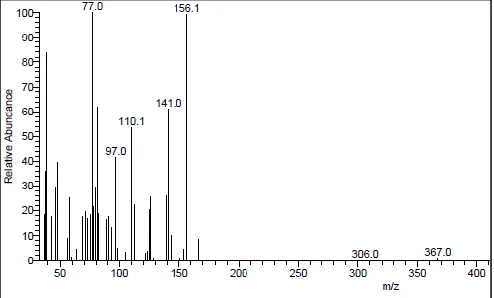
conditions and kept aside for completion. After completion of the reaction the solvent was removed under reduced pressure and the product was extracted with chloroform and dried over anhydrous sodium sulphate. The product obtained after the complete removal of chloroform was characterised by GC-MS (Fig. 3) spectral method and the product is identified as methyl phenyl sulfone.
3. RESULTS
3.1. Rate dependence of [PSAA] in TX-100 medium
The observed pseudo first order rate constants at different concentrations of PSAA and [FeIII(salen)Cl] are recorded in Table 1. The reaction is found to be first order with respect
to oxidant, [FeIII(salen)Cl] which is evident from the linear log OD vs. time plot. However, the
pseudo first order rate constant decreases tremendously with increasing concentration of [FeIII(salen)Cl]. Such type of rate retardation is common in reactions where salen complexes
are involvedand is explained by decrease in concentration of active species as a result of dimerization of salen at high concentrations6,9. The fractional-order dependence on PSAA is
shown from the linear plot of log k1 vs. log [PSAA] with a fractional slope. This is further
confirmed from the linear Michaelis-Menten plot of 1/k1vs. 1/[PSAA] with definite intercept.
The linear Michaelis-Menten plot shows that the PSAA binds to the oxidising species, [FeIII(salen)Cl] before the rate controlling step.
Table 1. Pseudo-first-order rate constants for the oxidative decarboxylation of PSAA by [FeIII(salen)Cl] in TX-100 medium
102 [PSAA] (M) 104 [complex] (M) 104 k
1 (s-1)
1.0 1.0 1.14 ± 0.01
2.5 1.0 3.30 ± 0.03
5.0 1.0 11.5 ± 0.20
7.5 1.0 28.3 ± 0.90
10 1.0 49.2 ± 1.75
5.0 0.5 32.4 ± 1.81
5.0 1.0 11.5 ± 0.20
5.0 5.0 8.03 ± 0.02
TX-100 = 0.1 M; solvent = 99 % H2O - 1 % DMF (v/v);temp. = 30 oC.
3.2. Effect of TX-100 on reaction rate
To analyse the effect of micelle on the reaction rate of electron transfer reaction between PSAA and [FeIII(salen)Cl] complexes, a series of kinetic runs were carried out with
various concentration of TX-100 from 5 x 10⁻⁴ to 9 x 10⁻¹ M at constant [PSAA], [complex],
solvent composition and temperature. Though the reaction rate is found to be increases with increase in concentration of surfactant at low region, the rate constant reaches a maximum and then decreases at high concentration of the surfactant. The observed results are presented in Table 2 and Fig. 4. The results show that the micelle, TX-100 has both acceleration and inhibition effects with bell shaped curve.
Table 2. Dependence of reaction rate with TX-100 variation 102
[TX-100] M) 104
k1 (s-1)
0 17.0 ± 0.05
0.05 18.3 ± 0.39
0.5 22.0 ± 0.47
5.0 15.6 ± 0.29
10 11.5 ± 0.20
30 10.5 ± 0.15
50 11.6 ± 0.40
90 3.75 ± 0.12
[PSAA] = 5.0 x 10⁻² M; [FeIII(salen)Cl] = 1 × 10⁻⁴ M; solvent = 99 % H
Fig. 4. Variation of rate constants with [TX-100].
3.3. Effect of substituent on PSAA in TX-100 medium
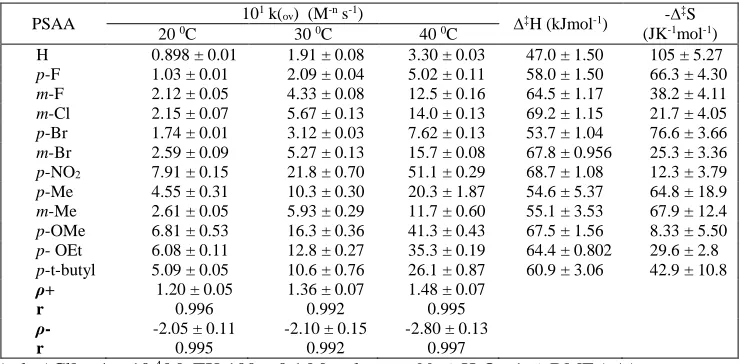
The effect of substituent on the reaction rate was studied with several para- and meta-substituted PSAA’s with [FeIII(salen)Cl] in TX-100 medium and the corresponding data’s are
given in Table 3. From the study of substituent effect it is clear that both electron releasing and electron withdrawing groups in PSAA accelerate the reaction rate. This indicates that both the substituents facilitates the electron transfer from PSAA to [FeIII(salen)Cl] in the micellar
medium. As the reaction is fractional order with respect to PSAA. The overall rate constants used to evaluate the reaction constant ρ from the Hammett correlation.
Table 3. Substituent and temperature effects for the oxidative decarboxylation in TX-100.
PSAA 10
1 k(
ov) (M-n s-1)
∆‡H (kJmol-1) -∆‡S
(JK-1
mol-1
)
20 0C 30 0C 40 0C
H 0.898 ± 0.01 1.91 ± 0.08 3.30 ± 0.03 47.0 ± 1.50 105 ± 5.27
p-F 1.03 ± 0.01 2.09 ± 0.04 5.02 ± 0.11 58.0 ± 1.50 66.3 ± 4.30
m-F 2.12 ± 0.05 4.33 ± 0.08 12.5 ± 0.16 64.5 ± 1.17 38.2 ± 4.11
m-Cl 2.15 ± 0.07 5.67 ± 0.13 14.0 ± 0.13 69.2 ± 1.15 21.7 ± 4.05
p-Br 1.74 ± 0.01 3.12 ± 0.03 7.62 ± 0.13 53.7 ± 1.04 76.6 ± 3.66
m-Br 2.59 ± 0.09 5.27 ± 0.13 15.7 ± 0.08 67.8 ± 0.956 25.3 ± 3.36
p-NO2 7.91 ± 0.15 21.8 ± 0.70 51.1 ± 0.29 68.7 ± 1.08 12.3 ± 3.79
p-Me 4.55 ± 0.31 10.3 ± 0.30 20.3 ± 1.87 54.6 ± 5.37 64.8 ± 18.9
m-Me 2.61 ± 0.05 5.93 ± 0.29 11.7 ± 0.60 55.1 ± 3.53 67.9 ± 12.4
p-OMe 6.81 ± 0.53 16.3 ± 0.36 41.3 ± 0.43 67.5 ± 1.56 8.33 ± 5.50
p- OEt 6.08 ± 0.11 12.8 ± 0.27 35.3 ± 0.19 64.4 ± 0.802 29.6 ± 2.8
p-t-butyl 5.09 ± 0.05 10.6 ± 0.76 26.1 ± 0.87 60.9 ± 3.06 42.9 ± 10.8
ρ+
r
1.20 ± 0.05 0.996
1.36 ± 0.07 0.992
1.48 ± 0.07 0.995
ρ-
r
-2.05 ± 0.11 0.995
-2.10 ± 0.15 0.992
-2.80 ± 0.13 0.997
[FeIII(salen)Cl] = 1 × 10⁻⁴ M; TX-100 = 0.1 M; solvent = 99 % H
2O - 1 % DMF (v/v).
On applying Hammett correlation between substituents constants σ and log kov of
meta- and para- substitueted PSAA’s, a non-linear upward ‘V’-shaped Hammett plot is
observed. The upward curve consists of ERGʹs fall on one side of the line having negative ρ value and the EWGʹs fall on another line having positive ρ value. The Hammett plot in presence of TX-100 medium was shown in Fig.5.
Similar ‘V’-shaped Hammett plot is reported earlier in oxygen atom transfer reaction of axially ligated Mn(V)-oxo complexes10, addition of phenols to tetramesityldisene11,
pyridinolysis of bis(2,6-dimethyl phenyl chlorophosphate) in acetonitrile12, osmium(III)
catalysed oxidation of some substituted trans-cinnamic acids by chloramine-T in alkaline medium13.
3.4. Effect of temperature in TX-100 medium
The reactions of all substituted PSAA’s with [FeIII(salen)Cl] complex was carried out
at 3 different temperature in TX-100 medium. The activation parameters ∆‡H and ∆‡S values for several PSAAs with [FeIII(salen)Cl] at different temperatures are calculated using Eyring’s
plot and are summarized in Table 3. A linear isokinetic relationship is found using the rate constants at two different temperatures as proposed by Exner14 by applying the following
equation proves that all the substituted PSAAs follow the same mechanism. log kov(T2) = a + b log kov(T1) Where T2 > T1
4. DISCUSSION
An obvious red shift in wavelength for parent complex from 468 nm to 490 nm and significant decrease in absorbance was noted when we changed from DMF to aqueous DMF. This result indicates that there was an interaction of complex with water and confirm the formation of active species [FeIII(salen)]+. In the present reaction one of the reactant PSAA is
neutral PSAA molecule can placed in a micellar phase by hydrophobic and hydrogen bonding or by both together. PSAA has carbonyl oxygen which has a free hydrogen bonding site. It can form hydrogen bonding with TX-100 through oxyethylene oxygen atom. Also the oxidant [FeIII(salen)]+ cation binds to the neutral head group of the TX-100 by the weak electrostatic
interaction between the π-electrons of the benzene ring and the positively charged active species. Thus both the reactants come close together in the stern layer of micelle and accelerate the reaction rate. Enhancement of rate was noted in the oxidation of methionine by MnO215,
oxidation of dextrose by N-bromophthalimide 16 in TX-100 medium and was discussed by
H-bond formation between the substrate and polar ethylene oxide of TX-100. In the first step (scheme-1) the active species [FeIII(salen)]+ (C
1) is formed by the
removal of Cl- from [FeIII(salen)Cl] complex. The rate enhancement observed in the reaction
between PSAA and [FeIII(salen)]+ in micellar medium may be due to the hydrophobic and
hydrogen bond interaction occur between the surfactant and reactants. In the reaction, the nucleophilic attack of sulfur atom of PSAA to [FeIII(salen)]+ is proposed. As the reaction
follows a fractional-order dependence on the PSAA, it is reasonably to envisage that the reaction follows Michaelis-Menten kinetics. This observation is kinetic evidence for the formation of adduct C2 between PSAA and [FeIII(salen)]+. As a result of the nucleophilic attack
of PSAA, a positive charge is developed on the sulfur atom of PSAA. The oxidant accept one electron from PSAA and converts into [FeII(salen)]. During the electron transfer reaction,
sulfoxide cation radical is formed as the intermediate species (C3) which was proposed by
many authors17,18 on sulfur compounds.
Fe O N III O N
H2O
Cl
(C1) S C6H5
CH2COOH
(C2)
S
CH2COOH H2O
(C1) O
O C6H5
S
CH2COOH O
C6H5
HO S CH2COOH
C6H5
O
(C3)
HO
C6H5 S
(C4) Fe O
Fe O
HOOCH2C
S O O O N N Fe O
C6H5
CH2COOH (C1)
S III CH3 O N III
(C2) O
O N
N
II
C6H5
O H+ N H+ CO2 Cl -+ + + : + . . + . + + . +
+ fast +
k2 .+
.
+ +[FeII(salen)] k3
EDG
EWG
On the basis of the above discussions and observed substituent effects with rate acceleration, two different rate determining steps have been proposed reaction. The change in rate determining step within the same mechanism was given the ‘V’-shaped Hammett in the reactions of PSAA with oxo(salen)chromium(VI) oxidation19 and the electron transfer reaction
of PSAA with iron(III)polypyridyl complexes17. The formation of sulfoxide cation radical C 3
(step k2) has been considered as the rate determining step for electron releasing groups present
in the PSAA. The nucleophilic attack of water on the cation radial leads to the formation of sulfoxide radical (C4) is considered as the rate determining step (k3) for electron withdrawing
groups present in the PSAA. The sulfoxide radical then transfer its one electron to the second molecule of [FeIII(salen)]+ species and converted into sulfoxide cation, which undergoes
decarboxylation in a fast steps yield the final product, methyl phenyl sulfone.
5. CONCLUSION
The electron transfer reaction between substituted PSAA and [FeIII(salen)Cl] was
studied in aqueous TX-100 medium. The effect of [PSAA], [FeIII(salen)Cl] and temperature
on the reaction rate was studied. The observed substituent effect on PSAA and non-linear Hammett behaviour with upward curvature were explained based upon the change in rate determining step in the mechanism from electron transfer to nucleophilic attack of water upon changing the substituents from electron donating to electron withdrawing. Methyl phenyl sulfone was identified as the only product by GC-MS analysis. A satisfactory mechanism incorporating all the effects was proposed.
REFERENCES
1. Singh, M. Syn. React. Inorg. Metal-Org. Nano-Metal Chem., 42, 1315 (2012).
2. Balakumar, P., Balakumar, S. & Subramaniam, P. Der Chemica Sinica 3, 959 (2012). 3. Al-Lohedan, H.A., Bunton, C.A. & Mhala, M.M. J. Am. Chem. Soc. 104, 6654 (1982). 4. Rodenas, E. & Vera, S. J. Phys. Chem. 89, 513 (1985).
5. Cuccovia, I.M., Schroter, E.H., Monteiro, P.M. & Chaimovich, H. J. Org. Chem. 43, 2248 (1978).
6. Mary Imelda Jayaseeli, A. & Rajagopal, S. J. Mol. Cat. A: Chem. 309, 103 (2009). 7. Crockford, H.D. & Douglas, T.B. J. Am. Chem. Soc. 56, 1472 (1934).
8. Pasto, D.J., Mcmillan, D. & Murphy, T. J. Org. Chem. 30, 2688 (1965).
9. Sivasubramanian, V.K., Ganesan, M., Rajagopal, S. & Ramaraj, R. J. Org. Chem. 67, 1506 (2002).
10. Heather, M.N., Tzuhsiung, Y., Regina, A.B., Timothy, H.Y., Michael, T.G., Matthew, G.Q., Sam P.V. & David P.G. J. Am. Chem. Soc. 136, 13845 (2014).
11. Yitzhak, A. & Moshe, N. J. Am. Chem. Soc. 118, 9798 (1996). 12. Hasi, R.B. & Hai, W.L. Bull. Korean Chem. Soc. 32, 12, 4179 (2011).
14. Exner, O. Collect. Czech. Chem. Commun. 29, 1094 (1964). 15. Altaf, M. & Jaganyi, D. J Dispersion Sci. Tech. 34, 1481 (2013). 16. Singh, M. Res. Chem. Intermed. 39, 469 (2013).
17. Subramaniam, P., Janet Sylvia Jaba Rose, J. & Jeevi Esther Rathinakumari, R. J. Phys.
Org. Chem. 29, 496 (2016).
18. Ganesan, M., Sivasubramanian, V.K., Rajagopal, S. & Ramaraj, R. Tetrahedron 60, 1921 (2004).
![Table 2. Dependence of reaction rate with TX-100 variation 102 [TX-100] M) 0](https://thumb-us.123doks.com/thumbv2/123dok_us/8805576.1774380/4.612.195.414.535.631/table-dependence-reaction-rate-tx-variation-tx-m.webp)
![Fig. 4. Variation of rate constants with [TX-100].](https://thumb-us.123doks.com/thumbv2/123dok_us/8805576.1774380/5.612.190.419.440.624/fig-variation-rate-constants-tx.webp)