CC S.. =
BY NC ND
http://doi.org/10.5114/bta.2019.90241
In vitro
regeneration and secondary metabolites
of
Viola caspia
subsp. sylvestrioides Marcussen
ZAHRA GHARARI1*, ALI SHARAFI2, KHADIJEH BAGHERI1, ALIREZA YAZDINEZHAD2, SOROUSH BIJANI2
1Department of Plant Production and Genetics, Faculty of Agriculture, University of Zanjan, Zanjan, Iran
2School of Pharmacy, Zanjan University of Medical Sciences, Zanjan, Iran
Abstract
Viola caspia subsp. sylvestrioides, a small important medicinal herb, belongs to the subsection Rostratae (sec.
Viola) of genus Viola L. This study was performed to develop an efficient protocol for in vitro regeneration of
V. caspia subsp. sylvestrioidesas an ex situ technique for conservation of endangered plants and extraction of secondary metabolites. Leaf and petiole explants were cultured on half and full-strength Murashige and Skoog
(MS) media supplemented with different concentrations and combinations of 6-benzylaminopurine (BAP), iso-pentenyl adenine (2ip), thidiazuron (TDZ), and naphthalene acetic acid (NAA). Direct organogenesis was induced on half and full-strength MS media supplemented with TDZ (0.7 to 3.5 mg/l) from leaf and petiole explants. In-direct shoot organogenesis was induced on half-strength MS supplemented with 3.5 mg/l 2ip and 2.5 mg/l NAA followed by transferring the obtained callus onto a half-strength MS containing 0.5 mg/l BAP. The highest fre-quency of shoot organogenesis (100 and 86.66%) was noted for petiole and leaf explants, respectively, on half-strength MS medium supplemented with 2.8 mg/l TDZ (approx. 7.66 and 4.33 shoots per petiole and leaf explant, respectively). The induced shoots were used for root induction on a half-strength MS medium with 0.5 mg/l in-dole-3-butyric acid (IBA). Phytochemical constituents in leaf tincture were determined by gas chromato-graphy/mass spectrometry (GC/MS) analysis. GC/MS results revealed that vitamin E was the main component in the tincture of Viola leaves. The present study provides a simple and rapid protocol for in vitro regeneration of V. caspia subsp. sylvestrioides plants which can be used for gene transfer and conservation purposes, and in pharmaceutical studies.
Key words: GC/MS analysis, organogenesis, thidiazuron, Viola, vitamin E
Introduction
Viola caspia (Rupr.) Freyn. is a perennial plant that requires cool, moist, shady habitats with humus-rich soil for growth. The species is octoploid with chromosome number 2n = 8x = 40 (Marcussen and Borgen, 2011a). Plants develop insect-pollinated chasmogamous flowers which are replaced by seasonal cleistogamic flowers later in the season. Both flower types develop capsules fulfilled with seeds (Marcussen and Borgen, 2011a).
Based on the petal color, Viola caspia (Rupr.) Freyn is divided in two subspecies: V. caspia subsp. sylvestri-oides Marcussen and V. caspia subsp. caspia. The syl-vestrioides petal color is lavender blue (Fig. 1A) and it
grows 1700–1800 m above the sea level in Ardebil, in the north-west of Iran (Yousefi et al., 2012). V. caspia subsp. caspia has whitish corollas and grows 300–400 m above the sea level in Lahijan, Guilan, in the north of Iran (Yousefi et al., 2012; Saeidi Mehrvarz et al., 2013). Two taxa often grow in the same habitats in mixed populations, but there is no evidence of gene flow be-tween these two subspecies. Intraspecific variation in V. caspia, based on allozyme analysis, showed that two co-rolla color morphs differ considerably in their allozyme multilocus profiles (Marcussen and Borgen, 2011a).
V. caspia subsp. sylvestrioides belongs to subsection Rostratae Kupffer W. Becker, of the genus Viola (
ceae), that is commonly known as “Banafshe” in Persian and is an important small, ornamental, perennial medi-cinal herb restricted to northeastern Crimea, Turkey, Caucasus and the Caspian coast (Marcussen et al., 2011b). The whole plant is medicinally useful. The herbal tea of this plant is an expectorant, and the oil can be used for treating sinusitis, migraine, and headache (Zargari, 1997).
The Violaceae family includes species biosynthesizing cyclotides, flavonoids, alkaloids, saponins, tannins, cou-marins, and salicylates. In traditional medicine viola is used to treat cough, asthma, and catarrhal and pulmo-nary problems (Pullaiah, 2006; Vohora, 1986). Metabo-lites of Viola have a wide range of biological activities and pharmacological applications, such as anti-cancer (Gerlach et al., 2010), anti-inflammatory (Koocheck et al., 2003), anti-viral (Hallock et al., 2000), antibac-terial (Gruber et al., 2007), and antioxidant properties (Stojkovic et al., 2011), together with antifouling activi-ties (Göransson et al., 2004), cytotoxic effects (Lindholm et al., 2002), and anti-bronchitis activity (Karnick, 1996). These medicinal properties make Viola matebolites potential candidates for pharmaceutical and biotechno-logical studies. In recent years, there has been much progress in the understanding of the molecular regula-tion of the biosynthesis of secondary metabolites (Sta-niek et al., 2013). However, the lack of effective proto-cols for in vitro regeneration and genetic transformation of plants has limited the efforts of its regulation. The low seed germination percentage and a long dormancy pe-riod of viola limit its propagation by seeds. Moreover, in recent times V. caspia subsp. sylvestrioides has been found to be threatened in its habitats in Iran due to severe grazing and its excessive use (by people) in tra-ditional medicine. Hence callus culture, plant regenera-tion, and micropropagation techniques could be consi-dered as alternative methods for its conservation. Also, one of the benefits of in vitro regeneration is that both, the regenerated plants and the callus, can be used as a source of important bioactive metabolites. Therefore, an efficient protocol is necessary for successful tissue culture and plant regeneration of Viola. In recent years there have been some effective reports on plant regene-ration of the Viola species (Chalageri and Babu, 2012; Kaloo et al., 2013; Vishwakarma et al., 2013; Slazak et al., 2015; Żabicki et al., 2019), but there is no report on tissue culture and plant regeneration of V. caspia
subsp. sylvestrioides. In this study we aimed at obtaining an efficient shoot regeneration protocol of V. caspia subsp. sylvestrioides under in vitro conditions using leaf and petiole explants and assessing the secondary meta-bolites in leaf extracts by gas chromatography/mass spectrometry (GC/MS) analysis.
Materials and methods
Plant material and seed germination
Seeds of V. caspia subsp. sylvestrioides were collec-ted from Almas road, Ardebil, Iran (the plants were identified by Dr. Shahryar Saeidi Mehrvarz, associate professor of botany, University of Guilan, Rasht, Iran). They were subsequently scarificated with 95% sulfuric acid for 8 min for breaking the dormancy, and after that, were sterilized with 10% sodium hypochlorite solution containing one drop of Tween-20 for 8 min and rinsed four times in sterile distilled water. For germination, the seeds were planted in glass bottles containing 30 ml of quarter-strength MS medium supplemented with 3% su-crose and 0.7% agar at a pH of 5.6–5.8 and were incuba-ted with 16 h light photoperiod (35 μmol m!2s!1) inside
a growth chamber at a temperature of 24–25EC.
In vitro tissue culture and shoot organogenesis
The explants, including petiole segments (1 cm) and leaf blades (1 × 1 cm), were obtained from two-month old seedlings. For regeneration, two separate experiments were carried out. The first experiment was carried out to evaluate the effects of benzylaminopurine (BAP), isopentenyl adenine (2ip) (cytokinins), and, NAA (auxin) on callus induction and regeneration. Leaf and petiole explants were placed horizontally with the adaxial sur-face toward the media for callus and/or shoot induction. For this purpose, a half-strength MS medium was sup-plemented with BAP or 2ip at 2, 2.5, and 3 mg/l in com-bination with NAA (2, 2.5, and 3 mg/l). The rate of callus induction on explants was evaluated in the primary cul-ture. Then the explants producing callus were subcultu-red in half-strength MS medium containing 0.5 mg/l BAP (for shoot induction) and after two successive passages, the induced shoots were cultivated on quarter-strength MS medium.
0.7% agar and supplemented with TDZ at concentrations of 0, 0.7, 1.4, 2.1, 2.8, or 3.5 mg/l. In both experiments, two parameters were evaluated: the frequency of regene-ration and the number of shoots per explant.
Root induction and acclimatization
Four-week-old shoots (approx. 3 cm long) were trans-ferred individually into a half-strength MS medium con-taining 0.5 mg/l IBA. In vitro-rooted shoots were taken out from the culture bottles and washed using sterile warm water to remove the solid media attached to the roots. The plantlets were transplanted into pots contai-ning a mixture of soil, peat moss, and sand (4 : 3 : 3 w/w/w) autoclaved at 121EC for 25 min. Individual potted plants were kept covered with transparent polyethylene bags, to maintain a relatively high humidity level during the initial stages of pre-hardening, at 3000 Lux and 16 h photoperiod at 24–25EC in a growth chamber for two weeks. Then, the transparent poly-ethylene bags were gradually opened and removed be-tween 14–18 days after the hardening was complete. After two months, at the beginning of spring, these plantlets were transferred to field conditions.
GC/MS analysis of V. caspia subsp. sylvestrioides tincture
For the GC/MS analysis, the plant leaves were thoroughly washed to remove dust particles and then air dried at room temperature. Immediately after drying, 2.5 g of leaves were powdered using an electric mixer-grinder and sieved through a BSS mesh (no. 85 sieve). The sieved powder was extracted with 50 ml ethanol. The tincture was filtered and kept at 4EC before in-jecting into GC.
The tincture was analyzed by a GC/MS (Agilent 6890 GC), equipped with a Rtx-5 capillary column of 30 m length × 0.25 mm inner diameter (ID) and 0.25 μm sta-tionary phase film thickness, with an Agilent 5973 mass selective detector. The column temperature range was 40EC (holding time for 1 min) to 240EC (holding time 5 min) varied at 3EC min!1. Helium was used as the
car-rier gas. For GC/MS detection, an electrospray ioniza-tion (ESI) system with an ionizaioniza-tion energy of 70 eV was used. The injector temperature was 250EC and injection volume was 1 μl. The components were identified by comparing their relative retention times with those of authentic samples on the HP-5 MS capillary column and
also by comparing their mass spectra with those in the GC/MS library and literature (Adams, 2007).
Experimental design and statistical analysis
A factorial experiment, based on a completely rando-mized design with three replicates and 10 explants in each replicate, was used. The effect of different treat-ments was compared by Duncan’s multiple range tests with a confidence level of P# 0.01. Statistical analysis and means comparison were done using the IBM SPSS Statistics 22.0 software.
Results
Tissue culture and plant regeneration First experiment
In the preliminary experiments, Viola plants were growing well when their seeds were cultured on half, instead of a full-strength, MS medium. Therefore, for further experiments, all explants were cultivated on half-strength MS medium. Callus induction occurred along the edges of explants (petioles and leaves) within 3 weeks of culture on all the tested media (Fig. 2A, Fig. B). The use of 2ip in comparison with BAP resulted in a high percentage of callus-producing explants (Ta-ble 1). In the medium containing 2ip and NAA, the fre-quency of callus induction in the leaf explants was higher than in petiole explants (93.33 ± 5.77a and 80.00
± 10.00 b) respectively, for leaf and petiole explants in
a medium containing 3mg/l 2ip and NAA). However, in the medium containing BAP and NAA, it was higher in the petiole explants (63.33 ± 5.77ab and 46.66 ± 5.77a,
A B
A B C
Fig. 1. A) Viola caspia subsp. sylvestrioides in nature, B) in vitro germinated seedlings from seeds
Fig. 2. Callogenesis and regeneration of V. caspia subsp. sylvestrioides via leaf and petiole explants on Murashige and Skoog (MS) medium containing isopentenyl adenine and naphthalene acetic acid; A) induction of callus from leaf, B) petiole, C) shoot
regeneration from petiole explants; bars (a = 0.8 mm, b =1 mm, c = 2 mm)
Second experiment
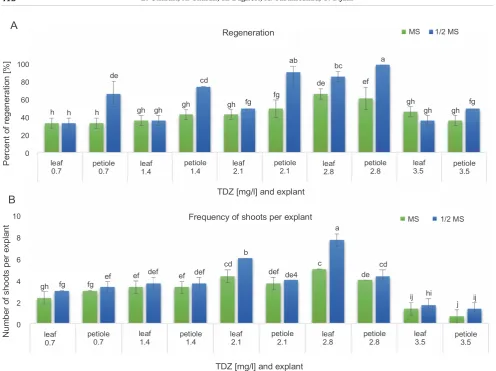
During the second part of this study, shoots were developed directly from petiole and leaf explants (Fig. 3) on half and full-strength MS media, supplemented with TDZ alone in different concentrations, for a duration of 4 weeks. The half-strength MS medium supplemented with TDZ was more effective in promoting shoot deve-lopment than the full-strength MS medium supplemen-ted with the same concentration of TDZ. For leaf ex-plants, there was no significant difference in shoot in-duction between the tested media with either full-or half-strength MS medium except for 2.8 mg/l (approximately 66.6% and 86.6%, respectively in full-and half-strength MS) and 2.1 mg/l (approximately 43.3% and 50%, res-pectively in full and half-strength MS). For petiole ex-plants, there was a significant difference in shoot in-duction due to TDZ concentrations in full-strength MS medium (Fig. 4). The highest frequency of shoot organo-genesis, 100% and 86.66%, was observed in petiole and leaf explants, respectively, on the half-strength MS medium supplemented with 2.8 mg/l TDZ, but this was not significantly different from shoots derived from
pe-tioles with 2.1 mg/l TDZ (Fig. 4A). With higher TDZ concentrations (3.5 mg/l), low frequencies of shoot organogenesis were observed in leaf and petiole explants (as compared to other media). For leaf explants, frequen-cies of shoot organogenesis were approximately 46.6% and 36.6%, respectively on full and half-strength MS media; however for petiole explants they were 36.6% and 50%, respectively, in full and half-strength MS media (Fig. 4A).
Frequency of shoot induction per explant
A B C D E
F G H J
I
Table 1. Effect of isopentenyl adenine (2ip), benzylaminopurine (BAP), and naphthalene acetic acid (NAA)
on the frequency of callus induction from petiole and leaf explants of V. caspia subsp. sylvestrioides on half-strength
Murashige and Skoog (MS) medium
Medium [mg/l]2ip [mg/l]NAA Rate of callus formation [%] leaf petiole 1
2 3 4 5 6 7 8 9 MS*
2.00 2.00 2.00 2.50 2.50 2.50 3.00 3.00 3.00 0.00
2.00 2.50 3.00 2.00 2.50 3.00 2.00 2.50 3.00 0.00
16.66 ± 5.77f
36.66 ± 5.77d
53.33 ± 5.77c
23.33 ± 5.77ef
43.33 ± 5.77cd
80.00 ± 10.00b
33.33 ± 5.77de
53.33 ± 5.77c
93.33 ± 5.77a
00.00 ± 0.00
13.33 ± 5.77d
23.33 ± 5.77cd
43.33 ± 5.77b
16.66 ± 5.77d
26.66 ± 5.77cd
73.33 ± 15.27a
20.00 ± 0.00cd
33.33 ± 5.77bc
80.00 ± 10.00a
00.00 ± 0.00 BA [mg/l] NAA [mg/l] leaf petiole 1
2 3 4 5 6 7 8 9 MS*
2.00 2.00 2.00 2.50 2.50 2.50 3.00 3.00 3.00 0.00
2.00 2.50 3.00 2.00 2.50 3.00 2.00 2.50 3.00 0.00
0.00 ± 0.00d
16.66 ± 5.77c
36.66 ± 5.77b
3.33 ± 5.77d
23.33 ± 5.77c
46.66 ± 5.77a
6.66 ± 5.77d
33.33 ± 5.77b
53.33 ± 5.77a
00.00 ± 0.00
10.00 ± 10.00f
46.66 ± 5.77d
56.33 ± 5.77abc
23.33 ± 5.77e
50.00 ± 0.00d
63.33 ± 5.77ab
33.33 ± 5.77e
53.33 ± 5.77cd
66.66 ± 5.77a
00.00 ± 0.00
Data are from three independent experiments; * the medium was used as a control
Fig. 3. Direct organogenesis of V. caspia subsp. sylvestrioides; A) and B) direct shoot formation from leaf lamina explants and C) and D) petiole explants; E) shoot formation from leaf explant after 3 weeks; F) rooted shoot after 2 weeks of culture on half-strength MS medium supplemented with 0.5 mg/l indole-3-butyric acid; G) acclimatized in vitro plant after 1 month of culture in the greenhouse; H) regenerated plantlets with capsules developed from cleistogamous flowers; I) opened, tripartite capsule, visible
P
erc
en
t o
f re
g
en
era
tio
n
[%
]
Regeneration MS 1/2 MS
100
80
60
40
20
0
h h h
de
gh gh gh
cd
gh fg fg
ab
de bc
ef a
gh
gh gh
fg
leaf
0.7 petiole0.7 leaf1.4
petiole
1.4 leaf2.1 petiole2.1 leaf2.8
petiole
2.8 leaf3.5 petiole3.5
A
TDZ [mg/l] and explant
Frequency of shoots per explant MS 1/2 MS
B
leaf
0.7 petiole0.7 leaf1.4 petiole1.4 leaf2.1 petiole2.8 leaf3.5 petiole3.5
TDZ [mg/l] and explant petiole
2.1 leaf2.8
N
u
m
b
er
o
f s
ho
ots
p
er
e
xp
la
n
t 10
8
6
4
2
0
gh fg fg
ef ef def ef def
cd b
def de4 c
a
de cd
ij hi
j ij
Fig. 4. Effect of thidiazuron concentration, explant type and MS strength on shoot organogenesis and the frequency of shoot
induction per leaf and petiole explant of V. caspia subsp. sylvestrioides. A) shoot organogenesis frequency; B) frequency of shoot induction per explant
Table 2. Chemical composition and percentage of compounds in leaf tincture of V. caspia subsp. sylvestrioides
Peak Compounds Retentiontime
[min]
Percent of total
[%] 1
2 3 4 5 6 7
Ethyl iso-allocholate
1,2-benzenedicarboxylic acid, dinonyl ester Vitamin E
Phthalic acid, bis(7-methyloctyl) ester
2,4,6-decatrienoic acid, 1a,2,5,5a,6,9,10,10a-octahydro-5,5a-dihydroxy-4-(hydroxymethyl)-
1,7,9-trimethyl-1-Docosanoic acid, 1,2,3-propanetriyl ester
D-homo-24-nor-17-oxachola-1,20,22-triene-3,16-dione,7-(acetyloxy)-14,15:21,23-diepoxy-4,4,8-trimethyl-,
30.135 31.347 35.028 42.406 42.850 43.851 44.084
1.289 24.19 35.257 17.232 16.402 3.116 2.514
in the greenhouse (Fig. 3G). In the greenhouse and under field conditions, they produced chasmogamous and clestogamous flowers and capsules filled with seeds (Fig. 3I, Fig. 3J).
GC/MS analysis of the leaf tinctures
Table 2 and are presented in order of their retention times. The main compounds found were vitamin E (35.257%) and 1,2-benzenedicarboxylic acid, dinonyl ester (24.19%), while ethyl iso-allocholate and D-homo- 24-nor-17-oxachola-1,20,22-triene-3,16-dione,7-(acetyl-oxy)-14,15:21,23-diepoxy-4,4,8-trimethyl-, were found in small quantities (1.289%, and 2. 514%, respectively).
Discussion
In recent years the use of different cytokinins inclu-ding BAP, kinetin (KIN) and TDZ has been reported for the regeneration and micropropagation of Viola plants (Slazak et al., 2015, Żabicki et al., 2019). Our results show that petiole and leaf explants regenerated with 2ip at 3 mg/l and NAA at 2.5 mg/l (Fig. 2C). The results (also) revealed that a higher concentration of 2ip (3 mg/l) was more effective in callus proliferation and the regeneration of explants. Similar observations have also been made by Chaudhuri et al. (2004) in Tylophora indica.
TDZ, a diphenyl urea derivative, is involved in the biosynthesis of auxin with increasing levels of indole-3-acetic acid (IAA) and its precursor (tryptophan) (Murthy et al., 1998). In many plant species, TDZ appeared as a potent bioregulant in cell and tissue cultures (Yancheva et al., 2003; Matand and Prakash, 2007). Depending on the genotype of plants and the type of explants, TDZ induces different regeneration responses (Passey et al., 2003). TDZ, with a high cytokinin-like activity (Huette-man and Preece, 1993), is widely used to promote shoot proliferation in many plant species, including the mem-bers of Violaceae (Sato et al., 1995; Slazak et al., 2015; Żabicki et al., 2019). The study by Slazak et al. (2015) revealed that TDZ had the potential to induce direct and indirect organogenesis in leaf and petiole explants of Viola uliginosa Besser (Slazak et al., 2015). The authors also reported that organogenesis was induced in leaf and petiole fragments with a combination of KIN and 2,4-D, followed by a callus transfer on TDZ (Slazak et al., 2015). In the current study, the different concentrations of TDZ, the type of explants and the strength of the MS medium proved to be important factors affecting the frequency of shoot regeneration. Petiole explants and half-strength MS medium (2.8 mg/l) were more produc-tive in efficient shoot organogenesis in Viola caspia subsp. sylvestrioides, in agreement with previously
re-ported results on Viola wittrockiana (Sato et al., 1995), where it was shown that multiple shoot organogenesis could be achieved from petiole callus using a half-strength MS medium supplemented with BAP in com-bination with NAA. The number of regenerated shoots formed on leaf explants was greater than the number of shoots obtained on petiole explants (approx. 7.6 and 4.3 shoots per explant, respectively, for leaf and petiole ex-plants on a medium containing 2.8 mg/l TDZ), which was consistent with the results obtained by Slazak et al. (2015).
Over the past decades, efforts have been made to extract secondary metabolites of medicinal plants, eluci-date their structure and evaluate their biological activity. When natural resources are limited or a chemical syn-thesis is impossible, plant cell tissue culture techniques appear to be eco-friendly, alternative methods for the production of secondary metabolites. Also, in many in-stances it is difficult to cultivate plant species with tradi-tional methods, or it takes a long time, frequently, seve-ral years (Greger, 2017). The excessive exploitation of medicinal plants from wild populations in their natural habitats for medical and industrial purposes and insuffi-cient cultivation fields have led to the reduction of bio-diversity and depletion of natural populations of these plants. Therefore, various sets of biotechnical approa-ches, such as in situ and ex situ conservation methods (Huang, 2011; Liu et al., 2011), should be applied to im-prove the yields of medicinal plants.
preven-tion of oxidative stress (Burton et al., 1983), protecpreven-tion of cell membranes (Howard et al., 2011), regulation of plate-let aggregation and protein kinase c activation (Li et al., 2001), and prevention of diseases such as cardiovascular (McAnally et al., 2007) and Alzheimer’s diseases (Mangia-lasche et al., 2013), and cancer (Wells et al., 2010). The presence of high amounts of vitamin E in the V. caspia subsp. sylvestrioides tinctures indicates that viola species may be are useful in the therapy of most disorders. This regeneration protocol can produce large populations of these plants which will be useful for the extraction of these pharmaceutical compounds.
Conclusion
This study has developed an efficient, effective, and reproducible protocol for direct and indirect shoot or-ganogenesis of V. caspia subsp. sylvestrioides. In addi-tion, the tincture obtained from V. caspia subsp. syl-vestrioides leaves contains high amounts of biologically active compounds such as vitamin E. To conclude, the present study can contribute to the mass propagation of V. caspia subsp. sylvestrioides for ex situ conservation purposes, gene transformation goals, production of large amounts of pharmaceutical compounds and commercial cultivation. The acclimatized in vitro-obtained plants can also be used as alternatives to wild populations of V. caspia subsp. sylvestrioides.
Acknowledgments
The authors would like to thank the authorities of the Faculty of Pharmacy, Zanjan University of Medical Sciences, for their support.
References
Adams R.P. (2007) Identification of essential oil components by gas chromatography/mass spectrometry. Carol Stream: Allured Publishing Corporation.
Burton G.W., Joyce A., Ingold K.U. (1983) Is vitamin E the only lipid-soluble, chain-breaking antioxidant in human blood plasma and erythrocyte membranes? Arch. Biochem. Biophys. 221: 281–290.
Chalageri G., Babu U.V. (2012) In vitro plant regeneration via petiole callus of Viola patrinii and genetic fidelity asses-sment using rapd markers. Turk. J. Bot. 36: 358–368. Chaudhuri K., Ghosh B., Jha S. (2004) The root: a potential
new source of competent cells for high-frequency regene-ration in Tylophora indica. Plant. Cell. Rep. 22: 731–740. Gerlach S.L., Rathinakumar R., Chakravarty G., Göransson U., Wimley W.C., Darwin S.P., Mondal D. (2010) Anticancer and chemosensitizing abilities of cycloviolacin 02 from
Viola odorata and Psyle Cyclotides from Psychotria lepto-thyrsa. Biopolymers 94: 617–625.
Göransson U., Sjögren M., Svangård E., Claeson P., Bohlin L. (2004) Reversible antifouling effect of the cyclotide cyclo-violacin o2 against barnacles. J. Nat. Prod. 67: 1287–1290. Greger H. (2017) Phytocarbazoles: alkaloids with great struc-tural diversity and pronounced biological activities. Phyto-chem. Rev. 16: 1095–1153.
Gruber C.W., Anderson M.A., Craik D.J. (2007) Insecticidal plant cyclotides and related cystine knot toxins. Toxicon. 49: 561–575.
Hallock Y.F., Sowder R.C., Pannell L.K., Hughes C.B., Johnson D.G., Gulakowski R., Cardellina J.H., Boyd M.R. (2000)
Cycloviolins a-d, anti-hiv macrocyclic peptides from Leonia cymosa. J. Org. Chem. 65: 124–128.
Hellinger R., Koehbach J., Fedchuk H., Sauer B., Huber R., Gruber C.W., Gründemann C. (2014) Immunosuppressive activity of an aqueous Viola tricolor herbal extract. J. Ethnopharmacol. 151: 299–306.
Howard A.C., McNeil A.K., McNeil P.L. (2011) Promotion of plasma membrane repair by vitamin E. Nat. Commun. 2: 597–605.
Huang H. (2011) Plant diversity and conservation in China: planning a strategic bioresource for a sustainable future. Bot. J. Linn. Soc. 166: 282–300.
Huetteman C.A., Preece J.E. (1993) Thidiazuron: a potent cytokinin for woody plant tissue culture. Plant. Cell. Tiss. Org. Cult. 33: 105–119.
Kaloo Z., Akhtar R., Zafrul-Haq W.B. (2013) Effect of growth regulators on the in vitro multiplication of Viola odorata. Int. J. Med. Plant. Res. 2: 187–189.
Karnick C.R. (1996) Pharmacology of Ayurvedic medicinal plants. Delhi: Shri Satguru Publications.
Koochek M.H., Pipelzadeh M.H. Mardani H. (2003) The ef-fectiveness of Viola odorata in the prevention and treat-ment of formalin-induced lung damage in the rat. J. Herbs. Spices. Med. Plants. 10: 95–103.
Li D., Saldeen T., Romeo F., Mehta J.L. (2001) Different iso-forms of tocopherols enhance nitric oxide synthase phos-phorylation and inhibit human platelet aggregation and lipid peroxidation: implications in therapy with vitamin E. J. Cardiovasc. Pharmacol. Ther. 6: 155–161.
Lindholm P., Göransson U., Johansson S., Claeson P., Gullbo J., Larsson R., Bohlin L., Backlund A. (2002) Cyclotides: a no-vel type of cytotoxic agents. Mol. Cancer. Ther. 1: 365–369. Liu C., Yu H., Chen S.L. (2011) Framework for sustainable use of medicinal plants in China. Plant Divers. 33: 65–68. Mangialasche F., Westman E., Kivipelto M., Muehlboeck J.S., Cecchetti R., Baglioni M., Tarducci R., Gobbi G., Floridi P., Soininen H. (2013) Classification and prediction of cli-nical diagnosis of Alzheimer’s disease based on MRI and plasma measures of α-/γ-tocotrienols and γ-tocopherol. J. Intern. Med. 273: 602–621.
Marcussen T., Borgen L. (2011) Species delimitation in the Ponto-Caucasian Viola sieheana complex, based on evi-dence from allozymes, morphology, ploidy levels, and cros-sing experiments. Plant. Syst. Evol. 291: 183–196. Matand K., Prakash C. (2007) Evaluation of peanut genotypes
for in vitro plant regeneration using thidiazuron. J. Bio-technol. 130: 202–207.
McAnally J.A., Gupta J., Sodhani S., Bravo L., Mo H. (2007)
Tocotrienols potentiate lovastatin-mediated growth suppres-sion in vitro and in vivo. Exp. Biol. Med. 232: 523–531. Murthy B., Murch S., Saxena P.K. (1998) Thidiazuron: a
po-tent regulator of in vitro plant morphogenesis. In vitro Cell. Dev. Biol. Plant. 34: 267–275.
Passey A., Barrett K., James D. (2003) Adventitious shoot regeneration from seven commercial strawberry cultivars (fragaria×ananassa duch.) using a range of explant types. Plant. Cell. Rep. 21: 397–401.
Pullaiah T. (2006) Encyclopedia of world medicinal plants. New Delhi: Regency Publications.
Saeidi Mehrvarz S., Vafi M., Marcussen T. (2013) Taxonomic and anatomical notes on Viola sect. Viola (Violaceae) in Iran. Wulfenia 20: 73–79.
Sato T., Kwon O.C., Miyake H., Taniguchi T., Maeda E. (1995)
Regeneration of plantlets from petiole callus of wild Viola (Viola patrinii DC.). Plant. Cell. Rep. 14: 768–772. Slazak B., Sliwinska E., Saługa M., Ronikier M., Bujak J.,
Słomka A., Göransson U., Kuta E. (2015) Micropropaga-tion of Viola uliginosa (Violaceae) for endangered species conservation and for somaclonal variation-enhanced cyclo-tide biosynthesis. PCTOC 120: 179–190.
Staniek A., Bouwmeester H., Fraser P.D., Kayser O., Martens S., Tissier A., Van Der Krol S., Wessjohann L., Warzecha H. (2013) Natural products–modifying metabolite path-ways in plants. Biotechnol. J. 8: 1159–1171.
Stojkovic D., Glamoclija J., Ciric A., Siljegovic J., Nikolic M., Sokovic M. (2011) Free radical scavenging activity of Viola odorata water extracts. J. Herbs. Spices. Med. Plants. 17: 285–290.
Vishwakarma U.R., Gurav A.M., Sharma P.C. (2013) Regene-ration of multiple shoots from petiole callus of Viola ser-pens Wall. Pharmacognosy. Res. 5: 86–92.
Vohora S.B. (1986) Unani Joshandah drugs for common cold, catarrh, cough, and associated fevers. J. Ethnopharmacol. 16: 201–211.
Wells S.R., Jennings M.H., Rome C., Hadjivassiliou V., Papas K.A., Alexander J.S. (2010) Α-, γ-and δ-tocopherols reduce inflammatory angiogenesis in human microvascular endo-thelial cells. J. Nutr. Biochem. 21: 589–597.
Yancheva S.D., Golubowicz S., Fisher E., Lev-Yadun S., Flaish-man M.A. (2003) Auxin type and timing of application determine the activation of the developmental program during in vitro organogenesis in apple. Plant. Sci. 165: 299–309.
Yousefi N., Mehrvarz S.S., Marcussen T. (2012) Anatomical studies on selected species of Viola (Violaceae). Nord. J. Bot. 30: 461–469.
Żabicki P., Sliwinska E., Mitka J., Sutkowska A., Tuleja M., Migdałek G., Żabicka J., Słomka A., Kwiatkowska M., Kuta E. (2019) Does somaclonal variation play advantageous role in conservation practice of endangered species: com-prehensive genetic studies of in vitro propagated plantlets of Viola stagnina Kit. (Violaceae). Plant. Cell. Tissue. Organ. Cult. 136: 339–352.