Biolinguistics 4.4: 307, 2010 ISSN 1450–3417 http://www.biolinguistics.eu
In Memoriam Ursula Kleinhenz
Kleanthes K. Grohmann
The fourth volume of Biolinguistics comes to an end and with it another year — and with it also, very sadly, the passing of a good friend, a wonderful human being, a hard-working editor, and a tremendous loss to the linguistic community. Goodbye, Ursula!
This is not an obituary; Ursula’s colleagues from Mouton de Gruyter already were so kind as to post a very touching message on Linguist List (http:// linguistlist.org/issues/21/21-5026.html). To those of us who knew her, Ursula’s death did not come as a surprise, after a long battle with cancer — but as a shock nevertheless, and it does not make the loss any easier to cope with. Ursula died at age 45 in the final editing process of this issue, on 9 December 2010, hence the inclusion of this brief note here.
I got to know Ursula very well in the summer of 1999, when I spent three months in Berlin at ZAS. We became good friends very quickly, after having met previously at conferences, thanks to her open, friendly attitude which I always admired. How can you not — with that laughter?! We stayed in touch, met at irregular intervals at conferences, offices, cafés — and as so often in situations such as this, I wish we had done so more intensely, especially in the past few years. I cannot change that, I cannot turn back the time, but I can wish you all the best wherever you may be or go, Ursula.
Kleanthes K. Grohmann University of Cyprus
Department of English Studies P.O. Box 2053
1678 Nicosia Cyprus
Biolinguistics 4.4: 308–323, 2010 ISSN 1450–3417 http://www.biolinguistics.eu
Comments on Chomsky’s Analogies between
the Biolinguistic Approach and Evo-Devo
Antonio Benítez-Burraco & Víctor M. Longa
In some recent papers, Chomsky has suggested some non-trivial analogies between the biolinguistic approach and evolutionary developmental biology (Evo-Devo). In this paper, the point is made that those analogies should be handled with caution. The reason is that the Evo-Devo version chosen by Chomsky in order to build the analogies fully assumes a gene-centric pers-pective. Although providing genes with a special power fits in well with the Principles-and-Parameters model, it does not agree at all with the reduction of the power attributed to genes that the Minimalist Program has placed on the agenda. Nevertheless, other Evo-Devo approaches exist that seem more accurate than the particular version adopted by Chomsky — approaches therefore which are more promising for fulfilling the minimalist biolinguistic approach.
Keywords: evolutionary developmental biology; gene-centrism; Minima-list Program; Principles-and-Parameters Theory
1. Introduction
From its origins, Generative Grammar has compellingly argued that language is biologically seated. Therefore, Chomsky has repeatedly claimed that linguistics should be thought of as a branch of biology (apart from Chomsky 1980, see e.g. Chomsky 1975: 123, 1986: 27, 2000: 90, 2005: 2 for wide discussion). To be more precise, as Freidin & Vergnaud (2001: 648) put it, a branch of theoretical develop-mental biology, because a core concern of Generative Grammar is to explain language growth in the individual.
Within this context, Chomsky has recently pointed out (see Chomsky 2007, 2008, 2010) non-trivial analogies between the biolinguistic approach (henceforth, BA) and evolutionary developmental biology (Evo-Devo). Our paper makes the point that Chomsky’s analogies should be handled with caution. As Hall & Olson
(2003: xv) write, “no unified theory of evodevo exists”. This means that the Evo-Devo perspective, according to which “[e]volution is biased by development” (Raff 2000: 78), can be implemented through different theories and assumptions. Chomsky’s analogies between the BA and Evo-Devo raise the problem that they are based on an Evo-Devo theory which is directly linked to developmental gen-etics and which, accordingly, takes genes to have a core or special power, as re-presented by Carroll (2005). To our mind, Chomsky’s analogies may be accurate as regards Principles-and-Parameters Theory (henceforth, PPT), but they do not sit properly with a truly minimalist BA. Therefore, for those analogies to be sustained, we suggest that the need exists to consider other Evo-Devo theories which reject gene-centrism or primacy of the genes.
2. Chomsky’s Analogies
According to Chomsky (2010: 45), there are “some analogies between ‘the Evo Devo revolution’ in biology and ideas that have been lurking in the background of biolinguistics since its origins […]”. The first one refers to the PPT.1 In that model, the principles of Universal Grammar (henceforth, UG), or linguistic geno-type, were considered to be ‘open’, in such a way that enabled a narrow range of parametric variation. The setting of a principle P in the parameters A or B was considered to be triggered by the linguistic environment the learner is exposed to (Turkish, Spanish, etc.). Thus, grammars are the result of fixing the same prin-ciples in different positions. This view has been nicely expressed by means of the well-known ‘switch metaphor’:
We may think of the language faculty as a complex and intricate network of some sort associated with a switch box consisting of an array of switches that can be in one of two positions. [...]. The fixed network is the system of principles of universal grammar; the switches are the parameters to be fixed by experience.
(Chomsky 1988: 62–63) In the same vein, Evo-Devo has shown that “the same regulatory genes were shared by animals with different body plans (for example, insects and vertebrates)” (Raff 2000: 75). Minor changes in regulatory mechanisms produce very different results on the surface (see Carroll 2005 for a wide discussion).2 In fact, Chomsky (2007: 3) points out that PPT “was also suggested by major developments in general biology, specifically François Jacob’s account of how slight changes in the hierarchy and timing of regulatory mechanisms might yield great superficial differences ⎯ a butterfly or an elephant, and so on” (see also Chomsky 2010: 49). For obvious reasons, that model “seemed natural for lang-uage as well; slight changes in parameter settings might yield superficial variety,
1 Anyway, that analogy is not new; it can be traced back to Chomsky (1980: 66–67), although
at that time the label ‘Evo-Devo’ had not yet been coined.
2 Carroll (2005: 111) also adopts the switch metaphor; he speaks of genetic switches, the
through interaction of invariant principles with parameter choices” (Chomsky 2007: 3).3
That situation meant the discovery, both in biology and in linguistics, of deep homologies among organisms on one side, and among languages on the other. Such a discovery reversed the traditional assumption of an “endless variation” (Boeckx 2009: 88) held by both disciplines. As regards language, Joos’s (1957: 96) claim that languages “can differ from each other without limit and in unpredictable ways” is well known. Generative Grammar showed that assump-tion to be untenable. In biology, the prevailing assumpassump-tion was very similar; as Mayr (1963: 609) put it, “[m]uch that has been learned about gene physiology makes it evident that the search for homologous genes is quite futile except in very close relatives”. That is, different genes for different animals. As Carroll (2005: 9) points out, “[f]or more than a century, biologists had assumed that different types of animals were genetically constructed in completely different ways”. Evo-Devo has shown, in the same vein as PPT, that such a contention was unjustified.
Chomsky’s (2010) second analogy between the BA and Evo-Devo has to do with third factor conditions, that is, “[p]rinciples not specific to the faculty of language” (Chomsky 2005: 6). According to Chomsky (2007: 3), “some of the third factor principles have the flavor of the constraints that enter into all facets of growth and evolution, and that are now being explored intensively in the evo-devo revolution” (see also Chomsky 2010: 51). Therefore, Evo-Devo discoveries point to “architectural constraints that limit adaptive scope and channel evoluti-onary patterns” (Chomsky 2010: 51).
Chomsky (2010: 45) asserts that “the analogies have been suggestive in the past, and might prove to be more than that in the years ahead”. This assertion suggests that both analogies apply to any stage of the BA, that is, both to the PPT and to the Minimalist Program (henceforth, MP). We contend, though, that whereas the first analogy is applicable to PPT, none of them can aptly character-ize the minimalist BA. The reason is that the Evo-Devo approach referred to by Chomsky is a strictly gene-centered theory, and gene-centrism is explicitly reject-ed by MP. To sum up, we will aim to show that the Evo-Devo version derivreject-ed from developmental genetics is not an accurate analogy for the BA which MP has brought to the fore.
3. On the Status of Evo-Devo
The so-called Modern Synthesis (and the Neo-Darwinism which emerged from it) was undoubtedly a fundamental hallmark in biology: It gave rise to modern biology. However, some of their effects were clearly undesirable. One of them was gene-centrism (for criticism, see Goodwin 1994, Oyama 1985, Moore 2001, and our discussion below). Another undesirable outcome of Modern Synthesis
3 Chomsky (1981: 3–4) already made the same point: “[T]he languages that are determined by
(and Neo-Darwinism) was to ignore development or, at least, leave it aside, thus favouring the dissociation between phylogeny and ontogeny (a wide consensus exists on this topic; see Griffiths & Gray 2001: 195, Robert et al. 2001: 954, Weber & Depew 2001: 239, Wimsatt 2001: 219; Robert 2002: 592, Gilbert 2003: 470–471, Gilbert & Burian 2003: 68–69, Carroll 2005: 6–8, and Jablonka & Lamb 2005: 27; for an in-depth analysis of the causes, see Robert 2004 and Amundson 2007). Two reasons underlie that dissociation: First, since Modern Synthesis, population gen-etics has become the core discipline of Evolutionary Biology (Wimsatt 2001: 219). Population genetics studies the gradual change of genetic frequencies at the pop-ulation level. Therefore, the definition of evolution within Modern Synthesis as a process affecting populations, not individuals, led to a non-developmentalist theory (Moore 2001: 167). Second, since Modern Synthesis, it has been considered (as pointed out above) that development involved different explanations for dif-ferent animals (see Carroll 2005: 6).
This disagreement between evolution and development has been reversed by Evo-Devo, which has bridged the gap between both levels in such a way that evolution is accounted for by means of developmental factors. Indeed, Gould (2002: chap. 10) defines Evo-Devo as the evolution of development. More concre-tely, Evo-Devo aims “to unveil how developmental processes and mechanisms become modified during evolution” (Baguñá & García Fernández 2003: 705).4 It is for that reason that, according to Fodor & Piattelli-Palmarini (2010: 30), Evo-Devo has made it possible to turn around Dobzhansky’s (1973) claim that “nothing in biology makes sense except in the light of evolution”; as Fodor & Piattelli-Palma-rini put it, Evo-Devo “tells us that it’s the other way around: nothing in evolution makes sense except in the light of developmental biology”.
However, it should be noted that Evo-Devo is a general perspective, rather than a specific theory or model. This means that any theory which reliably links evolution and development will be an Evo-Devo theory, no matter how concre-tely that relation will be implemented and approached. Accordingly, Hall & Olson (2003: xv) argue, as stated above, that “no unified theory of evodevo exists”, whereas Robert (2002: 597) makes the same point: “Like any field of biology, evo-devo commands a diverse range of theoretical perspectives and experimental approaches”. Indeed, Balari & Lorenzo (2009: 7) characterize at least three types of different (and even conflicting) Evo-Devo theories: (i) those assuming the ‘genetic program’ metaphor, (ii) those which extend the metaphor beyond genes and assume a developmental program, and (iii) those which com-pletely abandon the idea of ‘program’, and take development to be the outcome of a developmental system. To sum up, all those approaches share “the idea that evolution is strongly constrained by the very same factors that strongly constrain the development of individuals” (Balari & Lorenzo 2009: 3); however, each concrete approach implements the same idea very differently.
Most of the disagreements among the several implementations of Evo-Devo are to do with one of the main problems theoretical biology is concerned
4 In the opinion of Robert et al. (2001: 956), the general objective of Evo-Devo can be
with, that is, to integrate developmental biology within genetics and evolution-ary theory, as pointed out by Weber & Depew (2001: 239)5:
The field has been left to contestations between molecular reductionists, who assume that the problem of development is simply the problem of turning structural genes on and off, and those who identify in one way or another with the contemporary ‘developmentalist challenge’, who are confident that what genes do is far from the whole story.
Let us note that the geneticist Devo approach (henceforth, Evo-DevoGEN), finely represented by Carroll (2005), still assumes the primacy of genes which characterized Neo-Darwinism.6 And it should also be noted that this Evo-DevoGEN is the approach taken by Chomsky in order to build the analogies with the BA (indeed, Chomsky 2007: 3 himself cites Carroll 2005, a leading practitioner of Evo-DevoGEN, as a representative instance of Evo-Devo).
4. The Evo-Devo Approach Chosen by Chomsky
As pointed out, Chomsky’s analogies between Evo-Devo and the BA are based on Evo-DevoGEN. Although, as Gould (2002: chap. 10) discusses, Evo-DevoGEN has changed relevant assumptions of orthodox Neo-Darwinism (which assumed that genes of different animals were different as well), in another respects Evo-DevoGEN still accepts core Neo-Darwinian premises; for instance, the prominent role attributed to genes (and the notion of genetic program). However, it is our opinion that this primacy of the genes is in conflict with the reduction of the genetic endowment that MP has brought to the fore (see Chomsky 2005 for more discussion as well as sections 5 and 6 below).
The genetic primacy is clearly perceived in Carroll (2005). In fact, Carroll’s (2005: 8) initial claim that “genes must be at the center of the mysteries of both development and evolution” advances the content of the whole book. Carroll (2005: 9) reduces Evo-Devo to “the comparison of developmental genes between species”, an assumption which is denied by other Evo-Devo theories. More concretely, Carroll’s book is built around the notion of ‘genetic tool kit’, which is common to complex organisms. Therefore, the diversity of animal forms is not to do with different genes, but with how the same genes are used differently. According to Carroll (2005: 11), the development of form “depends upon the turning on and off of genes at different times and places in the course of develop-ment”. That is, Carroll’s framework is entirely based on genes.
For that reason, Carroll’s recurrent references to the genome as the source of form (which point to the prominence of the notion of genetic program), do not come as a surprise. Carrol’s (2005) own words illustrate:
5 See Walsh (2007) and Pigliucci (2007) as interesting attempts to widen the Modern Synthesis
in the light of the findings raised by developmental biology. 6 Evo-Devo
GEN derives from developmental genetics which emerged in the eighties (Raff 2000:
[…] the species-specific instructions for building an animal are encoded in its DNA […] (p. 11)
Evolutionary changes within this regulatory DNA lead to the diversity of form (p. 12)
This regulatory DNA contains the instructions for building anatomy (p. 12) Where do we look these rules and instructions [for generating animal form]? In DNA. In the entire complement of DNA of a species (the genome), there exists the information for building that animal. The instructions for making five fingers, or two eyespots, or six legs, or black and white stripes are somehow encoded in the genomes of the species that bear these traits (p. 35). Therefore, according to Carroll (2005: 35), “[e]volution of form is ultimately then a question of genetics.” Balari & Lorenzo (2009: 6) argue that this under-standing of Evo-DevoGEN “can safely be judged a constructive enlargement of the strictly genocentric model of the MES [Modern Evolutionary Synthesis — ABB & VML]”. That is, as the quotes above make clear, Evo-DevoGEN clearly assumes the Neo-Darwinian genocentrism (or dictatorship of the genes, following Goodwin 1994), which means, in words of Oyama (2001: 177–178), to attribute a special directive power (both formative and informative) to the genes.
To make this point clearer, we should notice the great resemblance between Carroll’s assumptions and those of Neo-Darwinian scholars, like Dawkins (1976) or Maynard-Smith & Szathmáry (1999), who also argue for the existence of master plans within the genes:
[…] the genes are not only the Andromedans [i.e. the devices — ABB & VML] who sent the coded instructions; they are also the instructions them-selves (Dawkins 1976: 54).7
[…] each egg contains, in its genes, a set of instructions for making the ap-propriate adult. […] it is the information contained in the genes that specifies the adult form (Maynard-Smith & Szathmáry 1999: 2).
The basic picture, then, is that the development of complex organisms de-pends on the existence of genetic information, which can be copied by tem-plate reproduction. Evolution depends on random changes in that genetic information, and the natural selection of those sets of instructions that spe-cify the most successful organisms (Maynard-Smith & Szathmáry 1999: 2).
To sum up, we believe that Robert et al. (2001: 959) accurately contend that Evo-Devo “continues to show a tendency toward reductionism and gene-centrism; developmental mechanisms are ultimately genetic”.8 Therefore, Evo-DevoGEN does not run the risk of being gene-centric, as argued by Robert (2003a: 479); indeed, Evo-DevoGEN is clearly gene-centric.
7 See Dawkins (1976: chap. 3) for a wide exposition presenting genes as a collection of
instruc-tions for building the body.
8 For instance, Raff (2000: 74) writes that “[d]evelopment is genetically programmed”. Such a
5. Is Evo-DevoGEN a Good Analogy for the Minimalist BA?
The take-home message of the above discussion is the following: Evo-DevoGEN may be a fine analogy for the BA derived from the PPT. However, it is not an ac-curate analogy as regards the minimalist BA. We develop both claims in turn.
As pointed out in Section 2, Evo-DevoGEN shows clear parallelisms with PPT. Besides from those raised by Chomsky, we would like to add another one: PPT shared the strong geneticism held by Evo-DevoGEN. PPT, and the remainder of the generative models previous to MP, took for granted the need to postulate the notion of ‘genetic program for language’ (Chomsky 1980: 234) or equivalent notions for characterizing UG.9 Lightfoot (1982: 22) illustrates that position:
The genotypical principles responsible for language acquisition can be viewed as a theory of grammar, sometimes called Universal Grammar. This represents the genetic equipment that makes language growth possible.
That is, (non-minimalist) Generative Grammar considered the genes to be the primary or central cause, in the same way as in Evo-DevoGEN. The linguistic plan of the organism would lie in the genome, and this assumption has a clear parallelism in Evo-DevoGEN: The source of the form or body plan would lie in the genome, as Carroll’s previous statements made it clear (see Longa 2006, 2008, and Lorenzo & Longa 2009 on the generative gene-centrism).
For those reasons, we have argued before that Evo-DevoGEN could be an interesting analogy for PPT and for the BA arising from it. However, we do not share Chomsky’s (2010: 45) statement that “the analogies have been suggestive in the past, and might prove to be more than that in the years ahead”. Those analo-gies are not valid for characterizing the BA arising from the minimalist agenda. That is because the minimalist BA abandons core assumptions of the previous models, like gene-centrism itself, and the notion of UG, which is reduced to a minimum. Thus, we do not really expect Evo-DevoGEN to inspire the minimalist research.10 We will justify the reasons (see Longa & Lorenzo 2008 for an exten-sive analysis of differences between PPT and MP).
As specified above, all the models previous to MP, and PPT paradigma-tically, assumed the need for postulating a “genetically determined initial state” (Chomsky 1980: 233) for explaining language growth in the individual. Such a
9 Some of these notions being ‘linguistic genotype’ (Chomsky 1980: 65, Lightfoot 1982: 21,
1999: 52, 2006: 45–46), ‘blueprint’ (Hyams 2002: 229), ‘genetic endowment’ (Anderson & Lightfoot 2002: 22, Guasti 2002: 271, Lightfoot 1982: 56), ‘genetic equipment’ (Guasti 2002: 18, Lightfoot 1982: 22), or ‘genetic make-up’ (Thornton & Wexler 1999: 1). Given that frame-work, Jenkins (1979: 106) characterized Generative Grammar as belonging to the “traditional study of the genetics of organisms”.
10 This means we consider that MP is not a mere extension of PPT nor does it presuppose its
state, or UG, was conceived of as a body of specifically linguistic knowledge, that is, principles which “do not arise in other cognitive domains” (Tracy 2002: 656). According to that perspective, it is safe to say that “a strong background of gen-etic instructions is supposed to govern the acquisition of grammars” (Lorenzo & Longa 2009: 1302).
MP, though, has sustained a great reduction of the role given to genetic endowment (such a reduction fitting in well with the analysis of alleged ‘genes of language’; see the wider discussion in Benítez Burraco 2009). Minimalism has therefore originated a new way of understanding the Faculty of Language (henceforth, FL), which is specially connected to the issue of language specificity: How specific or unspecific is language? The minimalist answer to that question is the opposite of the one suggested by the previous models.
Pre–minimalist models assumed as a basic statement that “the functioning of the language faculty is guided by special principles specific to this domain” (Chomsky 1980: 44), that is, principles of a purely grammatical nature, and “en-coded in the genes of the children” (Smith 1999: 173). According to those models, FL was endowed with a high specificity. However, MP rejects that format, and assumes a language architecture which is characterized by its opposing state-ment, unspecificity in FL. Minimalism considers that the mind does not require a specific grammatical system. From the view of the strongest minimalist thesis (Chomsky 2000), the best minimalist version is the version postulating the most direct connection (i.e. optimal) between the two external modules. That amounts to saying that the best minimalist version is the version containing a minimum of specific grammatical machinery (Lorenzo & Longa 2003), because that machinery would ‘disturb’ the direct nature of the relationship.
From that perspective, the structure of FL would be minimal, with no hints of specific principles; its mechanisms would have to do (i) with requirements im-posed by the external modules, or (ii) with principles derived from conceptual necessity, which ‘come for free’, that is, the simplest solutions amongst all con-ceivable ones, for which there is no need to postulate special stipulations in the form of grammatical principles arising from genetic instructions. For instance, movements of constituents are as short as possible not because that condition is stipulated by an autonomous grammatical module, as in GB, but because it is the most economical and efficient way for a computational system to operate. To summarize, from the viewpoint of MP, FL is the simplest way to productively link sounds and meanings. Thus, the specificity thesis argued for by the previous generative models and the unspecificity thesis sustained by MP are conceptually in conflict (for a wider analysis, see Longa & Lorenzo 2008).11
The unspecificity thesis has been made especially clear in Chomsky’s recent papers (Chomsky 2004 et seq.), which consider that the abandonment of gramma-tical machinery will let us go “beyond explanatory adequacy” (Chomsky 2004), thus reaching a true principled explanation of language design. Chomsky (2005: 6) proposes three factors in language growth: genetic endowment, external data
11 In fact, Chomsky (2000: 113) clearly contends, as regards GB, that “a basic assumption of the
(experience), and “principles not specific to the faculty of language” — those principles comprising, amongst others, principles of structural architecture, effici-ent computation, etc. The point in order is that MP’s unspecificity thesis leads to the primacy of the third factor; as Chomsky (2005: 9) points out, “we need no longer assume that the means of generating expressions are highly articulated and specific to language. We can seriously entertain the possibility that they might be reducible to language-independent principles”.
This way, the minimalist proposal of reducing the role of genes in language growth leads to reducing the UG to a minimum. That means, as clearly stated by Chomsky (2005: 9), that MP crucially implies “shifting the burden of explanation from the first factor, the genetic endowment, to the third factor, language-independent principles of data processing, structural architecture, and compu-tational efficiency”. It is in this sense that the notion of (a rich) genetic program for language seems to be ill-suited from a minimalist perspective.12 To sum up, we claim that, if the minimalist unspecificity thesis is seriously considered, the assumption of a highly detailed structure of purely linguistic knowledge, as sus-tained by GB, should be replaced by another according to which the initial state should be freed from any grammatical residue (Lorenzo & Longa 2003). This means the abandonment of gene-centrism by MP.
To summarize the discussion, if the differences opposing Evo-DevoGEN (based on the notion of genetic program), and the minimalist BA (which avoids that notion), are considered, Evo-DevoGEN does not seem an accurate analogy for the minimalist BA.
6. Are There Analogies between the Third Factor and Evo-DevoGEN Constraints?
As pointed out above, Chomsky’s second analogy between Evo-Devo and the BA refers to the third factor conditions. According to Chomsky (2007: 3), “some of the third factor principles have the flavor of the constraints that enter into all facets of growth and evolution, and that are now being explored intensively in the evo-devo revolution”, because evo-devo discoveries point to “architectural constraints that limit adaptive scope and channel evolutionary patterns” (Choms-ky 2010: 51). However, to our mind, this analogy is not accurate either, if referred to Evo-DevoGEN.
It is safe to argue that Evo-DevoGEN has shown that not every organic de-sign is feasible. This topic is emphasized by Gould’s (2002: chap. 10) discussion of Evo-Devo. This author claims that Neo-Darwinism attributed an excessive power to natural selection. If this mechanism had the power it is usually endowed with, more than 500 million years of independent evolution should suffice to erase any trace of genetic homology, that is, adaptive evolution should have reconstructed every locus over and over again to face the changing requirements of changing environments (see Goodwin 1994: 116–121 for a similar argument related to the
12 As Lorenzo & Longa (2009: 1306) point out, even if a minimal version of UG were found to
models of phylotaxis). Therefore, Gould considers natural selection to have a re-stricted scope, as opposed to Neo-Darwinist expectations.
That said, we believe that the minimalist third factor conditions and the ar-chitectural constraints brought to the fore by Evo-DevoGEN cannot be conflated or compared: Practitioners of Evo-DevoGEN attribute those constraints to purely gen-etic factors. For instance, Carroll (2005: 64) claims that “these Hox genes were so important that their sequences have been preserved throughout this enormous span of animal evolution [since the Cambrian to the present — ABB & VML]”. A quite similar statement is made by Raff (2000: 76): Those architectural constraints are due to “deeply conserved gene expression patterns”, which in turn are motiv-ated by the fact that “the same regulatory genes have conserved roles in develop-ment” (Raff 2000: 75). As we can appreciate, the explanation raised by Evo-DevoGEN to account for those architectural constraints is merely genetic, the evo-lutionary novelties arising because “conserved genes and gene pathways can be and are co–opted to new functions” (Raff 2000: 76). (This issue is widely analyzed in Carroll (2005) by means of the genetic switches of the genes, which can aug-ment in number but where switches already existing are preserved.)
We think that Evo-DevoGEN‘s geneticist view of constraints on animal form is very different from what third factor effects actually mean: Third factor prin-ciples are based on the opposite premise, conditions which spontaneously arise, with no role for genetic specifications. Furthermore, it should be noted that these principles do not depend on the environment, but derive from the dynamics of the system itself (in this case, language). However, Evo-DevoGEN’s opinion on that matter is different. For instance, Carroll (2005: 165) states that genes from the toolkit represent possibilities, but the actual fulfillment of potential is ecologically guided. More specifically, “the realization of this power is shaped, of course, by natural selection” (Carroll 2005: 287). Sincerely, we do not find many differences from the Neo-Darwinian view on natural selection. According to Carroll, gene stability and gene expression patterns are due to their functionality.13
That is, again, the opposite of the meaning of the third factor effects argued for by the minimalist BA. Therefore, Chomsky’s analogy does not seem to be valid. It could well be valid if Chomsky referred to an Evo-Devo approach differ-ent from the geneticist one. If this were the case, though, Chomsky should ex-plicitly point that out. In fact, one of the research programs that Müller (2007: 943) recognizes in Evo-Devo points to “properties of development that are not directly genetically determined, such as self-organization or geometric and phy-sical factors.” This view would agree with Chomsky’s position; however, such a view seems absent from Evo-DevoGEN.
7. Therefore: Which Evo-Devo — If Any?
We have argued that Chomsky’s election (i.e. Evo-DevoGEN) in order to draw
13 This seems to cast doubt on Fodor & Piattelli-Palmarini’s (2010: 32) claim that Evo-Devo
alogies between Evo-Devo and the BA does not fit in at all with MP. Does this mean that we should avoid any kind of analogy between the minimalist BA and Evo-Devo? Not really. We should keep in mind that the Evo-Devo perspective can be implemented through several theories; any theory reliably linking evo-lution and development will undoubtedly be an Evo-Devo theory, even although it does not share Evo-DevoGEN’s strongly geneticist assumptions.
If the reduction of the role of genetic endowment raised by MP is considered, in order to draw analogies between Evo-Devo and the minimalist BA an Evo-Devo theory rejecting gene-centrism and the notion of genetic program should be chosen. Such an Evo-Devo theory could well be Developmental Sys-tems Theory (henceforth, DST; see Oyama 1985, 2000, Oyama et al. 2001b; see also Longa 2008 and Lorenzo & Longa 2009 for a implementation of the minimalist framework from the DST view).
DST is a general theoretical perspective on development, heredity, and evo-lution, according to which the need exists to reduce the importance that genes were traditionally given. According to DST, development does not entail any kind of pre–existing genetic program; genes are not the source of the form. Quite the opposite: Genes are just one of many developmental resources. Therefore, DST rejects the idea that genes are endowed with any special directive power.14 The main notion of DST is that of ‘developmental system’, which is to be under-stood as the overall collection of heterogeneous influences on development.
DST’s key idea is represented by the so-called ‘parity thesis’: “Parity is the idea that genes and other material causes are on a par” (Griffiths & Gray 1998: 254), this thesis having its source in Oyama’s (1985: 201) ‘parity of reasoning’. According to DST, development arises from interaction between a wide number of heterogeneous resources and factors, all of them necessary (not only genetic ones) for development to take place.15 Accordingly, it is not possible to provide genes with any special formative power, nor is it possible to consider that genes contain the master plan of the organism either (on DST features, see Oyama et al. 2001a, Robert et al. 2001, Robert 2003b, or Longa 2006, 2008). DST contends that phylogeny is simply the derivational history of developmental systems (Oyama 1985: 179), and is explainable through a progressive modification of those sys-tems.
We think that DST seems more promising than Evo-DevoGEN for drawing analogies with the minimalist BA. Anyway, DST is not the only Evo-Devo theory suitable for approaching such an objective. Other Evo-Devo theories could be sui-table for such a task; for instance, the view represented by West-Eberhard (2003), which relies on the concept of phenotypic plasticity. According to Walsh (2007: 193), such an approach “reverses the causal priority of genotype over phenotype in evolution that is the cornerstone of sub–organismal, replicator interpretation of the modern synthesis. Phenotypic novelties are initiated in development and not by mutation.”
14 As Oyama (2000: 118) puts it, “a gene is a resource among others rather than a directing
in-telligence that uses resources for its own ends”.
15 In this sense, the third factor deserves careful consideration because it widens the
8. Conclusion
This paper has aimed to show that the analogies between the minimalist BA and the Evo-Devo version adopted by Chomsky (Evo-DevoGEN) do not seem applic-able to the minimalist BA. Evo-devoGEN is a gene-centric theory, and its essence does not agree at all with the reduction of the power attributed to genes that MP has placed on the agenda. In order to establish more productive analogies, it would be necessary to adopt another Evo-Devo version that, at least, assumes the parity thesis. This is not made by the approach represented by Sean Carroll. If the minimalist BA is to be seriously considered, our conclusion is clear: Evo-Devo, of course, but not Evo-DevoGEN.
To put it in other words, Boeckx (2006: 10) wrote that minimalism “may well turn out to provide remarkable support for a silent revolution in biology (often called the Evo Devo revolution)”. We strongly agree, but we believe that minimalism will not provide any kind of support for Evo-DevoGEN.
References
Amundson, Ron. 2007. The Changing Role of the Embryo in Evolutionary Thought:
Roots of Evo-Devo. Cambridge: Cambridge University Press.
Anderson, Stephen R. & David Lightfoot. 2002. The Language Organ: Linguistics as
Cognitive Physiology. Cambridge: Cambridge University Press.
Baguñá, Jaume & Jordi García-Fernández. 2003. Evo-Devo: The long and winding road. International Journal of Developmental Biology 47, 705–713.
Balari, Sergio & Guillermo Lorenzo. 2009. Computational phenotypes: Where the theory of computation meets evo-devo. Biolinguistics 3, 2–60.
Benítez Burraco, Antonio. 2009. Genes y Lenguaje: Aspectos Ontogenéticos, Filogené-ticos y Cognitivos. Barcelona: Reverté.
Blumberg, Mark S. 2005. Basic Instinct: The Genesis of Behavior. New York: Thun-der’s Mouth Press.
Boeckx, Cedric. 2006. Linguistic Minimalism: Origins, Concepts, Methods, and Aims. Oxford: Oxford University Press.
Boeckx, Cedric. 2009. Language in Cognition: Uncovering Mental Structures and the
Rules Behind Them. Oxford: Wiley-Blackwell.
Carroll, Sean B. 2005. Endless Forms Most Beautiful: The New Science of Evo Devo and
the Making of the Animal Kingdom. New York: W.W. Norton & Co.
Chomsky, Noam. 1975. Reflections on Language. New York: Pantheon.
Chomsky, Noam. 1980. Rules and Representations. New York: Columbia University Press.
Chomsky, Noam. 1981. Lectures on Government and Binding. Dordrecht: Foris. Chomsky, Noam. 1986. Knowledge of Language: Its Nature, Origins, and Use. New
York: Praeger.
Chomsky, Noam. 2000. Minimalist inquiries: The framework. In Roger Martin, David Michaels & Juan Uriagereka (eds.), Step by Step: Essays on Minimalist
Syntax in Honor of Howard Lasnik, 89–155. Cambridge, MA: MIT Press.
Chomsky, Noam. 2004. Beyond explanatory adequacy. In Adriana Belletti (ed.),
The Cartography of Syntactic Structures,vol. 3. Structures and Beyond, 104–131. New York: Oxford University Press.
Chomsky, Noam. 2005. Three factors in language design. Linguistic Inquiry 36, 1– 22.
Chomsky, Noam. 2007. Approaching UG from below. In Uli Sauerland & Hans-Martin Gärtner (eds.), Interfaces + Recursion = Language? Chomsky’s
Minima-lism and the View from Syntax–Semantics, 1–29. Berlin: Mouton de Gruyter.
Chomsky, Noam. 2008. The biolinguistic program: Where does it stand today? Ms., MIT.
Chomsky, Noam. 2010. Some simple evo devo theses: How true might they be for language. In Richard K. Larson, Viviane Déprez & Hiroko Yamakido (eds.),
The Evolution of Language: Biolinguistic Perspectives, 45–62. Cambridge:
Cam-bridge University Press.
Dawkins, Richard. 1976. The Selfish Gene. Oxford: Oxford University Press.
Dobzhansky, Theodosius. 1973. Nothing in biology makes sense except in the light of evolution. American Biology Teacher 35, 125–129.
Fodor, Jerry & Massimo Piattelli-Palmarini. 2010. What Darwin Got Wrong. New York: Farrar, Straus & Giroux.
Freidin, Robert & Jean-Roger Vergnaud. 2001. Exquisite connections: Some remarks on the evolution of linguistic theory. Lingua 111, 639–666.
Gilbert, Scott F. 2003. The morphogenesis of evolutionary developmental biology.
International Journal of Developmental Biology 47, 467–477.
Gilbert, Scott F. & Richard M. Burian. 2003. Developmental genetics. In Brian K. Hall & Wendy M. Olson (eds.), Keywords & Concepts in Evolutionary
Develop-mental Biology, 68–74. Cambridge, MA: Harvard University Press.
Goodman, Corey S. & Bridget C. Coughlin. 2000. Introduction: The evolution of evo-devo biology. Proceedings of the National Academy of Sciences 97, 4424– 4425.
Goodwin, Brian 1994. How the Leopard Changed Its Spots: The Evolution of Complex-ity. New York: Charles Scribner’s Sons.
Gould, Stephen J. 2002. The Structure of Evolutionary Theory. Cambridge, MA: Har-vard University Press.
Griffiths, Paul E. & Russell D. Gray. 2001. Darwinism and developmental sys-tems. In Oyama et al. (2001b), 195–218.
Griffiths, Paul E. & Russell D. Gray. 2004. The developmental systems perspective: Organism-environment systems as units of development and evolution. In Massimo Pigliucci & Katherine Preston (eds.), The Evolutionary
Biology of Complex Phenotypes, 409–431. Chicago: University of Chicago
Press.
Griffiths, Paul E. & Russell D. Gray. 2005. Discussion: Three ways to misunder-stand developmental systems theory. Biology & Philosophy 20, 417–425. Griffiths, Paul & Robin D. Knight. 1998. What is the developmentalist challenge?
Guasti, Maria Teresa. 2002. Language Acquisition: The Growth of Grammar. Cam-bridge, MA: MIT Press.
Hall, Brian K. 2000. Guest Editorial: Evo-devo or devo-evo ⎯ does it matter?
Evolution & Development 2(4), 177–178.
Hall, Brian K. & Wendy M. Olson. 2003. Introduction: Evolutionary develop-mental mechanisms. In Brian K. Hall & Wendy M. Olson (eds.), Keywords &
Concepts in Evolutionary Developmental Biology, xiii–xvi. Cambridge, MA:
Harvard University Press.
Hornstein, Norbert. 2009. A Theory of Syntax: Minimal Operations and Universal
Grammar. Cambridge: Cambridge University Press.
Hornstein, Norbert, Jairo Nunes & Kleanthes K. Grohmann. 2005. Understanding
Minimalism. Cambridge: Cambridge University Press.
Hyams, Nina. 2002. Clausal structure in child Greek: A reply to Varlokosta, Vainikka and Rohrbacher and a reanalysis. The Linguistic Review 19, 225– 269.
Jablonka, Eva & Marion Lamb. 2005. Evolution in Four Dimensions. Genetic,
Epige-netic, Behavioral, and Symbolic Variation in the History of Life. Cambridge, MA:
MIT Press.
Jenkins, Lyle. 1979. The genetics of language. Linguistics and Philosophy 3, 105–119. Joos, Martin (ed.). 1957. Readings in Linguistics. Chicago: University of Chicago
Press.
Lightfoot, David. 1982. The Language Lottery: Toward a Biology of Grammars. Cambridge, MA: MIT Press.
Lightfoot, David. 1999. The Development of Language: Acquisition, Change, and Evo-lution. Oxford: Blackwell.
Lightfoot, David. 2006. How New Languages Emerge. Cambridge: Cambridge Uni-versity Press.
Longa, Víctor M. 2006. No sólo genes: El Programa Minimalista y la reformu-lación de la noción de innatismo. Ludus Vitalis: Revista de Filosofía de las
Ciencias de la Vida XIV, 141–170.
Longa, Víctor M. 2008. Una visión crítica sobre la noción de ‘programa genético’ desde la biología y la lingüística: Consecuencias para la conceptualización de la ontogenia del lenguaje. Verba 35, 347–385.
Longa, Víctor M. & Guillermo Lorenzo. 2008. What about a (really) minimalist theory of language acquisition? Linguistics 46, 541–570.
Lorenzo, Guillermo & Víctor M. Longa. 2003. Minimizing the genes for grammar: The Minimalist Program as a biological framework for the study of lang-uage. Lingua 113, 643–657.
Lorenzo, Guillermo & Víctor M. Longa. 2009. Beyond generative geneticism: Re-thinking language acquisition from a developmentalist point of view.
Lingua 119, 1300–1315.
Martin, Roger & Juan Uriagereka. 2000. Introduction: Some possible foundations of the Minimalist Program. In Roger Martin, David Michaels & Juan Uri-agereka (eds.), Step by Step: Essays on Minimalist Syntax in Honor of Howard
Lasnik, 1–29. Cambridge, MA: MIT Press.
Maynard-Smith, John & Eörs Szathmáry. 1999. The Origins of Life: From the Birth of
Mayr, Ernst. 1963. Animal Species and Evolution. Cambridge, MA: Harvard Univer-sity Press.
Moore, David S. 2001. The Dependent Gene: The Fallacy of ‘Nature vs. Nurture’. New York: W.H. Freeman.
Müller, Gerd B. 2007. Evo-devo: extending the evolutionary synthesis. Nature Re-view Genetics 8, 943–949.
Oyama, Susan. 1985. The Ontogeny of Information: Developmental Systems and
Evo-lution. Cambridge: Cambridge University Press (2nd edn. published in 2000,
Durham, NC: Duke University Press).
Oyama, Susan. 2000. Evolution’s Eye: A Systems View of the Biology-Culture Divide. Durham, NC: Duke University Press.
Oyama, Susan. 2001. Terms in tension: What do you do when all the good words are taken? In Oyama et al. (2001b), 177–193.
Oyama, Susan, Paul E. Griffiths & Russell D. Gray. 2001a. Introduction: What is Developmental Systems Theory? In Oyama et al. (2001b), 1–11.
Oyama, Susan, Paul E. Griffiths & Russell D. Gray (eds.). 2001b. Cycles of
Contin-gencies: Developmental Systems and Evolution. Cambridge, MA: MIT Press.
Pigliucci, Massimo. 2007. Do we need an extended evolutionary synthesis? Evo-lution 61, 2743–2749.
Raff, Rudolf A. 2000. Evo-devo: The evolution of a new discipline. Nature Reviews Genetics 1, 74–79.
Robert, Jason Scott. 2002. How developmental is evolutionary developmental bio-logy? Biology & Philosophy 17, 591–611.
Robert, Jason Scott. 2003a. Developmental Systems and animal behavior. Critical notice of Evolution’s Eye: A Systems View of the Biology–Culture Divide. Biolo-gy & Philosophy 18, 477–489.
Robert, Jason Scott. 2003b. Developmental systems theory. In Brian K. Hall & Wendy M. Olson (eds.), Keywords & Concepts in Evolutionary Developmental
Biology, 94–97. Cambridge, MA: Harvard University Press.
Robert, Jason Scott. 2004. Embryology, Epigenesis, and Evolution: Taking Development
Seriously. New York: Cambridge University Press.
Robert, Jason Scott, Brian K. Hall & Wendy M. Olson. 2001. Bridging the gap bet-ween developmental systems theory and evolutionary developmental bio-logy. BioEssays 23, 954–962.
Smith, Neil. 1999. Chomsky: Ideas and Ideals. Cambridge: Cambridge University Press.
Thornton, Rosalind & Kenneth Wexler. 1999. Principle B, Ellipsis, and Interpretation
in Child Grammar. Cambridge, MA: MIT Press.
Tracy, Rosemarie. 2002. Growing (clausal) roots: All children start out (and many remain) multilingual. Linguistics 40, 653–686.
Walsh, Denis M. 2007. Development: Three grades of ontogenetic involvement. In Mohan Matthen & Christopher Stephens (eds.), Handbook of the Philosophy of
Science: Philosophy of Biology, 179–199. Amsterdam: Elsevier.
Weber, Bruce H. & David J. Depew. 2001. Developmental systems, Darwinian evolution, and the unity of science. In Oyama et al. (2001b), 239–253.
Wimsatt, William C. 2001. Generative entrenchment and the developmental sys-tems approach to evolutionary processes. In Oyama et al. (2001b), 219–237.
Antonio Benítez Burraco Víctor M. Longa
Universidad de Huelva Universidad de Santiago de Compostela
Departamento de Filología Española y Departamento de Literatura Española, Teoría de sus Didácticas, Campus de “El Carmen” la Literatura y Lingüística General
Avda. Fuerzas Armadas s/n. Plaza Isabel la Católica, 2, 2º E
ES–21071 Huelva ES–36204 Vigo
Spain Spain
Biolinguistics 4.4: 324–355, 2010 ISSN 1450–3417 http://www.biolinguistics.eu
The Cartography of Ibero-Romance
Agrammatic Deficits
Silvia Martínez-Ferreiro
This paper aims at examining whether grammatical errors produced by Broca’s aphasics are a consequence of a selective impairment of functional categories in three closely related Ibero-Romance languages — Catalan, Galician, and Spanish — for which almost no work had hitherto been done. In addition, a reinterpretation will be proposed under cartographical terms (Cinque 1999, 2002, 2006, Belletti 2004, Rizzi 2004) of previous structural neurolinguistic models of agrammatic production, more specifically the Tree-Pruning Hypothesis (Friedmann 1994, Friedmann & Grodzinsky 1997, and subsequent work). Cartography has been applied to the field of lang-uage variation. However, the present article constitute a completely new use. Since the Tree-Pruning Hypothesis was based on a model of monolithic nodes, the application of the cartographic tree structure provides us with further insights about the degree of structural preservation or damage of functional categories.
Keywords: Broca’s aphasia; cartographic syntax; Catalan; functional cate-gories; Galician; mild and moderate agrammatism; Spanish
1. The Departure Point
The departure point is the Tree-Pruning Hypothesis (TPH) of Friedmann (1994, 1998), Friedmann & Grodzinsky (1997, 2000), and much subsequent work. This hypothesis was first proposed after the observation of a clear dissociation bet-ween tense and agreement production in Hebrew and Palestinian Arabic agram-matic speakers. While tense was found to be impaired, agreement turned out to be spared in agrammatic subjects. This dissociation was accounted for in structu-ral terms. According to the TPH, the functional heads C, T, or Agr may be under-specified in agrammatism. According to the authors, an underunder-specified node can-not project any higher (Friedmann & Grodzinsky 1997: 420). The possible sites of the deficit are represented in (1).
(1) CP
3 only C impaired
C' 3 C0 TP
3 C & T impaired
T'
3
T0 NegP
3
AgrP
3 C, T & Agr impaired
Agr'
3
Agr0 VP
3
NP V'
3
V NP
In this study, the tree structure illustrated above will be enriched according to cartographic proposals. Consequently, the traditional CP and TP nodes will be seen as complex arrays of functional projections as illustrated in (2) for the IP-field, in (3) for the clause-internal periphery, and (4) for the CP-field.
(2) Cinque’s (2006) inflectional hierarchy
MoodPspeech act > MoodPevaluative > MoodPevidential > ModPepistemic > TP(past) > TP(future) > Moodirrealis > ModPalethic > AspPhabitual > AspPdelayed (or ‘finally’) > AspPpredispositional > AspPrepetitive (I) > AspPfrequentative (I) > ModPvolitional > AspPcelerative (I) > TP(Anterior) > AspPterminative > AspPcontinuative (I) > AspPperfect > AspPretrospective > AspPproximative > AspPdurative > AspPprogressive > AspPprospective > AspPinceptive (I) > ModPobligation > ModPability > AspPfrustrative/success > ModPpermission/ability > AspPconative > AspPcompletive (I) > VoiceP > PerceptionP > CausativeP > AspPinceptive (II) > (AspPcontinuative (II)) > AndativeP > AspPcelerative (II) > AspPinceptive (II) > AspPcompletive (II) > AspPrepetitive (II) > AspPfrequentative (II)
(Cinque 2006: 12, 76, 82, 93)
(3) Belletti’s (2004) clause internal periphery TopP > FocP > TopP > vP
(4) Rizzi’s (1997, 2002) CP-field
2. Participants
To get the relevant data for our approach, 23 mild agrammatic speakers of Catalan, Galician, and Spanish plus one moderate Catalan agrammatic took part in a battery of tasks assessed to test different portions of a fully fledged function-al structure; function-all participants were diagnosed as Broca’s, mixed transcorticfunction-al, and global aphasics. The battery of tests, which included eight tasks, was run in two experimental sessions involving 15 mild agrammatics (five per language), 15 con-trols (again, five 5 per language) and the one Catalan moderate agrammatic.1
In session one, negation of simple tenses, negation of compound tenses and verbal periphrases, question production, and the production of relative clauses were tested. With the exception of CM, treated as a case study to control for the role of severity in agrammatic deficits, the participants in session one (10 men and five women) were classified as mild agrammatics by clinical consensus and varied in age between 27 and 83 years, with an average of 55 years. Time post on-set varied from one month to 11 years.
In session two, we tested clitic production, clitic comprehension, tense com-prehension and comcom-prehension of questions. 12 men and four women, all right-handed and with an age ranging from 29 to 82 years (mean age: 55.5), partici-pated in the study: 15 mild agrammatic subjects plus one Catalan moderate agrammatic. Again with the exception of CM, all subjects were diagnosed as mild agrammatics with a time post-onset varying from one month to 9 years.
Despite the fact that all experimental subjects declared themselves bilingual Catalan–Spanish or Galician–Spanish to a varying degree, they were tested as monolinguals in the language of their choice. Consequently, no bilingual data is presented here. However, possible interferences were taken into account in the analysis of the results. Individual profiles including age, gender, education, etiol-ogy, time post-onset, and diagnosis have been plotted in the appendices A and B. In addition to the brain-damaged group, 15 control subjects (five Catalan, five Galician, and five Spanish speakers) were recruited from the areas of Barce-lona and Pontevedra, all right-handed; eight men and seven women. The age ranged from 45 to 85 years old (mean: 53.6) and the level of education also varied across subjects. Four subjects had completed primary school, seven secondary school, and four had received university education. All subjects declared them-selves to be bilingual Catalan-Spanish or Galician-Spanish.
3. The IP-Field
In order to get a better insight into the inner organization of the IP-field and to check how agrammatic data can contribute to further confirm the ordering restrictions of the functional categories proposed by cartographic proposals, we have analyzed data involving different sections of the IP-area. Despite a major
focus on production, some comprehension tasks have also been run to assess participants’ performance aiming at a unified account across modalities.
3.1. Negation
Contrary to what is observed for multiple functional elements, where evidence shows a very robust pattern cross-linguistically, negation in agrammatism has given rise to a lot of debate due to conflicting evidence documented in the litera-ture. While it has been found to be spared in Japanese (Hagiwara 1995), Hebrew and Palestinian Arabic (Friedmann & Grodzinsky 2000), and French (Lonzi & Luzzatti 1993), some studies report that it is damaged in English (Rispens et al. 2001).
To check the degree of preservation of negation in agrammatic Ibero-Romance, we ran a production task including 25 items containing simple tenses (simple present, imperfect, simple future) plus 25 items with complex forms and verbal periphrases. Such a design allowed not only to test production skills with respect to negation but also to check repetition skills for tense and agreement as well as complex verbal clusters.
As illustrated in examples (5) and (6) from Galician, subjects were asked to negate the declarative sentence produced by the experimenter. To do so, a nega-tive marked had to be added to the given structure with no other modification required.
(5) Os nenos actuaban o martes. Galician the boys perform.IMP.3.PL the Tuesday
‘The boys were performing on Tuesday.’ Target answer:
Os nenos non actuaban o martes. the boys not perform.IMP.3.PL the Tuesday ‘The boys were not performing on Tuesday.’
(6) Vós destes en frega–los pratos. Galician you take.PRET.2.PL in wash.INF–the dishes
‘You took to washing the dishes.’ Target answer:
Vós non destes en frega–los pratos. you not take.PRET.2ND.PL in wash.INF–the dishes ‘You didn’t take to washing the dishes.’
Simple tenses (correct/total)
Complex tenses (correct/total)
Catalan Galician Spanish
99.2% (124/125) 97.6% (122/125) 98.4% (123/125)
99.2% (124/125) 96.8% (121/125) 93.6% (117/125)
Total 98.4% (369/375) 96.5% (362/375)
Table 1: Negation of simple and compound tenses
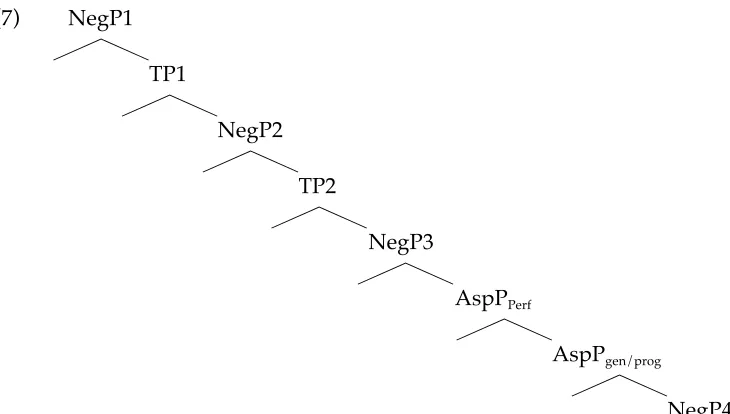
The main error type we documented was the omission of the negative marker. To account for our results under the terms given by the TPH, we have to adopt an account based on the low generation position of negation, thus justify-ing its preservation. To do so, we will assume the complex system of positions postulated by Zanuttini (2001) and claim that agrammatic subjects can construct their negative structures relying on NegP4, situated in the lower portions of the IP-field.
(7) NegP1 3
TP1
3
NegP2
3
TP2 3 NegP3 3
AspPPerf
3
AspPgen/prog 3 NegP4
3.2. Tense and Agreement
Tense (correct/total)
Agreement (correct/total)
Catalan Galician Spanish
85.5% (106/124) 84.4% (103/122) 86.4% (108/125)
94.3% (117/124) 99.2% (121/122) 99.2% (124/125)
Total 85.4% (317/371) 97.5% (362/371)
Table 2: Repetition of tense and agreement
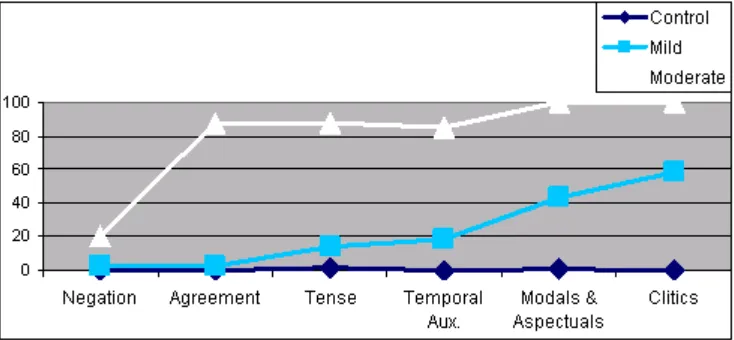
Despite being extracted from a repetition task, the results show a clear parallel with those documented in previous studies (Martínez-Ferreiro 2003, Gavarró & Martínez-Ferreiro 2007). The TPH provides us with exact predictions regarding the behavior of agreement, which is expected to be relatively spared. The fact that agreement is cross-linguistically less impaired than tense indicates that the two functional categories behave differently in agrammatism. In this work, along with Chomsky (1995 et seq.), we assume that AgrP is no longer an independent functional node but rather an operation taking place in a designated position lower than TP(past) (Gavarró & Martínez-Ferreiro 2007).
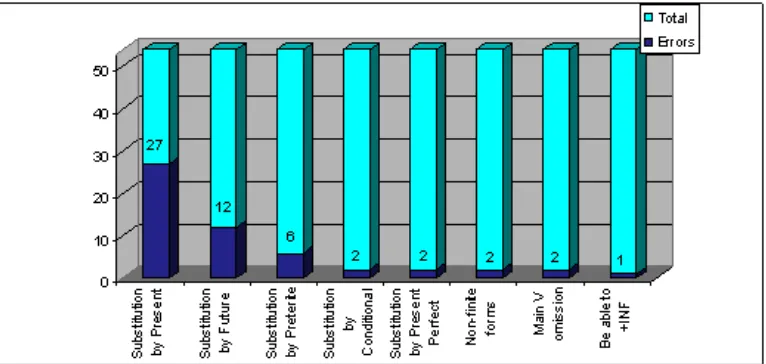
Regarding the nature of the errors, most were substitution errors being omissions restricted to the drop of the complete verbal form.2 While tense errors revealed a consistent tendency towards the forms of the simple present (see Graph 1 below), the number of agreement errors was so scarce, that no default form was documented (as in Graph 2).
In addition to these results, substitutions of a finite verb by a non-finite verb form and main verb omissions were strikingly scarce. No non-finite forms were detected in Galician or Spanish and, in the case of Catalan, only two ex-amples were registered. Participants also produced two omissions of lexical main verbs: one in the Catalan sample and the other in the Galician sample (represen-ting 0.5% of the total number of errors).
Graph 1: Tense substitutions in agrammatic Ibero-Romance
Graph 2: Agreement substitutions in agrammatic Ibero-Romance
Going back to tense errors, the present was not only the better preserved form (6% errors in Catalan and 2% in Galician and Spanish) but also the most productive form for substitution (62.8% of errors), followed by the future (27.9% of errors) and the past tense (9.3% of errors).3 Structurally, although Cinque’s hierarchy does not provide us with a specific functional head for present tense, the results seem to point to the ordering in (8), where the present would occupy a low position in the TP-field. The assumption of the present as the default form in a framework just sensitive to the [±past] distinction would not predict the prefer-ence for future forms vs. past forms.4
(8) TP(past) 3
TP(future) 3
TP(present)
In addition to the production results, we also tested participants’ abilities for tense recognition by means of a comprehension task which included 25 items with simple tenses (simple present, imperfect, simple future). Items paralleled the structure of those included in the repetition task with a length of four to five words. After hearing a sentence read by the experimenter, participants were asked to select the right match among the stimulus visually presented; both example sentence and stimulus picture are provided in (9).
(9) El chico abrió el bote. Spanish the boy open.PAST.3.SG the jar
‘The boy opened the jar.’
3 This error pattern (present > future > past) has also been documented for other languages such as Greek (Koukoulioti & Bastiaanse 2010).
The results indicate that comprehension is also affected in mild agrammatics.
Tense Comprehension (correct/total)
Catalan Galician Spanish
82.4% (103/125) 86.4% (108/125) 83.2% (104/125)
Total 84.0% (315/375)
Table 3: Tense comprehension
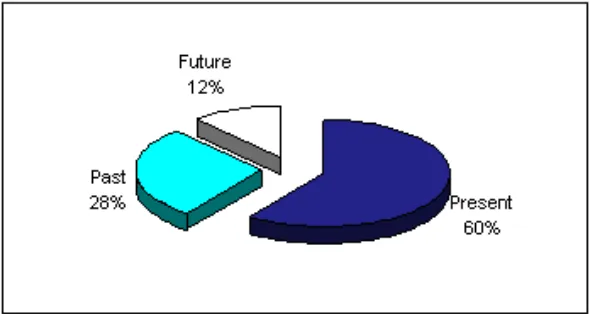
As illustrated in Table 3, out of 125 responses per language, there were 17.6% errors in Catalan, 13.6% in Galician, and 16.8% in Spanish. Misidentifi-cations, as in the case of production, mainly leant towards the present according to the ordering TP(past) > TP(future) > TP(present). This is illustrated in Graph 3:
Graph 3: Tense misidentifications in Ibero-Romance agrammatic comprehension
The statistical analysis revealed no significant differences between pro-duction and comprehension (Wilcoxon Signed Rank test, p > 0.05) even though the chance of providing the correct answer varied across tasks. While in the repe-tition tasks, subjects could opt for up to 6 simple tenses in indicative — simple present, simple past (except for Catalan in which this form is analytic), imperfect, pluperfect (only in Galician), simple future, and simple conditional — in the comprehension task, the chance probability was one in three (i.e. simple present, simple future, simple past).
3.3. Modals, Aspectuals, and Temporal Auxiliaries
experimental design had to be adapted.5 In the case of Catalan and Spanish, the test contained 12 periphrastic forms plus 13 compound tenses, while in the case of Galician, all 25 items were periphrastic forms. All six agreeing forms were in-cluded in the design.
A summary of the results has been plotted in Tables 4 and 5. The former in-dicates the degree of preservation of temporal auxiliaries. Insofar as these forms crucially depend on high parts of the IP-area, they were susceptible to impair-ment as we have already discussed for tense in main verbs. 58.3% of the errone-ous utterances lacked an auxiliary form. Differences were significant with control subjects at a level of p < 0.01 (Mann-Whitney U test, Z = –3.106).
Auxiliary verbs (correct/total)
Catalan Spanish
87.7% ( 57/ 65) 75.4% ( 49/ 65) Total 81.5% (106/130)
Table 4: Auxiliary verb repetition
The type of errors documented in our sample has been listed in order of decreasing frequency (10).
(10) a. Tense substitutions (10/24) — generally towards the present b. Auxiliary omission + tense substitution (7/24)
c. Auxiliary omission (6/24) — main verb adopts given tense d. “Don’t know” responses (1/24)
Table 5 shows the correct responses for periphrastic constructions.
5 The notation compound tenses vs. periphrastic forms will be used throughout this section, the former referring to clusters of temporal auxiliaries + past participle and the latter to clusters including modals or aspectuals (+ preposition) + non-finite verb forms. Notice that the traditional nomenclature ‘temporal auxiliaries’ has been preserved to trace a clear cut in between those forms exhibited by Catalan and Spanish but absent in the case of Galician.
According to Veiga (1991), the Galician system derives from protoromanic varieties previous to the temporalization of compound forms. But the ban against perfect auxiliaries has an exception, as in the case of Portuguese, with the verb ter (from Latin tenere ‘to have’) which may be used as an auxiliary verb:
(i) Teño comido con Maria moi amiudo. Portuguese have.PRES.1.SG eaten with Maria very often
‘I have eaten with Mary very often.’
Verbal periphrases (correct/total)
Catalan Galician Spanish
51.7% ( 31/ 60) 56.0% ( 70/125) 63.3% ( 38/ 60)
Total 56.7% (139/245)
Table 5: Repetition of verbal periphrases
The results indicate a clear increase in the number of errors with modal and aspectual auxiliaries (57% preserved across languages, 138 out of 245 responses) with respect to tense (15% errors) and with respect to temporal auxiliaries (18.5% errors), even though statistical differences (at a 5% level) were only found for Galician.
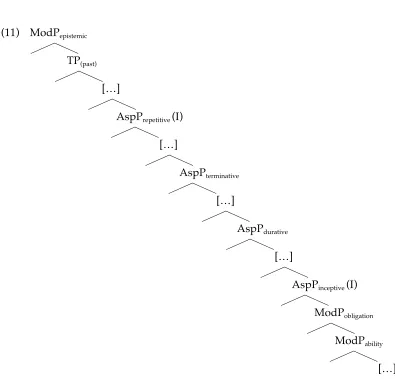
Regarding the nature of errors, 79.2% had to do with a simplification of the verbal cluster. A detailed analysis according to frequency is given in Graph 4:
Graph 4: Errors in the repetition of periphrastic forms
(11) ModPepistemic 3
TP(past) 3 […] 3
AspPrepetitive (I) 3 […] 3
AspPterminative 3 […]
3
AspPdurative 3 […] 3
AspPinceptive (I) 3
ModPobligation 3 ModPability 3 […]
Errors were broken down by category and summarized in Table 6:
5 Catalan & 5 Spanish subjects (correct/total answers)
5 Galician subjects (correct/total answers)
Repetitive — 60.0% (12/20)
Terminative 67.5% (27/40) 60.0% (15/25)
Durative 30.0% ( 6/20) 40.0% ( 6/15)
Aspectuals
Inceptive 70.0% ( 7/10) 60.0% (15/25)
Obligation 60.0% (18/30) 53.3% (16/30)
Modals
Ability/Possibility 50.0% ( 5/10) 40.0% ( 2/ 5) Modals/
Aspectuals 60.0% ( 6/10) 80.0% ( 4/ 5)
Table 6: Modals and aspectuals
3.4. Clitics
The last category observed in the IP-area was that constituted by clitics, including both object clitics and reflexive forms. In order to check how agrammatic deficits affected the highest portions of the IP, we tested both our experimental and our control populations for their production and comprehension skills.
The languages under investigation show considerable formal variation at this respect. While in Catalan and Spanish, reflexive and non-reflexive clitics appear in pre-verbal position with finite and post-verbally with non-finite forms and imperatives (12), in Galician, they tend to appear in post-verbal position (13).
(12) a. Reflexive:
S’ha vist. / Veure’s. Catalan Se ha visto. / Verse. Spanish ‘She has seen herself.’ / ‘To see herself.’
b. Non-reflexive:
La vigilava. / Vigilar-la. Catalan La vigilaba. / Vigilarla. Spanish ‘I/He/She watched over her.’ / ‘To watch over her.’
(13) a. Reflexive:
Viuse. / Verse. Galician ‘She has seen herself.’ / ‘To see herself.’
b. Non-reflexive:
Vixiábaa. / Vixiala. Galician ‘I/He/She watched over her.’ / ‘To watch over her.’
Exceptions to the Galician enclitic pattern can be found with negation, with most subordinate constructions, with quantifiers, and with focalizations. In addition, in infinitival clauses, there are contexts in which both patterns appear in free variation (Uriagereka 1995, Raposo & Uriagereka 2005).
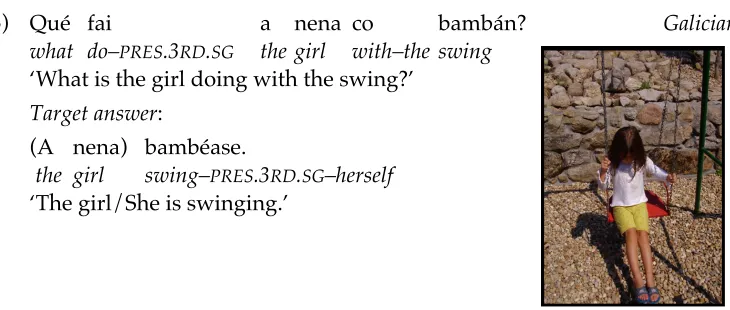
In order to be properly uttered, clitics, with independence of their position in relation to the verb, crucially depend on the projection of a functional pro-jection residing between the CP- and the IP-areas — namely F (Ledgeway & Lombardi 2005, Raposo & Uriagereka 2005). To obtain production data that allow us to test the behavior of these forms in agrammatic speech, we ran an elicited production task with the support of pictures that included 13 items aimed at eliciting object clitics (14) plus 12 items for reflexive forms (15).
(14) Qué fai o mozo co coche? Galician what do-PRES.3RD.SG the teenager with-the car
‘What is the teenager doing with the car?’ Target answer:
(O mozo) lávao.