CLIMATE CHANGE AND WATER MANAGEMENT IN THE
DEVELOPING WORLD
Peter Rogers
Harvard University
INTRODUCTION: CLIMATE CHANGE AND THE DEVELOPING WORLD
…“future-oriented concern for climate change has drawn attention (of the developed countries) away from the economic misery and ecological degradation endemic in large parts of the world today. Disaster is not something for which the poorest have to wait; it is a frequent occurrence” (P. Dasgupta in Vaitheeswaran, 2002).
It should be stressed at the outset that climate change is not the major concern of most people living in the developing world. Events potentially happening two or three decades in the future do not have much resonance in countries mired in trying to climb out of extreme poverty now. Hence, the issues of time and economic costs and benefits are critical in any discussion of water development in the developing world and how this influences the availability of the resource in terms of quantity and variability.
CHALLENGING PREVAILING WISDOM
At any time in the history of the development of resources management there is the suspicion that, somehow or other, things are not working out as originally planned. At the outset of the 21st century this is true of many areas such as energy, agriculture, and climate, and is particularly true for water resources management. It is tempting to say that everything that could be said about water management has already been said. A couple of centuries of diligent research and development have provided scientific concepts, technology, laws, and management institutions which, by and large, have served to meet most of society’s material needs. So, why challenge this wisdom, and why now?
It turns out, however, that the conventional approaches have been shown to be not effective in protecting the resource even for the current situation and to be widely viewed as not being able to address future needs and demands under a highly uncertain future. The ever increasing need to spend large sums to correct
mistakes of excess pollution, or inappropriate allocation of the resource, made in the recent past tells us that even under the best conditions (in the developed countries) our approaches are lagging behind needs and under the worst conditions (the developing countries) have produced major problems which cannot be easily solved. All of these concerns are magnified by the suspicion that we may be entering a period of rapid human-induced climate change with very uncertain implications for water resource management. Despite what may occur in the future, the overhang of existing problems in the developed countries seems to necessitate fairly radical reevaluation of the prevailing approaches that have placed us in this situation. From a climate point of view the conventional wisdom appears to be best expressed as:
• “Climate change will lead to an intensification of the global hydrological cycle and can have major impacts on regional water resources, affecting both ground and surface water supply for domestic and industrial uses, irrigation, hydropower generation, navigation, in-stream ecosystems and water-based recreation.”
• “The impacts of climate change will depend on the baseline condition of the water supply system and the ability of water resource managers to respond not only to climate change but also to population growth and changes in demands, technology, and economic, social and legislative conditions” (IPCC, TAR, 2001).
The first quotation refers to the physical world and the uses of the water itself (the hardware), the second refers to the societal actions and behaviors (the software). The first quotation is the future that may lead us to panic in the face of dwindling resources; the second gives us the hope that we can use the hardware and the software in conjunction to deal effectively with the challenges implied in the first quotation. I believe that conventional wisdom has all the tools needed to help humankind weather the water resources challenges posed by rapid climate change.
IN DEFENSE OF CONVENTIONAL WISDOM
way the water community currently does business. I believe that conventional wisdom and conventionally accepted concepts and ideas about water could, if understood as a whole, significantly improve the sustainability of water as a resource and as a pillar of the ecosystem within which we all live in the face of the real possibilities of climate change. Part of the problem is that conventional wisdom is not so widely understood as it appears and not so widely applied.
SOME FACTS OF LIFE FOR WATER
There are nine very important facts-of-life concerning water, which are well known, but generally not understood by all of the different water constituencies. They are certainly never quoted together as the fabric or the framework under which to view water problems.
Asymmetries in Water Use
There are two ways of characterizing water use; withdrawals and consumption. Withdrawals reflect the amounts of water removed from the water source for use and consumption is the amount of water actually consumed or evaporated in the production process. For most uses small amounts of water are actually consumed with the bulk returning, albeit in some cases polluted, to the water source. Irrigation uses, however, typically evaporate more than 70 percent of the withdrawn water. Industry, particularly heavy industry and fossil fuel electric generation, withdraw huge amounts of water, but consume little. Municipal and commercial withdrawals are typically the smallest withdrawals with about 20 percent consumptive use.
Blue/Green/BrownWater
Falkenmark (2001) made a revolutionary change in how we look at the hydrological cycle. She pointed out that water balances typically kept track only of the blue water. By this she means all of the water that
appears as runoff to the streams and as groundwater recharge, but the green water involved in supporting
the non-irrigated lands of the globe does not appear directly in the balances. Using this concept, Postel et al., (1996) show a global water balance that truly reflects the use of both blue and green water for supporting humanity and the ecosystem. They showed that of the 110,300 cubic kms per year Reusable Fresh Water Supply on the land surface of the globe, only 40,700 were blue water, and 69,600
were green water. They also showed that human
appropriations of the green water were almost three times as large as those of the blue water. The
possibility of using more of the green water and reducing
the demands on the blue water are active questions that
could lead to dealing more easily with feeding future populations.
Irrigation Flywheel
In many countries of the world, as much as 60-95 percent of all water is consumed by irrigated agriculture. This fact is extremely important when looking toward potential future water shortages. Typically, a 10% reduction in irrigation would more than double the water available for industrial and municipal uses. In other words, provided that effective wastewater management programs are in place, the amounts of water made available for municipalities and industries could be effectively doubled. The question then hinges on whether or not such a 10% reduction in irrigation efficiencies could be achieved (or equivalent areas for rainfed crops developed) at the same time as agriculture is being expanded to meet increasing demands for food, fiber, and other industrial crops.
Virtual Water Escape Hatch
Directly related to the irrigation flywheel is what Allan (2001) characterized as the use of imports of food crops as a substitute for use of domestic water for irrigation. Essentially the importing country is importing the water that was used to grow the crops in the exporting country. This virtual water can amount to as much as 1,000-5,000
tons of water per ton of crop imported. Hence, an import of 2 million tons of food from a rain-fed source will save the importer 2-10 billion tons (or 2-10 cubic km; the annual average flow of the Nile is approximately 60 cubic km) of domestic water. Virtual water, through the global food trade, can help overcome the wide disparities between the distributions of water resources among countries. Based upon estimates of the world agricultural trade, virtual water could amount to as much as 700-800
km3 per year (Ramirez and Rogers, 2002; Hoekstra and Hung, 2002).
Low Cost Desalination Breakthrough
economically achievable technology can solve the problems as they develop.
Idiosyncrasy of Water Institutions
Unfortunately, one water fact-of-life makes it very difficult to implement the types of technical and social breakthroughs already conceptually available; the hurdle is that property rights, institutions, and laws vary widely from country to country -- even within countries. The plethora of institutions and legal regimes in all countries tends to get in the way of rational water management. In many cases it is impossible to reallocate or trade between conflicting water uses. The confusion allows for the entrenchment of bad conventional institutional views and blocks consideration of newer approaches. Approaches such as public/private partnerships are often difficult to implement under these Balkanized conditions. Understanding how to devise effective water governance is now imperative (Rogers and Hall, 2002).
Sanitation, Health, and Human Dignity
The major reason for widespread dissatisfaction about water issues in developing countries stems from the vast numbers who have no access to adequate drinking water or sanitation. The numbers often used are one billion without adequate water supply and two billion without access to adequate sanitation. Whatever the actual numbers are, they represent a massive failure by national governments and the world community to deal with these two issues, which involve human dignity much more than economics. It is economics, however, that drives the non-performance in meeting these water needs. It is simply beyond the financial capabilities of existing governmental and international agencies to cover the cost of providing conventional water and sanitation to these persons and their increasing numbers. Either large new sources of finance will be needed, or the conventional views of water-borne sanitation will have to be changed toward well-known ecological sanitation practices that use little or no water.
Trans-boundary Conflicts
Two or more riparian countries share more than 261 river basins worldwide, and 40 percent of the global population lives within these basins (Wolf et al., 1999). Often the basins are shared by water-rich and water-poor countries or by heavily polluting industries in some countries and not in others. Since there is no strong international law governing the resolution of trans-boundary water quality and
quantity disputes, the potential for physical and armed conflict remains high. This issue needs careful consideration by riparians and the regional family of nations to head off these conflicts from becoming worse.
Uncertain Future of Water
Water has always been a fugitive resource with high variability. From the first records ever kept on the globe, the variability of the water supply has been first and foremost in the minds of priests, judges, kings, and statesmen. The first half of the 20th century was a period when statisticians first attempted to find long-term trends in hydrological records. By the end of the century, hydrologists were searching for evidence of long-term anthropogenic climate change caused by greenhouse gases. Many conflicting data sets and theories have been reviewed with contradictory results (see Easterling, 2000 and Vinnikov and Robock, 2002). While at present there is no consensus as to potential change in variability of precipitation over the next 5 decades, there seems to be a consensus of increased precipitation over large areas of the globe and a rise of sea level from 0.1m - 0.3m. The recent IPCC report, however, does little to resolve these anomalies.
While most of the discussion about the uncertain future of water has focused upon the water supply side of the equation, much larger uncertainties can be expected on the water demand side influenced by demographic parameters, economic growth, technology change, and life styles. There is a pressing need for water planners and agencies to improve their approaches to resolving resource issues with such high levels of uncertainty.
CLIMATE CHANGE AND WATER RESOURCES OF THE DEVELOPING COUNTRIES
An old political saying is that: Facts are facts, but perceptions are reality. In the world of climate
predictions it is so hard to separate fact from fact and fact
from fiction that many observers substitute perceptions
for reality. Major sources of facts in the area of climate
change are the three IPPC Reports (1990, 1996, and 2001). Despite being a mine of extremely useful information, these reports are difficult to use because of the innumerable assumptions made by each strand of the overall story line. In other words, due to the cascading of assumptions the facts become hard to distinguish from fiction.
THREE MAJOR ISSUES FACING DEVELOPING COUNTRIES
2000) focused upon the average availability of water as a resource. In dealing with water development, however, we have to deal with the social and economic dimensions along with the physical and environmental factors. I believe that there are three major issues relating climate change to water development in developing countries; first, the expected lifetime of water infrastructure; second, the effects of changes in variability and extremes under changed climates on water availability; and third, the benefits and costs associated with allocation of water among uses under altered climatic conditions.
The Life of Water Infrastructure
The life of water infrastructure does not generally receive serious attention in the water planning literature. This is probably because there are three different concepts of the life of a project, the first deals with the planning life that is chosen for
planning water projects. This is often taken to be 50 years for dams and reservoirs and maybe 15 to 20 years for water and wastewater treatment plants, and is often viewed as an arbitrary choice. The second is the physical life of the project. For water projects this
can be a very long time (there are dams and aqueducts built by the Romans 2000 years ago and still in use in parts of Europe and North Africa). The third concept is the economic life of the project. This
is the most difficult to assess since it depends upon a variety of socio-economic parameters as well as engineering parameters.
Often the planning life and the physical life are assumed to be identical and the analysis of the project is carried out for some 50 years. The economic life is calculated based upon the marginal cost of maintaining the project functioning so that the benefits for an additional year’s output of a project is just equaled by its costs. Depending upon the social rate of discount and the climate impacts this could be a significantly shorter period of less than 20 years (see Rogers in Frederick and Rosenberg, 1994).
One can immediately see the difficulty. If the climate is changing it only becomes significant for the most exaggerated scenarios explored by the TAR after about 30 to 50 years in the future. This implies that taking climate change into account will not have serious effects upon short-lived water infrastructure in developing countries even under the most extreme scenarios. If the projects have an economic life of more than 50 years, then taking account of potential climate change in their planning could be considered a wise investment.
What are typical economic lives of development projects? Burton and van Aalst (1999) reviewed six case studies of proposed World Bank water investments that showed economic lives ranging from 25 to 50 years and levels of protection ranging from one-in-ten year events to one-in-fifty year events. So none of the projects examined would likely experience serious economic difficulties, since their life spans are coming to an end just as the climate impacts become noticeable. At that point of time the responsible agency would then select another project that would have climate change taken into account in its design.
Change in Variability and Extremes with Climate Change
From a water resources development aspect any change in the extreme hydrological events or the variability of the events themselves could have a major impact on the development of the resource. There are data on the observed behavior of extremes in North America and a few other locations (Easterling et al., 2000) that show convincing evidence for an upward trend in minimum temperatures, but no trend for maximum temperatures over the 20th century. This is accompanied by an increase in heavy precipitation and a small increase in total precipitation. Other regions such as Ethiopia, Kenya and Thailand show large decreases in both. In a seemingly contradictory paper, Vinikov and Robock (2002) see no increase in the variability of annual precipitation, Palmer Drought Severity Index, and sea level variations for the U.S. over the past 100 years, and the All-India monsoon rainfall index and the Southern Oscillation index over the same century. Part of the problem of reconciling these two papers is that time intervals chosen were different, with the Easterling paper using time intervals of days and the Vinikov and Robock paper using annually aggregated data. Whatever the resolution of the differing interpretations given by these two recent papers, they serve to emphasize the point made earlier that in some cases we cannot easily label the observed data as “fact” or “fiction.”
The Costs Associated with Allocation among Water uses Under Altered Climatic Conditions
This is the most contentious of the issues facing developing countries. All countries, whether they like it or not, have essentially de facto allocated water among
WS and sanitation
Food production
Energy production
Industrial water
Transportation
Flood management
Drought management
Coastal protection Incr/decr ppt
Change seasonality
Change variability
Change extremes
Sea level rise
Change assimilative of surface waters
Change stream biota
CO2 fertilization
Climate Water Issues Water Development Issues Current Needs
$30 billion/yr
$30-35 billion/yr
$7.5 billion/yr
$7.5 billion/yr
? billion/yr
? billion/yr
? billion/yr
? Billion/yr
$75-80 billion/yr
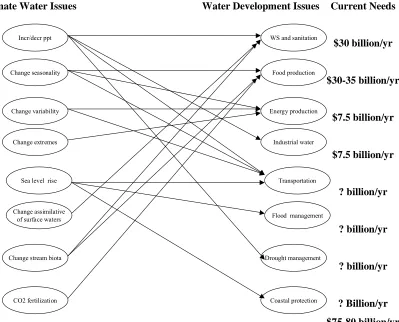
Figure 1. Scope of Developing Country Water Needs and Current Climate Water Concerns
(for example see Seckler et al., 1998, for agricultural claims and Johnson et al., 2001, for domestic supply and ecosystem claims). The clinching argument for reallocation probably lies in the costs associated with climate change. Many guesstimates have been made as to the costs of meeting future water demands in the developing countries in the absence of climate change considerations.
Figure 1 shows the eight major water consequences of climate change and relates them to the eight major water development issues faced in developing countries. It also gives estimates from the World Water Commission on the needed annual investment to meet the demands placed upon the resources until 2025. In an ambitious paper, Tol (2002) estimated the economic benefits and costs of climate change in the developing countries by broad regions. Table 1 summarizes the results from all sectors (agriculture, forestry, ecosystems, etc.) and of total benefits by specific water sectors by region.
The interesting thing to notice in the table is that quite severe climate change is not necessarily a disaster in all of the regions and all sectors. Some of
the regions report positive benefits and some negative. The overall picture shows an annual net benefit of $38 billion per year from all sectors and all regions. However, the consequences for water resources are almost all negative with an estimated global annual loss of $79 billion. Surprisingly, these damages are almost identical with the estimates from the WWC (in Figure 1) of annual investment needs to achieve sustainable water sector development.
CONCLUSIONS
Assuming that the recent IPCC estimates of likely climate change over the next 50 years were to occur, there is some reason to believe that the consequences will not be so disastrous as might be expected if we were to carry on our planning and development of water resources using conventional wisdom rather than
adjusting our actions to what current conventional
Region Total Annual
Regional Damages (-) and Benefits (+)
Total Annual Regional Damages (-) and Benefits (+) for Water Resources Central and Eastern Europe &
the Former Soviet Union (+) $57 (-) $76
Middle East (+) $4 (-) $1
Latin America (-) $1 (-) $1
South & Southeast Asia (-) $14 (-) $1
Centrally Planned Asia (+) $9 (+) $2
Africa (-) $17 (-) $2
Total (+) 38 (-) $79
Amounts are shown in billions of U.S. dollars.
Table 1. Future annual effects due to a climate change of 1oC and 0.2m sea level rise (Source: Tol, 2002)
Note: Without climate change the World Water Commission estimated annual investment needs in 2025 of US$180 billion (water and sanitation $75 billion; agriculture $30 billion; and environmental, energy, and industry $75 billion).
ACKNOWLEDGEMENTS
The paper was originally presented at the joint ASCE/UNCOWR/EWRI conference on Integrated Trans-boundary Water Management, Park Place
Hotel, Traverse City, Michigan, July 23-26, 2002. Support for the paper was provided by the Institute for Water Resources of the U.S. Army Corps of Engineers.
AUTHOR INFORMATION
Born in Liverpool, England, educated in England and the United States; Ph.D. Harvard University, 1966. Gordon McKay Professor of Environmental Engineering and Professor of City and Regional Planning, Harvard University since 1974.
REFERENCES
Allan, J.A., 2001. The Middle East Water Question: Hydropolitics and the Global Economy. London, I.B.
Tauris.
Burton, I. and M. Van Aalst, 1999. Come Hell or High Water—Integrating Climate Change and Vulnerability into Bank Work. Environmentally Sustainable Development, World Bank.
Easterling, D.R., et al., 2000. Observed Variability and Trends in Extreme Climate Events: A Brief Review, Bulletin of the American Meteorological Society 81, pp. 417-425.
Falkenmark, Malin. 2001. Human Dimensions of Freshwater: Time to Overcome Water Blindness and Bridge the Science/Policy Gap. Newsletter of the International Human Dimensions Programme on Global Environmental Change, Bonn, Germany.
Frederick, K.D., and N.J. Rosenberg, (Editors), 1994.
Assessing the Impacts of Climate Change on Natural Resource Systems. Kluwer Academic Publishers.
Gleick, P.H. The World’s Water 2000-2001. Island Press.
Hoekstra, A.Y. and P.Q. Hung, 2002. Virtual Water Trade: A Quantification of Virtual Water Flows between Nations in Relation to International Crop Trade. Technical Report Virtual Water Research Report Series No. 11, IHE Delft.
IPCC, 1989. Climate Change 1989: First Assessment Report Cambridge University Press.
IPCC, 1996. Climate Change 1995: Second Assessment Report Cambridge University Press.
IPCC, 2001. Climate Change 2001: Third Assessment Report Cambridge University Press.
Johnson, N., C. Revenga and J. Echeverria, 2001. Managing Water for People and Nature, Science 292:
Postel, S.L, G.C. Daily, and P.R. Erhlich, 2001. Human Appropriation of Renewable Fresh Water,
Science 271: 785-788.
Ramirez-Vallejo, J. and P. Rogers, 2002. Agricultural Trade and Virtual Water Flows. Working Paper. Division of Engineering and Applied Sciences, Harvard University.
Raskin, P., et al., 1997. Comprehensive Assessment of the Freshwater Resources of the World. Stockholm
Environment Institute, Stockholm.
Rogers, P. and A. Hall, 2002. Effective Water Governance. TEC Background Paper No. 7. Global
Water Partnership.
Seckler, D., U. Amarasinghe, D. Molden, R. de Silva and R. Barker, 1998. World Water Demand and Supply, 1990 to 2025: Scenarios and Issues.
Research Report 19. International Water Management Institute, Sri Lanka.
Tol, R.S.J, 2002. Estimates of Damage Costs of Climate Change Part I: Benchmark Estimates, Environmental and Resource Economics 21: 47-73.
Tol, R.S.J, 2002. Estimates of Damage Costs of Climate Change Part II: Dynamic Estimates, Environmental and Resource Economics 21:135-160.
Vaitheeswaran, V., 2002. How Many Planets: A Survey of the Global Environment, The Economist, July 6.
Vinnikov, K.Y. and A Robock, 2002. Trends in the Moments of Climatic Indices, Geophysical Research Letters 29(2): 14-1: 14-4. GLO14025.
Wolf, A., J. Natharius, J. Danielson, B. Ward, and J. Pender. 1999. International River Basins of the World,
International Journal of Water Resources Development
15(4) 387-427.