111
DOI: 10.15415/jce.2016.22006
Journal of Chemistry, Environmental Sciences
and its Applications Vol - 2, No - 2
March 2016 pp. 111–120
Occupational Hazards And Their Impact On
Workers In Pulp And Paper Industries
ANURADHA SHARMA1*, V.K. RATTAN21D.A.V. College, Sector -10, Chandigarh
2S.S.B.U.I.C.E.T., Panjab University, Chandigarh
*Email: [email protected]
Received: November 13, 2015| Revised: November 23, 2015| Accepted: December 11, 2015 Published online: March 14, 2016
The Author(s) 2016. This article is published with open access at www.chitkara.edu.in/publications
Abstract: The use of numerous synthetic chemicals and other aspects of constructed environment in paper industry have become a matter of concern to the environmentalists. Several studies have revealed that chemical industries are associated with health hazards. However, precious little data is available about the effects of such environment on the health of workers in these industries. Therefore, present study was aimed to investigate the existence of various psychological disorders and physical ailments in workers exposed to hazardous environment in factory premises. The data was collected on a specially designed survey performa from different pulp and paper industries. It was found that the workers were provided with protecting devices but most of them do not use them because of unawareness and climatic discomfort. In order to check the effectiveness of protecting/preventives devises, the workers were divided into two categories : (i) directly exposed (not taking preventive measures) and (ii) indirectly exposed (taking preventive measures) against these conditions vis-à-vis their health (healthy and sick), working conditions (good & poor) and job satisfaction (satisfied and unsatisfied). The extent of correlation amongst health, work environment and job satisfaction has been studied by using Youle’s Coefficient of association and to test the significance of association, Chi-square test of independence of attributes was deployed. The comparison of the two categories was made by using test of proportions. The statistical significance of the differences of the two categories of workers vis-a-vis their physical and mental health was studied by using test of proportions (Z-test). It was found that with the exception of the association between job satisfaction and physical health, which is moderately positive, there is high degree of positive association amongst job satisfaction-mental health and work environment; work environment-physical and mental health.
Keywords: Hazards; Pollutants; Psychological; Physical ailments; Pulp and Paper.
1. INTRODUCTION
Sharma, A.
Rattan, V.K. protein. A similar study on the relationship between exposure to air born particles in pulp and paper mills and markers of inflammation and coagulation in blood was reported by Westberg et al. [15]. Some researchers [5, 10] have highlighted the cancer risk associated with pulp and paper mills. Studies pertaining to occupational exposure to chemicals leads to an increase in mortality of workers have also been reported [2,3,6,8,10]. The unpleasant odour and continued roar of wood cutting machines put an excessive strain on workers. Allibacus et al. [1] have pointed out that the noice puts an excessive strain on nervous system and may cause deafness, speech interference, annoyance, impairment of efficiency, dizziness, irritability, nausea, fatigue, anxiety, insomnia and infertility. Further, Luthan [11] has reported that the effect of such type of strain would create physiological problems (heart disease, ulcers, arthritis and even cancer), and psychological disorders (tardiness, absenteeism, change in eating habits, rapid speech and sleep disorders) in workers. This study was therefore, undertaken to evaluate the prevalence of various physical and psychological disorders in workers exposed to heat, cold, noise, moisture, toxic vapours, dust, odour and vibrations in pulp and paper industries, on the one hand, and, to correlate the findings with age, length of service/duration of exposure in work environment on the other.
2. EXPERIMENTAL
The present work is in continuation of our earlier study – a UGC project undertaken at SSBUICET, P.U., Chandigarh. A random Sample of 181 workers comprising 19-illiterates, 36-below matric; 63 – matric, 31-Plus one to B.A., 4-Post graduates and 28-ITI diploma holders, formed the study group. Generally, the workers in pulp and paper mills are exposed to various physical conditions such as heat, cold, noise, dust, vibrations, humidity etc., which affect their physical and mental well being. The ‘chemical hazard’ also has a grave effect on the health of the workers. The hazard may be due to atmospheric contaminants like gases and fumes of various chemicals or by direct contact with the skin.
In order to investigate the impact of such conditions on the health status of the workers, the workers were thoroughly interviewed for their personal and occupational history on a specially designed survey performa. The performa was formulated keeping in mind the main objectives of the study. The data was collected, coded, tabulated, discussed and interpretations were made on the basis of :
(i) Possible link between years of service and health status.
(ii) Association between work environment and health (physical as well as mental).
Occupational Hazards And Their Impact On Workers In Pulp And Paper Industries
113
It is a well known fact that the workers in these industries are exposed to various toxic irritants such as wood dust, paper dust, lime dust, chlorine, sulphur dioxide along with number of other chemicals. Some workers use one or the other preventive / protecting devices against these, whereas others are not using these devices due to unawareness or most of them do not use them due to climatic discomfort and hence are directly exposed to these conditions. Therefore, it was decided to check the effectiveness of the preventives, for that matter workers were divided into two categories (i) directly exposed (not taking preventive measures) (ii) indirectly exposed (taking preventive measures) against these conditions and, their impact on the physical and mental health of the workers, working conditions (good and poor) and job satisfaction (satisfied and unsatisfied). The extent of correlation amongst health, work environment & job satisfaction has been studied by using Youle’s coefficient of association and to test the significance of association, chi-square test of independence of attributes is deployed. The comparison of the two kinds of workers was made by using test of proportions. The statistical significance of the differences of the two categories of workers viz-a-viz their physical and mental health was studied by using test of proportions (Z-test).
3. RESULTS AND DISCUSSION
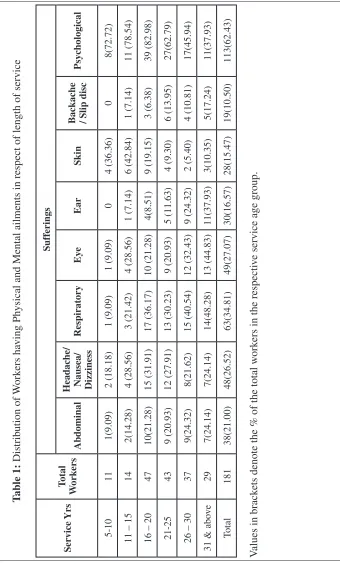
In our sampled population of 181 workers, 94 were found to be physically sick suffering from one or more than one ailments. The diseases of respiratory origin occupied the top slot (34.81%), followed by eye (27.07%), headache/ nausea (26.52%), abdominal (21.0%), ear (16.57%), skin (15.47%) in that order with backache/slipped discs (10.50%) occupying the bottom position. Of these, 113 (62.43%) workers suffer from psychological disorders. These workers who have been exposed to various chemicals, physical conditions or work under tense circumstances may not exhibit immediate symptoms of occupational diseases/changes in social behaviour. The symptoms of diseases may be delayed from a few hours to months or even years. Therefore, in order to see the impact of tenure of exposure on the physical and mental health of the labour force, we have correlated the diseases of workers (physical and mental) with the service age groups/length of service. The results are presented in Table-1.
Sharma, A. Rattan, V.K. Table 1: Distrib ution of W ork ers ha ving Ph
ysical and Mental ailments in respect of length of service
vice Yrs Total W ork ers Sufferings Abdominal
Headache/ Nausea/ Dizziness
Respiratory
Ey
e
Ear
Skin
Backache / Slip disc
Psychological 5-10 11 1(9.09) 2 (18.18) 1 (9.09) 1 (9.09) 0 4 (36.36) 0 8(72.72)
11 – 15
14 2(14.28) 4 (28.56) 3 (21.42) 4 (28.56) 1 (7.14) 6 (42.84) 1 (7.14) 11 (78.54)
16 – 20
47 10(21.28) 15 (31.91) 17 (36.17) 10 (21.28) 4(8.51) 9 (19.15) 3 (6.38) 39 (82.98) 21-25 43 9 (20.93) 12 (27.91) 13 (30.23) 9 (20.93) 5 (11.63) 4 (9.30) 6 (13.95) 27(62.79)
26 – 30
37 9(24.32) 8(21.62) 15 (40.54) 12 (32.43) 9 (24.32) 2 (5.40) 4 (10.81) 17(45.94) ve 29 7(24.14) 7(24.14) 14(48.28) 13 (44.83) 11(37.93) 3(10.35) 5(17.24) 11(37.93) Total 181 38(21.00) 48(26.52) 63(34.81) 49(27.07) 30(16.57) 28(15.47) 19(10.50) 113(62.43)
ets denote the % of the total w
ork
ers in the respecti
Occupational Hazards And Their Impact On Workers In Pulp And Paper Industries
115
of the lymphatic and haemopoietic tissue among the workers in the pulp and paper mills. Regarding respiratory ailments, our results are in agreement with the results of a parallel study conducted by Glindmeyer et al. [6], who have reported that the workers exposed to such environments in pulp and paper industry have lower pulmonary function tests. Our results are presented in Table-1.
Regarding skin problems, 28 workers have put up their complaints. 16 of them have revealed the skin disorders on finger webs/hands and fore-arms, 7 have reported itching and skin irritation on face and neck, whereas, 5 of them have complaints about the skin disorders on the lower extremity i.e., feet and legs etc. From Table-1, it is clear that the younger lot, with less service years of exposure, is more prone to skin problems than the elder ones. Further, the history has also indicated that most of the workers having skin disorders, were afflicted with chemicals in the plant in the initial years of exposure but later on immunity develops.
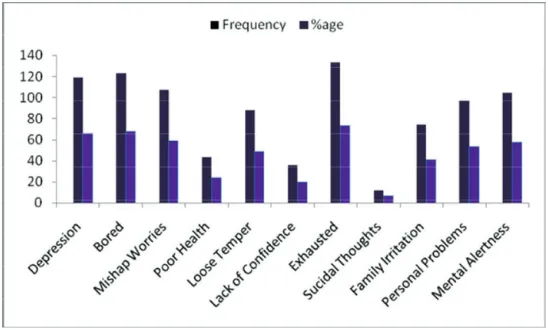
The last column of Table-1 is devoted to the mental health/psychological problems of the workers. Most of them have shown the feelings of low self-esteem, anxiety, boredom, frustration, resentment, aggression, and job dissatisfaction. About 12 cases have shown suicidal tendencies Fig. 1.
Sharma, A. Rattan, V.K.
These feelings may be attributed to the workers performing monotonous task in social solitary situations, reduction of task motivation. Boredom was the outcome of incongruity between alternative behaviour tendencies and work situation [13]. It is clear from Table -1 that the younger group with less length of service years faces more disorders than the elder ones. Job satisfaction is shown in Fig.2. It was observed that most of the workers were not satisfied with the existing status of their jobs. A similar study carried by Chhabra [4] has pointed out that one factor may cause job satisfaction in one sample and job dissatisfaction in another sample. Occupational level and the age of the respondent to some extent determine whether a particular factor will be a source of satisfaction or dissatisfaction on the job.
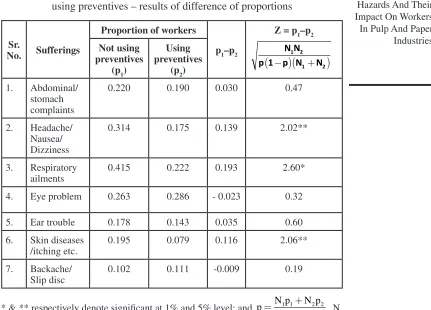
From the survey, it was found that some preventive/protecting devices such as gas masks, goggles, helmets, gloves, safety belts and apron etc. were provided to the workers to prevent them from the direct exposure to noxious conditions. But most of the workers do not use them regularly due to climatic discomfort and uneasiness. It was found that only 63 workers used preventives frequently out of the sampled 181.
In order to study the effectiveness of the preventives against these conditions on the physical health of workers, they were classified into two categories:
Category A = directly exposed (not taking preventives measures) Category B = indirectly exposed (taking preventives measures).
Occupational Hazards And Their Impact On Workers In Pulp And Paper Industries
117
Table 2: Comparisons of workers using preventives with those who are not using preventives –results of difference of proportions
Sr.
No. Sufferings
Proportion of workers
p1–p2
Z = p1–p2
N N p 1 p N
(
−)
1 2(
1+N2)
Not using preventives
(p1)
Using preventives
(p2)
1. Abdominal/ stomach complaints
0.220 0.190 0.030 0.47
2. Headache/ Nausea/ Dizziness
0.314 0.175 0.139 2.02**
3. Respiratory
ailments 0.415 0.222 0.193 2.60* 4. Eye problem 0.263 0.286 - 0.023 0.32
5. Ear trouble 0.178 0.143 0.035 0.60 6. Skin diseases
/itching etc. 0.195 0.079 0.116 2.06** 7. Backache/
Slip disc 0.102 0.111 -0.009 0.19
* & ** respectively denote significant at 1% and 5% level; and p N p N p
N N
1 2 2
1 2
= +
+
1 , N
1
and N2 are the total number of workers in category A and B respectively; and n1 and n2 represent the number of workers suffering from disease X in category A and category B respectively.
Sharma, A.
Rattan, V.K. Table 3: Association amongst Job satisfaction, Health status & Work environment : Results of statistical analysis
Youle’s Coefficient of Association Ho: Independence of Attributes 2
Job Satisfaction - Physical Health 0.49 8.09* Job Satisfaction - Mental Health 0.85 43.89* Work Environment - Physical Health 0.63 16.14* Work Environment - Mental Health 0.89 58.08* Job Satisfaction - Working Environment 0.70 23.09*
*All significant at 1 % level and Ho is rejected.
We have also worked out the relationship amongst job satisfaction, health status (physical & mental) and work environment by using Youle’s Coefficient of association. Further, the statistical significance of the association has been tested by using Chi-square test. The results of this exercise are reported in Table -3. It can be seen from the table that barring the association between job satisfaction and physical health which is moderately positive, there is high degree of positive association amongst the remaining pairs of attributes. Further the statistically significant computed values of chi-square in all the five associations reported in Table - 3, reinforce these associations. Thus it is clear from the table that healthier working environment leads to greater job satisfaction. Which in turn positively affect the physical as well as mental health of the workers.
4. SUMMARY AND CONCLUSIONS
Occupational Hazards And Their Impact On Workers In Pulp And Paper Industries
119
job satisfaction – mental health and work environment; work environment – physical and mental health. Thus, we can conclude that the healthier working conditions leads to greater job satisfaction, which is turn positively affect the physical as well as mental health of the workers.
REFERENCES
[1] Allibacus, B.R., Ramjeawon, T. and Subrathy, A.H., et al. (1996). Impact of noise on quality of life among residents around a thermal power station in Mauritius. Pollution Research, 15(1), 71-74.
[2] Andersson, E., Persson, B., Bryngelsson, IL., et al. (2007). Cohort mortality study of Swedish pulp and paper mill workers-nonmalignant diseases. Scandinavian J. of Work Environment and Health, 33(6), 470-478.
[3] Carl, R., Boffetta, P., et al. (2002). Exposure to asbestos and lung and pleural cancer mortality among pulp and paper industry workers. Journal Of Occupational Environmental Medicine, 44(6), 579-584.
[4] Chhabra, U., (1979). Level of job satisfaction among the scientific workers of an ICAR institute. Ph.D. Thesis submitted to Panjab University, Chandigarh.
[5] Colin L, S. & Sieswerda, L.E., (2010). Cancer risk associated with pulp and paper mills : a review of occupational and community epidemiology, Archieved – Cronic Diseases in Canada, 29 (2).
[6] Glindmeyer, H.W.L., Fryder, J.J., Friedman, L.M., Weill, M. and Jones, R.N.H.,
et al. (2003). Relationship of Asthma to irritant gas exposures in pulp and paper mills. Respiratory Medicine,97(5), 541-548.
[7] Jappinen, P., & Tola, S. (1990). Cardiovascular mortality among pulp mill workers. British Journal of Industrial Medicine, 47, 259-262. DOI :10.10.1136/oem.47:4.259.
[8] Korhonen, K., et al. (2004), Occupational exposure to chemical agents in paper industry. International Archieves of Occupational and Environmental Health, 77(7), 451-460.
[9] Li, Y., Rittenhouse-olson, K., Scheider, W., Mu, L., et al. (2012). Effect of particulate matter air pollution on C-reactive protein : a review of epidemiologic studies. Rev. Environ Health, 27, 133-149.
[10] Lee,W.J., Teschke, K., et al. (2002). Mortality from lung cancer in workers exposed to sulfur dioxide in the pulp and paper industry. Environmental Health Perspectives,110 (10), 991-996. [11] Luthans, F., (1995). Occupational stress. Organizational Behaviour, VII Ed., George Holmes
(pp. 308-314), McGraw-Hill, Inc., U.S.A.
[12] Milham, S., (1976). Neoplasia in wood and pulp industry. Ann. N.Y., Acad, Sci., 271, 294-300. [13] Rosseel, E., (1974). Fatigue and boredom resulting from reduced task motivation. Psychologica
Belgica, 14, 67-68.
[14] Toren, K., Persson, B., Westberg, G. et al.,(1996). Health effects of working in pulp and paper mills : malignant diseases. Am J ind Med , 29(2), 123- 130.