
AB INITIO ANALYSIS OF EXCHANGE INTERACTIONS IN
[V
2O(BIPY)
4CL
2]
2+COMPLEX
Ivan Ogurtsov*, Andrei Tihonovschi
Institute of Chemistry, Academy of Sciences of Moldova, Republic of Moldova, Chisinau, Academiei str., 3. * [email protected], +373 22 739675
Abstract: In this work an ab initio analysis of the binuclear vanadium complex [V2O(bipy)4Cl2]2+ electronic structure
is performed. The ground state was calculated to be a quintet, which means a ferromagnetic interaction between centers. The orbitals participating in exchange interaction according to ROHF+CI calculations are two molecular orbitals consisting of vanadium d-orbitals and two molecular orbitals with main contributions from p-orbitals of bipyridine ligands perpendicular to V-V axis, vanadium d- and p-orbitals and μ-oxygen p-orbital. Calculated energy values of the multielectronic states are placed in accordance with Lande rule. The value of magnetic moment at 293K calculated for the complex in vacuum taking into consideration the Boltzmann distribution and the energies of the excited states is 3.95BM which is in accordance with experimental value of 3.99BM (for complex in acetone).
Keywords: binuclear vanadium complex, binuclear μ-oxo-bridged complex, exchange interactions, magnetic
properties, theoretical ab initio study.
Introduction
Polynuclear compounds of vanadium as well as of other transitional metals are of great interest not only from the theoretical point of view. They can be used as models of metalloproteins of natural enzymatic systems (especially iron complexes) [1]. Moreover they can serve as model systems in studies and development of new molecular magnetic materials [2]. Natural enzymatic systems containing paramagnetic ions have been characterized by their magnetic properties [3] too.
Numerous magneto-structural correlations have been established for the polynuclear complexes (see, for instance [4-8] and references therein). In order to describe these correlations the Heisenberg-Dirac-Van Vleck model of the exchange interactions between metal centers is usually used. Detailed studies of the electronic structure and related properties are not performed. Meanwhile the knowledge of the interactions origin is needed to work out on the well-founded theoretical models of the polynuclear magnetic materials and to predict new systems with the wanted properties.
The relatively simple binuclear oxygen bridged compounds can be useful for the elaboration of the magnetic interactions models based on their electronic structure. There are known some theoretical attempts to give the interpretation of the exchange parameters dependence from the Metal-Oxygen-Metal angle values in these compounds [9]. However the suggested in [9] interpretation is based on the crystal-fi eld theory or on the Angular Overlap Model which both are only approximate models of the compounds electronic structure and do not give the base for the adequate exchange interaction theory.
O V
V* Cl
Cl* N3
N3*
N1 N1*
N4
N4*
N2
N2*
C2
C2*
C1 C
1*
For such a task binuclear systems with equivalent magnetic centers can represent a good choice. The simplest case is d1-d1 systems but for these complexes the only question that arises is which state is the ground from two possible
– singlet or triplet. Much more interesting are d2-d2 systems. There can be singlet, triplet and quintet states for these
complexes and it is interesting not only which state is the ground one but also what is the order of states and which are their energies and energy gaps between them. From the other point of view these systems are relative simple and easy to study.
The binuclear complex [V2O(bipy)4Cl2]2+ (Fig.1) was chosen for study in this work. First of all it is a representative
of the d2-d2 family and there are available experimental magnetic data for this complex to compare results with.
This work goals are the study of the [V2O(bipy)4Cl2]2+ binuclear complex electronic structure and the interpretation
of its magnetic properties using the ab initio approach.
Geometry optimization
The [V2O(bipy)4Cl2]2+ complex theoretically may have three different geometrical confi gurations with the mirror
analogues. However only one geometrical confi guration given in Fig. 1 was observed in experimental works [10]. In this work this system confi guration was initially built and optimized using MM+ methods. In the next step of the optimization the gradient methods realized in PC GAMESS [11] program package was used. Total energy calculations were performed in the ROHF (Restricted Open Hartree - Fock) and UHF (Unrestricted Hartree – Fock) approximations. Geometry optimizations using ROHF method have been carried out for three different spin states (S = 2, 1, 0). Process of the optimization using UHF method was converged only for the state with S=2. For further electronic structure studies there were selected two optimized geometries with lowest energies: one obtained in the UHF optimization and one in the ROHF (both optimized in the states with S=2 and with approximately coincided values of the total energy: -4833.76627647 Hartree (ROHF) and -4833.7689578 Hartree (UHF).
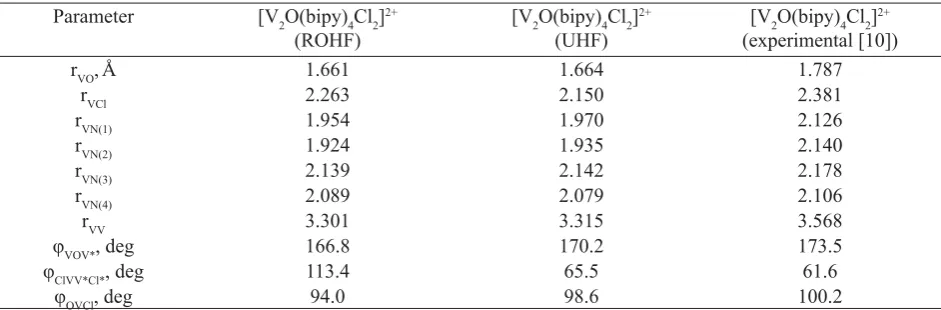
List of signifi cant parameters both calculated and observed experimentally is given in Table 1. It is seen that geometry obtained after ROHF optimization is satisfactorily good in distances and angles between different parts of molecule. However the dihedral angle Cl-V-V*-Cl* was calculated to be about 113° while reported experimental value is
about 62° [10]. The geometry parameters obtained by the UHF optimization are suffi ciently close to that given by X-ray data. Therefore below this conformation will be used in study of the [V2O(bipy)4Cl2]2+electronic structure.
Table 1
Experimental and calculated values of the geometry parameters Parameter [V2O(bipy)4Cl2]2+
(ROHF)
[V2O(bipy)4Cl2]2+
(UHF)
[V2O(bipy)4Cl2]2+
(experimental [10])
rVO,Å 1.661 1.664 1.787
rVCl 2.263 2.150 2.381
rVN(1) 1.954 1.970 2.126
rVN(2) 1.924 1.935 2.140
rVN(3) 2.139 2.142 2.178
rVN(4) 2.089 2.079 2.106
rVV 3.301 3.315 3.568
φVOV*, deg 166.8 170.2 173.5
φClVV*Cl*, deg 113.4 65.5 61.6
φOVCl, deg 94.0 98.6 100.2
Electronic structure calculations
Electronic structure studies were performed both using ROHF method with further taking into consideration CI (Confi guration Interaction) and by the UHF method. The basis set STO-6G (Slater Type Orbital approximated by 6 Gauss-type orbitals) was used for all calculations. The calculations were carried out for geometry confi guration obtained using ROHF as well as for geometry confi guration obtained using UHF.
All the UHF calculations were performed for states with spin values equal to S=2, 1, 0. When the ROHF+CI method was used the active space was selected according to reasons described below.
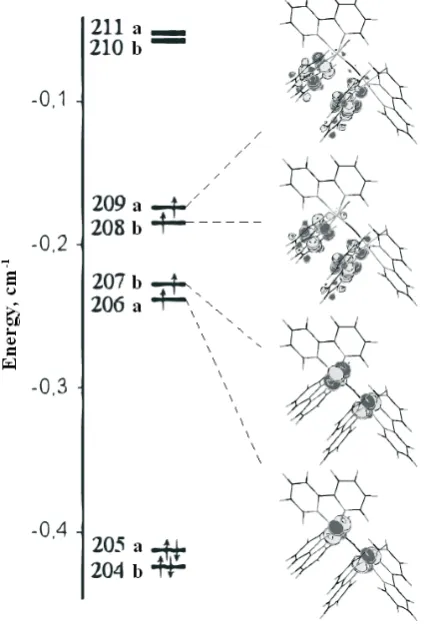
One-electron energy levels and molecular orbitals
Table 2
One-electron states considered as active in CI calculations
Table 2. One-electron states considered as active in CI calculations.
ʋ Sym Energy Composition
211 a -0.0575
210(LUMO) b -0.0581 209(HOMO) a -0.1819
208 b -0.1822
207 b -0.2292
206 a -0.2296
205 a -0.4177
and in the Table 2 are linear combinations of p-orbitals located on nitrogen and carbon atoms of the bipyridine ligands laying perpendicularly to V-V axis:
C1 and C2 (C1* and C
2*) are two carbon atoms connecting pyridine cycles in the bipyridine molecule (Fig. 1).
In the state with the total spin value equal to S=2 four electronic orbitals beginning with 206 are populated by one electron each. It is seen that two of these molecular orbitals (206 and 207) are composed from the vanadium d-orbitals and two MO (208 and 209) are the combinations of the vanadium p- and d-orbitals as well as of the μ-oxygen pz-orbital and px-orbitals of the bipyridine ligands perpendicular to V-V axis. In the Fig. 2 these four states are given in picture form.
Multielectronic states
According to above discussion only 7 orbitals (from 205 to 211) can be introduced in the active space for the ROHF+CI calculations. In this approximation 7 multielectronic confi gurations with full spin value S=3, 140 confi gurations with S=2, 588 confi gurations with S=1 and 490 confi gurations with S=0 form a basis for the CI calculations.
From our calculations we have obtained ten multielectronic states and lowest of them are given in Fig. 3. The formulas for these multielectronic states are given in Table 3. As it was mentioned above only four one-electron states are participating in forming of the ground and fi rst two excited states.
Table 3
Composition of the lowest multielectronic states in the CI. approximation State Term Formula
2nd excited 1A 0.5{[206a2 208b 2] – [207b2 208b 2] + [207b2 209a2] – [206a2 209a2]}
1st excited 3B 0.5{[206a2 208b↑209a↑] – [207b2 208b↑209a↑] + [206a↑207b↑208b2] – [206a↑207b↑209a2]}
Ground 5A [206a↑207b↑208b↑209a↑]
From the Table 3 and Fig. 3 it is seen that the ground state is the multielectronic state 5A consisting of one electronic
confi guration in which two electrons are placed on mainly metal d-orbitals (206 and 207) and two on the hybrid
dp
Φ
bipyorbitals (208 and 209). The wave functions of the excited multielectronic states 3B and 1A are the linear combinations
of different confi gurations obtained by the respective populations of the same orbitals. It follows that we can imagine the scheme of formation of the molecular orbitals participating in exchange interactions from four localized magnetic orbitals as it is shown in Fig. 4.
Fig. 3.Multielectronic states schemes (State symmetries are given according to C2 molecular symmetry group). One-electron states are given beginning with the MO № 206.
The exchange interaction in this case is due to superexchange between the electron pairs localized on the vanadium centers through the hybridized metal d- and p-orbitals with the bipyridine and oxygen p-orbitals. This interpretation differs qualitatively from the d2 -d2 model served as base for the Heisenberg interpretation of magnetic properties
of binuclear systems. ROHF+CI calculation give the order of states with different spin values (Fig. 5) similar to the Heisenberg model (Fig. 5 inserted picture) and even the energy differences between fi rst excited and ground states and second excited and fi rst excited states ratio 4:2 is preserved (according to Lande rule). When carrying out calculations using UHF method it was obtained that ground state is a state with S=2 too but the other UHF calculations results does not coincide with ROHF calculations and Heisenberg model.
Thus in spite of the qualitative difference in interpretation of the exchange interaction origin the intervals between the energy levels satisfy the Lande rule in both approaches and correspond to ferromagnetic interaction of two localized spins (S1=S2=1). This conclusion confi rms the applicability of the Heisenberg model for the magnetic properties interpretation in the considered case.
For the system under consideration the reported experimental value of the exchange parameter [9] J is less than -400cm-1 and the ground state is quintet one with total spin value S=2.
Fig. 5.Multielectronic states spectra obtained in different approximations: a) ROHF+CI, optimized in UHF, J’ = 10.3 cm-1; b). ROHF+CI, optimized in ROHF, J” = 18.0 cm-1.
For the calculated values of energies of the ground and excited states (ROHF) we have built plots of dependence of magnetic moment μeff from temperature T (Fig. 6). These plots were constructed using well-known formulas (see [7] for instance).
The magnetic moment values for T=293K (room temperature) are μJ’ = 3.95BM; μJ” = 4.04BM. This is in a good accordance with experimental data for the complex in acetone μeff, 293 = 3.99BM (2.82BM per vanadium atom) [13]. However calculated plot differ from straight horizontal at μeff = 4.48BM (3.17BM per vanadium atom) obtained in [10]. The difference may be because of the solid state effect (measurements in [10] were carried out for the powder form) and/or temperature independent paramagnetism. The value of 4.48BM obtained in [10] is lower than 4.7BM needed for the ground state with S=2 to be the only populated state. This means that the excited state(s) are populated at room temperature too.
Conclusions
It follows from our calculations that the exchange interaction in the [V2O(bipy)4Cl2]2+ can be envisaged as the
superexchange of the V atoms electronic pairs localized on the magnetic orbitals of d- type metal orbitals and of the d- type metal orbitals hybridized with p- orbitals of the bridge oxygen and bipyridine molecules laying perpendicularly to V-V axis. In our calculations we have obtained results which are in accordance with experiment - in studied complex there is a ferromagnetic interaction between centers. The magnetic moment value is predicted with a good adequacy. The ab initio study have confi rmed the keeping of the Lande rule in energy spectrum of the [V2O(bipy)4Cl2]2+ too.
References
Armstrong W.H., Spool A., Papaefthymion G.C., Frenkel R.B., Lippard S.J.
[1] J. Am. Chem. Soc. 1984, Vol.
106, p. 3653.
Gatteschi, D.
[2] Adv. Mat. 1994, Vol. 6, p. 635.
Dawson J., Gray H.B., Hoenig H.E., Rossmann G.R., Schredder J.M., Wang R-H.
[3] Biochemistry. 1972, Vol.
1, 3, p. 461.
Crawford V.H., Richardson H.W., Wassen J.R., Hodgson D.J., Hatfi eld W.E.
[4] Inorg. Chem. 1976, Vol. 9, p.
2107.
Glerup J., Hodgson D.J., Pedersen E.
[5] Acta Chem. Scand. 1983, Vol. A37, p. 161.
Weihe H., Güdel H.U.
[6] J. Am. Chem. Soc. 1997, Vol. 119, p. 6539.
Kahn, O.
[7] Molecular magnetism. N.Y. : VCH Publishers Inc., 1993.
Tsukerblat, B. S.
[8] Group Theory in Chemistry and Spectroscopy. A Simple Guide to advanced Usage. London : Academic Press, 1994.
Weihe H., Güdel H.U.
[9] J. Am. Chem. Soc. 1998, Vol. 120, p. 2870.
Brand S.G., Edelstein N., Hawkins C.J., Shalimoff G., Snow M.R., Tiekink E.R.T.
[10] Inorg. Chem. 1990, Vol.
29, pp. 434-438.
Granovsky, A.
[11] PC GAMESS version 7.0. [Online] http://classic.chem.msu.su/gran/gamess/index.html.
Abragam A., Bleaney B.
[12] Electron paramagnetic resonance of transition ions. Moscow : Mir, 1972. Vol. I.
Toma H.E., Santos P.S., Lellis F.T.P.
![Fig. 1. The system [V2O(bipy)4Cl2]2+ and atom numbering.](https://thumb-us.123doks.com/thumbv2/123dok_us/8796574.1769548/1.595.156.401.515.699/fig-the-system-bipy-cl-and-atom-numbering.webp)

![Fig. 6. Calculated dependence of the magnetic moment value from the temperature. g=1.915 [12].](https://thumb-us.123doks.com/thumbv2/123dok_us/8796574.1769548/5.595.175.371.220.396/fig-calculated-dependence-magnetic-moment-value-temperature-g.webp)
