Utilization of Industrial Waste in Pavement
Atul Ashok Idate 1 Sushma Shekhar Kulkarni 2
1
P.G.Scholar, Department of Civil Engineering, Rajarambapu Institute Of Technology, Islampur, Maharashtra, India 2
Director, Rajarambapu Institute Of Technology, Islampur, Maharashtra, India [email protected], [email protected]
Abstract - Traditionally aggregates, soil, sand, cement bitumen etc. are used for pavement construction. These traditional materials are being exhaustible in nature. Quantity of these conventional materials is reducing gradually. Also, cost of extracting good quality of traditional material is increasing. Concerned about this, we are looking for alternative materials for pavement construction, and industrial waste materials are one such category. If these materials can be suitably utilized in pavement construction, the disposal and pollution problems may be reduced. These industrial wastes have occupied large amount of land around plants throughout the country. Keeping in mind the need for bulk use of industrial wastes in India, it was thought an expedient to test these materials and develop specifications to enhance the use of these industrial wastes in pavement construction, from which higher economic returns may be possible.
Keywords – Natural materials, Disposal.
1. I
NTRODUCTIONNow-a-days disposal of different wastes produced from different Industries is a great problem. This material causes environmental pollution in the nearby locality because many of them are non-biodegradable. In recent years, applications of industrial wastes have been considered in pavement construction with great extent by many industrialized and developing countries. The use of industrial waste materials in pavement making is based on technical, ecological, and economic criteria. The lack of conventional road materials and the protection of the environment make it imperative for investigate the possible use of industrial waste materials carefully. India is having a large network of industries located in different parts of the country and many more is planned for the near future. Several million metric tons industrial waste materials are produced in these industrial establishments. If these industrial waste materials suitably used in pavement construction then pollution and disposal problem may be reduced. Following are the objectives of this study.
Objectives
1. To study conventional methods and materials developed & available for maintenance and repairs of flexible pavement.
2. To find cost effective industrial waste material to be used for maintenance of flexible pavements.
3. To find effective process for application of the new material.
4. Compare cost and durability of new developed material with conventional material
2. L
ITERATURER
EVIEWDr. D S V Prasad, Dr. G V R Prasada Raju and M Anjan Kumar [1] explained that the load carrying capacity is substantially increased For Waste plastics reinforced model flexible pavement, compared to other alternatives studied in this investigation. At all the deformation levels, waste plastics reinforced model flexible pavements has shown better performance, followed by reinforced sub base with waste tyre rubber. The improvement in the load carrying capacity could be attributed to improved load dispersion through reinforced sub base on to the sub grade
Tara Sen and Umesh Mishra [2] discussed a review of various Industrial wastes for use in the construction of highway has been discussed in this paper. The waste materials are fly ash, blast furnace slag, cement kiln dust which are the industrial wastes posing problems in the disposal and being deposited near the industries if these materials can be suitably utilized in highway construction, the pollution and disposal problems may be partly reduced
Foundry sand facts for civil engineers [3] explained that we can use the foundry sand in many civil engineering applications such as embankments, flow able fill, and hot mix asphalt and agriculture field. The used foundry sand for above application for replacement of fine aggregate is 100%. And also they got satisfactory results
K V R D N Sai Bruhaspati and B N D Narsingh Rao.[4] explained design for new pavement is worked out with relevant practices in country. The design of new pavement is carried out as per IRC: 37-2001. This pavement study will help, if non conventional pavement design is adopted in the construction of pavement, there will be improved performance of pavement, thus increasing the life of pavement and leading to financial savings.
3. E
XPERIMENTALD
ESIGN1. Selection and collection of industrial waste materials from the nearby areas.
2. Testing of industrial waste materials according to conventional test procedures and comparison of obtained results with standard or acceptable values. 3. Determine optimum binder content by Marshall Test
4. After finding optimum binder content test industrial waste material for optimum binder content, also compare the obtained test values with the standards or acceptable values.
5. Field application of industrial waste materials for cost and durability comparison
6. Conclusion and remarks of industrial waste materials.
4. E
XPERIMENTALS
TUDY4.1 Foundry sand:
Foundry sand is high quality silica sand that is a byproduct from the production of both ferrous and nonferrous metal castings. Foundry sand is basically fine aggregate. It can be used in many of the same ways as natural aggregates. In this study foundry sand is collected from nearby area and some conventional test are performed on foundry sand to determine the properties such as specific gravity, sieve analysis, moisture content etc.
Table no 1 – Test on foundry sand
Sr.
no Tests
Actual Results
Standard values
1 sp. Gravity- 2.45 2.5-2.7
2 Sieve analysis
(fineness modulus)
3.091 3.5
3 Moisture content 3.25 3.5
After testing the foundry sand as per the conventional test procedures, it is also necessary to compare the results obtained with the standard values or acceptable values of foundry sand. These standard values are taken from the foundry sand facts by U.S Dept. of transportation. Above table no 1 shows the comparison of obtained values of foundry sand with the standard values.
4.2 Bitumen:
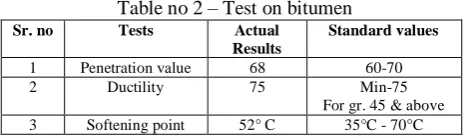
Bitumen is a black, sticky and viscous liquid, in some natural deposits. It is also by-product of fractional distillation of crude petroleum.. The properties of bitumen such as penetration value, ductility value, softening point etc. are as follows
Table no 2 – Test on bitumen
Sr. no Tests Actual
Results
Standard values
1 Penetration value 68 60-70 2 Ductility 75 Min-75
For gr. 45 & above 3 Softening point 52° C 35°C - 70°C
After testing the bitumen as per the conventional test procedures, it is also necessary to compare the results obtained to the standard values or acceptable values of bitumen. These standard values are taken from the reference book of highway engg. of justo khaana. Above table no 2 shows the comparison of obtained values with the standard values.
4.3 Construction waste:
Waste construction materials production is increasing in many countries around the world. One solution for disposing these materials is to use them in pavement layers. Their characteristics are determined by performing several tests on a number of samples. The activity which produces construction waste include site formation, tunneling works, demolition of building and structures, decoration and reconstruction works, new construction and maintenance works. Recycled aggregates and R.C.C waste is used in this study. The properties of these wastes products are as follows-
Table no 3 – Test on construction waste
Sr no
Tests Results Standard results
1 Crushing strength 23% Up to 45%-base course 2 Water absorption on
aggregate
0.406% Less than 0.6%
3 Specific gravity 2.77 2.6-2.9
After testing the concrete rubble as per the conventional test procedures, it is also necessary to compare the results obtained to the standard values or acceptable values of aggregates. These standard values are taken from the reference book of highway engg. of justo khaana. Above table no. 3 shows the comparison of obtained values with the standard values.
5. T
ESTING OFB
ITUMINOUSM
IXThe testing of bituminous mix is done for determining the properties of concrete rubble, foundry sand and bitumen which would give the properties such as stability, durability, workability and skid resistance. In India for testing of such properties Marshall Stability method is used.the sample was prepared it was tested for Marshall Test. The test was performed as per ASTM d 6927 – 06. Three samples of different binder content (i.e. 5%, 6%, and 7%) are prepared for conventional materials for finding optimum binder content. After that industrial waste materials are tested in Marshall Test. Following table no. 4 shows the test results for Marshall Stability test with conventional mix.
Table no 4 – Marshall stability test Bitu
men (%)
Samp le no:
Wt in Air gm
Wt in Wate r gm
Flow value (mm)
Stabilit y Value( kg)
% air Voids Vv
VFB %
5 1 1172 703 4.2 350 4.12 78.12
2 1170 700 4 352 4.15 78
6 1 1184 605 3.8 365 5.05 75.29
2 1184 606 3.8 364 5 75
7 1 1194 700 4 352 5.49 74.89
5.1 Marshall stability:
Graph 1- Variation of Marshall Stability with different binder content
From graph no. 1, it is observed that stability value increases with increase binder content up to certain binder content, then stability value decreases. Variation of Marshall Stability value with different binder content is given in above graph. From the analysis of Marshall Stability value optimum binder content selected as 6%.
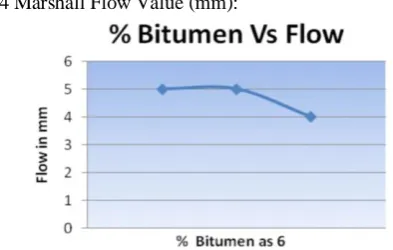
5.2 Marshall Flow Value (mm):
Graph no. 2- Variation of Flow Value with different binder content
From the graph no. 2, it is observed that the flow value for the bitumen content 6 is less as compare to 5 and 7. So optimum bitumen content is 6
After analysing the graph no. 1 & 2, we found that 6% bitumen content is optimum, so 6% bitumen content is selected for bituminous mix of foundry sand and concrete rubble. From the Marshall test we can determine the properties such as stability, durability, bleeding, density etc. After finding the optimum binder content next step is to test the selected industrial waste materials to that optimum binder content. Following table no. 5, Shows test results of Marshall Test of mix using concrete rubble and foundry sand as a total replacement Following table shows the result values of bituminous mix of foundry sand and concrete rubble.
Table no 5 – Marshall Stability test using industrial waste. Bit
um en (% )
Sam ple no:
Wt in Air gm
Wt in Water gm
Flow value (mm)
Stability Value
(kg)
% air Void s Vv
VFB %
6
1 1184 704 5 475 4.12 78.18
2 1186 705 5 480 3.15 77.20
3 1190 700 4 465 2.00 78.45
5.3 Marshall stability:
Graph no. 3- Variation of Marshall Stability with total replacement of fine aggregates
From graph no. 3, for 6% bitumen content the stability value increases and from which resistance of the bituminous mix to the deformation also increases, so ultimately it reduces the stress which causes strain depends upon the field conditions
5.4 Marshall Flow Value (mm):
Graph no. 4- Variation of Marshall Flow with total replacement of fine aggregates
Graph no 4 shows the flow value for three samples prepared with concrete rubble and foundry sand gives the flow value results ranges between 4-12, which are acceptable values. As the flow value comes at minimum range, deformation of bituminous mix reduced
5.5 Air void:
Graph no. 5- Variation of air void of with total replacement of fine aggregates
bituminous mixes improve, also we can achieve maximum density with lesser no. of voids
5.6 Void filled with Bitumen (VFB):
Graph no. 6- Variation of VFB with total replacement of fine aggregates
From the above graph no. 6, it is observed that the voids filled with bitumen in three samples prepared with industrial wastes. Voids filled with bitumen are within acceptable range. i.e. (75-85)
6 D
ESIGN OFT
HEP
AVEMENT FORF
IELDT
ESTW
ITH THEF
OLLOWINGD
ATA Design parameters-1. Initial traffic in the year of completion of construction = 150 CVPD
2. Traffic growth rate = 5 % 3. Design life = 15 years
4. Vehicle damage factor based on axle load survey = 2.5 standard axle per commercial vehicle
5. Design CBR of sub grade soil = 4%.
Solution
1. Distribution factor = 0.75 2. N=365*[(1+R)^n-1]/r*A*L*D*F
3. Total pavement thickness for CBR 4% and traffic 7.2 msa from IRC: 37 2001 chart1 = 660 mm
4. Pavement composition can be obtained by interpolation from Pavement Design Catalogue (IRC: 37 2001).
(a) Bituminous surfacing = 25 mm SDBC + 70 mm DBM
(b) Road-base = 250 mm WBM
(c) Sub-base = 315 mm granular material of CBR not less than 30 %.
7 F
IELDA
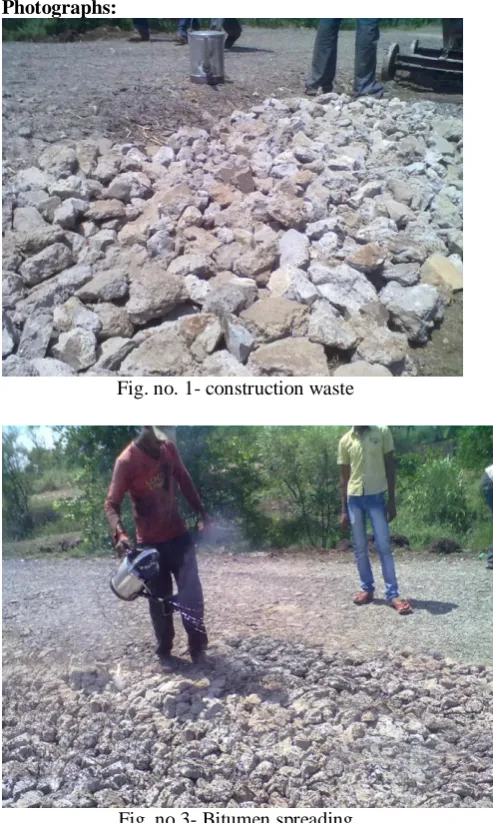
PPLICATIONSFor field test of 10 sq.m area two sites are selected. This field test patch is made where conventional as well as industrial wastes both are used. That’s why the new road construction site was selected is at Narsighpur, Tal- Walwa. Dist.- Sangli.
Photographs:
Fig. no. 1- construction waste
Fig. no.3- Bitumen spreading
8 D
URABILITYC
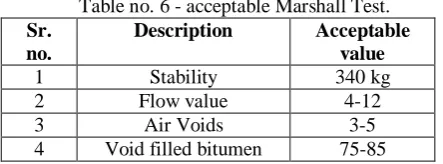
OMPARISONAfter field application next step is to extract the sample with help of sample extractor and test the extracted samples in the Marshall test. Following table no. 6, shows the acceptable values of Marshall Test.
Table no. 6 - acceptable Marshall Test.
Sr. no.
Description Acceptable value
1 Stability 340 kg
2 Flow value 4-12
3 Air Voids 3-5
4 Void filled bitumen 75-85
8.1 For conventional materials:
The sample is extracted from the pavement which is constructed with conventional material. After that the sample is tested according to Marshall Test in Marshall Apparatus. Following are the test results Marshall test for conventional mix.
Table no. 7 - Results of Marshall test for conventional materials Sam ple no: Wt in Air gm Wt in Water gm Flow value (mm) Stability Value(kg) % air Void s Vv VFB %
1 1194 700 4 352 5.49 74.89 2 1194 700 5 354 5.57 74.80 3 1192 700 4 353 5.50 74.85
8.2 For industrial waste:
Here also sample of industrial waste material is extracted from pavement. Following are the test results Marshall test for industrial waste mix.
Table no. 8 - Results of Marshall test for industrial wastes
Sam ple no: Wt in Air gm Wt in Wat er gm Flow value (mm) Stability Value(kg ) % air Void s Vv VFB %
1 1184 605 3.8 365 5.05 75.29
2 1184 606 3.8 364 5 75
3 1182 605 4 360 5.05 75.10
The above table no. 7 & 8, shows the parameters and their acceptable values. All the materials are having test results according to the standards.
9 C
OSTC
OMPARISONS9.1 Quantities of material: Considering for 10 m2 area:
Volume of pavement= 4 * 2.5 * 0.250= 2.5 cu.mt Quantity of aggregates= 0.75 * 2.5= 1.875 cu.mt Quantity of filler= 0.19 * 2.5 = 0.475 cu.mt
15.12 kg bitumen used per m3, for 2.5 m3 of aggregates= 37.8 kg bitumen is required,
9.2 Cost for conventional Mix:
Table no. 9 -Cost of conventional materials.
Des. Qty Rate Total
Aggregate 1.875 cu.mt 780/cu.mt 1462.50
Filler 0.475 cu.mt 425/cu.mt 201.875
Bitumen 37.8 kg 47/ kg 1776.60
Total 3340.97
9.3 Costs for Mix with Construction Waste and Foundry Sand:
Table no. 10- Cost of industrial waste.
Des. Qty Rate Total
Aggregate 1.875 cu.mt 780/cu.mt 403.12
Filler 0.475 cu.mt 180/cu.mt 85.5
Bitumen 37.8 kg 47/ kg 1776.60
Total 2265.22
Therefore saving in cost per10 m2 is Rs.1075.75 by using construction waste and foundry sand replacement for fine aggregates in bituminous mix. Hence saving in cost for 1 m2 is Rs.107.60.
10. C
ONCLUSIONS1. From the result and analysis of various properties of concrete rubble and foundry sand it is found that these industrial waste materials can be used as a replacement for conventional materials in bituminous mix.
2. Bituminous mixes prepared with using conventional materials with different bitumen content gives the optimum bitumen content as 6%. From this we conclude that, the mix having bitumen content 6% is economical mix by using concrete rubble and foundry sand for pavement construction.
3. Bituminous mixes prepared with concrete rubble and foundry sand gives the Marshall Stability avg. value as 475 kg (for cylindrical mould of 101.6 mm diameter and 63.5 mm height) and conventional material gives stability values 360 kg. So industrial wastes are having 115 kg more Marshall Stability value as compare to conventional mixes. As the stability value increases resistance of the bituminous mix to the deformation also increases, so ultimately it reduces the stress which causes strain depends upon the field conditions.
4. The sample prepared with concrete rubble and foundry sand gives the air voids results ranges between 3-5, which are acceptable. As the voids are minimized, the resulting strength property of bituminous mixes improve, also we can achieve maximum density with lesser no. of voids.
6. Saving in cost per 1 m2 is Rs.109 by using concrete rubble and foundry sand replacement for conventional materials in bituminous mix. So cost saving for 1 km length single lane road in Rs. 4, 30,000. Thus there is 32% cost saving with industrial wastes as a replacement for conventional materials. 7. From the overall cost effectiveness i.e. cost of
material, labor, and equipment the thro-and-roll method is more effective for pavement maintenance. 8. From the result and analysis of various properties of
concrete rubble and foundry sand it is found that use of these industrial wastes in pavement construction is economical and efficient rather than conventional materials. Also the qualities of these industrial wastes are good as compared to the conventional materials. 9. By using concrete rubble and foundry sand in
bituminous mix environmental effects from wastes and disposal problems of waste can be reduced.
11 A
CKNOWLEDGEMENTSI also very thankful to Dr. Mrs. S. S. Kulkarni and Dr. S. S. Santpur and Mr. D. S. Patil for their valuable suggestions, critical examination of work during the progress, I am indebted to them.
In addition, very energetic and competitive atmosphere of the Civil Engineering Department had much to do with this work. I acknowledge with thanks to faculty, teaching and non-teaching staff of the department, Central library and Colleagues.
12 REFERENCES
[1] Dr D S V Prasad, Dr. G V R Prasada Raju and M Anjan Kumar (Jan-June 2012), “utilization of waste materials in pavement system “Indian journal o advance in civil engineering, vol. 2, no.1, pp.17-24.
[2] Dr. D S V Prasad, Dr. G V R Prasada Raju and M Anjan Kumar(2009) “Utilization of Industrial Waste in Flexible Pavement Construction” EJGE, vol.-13,bun.D.
[3] Mohan Ramanathan (February 2012), “Recycling of Construction & Demolition Waste” The Master builder, pp.148-152.
[4] Rosario Herrador, Pablo Perez, Laura Garach and Javier Ordonez (February 2012), “Use of Recycled Construction and Demolition Waste Aggregate for Road Course Surfacing” journal of transportation engineering, pp.182-190.