Total internal reflection
Specification references
4.4.2 d) (i) e)
M1.1
M4.1, M4.4, M4.5
Introduction
In the worksheet ’11.8 Support: Refraction and Snell’s law’ you practised using Snell’s law in refraction problems. In this worksheet you will meet the concept of total internal reflection and the critical angle. You will practise and become more confident at working out problems involving total internal reflection.
Learning outcomes
After completing the worksheet you should be able to:
draw or complete ray diagrams representing refraction problems
use your knowledge of geometry to find angles in diagrams representing refraction problems
apply the equation n1 sin θ1n2 sin θ2 (Snell’s law) to problems on refraction
describe what the term ‘critical angle’ means
apply the equation n1 sin θcn2 sin 90 to problems relating to the critical
angle
determine whether total internal reflection will occur in different situations
use the equation angle of incidence angle of reflection in total internal reflection problems.
Background
You have already learnt that refraction is the change in direction of light when it passes, at an angle, across a boundary between two transparent substances, such as air and glass.
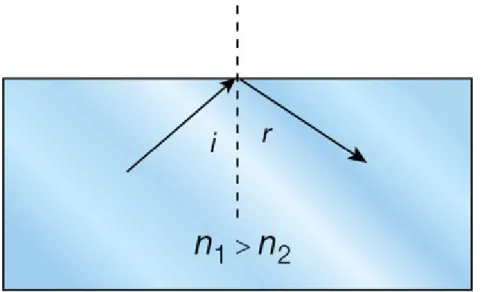
If a ray of light passes from a more optically dense material into a less optically dense material with an angle of incidence greater than the critical angle (θc), the ray
is totally internally reflected. This means that the ray is reflected back into the first material instead of passing into the second material, as shown in Figure 1. The usual laws of reflection are obeyed – the angle of reflection is equal to the angle of incidence.
A more optically dense material has a higher refractive index, n1.
Figure 1 Total internal reflection
If the angle of incidence is equal to the critical angle (θiθc) then the angle of
refraction is 90° and the ray travels along the boundary between the two materials, as shown in Figure 2.
Figure 2 Refraction along the boundary occurs when θiθc
The critical angle can be calculated using either Equation 1 or Equation 2.
Equation 1 n1 sin θc n2 sin 90 °
Equation 2 sin θc (since sin 90 ° 1)
It is often easier to use Equation 1 since n1 and n2 are more easily identified.
Exam-style optics questions often:
contain a diagram which you should use to help you answer the question
require you ‘to complete the path of the ray’ on a ray diagram
require the use of geometry
Worked example
Exam-style question
An equilateral triangular glass prism is made of glass of refractive index 1.48. A ray of red light is incident at P at an angle of 40° to the normal, as shown in Figure 3.
Figure 3
a Calculate the angle of refraction, θ.
b Calculate the critical angle between the glass and air.
c Draw the path of the ray after it reaches Q, marking any values of angles on Figure 3.
Answer
a Step 1
Write down Snell’s law and identify the values. Snell’s law: n1 sin θ1n2 sin θ2
The light passes from air (n1) into glass (n2). The angle of incidence, θ1, is 40° and
the angle of refraction is θ2.
n1 1
n2 1.48
θ1 40°
θ2θ ? This is the angle you need to find.
Step 2
Substitute the values into the equation and rearrange to find θ. 1.0 sin 40 1.48 sin θ
sin θ 0.4343
θ sin−1 (0.4343) On your calculator: [shift][sin] 0.4343
Write down Snell’s law and identify the values. Snell’s law: n1 sin θ1n2 sin θ2
Part b asks for the critical angle between the glass and air, so the light now passes from glass (n1) into air (n2). The angle of incidence, θ1, is equal to the critical angle,
which you need to find. The critical value is defined as the angle of incidence for which the angle of refraction, θ2, is equal to 90°.
n1 1.48
n2 1
θ1θc ? This is the angle you need to find.
θ2 90°
Step 2
Substitute the values into the equation and rearrange to find θc.
1.48 sin θc 1.0 sin 90°
1
sin θc
0.6757
θc sin −1(0.6757) On your calculator: [shift][sin] 0.6757
42.5°
43° to two significant figures c Step 1
Before you can draw the ray, you need to find the angle of incidence at Q and see if it is bigger or smaller than the critical angle to find out what happens next. Use what you know about the geometry of triangles.
angle APQ 90 − θ the normal is at 90° to the surface, by
90 − 26 definition use the value of θ you calculated in
64° part a
angle PAQ 60° all angles in an equilateral triangle are 60°,
angle AQP 180 − 64 − 60 the sum of the internal angles of a triangle
56° is 180°
angle of incidence at Q 90 − 56 this is the angle between the ray and the
Step 2
Compare the angle of incidence with the critical angle. angle of incidence at Q 34°
θc 43° this is the value of θc you calculated in part b
The angle of incidence at Q is less than the critical angle, so the ray is not totally internally reflected. The ray passes from glass (refractive index of 1.48) into air (refractive index of 1) and so is refracted away from the normal.
Step 3
Draw the refracted ray on the diagram.
Figure 4
Questions
1 A ray of light is travelling in glass towards a glass-air boundary at an angle of incidence equal to 60.
a Find the critical angle for the glass-air boundary. The refractive index of glass is 1.5 and the refractive index of air is 1.0. (2 marks)
b Describe and explain what will happen to the ray of light when it reaches the glass–air boundary. (2 marks)
2 In an optical fibre a ray of light strikes the core at A. It is then refracted, as shown in Figure 5, and hits the core–cladding boundary at B at the critical angle c.
Refractive index of cladding is 1.45. Refractive index of core is 1.48.
Figure 5
a Calculate the critical angle at B. (2 marks) b Calculate the angle of refraction at A. (1 mark)
3 The triangular prism shown in the diagram has a right angle at A and 45° angles at B and C. A ray parallel to BC enters the prism at P and is refracted as shown in Figure 6.
Refractive index of glass 1.5.
Figure 6
a State the angle of incidence in air. (1 mark)
b Calculate the angle of refraction at P. (2 marks)