Implementation and evolution of the horizontal integration at shiraz
medical school
MITRA AMINI1, JAVAD KOJURI1, ALI MAHBUDI2, FARHAD LOTFI3*, ATEFEH SEGHATOLESLAM4, ZAHRA KARIMIAN5, MESBAH SHAMS6
1Education Development Center, Shiraz University of Medical Sciences, Shiraz, Iran; 2English Language Department, Paramedical School, Shiraz
University of Medical Sciences, Shiraz, Iran; 3School of Health Management and Information Sciences, Tehran University of Medical Sciences, Tehran,
Iran; 4Deputy of Education for Basic Sciences, Medical School, Shiraz University of Medical Sciences, Shiraz, Iran; 5Shahid Beheshti University,
Tehran, Iran; 6Deputy of Clinical Education at Medical School, Shiraz University of Medical Sciences, Shiraz, Iran
Introduction: General medical education starts with basic sciences which usually continue about 2.5 to 3 years. In this period, the students study basic medical sciences and then start the clinical stage in which they deal with diagnoses, care, and cure of disease. The purpose of this study was to assess the integration of basic sciences period with the clinical period at Shiraz University of Medical Sciences.
Methods: The present study is a descriptive one. The sample of the study consisted of all students entered Shiraz University of Medical Sciences in January, 2009, and November, 2009, professors of basic sciences courses, and some clinical professors. To evaluate the integration program, we devised various instruments. The collected data were analyzed, using SPSS software.
Result: The findings showed that in spite of the students’ objections new educational methods in the first year of implementation, they felt more satisfied as the drawbacks were removed over time.
Conclusion: The assessment of educational curricula is an important step to identify educational problems and promote the students’ learning. This issue can help the curriculum planners to design the educational programs so that students, particularly medical students, will be able to acquire the required knowledge and skill and integrate them for the promotion and maintenance of society’s health.
Introduction
E
valuation is the core element in designing and implementing any educational program, whether it is at a national level or a course at a college. Good educational programs are dynamic in nature and should regularly be revised based on feedback by the target and executive groups (1).Different models and approaches have been employed to evaluate educational programs. One of the models used for this purpose is Kirkpatrick’s four-level education model. The first level, reaction, is concerned with how well the students are satisfied with the given program. In addition, the strengths and the weaknesses of the program are determined based on
the students’ viewpoints. At the second level, the rate of achieving educational goals is calculated through students’ self-assessment, team assessment and tests. At the third level, behavioral changes are evaluated and at the fourth level, results, the final outcomes that occur due to the attendance and participation in a training program are determined (2,3).
In medical sciences the progress index is evaluated through objective and tangible indices such as mortality rate due to cardiovascular diseases while in the education domain, the achievement of such indices is less probable because of the following reasons. First, the nature of education strategies is different from that of medical sciences in which any outcome can Evaluation, Basic sciences, Horizontal integration
Keywords:
Corresponding author:
Farhad Lotfi Address: Education
Development Center, Sina-Sadra Halls Complex, Neshat Ave., Shiraz, Iran.
E-mail: [email protected]
Please cite this paper as:
Amini M, Kojuri J, Mahbudi A, Lotfi F, Seghatoleslam A, karimian Z, Shams M. Evaluation of the Integration Program at Shiraz Medical School. J. Adv Med&Prof.
be attributed to a specific intervention. For example, if a modification in the class causes improvement in the examination results, other variables such as the students’ high motivation and awareness of that particular intervention might have been influential (4-8). Second, a curriculum is not like a medication to be used in a standard dose and then assess its effect. A curriculum consists of different component and is taught by instructors with different educational backgrounds. Finally, the interval between the time of learning and achievement of some outcomes such as an individual’s job performance in future is so long that the impact of curriculum in the person’s profession is unclear and in some cases unachievable (9). To overcome the first and second problem, we can make use of triangulation (4). Such approaches can be effective in elucidating the determinants, strengths and weaknesses of teaching-learning process (10). Regarding the implementation of a new curriculum, the assessment of the would-be doctors’ performance is not feasible. As a result, such curricula are evaluated up to the second level of Kirkpatrick’s. Since in most developed countries there have been some modifications in general medical curricula in the form of integration so that they have witnessed far-fetched achievements, we decided to evaluate the integration program comprehensively to find out the
positive and negative aspects of this program.
Methods
This study is of a descriptive type performed through the triangulation approach. The statistical population consisted of medical students at basic sciences level, basic sciences professors and a number of clinical professors. The evaluation of the program covered the first and second levels of Kirkpatrick’s four-level evaluation model. At the first level the students’ satisfaction with the program was evaluated and the strengths and weaknesses of the program from the students’ points of view were determined. At the second level the rate of achieving educational objectives were evaluated through students’ self-assessment, team assessment and examinations. Various instruments were employed for this purpose. The students’ satisfaction with education atmosphere was evaluated through Dundee Ready Educational Environment Measure, a standard questionnaire for this purpose. The questionnaire was first tailored to our integration program, then its validity was verified by experts and its reliability was found to be 0.82, using Cronbach Alpha. To determine the professors’ views, we employed a semi-structure interview. Furthermore, to assess the rate of achieving the educational objectives, based on the
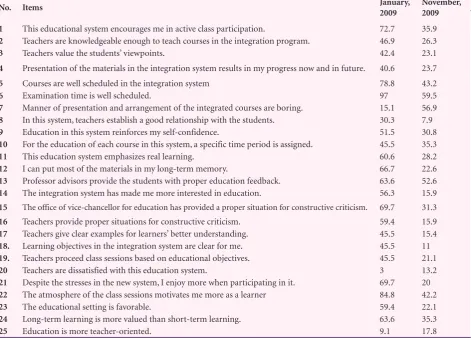
Table 1. Students’ viewpoints about the educational setting
No. Items January, 2009 November, 2009
1 This educational system encourages me in active class participation. 72.7 35.9
2 Teachers are knowledgeable enough to teach courses in the integration program. 46.9 26.3
3 Teachers value the students’ viewpoints. 42.4 23.1
4 Presentation of the materials in the integration system results in my progress now and in future. 40.6 23.7
5 Courses are well scheduled in the integration system 78.8 43.2
6 Examination time is well scheduled. 97 59.5
7 Manner of presentation and arrangement of the integrated courses are boring. 15.1 56.9
8 In this system, teachers establish a good relationship with the students. 30.3 7.9
9 Education in this system reinforces my self-confidence. 51.5 30.8
10 For the education of each course in this system, a specific time period is assigned. 45.5 35.3
11 This education system emphasizes real learning. 60.6 28.2
12 I can put most of the materials in my long-term memory. 66.7 22.6
13 Professor advisors provide the students with proper education feedback. 63.6 52.6
14 The integration system has made me more interested in education. 56.3 15.9
15 The office of vice-chancellor for education has provided a proper situation for constructive criticism. 69.7 31.3
16 Teachers provide proper situations for constructive criticism. 59.4 15.9
17 Teachers give clear examples for learners’ better understanding. 45.5 15.4
18. Learning objectives in the integration system are clear for me. 45.5 11
19. Teachers proceed class sessions based on educational objectives. 45.5 21.1
20 Teachers are dissatisfied with this education system. 3 13.2
21 Despite the stresses in the new system, I enjoy more when participating in it. 69.7 20
22 The atmosphere of the class sessions motivates me more as a learner 84.8 42.2
23 The educational setting is favorable. 59.4 22.1
24 Long-term learning is more valued than short-term learning. 63.6 35.3
objectives of each organ, we devised a questionnaire to be completed by the students. With the professors’ collaboration, a portfolio was prepared for each organ and the students completed the portfolios. The students’ satisfaction with the early clinical exposure programs was determined using a valid and reliable questionnaire. The collected data were analyzed, using SPSS software.
Results
Different instruments were employed to assess the integration program. The findings for each are as follows:
A. Evaluation of educational setting
The students’ viewpoints (January, 2009 and November, 2009) are shown in Table 1. To have of a better comparison regarding the students’ satisfaction with the educational setting only the percentage of proponents (disagree, partly disagree) is displayed.
As the students’ viewpoints in these two succeeding periods show the program has improved and Pearson correlation confirms this, too (p value = 0.021).
B. Educational objectives
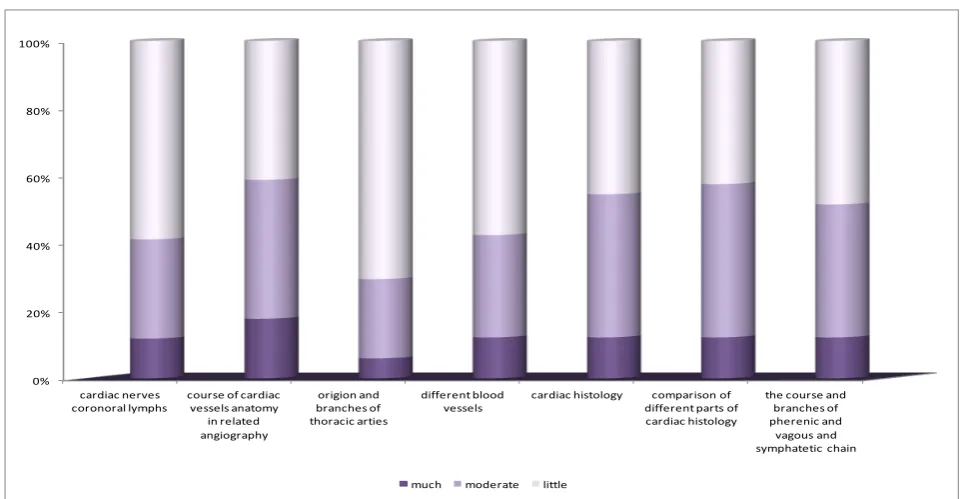
To evaluate the rate of achieving educational objectives, a questionnaire was prepared based on the Likert scale for each course and was distributed among the students. The collected data were converted
Figure 2. Rate of achieving educational objectives for cardiology course
Figure 1. Rate of achieving educational objectives for cardiology course 0%
20% 40% 60% 80% 100%
surface anatomy &
parietarial topographic of thorax &
breast
surface anatomy of pericardial
radiology
pariefarral antomy of thorax(skin, superficial
fascia & breast)
Vascular and thoracic nerve
origin
origion, insertion function and
nerves diagrphram
anatomy of visceral and parietarial cardial sinuses
visceral and parietarial
cardial vessels, nerves and
lymphs
surface anatomy of heart and its
valves much
moderate little
0% 20% 40% 60% 80% 100%
cardiac nerves coronoral lymphs
course of cardiac vessels anatomy
in related angiography
origion and branches of thoracic arties
different blood vessels
cardiac histology comparison of different parts of cardiac histology
the course and branches of pherenic and
vagous and symphatetic chain
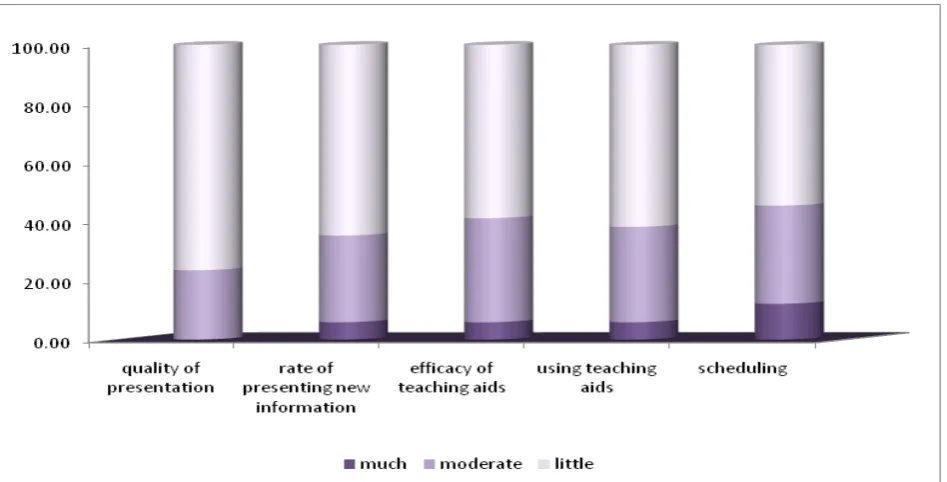
into percentage of which the bar graph for the cardio course is given (Figures 1-3).
C. Early clinical exposure with the patient
To learn the integrated courses better, the program of early clinical exposure with patient was implemented. For the evaluation of this program, a questionnaire was also developed and the students were asked to give their comments. The results are displayed in the figure 4.
D. Educational portfolio
One of the instruments which can determine the strengths and weaknesses of each course, the
instructor who taught it and the topic which was taught is educational portfolios. To examine the students’ viewpoints, educational portfolios were prepared for all organs and the students were asked to complete them. Regarding the large volume of the portfolios, the result of the portfolio for the lung anatomy is presented here.
The students who completed the portfolios were 46 of who over 50% recorded the learned points in the portfolios.
Learning mode: Over 50% of the students completed this part. Interestingly, most students stated drawing as the most significant way of learning and repeatedly emphasized this in their comments.
Figure 3. Students, viewpoints on the cardiology course
Educational activities the students made use of for better learning:
• Sources introduced by the instructor (33 cases)
• Internet (18 cases)
• Laboratory work (7 cases)
• Educational films (6 cases)
• Atlas, tape transcription, past handouts (4 cases)
• Relevant articles (2 cases)
As it is evident, most students tend to consult the sources introduced by the instructors, followed by Internet, laboratory and films. Studying articles is the least type of sources referred to by the students. This refers to the fact that the students tend to make use of visual and practical sources more. This is predictable as the students have to study a large volume of materials in a limited period of time which has been mentioned in the part on free comments.
The students’ viewpoints about learning the course Most students expressed their satisfaction of being able to learn the topics. In spite of dissatisfaction in one or two cases, on the whole, the students believed the instructors were able to transfer the materials well, especially, through drawing. The students preferred this method over the other ones. However, most students believed that the process of teaching was fast and because of the large volume of the materials, they were not able to grasp the materials or take notes well. On the other hand, it seemed that the students were more concerned with taking notes than listening for comprehension. They repeatedly stated that if instructors provided them with the PowerPoint or some handouts, they would make use of the class time much better. In fact, in spite of the instructors’ effective method of teaching, tension for exam, note taking and missing some materials affect class productivity. On the whole, all students pointed out the large volume of the courses, too many class session and fast teaching pace.
E. Semi-structured Interview
One of the qualitative ways to examine the instructors’ viewpoints about the integration program is semi-structured interview. For this purpose, some questions were prepared in advance and the instructors were interviewed. The following results were obtained.
• Currently, only the timetable for courses has changed without any significant change in the content or even the slides presented by the instructors. So there is an urgent need for revising the content and methods of teaching.
• As the teachers got involved in the integration program spontaneously and only with a change
in the time of presenting the courses, there is no information about the adjacent departments and the method of teaching in them.
• Practically, only the Anatomy and Physiology departments have been involved in the integration program. In the biochemistry course, there have been some changes only in the bio-molecules with no changes in other parts. Other courses should also be considered in the integration program.
• Revision in the content of biochemistry course is essential.
• The direction of the biochemistry course should be toward the applied version. This necessitates change in the board members’ attitude. In fact, the sequence of the topics has changed not the content.
• As there is no possibility for replacement and compensation in the program, the students encounter a lot of problems.
• The exams are held as in the past without any change in the question items. There are, in fact, discrete items for each course which suggests no integration. So one of the priorities is the revision of the exam items.
• The main objectives of the integration system, based on studies in colleges in other countries, should be decreasing the volume of course contents not increasing them. This has not happened yet.
• Regarding basic sciences comprehensive exams, the courses need to match such exams.
• Before starting the integration in Shiraz Medical School, the departments should have been provided with a report on the results of the integration system at Shahid Beheshti University of Medial Sciences.
• The final results of the integration system could be judged after the first basic sciences comprehensive examination
• The courses should, first, be presented pre-clinically for two years to the students.
• Both the previous and the present programs have significant weaknesses which should be removed.
• Examinations have their own problems.
• Presently, it is not clear what different departments expect from one another. The integration has only changed the timetable of teaching the topics.
• For more precise assessment of this program, the results should be compared with control department such as pathology, …
internal department.
• The leadership responsibility for each block should be given to one person.
• There are a lot of problems in practice course exams. Some practice courses are, in fact, omitted.
• For better coordination of offering different courses, they should be planned again.
• Some courses such as pathology and histology are more amenable to integration. So the integration of such courses should be considered.
Discussion
An educational curriculum is an important factor of an educational system. It needs to be modified and revised based on the society requirements, fast development of the science and technology and their application. Accredited universities throughout the world have made modifications in their medical curricula in different ways.
In a study in Seri Lanka, DREEM was used as an important instrument to examine the educational settings in the three preclinical, Para-Clinical and clinical phases (11). In a study in a medical college in Sweden on assessment of the educational setting after a reform in the curriculum, it was found that the educational environment was very good and got better over time. However, there were only some items which still were not good such as supporting systems to help students overcome their stress, feedback, and constructive criticism from instructors (12).
As shown in Table 1, the educational environment, after curriculum modification, has become more favorable over time. There are still some problems including teacher-oriented education, time-table for organs, feedback from professor advisors to the students on educational condition, time-table for examinations, etc which will improve over time and with more attention by education officials.
In a review study of 77 articles on self-assessment, it was found that although the relationship between self-assessment and proper clinical performance has not been examined yet, self-assessment, together with feedback can determine the strengths and weaknesses of a program (13).
The students offered some suggestions and comments in their portfolios which provided the necessary feedback for the teachers to improve their methods of teaching. A study in Maastricht College in the Netherlands suggested that portfolios are good adjunct assessments for the first years of medical education. Another study in Sweden showed that portfolios are preferred by the students and instructors can also trust portfolios for their students’
assessments (14).
The feedback from the results of these portfolios to instructors can foster students’ learning. The students’ viewpoints about the anatomy course, lung organ, are given below:
• Instructors should be justified.
• The volume of topics for each session should be less. A larger volume makes teachers teach faster and this results in less comprehension. (There are too many terms in this section.)
• Teachers should not be too formal. Sometimes humor is necessary.
• Teachers speak too fast and do not let students interact with them well.
• The method of presenting the topics is very good but there are too many sessions per week.
• Teaching through drawing is excellent.
• Students should study some articles and present them for ten minutes in class. (more students’ participation)
• Method of teaching is excellent.
• Teaching through drawing is much better than using slides.
• Teachers should slow down their teaching pace.
• The volume of the materials should be decreased.
• The students should be provided with handouts, PowerPoint, and slides.
• More pictures should be included in the PowerPoint.
• The topics should be presented at patients’ bedside.
• More repetition by teachers
• Pictures and images with more resolution
• Taking quizzes and more time to answer them
• Films help more.
• More use of early clinical exposure with patients
The concept of integration, as theory with practice and systematic unity of scientific materials, is supported by most education experts, particularly in medical sciences. However, it seems that the present activities in the form of integration need more evaluation and modification in order to achieve the intended objectives.
Acknowledgement
The authors express their great to university chancellor and vice-chancellor for education, medical school Dean, vice Dean for Basic Sciences Education, clinical sciences and general medicine, Education Development Center’s staff and medical education personnel for their support and help.
References
2. Mahjoor SR. Educational evaluation: Theories, concepts, principles and models. 1997 [in Persian].
3. Winfrey EC. Kirkpatrick’s four levels of evaluation. 1999; Hoffman. B (Ed.), Encyclopedia of Educational Technology. December 12, 2007; from http://coe.sdsu.edu/eet/articles/ k4levels/ start.htm.
4. Norman GR. Reflections on BEME. Journal of Medical Teacher. 2000; 22:141¬4.
5. Colliver J. Effectiveness of problem based learning curricula. Acad Med. 2000; 75:259¬66.
6. Albanese MA, Mitchell S. Problem based learning: a review of literature on its outcomes and implementation issues. Acad Med. 1993; 68:52¬81.
7. Vernon DTA, Blake RL. Does problem based learning work? A Meta Analysis of evaluative research. Acad Med. 1993; 68:550 63.
8. Enarson C, Cariaga Lo L. Influence of curriculum type on student performance in the United States Medical Licensing Examination Step 1and Step 2 exams: problem based learn-ing vs. lecture based curriculum. Journal of Medical Educa-tion. 2001; 35:1050¬5.
9. Monette J, Tamblyn RM, McLeod PJ, Gayton DC. Charac-teristics of physicians who frequently prescribe long act-ing benzodiazepines for the elderly. Eval Health Prof. 1997; 20:115 30.
10. Ringsted C, Research in medical education. Notfall & Ret-tungsmedizin. 2009; 12: 57-60.
11. Jiffry MTM, Mcaleer S, Fernando S, Marasinghe RB. Using the DREEM questionnaire to gather baseline information on an evolving medical school in Sri Lanka. Journal of Medical Teacher. 2005; 27(4):348-352.
12. Thome G, Hovenberg H, Edgren G. Portfolio as a method for continuous assessment in an undergraduate health edu-cation programme. Medical Teacher, 2006; 28(6):e171-e176. 13. Colthart I, Bagnall G, Evans A. Albutt H, Haiq A, Llling J,
Mckinstry B. The effectiveness of self assessment of learner needs, learner activity, and impact on clinical practice: BEME Guide no.10. Medical Teacher. 2008; 30:124-145.