
Influence of Selected Meteorological Phenomena on Work Injury Frequency in Timber Harvesting Process (p.185-191)
7
0
0
Full text
(2) J. Suchomel and K. Belanová. Influence of Selected Meteorological Phenomena on Work Injury ... (185–191). high production of perspiration, it can easily lead to restrictions of evaporation caused by inappropriate clothing or high environment humidity. The parameter that characterizes the isolation capacity of clothing is called thermal isolating clothing resistance whose unit is clo. One clo is the isolating resistance of a common man’s clothing worn in the countries of middle climate and holds the thermal equilibrium of a person sitting standstill in an environment where the air temperature is 21°C, relative humidity is less than 50% and the velocity is not higher than 360 meters per hour. Under these conditions the thermal production is approximately 210 kJ m² per hour and the thermal loss must also equal 210 kJ m² per hour so that the person can feel thermal comfort. For ensuring appropriate clothing isolating features, it is necessary to change clothing for various types of hard physical labor and wear several layers of cloths. Wearing of clothing that can be zipped and unzipped enabling the circulation of air was well acquitted. The air heats itself by the body surface and rises by thermal convection. The ventilation can be reached by opening the top parts of the clothing. The main problem still remains of the thermal isolation of extremities/limbs especially fingers, which have become the limiting factor for extreme frost tolerance. Feet are the limiting factor for sitting or standing individuals. Wearing shoes with very good isolation and adequate thermal isolation of other body parts enable the individual to bear the foot skin pane at –20°C for approximately 140 minutes and at –40°C for approximately 70 minutes (Matou{ek 1987).. 3. Rainfall – Oborina Rainfall influences directly a person working in the forest – just by its presence where the performance of certain operations can become more difficult, more exhausting and often impossible. A far greater impact of rainfall can be observed in combination with lower temperatures in winter when the prevailing amount of timber production in the Slovak forestry is carried out. Frozen soil surface or snow cover under which a lot of brushwood is hidden becomes a site of many forest accidents. Due to specific microclimatic forest soil conditions, there is an all-year-round risk of slips and falls. It would be interesting to analyze the impact of other weather factors for example humidity, atmospherics pres-. 1. sure, air circulation, solar radiation and others on the occurrence of work accidents. The effects or concurrence of multiple meteorological factors with one figure are presented by various parameters for example effective temperature, equivalently-effective temperature, cooling-down temperature (refrigeration) ([amaj et al. 1994).. 4. Material and methods – Materijal i metode The aim of the article is to analyze the impact of chosen weather factors on the occurrence of work accidents in a group of forest workers. Due to problem complexity, for the analysis of this issue it was necessary to choose branches1 typical of the location in lowland and highland areas (in terms of the current climatic classification of the Slovak territory). These criteria were met by Branches Liptovský Hrádok, Námestovo and Kriváò. Geographical location of the branch Liptovský Hrádok is in the Liptovská fold. The territory is characterized by great relief diversity; it has different altitudes and is therefore climatically diverse with annual average temperatures ranging between 0.2 and 6.3°C. The average annual rainfall is in the interval between 690 and 1810 mm. In this area the snow cover lasts for about 80 to 222 days (Hribik et al. 2008). The area and location of the branch Námestovo belongs to the geographical region of Orava. This area also has different altitudes, and it is therefore also climatically considerably heterogeneous with annual average temperatures ranging between 0.4 and 4.7°C. The average annual rainfall is in the interval between 720 and 1800 mm. In this area the snow cover lasts for about 100 to 220 days (Hribik et al. 2008). The branch Kriváò is geographically located in the Pol'ana mountains. Thank to its great orographic diversity this area is also climatically heterogeneous with the annual average temperatures ranging between 3.7 and 6.2°C. The average annual rainfall is in the interval between 720 and 1200 mm. In this area the snow cover lasts for about 80 to 180 days (Hribik et al. 2008). The primary data for the frequency evaluation of weather-based work accidents were the data on the weather that characterized a certain day or hour when the work accident occurred as well as data on a specific location where the meteorological and pre-. Regional branches of the state-owned enterprise Lesy SR, š.p.. 186. Croat. j. for. eng. 30(2009)2.
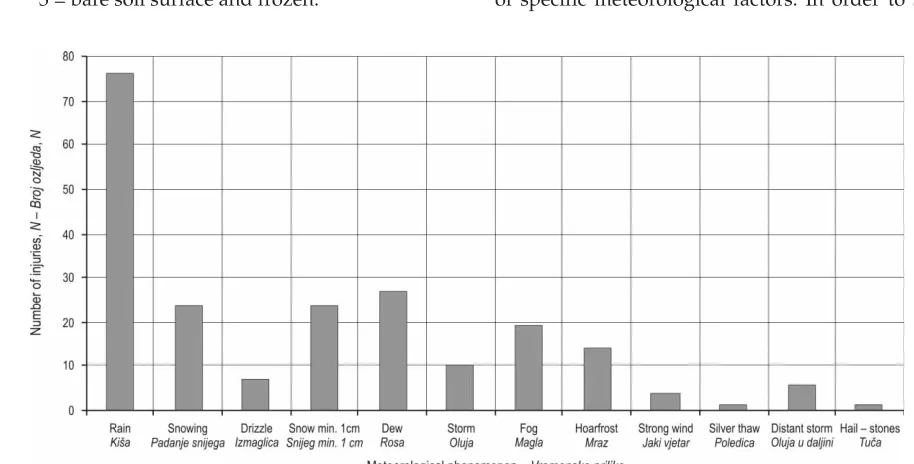
(3) Influence of Selected Meteorological Phenomena on Work Injury ... (185–191). cipitation-gage station was installed. We used the following data: Þ air temperature [°C], Þ rainfall [mm], Þ snow cover [cm], Þ soil surface. The altitude of the occurrence of work accidents was determined by temperature setting. The basic methods used for temperature setting were interpolation or regressive theorem, which enabled us to assign other missing data by using the known temperatures. The data about rainfall and snow cover were collected from precipitation-gage stations enabling a considerably precise condition setting, because the density of the precipitation-gage stations network is wider than the density of meteorological stations. The frequency of work accidents can be influenced by the soil surface and by various weather effects. These are listed in the meteorological stations in the form of a code, as for example: I = dew, P = coherent snow cover of 1 cm and more, M = fog, ice fog, ground fog, Soil surface conditions: 0 = dry soil surface, 1 = wet soil surface, 3 = bare soil surface and frozen.. J. Suchomel and K. Belanová. The data on work accidents were taken from the existing state-owned enterprise Lesy SR work accidents database (Suchomel et al. 2008). The following data were used from the database: the source of work injury, type of injury and injured body part (the criteria were used according to the Ministry of Labor, Social Affairs and Family Regulation No. 500/2006, which specifies the pattern for recording a registered injury). The data were processed with Microsoft Excel. Afterwards different types of charts were created and evaluated.. 5. Results – Rezultati The total sum of work injuries listed in the branches Liptovský Hrádok, Námestovo and Kriváò in the research period in the production-transport process was 209. Out of all accidents, 36% occurred during rain, ice rain, or rain shower. In 24 work-accident cases it was snowing or snow occurred and also in 24 cases the snow cover of not less than 1 cm was recorded. In 13% of days (27 cases) when the work accidents occurred, dew was recorded in the research area, which is equal, in case of forest work, to all other above mentioned meteorological factors in maintaining work safety in the sense of work accidents origin group IV – work, or road traffic area as a source of workers’ falls, where 29% of injuries were recorded in timber harvesting/logging process in the Slovak forestry sector (Suchomel et al. 2008). Figure 2 shows the share of injuries by occurrence of specific meteorological factors. In order to sim-. Fig. 1 The most occurring meteorological factors by work injuries Slika 1. Naju~estaliji meteorolo{ki ~imbenici prema ozljedama na radu Croat. j. for. eng. 30(2009)2. 187.
(4) J. Suchomel and K. Belanová. Influence of Selected Meteorological Phenomena on Work Injury ... (185–191). plify the interpretation, injuries with the highest share were aggregated into three groups: wounds, fractures and the third group were wrenches and dislocations mostly concerning lower limbs. Besides the occurring meteorological factors, »dry surface« and »slippery surface« categories were also evaluated by the analysis of accident frequency. In the category »slippery surface«, the following soil surface conditions were considered: wet, soggy and frozen surface. Clearly, the accidents occurred most frequently during rain (72 cases) of which 65% were injuries (surface and open wounds), 21% fractures and 9% wrenches and dislocations. In addition to the graphically illustrated results, injuries were also recorded that required subsequent amputation (for example fingers). These injuries occurred during rain or directly under its influence. With 15 injuries, the work place with slippery surface was recorded as the second most risky work place. The same share of injuries (14 cases) was registered during snow fall, or snow showers and coherent snow cover. Most fractures happened during rain, as already stated above. The total number of 10 fractured body parts was recorded while it was snowing, or with the snow cover and it is interesting that the same number of work injuries with fractures occurred on dry work surface. Besides rain, wrenches and dislocations were most frequently recorded on slippery surface (5 cases) and during dew (4 cases). Registering work injuries with the ESAW (European statistics on accidents at work) methodology. requires the entry of variation category (Fig. 3). The variation describes unusual events as for example partial or whole loss of vehicle control or a fall on something or from something. The most recorded variation was the loss of control, command, whole or partial of the machine, vehicle or manipulating facility, hand gear (tools), object, animal – in 65 cases. We can also consider the negative impact of unfavorable weather conditions on the risk of occurrence of work accidents in these cases but the primary records were not sufficient for a precise analysis. Similarly, only hypothetical statements could be made in the case of variations »uncoordinated workers movements« and »material factor fall, collapse«, where again reliable assessments of variation by unfavorable weather conditions were not possible. In almost 38% of all analyzed work accidents, slip or bad pack – without fall (22 cases) and the worker’s slip with subsequent fall (57 cases) as variation or unusual event were recorded. Suchomel et al. 2008 analyzed in detail the frequency of worker’s »slips« and »falls« depending on unfavorable weather (snow and/or rain) and the ground slope. For examination and evaluation of this matter the statistical method of contingent table was used. The result of the analysis shows that the statement: Slip and fall accidents at work do not depend on changes of terrain slope and bad weather occurrence, cannot be rejected with a 95% reliability. By evaluating the sources of work injuries in the relevant data files, it was found out that working or. Fig. 2 Injury type and share by occurring meteorological phenomena Slika 2. Vrste i broj ozljeda prema vremenskim prilikama 188. Croat. j. for. eng. 30(2009)2.
(5) Influence of Selected Meteorological Phenomena on Work Injury ... (185–191). J. Suchomel and K. Belanová. Fig. 3 Variations occurred by meteorological phenomena Slika 3. U~estalost uzroka ozljede prema vremenskim prilikama road traffic places as the sources of workers’ fall were recorded in 53 cases. The highest amount of accidents was recorded on slippery work surface (without rainfall). This phenomenon was also frequent in the source group V – material, burdens, objects and I – means of transport, where workers slips often occurred in entering the vehicle, or in leaving it. Ap-. proximately 10% of all accidents happened when snow cover higher than 1 cm was present. As stated above, clearly the most frequently registered accidents occurred during rain and the most frequent accident source during this weather was group III – machines, where a transportable chain saw is also included, as well as group II – raisers and transport-. Fig. 4 Sources of injuries occurred by meteorological phenomena Slika 4. U~estalost izvora ozljeda prema vremenskim prilikama Croat. j. for. eng. 30(2009)2. 189.
(6) J. Suchomel and K. Belanová. Influence of Selected Meteorological Phenomena on Work Injury ... (185–191). ers, raising and transporting tools. During rain, any activity in the forest is dangerous, not to speak about performing difficult and risky work activities such as logging.. 5. Conclusion – Zaklju~ak It can be concluded that out of 209 work accidents in 190 cases the occurrence of some metrological phenomena was recorded. The most frequent phenomenon was rain (36%), in 13 percent of days (27 cases), where an accident occurred, dew was recorded in that location, in 24 cases it was snowing and similarly in 24 cases of work accidents, snow cover higher than 1 cm was recorded. Besides rain, the most frequent injuries, wrenches and dislocations were recorded on slippery surface, and fractures occurred mostly as a result of snow fall or snow cover. Slips and falls were mostly recorded during rain and also on slippery surface without the occurrence of any meteorological phenomena. The share of slippery surface in the cases of work accidents also corresponds to 25% of source accident group IV – work places. The occurrence of unfavorable weather cannot always be absolutely predicted. The elimination of work accident risks in these conditions is possible, especially by providing the proper protection at work, enhancing safety measures and especially by complying with the prescribed technological procedures.. 6. Acknowledgements – Zahvala This article arose thanks to the Ministry of Education of the Slovak Republic within the grant KEGA 3/6429/08 – »Integration of content and structure of classes in field of ergonomics, work safety and protection of health at work, in study programs of Technical University in Zvolen.«. 7. References – Literatura Matou{ek, J., 1987: Po~así, podnebí a ~lovìk. Avicenum, Praha, 293 pp. Suchomel, J. a kol., 2008: Analýza pracovných úrazov v Lesoch SR, {.p. TUZVO, ISBN 978–80–228–1979–4, 135 pp [amaj, F., Pro{ek, P., ^abajová, Z., 1994: Agrometeorológia a bioklimatológia. Vysoko{kolská skripta. Univerzita Komenského, Bratislava: p. 306 [kvarenina, J., Mindá{, J., 2001: Klíma. In: Bublinec, E., Pichler, V. et al. : Slovenské pralesy – diverzita a ochrana. ÚEL SAV Zvolen: 200 pp. Vyhlá{ka 500/2006 Z. z., ktorou sa ustanovuje vzor záznamu o registrovanom pracovnom úraze. Hríbik, M., [kvarenina, J., Kyselová, D. 2008: Hydrofyzikálne vlastnosti snehovej pokrývky v horských ekosystémoch Po'any, Nízkych a Západných Tatier v zimách rokov 2005/06-2007/08. In: Hydrologie malého povodí 2008 / ed. Miloslav [ír, Miroslav Tesaø, ¼ubomír Lichner. – Praha : Ústav pro hydrodynamiku AV ^R, 2008. ISBN 978–80–87117–03–3. p. 341–348.. Sa`etak. Utjecaj vremenskih prilika na u~estalost ozlje|ivanja u postupcima pridobivanja drva Vrijeme i klima zna~ajno utje~u na u~inkovitost i kvalitetu rada, ali i na sigurnost pri obavljanju {umskih radova. Sve atmosferske sastavnice okoli{a, fizi~ke, kemijske i biolo{ke, djeluju na ljudski organizam koji zajedno s okoli{em tvori jednu zajedni~ku biolo{ku cjelinu. Klima i vrijeme pritom su odre|eni meteorolo{kim ~imbenicima, vrijeme kao zbroj meteorolo{kih ~imbenika koji imaju kratkoro~an karakter, a klima kao zbroj meteorolo{kih ~imbenika s dugoro~nim djelovanjem. Vrijeme i vremenske promjene karakteristi~ne za odre|eno podru~je tvore klimu toga podru~ja. Vrijeme ili klima izravno utje~u na ~ovjeka preko hladno}e, topline, oborine, vjetra i dr. Pri radu na otvorenom vrijeme mo`e djelovati na promjenu uvjeta rada i na obavljanje posla utjecajem na psihi~ko i fizi~ko stanje radnika. Temperatura je zraka sna`no povezana s izvedbom ljudskoga organizma koja opada s vi{im temperaturama. Psihi~ka aktivnost pritom trpi vi{e od fizi~ke. Porast temperature za npr. 4 °C, s 20 °C na 24 °C, uzrokovat }e smanjenje psihi~ke aktivnosti za pribli`no 15 %. Optimalna temperatura za srednje te`ak rad je temperatura izme|u 15 i 17 °C. Oborina izravno utje~e na radnika pri radu u {umi. Samom pojavom oborine obavljanje {umskih radova postaje te`e, iscrpljuju}e i ~esto nemogu}e. Mnogo ve}i utjecaj oborina mo`e imati zajedno s niskom temperaturom i pojavom snijega zimi. Smrznuta povr{ina tla i snje`ni pokriva~ skrivaju mnoge opasnosti i postaju mjesta brojnih nesre}a u {umarstvu. Cilj je ovoga rada bio da se istra`i utjecaj odabranih meteorolo{kih prilika na u~estalost pojavljivanja ozljeda pri {umskim radovima u slova~kom {umarstvu. U ~lanku se tako|er analiziraju brojnost i vrste ozljeda te uzroci i. 190. Croat. j. for. eng. 30(2009)2.
(7) Influence of Selected Meteorological Phenomena on Work Injury ... (185–191). J. Suchomel and K. Belanová. izvori ozljeda na radu. Istra`ivanja su provedena u tri regionalne podru`nice dr`avnoga {umarskoga poduze}a Lesy SR. Podru`nice Liptovský Hrádok, Námestovo i Kriváò odabrane su, s obzirom na klimatsku klasifikaciju Slova~ke, kao predstavnici tipi~nih lokacija nizinskih i gorskih podru~ja. Podaci o ozljedama na radu preuzeti su iz slu`benih evidencija dr`avnoga {umarskoga poduze}a. Kao osnovni ulazi za procjenu u~estalosti ozljeda uzrokovanih vremenskim prilikama uzeti su podaci o vremenu tijekom odre|enoga dana ili sata u kojem se dogodila nesre}a i podaci o to~noj lokaciji nesre}e odnosno mjerenja najbli`ih meteorolo{kih postaja. Ukupno je na pridobivanju drva u promatranom razdoblju zabilje`eno 209 ozljeda na radu. Od ukupnoga broja nesre}a 36 % ih se dogodilo za vrijeme ki{e, tu~e ili pljuskova. U 24 slu~aja je snije`ilo i isto tako u 24 slu~aja ozljede su se dogodile pri snje`nom pokriva~u ve}em od 1 cm. U danima kada su se dogodile ozljede na radu u 13 % njih (27 nesre}a) na radili{tima je zabilje`ena rosa. Najvi{e se nesre}a (72 ozljede) dogodilo prilikom padanja ki{e, a od toga je 65 % povr{inskih i otvorenih rana, 21 % prijeloma i 9 % uganu}a i i{~a{enja. Oko 10 prijeloma zabilje`eno je za padanja snijega ili pri snijegom pokrivenom tlu. Jednak broj ozljeda s prijelomima se dogodio i na suhoj radnoj povr{ini. Osim na ki{i uganu}a i i{~a{enja naj~e{}e su zabilje`ena na skliskoj povr{ini (5 slu~ajeva) i pri rosi (4 slu~aja). S obzirom na mjesto nastanka ozljeda radni je prostor kao izvor padova pri radu na pridobivanju drva zabilje`en u 29 % nesre}a. Skliska povr{ina (bez ki{e) s 15 ozljeda drugi je najzna~ajniji izvor nesre}a. Kao naj~e{}i uzrok ozljeda u 65 slu~ajeva naveden je gubitak kontrole i mo}i upravljanja nad radnim sredstvom – strojem, vozilom, ru~nim alatom i predmetom rada. Gotovo u 38 % svih analiziranih nesre}a poskliznu}e bez pada (22 slu~aja) i poskliznu}e s padom radnika (57 slu~ajeva) zabilje`eni su kao uzrok ozljeda. Pojava nepovoljnih vremenskih prilika ne mo`e se uvijek to~no predvidjeti. Otklanjanje rizika od nesre}a u takvim uvjetima ipak je mogu}e, i to odgovaraju}om za{titnom opremom, pove}anom pa`njom pri radu i osobito primjenom pravilnih tehnolo{kih postupaka. Klju~ne rije~i: {umarstvo, {umski rad, sigurnost pri radu, ozljede, vrijeme, meteorolo{ke prilike. Authors' address – Adresa autorâ: Asst. Prof. Jozef Suchomel, PhD. e-mail: [email protected] Department of Fo0rest Exploitation and Mechanisation Forestry Faculty Technical University in Zvolen T. G. Masaryka 24 960 53 Zvolen. Received (Primljeno): June 4, 2009 Accepted (Prihva}eno): November 15, 2009 Croat. j. for. eng. 30(2009)2. Katarína Belanová, PhD. e-mail: [email protected] Forest Enterprise Technical University in Zvolen [tudentská 20. 191.
(8)
Figure


Related documents
Assessing the Impact of Biodiversity Conservation in the Management of Maize Stalk Borer (Busseola f
Field experiments were conducted at Ebonyi State University Research Farm during 2009 and 2010 farming seasons to evaluate the effect of intercropping maize with
The continuing proliferation of intermediaries that bring together free agents and clients to deliver customized executive learning programs will pose an increasing challenge
Government to work with the Government of Switzerland, including through the Round Table meetings hosted by State Secretariat for Economic Affairs (SECO) that are set
d-link netdefend utM firewalls integrate an intrusion prevention system (ips), gateway AntiVirus (AV), and web Content filtering (wCf) for superior layer 7
Tokyo Disney Resort has a lot of amazing facilities, exciting outdoor entertainment facilities, indoor tourism attractions and a lot of cartoon theme restaurants, souvenirs
Cyt c: cytochrome c; FVSMC: vascular smooth muscle cells isolated from female rats; IAPs: inhibitors of apoptosis protein; MMP: mitochondrial membrane potential; MVSMC: vascular
In her doctoral dissertation (Eawag/Neuchâtel University), she demonstrated that these interactions can be enhanced by river restoration: “We found that, for example, gravel
Question #1 Do you believe your child’s 8 th grade math teacher did an adequate job teaching your child Algebra? Please explain. 4 out of 5 parents believed their child’s 8 th
