
1. Introduction
Today multi agent systems, as a distributed artificial intelligence (DAI) method, are popularly used in power engineering disciplines, such as power system modeling and simulation [1], generation expansion planning [2], network management [3], smart grid operation [4], elec-tricity market [5], substation automation [6], restoration [7], reconfiguration [8], load shedding [9], monitoring and diagnostic [10], power system control [11] and protection [12]. Despite this popularity, few studies have looked at MAS capabilities from the lens of power engineers. A number of researchers have discussed MAS in the power engineering literature. However, only limited in-depth analysis has been undertaken in order to provide practi-tioners with an appropriate use of MAS in power system. States of the art of MAS from the power engineering per-spective coupled with an advanced taxonomy in power engineering were provided by the authors in [13]. The re-search of [14] argues key terminology and concepts asso-ciated with multi-agent systems. It also argues the MAS
important contributions to power system. Some guidance and recommendations are given in [15] concerning MAS design and implementation in power system. In the same vein, [16] and [17] argue different concepts and ap-proaches of multi-agent systems in power system. Also, some theoretical and practical benefits of multi-agent sys-tems are discussed in [18].
Despite an extensive body of publications on MAS, few studies have examined issues, such as MAS compat-ibility with power system categories or the way of MAS design tailored to power system categories. No literature appears to have focused on the compatibility of MAS ca-pabilities in power system. Addresses this gap in the knowledge the authors have reviewed MAS applications from the lens of power engineering in [13] and in con-tinue, the results of an investigation concerning the com-patibility of MAS capabilities in different power system categories are presented in this paper. For achieving this purpose, a framework for applying MAS in power engi-neering is developed in three steps: i) illustrating MAS capability compatibility with its operation phase, ii) es-tablishing MAS operation phase compatibility with power system categorizes and iii) evaluating MAS compatibili-ties with different power system categories. A fuzzy in-ference system is adopted to evaluate the paper proposed framework.
The paper will be relevant to academics and practition-ers interested in applying MAS to power system. It pres-ents a guideline for design of MAS in power engineering categories which demonstrates for designer which
capa-Perspective of MAS in Power System via a Fuzzy
Frame-work
S. Razini*, M. H. Moradi*(C.A.)and S. M. Hosseinian**
Abstract:Multi agent systems (MAS) are popularly used in practice, however; a few studies have looked
at MAS capabilities from the power engineering perspective. This paper presents the results of an investi-gation concerning the compatibility of MAS capabilities in different power engineering categories. Five MAS capabilities and seven power system categories are established. A framework for applying MAS in power engineering is developed. A fuzzy inference system is adopted to evaluate the paper proposed frame-work. Two approaches, namely simulation and real, are considered for different power categories. The paper shows that MAS capabilities are generally compatible with both approaches, although compatibility of MAS with real approach is more significant. The paper concludes that in the near future MAS is anticipated to be a key important tool in the development of intelligent systems and smart grids in power system. This paper contributes to thinking on perspective of MAS in power System.
Keywords:multi agent systems; power system; fuzzy assessment
Iranian Journal of Electrical & Electronic Engineering, 2017. Paper received 6 September 2016 and accepted 10 April 2017. * The authors are with the Department of Electrical Engineering, Fac-ulty of Engineering, Bu-Ali Sina University, Hamedan, Iran. ** The author is with the Department of Civil Engineering, Faculty of Engineering, Bu-Ali Sina University, Hamedan, Iran.
E-mails: [email protected], [email protected] and [email protected].
Corresponding Author: M. H. Moradi.
bilities of MAS are more important in each category of power system studies and therefore which challenges should be overcome at the MAS design process. It pro-vides an understanding of the design of MAS within power system, broader than currently available.
The order of presentation in this paper is as follows. Firstly, background on multi agent systems is given. Then applications of MAS in power engineering are discussed. This is followed by developing a fuzzy inference system to evaluate MAS compatibility with different power system categories. Finally, discussion and results are provided.
2. Background on multi agent systems
In the following, some definitions, capabilities and op-eration of MAS are briefly outlined.
2. 1. Definition
In this paper, the term agent is defined in the sense of [19] as “a computer system that is situated in some envi-ronment, and is capable of autonomous action in this en-vironment in order to meet its design objectives”. A multi-agent system (MAS) refers to a collection of agents interacting and negotiating with each other within the same environment to solve an overall problem [18] and [20]. In a multi agent system, the overall goal is divided to some local goals for each agent [14] and the system data are decentralized so that agents have incomplete in-formation and the agents are not able to solve the problem alone [21]. The term environment refers to what external to the agent. Environment, which might be physical and non-physical, should be partially or fully observed and al-tered by the agent. Physical environment (e.g. distribution networks) can be observed by sensors while non-physical environment, also referred to as computing environment, (e.g. data sources or computing resources) can be ob-served by system calls, program invocation, and messag-ing. Environment might be altered by agent actions, physically or non-physically, such as closing a normally-open point to reconfigure a network or storing diagnostic information in a database for other agents [14].
Typically, agents are distinguished from similar hard-ware or softhard-ware systems based on their intelligence and flexibility [14]. Characteristics, such as reactivity, pro-ac-tiveness and social ability are central in intelligent agents in order to satisfy their design objectives [19], [22].
2. 2. MAS Capabilities
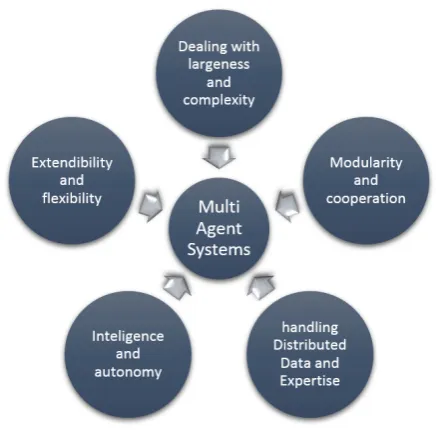
A number of capabilities for MAS have been discussed in the relevant studies [14], [18], [20] and [21]. Following such studies, five main capabilities for MAS are consid-ered in [13], as shown in Figure 1. These capabilities are: dealing with large and complex problems, modularity and cooperation, intelligence and autonomy, handling distrib-uted sources of data and expertise, and extendibility and flexibility.
2. 3. MAS Operation
Operation of multi agent systems might be considered in three phases, namely: perception (or data acquisition), reasoning (or decision making), and action, as shown in Figure 2. In the perception phase, the required data is ob-tained, either by considering some assumptions (predict-ing future) or by monitor(predict-ing real exercises (gather(predict-ing real data), while in the reasoning phase, the decision making process is conducted, either offline or online. In the action phase, agents affect the environment physically (hardware actions) or non-physically (software actions).
3. Power engineering categories
Different categories might be attached to power engi-neering studies so that MAS can be applied. In this paper, seven categories are studied by focusing on the time frame
Fig. 1.Capabilities of multi agent systems
Fig. 2. Operation of MAS and interactions of agents [22]
of the power study problems and considering MAS appli-cations [13] as discussed below.
Expansion planning:This refers to studies concerning
the plan of power system expansion in medium or long time horizon.
Electricity market: This refers to studies dealing with
simulation and prediction of electrical market actors’ re-action from the financial and economy perspective.
Management:This refers to studies concerning the
man-agement of technical and economic conditions of the network in the near future, such as generation scheduling, optimiza-tion, unit commitment, and economic power dispatching.
Network operation:This refers to studies dealing with
the improvement of network conditions (such as reliabil-ity, flexibility and providing a continuous service) in medium and short time operation (such as restoration, re-configuration and load shedding).
Control:This refers to studies dealing with automatic
and real-time actions to control the system condition and to keep the system electrical variables in permitted ranges.
Monitoring and diagnostics:This refers to studies
coping with post-fault monitoring and defect diagnosing in the system.
Protection: This refers to studies dealing with fault
de-tection to protect the system via fault clearing.
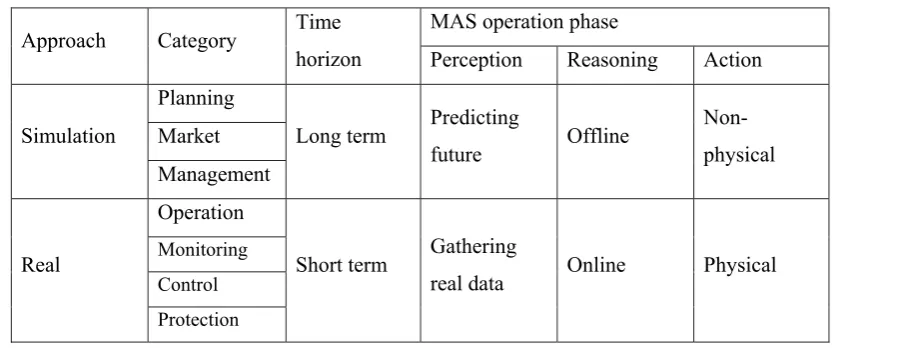
By considering the MAS operation phases, discussed earlier, the above categories might be further organized in two approaches, namely simulation and real [14]. In simulation, agents simulate the behavior of the system’s components by focusing on far future which is typically treated off line. In comparison, in a real approach agents operate directly in a real environment which is typically treated online. With a simulation approach the action of-fered by MAS, in the action phase, is implemented through the aid of software agents or unreal simulated agents. The action of MAS in a real approach is applied
by the help of real agents or hardware. The categories of each approach and their common characteristics are sum-marized in Table 1 and are discussed in the following.
3. 1. Simulation approach
In a simulation approach, agents play the role of system components to predict the component actions in advance. This in turn provides a way for testing the complexity of power system behavior in the real world [14]. Simulation approaches focus on long time studies. Expansion planning, electricity market and network management are three major categories using a simulation approach. These three cate-gories adopt predicted data for the estimation of far future in the perception phase while they gather real data for the estimation of current conditions. Also in these three cate-gories, offline reasoning is employed for making decision associated with non-physical actions.
3. 2. Real approach
In real approaches, agents typically behave in real world rather than in simulated environment. Real ap-proaches find favor in categories, such as network opera-tion, control, monitoring and protection of power engineering as these categories focus on short time hori-zon. These categories use real data of current conditions, make decision in real time and influence the environment by physical actions.
4. Research question
Based on the paper discussion the research question is proposed as,
How compatible is MAS in handling different cate-gories of power system?
To address the research question following methodol-ogy is developed.
Approach Category Time
horizon
MAS operation phase
Perception Reasoning Action
Simulation
Planning
Long term Predicting
future Offline
Non-physical Market
Management
Real
Operation
Short term Gathering
real data Online Physical
Monitoring
Control
Protection
Table 1.Characteristics of power system approaches verses MAS operation
5. Methodology
The paper methodology comprises three steps: illus-trating the level of compatibility of MAS capabilities with MAS operation; determining how MAS operation are compatible with power system; and demonstrating how power system is compatible with MAS capabilities.
Step 1: Compatibility of MAS capabilities with MAS operation
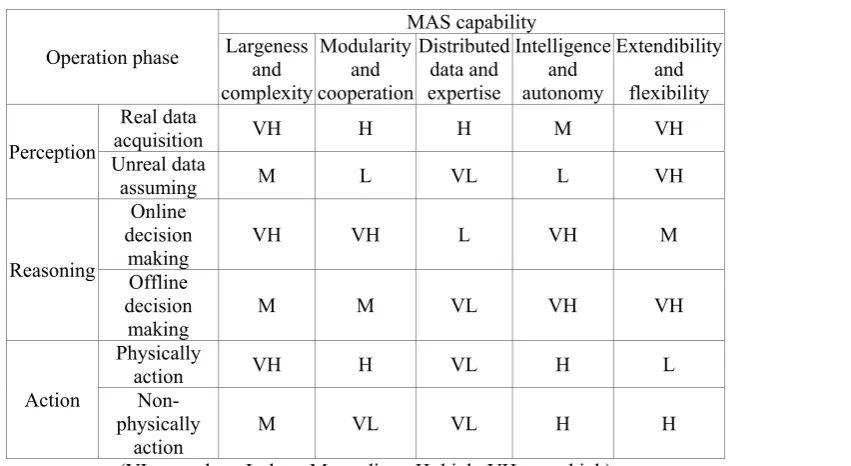
The level of compatibility of MAS capabilities with different MAS operation phases depends on the number of factors which are affected by the problem nature, such as planning, market, management, operation, control, monitoring and protection. Five capabilities were consid-ered, earlier in this paper, for MAS. The compatibility of each of the five MAS capabilities with the MAS operation phases depends on characteristics of the given case study. For example, in the perception phase, among different ca-pabilities of MAS, the capability of dealing with large and complex systems is of particular significance when real data acquisition is required; however, in the case of unreal data this capability is not of interest. Also capabilities of being modular and cooperative as well as being extendible are more significant for the case of gathering real data rather than the case of assuming unreal data. This is be-cause modularity and cooperation capabilities help in data gathering process particularly where such data is spread over the system. In comparison, extendibility aids in pro-viding new sources of data. Moreover, in the reasoning phase, the ability of cooperation and modularity of MAS is central in online decision making processes as such
ability enhances the speed of reasoning at real time using parallel processing. However, in the case of offline deci-sion making the speed of the reasoning phase is not of in-terest. Moreover, the capability of being intelligent and flexible stands out as a dominate capability either in on-line or offon-line decision making. Being intelligent aids the system to decide autonomously while being flexible helps in dealing with fault tolerance of decisions. Furthermore, in the action phase, cooperation and autonomy capabilities are essential for both physically or non-physically actions as such capabilities make the actions of agents aligned; this in turn assists in meeting the system objective. To pro-vide a rigorous framework for the above discussion Table 2 is presented. This table is an attempt to provide com-patibility of MAS capabilities with the MAS operation phase in linguistic terms. The table is derived from the relevant literature by the authors, though it is acknowl-edged that assessing such compatibility level subjectively is not easy.
Step 2: MAS operation phase compatibility with power system
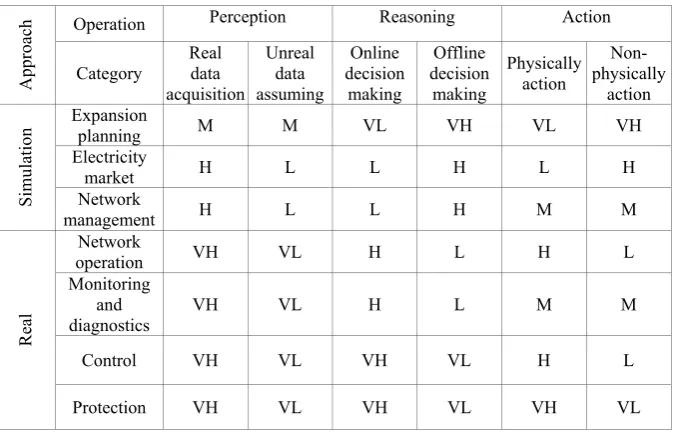
To assess the MAS operation phase compatibility with different power system categories a comprehensive liter-ature review was conducted. The results are summarized in Table 3. This table, for example, shows that in the elec-tricity market category, perception highly relies on real data acquisition, though, assuming unreal data is not of significance. Reasoning, in this category, is offline most of the time while MAS action is applied non-physically. Moreover, protection relies highly on: real data in the per-ception phase, making decisions online in the reasoning
Operationphase
MAS capability Largeness
and complexity
Modularity and cooperation
Distributed dataand expertise
Intelligence and autonomy
Extendibility and flexibility
Perception
Real data
acquisition VH H H M VH
Unreal data
assuming M L VL L VH
Reasoning
Online decision
making
VH VH L VH M
Offline decision
making
M M VL VH VH
Action
Physically
action VH H VL H L Non
-physically action
M VL VL H H
(VL: verylow, L:low, M:medium, H: high, VH: very high) Table 2.Compatibility of MAS capabilities with operation phase
phase, and behaving physical in the action phase.
Step 3: Compatibility of MAS with power system To assess the compatibility of MAS with different power system categories a fuzzy inference system is de-veloped. The development is based on the Mamdani in-ference. Mamdani defines the characteristics of the fuzzy system so that minimum is used for AND operator, max-imum for OR operator, minmax-imum for implication, maxi-mum for aggregation and centroid for de-fuzzification. In the proposed fuzzy system, inputs are the MAS operation phases and outputs are the levels of compatibility of MAS capabilities with power system categories. The relations
of Mamdani inference system are presented in appendix. Eight rules based on if-then statements are considered, as shown in Table 4. For example, Rule1 is presented by the term: if perception is unreal, reasoning is offline and action is non-physical then the compatibility level of ca-pabilities for dealing with largeness and complexity are VL, for modularity and cooperation are VL, for handling distributed data and expertise are VL, for intelligence and autonomy are M, and for extendibility and flexibility are VL.
Membership functions of the fuzzy system inputs and outputs are defined by triangular sets; two examples are illustrated in Figure 3.
Rules
Inputs(If … ) Outputs(then … )
Perception Reasoning Action
Dealing with largeness and
complexity
Modularity and
cooperation
Handling distributed data and expertise
Intelligence and autonomy
Extendibility and flexibility
Rule1 Unreal Offline Nonphysical VL L VL M M
Rule2 Unreal Offline Physical VL M VL H H
Rule3 Unreal Online Nonphysical H H M H M
Rule 4 Unreal Online Physical H VH M VH H
Rule 5 Real Offline Nonphysical M M H H H
Rule 6 Real Offline Physical M H H H VH
Rule 7 Real Online Nonphysical VH H H H H
Rule 8 Real Online Physical VH VH VH VH VH
(VL: very low, L: low, M: medium, H: high, VH: very high) Table 4.Rules of fuzzy interface
A
pp
roa
ch Operation Perception Reasoning Action
Category
Real
data
acquisition
Unreal
data
assuming
Online
decision
making
Offline
decision
making
Physically
action
Non
-physically
action
S
i
m
ula
tion
Expansion
planning M M VL VH VL VH
Electricity
market H L L H L H
Network
management H L L H M M
R
eal
Network
operation VH VL H L H L
Monitoring
and diagnostics
VH VL H L M M
Control VH VL VH VL H L
Protection VH VL VH VL VH VL
Table 3.Compatibility of MAS operation phase with different power system categorizes
Inputs of the system are crisp sets (0, 0.25, 0.5, 0.75 and 1), shown in Table 5, defined by allocating numbers to the linguistic terms (VL, L, M, H and VH) of Table 3.
6. Results and discussion
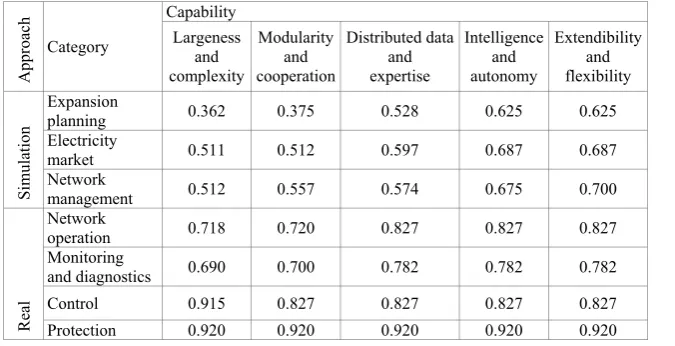
The results of the proposed fuzzy inference system are summarized in Table 6. This table gives the compatibility level of MAS capabilities with power system categories. The results demonstrate that in categories using
simula-tion, the MAS compatibility is low and MAS capabilities are not of particular significance. This might be largely due to the fact that such categories use unreal data in per-ception, off line decision making in reasoning and non-physical actions. However, the results demonstrate that in categories using real approaches, the MAS compatibility is high and MAS capabilities are of usefulness. This is be-cause such categories use real data in perception, on line decision making in reasoning and physical actions. In ad-Fig. 3.Examples of input and output membership functions
Power category
MAS operationphase
Perception Reasoning Action
Expansionplanning 0.5 0 0
Electricitymarket 0.75 0.25 0.25
Network management 0.75 0.25 0.5
Network operation 1 0.75 0.75
Monitoringand diagnostics 1 0.75 0.5
Control 1 1 0.75
Protection 1 1 1
Table 5.Inputs of fuzzy system
A
pp
roa
ch
Category
Capability
Largeness and complexity
Modularity and cooperation
Distributed data and
expertise
Intelligence and
autonomy
Extendibility
and
flexibility
S
i
m
ula
tion
Expansion
planning 0.362 0.375 0.528 0.625 0.625 Electricity
market 0.511 0.512 0.597 0.687 0.687
Network
management 0.512 0.557 0.574 0.675 0.700
R
eal
Network
operation 0.718 0.720 0.827 0.827 0.827
Monitoring
and diagnostics 0.690 0.700 0.782 0.782 0.782 Control 0.915 0.827 0.827 0.827 0.827
Protection 0.920 0.920 0.920 0.920 0.920 Table 6.Compatibility of MAS capabilities with power system categories
dition, the results show that being intelligent and ex-tendible is more compatible with power system cate-gories. Accordingly, it is anticipated in the near future MAS becomes a key important tool in the development of intelligent tools and smart grids in power system.
- Multi agent technology challenges and power engineering requirements
There are some key technical challenges in the case of effective implementation of multi-agent systems within the power engineering applications, such as: “selection of platform” to ensure long-term compatibility and the re-quired robustness for online applications, “selection of toolkit” which allow the reuse of existing agent behaviors and capabilities, “intelligent agent design” for different power engineering applications, “agent communica-tion languages and ontologies” to define how agents ex-change information, communicate, and negotiate, “standards of data”, “security of messaging” due to the peer-to-peer nature of agent systems and “mobility” com-pletely (source code and data) [14].
Although these challenges are discussed in literature but all these challenges are not a problem in every appli-cations. Table 6 is a guideline for design of MAS in power engineering categories which demonstrates for designer which capabilities are more important in each category and according to these requirements which challenges should be overcome. In the other words, the more com-patible a MAS capability with a power system category is the more consideration of this capability in the design of that category is required. For example, in the case where the social ability of power system is required the communication interfaces and the messaging standards are of very importance for inter-agent communication [14]. Such social ability is relevant to two capabilities: modularity and cooperation, and handling distributed sources of data and expertise. Table 6 shows that in real approaches, good communication is required because of a high level of compatibility and importance of these two capabilities of MAS.
Also in the case where interoperability with other sys-tems is required the improvement of flexibility and ex-tendibility capabilities is desire. Such improvement can be achieved via developing standards for MAS architec-ture, agent communication language, and content lan-guage [15]. For this purpose, a set of standards for an open architecture (agents can easily be added and removed) was established by Foundation for Intelligent Physical Agents (FIPA) to introduce standards for creating, locat-ing, removlocat-ing, and communicating with agents [14]. Table 6 illustrates that the compatibility of all power sys-tem categories (simulation and real) with the MAS capa-bility of being flexible and extendable is relatively high. This implies that the establishment of such standards is anticipated to find favor in the power system arena in the
near future particularly for microgrids and smart grids as extendibility and flexibilities are vital for these two sub-power systems.
7. Conclusion
Multi agent system is increasingly used in different cat-egories of power system. Practitioners need to consider two steps in order to understand how MAS should be ap-plied to the power system context. First, the problem na-ture should be analyzed to identify its requirements, then MAS should be adopted in such a way that the problem nature is addressed based on MAS capabilities. This paper developed a framework for applying MAS in power en-gineering via establishing five capabilities for MAS and seven categories for power system. The development was carried out based on finding the compatibility between such capabilities and categories. Three steps were consid-ered in finding such compatibilities: illustrating the level of compatibility of MAS capabilities with MAS opera-tion; determining how MAS operation are compatible with power system; and demonstrating how power system is compatible with MAS capabilities. The paper demon-strates that MAS capabilities are generally compatible with power system categories. In large and complex mod-ern power systems with cooperating modules and subsys-tems where huge data intelligent processing is required the necessity of MAS capabilities for handling such mod-ern power systems become evident. So MAS is suggested as an appropriate tool for modeling, analyzing and control of power systems.
The paper concludes that owing high adaptability of MAS capabilities with power system requirements, in the near future, MAS is anticipated to be a key important tool in the development of smart grids in power system.
Appendix: Mamdani fuzzy inference system
A fuzzy inference system comprises four principal component: a “fuzzification interface”, a “knowledge base”, a “decision making logic” and a “defuzzification logic” [23]. One of the most popular fuzzy reasoning methods is Mamdani inference system which uses a rule base for reasoning as follows [24]:
For simplicity, assume that we have two fuzzy rules as knowledge base, as follows:
R1: if x is A1and y is B1then z is C1, R2: if x is A2, and y is B2, then z is C2.
where x, y, and z are linguistic variables representing the process state variables respectively; Ai, Bi, and Ciare lin-guistic values of the linlin-guistic variables x, y, and z.
In the case of crisp inputs, the value of input may be treated as a fuzzy singleton. Then the firing strengths αi of the rules may be expressed as:
where µAi(x0) and µBi(y0) play the role of the degrees of partial match between the user-supplied data and the data in the rule base, also the sign of “^” implies intersection of two parameters that computed as minimum of them.
Fuzzy reasoning is associated with the use of Mam-dani’s minimum operation rule R, as a fuzzy implication function. In this mode of reasoning, the ith rule leads to the control decision
which implies that the membership function µC of the inferred consequence C is pointwise given by
References
[1] K. Hopkinson, X. Wang, R. Giovanini, J. Thorp, K. Birman and D. Coury, "EPOCHS: a platform for agent-based electric power and communication simulation built from commercial off-the-shelf
com-ponents," Power Systems, IEEE Transactions on,
vol. 21, no. 2, pp. 548-558, May 2006.
[2] E. Gnansounou, J. Dong, S. Pierre and A. Quintero, "Market oriented planning of power generation
ex-pansion using agent-based model," in Power
Sys-tems Conference and Exposition, 2004. IEEE PES, Oct. 2004.
The centroid Method are used for defuzzification of the result of mamdani inference system that generates the center of gravity of the possibility distribution of a control action.
In the case of a discrete universe, this method yields
where n is the number of quantization levels of the output. The fuzzy reasoning process is illustrated in Figure 4 [24].
[3] E. Davidson and S. McArthur, "Exploiting Multi-agent System Technology within an Autonomous
Regional Active Network Management System," in
Intelligent Systems Applications to Power Systems, 2007. ISAP 2007. International Conference on , Nov. 2007.
[4] G. Basso, N. Gaud, F. Gechter, V. Hilaire and F. Lauri, "A Framework for Qualifying and Evaluat-ing Smart Grids Approaches: Focus on
Multi-Agent Technologies," Smart Grid and Renewable
Energy, vol. 4, no. 4, pp. 333-347 , 2013.
[5] D. Koesrindartoto, J. Sun and L. Tesfatsion, "An
Fig. 4.Mamdani fuzzy inference process [24]
agent-based computational laboratory for testing the economic reliability of wholesale power market
designs," in Power Engineering Society General
Meeting, 2005. IEEE, June 2005.
[6] Q. Wu, J. Q. Feng, W. H. Tang and J. Fitch, "
Multi-agent based substation automation systems," in
Power Engineering Society General Meeting, 2005. IEEE, June 2005.
[7] D. Liu, Y. Chen, G. Shen and Y. Fan, "A Multi-Agent Based Approach for Modeling and
Simula-tion of Bulk Power System RestoraSimula-tion," in
Transmission and Distribution Conference and Ex-hibition: Asia and Pacific, 2005 IEEE/PES, 2005. [8] R. Lukomski and K. Wilkosz, "Modeling of multi-agent system for power system topology
verifica-tion with use of Petri nets," in Modern Electric
Power Systems (MEPS), 2010 Proceedings of the International Symposium, Sept. 2010.
[9] Y. Xu, W. Liu and J. Gong, "Stable Multi-Agent-Based Load Shedding Algorithm for Power
Sys-tems," Power Systems, IEEE Transactions on, vol.
26, no. 4, pp. 2006-2014, Nov. 2011.
[10] S. D. J. McArthur and E. Davidson, "Multi-agent systems for diagnostic and condition monitoring
applications," in Power Engineering Society
Gen-eral Meeting, 2004. IEEE, June 2004.
[11] B. Monchusi, A. Yusuff, J. Munda and A. Jimoh, "Fuzzy Multi-Agent Based Voltage and Reactive
Power Control," in International Conference on
Renewable Energies and Power Quality (ICREPQ’11), Spain, April, 2011.
[12] Y. Tomita, C. Fukui, H. Kudo, J. Koda and K. Yabe, "A cooperative protection system with an agent
model," Power Delivery, IEEE Transactions on,
vol. 13, no. 4, pp. 1060-1066, Oct 1998.
[13] M. Moradi, S. Razini and S. M. Hosseinian, "State of Art of Multi Agent Systems in Power
Engineer-ing: A Review," Renewable and Sustainable Energy
Reviews, vol. 58, pp. 814-824, 2016.
[14] S. McArthur, E. Davidson, V. Catterson, A. Dimeas, N. Hatziargyriou, F. Ponci and T. Fun-abashi, "Multi-Agent Systems for Power Engineer-ing Applications—Part I: Concepts, Approaches,
and Technical Challenges," Power Systems, IEEE
Transactions on, vol. 22, no. 4, pp. 1743-1752, Nov. 2007.
[15] S. McArthur, E. Davidson, V. Catterson, A. Dimeas, N. Hatziargyriou, F. Ponci and T. Fun-abashi, "Multi-Agent Systems for Power Engineer-ing Applications—Part II: Technologies, Standards, and Tools for Building Multi-agent
Sys-tems," Power Systems, IEEE Transactions on, vol.
22, no. 4, pp. 1753-1759, Nov. 2007.
[16] S. McArthur and E. Davidson, "Concepts and ap-proaches in multi-agent systems for power
appli-cations," in Intelligent Systems Application to
Power Systems, 2005. Proceedings of the 13th In-ternational Conference on, Nov. 2005.
[17] S. McArthur, E. Davidson and V. Catterson, " Build-ing multi-agent systems for power engineerBuild-ing
ap-plications," in Power Engineering Society General
Meeting, 2006. IEEE, 2006.
[18] V. Catterson, E. Davidson and S. Mcarthur, " Prac-tical applications of multi-agent systems in electric
power systems," European Transactions on
Electri-cal Power, vol. 22, no. 2, pp. 235-252, 2012. [19] M. Wooldridge, An Introduction to MultiAgent
Systems, 2nd ed., John Wiley & Sons, 2009. [20] M. Wooldridge, "Responding to Real-World
Com-plexity: Introduction to Multi-Agent Technology,"
Magenta Whitepaper, Winter 2007.
[21] K. P. Sycara, "Multiagent systems," American As-sociation for Artificial Intelligence, vol. 19, no. 2, pp. 79-92, summer 1998.
[22] R. Roche, B. Blunier, A. Miraoui, V. Hilaire and A. Koukam, "Multi-agent systems for grid energy
management: A short review," in IECON 2010
-36th Annual Conference on IEEE Industrial Elec-tronics Society, Nov. 2010.
[23] C. C. Lee, "Fuzzy logic in control systems: fuzzy
logic controller. I," IEEE Transactions on Systems,
Man, and Cybernetics, vol. 20, no. 2, pp. 404-418, 1990.
[24] C. C. Lee, "Fuzzy logic in control systems: fuzzy
logic controller. II," IEEE Transactions on Systems,
Man, and Cybernetics, vol. 20, no. 2, pp. 419-435, 1990.
Saleh Razini received the B.Sc. de-gree in power electrical engineer-ing, from Bu-Ali Sina University, Hamedan in 2008 and the M.Sc. degree in power systems and high voltage from K.N.Toosi university of technology, Tehran in 2011. He is Ph.D. student at Bu-Ali Sina university and his main research interests are power system planning and management, energy policy and renewable en-ergies.
Dr. M. H. Moradi is a lecturer in the department of electrical engi-neering, University of Bu–Ali Sina in IRAN. He obtained his B.Sc., M.Sc. and PhD from Sharif University of Technology, Tarbiat Modares University and Strath-clyde University in Glasgow, Scotland in 1991,
Biographies
Biographies
1993 and 2002 respectively. His research interests include New and Green Energy, Micro Grid Mod-eling and Control, DG Location and Sizing in Power System, photovoltaic systems and power electronics, Combined Heat and Power Plant, Power Quality, Supervisory Control, Fuzzy Con-trol.
S. Mahdi Hosseinian is Assistant Professor of the Civil Engineer-ing Department, Faculty of Engi-neering, Bu-Ali Sina University, Iran. He is a graduate of the Uni-versities of New South Wales in Project Management, Sydney in 2013. He publishes, teaches, and consults widely in most aspects of project manage-ment, systems, and problem-solving.
![Fig. 4. Mamdani fuzzy inference process [24]](https://thumb-us.123doks.com/thumbv2/123dok_us/27431.2003113/8.595.175.537.346.548/fig-mamdani-fuzzy-inference-process.webp)
