(www.rdmodernresearch.com) Volume 2, Issue 1, 2017
30
STUDY OF INTERRELATIONSHIP AMONG FDI, GDP AND
FOREIGN EXCHANGE RATE FROM 1982 TO 2015 OF G20
COUNTRIES: AN APPLICATION OF PREDICTIVE ANALYTICS
TECHNIQUES
Dr. Sarmita Guha Ray
Quantitative Researcher and Faculty, Department of MBA (Finance & System), University of Calcutta, Kolkata, West Bengal
Cite This Article: Dr. Sarmita Guha Ray, “Study of Interrelationship among FDI, GDP and Foreign Exchange
Rate from 1982 to 2015 of G20 Countries: An Application of Predictive Analytics Techniques”, International Journal of Scientific Research and Modern Education, Volume 2, Issue 1, Page Number 30-41, 2017.
Copy Right: © IJSRME, 2017 (All Rights Reserved). This is an Open Access Article distributed under the Creative Commons Attribution License, which permits unrestricted use, distribution, and reproduction in any medium, provided the original work is properly cited.
Abstract:
G20 Countries are identified as one of the most attractive long-term investment destinations. The presence of large domestic market, fairly well developed financial architecture and skilled human resources, it can attract much larger foreign investments than it has done in the past. Its present international investment regime facilitates easy entry of foreign capital in almost all areas subject to specific limits on foreign ownership. Entry options have not only become procedurally simpler, but prospects for higher yields from investment have also become brighter. But further boost to Foreign Direct Investment (FDI) will depend significantly on further liberalization of its foreign investment regime. This study attempts to focus on an insight into G20 countries: Study of interrelationship among FDI, GDP and Foreign Exchange Rate from 1982 to 2015 and forecast of GDP and Foreign Exchange Rate from 2016 to 2019.
Key Words: G20 Countries, FDI, GDP & Foreign Exchange Rate etc.
1. Introduction:
Since the unfolding of the 2008 global financial crisis, the G20 has played a major role in coordinating macroeconomic policies of major economies and reviving the world economy. As the world’s primary forum for international economic cooperation, its objectives have been to ensure more sustainable and balanced growth, achieve economic and financial stability and reform the prevailing international financial architecture. In the wake of the crisis, there was a sense of urgency and strong agreement to enact extraordinary policy measures to fend off the collapse of the real sector because of the “collapse of confidence” in the financial sector. The G20 performed spectacularly in this regard: global gross domestic product(GDP) contracted less than expected in 2009 and rebounded faster than expected in 2010(Ahluwalia 2011).These coordinated actions were widely credited for forestalling a second Great Depression, with the G20 declaring victory at their third summit at Pittsburgh in September 2009(“It worked”). Since 2009, Indian Council for Research on International Economic Relations (ICRIER), along with its partners, has been organizing a high level annual conference that brings together academics and key policymakers from G20 member countries and International Financial Institutions (IFIs) to deliberate on a range of issues related to the G20. G-20 Countries are:- As of 2014, Argentina, Australia, Brazil, Canada, China, France, Germany, India, Indonesia, Italy, Japan, Republic of Korea, Mexico, Russia, Saudi Arabia, South Africa, Turkey, the United Kingdom, the United States and the European Union make up the G20.
(www.rdmodernresearch.com) Volume 2, Issue 1, 2017
31
This study attempts to focus on an insight into G20 countries: Study of interrelationship among FDI, GDP and Foreign Exchange Rate from 1982 to 2015 and forecast of GDP and Foreign Exchange Rate from 2016 to 2019.
The rest of the paper is divided into four sections. Section II presents the literature review on policy regime as a determinant of FDI Section III represents the brief outline of the International Investment Regime i.e. FDI policy. Section IV represents the relationship between FDI and economic policy variables taking following factors into consideration namely, market size, openness (exports and imports), lending rates, debt service ability, strength of legal rights and tax structure followed by the concluding remarks. Section V represents the data and methodology and section VI represents the concluding remarks.
2. Literature Review:
FDI Defined: In the present era of liberalization, role played by growth of international trade have increasingly influenced FDI and FPI into developing countries. FDI is the largest component of long-term capital flows to developing countries and is expected to remain their dominant source of external finance. Danziger (1997) defines FDI broadly as an investment made by a foreign investor in order to acquire an ongoing interest in an enterprise operating in a country other than the investor's home country. The foreign investor intends to exercise some control over the management of the direct investment enterprise. It is a Greenfield investment if the foreign investor establishes a new venture in the host country. It is merger & acquisition if the foreign investor makes an acquisition of the whole or part of an existing firm or project in the host country is purchased. International Monetary Fund (1996) maintains that foreign direct investment (FDI) is a category of international investment in which a resident entity in one economy (the direct or foreign investor) acquires a lasting interest in an enterprise resident in another economy (the direct investment enterprise). Whether the lasting interest is related to a controlling interest or to potential control is immaterial. It is constituted that the foreign investor should own at least 10% of on overseas direct investment enterprise to control and influence the management of the investment (IMF 1996). FDI in India means investment by non-resident entity/person resident outside India in the capital of the Indian company under Schedule 1 of FEM (Transfer or Issue of Security by a Person Resident outside India) Regulations 2000 (Consolidated FDI Policy Circular, DIPP, 2010).
Foreign Portfolio Investment (FPI) on the other hand, is a financial investment made by an investor from one
country in the securities markets of another country, seeking purely financial gains in the form of income or capital. Generally, this is a short – term investment in shares, bonds, notes, money market instruments and financial derivatives, and does not imply significant control over or a lasting interest in the enterprises concerned.
FDI Determinants:
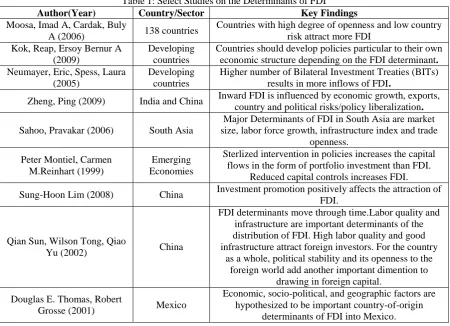
Table 1: Select Studies on the Determinants of FDI
Author(Year) Country/Sector Key Findings
Moosa, Imad A, Cardak, Buly
A (2006) 138 countries
Countries with high degree of openness and low country risk attract more FDI
Kok, Reap, Ersoy Bernur A (2009)
Developing countries
Countries should develop policies particular to their own economic structure depending on the FDI determinant.
Neumayer, Eric, Spess, Laura (2005)
Developing countries
Higher number of Bilateral Investment Treaties (BITs) results in more inflows of FDI.
Zheng, Ping (2009) India and China Inward FDI is influenced by economic growth, exports, country and political risks/policy liberalization.
Sahoo, Pravakar (2006) South Asia
Major Determinants of FDI in South Asia are market size, labor force growth, infrastructure index and trade
openness.
Peter Montiel, Carmen M.Reinhart (1999)
Emerging Economies
Sterlized intervention in policies increases the capital flows in the form of portfolio investment than FDI.
Reduced capital controls increases FDI.
Sung-Hoon Lim (2008) China Investment promotion positively affects the attraction of FDI.
Qian Sun, Wilson Tong, Qiao
Yu (2002) China
FDI determinants move through time.Labor quality and infrastructure are important determinants of the distribution of FDI. High labor quality and good infrastructure attract foreign investors. For the country
as a whole, political stability and its openness to the foreign world add another important dimention to
drawing in foreign capital.
Douglas E. Thomas, Robert
Grosse (2001) Mexico
Economic, socio-political, and geographic factors are hypothesized to be important country-of-origin
(www.rdmodernresearch.com) Volume 2, Issue 1, 2017
32
Singh Harinder, Jun, Kwang W(1995)
Developing countries
Political risk, business conditions and macroeconomic policies matter for FDI.
According to the OLI paradigm of Dunning , the presence of ownership-specific competitive (O) advantages in a transnational corporation, the presence of locational advantages (L) in a host country, and the presence of superior commercial benefits internally in a firm (I) are three important set of determinants which influence the FDI inflows. World Association of Investment Promotion Agencies (WAIPS), Newsletter (September-2005) emphasized on Transparency in investment rules and procedures through “e-regulations” system containing detailed, step-by-step, data on national legislation and procedures applicable to the foreign investment operation. It offers online access to forms and is connected to public offices; it also indicates where and how the investor can complain in case of disagreement. As per UNCTAD secretariat report on Investment Policy Developments in G20 countries (2009),167 policy measures have been undertaken, contained in laws and legislation adopted between 1 October 2008 and 15 June 2009 by the 42 countries surveyed. The various measures taken by most of the G20 countries includes:-
Easy entry of foreign investors: by opening up of previously closed sectors of the economy to foreign investment and removing/relaxing sectoral caps for foreign investment. For example 100 % foreign ownership under automatic route was allowed in electricity generation, transmission and distribution in June 1998.
Streamlining approval procedures: For example by lowering the threshold for review of investment and acquisition projects, clarifying decentralized responsibilities for approval of foreign investment projects, or relaxing the review procedures for foreign investment in real estate.
Facilitation of foreign investment projects: For example, in the form of granting specific incentives to investments in certain areas of a country, or facilitating the operation of companies in Special Economic Zones. Other measures aim at facilitating the operation of foreign investors.
China and India ---two emerging economy members of the G20 --- signed BITs, a development reflecting their growing role as capital exporting countries.
Moreover, three of these countries’ International Investment Agreements (IIAs) are South-South agreements, demonstrating the increasing importance of South-South economic cooperation in the field of FDI. Undoubtedly, most of the G20 countries are identified as the fastest growing economy (For example India as well as China) today and has been able to attract substantial foreign investment. However greater investments can flow in with right kind of policy framework.
3. Brie Outline of the Regime:
Among the most favoured destination of FDI of the G20 countries, India’s present policy framework for inward FDI was introduced by the Industrial Policy Statement of July 24, 1991. The foreign investment regime in India has been gradually liberalized by successive governments since the liberalization process commenced in 1991. Attempts have been made to simplify the regime to encourage FDI and to foster competition in the Indian market. Foreign investment, while still controlled, is actively encouraged by the Indian government and amounted to USD 35.1 billion in fiscal year 2009. The policy is reviewed on continued basis and amendments are notifies through Press Notes by SIA, DIPP. The present policy allows foreign investors to invest in resident entities through either the automatic route or the government –administered route. Most sectors and activities qualify for the automatic route. This route allows investors to bring in funds without obtaining prior permission from the Government, RBI, or any other regulatory agency. However, invested enterprises are required to inform RBI within 30 days of receipt of funds and also comply with documentation requirements within 30 days of issue of shares to foreign investors.
4. Economic and Policy Variables as Determents of FDI of the G20 Countries:
The direction and magnitude of capital flows between emerging and developed-country markets depend on the relative attractiveness of placing funds in emerging markets vis-a-vis developed-country markets, as well as the ease with which such transactions can be carried out which in turn depends on the liberalization of policy regime. The FDI environment in India has undergone a sea change since the inception of economic reforms in 1991 .Like other members of the G20 countries India’s strengths as an investment destination rest on strong fundamentals, including a large and growing market; world-class scientific, technical and managerial manpower, cost-effective and highly skilled labor, an abundance of natural resources, liberal and investor friendly international regime and an independent judiciary. Out of the determinants widely used by researchers, this study examines the economic and policy variables as a determinant of FDI.
5. Data and Methodology:
In order to show the interrelationship between FDI, GDP and FOREIGN EXCHANGE RATE, all data are collected from the World Bank and the period of study is 1982 to 2015. To materialize this interrelationship, we set out two linear regression equation: -
Linear regression equation when GDP depends on FDI
Linear regression equation when Foreign Exchange Rate depends on FDI.
(www.rdmodernresearch.com) Volume 2, Issue 1, 2017
33
(www.rdmodernresearch.com) Volume 2, Issue 1, 2017
34
(www.rdmodernresearch.com) Volume 2, Issue 1, 2017
35
(www.rdmodernresearch.com) Volume 2, Issue 1, 2017
(www.rdmodernresearch.com) Volume 2, Issue 1, 2017
37
Above four tables show Official exchange rate (LCU per US$, period average) data from 1982 to 2015, collected from World Bank data database:
The whole process of determining the relationship among FDI, GDP and Foreign Exchange Rate involves application of two predictive analytics techniques i.e. Multiple Linear Regression equation and Time Series Forecasting. Before deploying these two predictive analytics techniques, pairwise correlation among FDI, GDP and Foreign Exchange Rate has been calculated given that all the variables has been converted in numerical format. Multiple Linear Regression equation has been applied under two scenarios:
when GDP depends on FDI
when Foreign Exchange Rate depends on FDI
Application of Multiple Linear Regression equation has been done through the following steps:-
Detection and elimination of outliers of the independent variables i.e. GDP and Foreign Exchange Rate.
Checking and replacement of missing value in the whole data set.
Application of code for Multiple Linear Regression equation on the whole dataset.
Extraction of intercept, coefficients, P-values of T-test and adjusted R squared country-wise and scenarios-wise.
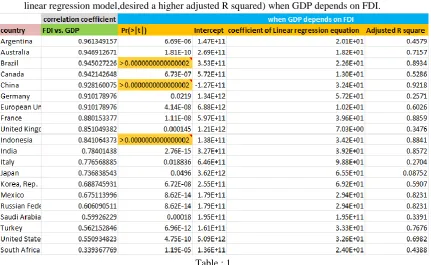
Table showing degree of correlation between FDI and GDP of G20 countries sorted in Largest To Smallest order with : -
respective p-value of t-test(lower p-vale of t-test implies lower significance of correlation coefficient and higher p-vale of t-test implies higher significance of correlation coefficient)
intercept , coefficient of linear regression equation and Adjusted R squared(impling robustness of linear regression model,desired a higher adjusted R squared) when GDP depends on FDI.
Table : 1
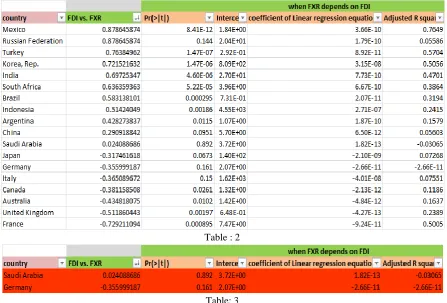
Table showing degree of correlation between FDI and Foreign Exchange Rate of G20 countries sorted in Largest To Smallest order with : -
respective p-value of t-test(lower p-vale of t-test implies lower significance of correlation coefficient and higher p-vale of t-test implies higher significance of correlation coefficient)
(www.rdmodernresearch.com) Volume 2, Issue 1, 2017
38
Table : 2
Table: 3
Linear regression model of the above two countries will be rejected from Table: 2 because they have negative Adjusted R Squared i.e. linear regression model of these countries has no explanatory potential. Only correlation coefficient and respective P-value of t-test will be considered will be considered for these two countries in the scenario where Foreign Exchange Rate depends on FDI. To improve Adjusted R squared of Saudi Arabia and Germany , one new data set has been inserted which is Inflation, GDP deflator (annual %).
(www.rdmodernresearch.com) Volume 2, Issue 1, 2017
39
Above four tables show Inflation, GDP deflator (annual %)data from 1982 to 2015, collected from World bank data database:
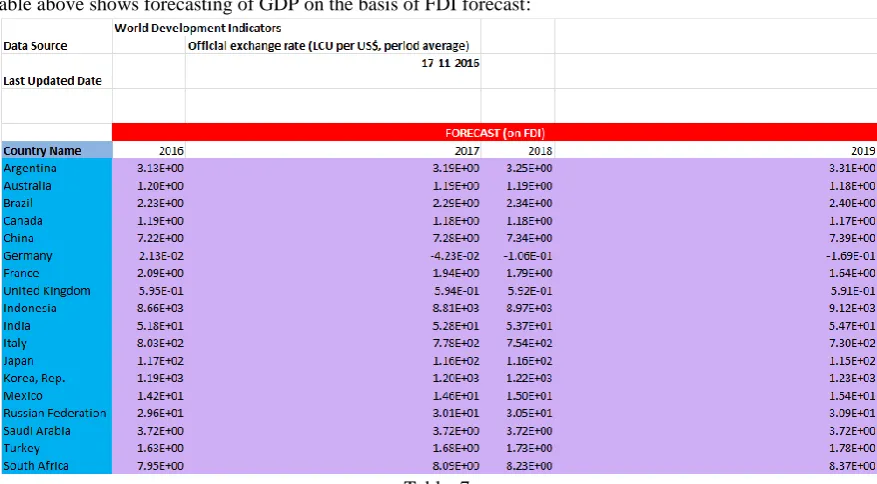
Since both GDP and Foreign Exchange Rate are dependent on FDI, FDI has been forecasted for 4 years i.e. 2016, 2017, 2018 and 2019 using ARIMA modelling. Before applying ARIMA modelling, the whole data range of FDI from 1982 to 2015 has been stationary .Long term trend has been removed by differentiating and uneven variance has been removed by logarithm of the data range. Stationarity has been checked by ADF test. Then code for ARIMA modelling has been applied to forecast the stipulated time period. MAPE has been extracted from ARIMA model and checked whether it is within the optimum level or not. Intercept and coefficients as derived from Multiple Linear Regression equation has been applied on forecasted FDI and forecasted GDP and Foreign Exchange Rate has been calculated.
Table: 5
(www.rdmodernresearch.com) Volume 2, Issue 1, 2017
40
Table above shows forecasting of GDP on the basis of FDI forecast:
Table: 7
Table above shows forecasting of Foreign Exchange Rate on the basis of FDI forecast:
6. Concluding Remarks:
After analysing the whole collected data set, pair-wise ( FDI vs. GDP and FDI vs. Foreign Exchange Rate) correlation coefficients with respective p-values of T-test , intercept and coefficients from two Linear regression equations. Now from the point of view of pair-wise correlation coefficients with respective p-values of T-test, European Union has highest correlation coefficients (0.737) between FDI and GDP after considering p-values of T-test and in case of FDI and. Foreign Exchange Rate, it is Saudi Arabia (0.0241). Added to this, FDI vs. Foreign Exchange Rate data sets of some countries (Germany, Italy, Japan, Canada, Australia, United Kingdom and France) are giving negative correlation coefficients implying adverse relationship between FDI and. Foreign Exchange Rate. Coefficients from two linear regression equations have a unique statistical significance. It describes the domination power of FDI on GDP and Foreign Exchange Rate. In respect of linear regression Equation of when GDP depends on FDI with due significance to Adjusted R squared, China has highest coefficient of linear regression equation (32.36719) with Adjusted R squared of 0.9218 and the lowest one (65.53453) is Japan with Adjusted R squared of0.08752. In respect of linear regression Equation of when GDP depends on Foreign Exchange Rate with due significance to Adjusted R squared, Mexico has highest coefficient of linear regression equation (0.0000000003663684) with Adjusted R squared of 0.7649 and the lowest positive one (0.002497348) is Saudi Arabia with Adjusted R squared of0.02858. But some countries in these equation are giving negative coefficient of linear regression equation which are France ,United Kingdom , Australia , Canada , Italy , Japan and Germany implying negative effect of FDI growth on Foreign Exchange rate. The present study analysis the policy related variables like openness of the economy, foreign exchange reserves, debt service ratio, strength of legal rights, tax policies and economic determinant, that is, GDP to throw light at the possible variables influencing the foreign direct investment inflows in India. The analysis shows that independent variables including GDP, Openness and LR affect the inflows of FDI to India. Among the major reasons which discourage the international investors from investing in India despite of its consistent economic growth includes: 1) Politics and corruption 2) Lack of infrastructure 3) Inadequate Legal system 4) Instability of Indian Social and Political environment 5) Absence of Corporate governance practices 5) Maturity of the financial markets All in all a more open policy frame is required which can be integrated with developing economies policy frame so that India becomes the most attractive destination and actually receive Foreign Direct Investment in the sectors which has potential to grow from foreign capital. Furthermore the integration at National level is required .As sectors which are covered under automatic route are subject to other caveats imposed by State and respective Ministry.
References:
1. Agnès Bénassy-Quéré, Maylis Coupet, Thierry Mayer(2005),Institutional determinants of Foreign Direct Investment,CEPII, Working Paper No 2005-05.
2. Aitken, B & Harrison A (1994), Do Domestic firms benefit from Foreign Direct Investment?, Washington, World Bank Research Deptt.
(www.rdmodernresearch.com) Volume 2, Issue 1, 2017
41
4. Bruce A. Blonigen(2005),A Review of the Empirical Literature on FDI Determinants, ,N B E R Wo r k i n g P a p e r N o . 1 1 2 9 9 . http://www.nber.org/papers/w11299
5. Damija, Nidhi(2008),Foreign Institutional Investment in India: An exploratory Analysis of Patterns across firms. Journal of Applied Economic Research, Volume 2
6. Daniele, Vittorio and Marani, Ugo (2006),Do institutions matter for FDI?A comparative analysis for the MENA countries , MPRA Paper No. 2426, Online at http://mpra.ub.unimuenchen. de/2426/ 7. Danziger, E (1997), Danziger Investment Promotion manual, London FDI International. 8. DIPP(2009),Fact Sheet on FDI , FDI Statistics 2009
9. DIPP(2008), Fact Sheet on FDI , FDI Statistics 2008
10. Dunning J.H., “The Eclictic Model of FDI”, Multinational Enterprise and the Global Economy Reading, Addison Wesley, 1993, pp. 82-95.
11. Fernando Luis Pascoal (2002), Foreign direct investment: its determinants and relevance to developing countries. PhD Dissertation, University of South Africa.
12. Globerman Steven, Shapiro Daniel (2002), Global Foreign Direct investment flows: The role of Governance Infrastructure, World Development Vol.30, No.11, pp 1899-1919.
13. Henley, John S(2004), Chasing the Dragon: Accounting for the underperformance by India by comparison with China in attracting Foreign Direct Investment Journal of International Development,Wiley Interscience Publication
14. Javorcik Beata S., Wei Shang-Jin (2009), Corruption and cross border investment in emerging markets: Firm-level evidence, Journal of International money and Finance. Pp 605-624
15. Kok, Reap, Ersoy Bernur A (2009), Analyses of FDI determinants in developing countries, International Journal of social economics. Vol. 36. pp 105-123.
16. Moosa, Imad A, Cardak, Buly A (2006), The determinants of Foreign Direct Investment: An extreme bound analysis, Journal of Multinational Financial management. Pp 199-211.
17. Neumayer, Eric, Spess, Laura (2005), Do bilateral investment to developing countries? World DevelopmentVol.33, No.10, pp 1567-1585.
18. Neumayer, Eric (2007), Do double taxation treaties increase foreign direct investment todeveloping countries? Journal of Development Studies 43 (8), 2007, pp. 1501-1519
19. OECD, Protection of 'critical infrastructure' and the role of investment policies relating to national security, OECD Report Available at www.oecd.org/daf/investment/statistics
20. Palit Amitendu (2009), India's foreign Investment policy, achievement and inadequacies, ifri.org 21. Peter Montiel, Carmen M. Reinhart (1999), Do capital controls and macroeconomic policies influence
the volume and composition of capital flows? Evidence from the 1990s, Journal of International Money and Finance, 18 (1999) pp619–635.
22. Prasanna, P. K.(2008). Foreign Institutional Investors: Investment Preferences in India Journal of Administration and Governance (JOAAG), Vol. 3. No. 2
23. Ramkishen S. Rajan, Sunil Rongala and Ramya Ghosh(2008), Attracting Foreign Direct Investment ( FDI ) to India http://www.freewebs.com/ rrajan1/IFDI.pdf.
24. RBI (2009), Handbook of Statistics on Indian Economy, RBI Publications 25. RBI (2008), Handbook of Statistics on Indian Economy, RBI Publications
26. Sahoo, Pravakar(2006), Foreign Direct investment in South Asia: Policy, Trends, Impact and determinants. ADBInstitute Discussion paper No. 56.
27. Sung Hoon Lim (2008), How investment promotion affects attracting foreign direct investment:Analytical argument and empirical analyses, International Business Review. pp 39-53. 28. Thorsten Beck,Aslh Demirgu,c-Kunt,Vojislav Maksimovic(2002), Financing Patterns Around the
World, Policy Research Working Paper. World Bank Research Group.
29. UNCTAD (2002) World investment report: transnational corporations and export competitiveness. UNCTAD, United Nations, New York.
30. United Nations (2009), Investment Policy Review of Burkina Faso ) , Main conclusions and recommendations. New York.
31. UNTACD (2008), International investment rule-making, UNCTAD Series on International Investment Policies for Development.
32. UNTACD (2009) to (2016), World Investment Report 2009 to 2016.
33. UNCTAD (2009), Investment Policy Developments in G-20 Countries, New York. 34. WAIPA (2005), What’s next Strategic views on FDI.WAIPA Newsletter, Issue 3. 35. World Bank (2009).Doing Business 2009, Washington, DC: World Bank.
36. World Economic Forum (2007).Global Competitiveness Index 2007-08, World Economic Forum, Davos.