December 2016, Vol. 4, No. 2, pp. 9-15
ISSN: 2374-2674(Print), 2374-2682(Online)
Copyright © The Author(s). 2015. All Rights Reserved.
Published by American Research Institute for Policy Development
DOI: 10.15640/jlcj.v4n2a2
URL: https://doi.org/10.15640/jlcj.v4n2a2
Special Weapons and Tactics Operations: Examining the Effects of Differential
Police Training on Hostage Rescue Effectiveness
Avdi S. Avdija, Ph.D.
1Abstract
The purpose of this study is to test the effects of differential police training on hostage rescue effectiveness. More specifically, this study looks at the types of police trainings that are the most effective in preparing SWAT officers in dealing with hostage rescue situations. The analyses are based on a national sample of 341 law enforcement agencies, which employed at least 50 sworn officers. To improve the SWAT response effectiveness in hostage rescue situations, this study shows that two factors play a significant role; namely, the training for hostage rescue situations and an increase in the average training hours per month. Among the types of trainings that were thought to be effective but did not show a significant effect in this present study were training for crowd control/civil unrest, having military training, and training for building searches.
Keywords
: SWAT operations, hostages rescue effectiveness, police training.Introduction
The Special Weapons and Tactics Operations known as the S.W.A.T. teams are an important aspect of any city’s police force. They are contributory in any situation that requires special tactics and precision to carry out police interventions. Usually their service is needed in situations where normal police response cannot adequately deal with the raised situations and thus could result in casualties. A hostage situation would be a typical example, as well as when a criminal barricades himself in a building, riots, and other high risk operations. (Avdija, 2014; Compton, Demir, Oliva, and Boyce, 2009; Snow, 1999, 1996). Because of the burden placed upon them by their unique responsibilities, S.W.A.T. teams have to undergo more intense training than most of other regular police officers. To successfully carry out their missions, they are also given exceptional tools (e.g., tactical weapons) to adequately deal with situations. Ultimately, in the policing world, S.W.A.T. is considered an answer in dealing with the more equipped criminals of the day, and the unique situations that crime presents today. Nonetheless, the success of the SWAT team is largely due to its intense focus on training and rigorous requirements for acceptance to the team. An untrained SWAT team with less than qualified members, by definition, is a disabled police force.
SWAT Team Requirements and Training
For those officers who wish to raise the bar and become an elite police officer, the road is tough. In order for one to become a SWAT team member, he/she must work for a few years as a police officer, depending on the requirements for the specific SWAT team they would like to join. The number of years of police work before joining the SWAT team varies from one department to another. Additionally, there is no specific set of requirements that can be uniformly used by all police departments, especially for small departments. In the selection of candidates for the SWAT team, personal attributes are very important. Perhaps one of the most important attributes of a SWAT member is the level of intelligence. An applicant needs to be intelligent in order to be able to be an effective SWAT member.
1
They need to be able to think on their feet, make quick decisions in situations where teammate’s lives could be lost with the simplest mistake. It’s a job with a tremendous amount of responsibility. Furthermore, intelligence is also a key factor in helping plan the mission and deciding backup plans in case something goes wrong. Because of the nature of police work, SWAT members must always be prepared for the worst (Avdija, 2014). The second attribute of a SWAT member is the physical fitness. However, while physical strength is an important factor in becoming a SWAT member, endurance is an even more important attribute. An effective SWAT team requires constant training, besides the initial basic training that members go through before joining the operations. There are several types of training (Jones, 1998) that are used to assist the SWAT team members to prepare for high risk situations (see Table 1 for a more detailed list of types of trainings). The number of hours of training per month may vary from department to department; however, most police department require somewhere between 8 to 16 hours of training per month in various conditions (Snow, 1996; Dempsey & Forst, 2013). Among many types of training, one of the most valuable training they receive is the hostage rescue situations.
Hostage Rescue Situations
Without a doubt, the most valuable step, and perhaps a life saving step in hostage rescue situations is hostage negotiation (Miller, 2005). Unfortunately, this first step is also the most stressful and complex process in these types of situations (Norton & Petz, 2012; McMains & Mullins, 2010). To effectively and peacefully resolve a hostage situation conflict, it involves an adequate training and psychological preparations, as well as certain attributes and skills of the negotiators (Soskis & Van Zand, 1996; McMains & Mullins, 2010; Norton & Petz, 2012; see also Hatcher, Mohandie, Turner, & Gelles, 1998). With proper skills and training, hostage negotiators can avoid the deployment of the SWAT team altogether. In fact, research shows that most hostage rescue situation to which the SWAT teams are deployed are resolved peacefully through negotiations (Miller, 2005). Depending on the type of hostage situation, to peacefully resolve these situations though negotiations, Miller (2005) recommends teamwork and a collaborative effort between the law enforcement and the mental health professionals as one of the most effective approaches (see also Butler, Leitenberg, & Fuselier, 1993).
The assumption is that most suspects are either mentally unstable/ill or under the influence of illicit drugs or alcohol. In fact, some suspects are so emotionally charged and suicidal that they expect a fatal outcome with a simple mistake made by negotiators (Lindsay & Lester, 2004; Miller, 2005; Kingshott, 2009; Madrigal, Bowman, & McClain, 2009). Nevertheless, only when the negotiation process fails, then SWAT team intervention becomes the alternative solution. In this case, the lives of hostages may very well depend on the SWAT effectiveness during those interventions. Some intervention may be more effective if the SWAT team employ the stealth movement opposed to the dynamic, rapid-response movement. However, the circumstances surrounding the incident dictate which SWAT movement is more appropriate for the situation at hand. Both these types of SWAT interventions require precision, and the best way to maximize life-saving efforts and precision is through preparation and training.2
The Current Study
The current study investigates the extent to which police trainings affect the outcome of hostage rescue incidents. More specifically, the main goal of this study is to examine the types of police trainings that are the most effective in preparing SWAT officers to successfully deal with hostage rescue situations. The second objective is to examine the types of trainings that have a negative effect, if any, on the hostage rescue effectiveness. The focus will be primarily on predictors that have a statistically significant effect on the outcome variable. It is noteworthy that this study is limited to examining only the effects of police trainings on hostage rescue outcome. The broad goal of this study is to contribute to a very limited literature on SWAT operations and their effectiveness.
2
Methodology
Outcome Variable
The outcome variable in this study is hostage rescue effectiveness, measured dichotomously with binary (Yes/No) response categories. The question that measured the outcome variable in this study focused on whether or not the SWAT team had to physically rescue hostages during a hostage situation. The intervention events in which the SWAT teams had to physically rescue hostages were coded 1 for Yes, and 0 for No. It is estimated that the hostage rescue effectiveness (the effect) is influenced by the type of training the police officers receive (the cause). Thus, the probability of an outcome (e.g., hostage physically rescued or not) can be predicted based on the type of police training the SWAT officers have completed.
Predicting Variables
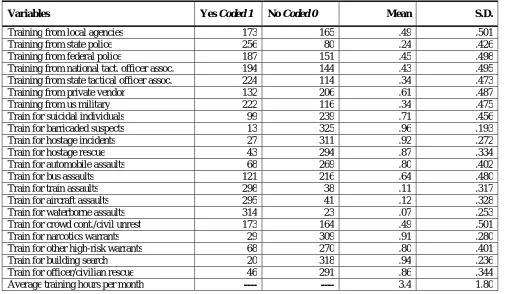
The independent variables in this study include twenty-one types of police trainings that most SWAT officers have to go through to gain or maintain their SWAT status in the police force. Additionally, among the predictors of hostage rescue effectiveness is the average number of hours the police officers take monthly. The average monthly training hours are measured in four-hour increments (e.g., 1 to 4, coded 1, 5 to 8 hours, coded 2, 9 to 12 hours, coded 3, etc.). When interpreting the regression coefficients on Tables 2 and 3, the readers should be aware that one unit change in the average monthly training hours means four hours change. The police training variables on the other hand are dichotomous, and they are measured with Yes/No response categories. The responses are coded 1 for Yes, and 0 for No. In terms of interpreting the results in Tables 2 and 3, the positive coefficients indicate increased hostage rescue effectiveness based on specific police training the SWAT members have received. Table 1 below presents the descriptive statistics of the independent variables in this study (e.g., frequency counts, the mean score for each variable, and the standard deviation of scores).
Table 1: Descriptive Statistics for the Predictors
Variables Yes Coded 1 No Coded 0 Mean S.D.
Training from local agencies 173 165 .49 .501
Training from state police 256 80 .24 .426
Training from federal police 187 151 .45 .498
Training from national tact. officer assoc. 194 144 .43 .495
Training from state tactical officer assoc. 224 114 .34 .473
Training from private vendor 132 206 .61 .487
Training from us military 222 116 .34 .475
Train for suicidal individuals 99 239 .71 .456
Train for barricaded suspects 13 325 .96 .193
Train for hostage incidents 27 311 .92 .272
Train for hostage rescue 43 294 .87 .334
Train for automobile assaults 68 269 .80 .402
Train for bus assaults 121 216 .64 .480
Train for train assaults 298 38 .11 .317
Train for aircraft assaults 295 41 .12 .328
Train for waterborne assaults 314 23 .07 .253
Train for crowd cont./civil unrest 173 164 .49 .501
Train for narcotics warrants 29 309 .91 .280
Train for other high-risk warrants 68 270 .80 .401
Train for building search 20 318 .94 .236
Train for officer/civilian rescue 46 291 .86 .344
Average training hours per month ---- ---- 3.4 1.80
Data Source
The sample of 341 agencies includes state law enforcement agencies, country, municipal, and special jurisdiction law enforcement agencies. The data were collected post incidents; meaning the data includes administrative archived Post Critical Incident Reports (PCIR). The sampling units in this study are law enforcement agencies; whereas the units of analysis are the incidents involving SWAT interventions in hostage rescue situations.
Results
Before addressing the first objective of this study, I computed the correlation matrix and collinearity diagnostics to check for multi collinearity problems. A higher correlation between predictors is typically an indication of multi collinearity within the data (Pallant, 2011). However, after checking the collinearity diagnostics and the correlation matrix, I concluded there was no evidence indicating any violations of multi collinearity assumptions. The highest correlation between predictors was r < .405, and the Variance Inflation Factor (VIF) values ranged from 1.074 to 2.190, well below the suggested cut off value of 10. After the preliminary analyses were completed, then the main objective of this study was addressed using the multiple logistic regression analyses. The logistic regression allows us to predict change in the probability of the unknown values while statistically controlling for the influence of certain variables in the model. The outcome variable in this study was dichotomous in nature; thus, logistic regression was a more suitable statistical technique to carry out the analyses.
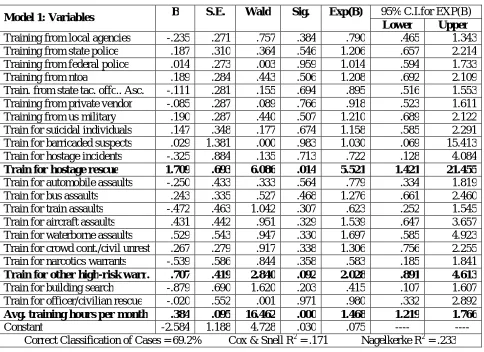
The main objective of this study was to examine the types of police trainings that are the most effective in preparing the SWAT officers in dealing with hostage rescue situations. To address this objective, the data are presented in Tables 1 and 2. The full model is presented in Table 2; whereas a more parsimonious model with only two variables is presented in Table 3. Using backward deletion of insignificant variables, I removed one variable at the time until all variables in the model remained statistically significant. The purpose of Table 3 was to develop a specific model that best explains hostage rescue effectiveness; a model that has fewer variables with the highest explanation power. The full model, which consists of twenty-two types of police training variables, explained between 17% (Cox and Snell R-squared) and 23% (Nagelkerke R-squared) of the variation in the hostage rescue effectiveness, 2 = 57.623, df = 22, N=341, p < .001. However, as shown in Table 2, most of the variables in the first model were statistically insignificant. The second model with only two statistically significant variables presented in Table 3 explained between 14% (Cox and Snell R-squared) and 18% (Nagelkerke R-squared) of the variation in the hostage rescue effectiveness, 2 = 45.278, df = 2, N=341, p < .001. Each of the two models correctly classified approximately 69% of the cases.
Table 2: Logistic Regression Analysis Predicting Hostage Rescue Effectiveness
Model 1: Variables B S.E. Wald Sig. Exp(B) 95% C.I.for EXP(B)
Lower Upper
Training from local agencies -.235 .271 .757 .384 .790 .465 1.343 Training from state police .187 .310 .364 .546 1.206 .657 2.214 Training from federal police .014 .273 .003 .959 1.014 .594 1.733 Training from ntoa .189 .284 .443 .506 1.208 .692 2.109 Train. from state tac. offc.. Asc. -.111 .281 .155 .694 .895 .516 1.553 Training from private vendor -.085 .287 .089 .766 .918 .523 1.611 Training from us military .190 .287 .440 .507 1.210 .689 2.122 Train for suicidal individuals .147 .348 .177 .674 1.158 .585 2.291 Train for barricaded suspects .029 1.381 .000 .983 1.030 .069 15.413 Train for hostage incidents -.325 .884 .135 .713 .722 .128 4.084
Train for hostage rescue 1.709 .693 6.086 .014 5.521 1.421 21.455
Train for automobile assaults -.250 .433 .333 .564 .779 .334 1.819 Train for bus assaults .243 .335 .527 .468 1.276 .661 2.460 Train for train assaults -.472 .463 1.042 .307 .623 .252 1.545 Train for aircraft assaults .431 .442 .951 .329 1.539 .647 3.657 Train for waterborne assaults .529 .543 .947 .330 1.697 .585 4.923 Train for crowd cont./civil unrest .267 .279 .917 .338 1.306 .756 2.255 Train for narcotics warrants -.539 .586 .844 .358 .583 .185 1.841
Train for other high-risk warr. .707 .419 2.840 .092 2.028 .891 4.613
Train for building search -.879 .690 1.620 .203 .415 .107 1.607 Train for officer/civilian rescue -.020 .552 .001 .971 .980 .332 2.892
Avg. training hours per month .384 .095 16.462 .000 1.468 1.219 1.766
Constant -2.584 1.188 4.728 .030 .075 ---- ---- Correct Classification of Cases = 69.2% Cox & Snell R2 = .171 Nagelkerke R2 = .233
Note: N = 341; B is the Unstandardized coefficient; Exp(B) is the factor change in the odds for a unit increase in the independent variable (e.g., odds ratio). Training from ntoa means Training from National Tactical office Association.
Table 3: Logistic Regression Analysis Predicting Hostage Rescue Effectiveness
Model 2: Variables B S.E. Wald Sig. Exp(B) 95% C.I. for EXP(B)
Lower Upper
Train for hostage rescue 1.515 .554 7.492 .006 4.551 1.538 13.468 Avg. training hours per month .414 .085 23.475 .000 1.513 1.280 1.788 Constant -3.339 .600 30.955 .000 .035 --- ---
Correct Classification of Cases = 69.6% Cox & Snell R2 = .136 Nagelkerke R2 = .186
Note: N = 341; B is the Unstandardized coefficient; Exp (B) is the factor change in the odds for a unit increase in the independent variable (e.g., odds ratio).
Discussion
In this sense, in the law enforcement spectrum, the SWAT team is viewed as a life-saving not a life-taking operation (Avdija, 2014). In the eyes of the public, on the other hand, the SWAT operations may not always be viewed as life-saving. There are many who disagree and look at them as a military force against ordinary people, and they view the SWAT officers as overaggressive individuals. Perhaps there are those in the police force, less trained, less professional officers, who may present themselves as overaggressive, but those are individual cases and can be considered as outliers in the overall view of the SWAT operations. Professionally trained SWAT officers are expected to be disciplined, intelligent, efficient, and effective in carrying out their duties as life-savers.
The key term here is “police training.” The current study shows that police officers who participated in hostage rescue training were 5.5 times more effective in rescuing hostages compared to officers who did not participate in such training. The OR for the average training hours per months was 1.468, p < .001. This means that for every four hours increase in the monthly training hours, hostage rescue effectiveness increases by a factor of 1.468, holding all other variables constant. This factor did not substantially change even after eliminating other variables in the model, as it is the case with Model 2 (Table 3).
One policy implication that is worth mentioning here is cost-effectiveness. Table 2 shows a long list of types of trainings that SWAT members may go though. Types of trainings that may not have much empirical validity in terms of their effectiveness, if that effectiveness is measured in terms of lives saved. Thus, police departments that have SWAT operations can reduce the costs by focusing more on the types of police trainings that actually produce some desirable results. This is not to say that all types of trainings that show an insignificant effect are ineffective. It only shows that certain types of police trainings (i.e., training for hostage rescue situations, and the number of hours of training per month) are more empirically validated than others.
Limitations of This Study
There is a significantly large number of missing data that were not included in the analysis. The missing data includes unknown cases, cases that were left blank by the police departments, unknown status, and cases that were not properly coded. The second limitation of this study is number of hostage cases analyzed here is not large enough. The analysis included only one year of data on hostage rescue cases. Nonetheless, this research article is one of very few publications on SWAT operations, and its main contribution is to bridge the gap between the practicality of SWAT operations and the academic world.
References
Avdija, A. S. (2014). SWAT Team: A Life-Saving Not a Life-Taking Police Operation. Global Journal of Interdisciplinary Social Sciences. 3 (4), 151-155.
Butler, W. M., Leitenberg, H., & Fuselier, D. G. (1993). The use of mental health professional consultants to plice hostage negotiation teams. Behavioral Science and the Law, 11, 213-221.
Compton, M. T., Demir, B., Oliva, J. R., & Boyce, T. (2009). Crisis intervention team training ans special weapons and tactics callouts in an urban police department. Psychiatric Services, 60 (6), 831-833.
Dempsey, J. S., & Forst, L. S. (2013). An introduction to policing (7th ed). Belmont, KY: Cengage Learning, Inc. .
Greenstone, J. L., (2005). The elements of police hostage and crisis negotiations: Critical incidents and how to respond to them. New York, NY: Howorth Press.
Hatcher, C., Mohandie, K., Turner, J., & Gelles, M. G. (1998). The role of the psychologist in crisis/hostage negotiations. Behavioral Sciences and the Law, 16, 455-472.
Jones, T. L. (1998). Swatcom: Tactical communications manual for SWAT operations. Boulder: Paladin Press. Kingshot, B. F. (2009) Suicide by proxy: Revisiting the problem of suicide by cop. Journal of Police Crisis
Negotiations, 9, 105-118.
Lindsay M., & Lester, D. (2004). Suicide by cop: Committing suicide by provoking police to shoot you. Amityville, NY: Baywood Publishing.
McMains, M., & Mullins, W. (2010). Crisis negotiations: Managing critical incidents and hostage situations in law enforcement and corrections. New Providence, NJ: Matthew Bender & Company.
Miller, L. (2005). Hostage negotiation: Psychological principles and practices. Journal of Emergency Mental Health, 7 (4), 277-298.
Norton, S. C., & Petz, M. (2010). Hostage negotiators: Managing psychological stress. Journal of Police Crisis Negotiations, 12, 28-38.
Pallant, J. (2011): SPSS: Survival manual (4th ed.). Crow’s Nest, Australia: Allen & Unwin. Snow, Robert L. (1996). SWAT Teams. New York, NY: Plenum Press.
Snow, R. L. (1999). SWAT teams: Explosive face-offs with American’s deadliest criminals. Cambridge, MA: De Capo Press.