Open Access
Research
Parental influences on adolescents' physical activity and sedentary
behavior: longitudinal findings from Project EAT-II
Katherine W Bauer*
1, Melissa C Nelson
1, Kerri N Boutelle
2,3and
Dianne Neumark-Sztainer
1Address: 1Division of Epidemiology & Community Health, School of Public Health, University of Minnesota, Minneapolis, Minnesota, USA, 2Division of General Pediatrics and Adolescent Health, Department of Pediatrics University of Minnesota, Minneapolis, Minnesota, USA and 3Department of Pediatrics and Psychiatry, University of California San Diego, San Diego, California, USA
Email: Katherine W Bauer* - [email protected]; Melissa C Nelson - [email protected]; Kerri N Boutelle - [email protected]; Dianne Neumark-Sztainer - [email protected]
* Corresponding author
Abstract
Background: The long-term role that parental encouragement and attitudes about fitness and exercise play in adolescents' physical activity and sedentary behavior habits remains unclear. This paper aims to longitudinally examine how parental encouragement to be physically active and parental concern about staying fit are associated with adolescents' physical activity and sedentary behavior habits five years later.
Methods: Project EAT-II adolescent and young adult participants (1130 male, 1386 female) completed surveys while in middle school or high school (1998–1999), and again 5 years later. Participants were asked whether their mother and father encourage them to be physically active and care about staying fit and exercising. Adolescent moderate and vigorous physical activity (MVPA) and TV/video watching (hours/ week) were assessed. Linear regression models adjusted for socio-demographic characteristics and baseline behavior were used to examine the association of Time 1 parental factors with behavioral outcomes among adolescents and young adults five years later (Time 2).
Results: After adjustment for socio-demographic characteristics and baseline MVPA, adolescent-reported maternal and paternal encouragement to be active, and paternal care for fitness, were positively associated with weekly hours of MVPA after five years in young adult males (p for trend ≤ .01). The positive relationship between maternal encouragement and MVPA approached significance among high-school aged females (p for trend = .06), and paternal encouragement was positively related to MVPA among high-school aged males (p for trend = .02). While maternal encouragement to be active was associated with decreased TV/video time among younger females (p for trend = .02), other parental factors were not associated with lower TV/video time among the other groups.
Conclusion: Parental encouragement to be active was associated with increased physical activity among males and younger females 5 years later. Younger adolescents appear to be especially influenced by their same-sex parent. These findings suggest that encouragement may be more influential than parental concern for fitness on adolescents' physical activity habits. Further research is needed to determine how parents can help adolescents decrease sedentary behavior time.
Published: 26 February 2008
International Journal of Behavioral Nutrition and Physical Activity 2008, 5:12 doi:10.1186/1479-5868-5-12
Received: 4 October 2007 Accepted: 26 February 2008
This article is available from: http://www.ijbnpa.org/content/5/1/12
© 2008 Bauer et al; licensee BioMed Central Ltd.
Introduction
The low level of physical activity among many adolescents is of public health concern. Studies performed in the United States have found that more than half of adoles-cents participate in moderate levels of physically activity less than 3 days a week[1] and on average engage in sed-entary behaviors such as television watching for approxi-mately 5 hours per day[2]. Additionally, physical activity levels tend to decrease as adolescents move into young adulthood[3], leaving them at risk for the poor health out-comes associated with physical inactivity, which include overweight and obesity [4-6]. Many researchers have sug-gested that parents play a critical role in adolescents' phys-ical activity and sedentary behavior habits[7,8].
Several studies have utilized cross-sectional data to exam-ine the relationship between parental support for and modeling of physical activity and adolescents' physical activity levels. The majority of these studies have found a positive relationship between parental encouragement to be physically active and adolescents' time spent engaging in physical activity and participation in organized sports [8-12]. One recent longitudinal study examining the rela-tionship between family support and physical activity among adolescent girls confirms this positive relation-ship[13]. There is also some evidence that parental mode-ling of physical activity and concern for fitness is associated with greater levels of physical activity among adolescents, although that relationship is less consist-ent[11,14]. Fewer studies have explained the relationship between parental encouragement and attitudes about fit-ness and the time adolescents spend engaging in seden-tary behaviors. These studies have produced mixed results [2,15].
Much of the previous research in this area has been cross-sectional, therefore additional longitudinal research is needed to determine the temporal relationship between parental factors and adolescents' activity habits. Longitu-dinal studies also enable us to assess the long-term rela-tionship between parental factors and adolescents' physical and sedentary activities.
Additionally, little work to date has examined parent-spe-cific (e.g. maternal vs. paternal) influences on adolescent males and females; it is possible that parents yield a gen-der-specific influence which is masked when maternal and paternal data are pooled. By addressing these issues and examining these relationships using the Project EAT-II cohort we can begin to gain insight into the temporal relationship between parental factors and adolescents' activity habits, and the long-term strength of that relation-ship. Thus, this paper aims to longitudinally examine the relationship between adolescent-reported parent-specific encouragement to be physically active and parental
con-cern about staying fit, and adolescents' physical activity and sedentary behavior habits five years later.
Methods
Study design and population
Project EAT-II is a longitudinal, follow-up study of Project EAT-I, which explored the socioenvironmental, personal, and behavioral determinants of dietary intake and weight-related variables among an ethnically diverse adolescent population. Project EAT-I enrolled 4746 participants including a younger cohort of middle-school students and an older cohort of high-school students recruited during the 1998–1999 academic year from 31 middle and high schools with ethnically and racially diverse student popu-lations. Project EAT-II aimed to resurvey the original par-ticipants by mail to assess changes in their eating patterns and weight status 5 years later (2003–2004). Of the origi-nal study population, 22.5% (1074) were lost to follow-up for various reasons, primarily missing contact informa-tion at Project EAT-I (n = 411) and no address found at follow-up (n = 591). Of the remaining 3672 participants who were contacted by mail, 2516 competed surveys. These 2516 participants represent 53.0% of the original study sample and 68.4% of participants who could be contacted for Project EAT-II. One-third of the participants (32.0%) were in the younger cohort; at Time 1, their mean age was 12.8 years (SD = 0.8) and at Time 2 their mean age was 17.2 years (SD = 0.6). Two-thirds of the participants (68.0%) were in the older cohort; at Time 1, their mean age was 15.8 years (SD = 0.8) and at Time 2 their mean age was 20.4 years (SD = 0.8). Although the younger cohort is smaller than the older, there is sufficient power to pre-cisely estimate the relationships between the parental var-iables and adolescents' outcomes in both cohorts.
Data collection
Surveys were sent by mail to the address provided by the participant during Project EAT-I. Methods to locate Project EAT-I participants and increase the survey response rate have been described elsewhere[3]. Data col-lection occurred between April 2003 and June 2004 and was conducted by the Data Collection and Support Serv-ices in the Division of Epidemiology and Community Health at the University of Minnesota. The University of Minnesota's Institutional Review Board Human Subjects Committee approved all study protocols.
Measures
Physical activity and sedentary behavior
spend doing the following activities...." Vigorous activity was described as strenuous, during which the heart beats rapidly, and moderate activity was described as not exhausting. More than 10 examples of specific activities were given after each question. Possible responses ranged from 0 to ≥6 hours per week. A continuous variable repre-senting total weekly hours of moderate and vigorous physical activity (MVPA) per week was created by sum-ming the weekly hours of moderate and vigorous activity.
Items to measure time spent watching television and vid-eos were adapted from Planet Health[18]. Participants reported average hours per weekday and weekend day (Saturday or Sunday) "watching TV & videos." Possible categorical responses ranged from 0 to ≥5 hours per day. These items have been validated and show moderate to high test-retest correlations. A continuous variable, total hours of TV & videos per week, was created by summing the average weekday hours multiplied by five, and average weekend hours, multiplied by two.
Adolescents' perception of parents
The Project EAT-I survey included two items asking how much the participant's mother encouraged them to be physically active and how much she cared about staying fit and exercising. The same two items asked about the participant's father's encouragement and care about stay-ing fit and exercisstay-ing. Possible response to these questions were: 1 = "not at all," 2 = "a little bit," 3 = somewhat," and 4 = "very much." These items had test-retest correlations between 0.66 and 0.69.
Sociodemographic characteristics
Gender, age, ethnicity/race and socioeconomic status (SES) were based on adolescents' self-report in Project EAT-I. The primary determinant of SES was parental edu-cational level, defined by the highest level of eduedu-cational attainment of either parent. In addition, an algorithm was developed to take into account family eligibility for public assistance, eligibility for free or reduced-cost school meals, and employment status of the mother and the father[19].
Data analysis
Because attrition in the study population during the 5-year study did not occur completely at random, the data were weighted to adjust for differential response rates in Project EAT-II using a response propensity method[20]. The use of this method with Project EAT data has been described in detail elsewhere, where it has been evaluated as a means of correcting potential response bias[21]. At Time 1, non-responders to Project EAT-II reported partic-ipating in fewer MVPA hours per week (7.1 vs. 7.5, p < .01) and more TV/video hours per week (18.9 vs. 17.8, p < .01), compared to those who did participate in Project
EAT-II. Additionally, there were some differences in the amount of parental encouragement and care for fitness reported by these two groups. After adjusting for sociode-mographics and weighting, there were no significant dif-ferences found in MVPA nor TV/video hours per week at Time 1 between responders and nonresponders at Time 2. The weighted ethnic/racial and SES proportion are 48.5% white, 19.0% black, 19.2% Asian, 5.8% Hispanic, 3.5% Native American, and 3.9% mixed or other race. Thirty-seven percent of the sample were of low or low-middle SES.
ANOVA models were used to calculate cohort and gender-specific weighted means and standard errors of baseline parental factors, as measured during Project EAT-I (Time 1), and cohort and gender-specific weighted means and standard errors of the primary outcomes, hours of physi-cal activity and sedentary behavior per week, as measuring during Project EAT-II (Time 2). The gender by cohort interaction was evaluated to determine if the pattern of means by gender of the parental variables or primary out-comes differed by cohort. If significant, post-hoc t-tests were used to test differences between the individual means.
Separate multiple linear regression models were devel-oped to examine the association between maternal and paternal variables and the adolescents' behavioral out-comes of weekly hours of MVPA and TV/video watching five years later. All analyses were stratified by gender and cohort ("younger cohort" refers to those transitioning from junior high/middle school to high school and "older cohort" refers to those transitioning from high school to young adulthood) to assess the differential impact of mothers and fathers on children of the same or opposite sex, and potential differences in the relationship between parental influence and behavioral outcomes for the younger versus older cohort. All of the models were first adjusted for race and SES (Model 1), and then adjusted for baseline values of the primary outcome (i.e. adolescent physical activity or TV/video viewing) along with race and SES (Model 2).
Results
Physical activity
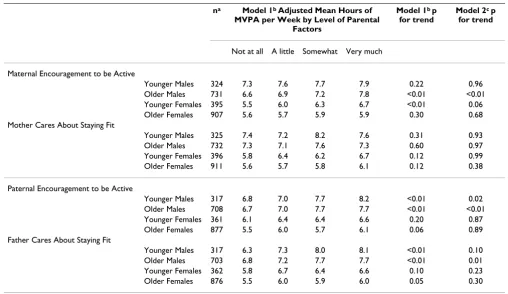
Table 2 contains the results from the separate regression analyses examining the association between the adoles-cent-reported parent-specific factors at Time 1 and hours of physical activity per week at Time 2. Based on Model 1, in which the regression analyses are adjusted for race and SES, among younger and older males and younger females encouragement to be physically active by a same-sex parent was associated with greater hours of MVPA five years later (p for trend = <.01). For example, younger males who reported at Time 1 that their father 'very much' encourages them to be physically active engaged in MVPA 1.4 more hours per week at Time 2, compared to those that reported their father did not encourage them to be physically active. Maternal encouragement also predicted more hours of MVPA after 5 years among older males, with those reporting no encouragement participating in 6.6 hours of MVPA per week compared to 7.8 hours per week among those who reported that their mother "very much" encouraged them to be active (p for trend < .01).
Adolescents' perception that their mother cares about staying fit and exercising was not related to hours of MVPA after 5 years. In contrast, paternal care for staying fit and exercising was related to increased MVPA hours among younger and older males (p for trend < .01) and among older females (p for trend = .05), in analyses adjusted for race and SES (Model 1).
After additional adjustment for baseline hours of MVPA (Model 2), the positive relationships between maternal and paternal encouragement, and paternal care for fitness, and MVPA among older males remained (p for trend ≤
.01). Additionally, the positive relationship between maternal encouragement and hours of MVPA among younger girls approached statistical significance (p for trend = .06), and the positive relationship between pater-nal encouragement and MVPA in younger males remained significant (p for trend = .02).
Sedentary behavior
Adolescent-reported parental factors were less predictive of TV/video watching after five years (Table 3). After adjustment for race and SES (Model 1), younger females' perception that their mother encourages them to be active was related to lower levels of TV/video five years later (p for trend < .01); however maternal encouragement to be physically active was associated with higher levels of TV/ video in older males (p for trend = .02). Younger females' perception that their mother cares about staying fit and exercising was also associated with lower levels of TV/ video hours after five years (p for trend = .04). Paternal factors did not have any relationship to hours of TV/video watching per week among any of the groups.
After additional adjustment for baseline hours of TV/ video watching (Model 2), the negative relationship between maternal encouragement to be physically active and TV/video use among younger females (p for trend = .02) remained, along with the positive relationship between maternal encouragement and TV/video use among older males (p for trend < .01). Additionally, a positive relationship between fathers' encouragement to be physically active and older males' hours of TV/video emerged (p for trend = .04).
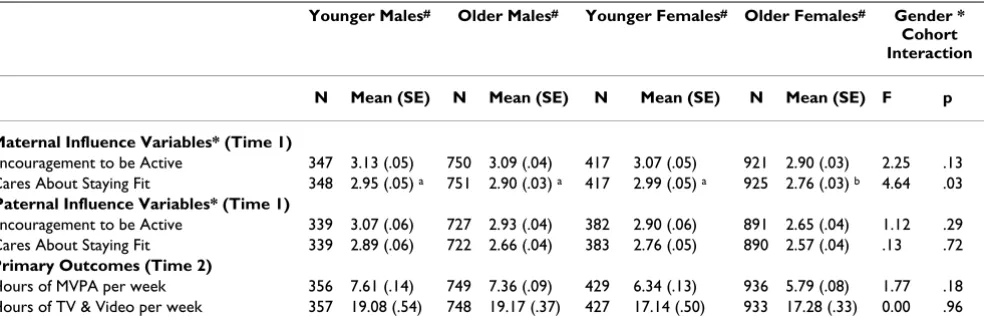
Table 1: Adolescent reports of parental influence variables at Time 1 and adolescent physical activity and sedentary behaviors at Time 2 by gender and cohort: Descriptive statistics
Younger Males# Older Males# Younger Females# Older Females# Gender *
Cohort Interaction
N Mean (SE) N Mean (SE) N Mean (SE) N Mean (SE) F p
Maternal Influence Variables* (Time 1)
Encouragement to be Active 347 3.13 (.05) 750 3.09 (.04) 417 3.07 (.05) 921 2.90 (.03) 2.25 .13 Cares About Staying Fit 348 2.95 (.05) a 751 2.90 (.03) a 417 2.99 (.05) a 925 2.76 (.03) b 4.64 .03 Paternal Influence Variables* (Time 1)
Encouragement to be Active 339 3.07 (.06) 727 2.93 (.04) 382 2.90 (.06) 891 2.65 (.04) 1.12 .29 Cares About Staying Fit 339 2.89 (.06) 722 2.66 (.04) 383 2.76 (.05) 890 2.57 (.04) .13 .72 Primary Outcomes (Time 2)
Hours of MVPA per week 356 7.61 (.14) 749 7.36 (.09) 429 6.34 (.13) 936 5.79 (.08) 1.77 .18 Hours of TV & Video per week 357 19.08 (.54) 748 19.17 (.37) 427 17.14 (.50) 933 17.28 (.33) 0.00 .96
#Younger refers to participants who were in middle school at Time 1, and high school at Time 2, Older refers to participants who were in high school at Time 1, and were young adults at Time 2
* Scale = 1 – 4 (1 = not at all; 2 = a little; 3 = somewhat; 4 = very much)
Discussion
The purpose of this study was to longitudinally examine how parental encouragement to be physically active and parental concern about staying fit are associated with ado-lescents' MVPA and TV and video watching behaviors after five years. Males' MVPA hours were predicted by paternal encouragement and care for fitness while younger females' MVPA was positively predicted by encourage-ment by their mothers, in analyses adjusting for sociode-mographics. After additional adjustment for baseline levels of MVPA many of these relationships remained or approached statistical significance. These findings suggest the long-term importance of encouragement to be active by adolescents' same-sex parent.
The results of this study indicate that parental encourage-ment to be physically active can predict adolescents' phys-ical activity habits, supporting previous evidence from the cross-sectional literature [8-12], including the review of correlates of physical activity among adolescents con-ducted by Sallis, et al. [8], and providing additional evi-dence to support Dowda, et al.'s recent findings that these may be lasting, long-term effects[13]. By examining the
gender and cohort groups separately, we were able to determine that males and females may not be influenced equally by both of their parents. Additional research is needed to understand why these patterns of influence emerged and how to intervene to improve adolescents' physical activity habits.
With the exception of older males, parental concern about their own fitness was not associated with adolescents' MVPA habits after adjustment for baseline MVPA. This finding is similar to findings of Trost, et al[11] in suggest-ing that parents should actively encourage their children to be physically active, and not assume that parental atti-tudes about their own fitness, or modeling of fitness, affects the adolescent. Additionally, none of the parental factors examined predicted the MVPA habits of girls mov-ing through high school and into young adulthood after adjustment for baseline MVPA. One possible reason for this lack of association is that girls of this age experience many competing influences that may affect their physical activity time. These influences include lack of support from peers or a school or neighborhood environment that doesn't encourage physical activity among high
school-Table 2: Adolescent physical activity at Time 2 by adolescent-reported parental factors at Time 1: 5-year longitudinal associations
na Model 1b Adjusted Mean Hours of
MVPA per Week by Level of Parental Factors
Model 1b p
for trend
Model 2c p
for trend
Not at all A little Somewhat Very much
Maternal Encouragement to be Active
Younger Males 324 7.3 7.6 7.7 7.9 0.22 0.96 Older Males 731 6.6 6.9 7.2 7.8 <0.01 <0.01 Younger Females 395 5.5 6.0 6.3 6.7 <0.01 0.06 Older Females 907 5.6 5.7 5.9 5.9 0.30 0.68 Mother Cares About Staying Fit
Younger Males 325 7.4 7.2 8.2 7.6 0.31 0.93 Older Males 732 7.3 7.1 7.6 7.3 0.60 0.97 Younger Females 396 5.8 6.4 6.2 6.7 0.12 0.99 Older Females 911 5.6 5.7 5.8 6.1 0.12 0.38
Paternal Encouragement to be Active
Younger Males 317 6.8 7.0 7.7 8.2 <0.01 0.02 Older Males 708 6.7 7.0 7.7 7.7 <0.01 <0.01 Younger Females 361 6.1 6.4 6.4 6.6 0.20 0.87 Older Females 877 5.5 6.0 5.7 6.1 0.06 0.89 Father Cares About Staying Fit
Younger Males 317 6.3 7.3 8.0 8.1 <0.01 0.10 Older Males 703 6.8 7.2 7.7 7.7 <0.01 0.01 Younger Females 362 5.8 6.7 6.4 6.6 0.10 0.23 Older Females 876 5.5 6.0 5.9 6.0 0.05 0.30
a n may differ slightly across variables and models
b Model 1: Adjusted for race (white/non white) and SES in 5 categories
aged girls[22,23]. Further research is needed to determine how families can support physical activity among older adolescent girls.
Parental factors had a less consistent relationship with TV/ video hours after five years. After adjustment for baseline TV/video, race, and SES, there is an unexpected positive relationship between parental encouragement to be phys-ically active and TV/video use among older males, while a negative relationship is seen among the younger females. These mixed results align with what has been reported previously. These findings suggest that in order to reduce sedentary behavior among adolescents parents should not rely on general encouragement to be active or personal concern for fitness[2,10]. As physical activity and seden-tary behavior have not been found to be strongly inversely related [6,24], it seems reasonable that different strategies work to encourage physical activity versus those that would decrease sedentary behavior. Additional longitudi-nal research is needed to determine which elements of the family environment are related to decreased sedentary behavior over time.
A strength of the current study was that the longitudinal design of Project EAT-II enabled us to examine
associa-tions between parent-specific factors and activity levels of adolescents over time. Additionally, the large and diverse nature of the study population allows for a fair amount of generalizability to other youth populations. However, in interpreting the findings, it is important to note that that this study only addressed two parental factors – encour-agement and parental care for fitness. There may be other behaviors, such as providing logistical support to engage in physical activity or parents participating in physical activity with their child, that influence physical activity through adolescence and into young adulthood. Further-more, it is noteworthy that the focus of the current analy-sis was on the association between adolescents' perceptions of their parents encouragement to be physi-cally active and their personal concerns about staying fit. Research has suggested that adolescent perceptions of parental attributes may be a stronger determinant of ado-lescents' behaviors than parental reports of their own atti-tudes and behaviors [25].
Conclusion
Building on previous research in this area, this research suggests that parental characteristics may influence ado-lescents' activity and sedentary behavior, though these relationships are highly complex. Our findings suggest
Table 3: Adolescent sedentary activity at Time 2 by adolescent-reported parental factors at Time 1: 5-year longitudinal associations
na Model 1b Adjusted Mean Hours of TV/
Video per Week by Level of Parental Factors
Model 1 p for trendb
Model 2 p for trendc
Not at all A little Somewhat Very much
Maternal Encouragement to be Active
Younger Males 324 19.4 18.4 20.4 17.4 0.50 0.63 Older Males 730 16.2 18.2 19.6 19.4 0.02 <0.01 Young Females 393 21.7 19.7 16.7 15.9 <0.01 0.02 Older Females 904 17.6 17.1 17.4 17.7 0.85 0.58 Mother Cares About Staying Fit
Young Males 325 18.4 19.7 18.7 18.0 0.78 0.94 Older Males 731 19.1 19.1 18.4 19.9 0.72 0.30 Young Females 394 20.9 17.0 17.6 16.3 0.04 0.45 Older Females 908 16.9 17.9 17.5 17.2 0.94 0.92
Paternal Encouragement to be Active
Younger Males 317 17.9 20.6 19.8 17.4 0.72 0.24 Older Males 707 18.4 18.8 18.3 19.4 0.46 0.04 Young Females 359 18.3 17.1 18.0 14.9 0.08 0.66 Older Females 874 18.7 16.4 17.7 17.2 0.29 0.22 Father Cares About Staying Fit
Young Males 317 17.3 18.8 19.3 18.1 0.67 0.15 Older Males 702 19.2 19.4 18.0 19.3 0.78 0.20 Young Females 360 17.7 15.9 16.9 16.5 0.61 0.27 Older Females 873 18.4 17.1 17.2 17.5 0.40 0.32
a n may differ slightly across variables and models
b Model 1: Adjusted for race (white/non white) and SES in 5 categories
that parental encouragement to be physically active is associated with increases in physical activity among some adolescents, and that encouragement to be active may be especially influential when coming from a same-sex par-ent. These findings have implications for family-based interventions aiming to increase adolescents' physical activity. This study suggests that in order to increase young adolescents' physical activity levels, and perhaps establish lifelong healthy habits, parents should actively encourage their children to participate in physical activity. Public health messages should also inform parents that mode-ling of physical activity or concern for fitness may not be enough to motivate their child, and physical activity-spe-cific encouragement may be necessary. Additional longi-tudinal and intervention research is needed to find effective ways for parents to help reduce sedentary behav-iors among their children.
Competing interests
The author(s) declare that they have no competing inter-ests.
Authors' contributions
KWB, MCN, KNB and DNS contributed to the study design, KWB conducted the statistical analysis and wrote the manuscript, and all authors edited the manuscript and read and approved the final manuscript. DNS is the Prin-cipal Investigator of Project EAT-II.
Acknowledgements
We would like to thank Dr. Marla E. Eisenberg for her statistical assistance with this paper. This study was supported by Grant R40 MC 00319 (D. Neumark-Sztainer, principal investigator) from the Maternal and Child Health Bureau (Title V, Social Security Act), Health Resources and Services Administration, U.S. Department of Health and Human Services. The first author is supported by the Adolescent Health Protection Program (School of Nursing, University of Minnesota) grant number T01-DP000112 (PI: Bearinger) from the Centers for Disease Control and Prevention (CDC). The contents of this paper are solely the responsibility of the authors and do not necessarily represent the official views of the CDC.
References
1. Eisenmann JC, Bartee RT, Wang MQ: Physical activity, TV
view-ing, and weight in U.S. youth: 1999 Youth Risk Behavior Sur-vey. Obes Res 2002, 10(5):379-385.
2. Norman GJ, Schmid BA, Sallis JF, Calfas KJ, Patrick K: Psychosocial and environmental correlates of adolescent sedentary behaviors. Pediatrics 2005, 116(4):908-916.
3. Nelson MC, Neumark-Stzainer D, Hannan PJ, Sirard JR, Story M:
Longitudinal and secular trends in physical activity and sed-entary behavior during adolescence. Pediatrics 2006,
118(6):e1627-34.
4. Berkey CS, Rockett HR, Field AE, Gillman MW, Frazier AL, Camargo
CA Jr., Colditz GA: Activity, dietary intake, and weight changes in a longitudinal study of preadolescent and adolescent boys and girls. Pediatrics 2000, 105(4):E56.
5. Kimm SY, Glynn NW, Obarzanek E, Kriska AM, Daniels SR, Barton
BA, Liu K: Relation between the changes in physical activity
and body-mass index during adolescence: a multicentre lon-gitudinal study. Lancet 2005, 366(9482):301-307.
6. Utter J, Neumark-Sztainer D, Jeffery R, Story M: Couch potatoes or french fries: are sedentary behaviors associated with body
mass index, physical activity, and dietary behaviors among adolescents? J Am Diet Assoc 2003, 103(10):1298-1305.
7. Lindsay AC, Sussner KM, Kim J, Gortmaker S: The role of parents
in preventing childhood obesity. Future Child 2006,
16(1):169-186.
8. Sallis JF, Prochaska JJ, Taylor WC: A review of correlates of phys-ical activity of children and adolescents. Med Sci Sports Exerc 2000, 32(5):963-975.
9. Heitzler CD, Martin SL, Duke J, Huhman M: Correlates of physical activity in a national sample of children aged 9-13 years. Prev Med 2006, 42(4):254-260.
10. Springer AE, Kelder SH, Hoelscher DM: Social support, physical
activity and sedentary behavior among 6th-grade girls: a cross-sectional study. Int J Behav Nutr Phys Act 2006, 3:8.
11. Trost SG, Sallis JF, Pate RR, Freedson PS, Taylor WC, Dowda M:
Evaluating a model of parental influence on youth physical activity. Am J Prev Med 2003, 25(4):277-282.
12. Adkins S, Sherwood NE, Story M, Davis M: Physical activity
among African-American girls: the role of parents and the home environment. Obes Res 2004, 12 Suppl:38S-45S.
13. Dowda M, Dishman RK, Pfeiffer KA, Pate RR: Family support for
physical activity in girls from 8th to 12th grade in South Carolina. Prev Med 2007, 44(2):153-159.
14. Davison KK, Cutting TM, Birch LL: Parents' activity-related
parenting practices predict girls' physical activity. Med Sci Sports Exerc 2003, 35(9):1589-1595.
15. McGuire MT, Hannan PJ, Neumark-Sztainer D, Cossrow NH, Story
M: Parental correlates of physical activity in a racially/ethni-cally diverse adolescent sample. J Adolesc Health 2002,
30(4):253-261.
16. Godin G, Shephard RJ: A simple method to assess exercise
behavior in the community. Can J Appl Sport Sci 1985,
10(3):141-146.
17. Godin leisure-time exercise questionnaire. Med Sci Sports Exerc 1997, 29:S36-S38.
18. Gortmaker SL, Peterson K, Wiecha J, Sobol AM, Dixit S, Fox MK,
Laird N: Reducing obesity via a school-based interdisciplinary intervention among youth: Planet Health. Arch Pediatr Adolesc Med 1999, 153(4):409-418.
19. Neumark-Sztainer D, Story M, Hannan PJ, Croll J: Overweight sta-tus and eating patterns among adolescents: where do youths stand in comparison with the healthy people 2010 objec-tives? Am J Public Health 2002, 92(5):844-851.
20. Little R: Survey nonresponse adjustments for estimates of
means . International Statistical Review 1986, 54:137-139.
21. Neumark-Sztainer D, Wall M, Eisenberg ME, Story M, Hannan PJ:
Overweight status and weight control behaviors in adoles-cents: longitudinal and secular trends from 1999 to 2004.
Prev Med 2006, 43(1):52-59.
22. Hohepa M, Schofield G, Kolt GS: Physical activity: what do high school students think? J Adolesc Health 2006, 39(3):328-336. 23. Neumark-Sztainer D, Story M, Hannan PJ, Tharp T, Rex J: Factors
associated with changes in physical activity: a cohort study of inactive adolescent girls. Arch Pediatr Adolesc Med 2003,
157(8):803-810.
24. Marshall SJ, Biddle SJ, Gorely T, Cameron N, Murdey I: Relation-ships between media use, body fatness and physical activity in children and youth: a meta-analysis. Int J Obes Relat Metab Disord 2004, 28(10):1238-1246.
25. Boutelle KN, Fulkerson JA, Neumark-Sztainer D, Story M, French SA: